Chapter 15:
Managing Crisis: Personally and Professionally
IM1-1
CHAPTER 15
Managing Crisis: Personally and Professionally
LEARNING OBJECTIVES
After studying this chapter, students should be able to:
• Describe some ways that crises affect people emotionally.
• Describe the characteristics of empathy fatigue.
CHAPTER OUTLINE
Aim of the Chapter
How Crises Affect Us
Stress and Emotional Fatigue Can Lead to Burnout
Crisis Situations Are Common in Counseling
Understanding Our Response to Crisis
CHAPTER OVERVIEW
• Counseling is a rich and rewarding profession that often involves helping clients through a crisis.
• One of the best ways to be able to help clients through crises is to be the best prepared you can
Chapter XIV:
Managing Crisis: Personally and Professionally
IM1-2
listen, to respect the client, and to encourage the client to tell his or her story.
• Self-talk has a significant effect on how we react to and respond to crisis events.
• Resilience is the ability of an individual to cope with and bounce back from stressful and adverse
events. Resilience can be fostered and developed, and one of the major ways is to stay
connected to family, friends, and community organizations.
SUGGESTIONS FOR ACTIVITIES
1. Exercise in Crisis Intervention. For this exercise, begin by working in dyads. One student assumes
2. How Crises Affect Us. The chapter includes a number of thought-provoking questions for
3. The Hazard of Vicarious Trauma. Remind students that vicarious trauma can result from long-
term and intense exposure to client trauma. When helpers experience this phenomenon, they
4. Factors That Influence One’s Crisis Response. The authors list several factors that tend to
influence how people respond to crisis. This would be excellent material for your students to
reflect on. Provide your students with the following instructions: In your journal, write your
reactions to this list and identify ways in which these ideas resonate with your own experiences.*
Chapter 15:
Managing Crisis: Personally and Professionally
IM1-3
5. Managing Your Self-Talk. In the chapter, we challenge the readers to examine their self-talk and
see how it works either for or against them and their problem-solving ability. They outline five
6. Applying the Scientific Method to Crises. Applying the scientific method of problem solving is a
good way to approach a crisis situation. The steps are outlined in the chapter. Describe some
7. The Role of Resilience. Some people are able to cope with and bounce back from stressful and
adverse events. They are considered resilient. Trauma can actually be a springboard for
8. Disaster Behavioral Health. An increasing number of helpers are needed to specialize in disaster
behavioral health. These professionals work with those who have been involved in fires, floods,
DISCUSSION QUESTIONS
Chapter XIV:
Managing Crisis: Personally and Professionally
IM1-4
1.
As a helper, which is the first and foremost thing that you consider in working with
clients in crisis?
2.
Which component do you want to develop in you in handling life crisis and why?
KEY CONCEPTS AND TERMS
Burnout is a phenomenon that crisis intervention and other frontline mental health workers may
experience after being exposed to many stressors.
Compassion fatigue, a stress-related syndrome, results from the cumulative drain on the helper’s
capacity to care for others. It is similar to the concept of empathy fatigue.
Coping mechanisms refer to the actions, behaviors, or environmental resources that clients can use in
getting through a crisis.
resources.
Empathy fatigue is the stress generated by listening to multiple stories of trauma that clients bring to
therapy, which may lead to a deterioration of the counselor’s resiliency or coping abilities over time. It is
similar to compassion fatigue.
First-order intervention can be thought of as psychological first aid.
Physical footprint refers to the physical area directly affected by any given disaster.
Positive and constructive thinking patterns, including ways of reframing a situation that can lessen
stress and anxiety by substantially changing a client’s perspective on a problem, are a type of strategy
used in crisis situations.
Chapter 15:
Managing Crisis: Personally and Professionally
IM1-5
making decisions. Self-talk can be managed.
Situational supports include people in the client’s life from whom they can draw strength during their
crisis.
Stress is a feeling of strain and pressure that can originate from external sources or internal sources.
Our stress may be acute or chronic.
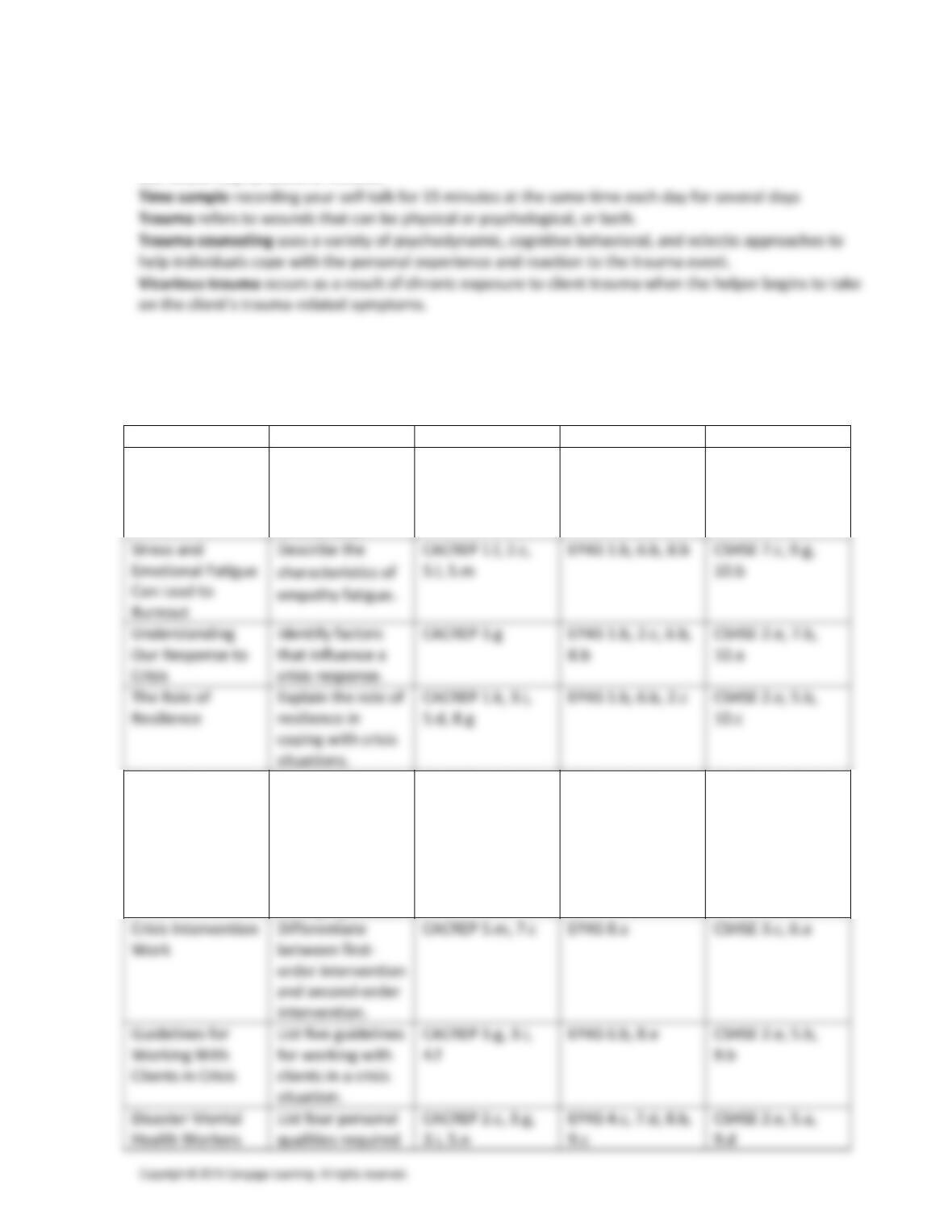
LO/STANDARDS CORRELATION CHART
A-head
LO
Standard 1
Standard 2
Standard 3
How Crisis Affect
Us
Describe some
ways that crisis
affect people
emotionally.
CACREP 1.c, 3.g,
5.m
EPAS 1.b, 6.b, 7.b
CSHSE 5.a, 7.c,
9.g, 10.e
Burnout
Crisis
crisis response.
situations.
Cognitive,
Emotional, and
Behavioral
Components of a
Crisis
Discuss the
cognitive,
emotional, and
behavioral
components
involved in
managing a crisis.
CACREP 1.k, 4.f,
5.n, 8.c
EPAS 6.b, 8.a
CSHSE 4.a, 5.b,
9.b, 10.a
intervention.
situation.
Health Workers
qualities required
3.i, 5.n
9.c
9.d

Chapter XIV:
Managing Crisis: Personally and Professionally
IM1-6
to work in the
field of disaster
mental health.