Chapter 12: Working in the Community
IM1-1
CHAPTER 12
Working in the Community
LEARNING OBJECTIVES
After studying this chapter, students should be able to:
• Explain why a community perspective is important to the professional helper.
CHAPTER OUTLINE
Aim of the Chapter
The Community Perspective
The Scope of the Community Approach
Client Advocacy and a Social Justice Perspective
Multiple Roles of Community Workers
CHAPTER OVERVIEW
• The community perspective emphasizes social change rather than merely helping people adapt
to their circumstances.
• It is not useful to focus on individual client treatment and neglect the institutional or social
Chapter 12: Working in the Community
IM1-2
• A comprehensive community counseling program has four aspects. Direct client services focus on
outreach activities for at-risk groups in the community. Direct community services in the form of
preventive education are geared to the population.
• Helpers need to assume an advocacy role for disenfranchised clients whose background makes it
SUGGESTIONS FOR ACTIVITIES
1. Exercise on Educating Clients About the Helping Process. Ask students to explore in small
groups what strategies they might use to work through the resistance that many people have
2. Community Resources. The goal of this activity is to assist students in becoming familiar with
community resources.
Instructions for students: How aware are you of the resources that exist in your community?
Would you know where to refer clients for special help? How aware are you of the support
systems that exist in your community? Individually or with other students, investigate a
Chapter 12: Working in the Community
IM1-3
3. Interview Activity. Several students can interview a variety of professionals in the mental health
field about the aspects of their work that they find most rewarding as well as the major problems
4. Skills in Community Intervention. In small groups, develop a list of skills human service
professionals need to have to effectively work in the community. Each group should then identify
an example of how those skills can be applied in community work. Have them discuss ways that
5. Helper Roles in the Community. Reflect on and discuss alternative roles human service
professionals might play in working in the community. Ask yourself which of the following roles
6. Challenging the “Nice Counselor Syndrome.” As stated in the text, many school counselors
become caught in the “nice counselor syndrome” and promote peace and interpersonal
harmony at any cost. This tends to uphold the status quo, which often needs to be challenged. In
7. Influencing Policymakers. Problems of contemporary society include poverty, homelessness,
crime, drive-by shootings, gang activities, AIDS, child abuse, intimate partner violence,
Chapter 12: Working in the Community
IM1-4
DISCUSSION QUESTIONS
1.
Benjamin was sacked few months ago from his office. So he felt very sad and
depressed. Later on, he got addicted to drugs and alcohol due to his unemployment. As
a helper, what are the strategies would you develop to deal effectively with him?
KEY CONCEPTS AND TERMS
Adviser is a helper role that involves initiating discussions with clients about ways to deal with
environmental problems that contribute to their personal problems.
Advocacy involves helpers speaking on behalf of oppressed client populations.
Advocates use their skills in helping clients to effectively deal with institutional barriers that impede their
personal, social, academic, or career goals.
Community orientation requires helpers to design interventions that go beyond the office.
Community workers are a diverse pool of human services workers whose primary duties revolve around
serving individuals within their community.
Consultant is a role that involves working with clients from diverse racial, ethnic, sexual/affectional,
ability, gender, and cultural backgrounds to design preventive programs aimed at eliminating the
negative impact of discrimination and oppression.
Direct client services focus on outreach activities to a population that might be at risk for developing
mental health problems.
Chapter 12: Working in the Community
IM1-5
and consultation in a variety of settings
Social Activism
people who are deeply engaged in their own communities and who are actively working
to promote change
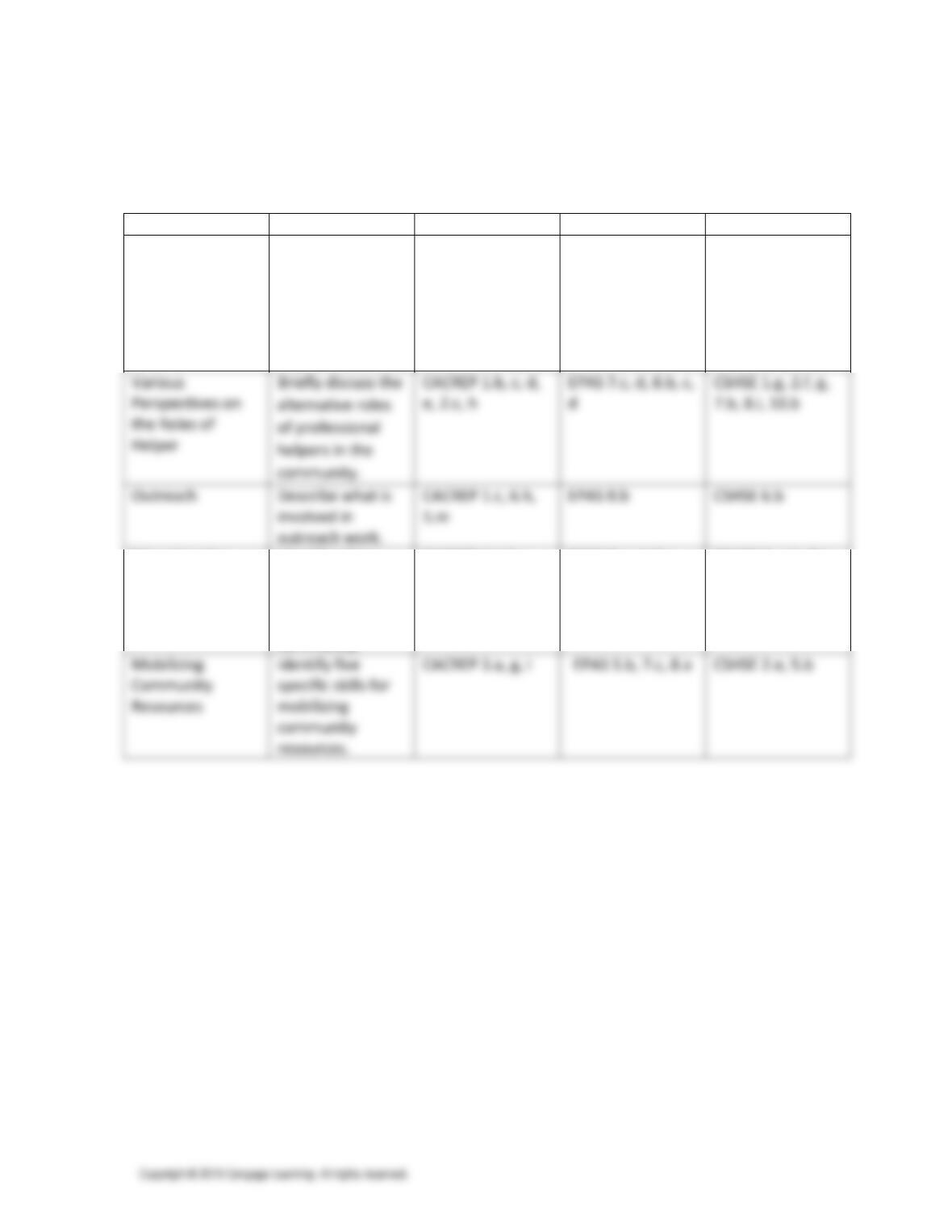
LO/STANDARDS CORRELATION CHART
A-head
LO
Standard 1
Standard 2
Standard 3
The Community
Perspective
Explain why a
community
perspective is
important to the
professional
helper.
CACREP 1.e
EPAS 9.c, 8.a, 8.b
CSHSE 10.c
Various
Briefly discuss the
alternative roles
of professional
helpers in the
community.
CACREP 1.b, c, d,
EPAS 7.c, d, 8.b, c,
CSHSE 1.g, 2.f, g,
outreach work.
Educating the
Community
Identify a few
ways professional
helpers can
educate the
community.
CACREP 1.j, 5.e,
8.d, 6.h
EPAS 7.c, d, 9.c
CSHSE 2.g, h, 8.i
resources.