1
Chapter 1
INTRODUCTION: FOUNDATIONS OF INTERVIEWING AND COUNSELING
What are the foundations of counseling and interviewing?
Chapter 1, “Introduction: Foundations of Interviewing and Counseling,” offers an
overview and a road map toward competence to your students. The chapter provides
ample support for your teaching of interviewing and counseling skills. In addition, the
chapter invites students to reflect on what brings them to the helping field and what some
CHAPTER GOALS
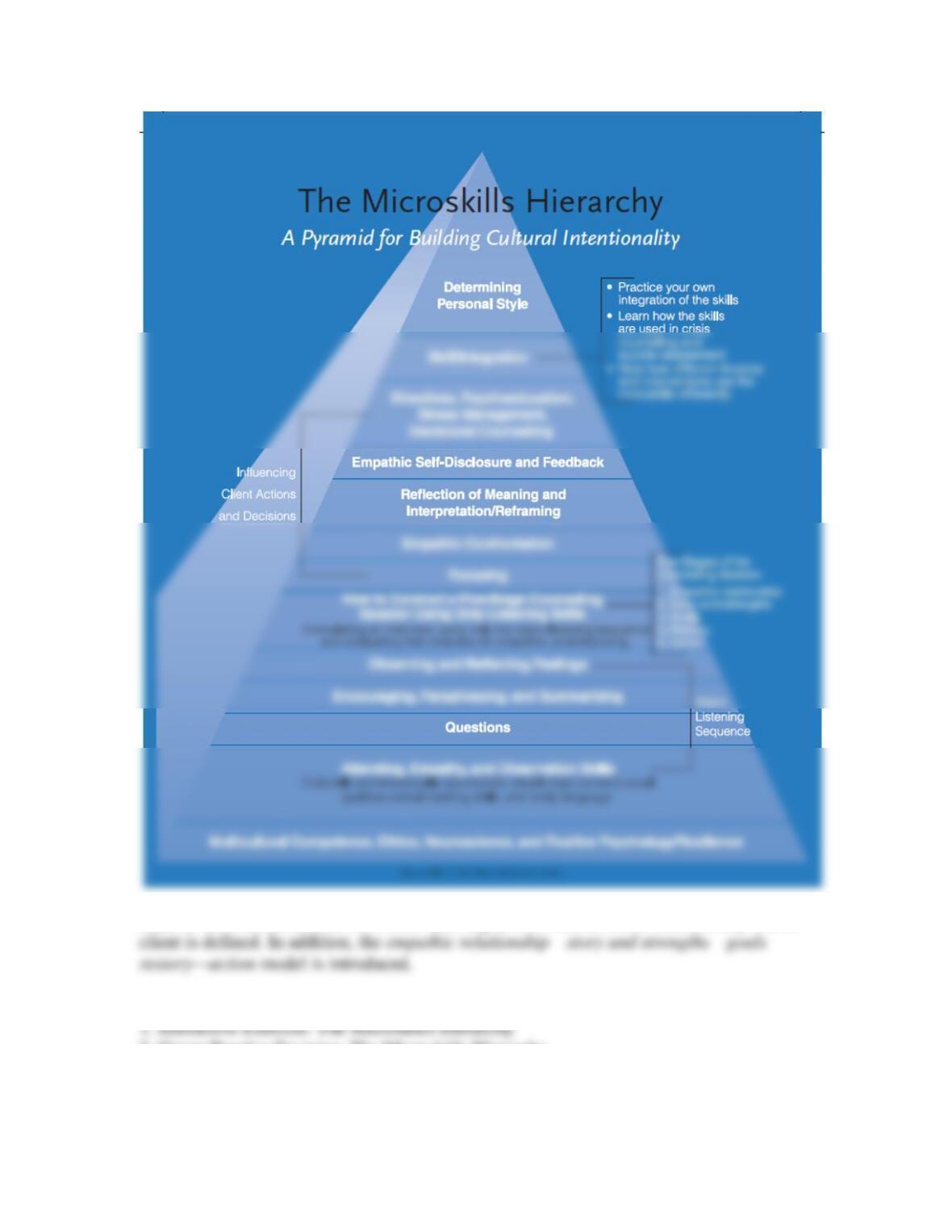
This chapter describes the microskills approach and shows how the step-by-step model of
the microskills hierarchy relates to broad concepts of interviewing, counseling, and
psychotherapy. Culturally intentional interviewing facilitates drawing out client stories,
enabling clients to find new ways of thinking about these stories, and finding new ways
of acting. It is important that the interviewer have multiple ways of responding to clients
Awareness, knowledge, skills, and actions developed through the concepts of this chapter
will enable you to:
▲ Reflect on your goals for helping and your natural style of being with others. You will
▲ Define and discuss similarities and differences among interviewing, counseling, and
psychotherapy.
▲ Gain knowledge of the microskills approach to the interview, a step-by-step approach
2
▲ Become aware that interviewing and counseling can change the brain in positive ways
and that neuroscience and neurobiology are now recognized as the cutting edge of our
INTRODUCTION
Teaching interviewing, counseling, and psychotherapy is a noble enterprise whose
ultimate goal is to develop effective helpers.
We value and respect your personal teaching style. Each of us has our own teaching style
and would imprint our personal style in our teaching. This is what makes education so
MINDTAP
To learn more visit www.CENGAGE.COM/mindtap
Essentials of Intentional Interviewing, Third Edition, is accompanied by the most modern
digital solution available. MindTap provides a personalized teaching experience with
relevant assignments that guide students to analyze, apply, and improve thinking,
allowing instructors to measure skills and outcomes with ease. Instructors can choose
MindTap features pre- and posttests, self-assessment tools, case studies, flashcards, group
activities, web links, portfolio of competence, and practice exercises to help students
3
further understand major concepts and sharpen their interviewing competencies. All of
these case studies, video clips of sessions, and other interactive exercises clarify what
These activities, coupled with role-plays in specific skills, will provide a solid
background for students entering the field of interviewing and counseling or joining
academic programs in the mental health and related fields. Furthermore, these activities
will become important as students move on in their studies and eventually are placed in
practicums and internships.
We have inserted this icon throughout the book to alert you and your students
of the availability of a digital resource or tool.
TWO KEY FEATURES OF ESSENTIALS OF INTENTIONAL INTERVIEWING,
THIRD EDITION
Each chapter of Essentials of Intentional Interviewing, Third Edition, begins and ends
with the following online self-assessments and activities. The purpose of the first
suggested set of online activities is to help students assess and document their baseline
awareness, knowledge, and skills of chapter content and practices.
Assess your current level of knowledge and competence as you begin the
chapter:
1. Self-Assessment Quiz: The chapter quiz will help you determine your current level
4
Assess your current level of knowledge and competence as you complete the
chapter:
2. Self-Assessment Quiz: The quiz will help you assess your current knowledge and
prepare for course examinations.
3. Portfolio of Competencies: Evaluate your present level of competence on the ideas
THE PORTFOLIO OF COMPETENCE
The Portfolio of Competence on MindTap is a central feature to help your students assess
their own learning and present evidence of their progress and competence. Here students
will find a checklist they can use to evaluate their present level of mastery. Dimensions
Students can complete the form in MindTap or instructors can download the form for
students to save and print. As the instructor, you can use this and other MindTap features
to monitor student progress throughout the term or use it as part of a final assignment for
evaluation of student portfolios.
Part of the Portfolio of Competence included in MindTap is Determining Your Own Style
and Theory: Critical Self-Reflection of ______________ [last part varies according to the
focus of each chapter focus]. We are very serious in asking students to think through their
5
past, when we’ve assumed that everyone understood, there was always someone who
couldn’t get things together. If everyone is patient, we’ll all get there!
The hard question, of course, is providing evidence that a student actually has
demonstrated intentional competence with a concept. When classes are small, we have
used audio files each week and listened specifically to see if intentionality has been
demonstrated. With larger classes, we ask for recorded demonstrations and transcript
OVERVIEW OF THE CHAPTER AND MINDTAP SUPPORT
YOU AS HELPER, YOUR GOALS, YOUR COMPETENCIES
This section introduces a complex counseling case and invites the student to reflect on the
realities of counseling, his or her understanding of the process, and the potential
outcomes. Each student working toward becoming an effective and intentional
List of MindTap resources available for this section:
2. Interactive Self-Assessment: Personal Strengths and Your Natural Style.
4. Case Study: What Do You Say Next? Working with a Difficult Case. This case study
INTERVIEWING, COUNSELING, AND RELATED FIELDS
6
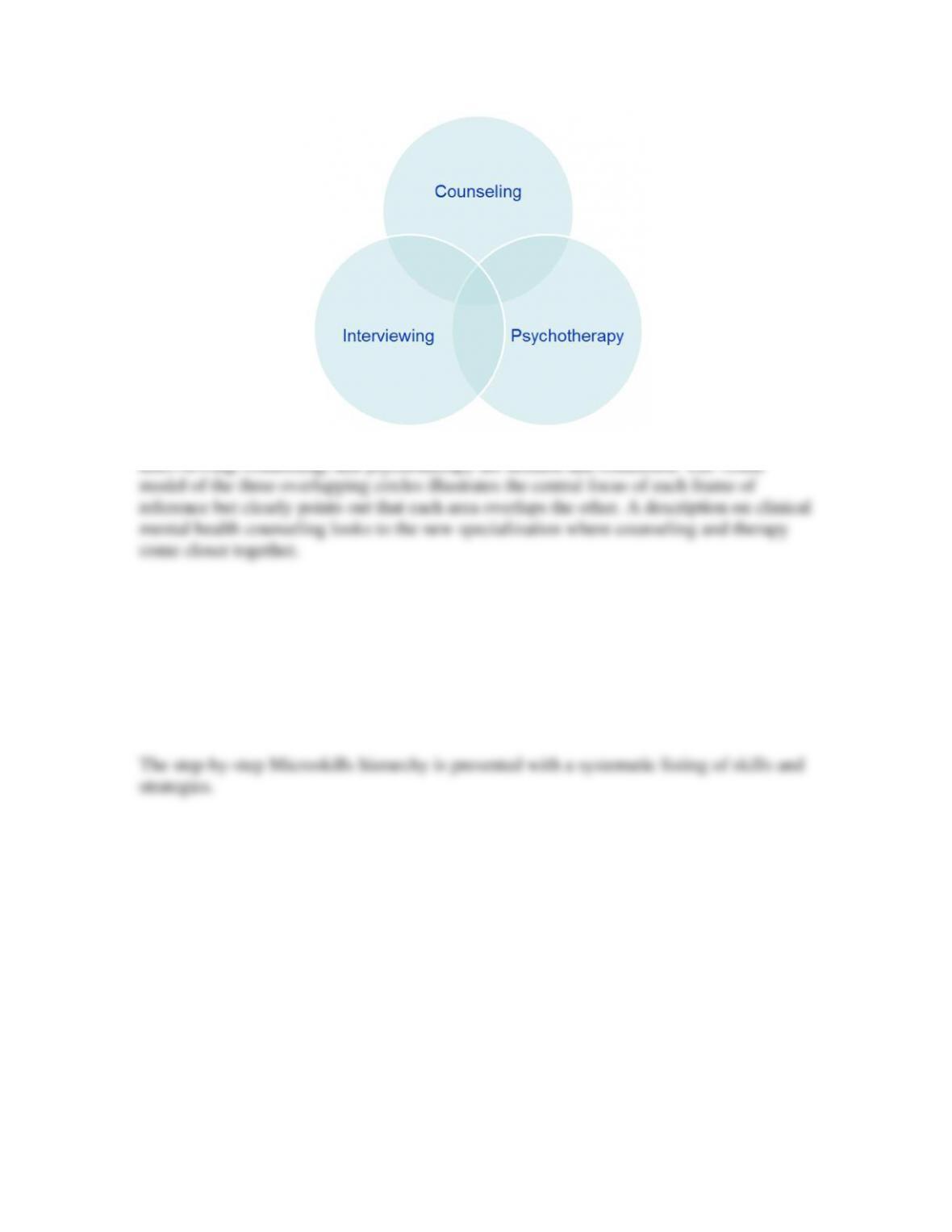
Interviewing, counseling, and psychotherapy are defined and contrasted. The visual
List of MindTap resources available for this section:
1. Website: Interviewing, Counseling, and Psychotherapy
2. Website: Crisis and Trauma. What do you think of these websites related to crises,
disasters, or trauma? What did you learn?
THE MICROSKILLS APPROACH
7
Each of the communication skill units that help you to interact more intentionally with a
List of MindTap resources available for this section:
2. Group Practice Exercise: The Microskills Hierarchy
8
CULTURAL INTENTIONALITY:
List of MindTap resources available for this section:
RESILIENCE AND SELF-ACTUALIZATION
The development of client intentionality is another way to talk about client resilience.
Resilience is the process whereby individuals exhibit positive behavioral adaptation when
they encounter significant stressors and adverse events. Resilience is a major goal of
counseling and therapy. Neuroscience speaks of the process of emotional regulation,
SELF-ACTUALIZATION AND SELF-IN-RELATION: KEYS TO RESILIENCE
A major goal of interviewing, counseling, and psychotherapy is to actualize the potential
inside all of the clients. As with Rogers and Maslow, we have an immense faith in the
Counseling and psychotherapy put the client in context. Sessions may be for the
NEUROSCIENCE: COUNSELING CHANGES THE BRAIN
Current neuroscientific evidence demonstrates the brain can be rewired and can produce
new neurons. This demonstrates the brain’s neuroplasticity and capacity for neurogenesis.
The brain can change and grow. Interviewing, counseling, and psychotherapy change the
brain and the mind.
Neuroscience demonstrates that stress underlies virtually all issues that clients bring to
us. Some 80% of medical issues involve the brain and stress. What we do can help our
clients, as we can use the listening and influencing skills to promote stress management.
OFFICE, COMMUNITY, PHONE, AND INTERNET: WHERE DO WE MEET
CLIENTS?
List of MindTap resources available for this section:
1. Website: Bureau of Labor: Counselors. Counselors work in diverse community
YOUR NATURAL STYLE AND BEGINNING EXPERTISE: AN IMPORTANT
AUDIO OR VIDEO EXERCISE
We recommend that students complete a recorded interview as soon as possible. This
provides a baseline for analysis of strengths (and areas for improvement) and may be
compared with student interviewing style later in the course.
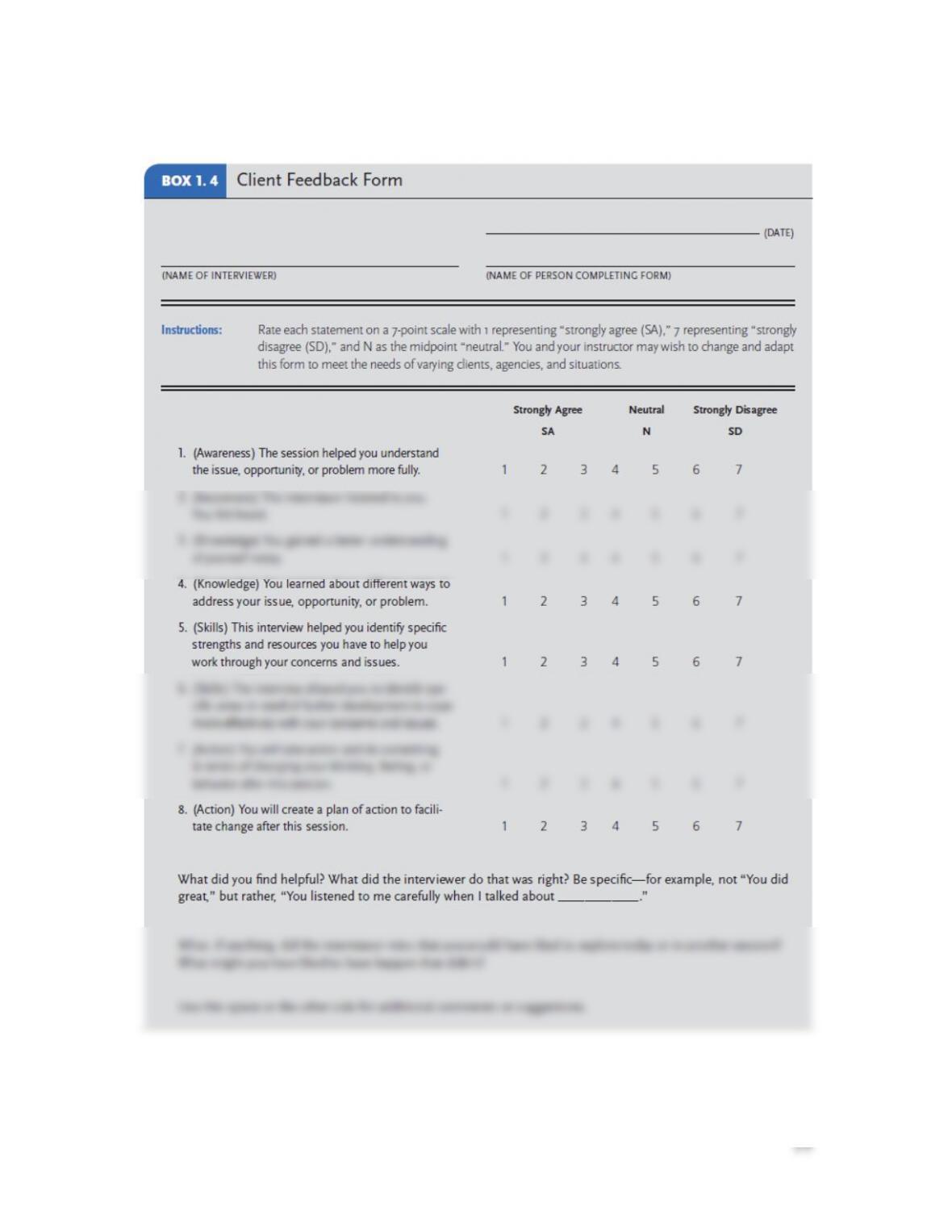
Please note the Client Feedback Form in Box 1.4. We recommend
that volunteer clients give the interviewer regular feedback.
List of MindTap resources available for this section:
1. Interactive Exercise: Your Natural Helping Style: An Important Audio or Video
DEMONSTRATIONS AND VIDEOS TO SUPPLEMENT ESSENTIALS OF
INTENTIONAL INTERVIEWING, Third Edition
You may wish to engage in a live demonstration interview with an individual in your
workshop or classroom. Or you may have suitable video examples you have developed in
the past. In addition, sometimes students have good examples that you may want to use.
The Microtraining/Alexander Street Press materials were specifically developed to
support Intentional Interviewing and Counseling chapters. These videos include many
subscripts marking skill usage. It is also possible to arrange to have all these videos and
many others available for streaming directly to your student’s home computer. Access the
• Basic Attending Skills has a brief introductory lecture by Allen Ivey on microskills,
where he outlines the purpose of intentional interviewing and the importance of
drawing out the client’s story.
• Counseling Children: A Microskills Approach by Mary Bradford Ivey shows how
CLASS PROCEDURES
The procedures we have used typically include:
1. Individual recognition. Students are asked to meet with someone that they did not
know before the class began. After a short time to get acquainted, the student pairs
are asked to identify one characteristic or strength they identify in each other that
2. Expectations, personal needs, strengths, and self-assessment. We have had classes
flounder when we forgot to ask their expectations and needs. We find that developing
3. Students grow from strengths. We have tried in the book and MindTap to help them
4. Cultural intentionality defined. It is helpful to have students write out what they
would say to clients from different cultural and ethnic/race backgrounds. Different
people respond differently, and the wide range of possibly useful responses illustrates
5. Ethical issues. A brief review of key ethical issues is important as we begin the class,
6. Classroom information and requirements. We prefer to save the “nitty-gritty” until a
later point in the course so that we have had some time to work on the important
issues. Here are some basic requirements we have used.
a. Completion of an audiotape or videotape of the student’s interviewing style during
the first week of the course. In this way, you can obtain a baseline of student
hour individual oral in which the student was expected to demonstrate
competence levels for all microskills and the basic structure of the interview. To
alleviate anxiety, we graded the examination on a “win-win” basis. Thus, students
e. Practice in skills on videotape/audiotape. We urge our students to purchase an
audio recorder and practice their skills outside of class. We also maintain a video
recording laboratory where students are required to complete four hours of
practice under the supervision of a graduate student. We discuss ethical and
f. Transcript. At the end of the course, students are required to present a transcript
of their own work following the guidelines presented in Box 13.5 in Chapter 13.
g. Portfolio of competence. The website contains material for self-assessment and
the gradual development of a student portfolio. We constantly stress the
7. Microskills hierarchy. To introduce the concept of single skills in the interview, we
find it extremely helpful to tape an interviewing show from popular television and
8. Cultural differences. Break students into groups and ask them to discuss whether or
not the skills presented on videotape are appropriate for the different cultural setting
9. Portfolio of competencies. As homework assignments are given, we like to again
stress the importance of students developing and keeping a portfolio of competencies.
10. Individual Practice Exercise: YOUR NATURAL STYLE AND BEGINNING
EXPERTISE: An Important Audio or Video Exercise. The final pages of Chapter 1
speak to the importance of recording an interview with a volunteer client. This
interview will also serve as a baseline for comparison as students work through this