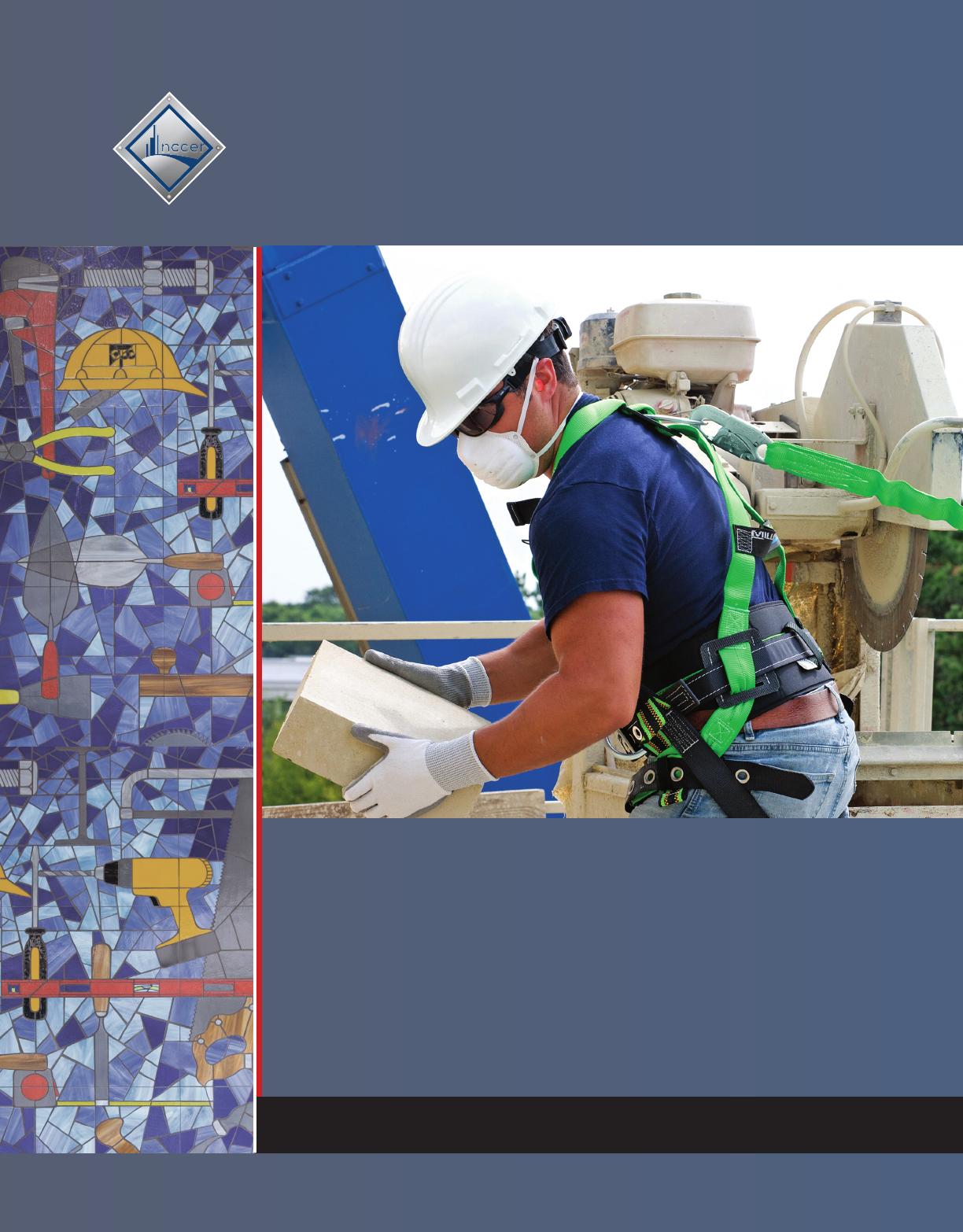
Core CurriCulum
Lesson Plans for Instructors
Basic Safety
(Construction Site Safety
Orientation)
00101-15
Module One
Lesson Plans for Module 00101–15
Basic safety (construction site safety orientation)
Module One (00101-15) explains the importance of safety in the construction and industrial crafts. Trainees will
learn how to identify and follow safe work practices and procedures and how to properly inspect and use safety
equipment. Trainees will be able to describe the safety practices associated with elevated work; energy release;
and various hazards encountered on job sites. NOTE: The successful completion of this module will award a
Construction Site Safety Orientation credential.
Objectives
Learning Objective 1
• Describe the importance of safety, the causes
of workplace incidents, and the process of haz-
ard recognition and control.
a. Detine incidents and the signiticant costs
Learning Objective 2
• Describe the safe work requirements for elevat-
ed work, including fall protection guidelines.
a. Identify and describe various fall hazards.
b. Identify and describe equipment and
methods used in fall prevention and fall
arrest.
c. Identify and describe the safe use of ladders
Learning Objective 3
• Identify and explain how to avoid struck-by and
caught-in-between hazards.
Learning Objective 4
• Identify common energy-related hazards and
explain how to avoid them.
a. Describe basic job-site electrical safety
guidelines.
b. Explain the importance of lockout/tagout and
describe basic procedures.
Learning Objective 5
• Identify and describe the proper use of personal
protective equipment (PPE).
Learning Objective 6
• Identify and describe other specitic job-site
safety hazards.
a. Identify various exposure hazards commonly
found on job sites.
b. Identify hazards associated with
environmental extremes.
Performance Tasks
Performance Task 1 (Learning Objective 2)
• Properly set up and climb/descend an exten–
sion ladder, demonstrating proper three-point
contact.
Performance Task 2 (Learning Objective 5)
• Inspect the following PPE items and determine
if they are safe to use:
– Hard hat
– Gloves
– Fall arrest harnesses, lanyards, and connect-
items:
– Eye protection
– Hearing protection
– Hard hat
– Gloves
– Fall arrest harness
Performance Task 4 (Learning Objective 4)
• Inspect a typical power cord and GFCI to en–
sure their serviceability.
00101-15 Basic Safety (Construction Site Safety Orientation) Module One i
ii NCCER – Core Curriculum 00101-15
Teaching Time: 12.5 Hours
(Five 2.5–Hour Classroom Sessions)
Session time may be adjusted to accommodate your class size, schedule, and teaching style.
Prerequisites
None
Before You Begin
Classroom Equipment
and Materials
Whiteboard/chalkboard
Markers/chalk
Pencils and paper
Core Curriculum PowerPoint®
Presentations
TV/DVD player
LCD projector and screen
Computer with internet access
Safety Considerations
During this module, trainees will be required to set up, climb, and descend an extension ladder. The trainees
should be carefully supervised during this activity and should be required to wear the PPE they would nor–
mally wear on a job site. Climbing/descending using three–point contact is an essential part of this activity.
Additional Resources
This module presents thorough resources for task training. The following resource material is suggested for
further study.
US Occupational Safety and Health Administration. Numerous safety videos are available on line at
www.osha.gov/video.
Construction Safety, Jimmie W. Hinze. 2006. Upper Saddle River, NJ: Pearson Education, Inc.
Appropriate PPE:
Eye protection
Work gloves
High-top safety shoes
Hearing protection
Hard hat
Double-insulated power tool
Job safety analysis (JSA) example
Extension ladder
Ground fault circuit interrupter (GFCI)
Damaged and undamaged extension
cords
Various types of respirators
Provide both defective and
serviceable examples of the following
items:
Equipment and Materials for Laboratories and
Performance Testing
00101-15 Basic Safety (Construction Site Safety Orientation) Module One iii
SeSSion one
Session One introduces trainees to basic
safety concepts, identities the causes of safety
incidents, and discusses how to recognize and
avoid safety hazards on the job. This section
also introduces the Safety Data Sheet (SDS) and
discusses its importance in managing hazards
related to chemicals used on the job.
1. Show the Session One PowerPoint®
presentation.
SeSSion Two
Session Two is all about elevated work and the
methods used to prevent injuries caused by
falls from heights. Included are discussions of
fall hazards; fall arrest equipment and methods;
types of ladders and the safe use of ladders;
and types of scaffolds and their safe uses.
1. Show the Session Two PowerPoint®
presentation.
6. Explain how to properly set up and climb a
ladder using three–point contact.
7. Describe the different types of scaffolds used
on job sites and explain how to inspect and
safely use scaffolds.
8. Trainees practice or complete a portion of the
requirements for Performance Tasks 2 and 3.
SeSSion Three
3. Describe the various caught-in/caught
between hazards associated with tools,
rotating equipment, and moving equipment.
4. Explain the hazards related to working
in excavations and trenches and discuss
methods used to protect workers in these
situations.
5. Discuss the various ways in which workers
can be injured by unwanted release of
energy.
The Lesson Plan for this module is divided into tive 2.5–hour sessions.
This time includes 10 minutes for administrative tasks and a 10-minute break per session.
Basic safety (construction site safety orientation)
Session Outline for 00101–15
Basic safety (construction site safety orientation)
Session Outline for 00101–15
SeSSion four
Session Four covers PPE and a variety of job
site hazards.
1. Show the Session Four PowerPoint®
presentation.
2. Show the trainees the various items of PPE
used on a job site and explain the purpose of
each item.
3. Demonstrate how to properly inspect and
7. Explain how extreme heat or cold can
create hazards, and discuss the methods for
mitigating these hazards.
8. Describe hot work hazards related to welding
and thermal cutting and explain how to
avoid these hazards.
9. Describe the causes of tires and explain the
methods used to prevent and tight tires.
10. Explain the hazards associated with contined
SeSSion five
Session Five is a review and testing session. In
addition, this session is used for the practice
and completion of Performance Task 1.
Have trainees complete the Module Review and
Trade Terms Quiz. Alternatively, these may be
assigned as homework at the end of Session
Four. Go over the Module Review in class prior
to the exam and answer any questions that the
trainees may have.
iv NCCER – Core Curriculum 00101-15
00101-15 Basic Safety (Construction Site Safety Orientation) Module One v
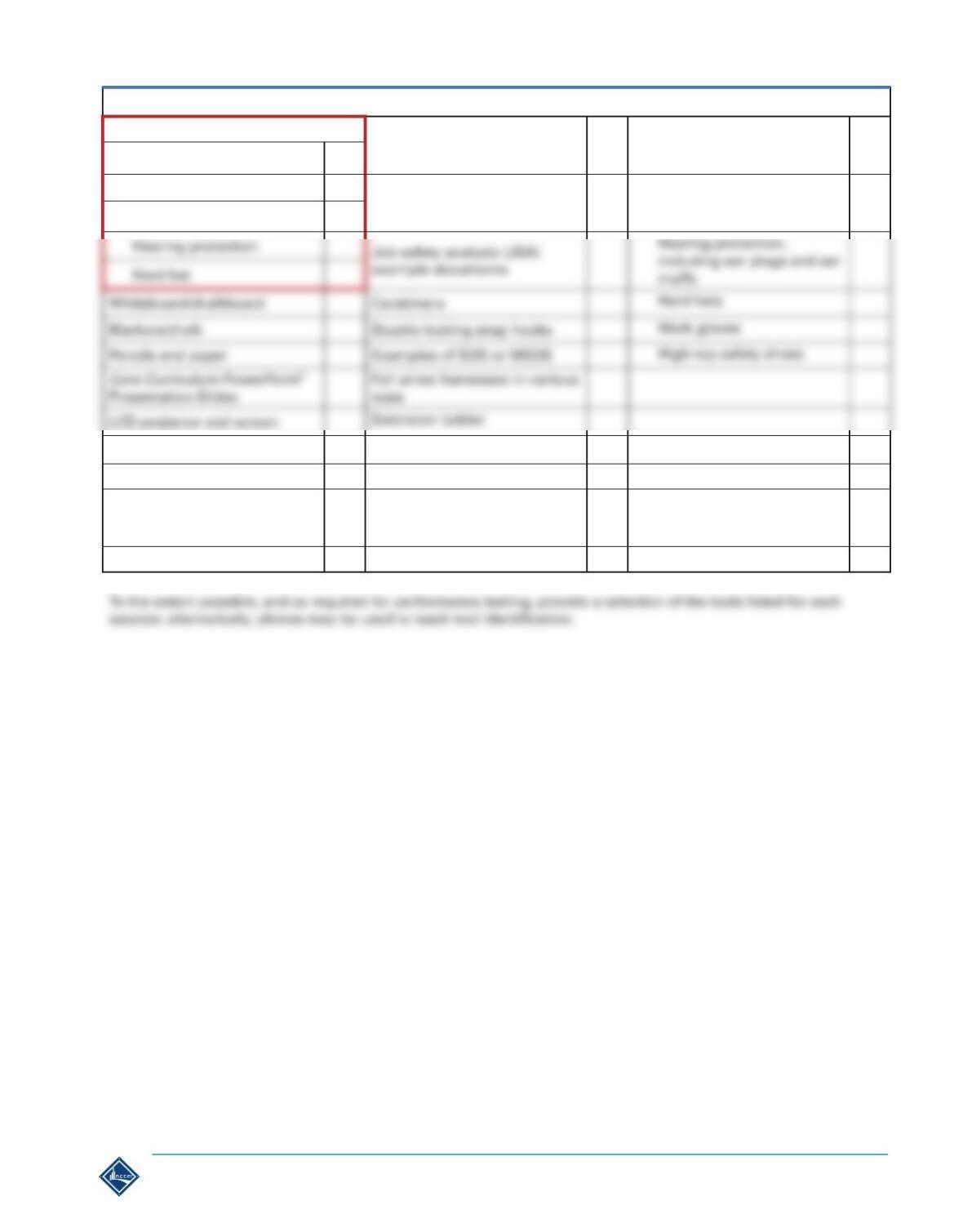
Materials Checklist for Module 00101-15, Basic Safety (Construction Site Safety Orientation)
Equipment and Materials
Personal protective equipment: Ground fault circuit interrupter
(GFCI)
Provide both defective and
serviceable examples of the
following items:
Eye protection
Work gloves Task safety analysis (TSA)
example documents
Eye protection, such as
safety glasses and face
shields
High-top safety shoes
DVD player Lanyards
Computer with internet access Various types of respirators
Copies of the Module
Examination and Performance
Profile Sheets
Damaged and undamaged
extension cords
Double-insulated power tool
00101-15 Basic Safety (Construction Site Safety Orientation) Module One 1
safety and Hazard recognition
Classroom Session 1 for 00101–15
Safety Considerations
The following consideration should be emphasized when introducing trainees to safety best practices.
Remind trainees that some forms of PPE are required any time they are in the shop or on the job site.
Safety Equipment
The use of specific safety equipment is not anticipated during this session.
Classroom and/or Lab Equipment
Job safety analysis (JSA) example documents
Task safety analysis (TSA) example documents
Examples of SDS or MSDS
Resources
No specific resources are required for this session.
Kickoff Activity
Schedule a safety expert, such as an OSHA inspector, as a guest speaker. Encourage the speaker to
emphasize safety by describing occasions in which workers were spared injury or death because they
Session Objective
When trainees have completed this session, they should be able to do the following:
1. Describe the importance of safety, the causes of workplace incidents, and the process of hazard
recognition and control.
a. Define incidents and the significant costs associated with them.
Session Performance Requirements
Trainees will not complete a Performance Task during this session.
Instructional Outline
Research has shown that varying instructional methods periodically throughout class sessions helps to
engage and hold trainees’ attention. The Core Curriculum PowerPoint® presentation that you received
2 NCCER – Core Curriculum 0 0101-15
safety and Hazard recognition
Classroom Session 1 for 00101–15
Classroom: Section 1.0.0
Explain that it is the employee’s responsibility to follow established safety practices and wear the
required PPE. Describe what a safety culture is, how a strong safety culture is achieved, and the benefits
a contractor derives from a strong safety culture.
Classroom: Sections 1.1.0–1.1.2
Explain what an incident is as defined by OSHA and discuss the categories of incidents. Describe the
“Fatal Four” hazard groups and use the chart provided to show how these four types of incidents
dominate the construction industry. Explain the various ways in which on the job incidents impact
workers, their families, and their employers.
Classroom: Sections 1.2.0–1.2.1
Identify the various causes of on-the-job incidents. Describe how poor communication can affect safety.
Describe the types of signs used to communicate safety information on a job site. Explain the difference
between information, caution, and danger signs.
Classroom: Sections 1.2.2–1.2.3
Classroom: Sections 1.2.4–1.2.5
Explain why lack of the necessary skills can result in an incident, citing the examples in the text.
Ask the trainees to give examples of additional situations where lack of skill could result in injury.
Emphasize the importance of being properly trained before using any power equipment or machinery.
Discuss intentional acts that can create unsafe conditions, such as vandalism and terrorist activities.
Classroom: Sections 1.2.6–1.2.7
Use the bulleted list to describe the types of unsafe acts that can lead to injury. At each bullet, give an
Classroom: Section 1.2.8
Use the bulleted list to describe the types of unsafe conditions that can lead to injury. At each bullet,
give an example of what can happen as a result of the unsafe condition. Alternately, have the trainees
give some of the examples. Emphasize that employees should have the right to refuse to perform work
under unsafe conditions.
00101-15 Basic Safety (Construction Site Safety Orientation) Module One 3
safety and Hazard recognition
Classroom Session 1 for 00101–15
Classroom: Sections 1.2.9–1.2.10
Describe how poor housekeeping can affect safety. Give examples of poor housekeeping and review the
basic rules for maintaining an organized, uncluttered workspace. Explain how deficiencies in the safety
management system can affect safety performance. Discuss the qualities that are present in a good
safety management system.
Classroom: Sections 1.3.0–1.3.1
Classroom: Section 1.3.2
Explain the difference between a job safety analysis (JSA) and a task safety analysis (TSA). Use the
figure or another JSA to explain how the JSA is developed.
Teaching Tip
Classroom: Sections 1.3.3–1.3.4
Explain how the risk level of an activity is determined and discuss acceptable vs. unacceptable risks.
Explain how risk is mitigated through the use of safety equipment and good safety practices. Explain
the need to report all incidents and describe how OSHA and employers use incident reports to help
improve safety management.
Classroom: Section 1.3.5
Provide the trainees with copies of a safety data sheet or refer them to the sample SDS in the text.
Discuss the purpose of each section. Explain that the older MSDS form may still be in use to some
extent. Briefly discuss the differences between the SDS and MSDS and provide a copy of an MSDS for
the trainees to examine.
Wrap Up
00101-15 Basic Safety (Construction Site Safety Orientation) Module One 5
elevated Work and fall Protection
Classroom Session 2 for 00101–15
Safety Considerations
The following consideration should be emphasized when discussing basic safety practices:
Remind trainees that some forms of PPE are required any time they are in the shop or job site
environments.
Safety Equipment
No specific safety equipment is required for this session.
Classroom and/or Lab Equipment
Fall arrest harnesses in various sizes
Lanyards
Carabiners
Double-locking snap hooks
Resources
No specific resources are required for this session.
Session Objective
When trainees have completed this session, they should be able to do the following:
Session Performance Requirements
By the end of this session, trainees should have completed, or be able to complete, the following
Performance Tasks under the supervision of the instructor:
Inspect the following PPE items and determine if they are safe to use:
6 NCCER – Core Curriculum 0 0101-15
elevated Work and fall Protection
Classroom Session 2 for 00101–15
Instructional Outline
Research has shown that varying instructional methods periodically throughout class sessions helps to
engage and hold trainees’ attention. The Core Curriculum PowerPoint® presentation that you received
with this lesson plan is keyed to the sections of the Trainee Guide indicated below and has been
designed for use with this lesson plan.
Review
Review the answers to the 1.0.0 and 2.0.0 Section Reviews.
Classroom: Sections 2.0.0–2.1.0
Explain the difference between fall prevention and fall arrest. Introduce the different methods used
Classroom: Sections 2.1.1–2.1.2
Explain how good housekeeping practices can prevent slips, trips, and falls. Discuss the various
methods used to prevent falls caused by unprotected sides, wall openings, and holes in the floor.
Explain the barricade color codes used to designate different levels of hazards. Discuss the rules for
protecting openings in floors, walls, and stairways, as well as the edges of decks and platforms.
Classroom: Sections 2.2.0–2.2.1
Use the figure to point out and describe each item of a personal fall arrest system. Use Figure 8 to
introduce the different types of permanent and temporary anchor points. Explain swing zone and
Classroom: Sections 2.2.2–2.2.3
Explain that fall protection harnesses are made in several sizes and that it is important to use the correct
size. Explain why proper positioning of the back D-ring is critical. Have examples of connecting devices
Demonstration
Show the trainees how to inspect fall arrest harnesses, lanyards, and connecting devices. If possible,
provide a harness that has failed inspection in order to make the activity more realistic. Then
demonstrate how to correctly put on and adjust a fall protection harness with the back D-ring in the
correct position.
00101-15 Basic Safety (Construction Site Safety Orientation) Module One 7
elevated Work and fall Protection
Classroom Session 2 for 00101–15
Laboratory/Performance Task
Provide the trainees with fall arrest harnesses, lanyards and connecting devices. Have the trainees
inspect a fall protection harness, lanyard, and connecting devices. This activity corresponds to a portion
of Performance Task 2.
Have the trainees don, fit, and remove a fall protection harness. This activity corresponds to a portion
of Performance Task 3.
Classroom: Section 2.2.4
Explain the difference between shock-absorbing and self-retracting lanyards. Point out that non-shock-
Classroom: Section 2.2.5
Explain that vertical and horizontal lifelines are used to allow movement. Point out that the minimum
breaking strength of a horizontal lifeline is determined by the number of workers to be attached to it
and that this determination must be made by a competent person. Advise the trainees to check with a
supervisor before attaching to a horizontal lifeline.
Classroom: Sections 2.2.6–2.2.7
Classroom: Section 2.3.0
Discuss maximum intended load for ladders and point out that this weight limit, which includes
personnel, tools, and materials, must not be exceeded. Use Table 2 to compare loads for different types
of ladders.
Classroom: Section 2.3.1
Identify the components of a straight ladder. Point out that metal ladders must not be used around
electrical wiring or electrical installations. Discuss the differences in weight and applications between
8 NCCER – Core Curriculum 0 0101-15
elevated Work and fall Protection
Classroom Session 2 for 00101–15
Classroom: Section 2.3.2
Explain how extension ladders are raised and lowered. Emphasize the importance of making sure the
rung locks are secure once the extension is raised. Discuss the minimum overlap requirement based on
the height of the ladder and point out the importance of leaving the extension stop in place. Point out
that no one should stand higher than the fourth rung from the top of an extension ladder.
Classroom: Section 2.3.3
Bring a stepladder into the classroom so trainees can examine it. Describe the component parts of a
step ladder. Show how to properly set up a step ladder, making sure that it is placed on a level surface.
Explain that one should never stand on the top rung or try to climb the back of the ladder. The knees
should never be above the top rung. Also point out that step ladders, like other types of ladders, have
maximum load limits.
Classroom: Sections 2.3.4–2.3.5
Describe how to properly inspect a ladder, looking for loose nails, screws, and other loose hardware;
Classroom: Sections 2.4.0–2.4.1
Identify the different types of scaffolds. Point out that only a competent person can approve the use of
scaffolds and must inspect them before use. Warn the trainees that rolling scaffolds may not be moved
while workers are on them.
Classroom: Sections 2.4.2–2.4.3
Describe the tagging system used to identify the status of a scaffold. Note that a yellow tag requires that
Wrap Up
Review the Trade Terms associated with Section 2.0.0 to reinforce the material that was presented. Ask
trainees to identify any terms that were new to them or meant something different than they expected.
Time permitting, show fall protection videos available at the osha.gov website.
Homework
Assign the reading of Sections 3.0.0 through 4.2.1. In addition, ask trainees to complete the 3.0.0 and
4.0.0 Section Reviews.
00101-15 Basic Safety (Construction Site Safety Orientation) Module One 9
Classroom Session 3 for 00101–15
struck-By, caugHt in or BetWeen,
and energy release Hazards
Safety Considerations
The following safety consideration should be emphasized in this session:
Remind trainees that some forms of PPE are required any time they are in the shop or job site
environments.
Safety Equipment
No specific safety equipment is required for this session.
Classroom and/or Lab Equipment
Double-insulated power tool
Resources
No specific resources are required for this session.
Session Objectives
When trainees have completed this session, they should be able to do the following:
3. Identify and explain how to avoid struck-by and caught-in-between hazards.
a. Identify and explain how to avoid struck-by and caught-in-between hazards.
Session Performance Requirements
By the end of this session, trainees should have completed, or be able to complete, the following
Performance Task under the supervision of the instructor:
Inspect a typical power cord and GFCI to ensure their serviceability.
Instructors are reminded that trainee performance during practice and laboratory sessions can be used
for verification of Performance Task completion.
Instructional Outline
Research has shown that varying instructional methods periodically throughout class sessions helps to
10 NCCER – Core Curriculum 00101-15
struck-By, caugHt in or BetWeen,
and energy release Hazards
Classroom Session 3 for 00101–15
Review
Review the answers to the 3.0.0 and 4.0.0 Section Reviews.
Classroom: Sections 3.0.0–3.1.1
Explain the difference between struck-by and caught-in/between hazards and give examples of each.
Describe the different ways in which workers can be struck by falling objects. Discuss the importance
of barricading areas where falling objects may be a hazard. Explain how toeboards, debris nets, and
other measures are used to prevent falling tools and other objects. Explain how to use the interlocking
method to stack material.
Classroom: Section 3.1.2
Classroom: Section 3.1.3
Point out the hazards that exist from moving vehicles and equipment on a job site, especially from
those operating in reverse. Explain why maintaining eye contact with vehicle and equipment operators
and listening for backup alarms is important. Use the bulleted list in the text to review the safety
requirements for vehicle and equipment operators.
Classroom: Sections 3.2.0–3.2.1
Describe the hazards related to trenches and excavations, including cave-ins, water accumulation,
falling objects, and hazardous atmospheres. Remind the trainees that more than 1,000 trench cave-ins
Classroom: Section 3.2.2
Discuss the purpose of tool and machine guards and identify the types of tools that typically require
protective guards. Describe how guards are applied to moving and rotating machinery. Emphasize
that protective guards must never be removed or bypassed. Use the example of the guard on a circular
saw being held back to expose the blade. Point out that only the guard designed for a tool or machine
should be used on it.
00101-15 Basic Safety (Construction Site Safety Orientation) Module One 11
Classroom: Section 3.2.3
Describe the hazards associated with cranes and heavy equipment. Identify common pinch points
on equipment such as excavators and backhoes. Explain how the upper rotating structure of some
equipment, such as cranes and excavators, extend beyond the tracks, creating a caught-between hazard.
Classroom: Sections 4.0.0–4.1.0
Explain what lockout/tagout is and point out that any source that can release energy—electrical,
Classroom: Sections 4.1.1–4.1.2
Explain what a ground is and why grounding is an important safety feature. Discuss the purpose of a
three-wire system and explain how double-insulated tools provide protection against electric shock.
Show the trainees a double-insulated power tool and point out the polarized two-prong plug.
Explain the purpose of a GFCI and briefly describe how it works. Show the trainees a GFCI and point
out the test and reset buttons. Explain that a GFCI should be tested before use. Point out that a GFCI-
protected device must not be plugged into a GFCI.
Classroom: Sections 4.1.3–4.1.5
Review the summary of electrical safety guidelines. Point out that work on electrical equipment
should be done whenever possible with circuits de-energized and locked out. Discuss the case history
Classroom: Section 4.2.0–4.2.1
Explain that some hydraulic, pneumatic, and electrical systems retain stored energy even after being
disabled. Show the trainees some lockout-tagout devices and explain how they are used. Discuss the
Demonstration
Show the trainees how to inspect an electrical extension cord and how to inspect and test a GFCI. Point
out reasons to reject power cords.
struck-By, caugHt in or BetWeen,
and energy release Hazards
Classroom Session 3 for 00101–15
12 NCCER – Core Curriculum 00101-15
Laboratory/Performance Task
Have the trainees inspect a power cord, and then inspect and test a GFCI. Provide cords that are
serviceable as well as those that are not. This activity corresponds to Performance Task 4.
Wrap Up
Review the Trade Terms introduced in this session to help reinforce learning. Ask trainees if they have
any questions about the session.
Homework
struck-By, caugHt in or BetWeen,
and energy release Hazards
Classroom Session 3 for 00101–15
00101-15 Basic Safety (Construction Site Safety Orientation) Module One 13
Classroom Session 4 for 00101–15
PPe and JoB site Hazards
Safety Considerations
The following safety consideration should be emphasized in this session:
Remind trainees that some forms of PPE are required any time they are in the shop or job site
environments.
Safety Equipment
No specific safety equipment is required for this session.
Classroom and/or Lab Equipment
Provide both defective and serviceable examples of the following items:
– Eye protection, such as safety glasses and face shields
– Hearing protection, including ear plugs and ear muffs
– Hard hats
– Work gloves
Various types of respirators
Resources
Refer to www.osha.gov for more information on PPE and site safety, including a number of videos on
both topics.
Session Objectives
When trainees have completed this session, they should be able to do the following:
5. Identify and describe the proper use of personal protective equipment (PPE).
a. Identify and describe the basic use of PPE used to protect workers from bodily injury.
14 NCCER – Core Curriculum 0 0101-15
Classroom Session 4 for 00101–15
PPe and JoB site Hazards
Session Performance Requirements
By the end of this session, trainees should have completed, or be able to complete, the following
Performance Tasks under the supervision of the instructor:
Inspect the following PPE items and determine if they are safe to use:
Eye protection
Hearing protection
Hard hat
Gloves
Approved footwear
Properly don, fit, and remove the following PPE items:
Eye protection
Instructional Outline
Research has shown that varying instructional methods periodically throughout class sessions helps to
engage and hold trainees’ attention. The Core Curriculum PowerPoint® presentation that you received
with this lesson plan is keyed to the sections of the Trainee Guide indicated below and has been
designed for use with this lesson plan.
Review
Review the answers to the 5.0.0 and 6.0.0 Section Reviews.
Classroom: Sections 5.0.0–5.1.0
Discuss the importance of wearing the required PPE at all times. Point out that some companies take
Classroom: Section 5.1.1
Provide hard hats for the trainees to examine. Point out the outer shell, webbing, and adjustment and
explain the proper way to wear the hat. Discuss the importance of inspecting the hard hat and keeping
it clean.
Classroom: Section 5.1.2
Discuss the different types of eye and face protection and provide examples for the trainees to examine.
Describe the situations in which full face protection is required. Point out that special tinted goggles are
required for anyone performing or working in proximity to welding or flame cutting.
00101-15 Basic Safety (Construction Site Safety Orientation) Module One 15
Classroom Session 4 for 00101–15
PPe and JoB site Hazards
Classroom: Sections 5.1.3–5.1.4
Provide a selection of approved work gloves for the trainees to examine. Point out that gloves are rated
for certain hazards. Emphasize how important it is to wear gloves at all times except when working
around rotating equipment. Explain that boots with safety toes are the required footwear for most jobs,
but some tasks require specialized footwear. Point out that boots must be frequently inspected and
must be replaced when worn or damaged.
Classroom: Section 5.1.5
Describe how excessive noise can damage hearing. Provide examples of ear plugs and ear muffs for the
trainees to examine. Use the table to discuss the sound levels that might be experienced on a job site
and the maximum exposure time associated with each.
Classroom: Section 5.2.0
Discuss the conditions under which a respirator may be required. Explain where silica dust comes from
Classroom: Sections 5.2.1–5.2.3
Provide examples of respirators for the trainees to examine. Discuss the different types of respirators
and their uses. Explain that, if respirators are required on the job, the employer must provide the
necessary equipment and training in how to use it. Point out that respirators are effective only if they fit
properly.
Demonstration
Show the trainees how to properly inspect, don, and remove eye protection, gloves, hard hat, and
hearing protection. Point out causes for rejection in common PPE.
Laboratory/Performance Task
Classroom: Sections 6.0.0–6.1.1
Explain how the HAZCOM standard applies to workers who may be exposed to chemical, biological,
or physical hazards on the job. Point out that exposure to hazardous materials may come through
16 NCCER – Core Curriculum 0 0101-15
PPe and JoB site Hazards
Classroom Session 4 for 00101–15
Classroom: Section 6.1.2
Explain what bloodborne pathogens are and how a person can come into contact with them. Point out
that exposure to bloodborne pathogens can be prevented by wearing protective clothing, masks, and
gloves and washing affected areas with soap and water.
Classroom: Sections 6.1.3–6.1.4
Give the trainees examples of chemicals that can be encountered on a job site and describe the various
hazards associated with chemical spills, such as release of toxic vapors, explosion, or fire. Remind the
Classroom: Sections 6.1.5–6.1.6
Identify sources of radiation and the symbols used to identify radiation hazards. Discuss signs used to
identify biological hazards.
Classroom: Section 6.1.7
Explain that evacuation of a job site may be necessary in the event of a chemical spill, explosion, fire,
gas leak, or other incident. Emphasize that workers must be familiar with audible warnings, locations
of emergency phones, and evacuation routes.
Classroom: Sections 6.2.0–6.2.4
Explain what heat stress is and identify its symptoms. Describe the causes and symptoms of heat
Classroom: Sections 6.2.5–6.2.7
Describe the symptoms of cold stress. Explain that dressing in layers is the best way to avoid cold stress
and that dry clothes should be carried in case of damp weather. Describe the symptoms and first aid
treatment for frostbite. Explain how hypothermia can occur and review its symptoms. Describe how to
treat a person with symptoms of hypothermia. Refer the trainees to the text and discuss the actions to
take if someone falls into the water.
Classroom: Sections 6.3.0–6.3.1
Identify the activities that qualify as hot work. Briefly explain how arc welding is performed and
discuss the hazards from heat and radiation. Point out that anyone working near an arc welding
00101-15 Basic Safety (Construction Site Safety Orientation) Module One 17
Classroom Session 4 for 00101–15
PPe and JoB site Hazards
Classroom: Sections 6.3.2–6.3.3
Explain how oxygen combines with a cutting gas such as acetylene to produce a flame hot enough
to melt metal. Briefly explain what brazing is and how it is used to join copper pipe. Discuss the
importance of properly handling and storing fuel gases under pressure. Point out that protective caps
must always be in place on gas cylinders when they are not in use and that the cylinders must be
secured to keep them from falling over. Discuss the proper methods for transporting and lifting fuel gas
cylinders.
Classroom: Section 6.3.4
Explain what a hot work permit is and why it is necessary. Discuss the importance of posting a fire
watch when hot work is being performed and explain the duties of a fire watch.
Classroom: Sections 6.4.0–6.4.2
Use the fire triangle to describe the conditions necessary for a fire to start and be sustained. Describe
the different types of combustible materials and how they are classified. Emphasize the importance of
keeping pressurized gas cylinders away from sources of heat.
Classroom: Section 6.4.3
Review the basic safety guidelines for fire prevention. Discuss the techniques used to prevent fire when
working with flammable or combustible liquids, flammable gases, and ordinary combustibles. Point
out the hazards of allowing oxygen to come into contact with oil or grease.
Classroom: Section 6.4.4
Explain the importance of knowing where fire extinguishers are located and the procedures to be
followed in case of a fire. Explain how fire extinguishers are classified for specific types of fires and why
Classroom: Section 6.4.5
Explain the PASS method for fighting a fire and describe how to properly use a fire extinguisher.
Classroom: Section 6.5.0
Explain what a confined space is and give examples. Explain how a permit-required confined space
is different and what must be done before it is entered. Describe what oxygen-deficient and oxygen-
enriched spaces are and discuss the related hazards. Point out that an attendant must be present when a
confined space is entered and that the attendant must remain outside a permit-required confined space.
Explain why special care is needed when using flammable or inert gases in a confined space.

PPe and JoB site Hazards
Classroom Session 4 for 00101–15
Wrap Up
Review the Trade Terms introduced in this session to verify that the trainees are familiar with the terms.
Ask trainees if they have any questions about the session.
Homework
Advise the trainees to review the procedures for setting-up, climbing, and descending a ladder in order

00101-15 Basic Safety (Construction Site Safety Orientation) Module One 19
Classroom Session 5 for 00101–15
laBoratory; revieW and testing
This session is reserved for a brief review of the module, administering
the module examination, and performance testing.
Safety Considerations
The following safety consideration should be emphasized in this session:
Remind trainees that some forms of PPE are required any time they are in the shop or job site
environments.
Safety Equipment
The following safety equipment is recommended for this session:
Eye protection
Classroom and/or Lab Equipment
Extension ladder
Copies of the Module Examination and Performance Profile sheets
Have the Module Review and Trade Terms Quiz answer key available for review prior to
administering the exam.
Resources
Area with a wall suitable for the erection and climbing of an extension ladder.
Session Objective
This laboratory is designed to support and emphasize the content of Learning Objective 2.
Session Performance Requirements
By the end of this session, trainees should have completed, or be able to complete, the following
Performance Tasks under the supervision of the instructor:
Properly set up and climb/descend an extension ladder, demonstrating proper three-point contact.
Instructors are reminded that trainee performance during practice and laboratory sessions can be used
for verification of Performance Task completion.
Instructional Outline
20 NCCER – Core Curriculum 00101-15
revieW and testing
Classroom Session 5 for 00101–15
Demonstration
Show the trainees how to properly erect and secure an extension ladder. Then demonstrate how to
safely climb and descend the ladder using three points of contact.
Laboratory/Performance Task
Have the trainees practice properly erecting and securing an extension ladder and climbing/
descending the ladder using three points of contact. It is suggested that trainees wear all common
PPE during this laboratory, to simulate normal construction site behavior. This activity corresponds to
Performance Task 1.
Review
Ask the trainees if they wish to review any particular information from the module. Have the trainees
complete the Review Questions and Trade Terms Quiz at the end of the module. Alternatively, if
Examination and Performance Task Verification
Administer the Module Exam. Allow one to two minutes per test item for the written exam. As they
begin, remind trainees that they must answer at least 70 percent of the questions correctly to pass the
module exam.
Administer any outstanding performance verifications and complete the Performance Profile Sheet for
each trainee.
Wrap Up
Ask the trainees if there were any problem areas on the exam and to identify a favorite and least
favorite part of this module. As an alternate or if time allows, briefly introduce the next topic in your
planned teaching sequence.
Homework
Assign the reading of the next module in the teaching sequence.
Instructor
Record the testing results on the Registration of Training Modules Form, and submit the report to your
Training Program Sponsor.

00101-15 Basic Safety (Construction Site Safety Orientation) Module One 21
ansWer keys
Module One (00101–15)
SECTION REVIEW ANSWER KEY
SECTION 1.0.0
Answer Section Reference Objective
1. c 1.0.0 1a
SECTION 2.0.0
Answer Section Reference Objective
1. c 2.1.2 2a
SECTION 3.0.0
Answer Section Reference Objective
SECTION 4.0.0
SECTION 5.0.0
Answer Section Reference Objective
SECTION 6.0.0
Answer Section Reference Objective
1. b 6.1.0 6a

22 NCCER – Core Curriculum 00101-15
Module One (00101–15)
ansWer keys
ANSWERS TO REVIEW QUESTIONS
Answer Section Reference
1. b 1.1.1
2. b 1.2.1
3. a 1.2.9
13. b 3.1.3
00101-15 Basic Safety (Construction Site Safety Orientation) Module One 23
Module One (00101–15)
ansWer keys
ANSWERS TO TRADE TERMS QUIZ
1. Lockout/tagout (LOTO)
24. Scaffold
NCCER makes every effort to keep its textbooks up-to-date and free of technical errors. We
ap pre ci ate your help in this process. If you find an error, a typographical mistake, or an in-
ac cu racy in NCCER’s curricula, please fill out this form (or a photocopy), or complete the on-
NCCER Product Development and Revision
13614 Progress Blvd., Alachua, FL 32615
Email: curriculum@nccer.org
Online: www.nccer.org/olf
NCCER CuRRiCula — uSER uPDaTE
❏ Trainee Guide ❏ Lesson Plans ❏ Exam ❏ PowerPoints Other _________________________
Craft / Level: Copyright Date:
Module ID Number / Title:
Section Number(s):
Description:
Recommended Correction:
Your Name:
Address:
Email: Phone: