Chapter I: Are the Helping Professions for You?
CHAPTER 1
Are the Helping Professions for You?
LEARNING OBJECTIVES
After studying this chapter, students should be able to:
•
Recognize your motives for becoming a helper.
•
Identify whether a helping career is for you.
CHAPTER OUTLINE
Aim of the Chapter
Examining Your Motives for Becoming a Helper
Typical Needs and Motivations of the Helper
How Your Needs and Motivations Operate
Our Own Beginnings as Helpers
Overview of Some of the Helping Professions
Social Work
Couples and Family Counseling
Clinical and Counseling Psychology
Licensed Professional Counselor
School Counseling
CHAPTER OVERVIEW
Chapter I: Are the Helping Professions for You?
Near the end of each chapter we list some of the chapter’s highlights. These key points serve as a review
of the messages we have attempted to get across. After you finish each chapter, we encourage you to
• Just as you are evaluated and graded in your educational program, you will be evaluated in the
professional world. Evaluation can create stress, but it is part of your educational program and your
future career.
• Remain open to the question of whether a career in one of the helping professions is right for you. In
• It is essential that helpers examine their motivations for going into the field. Helpers meet their own
needs through their work, and they must recognize these needs. It is possible for both client and
helper to benefit from the helping relationship.
• Some of the needs for going into the helping professions include the need to be needed, the need for
• Investigate various specialty areas in the helping professions before committing to a particular path.
Visit the websites of the professional organizations or associations of each of these specializations to
clarify your thinking about your career direction.
Chapter I: Are the Helping Professions for You?
you.
• Do not consider the selection of a career as a one-time event. Instead, allow yourself to entertain many
job possibilities over your lifetime.
SUGGESTIONS FOR ACTIVITIES
1. Mock Job Interview. With another student, role-play a job interview. One person is the director
of a counseling center, and the other is the applicant. After 10–15 minutes, switch roles. Discuss
how you felt in each position, and get feedback from your partner after both of you have had a
chance to play each role. Questions the interviewer might ask include the following:
◼ Why are you applying for this job?
◼ What are your expectations if you get the position?
2. An Ice Breaker. During the first few class meetings, it will be useful to use a variety of ice
breakers to help students get more comfortable with each other. Following are a few
suggestions for you to select from, depending on what you think best suits the needs of your
class and what fits your style of teaching.
Chapter I: Are the Helping Professions for You?
◼ Ask students to pair up for 5–10 minutes and discuss specific topics that they’d like to
cover in the course. What do they think would be useful to help them acquire skills they
will need to become an effective helper? After the dyads, ask if anyone would like to
share with the entire class what they’d like to learn during the term.
◼ One ice breaker that can get students to interact quickly is the human scavenger hunt,
in which students are given a list of 20 items and are instructed to write down the
names of other students in class who can relate to those items. For instance, items
3. Journal Writing Suggestions. As noted earlier, we strongly encourage that you make it a
requirement for your students to keep a journal as a part of this course. It is a good idea to state
your policy at the beginning about whether the journals will be completely confidential or,
better, whether you will request to see their journals either weekly or less frequently during the
course. Reassure students that they will not be forced to show any writing that they feel is too
personal to share.
If you want to provide your students with some suggestions for journal writing, following are a
few ideas:
◼ What I learned about others* and myself in a particular class meeting
Chapter I: Are the Helping Professions for You?
4. Self-Assessment: An Inventory of Your Attitudes and Beliefs About Helping. See pages 44–56
for a 35-item inventory that students can take initially to introduce them to the topics presented
in the book and to stimulate their thoughts.
5. Compiling Resources. Assign students to investigate a website of one of the professional
organizations in the helping professions. Ask them to compile a list of the resources that are
offered to undergraduate and graduate students and exchange this information with each other
in class.
DISCUSSION QUESTIONS
1. As an ideal helper, what are the strengths that you carry forward and use in this profession and discuss
how it will benefit the clients.
KEY CONCEPTS AND TERMS
Clinical psychologists focus on assessment, diagnosis, and treatment procedures of mildly to severely
disturbed individuals.
Counseling psychologists work with relatively healthy people in solving developmental problems and
functioning more effectively.
Chapter I: Are the Helping Professions for You?
physical, mental, developmental, cognitive, and psychiatric disabilities to help them achieve their
personal, career, and independent living goals in the most integrated setting possible.
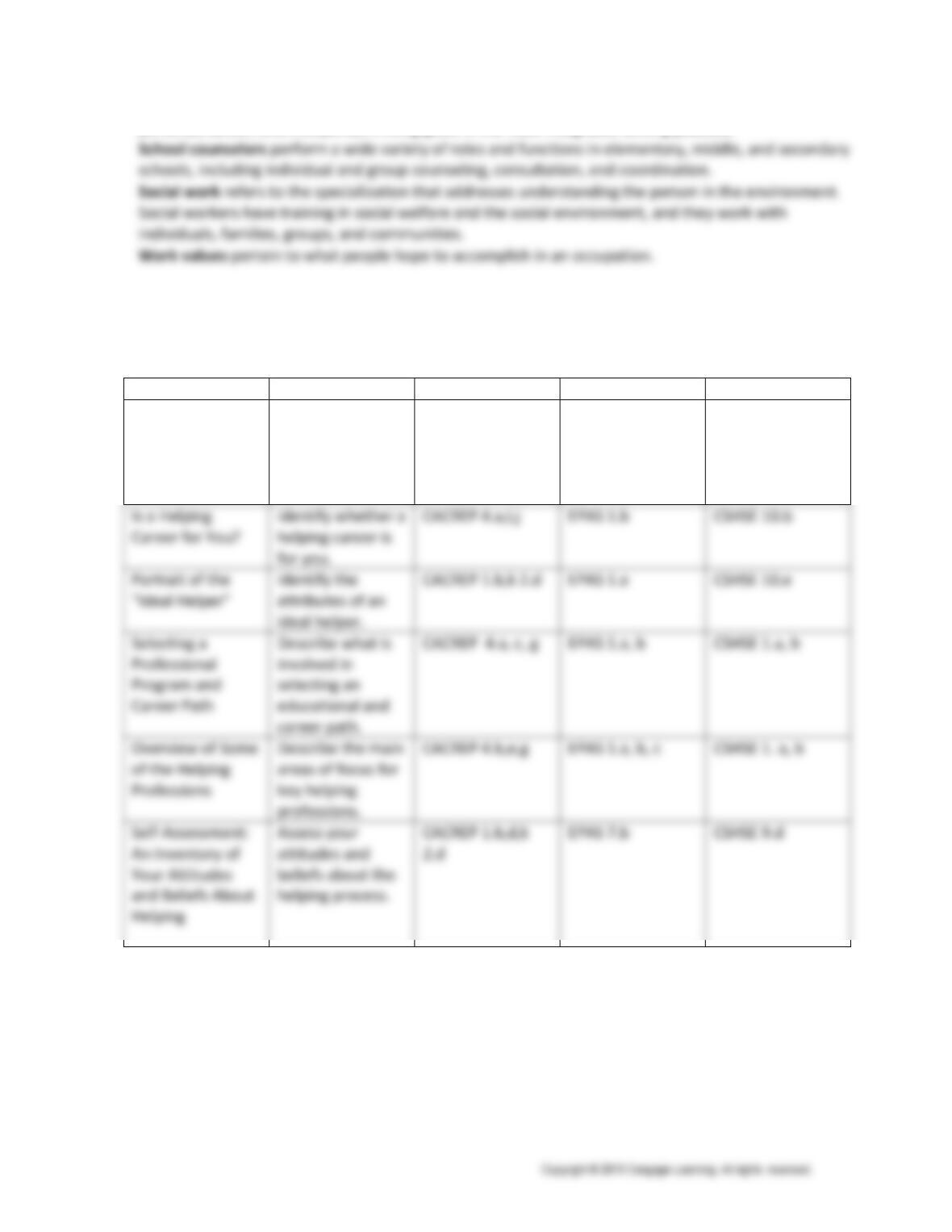
LO/STANDARDS CORRELATION CHART
A-head
LO
Standard 1
Standard 2
Standard 3
Examining Your
Motives for
Becoming a
Helper
Recognize your
motives for
becoming a
helper.
CACREP 1.a,b,c,d
EPAS 1.b
CSHSE 10.a
Is a Helping
Career for You?
Identify whether a
helping career is
for you.
CACREP 4.a,I,j
EPAS 1.b
CSHSE 10.b
Portrait of the
Identify the
attributes of an
ideal helper.
CACREP 1.b,k 2.d
EPAS 1.a
CSHSE 10.e
Professional
Program and
Career Path
involved in
selecting an
educational and
career path.
Overview of Some
of the Helping
Professions
Describe the main
areas of focus for
key helping
professions.
CACREP 4.b,e,g
EPAS 1.a, b, c
CSHSE 1. a, b
Helping