Part 2, Course Planning
38
TIPS FOR EFFECTIVE ONLINE TEACHING
If you are offering your business communication online, check with your college to learn what
resources and training are offered to online instructors. You should also do research to learn
about some of the best practices that others are using to make their classrooms positive,
interactive, and rich learning environments for online students. Here are a few proven best
practices:
• Organize your online course materials so that students can easily navigate them and can
clearly understand what is expected of them.
• Even when using publisher materials such as those provided with Business
Communication: Process and Product, personalize and embellish them to add greater
value and individuality to your course.
• Place a digital image of yourself in your online classroom so that students feel more of a
connection to you. Encourage students to share digital photos of themselves.
• If you decide to have mandatory on-campus meetings (for orientation, exams, and so on),
provide alternative accommodations for students who are unable to come to campus during
required times.
• Don’t expect that students can teach themselves. The active involvement of the instructor
is essential.
• The student needs to feel connected to the online class. Provide ample opportunities for
student-student interaction. Use the discussion board for class discussions, develop group
projects, and plan other activities so that students work with one another.
• When communicating with students, it’s important to do so in a respectful, positive way.
Check the tone of all e-mail messages and discussion board postings before sending them.
Also check your messages and postings carefully for accuracy and clarity before sending
them. You are serving as role model in this course, and your grammar and spelling must be
perfect!
Part 2, Course Planning 39
Suggestions for Reducing Cheating in Online Classes
Even when following best practices, online instructors are naturally concerned about testing and
security in their online classrooms. Without seeing the students in person, how can an instructor
be sure that the student is actually completing his or her own work? Here are some tips you can
use to combat cheating in your online classroom:
• Let students know exactly what you expect of them and inform them of any college
regulations concerning academic honesty.
• The more interaction you have with students, the more you will become aware of their
abilities and writing styles. Develop discussion board assignments that require students to
interact regularly and frequently with you and with each other.
• Use a variety of assessment instruments in your course, and require numerous and regular
assignments. The more required of students, the more difficult it would be for them to find
someone else to complete the work for them. Grades in an online business communication
Use the security features included with course management packages to perform the following:
1. Deliver questions one at a time, where students must answer a question before moving on to
the next question. Selecting whether questions can be revisited after they have been answered.
Part 2, Course Planning
40
Creating a Community With Your Students
One of the most important things that online instructors must realize is that it is imperative for
the instructor to establish and maintain early and regular communication with students and to
provide ample opportunities for students to interact and communicate with each other.
ILLEGAL POSTING OF SOLUTIONS
I want to apologize to users of my books for solutions that are being made available online.
Some websites offer solutions right out of the Instructor’s Manual, and they call them “discussion
guides” or “tutorial help.” Baloney! These are usually unscrupulous vendors trying to sell our
intellectual property.
Instructors should not post solutions or anything from the IM at unprotected websites.
If students come to class with answers and solutions that look exactly like those in the IM, you
know that they have found them online. Some unknowing or uncaring instructors have posted
I appreciate your help in protecting the authenticity and credibility of the IM teaching materials.
USING TEXTBOOK RESOURCES AND FEATURES
Chapter Opening Case Studies
Each chapter opens with an introduction to a case study featuring a premier or significant
organization or businessperson. These studies not only help students learn about real
organizations and the problems they face, but the case studies also provide a context in which
students can place the principles discussed in the chapter. Each case study has two parts. The
first part introduces the organization, sets the scene, and builds interest. Critical thinking
questions enable the instructor to guide class discussion so that students are able to relate the
Part 2, Course Planning 41
chapter concepts to a specific organization. The last segment furnishes more information about a
specific problem and sets up an application in which the students help to solve the problem.
End-of-Chapter and Web Activities
The eighth edition of Business Communication: Process and Product offers an enormous
collection of activities that can be used for in-class discussion and reinforcement as well as for
out-of-class assignments. In fact, no other business communication book offers the number or
the variety of activities as those presented in BC:PP, 8e. In this edition more than 40 percent of
Photo Essays
The photo essays bring business communication to life by demonstrating how concepts are
Ethics Checks
Documents for Analysis
Many chapters contain “Documents for Analysis.” These documents are also available at
www.cengagebrain.com so that students may edit and revise them without total retyping. For
distance learning classes, a digital set of solutions is available for instructors at the premium
instructor’s site.
Part 2, Course Planning
42
WORKPLACE SIMULATIONS
Available in this edition are three simulation activities, located at the student site that help
students transfer their skills to the workplace.
Writeaway Hotels Simulation encourages students to practice managing and writing e-mail
messages. Designed as an in-class activity, the simulation works best for 12 to 25 students, each
playing a role within the fictitious company, Writeaway Hotels. Within 30 minutes in a computer
ASSESSING WRITING ASSIGNMENTS
Assessing and grading student performance is probably the least appealing aspect of teaching
business communication. Although some instructors have developed “The Perfect Plan” for
grading and are quite satisfied with it, others are still searching. To help those who are still
searching, we present five methods for assessing student assignments.
Before examining these methods, you may want to consider these general ideas regarding
assessment and grading.
• Be aware of your goal in assessment. Is your goal to judge the student’s work and attach a
number or letter grade? Or is your goal to help students improve their writing? Probably
most of us try, to a certain extent, to accomplish both goals—without making the assessment
task burdensome.
Revision
Most writing authorities advocate revision as an important technique in developing writing skills.
You may want to allow students to rewrite a certain number of assignments, which you will
Part 2, Course Planning 43
totally regrade, reducing the second grade by one letter. Some instructors allow students to write
Correction Symbols and Comments
Resist the temptation to rewrite faulty student expression. Crossing out a student error and
Six Assessment Methods
Here are six possible methods for grading student assignments. They represent traditional,
behavioral, holistic, and criterion-based methods.
1. Assigned-Weights Method. Each document is graded according to assigned weights. For
example, the opening is assigned a weight of 10 points.
Possible Your
Category Points Score
Opening, closing 10 _______
Strategy, organization 10 _______
Completeness, accuracy 10 _______
Tone, goodwill effect 10 _______
Clarity, coherence 10 _______
Overall effect, originality 20 _______
Mechanics 30 _______
Spelling (–5 pts.)
Word choice (–5)
Major error (–6)
Minor error (–2 or more)
Idiom, syntax, or other error
(–2 to –12)
Bonus Points
TOTAL POINTS ______
If you prefer to penalize more (or less) for mechanical errors, change the points deducted. See
page 52 for a template using this method.
__________________________________________________________________________________________

Part 2, Course Planning
44
2. Dual-Criteria Method. Each assignment is graded on the basis of the following
criteria:
Content (10 pts.) Grammar/Mechanics (10 pts.)
Strategy Appearance
Organization Format
Coherence Grammar
Every assignment starts out with 20 points. The instructor devises a method of deducting points
for faults, for example, –2 for any content fault (or more, depending upon the severity of the
fault), –1 for minor grammar/mechanical problems, and –2 for severe grammar/mechanical
problems. Numbers may be converted to grades using this optional scale:
A = 18–20 points C = 8–13 points
B = 14–17 points D = 4–7 points
__________________________________________________________________________________________
3. Check-Mark Method. Students may rewrite assignments as often as required to receive a
check mark, which usually signifies “B” work. A student’s grade is determined by the
number of check-mark assignments completed during the marking period.
__________________________________________________________________________________________
4. 0, 1, 2 Holistic Method. Similar to the checkmark method, this holistic method includes only
three possible scores. Marilyn Dyrud, Oregon Institute of Technology, developed this plan
Part 2, Course Planning 45
2 An excellent letter/memo
• is mailable as is (requires no revision)
• follows format specs and assignment requirements
• is signed/initialed
1 An acceptable letter/memo
• may be mailed as is, but probably requires some revision
• follows format specs and assignment requirements
• is signed/initialed
0 An unacceptable letter/memo
• is not mailable (requires a major overhaul)
• does not follow format specs and/or assignment requirements
• has noticeable mechanical errors
• uses inappropriate tone
__________________________________________________________________________________________
5. Contract Method. At the beginning of a course, students sign contracts outlining the
requirements that will determine their final grades. An example of such a contract follows:
CONTRACT
During the semester I would like to work for a grade of _________. I will complete the
requirements stated below for this grade; if I fail to meet the requirements, I will contract down.
Proposed by __________________________ Date _______________________
Approved by _________________________ Date _______________________
Part 2, Course Planning
46
C-Level
2. I will meet the basic requirements of the course, performing at a satisfactory level and
3. I will make a positive contribution to the small-group activities.
B-Level
1. I will complete all requirements for the “C” level.
2. I will make an oral report on _________________________________________
(some phase of communication that meets the instructor’s approval).
3. I will interview a business executive on communication in his or her firm and write a report
4. I will perform at this grade level; that is, most papers will be satisfactory when turned in the
A-Level
1. I will complete all requirements for the “B” level.
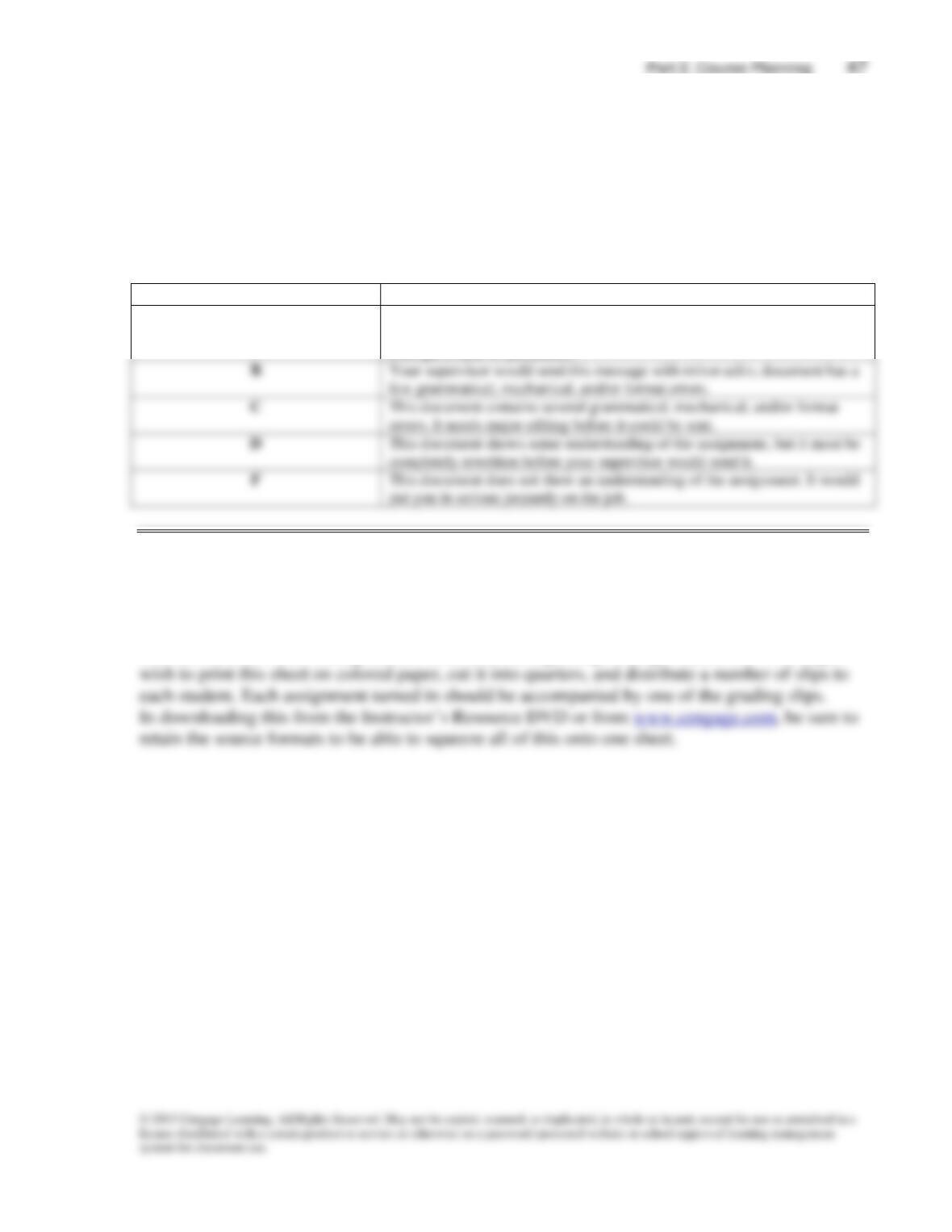
6. Workplace-Based Method. This method allows you to use a rubric to grade students in a way
that parallels how writing might be evaluated on the job. If you choose this method, you
should give students a copy of the rubric at the beginning of the course and explain it in
detail. The following workplace-based method is based on a grading plan developed by Mike
Markel, author of Technical Communication (Bedford St. Martin’s).
Grade
Description
A
Your supervisor would gladly send this message with no edits. This
document would make you stand out among other employees. You might
even get a raise or promotion!
“Assigned Weights” Template for Grading Writing Assignments
On the next page you will find a template for possible use in grading student writing
assignments. This “assigned weights” rubric is very effective in achieving objectivity in grading.
It is also effective in avoiding student confrontation regarding writing weaknesses. You might
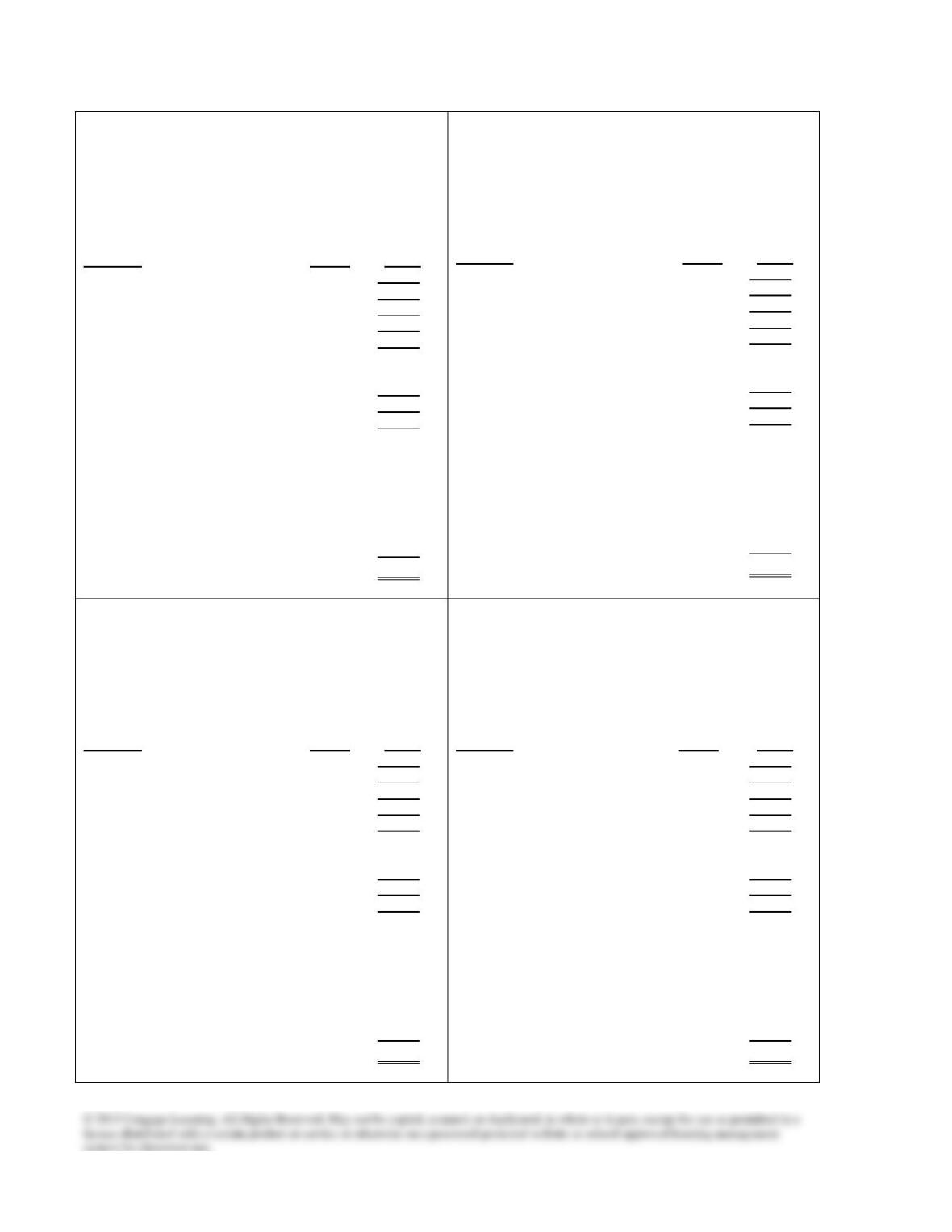
48 Part 2, Course Planning
BUSINESS COMMUNICATION ASSESSMENT
Assignment or page number _____________________
Staple this sheet to the upper left corner of the
document. Write your name on the back of your
document.
Possible Your
Category Points Score
Opening, closing 10
Strategy, organization 10
Completeness, accuracy 10
Tone, goodwill effect 10
Clarity, coherence 10
Fluency, written expression
(parallelism, sentence unity
conciseness, etc.) 10
Overall effect, originality 10
Mechanics 30
Spelling, typo (–4)
Word choice (–4)
Major error (comma splice,
run-on, fragment, subject-
verb agreement, etc.) (–6)
Minor error (–2)
Idiom, syntax, other errors (–2 to –6)
Bonus points
Total Points (100 possible)
BUSINESS COMMUNICATION ASSESSMENT
Assignment or page number _____________________
Staple this sheet to the upper left corner of the
document. Write your name on the back of your
document.
Possible Your
Category Points Score
Opening, closing 10
Strategy, organization 10
Completeness, accuracy 10
Tone, goodwill effect 10
Clarity, coherence 10
Fluency, written expression
(parallelism, sentence unity
conciseness, etc.) 10
Overall effect, originality 10
Mechanics 30
Spelling, typo (–4)
Word choice (–4)
Major error (comma splice,
run-on, fragment, subject-
verb agreement, etc.) (–6)
Minor error (–2)
Idiom, syntax, other errors (–2 to –6)
Bonus points
Total Points (100 possible)
BUSINESS COMMUNICATION ASSESSMENT
Assignment or page number _____________________
Staple this sheet to the upper left corner of the
document. Write your name on the back of your
document.
Possible Your
Category Points Score
Opening, closing 10
Strategy, organization 10
Completeness, accuracy 10
Tone, goodwill effect 10
Clarity, coherence 10
Fluency, written expression
(parallelism, sentence unity
conciseness, etc.) 10
Overall effect, originality 10
Mechanics 30
Spelling, typo (–4)
Word choice (–4)
Major error (comma splice,
run-on, fragment, subject-
verb agreement, etc.) (–6)
Minor error (–2)
Idiom, syntax, other errors (–2 to –6)
Bonus points
Total Points (100 possible)
BUSINESS COMMUNICATION ASSESSMENT
Assignment or page number _____________________
Staple this sheet to the upper left corner of the
document. Write your name on the back of your
document.
Possible Your
Category Points Score
Opening, closing 10
Strategy, organization 10
Completeness, accuracy 10
Tone, goodwill effect 10
Clarity, coherence 10
Fluency, written expression
(parallelism, sentence unity
conciseness, etc.) 10
Overall effect, originality 10
Mechanics 30
Spelling, typo (–4)
Word choice (–4)
Major error (comma splice,
run-on, fragment, subject-
verb agreement, etc.) (–6)
Minor error (–2)
Idiom, syntax, other errors (–2 to –6)
Bonus points
Total Points (100 possible)

49
ASSESSING ORAL PRESENTATIONS
Many instructors encourage peer evaluation of oral presentations. To guide your students in how
to evaluate a presentation, you might wish to use a rubric such as that shown below. This
descriptive evaluation system is helpful in teaching students what to look for and how to judge
presentations. This rubric was developed by Kim Sydow Campbell, David L. Mothersbaugh,
Charlotte Brammer, and Timothy Taylor at the University of Alabama. Notice that it assigns
numeric values to various levels of performance.
A Rubric for Judging the Quality of an Oral Business Presentation
1
2
3
4
5
Eye Contact
Essentially no eye
contact. Reads
continuously,
glancing up only
once or twice a
minute. Stares at
ceiling or
consistently looks at
slide screen
Somewhere between
no and moderate eye
contact.
Moderate eye
contact. Either faces
audience but refers to
notes or slides
occasionally (couple
of times a minute) or
turns body
sometimes to screen.
Somewhere between
moderate and
continuous eye
contact.
Continuous eye
contact. Faces
audience and refers
to notes or slides less
than once a minute.
Rarely glances at
slide screen or at part
of room away from
audience.
Body Language
Distracting. Sways,
paces, or fidgets so
that audience is
distracted from
Somewhere between
distracting and
neutral body
language.
Neutral. Stands
facing the audience.
Occasionally uses
hands and body
Somewhere between
neutral and engaging
body language.
Engaging. Uses
gestures (e.g.,
pointing with hands)
and expressions to
speaking too quickly,
or in a monotone.
intonation for
emphasis.
and volume.
Command of
Material
Poor. Struggles often
to find words. Reads
most of presentation.
Somewhere between
poor and adequate
command of
material.
Reads less than once
a minute, struggles
occasionally to find
words.
Somewhere between
adequate and
excellent command
of material.
Excellent. Does not
read from notes or
slides. Expresses
ideas fluently in own
words.
Visual Aids
Ineffective.
Overheads, slides, or
handouts are hard to
read, distracting, or
inadequate for
presentation.
Somewhere between
ineffective and
adequate visual aids.
Adequate. Readable
overheads, handouts.
Enhance
presentation.
Somewhere between
adequate and
excellent visual aids.
Excellent overheads
or slides. Easy to
read, attractive,
greatly enhance
presentation.
Content
Poor. Purpose not
clear, information
disjointed or
inadequate.
Somewhere between
poor and adequate
content.
Adequate.
Information is
usually relevant and
appropriate to
audience.
Somewhere between
adequate and
engaging content.
Engaging.
Information is
relevant to audience.
Excellent details.
Source: “Peer Versus Self-Assessment of Oral Business Presentation Performance,” Business
Communication Quarterly, Volume 64, Number 3, September 2001, pp. 25–42. Reprinted with
presentation. Poor
use of hands (in
pockets, jingling
keys, playing with
movements
appropriately, but
may still be a little
stiff or nervous.
enhance the
presentation. Speaker
looks very
comfortable and
natural.
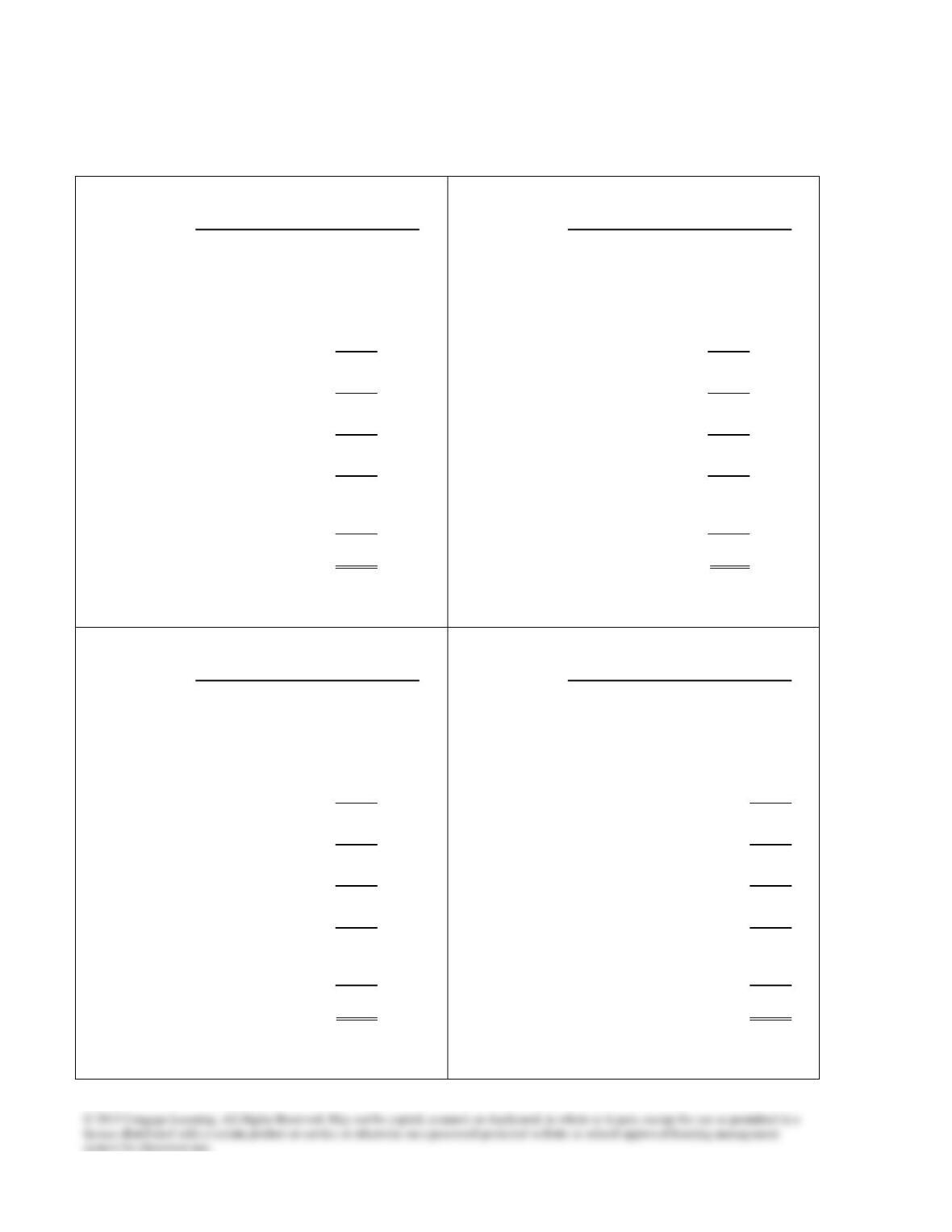
50 Part 2, Course Planning
Depending on what you emphasize in your class, you might wish to use the template shown on
this page for grading student oral presentations.
ORAL PRESENTATION ASSESSMENT
Speaker’s Name
Excellent 10 points
Above average 8–9 points
Average 5–7 points
Needs Improvement 4 or below
1. Were the opening and closing clear and
well planned?
2. Did the speaker help you remember
two to four main points?
3. Were the speaker’s movements and eye
contact effective?
4. Were the visual aids effective and
handled appropriately?
5. Was the presentation well organized,
coherent, and obviously practiced
before delivery?
Total Points (50 possible)
On the back add a statement of praise and one
pointer for improvement.
ORAL PRESENTATION ASSESSMENT
Speaker’s Name
Excellent 10 points
Above average 8–9 points
Average 5–7 points
Needs Improvement 4 or below
1. Were the opening and closing clear and
well planned?
2. Did the speaker help you remember
two to four main points?
3. Were the speaker’s movements and eye
contact effective?
4. Were the visual aids effective and
handled appropriately?
5. Was the presentation well organized,
coherent, and obviously practiced
before delivery?
Total Points (50 possible)
On the back add a statement of praise and one
pointer for improvement.
ORAL PRESENTATION ASSESSMENT
Speaker’s Name
Excellent 10 points
Above average 8–9 points
Average 5–7 points
Needs Improvement 4 or below
1. Were the opening and closing clear and
well planned?
2. Did the speaker help you remember
two to four main points?
3. Were the speaker’s movements and eye
contact effective?
4. Were the visual aids effective and
handled appropriately?
5. Was the presentation well organized,
coherent, and obviously practiced
before delivery?
Total Points (50 possible)
On the back add a statement of praise and one
pointer for improvement.
ORAL PRESENTATION ASSESSMENT
Speaker’s Name
Excellent 10 points
Above average 8–9 points
Average 5–7 points
Needs Improvement 4 or below
1. Were the opening and closing clear and
well planned?
2. Did the speaker help you remember
two to four main points?
3. Were the speaker’s movements and eye
contact effective?
4. Were the visual aids effective and
handled appropriately?
5. Was the presentation well organized,
coherent, and obviously practiced
before delivery?
Total Points (50 possible)
On the back add a statement of praise and one
pointer for improvement.

Part 2, Course Planning 51
© 2015 Cengage Learning. All Rights Reserved. May not be copied, scanned, or duplicated, in whole or in part, except for use as permitted in a
license distributed with a certain product or service or otherwise on a password-protected website or school-approved learning management
system for classroom use.
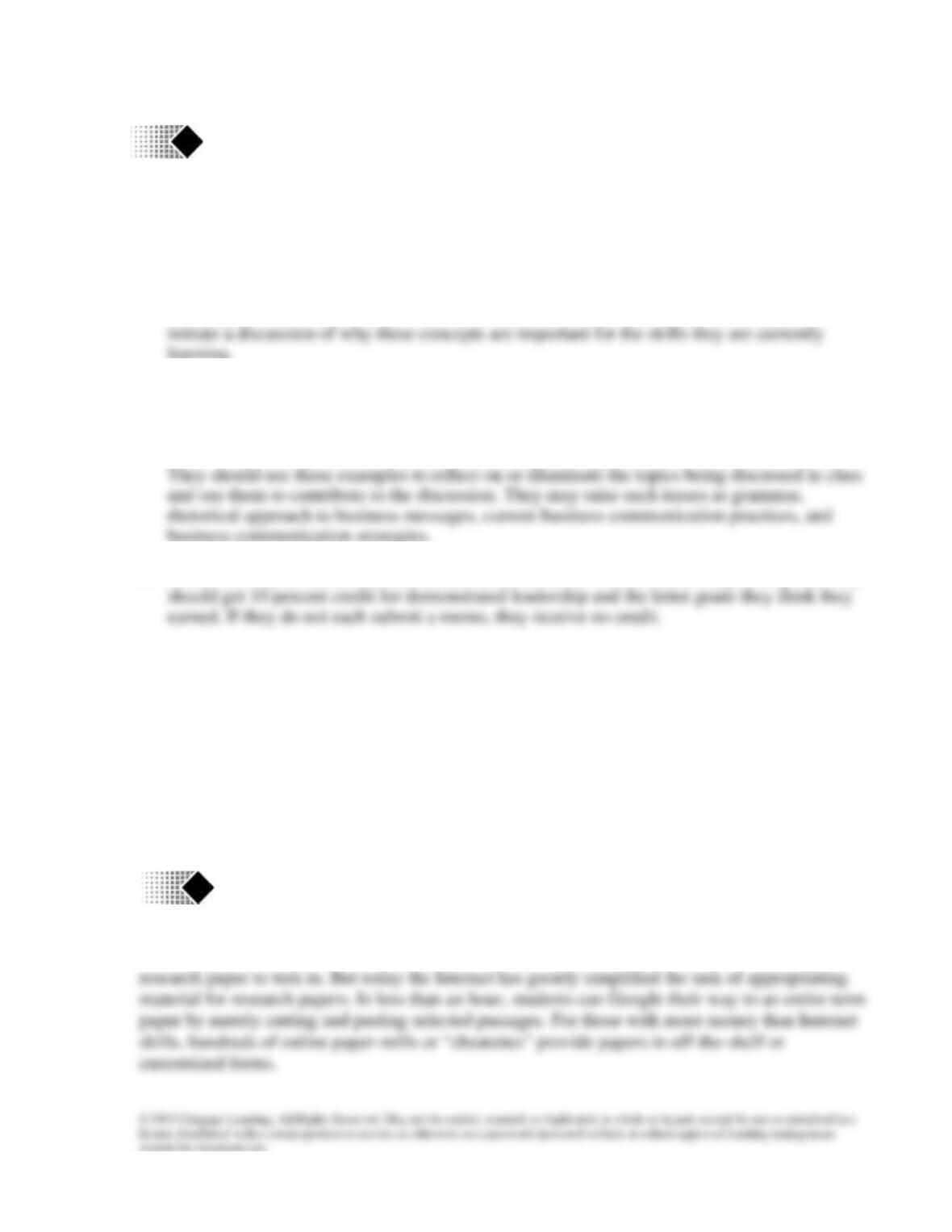
ASSESSING REPORTS AND RÉSUMÉS
REPORT ASSESSMENT
Before you turn in your report, study the categories in which it will be assessed. Turn in this
sheet when you submit the report. At that time, sign the statement below.
My report contains no sentences or parts of sentences that are copied verbatim (word for word)
from other writing without attribution.
Signed _________________________________________
Report format
Illustrates correct format
Displays headings appropriately
Shows neat overall appearance 20 points _________
Report content
Achieves the purpose of the report
Contains sufficient data, supported by concrete detail
Includes relevant data
Shows evidence of sufficient research
Achieves overall effectiveness 40 points _________
Report writing style
Shows good organization
Includes coherent and unified sentences and paragraphs
Uses transitions effectively
Attributes sources clearly and correctly 20 points __________
Grammar and mechanics
Uses appropriate grammar
Contains conventional spelling
Shows proper punctuation
Includes correct capitalization 20 points _________
Bonus points
Achieves exceptional merit _________
TOTAL POINTS 100 points _________
Comments

52 Part 2, Course Planning
RÉSUMÉ ASSESSMENT
Before you turn in your résumé, study the categories in which it will be assessed. Turn in this sheet when
you submit your résumé.
Résumé format
Illustrates effective résumé format
Uses appropriate font size and type
Positions name alone on first line
Displays headings appropriately
Shows neat, uncluttered overall appearance 20 points ________
Summary of qualifications
Lists most impressive qualifications in bulleted form
Experience section
Arranges experience in reverse chronological order
Includes employer’s name, city, and state
Includes dates of employment with month and year
Lists most important job title
Describes significant duties, activities, accomplishments,
and promotions
Uses present-tense verbs for current job
Specifies relevant activities for targeted position
Uses action verbs and keyword nouns to maximize
“hits” by scanners 30 points ________
Grammar and mechanics
Uses appropriate grammar and proper punctuation
Capitalizes correctly
Contains NO spelling errors 20 points ________
Education and other information
Includes the name and location of schools, dates of
attendance
List major fields of study and degrees or certificates
received (or dates expected)
Bonus points
Achieves exceptional merit ________
TOTAL POINTS 100 POINTS ________
Comments
Part 2, Course Planning 53
DEMONSTRATED LEADERSHIP ASSESSMENT
By Jo Koster Tarvers, Winthrop University
To make class participation more meaningful, you may wish to add a demonstrated leadership
assessment to your syllabus as part of the course grade.
Students may earn 10 percent of their grade if they do the following tasks:
1. On assigned dates, they each present to the class a summary of concepts from the text and
2. Participate regularly in online class discussions.
3. At least three times during the semester, they each bring into class or to on-line discussions
“real-world” examples from their own mail, work, reading, or discussions in other classes.
4. On the last day of class, they each submit a short memo to the instructor explaining why they
Benefits to the Student
This assessment is more concrete than a general “class participation” grade for two
reasons:
1. As students perform the tasks, they show the instructor and the class that they are
thinking about what business communication professionals think about and contribute to
the class’s improved understanding of the issues of the discipline.
2. The assessment allows the instructor to talk about “demonstrated leadership” in letters of
recommendation.
STRATEGIES FOR REDUCING PLAGIARISM
As many business communication instructors have learned, plagiarism has never been easier than
it is today. Previously, students had to make an effort and spend some money to find a prepared
54 Part 2, Course Planning
• Help students understand proper research practices. Don’t assume that students know
what plagiarism is. Teach them by showing examples of an original text, a plagiarized
version, and an acceptable paraphrased version. Create your own examples or use those
appearing in Chapter 11 of Guffey’s Business Communication: Process and Product, 8e,
pages 398-399. Other examples are available in the many websites devoted to plagiarism and
its prevention.
single most important technique in preventing plagiarism.
• Require students to save and submit Web pages. One of the biggest attribution problems
today is that of citing Internet references no longer available. To avoid this dilemma, ask
students to save a permanent copy of a Web page (click “Save as” on Internet Explorer and
save in a directory or print relevant pages).
• Assign original topics. Avoid repeating assignments used in previous classes, and don’t
allow popular topics that have a ton of prepared papers all ready to be purchased by writing-
and ethics-challenged students.
• Teach and grade citation techniques. Explain how to quote individuals and sources and
how to use APA, MLA, or your special citation format. Make the proper citation of sources a
specific part of the research paper grade.
• Consider using a commercial plagiarism detection service. If your school is willing to foot
the bill, subscribe to Turnitin.com. Students submit their papers to the service, which makes a
“digital fingerprint” of the paper. It cross-references that fingerprint against its database of
hundreds of thousands of papers. It also scours the Web searching for similar phrasing. Then
it creates a custom originality report for each paper. Few students dare to plagiarize if they
know their papers will be scrutinized electronically.
Although large schools assigning many term papers may find it worthwhile to invest in a service
such as Turnitin.com, you can achieve excellent results without investing in an expensive
service. Just implement the techniques discussed here—especially monitoring the entire writing
process.