21
a lofty one? Or are some means of communicating, such as quoting out of context, inherently
unethical no matter who is using them to what end? Those who lean toward the “ends justify the
means” position will soon find themselves pressed to answer the question of who decides on the
morality of goals. Surely Hitler believed his goal was noble, as do pro-life and pro-choice
advocates, liberals and conservatives.
The proponents of the other point of view, that some techniques of speaking are unethical,
are on sounder philosophical ground perhaps. But they rapidly run into problems when pressed
to differentiate between specific cases. It is wrong to make up evidence, but is it wrong for a
speaker to emphasize evidence that supports his/her thesis? It is wrong to substitute emotional
appeals for sound reasoning, but is it wrong to use emotional material to create a sense of
urgency in an indifferent audience?
Hance, Ralph, and Wiksell (1975) are among the writers who effectively argue that there is
22
Basic Course Materials
Sample Course Syllabus
For many students the first few days of a course are accompanied by feelings of uncertainty and
apprehension about what is expected of them. During this initial period the instructor can ease
Instructor: Neeley Silberman Dept. Office: Saint Mary’s, D329
Public Speaking I Dept. Phone: 555-4666
Office Hours: TTh 9:30-10:00 and by appt.
REQUIRED TEXT: Sprague and Stuart, The Speaker’s Compact Handbook
Also required: One DVD or recording DVR to be brought to class each day you are scheduled
to speak.
COURSE OBJECTIVES: This course is designed to provide you with basic theories and skills
evaluate the speaking of others.
ATTENDANCE: Your attendance and active participation are essential to the success of this
class. Your participation in exercises, speech evaluation, and class discussion is encouraged and
You must complete all assignments/exams to pass the course.
23
I. Speaking Assignments:
II. Examinations:
A. Two multiple choice exams based
on textbook, lectures, classroom
activities, and discussion 20% of grade
B. Final: Essay exam (comprehensive) 20% of grade
III. Attendance, participation, completion of
class exercises, and critiques 10% of grade
Sample Course Calendars
A course calendar should be prepared along with the course syllabus. Whether or not you expect
1. Skills-Oriented Class (Semester Calendar)
Class Class Assignment
Period Activity
1. Introduction to Course Lecture
24
6. Lecture/discuss Speech Topics &
Purposes, Topic Analysis, & Contexts 10, 33
15. Lecture/discuss/exercise
Supporting Materials 13, 14, 15
16. Lecture/discuss Research, Inform. Strategies
Scavenger Hunt exercise 12, 21
26. Lecture/discuss Audience Analysis
Audience Analysis Assignment 11
27. Lecture/discuss Persuasive
Strategies. Group exercise 22
28. Lecture/discuss Reasoning
Critique sample speech 23
29. Lecture/discuss Credibility
25
34. Speech IV
35. Speech IV
36. Lecture/discuss Motivational
Appeals. Advertisement exercise 24
2. Elective Course Calendar
Class Class
Period Activity Assignment
1. Orientation
2. Form support groups, get acquainted FNDTN., PREP. INTRO
3. Delivery/Confidence 1,4
4. Speech Ethics. Listening, Assign Speech I 2, 3
5. Speech purposes. Meet in groups 10
6. Organization 17-19
7. Introductions and Conclusions 30
26
29. Style and language 28
30. Reasoning 23
31. Discuss audience analysis
27
Sample Assignment Sheets
Besides the syllabus and calendar, we find it useful to distribute a sheet spelling out the purpose,
requirements, and grading criteria for each speaking assignment. Today’s students come from
varied academic backgrounds. While some are able to respond to a two- or three-minute oral
description of an assignment, many need more guidance and detail. Without lowering one’s
standards or getting into remedial instruction, a teacher can adapt to the needs of many entering
The assignment sheets include:
x One-Point Speech
x Supporting-a-Claim Speech
28
One-Point Speech
Assignment Sheet
Prepare a 3- to 4-minute presentation supporting a specific statement of fact or value. Your
outline should be a complete-sentence outline and is due on the day of your speech. Use and
label the supporting materials (examples, statistics, testimony) from Chapter 15. Also use and
label at least two of the techniques of clear explanation from Chapter 21 (emphasis cues,
signposting, acronym, slogan, or analogy).
The assignment is designed to build speech-making skills rather than represent a complete or
typical speech. Below is a brief example of the outline format you will use. Naturally, your
outline will include more details and will be of a more serious nature.
Outline
I. Gary Ruud is a lousy teacher.
A. Gary Ruud doesn’t show concern for his students.
1. Class evaluations indicate 97% of Gary Ruud’s students rank him in
the bottom 5th percentile in this category. (Statistic)
B. Gary Ruud grades unfairly.
1. Teachers generally use one of two grading systems.
a. First, using a typical curve suggests that there will be a small percentage of As
and Fs. Second, a larger percentage will be Bs and Ds. And, third, the largest
percentage will be Cs. (Enumeration)
29
Presentation
You are to use one or two 3×5 notecards. Delivery should be extemporaneous. Utilize the
30
Supporting-a-Claim Speech
Assignment Sheet
Purpose of This Assignment
In persuasive speaking it is essential the speech be made up of claims that support the
proposition/thesis. Each of these claims is then supported through the use of evidence and
reasoning. For example, the claim that fatty foods cause high cholesterol must be supported by
evidence such as statistics, testimonies, and/or examples. Once the evidence is established, the
Requirements
1. Create a proposition/thesis. (See example on next page.)
2. Create three main points/claims that support the proposition. [17]
6. You are required to turn in your completed planner on the day you speak. Your planner
should include:
x Clearly stated thesis [10d]
31
Supporting-a-Claim Speech: Example
Part One:
Proposition: The US school system should adopt a school uniform policy.
Main Point I: Within the last decade there has been an increase in juvenile crimes.
Main Point II: School uniforms will reduce competition.
Main Point III: School uniform programs will decrease juvenile crimes.
Part Two:
I. (Main Point/Claim): School uniform programs will decrease juvenile crimes.
A. (Evidence) Sonoma county school district has seen a 10% reduction in juvenile
crimes since implementing their school uniform policy one year ago (Stevens, 1997).
Statistic
B. (Evidence) Steven, a student at a school that has a uniform policy, stated that before
the policy he and his friends had stolen articles of clothing, but since the uniform
policy he has not found a need or desire to continue stealing clothing (Brawley,
1996).
Example
C. (Evidence) A Professor at the University of California, Berkeley states that her
research has found a direct correlation between the need for material possessions and
the need to commit crimes (Stevens, 1997).
Testimony
32
Tribute Speech
Assignment Sheet
Purpose of This Assignment
One of the forms of public speaking that we do not do enough of is paying tribute to another
human being. There are many occasions in our lives for giving a tribute: family gatherings,
Requirements
1. You will honor one living individual who has influenced you in a positive way. Share two
specific things about this person that made him/her so influential.
Criteria for Evaluation
First, you must meet all of the above requirements to receive a passing grade for the assignment.
Suggestions for Preparation
Choose a person who is important to you—who touched your life or impressed you. Keep in

34
Demonstration Speech
Assignment Sheet
Purpose of This Assignment
Informative speeches take many forms, one of which is the demonstration speech. The primary
purpose of any speech to inform is to ensure the audience’s clear understanding of the ideas
presented. This assignment asks you to explain and demonstrate to the audience the steps
involved in carrying out a certain task or process.
Requirements
1. The topic should be informative and challenging to this audience.
2. The speech should be four to six minutes in length.
8. A typed outline, submitted on the day of the speech, should
— state the specific purpose of your speech [10]
Criteria for Evaluation
First, you must meet all of the above requirements to receive a passing grade for the assignment.
Suggestions for Preparation
Select a topic that you are already familiar with and on which you can quickly gather additional
information.
36
Problem Solution Speech
Assignment Sheet
Purpose of This Assignment
This speech is to introduce you to persuasive speaking by working first on the logical substance,
or logos, that is the essence of any persuasive effort. If you advocate a change, you should be
Requirements
1. The topic should be timely, timeless [10], and controversial. Choose a topic on which you
hold strong convictions and upon which you can realistically expect to influence an audience
Criteria for Evaluation
First, you must meet all of the above requirements to receive a passing grade for the assignment.
Then, points will be assigned based on how well you carried out each aspect of the assignment.
37
Suggestions for Preparation
Select a topic that you can research readily in the time available. Once again, strong organization
is your best ally. Make your main points clear and be very explicit on how the subpoints relate to
each other and to the main points. Use summaries and transitions like the following: “I have
38
Audience-Analysis Project: Overview
Persuasive Speech
Purpose
The purpose of this assignment is to demonstrate that (a) you understand the theory of audience
analysis, and (b) that you can apply this theory by adapting your persuasive speech to this
particular audience. There are three parts to this assignment. Parts 1, 2, and 3 are to be turned in
along with your outline prior to your speech. All three parts are explained below so that you can
see how the assignment as a whole is structured.
Pre-Speech Analysis: Parts 1, 2, and 3
To complete these segments you must participate in the in-class audience analysis project. This
Part 1: General Audience Analysis
What do you know about the composition of this group offhand? Include audience size, age, sex,
Part 2: Specific Audience Analysis
What have you learned about your audience in terms of their attitudes toward your specific
Part 3: Persuasive Strategy
Justify your speech strategy with regards to your audience. What ratio of reasoning, motivational
Post-Speech Analysis: Parts 4 and 5
Part 4 is to be turned in no later than one class session after you deliver your speech.
Part 4: Comparison of Pre-Speech and Post-Speech Results
Report on the shift of attitude, if any. How successful were you? Give specific examples of
Part 5: Analysis of Persuasive Impact
Why do you think some people were persuaded? Why do you think some were not? If you had
40
Pre-Speech Audience Analysis
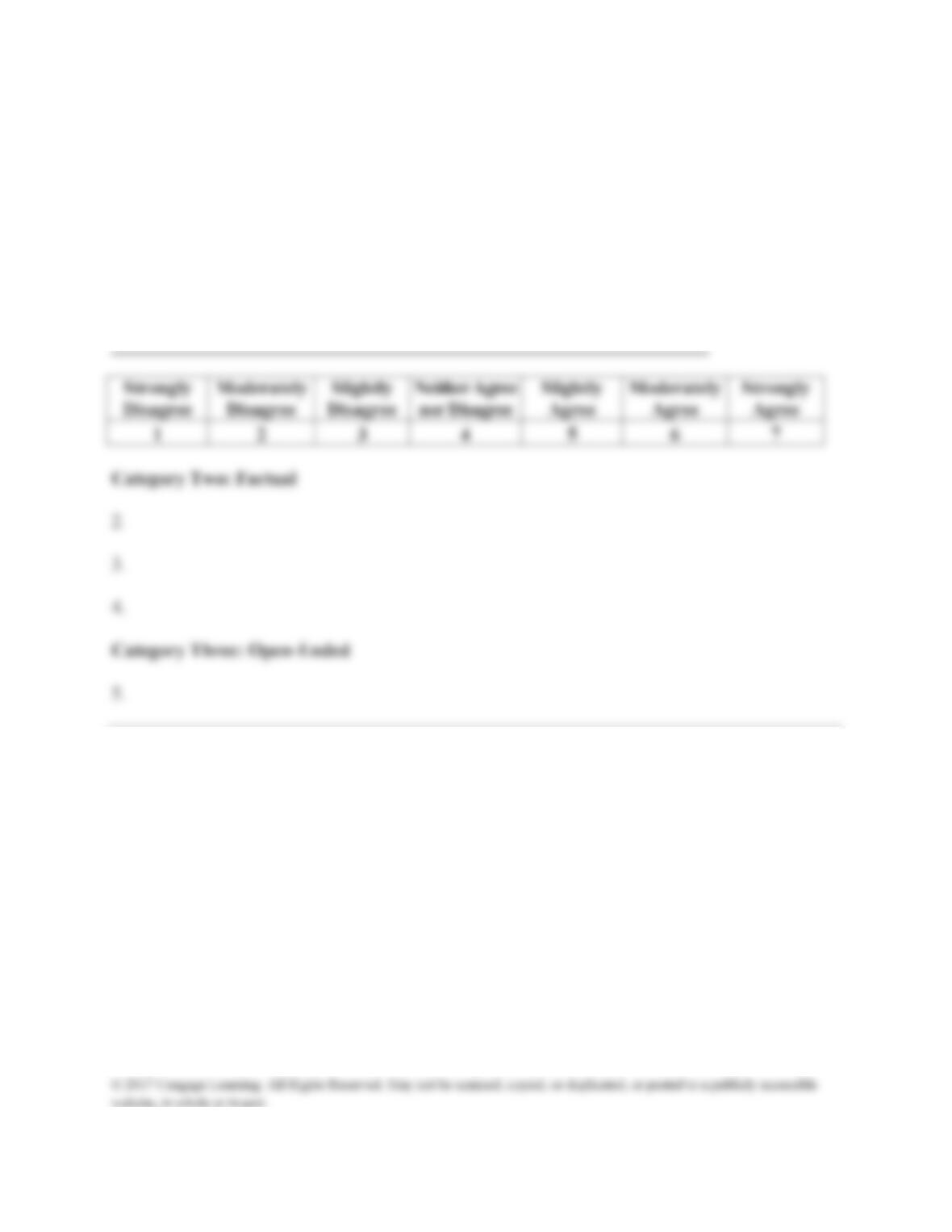
Write your proposition below and add four more questions that you would like to have answered
by your audience as you prepare your persuasive strategy. This is information you will be able to
use to reformulate your speech. The questions should be clear and concise, and the entire
questionnaire must be possible to complete within 2 minutes. Make _____ copies for the
audience and bring them to class on the day scheduled for the data collection.
Questionnaire
1. What is your attitude toward this statement?
Speaker’s Proposition: