41
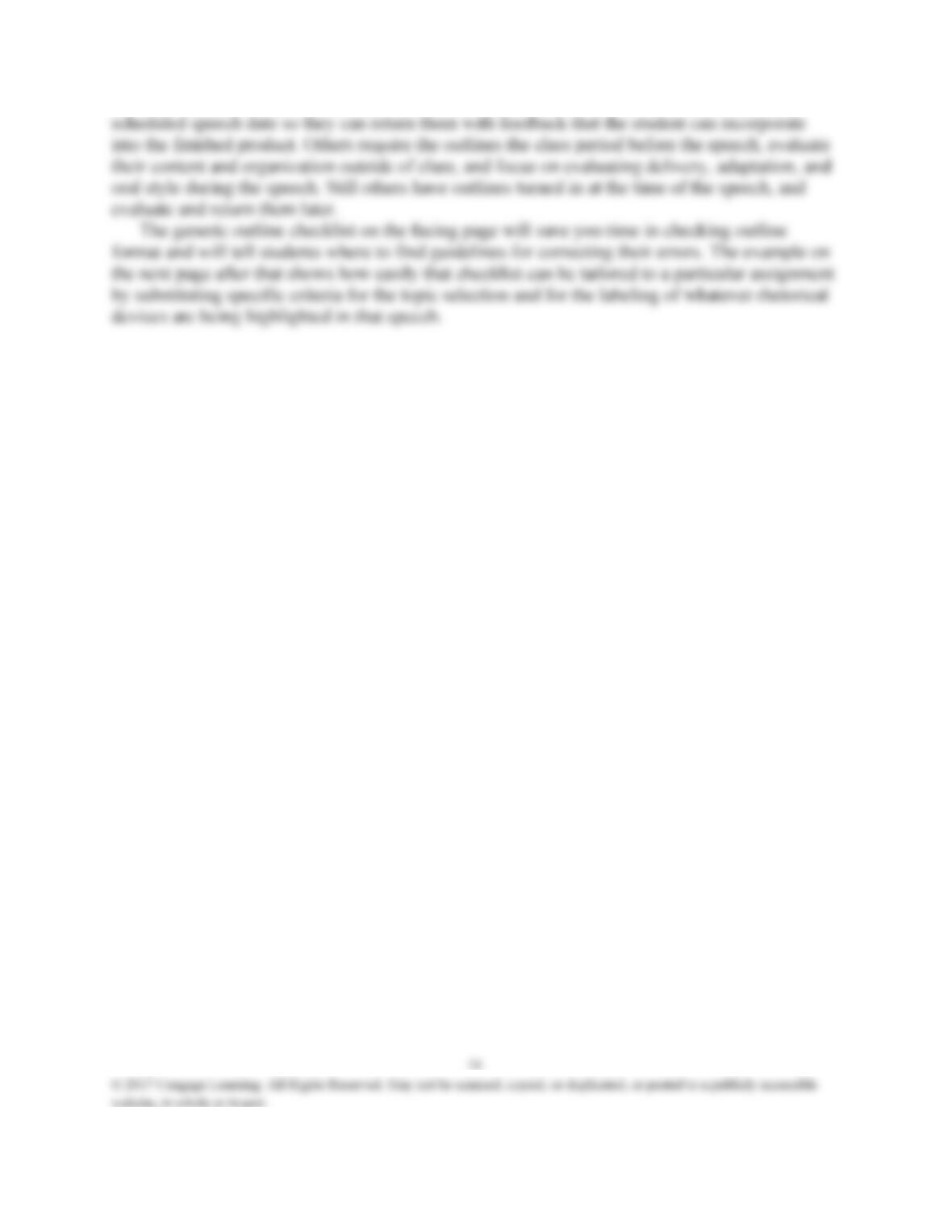
Sample Pre-Speech Audience Analysis
Questionnaire
1. What is your attitude toward this statement?
Speaker’s Proposition: “School uniforms should be required in all public schools for grades
K-8.”
Category Two: Factual
Category Three: Open-Ended
42
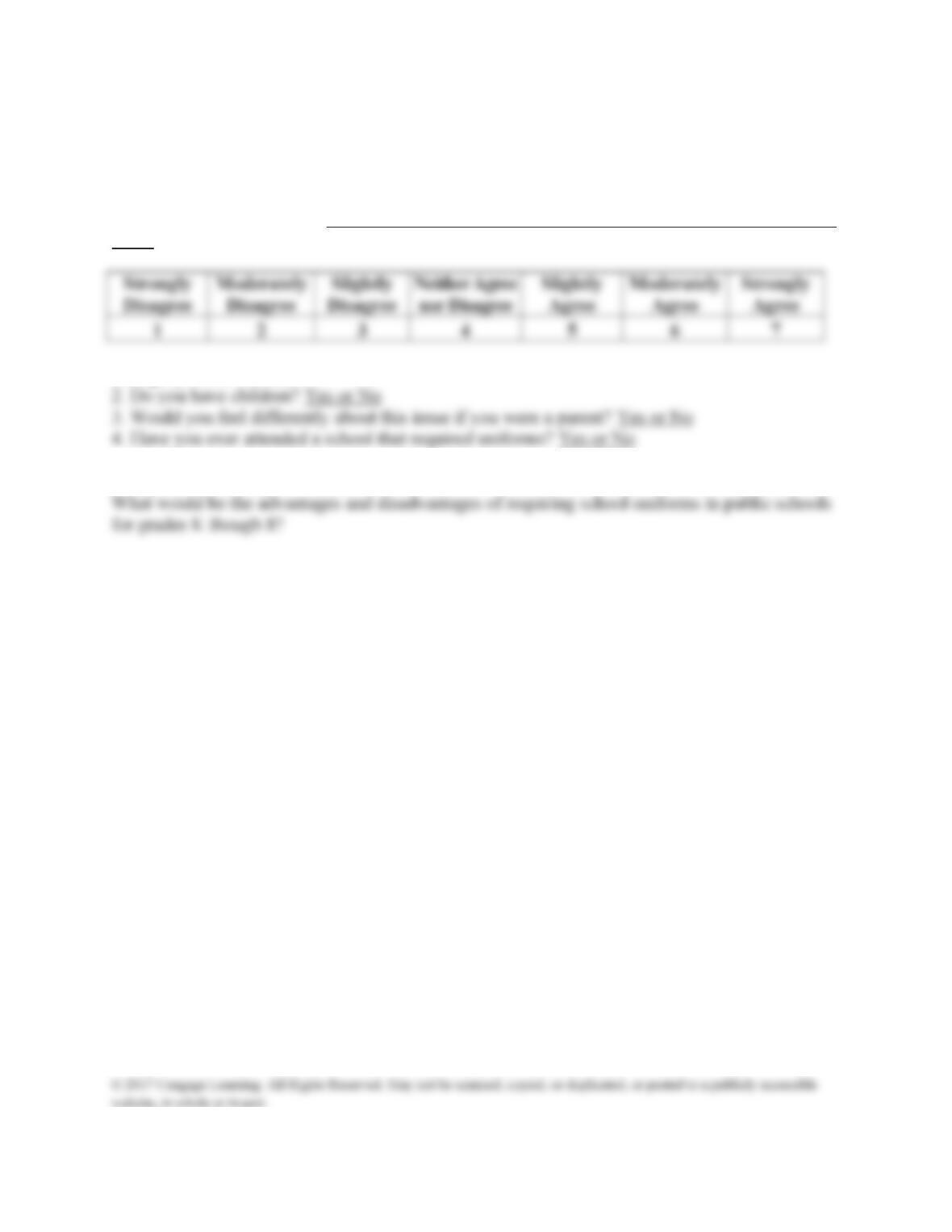
Post-Speech Audience Analysis
Speaker’s Name:
Instructions:
Put your name and proposition, exactly as it was phrased on the Pre-Speech Audience Analysis
Questionnaire, on this sheet and make _____ copies for your audience. Bring these to class with
you on the day of your final speech.
Speaker’s Proposition:
43
Short Speech Assignment Ideas
These short speech assignment ideas are easily adapted into in-class assignments or activities and
can be de-briefed to fit the learning objectives.
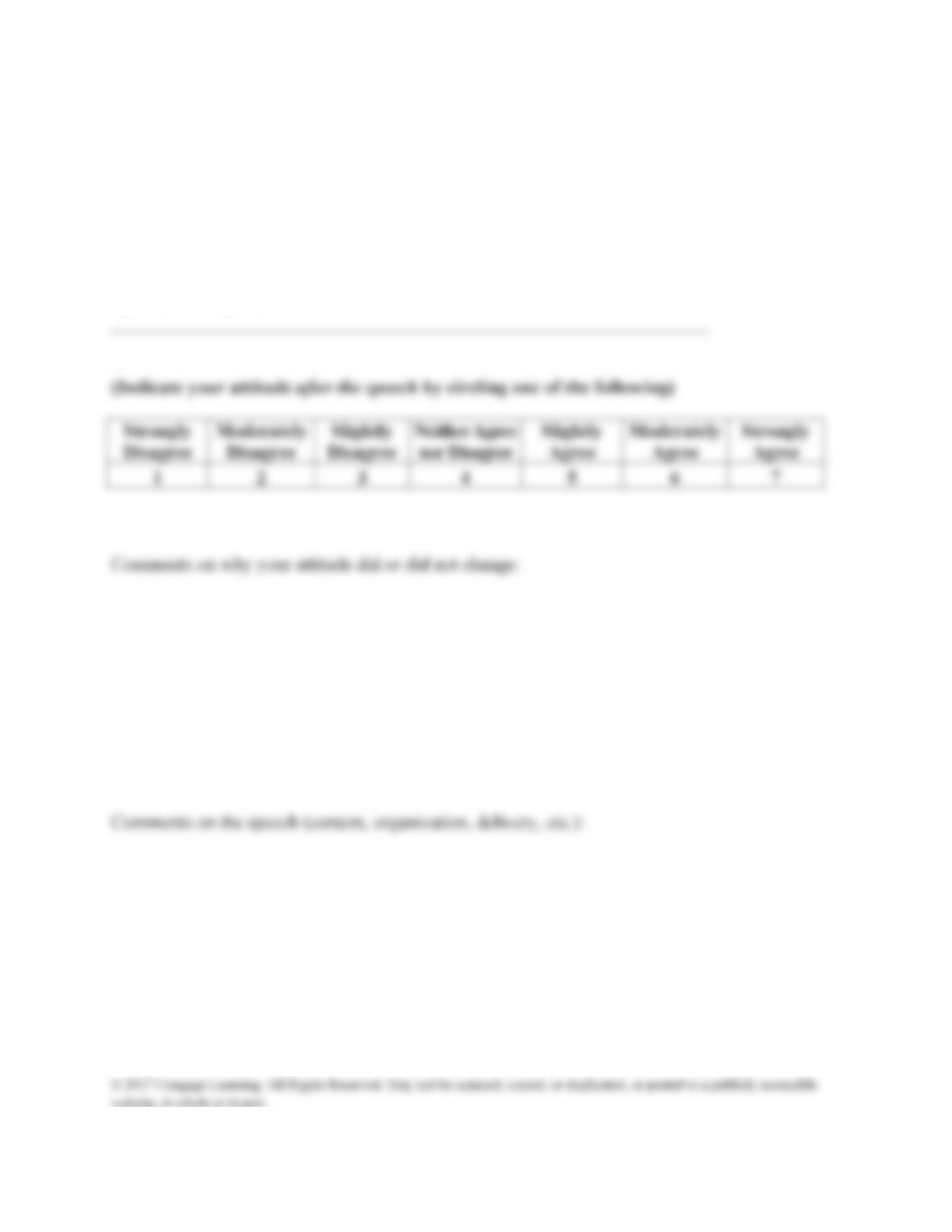
1. The Speech of Introduction
This popular assignment takes many forms. A student may introduce herself or himself,
2. The Personal Experience Speech
This speech is a good early assignment that introduces students to each other. The narrative
Variations:
The Culture Shock Speech. The student tells about an experience where he or she became
starkly aware of being in an unfamiliar cultural situation and discusses how communication

44
A Speech That Analyzes a Personal Decision. The student tells about a decision such as where
to go to college, what car to buy, what to major in, and discusses the process of the decision-
making. Who were the key sources consulted? How credible were they? How did logic and
emotion enter into the decision-making?
A Speech About a Person. The most unforgettable character the student ever met, the student
who has influenced you the most, the person admired the most, the favorite/least favorite teacher,
the most credible speaker you ever heard, the strongest leader you know, etc.
3. Television Advertisement Speech
Assigning this speech at the beginning of your discussion on persuasion helps students
4. The Group Speech
To ease speech anxiety and to emphasize the macrostructure of an organized speech some
instructors have students give their first speech in a group. Speaker One of the group presents the
45
5. The Demonstration Speech
This is a popular and effective assignment to use early in a course to break the ice and help
students learn about their classmates’ interests and talents; the heavy, intellectual topics can
Variations:
A Presentation Aid Speech Using Charts, Models, and So On. See 7, 26.
A Process Speech that requires explaining more complex and difficult material. Such topics
would be the process of photosynthesis, how an employee orientation program is established, or
how to analyze a poem.
Reminder: If you have not taught before, beware of the range of student creativity on this
6. The “What I Believe” Speech
This is another good first or second assignment. The goal is to communicate a belief and three
46
7. The Impromptu Speech
The instructor prepares a list of topics that are placed in a hat (envelope, bowl, whatever). Just as
it is his or her turn to speak each student draws three slips, selects one, returns the others and has
one minute to prepare a two- to three-minute speech.
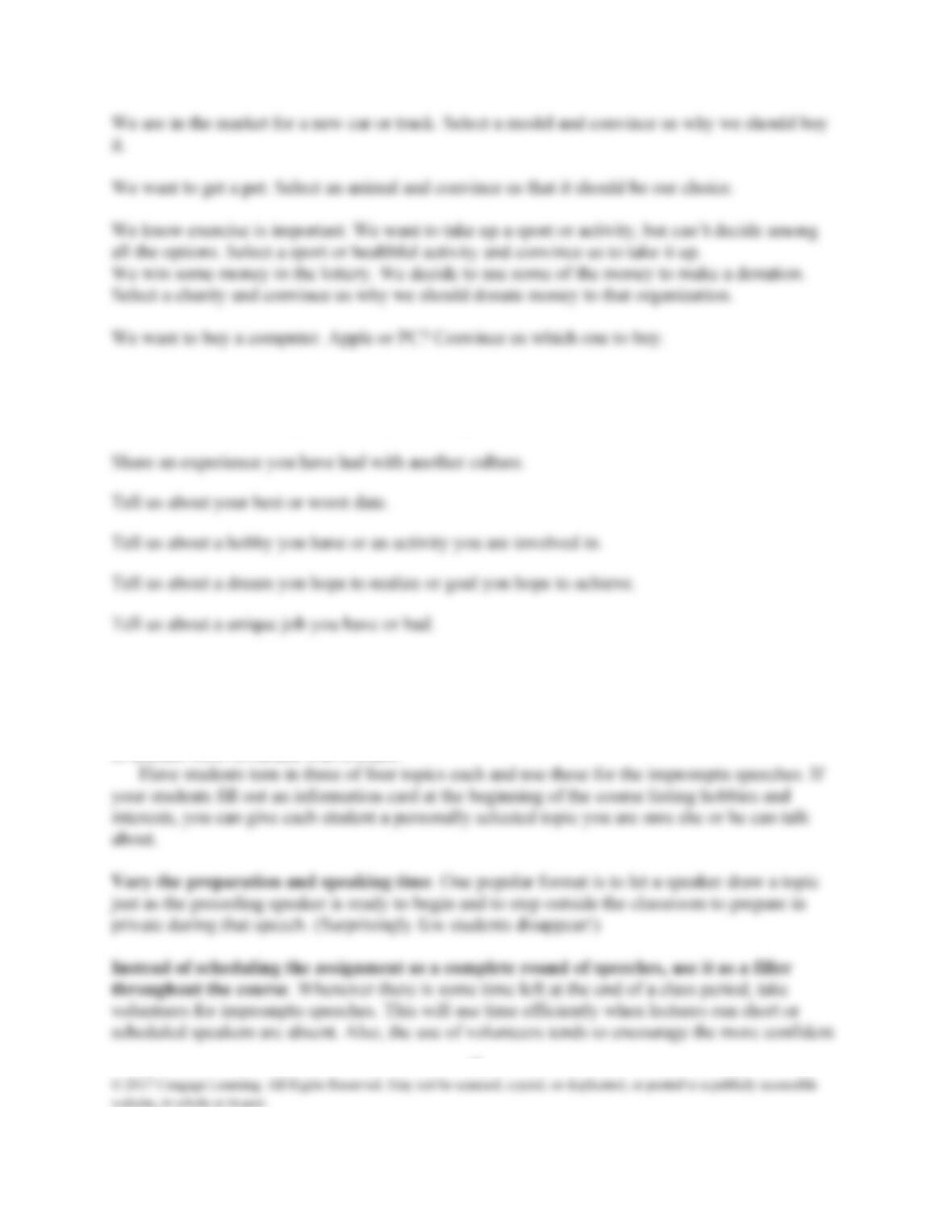
Here is a list of words that can be used for impromptu topics:
Persuasive Impromptu Topics:
Select something you have in your possession or on your person. Convince us why we need one
too.
47
Informative Impromptu Topics:
Tell us about a tradition you have in your family.
Variations:
Use proverbs, provocative questions or phrases as topics. One teacher brought a bag of
fortune cookies to her early morning class. Those who drew one of those inscrutable quotations
to discuss were rewarded with a snack.
48
8. The Rhetorical Analysis Speech
In this speech the student gives a speech about a speech, analyzing its effectiveness in terms of
rhetorical criteria. Speeches may be drawn from anthologies, Vital Speeches, or published
transcripts of current speeches. Require that a copy of the speech be turned in along with the
speech outline so that you can evaluate the student’s analysis. One format for a speech of this
type might be:
Introduction
Include a description of the occasion, setting, audience, speaker, etc.
I. Designate and justify what you think are the three most important criteria for speech
effectiveness.
II. Compare the speech to those criteria.
A. How the speech compares to the first criterion
Variations:
Cross-Cultural Speech Analysis. If you or your students were able to locate speeches by men
and women of various ethnic and cultural backgrounds, it would be very effective to use this
49
and supplemented in lecture or through additional readings such as those mentioned in Part I of
this instructor’s resource manual.
Combine the group speech and the rhetorical analysis speech. One group of students might
present a symposium/panel on a speech from American Rhetoric online speech bank
9. The Speech on an Abstract Concept
For this assignment the student is to select an abstract term or concept such as love, leadership,
Speech Outlines
You will notice that the treatment of organization in the Compact Handbook separates the
exploring and choosing of ideas from the preparation of the outline. In the former process, it
seems to be pedagogically sound to encourage experimentation and to discourage premature
moves toward locking into a set of main points and a specific phrasing. Students need to have
disposable drafts at this stage. The later process of refining a set of points into a final outline
requires quite a different set of skills and tools.
50
Those who prefer a more detailed outline argue that an instructor cannot really evaluate how
a student has put a speech together without a look at the substance of the speech. An outline that
contains more fully stated points and completely cited evidence is more like a legal brief. The
student is forced to lay out the points as they actually will be delivered. The issue of how to get
students to lay the outline aside and present the speech in an oral and conversational manner is a
different one altogether. It is secondary to the important skills of speech preparation, which are
developed through outlining.
lecture? Perhaps some humor can be shifted to the middle. Does a student support every main
point with a fact followed by a hypothetical example? Perhaps he or she can vary the forms of
support. An example of an annotated outline (Erian) can be found under Book Resources on the
Speaker’s Compact Handbook website.
Decide how you see the role of outlines in your class. Are they rough strategic plans for you
to respond to as you coach students before the speech? Or are they to serve as a reflection of the
final speech content? Clarifying these issues will help you decide when to collect outlines and
how to evaluate them. Some teachers have outlines due at least two class periods before the