Module 19 krugman 1
Module 19
Maximizing Utility
What’s New in the Fourth Edition?
• Updated business cases
• Updated Teaching Tips
• Handouts for in-class use
Module Objectives
• What factors determine how consumers spend their income?
• Why do economists use the concept of utility to describe people’s tastes?
• Why does the principle of diminishing marginal utility accurately describe consumer behavior?
• What is the optimum consumption bundle and why do we use marginal analysis to determine it?
Teaching Tips
Utility: Getting Satisfaction
Creating Student Interest
• Bring a supply of small treats to class (e.g., a box of “donut holes” works well in a morning class).
Ask for a volunteer who enjoys the treat you have brought. Tell them that you will give them the
treats in return for data you can use in the class. Give them a treat and let them eat it. Then ask the
student for your data—“How much did you like the donut hole?” The student will probably ask
you for more information, such as “compared with what?” or “on what scale?” Tell them that they
agreed to give you the data in return for the donut hole and press them to give you the answer.
After making the student squirm for a bit, explain that the satisfaction received from consuming a
good is measured in “utils,” or units of utility. Then ask the student “how many units of utility did
you receive from eating the donut hole?” Still, the student may not want to answer. Encourage
utility.
• If you don’t want to bring food to class, or if you have no volunteers for the exercise, talk about
what happens when you are really hungry and you order a pizza. Do you eat more than one slice?
Do you get the same satisfaction from each slice? Is it possible that the last slice actually gave you
negative satisfaction (after the fact)?
Presenting the Material
Module 19 krugman 2
• Use Handout 19-1 to introduce the calculation of marginal utility and to discuss diminishing
marginal utility.
• Students often are mystified by the whole concept of attaching a number to how much they like
something. Explain that the numbers are useful for explaining how consumers make decisions.
Budgets and Optimal Consumption
Creating Student Interest
• Ask students if they have a budget constraint. What determines their budget constraint? Does
everyone have a budget constraint? Is it possible to consume beyond your budget constraint? If so,
for how long? Students may say that credit cards or other sources of credit can allow them to
consume beyond their budget constraint. If that is the case, point out that this can’t go on forever
and ask them what it does to their budget constraint in the future if they run up their credit card
Spending the Marginal Dollar
Creating Student Interest
• Present the class with the following scenario: Each student has $10 to spend on either Oreos or
Chips Ahoy cookies. Ask them which they would buy and why. There will probably be a
discussion about the different characteristics of the cookies (the tastiness of the creamy center
filling versus the chocolate chips) and who likes which kind of cookie and why. If during the
Presenting the Material
• Return to the Handout 19-1 to see how marginal utility per dollar is calculated.
Module 19 krugman 3
From Utility to the Demand Curve
Creating Student Interest
• Ask students how they have responded to increases in the price of gasoline over the past few years.
Ask them how they would respond if the price of gasoline doubled over the next two years. What
alternatives do they have for buying gasoline? Could they change to zero consumption of gasoline
in the short run? In the long run? In the short run, when the price of gasoline increases, what
happens to the income they have to spend on other goods?
Presenting the Material
• Review the law of demand and the downward-sloping individual and market demand curves. The
law of diminishing marginal utility is behind the law of demand. Use the following examples:
o The substitution effect: The change in quantity consumed as the consumer substitutes the
relatively cheaper good for the more expensive good.
▪ As the price of gasoline rose from $1.50 to $2.00, the marginal utility per dollar of
a gallon of gasoline fell. Consumers could increase their utility by purchasing
fewer gallons.
o The income effect: The change in purchasing power due to the higher price of a good.
▪ College tuition has risen steadily over the past 10 years. The result is that tuition
• Use Handout 19-2 to discuss substitution and income effects.
Module Outline
I. Utility: Getting Satisfaction
A. Utility and consumption
1. The utility of a consumer is a measure of the satisfaction the consumer derives from
consumption of goods and services, or their consumption bundle.
2. An individual’s utility function gives the total utility generated by their consumption
bundle, measured in utils.
B. The principle of diminishing marginal utility
1. The principle of diminishing marginal utility says that each successive unit of a good
or service consumed adds less to total utility than the previous unit.
II. Budgets and Optimal Consumption
Module 19 krugman 4
A. Budget constraints and budget lines
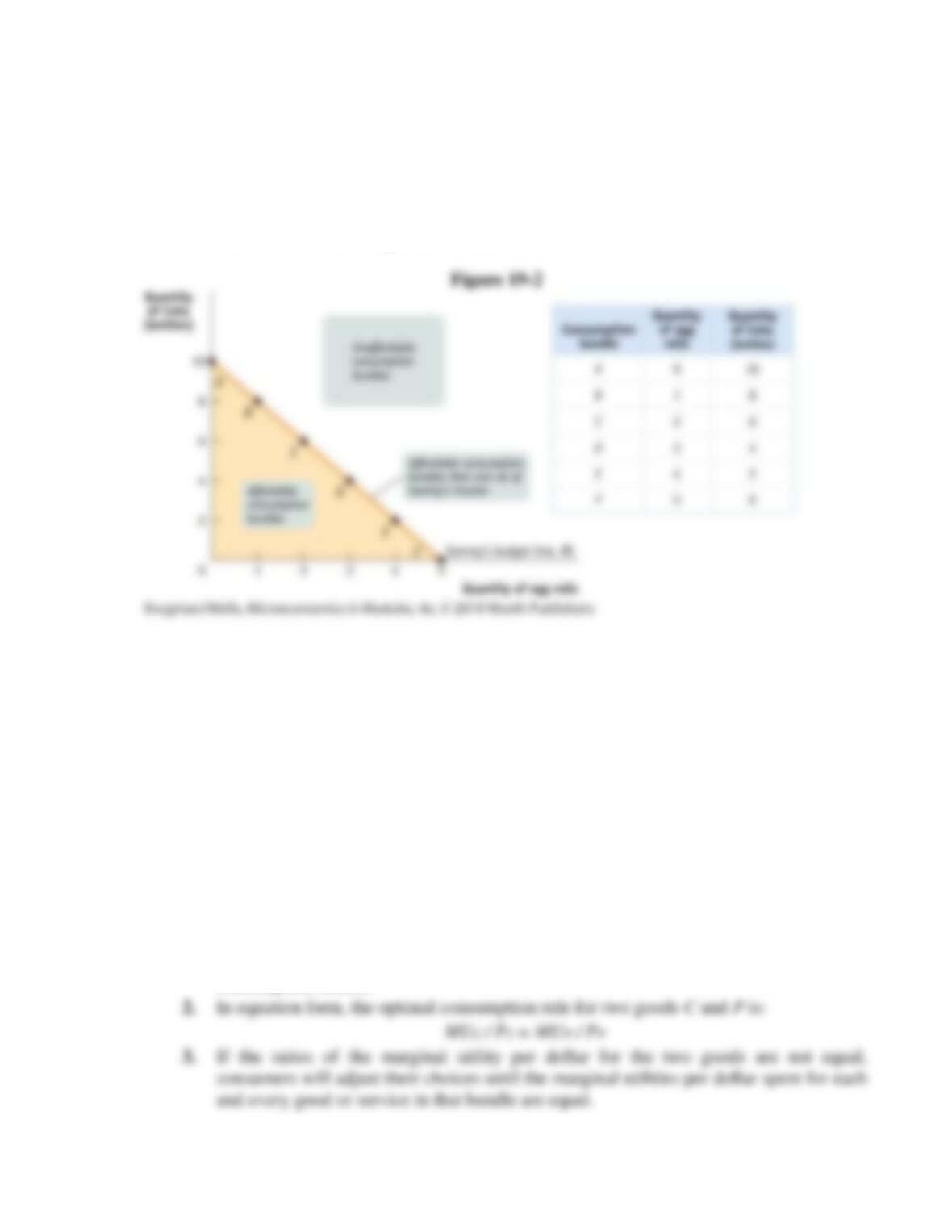
1. A consumer’s budget constraint defines the consumption possibilities for the consumer
and depends on the consumer’s income and the prices of the goods and services as
illustrated in Figure 10-2, shown next.
2. Every consumption bundle on or inside the budget line is affordable, whereas every
bundle outside the budget line is unaffordable.
B. Optimal consumption choice
1. An individual’s optimal consumption bundle is the one that maximizes total utility and
so puts the individual at the top of their total utility curve.
III. Spending the Marginal Dollar
A. Marginal utility per dollar
1. When deciding to purchase a good, a consumer weighs the additional utility to be
derived from the good against the additional cost (price) of the good.
2. MUc and MUp indicate the marginal utility of clams and potatoes, respectively.
3. The marginal utility per dollar of clams = MUc/Pc, and the marginal utility per dollar
of potatoes = MUp/Pp.
B. Optimal consumption
1. According to the utility-maximizing principle of marginal analysis, the marginal utility
per dollar spent must be the same for all goods and services in the optimal
consumption bundle.
Module 19 krugman 5
IV. From Utility to the Demand Curve
A. Marginal utility, the substitution effect, and the law of demand
1. If the price of a good rises (falls), the marginal utility per dollar of that good falls
(rises) and gives the consumer an incentive to consume fewer (more) units.
2. Point 1 confirms the law of demand: The individual’s demand curve, which relates an
individual’s consumption of a good to the price of that good, is normally downward
sloping.
3. When a good absorbs a small share of the consumer’s budget, the substitution effect is
essentially the entire reason that the demand curve slopes downward.
B. The income effect
1. For the great majority of goods and services, the income effect is not important and
has no significant effect on individual consumption because the good absorbs a small
share of a consumer’s budget.
2. When the income effect matters at all (when a good absorbs a large share of a
consumer’s budget), the income effect usually reinforces the substitution effect. When
Case Studies in the Text
Economics in Action
Lower Gasoline Prices and the Urge to Splurge—This EIA discusses gasoline prices and how the recent
lower prices increase consumer spending, using the income and substitution effects.
Ask students the following questions:
1. Gasoline prices fell in the 2014 to 2015 period. In what way did the income effect prevail?
2. How did the substitution effect play out when gasoline prices fell? (People bought not only
Web Resources

Module 19 krugman 6
Handout 19-1
Date_________ Name____________________________ Class________ Professor________________
Maximizing Utility
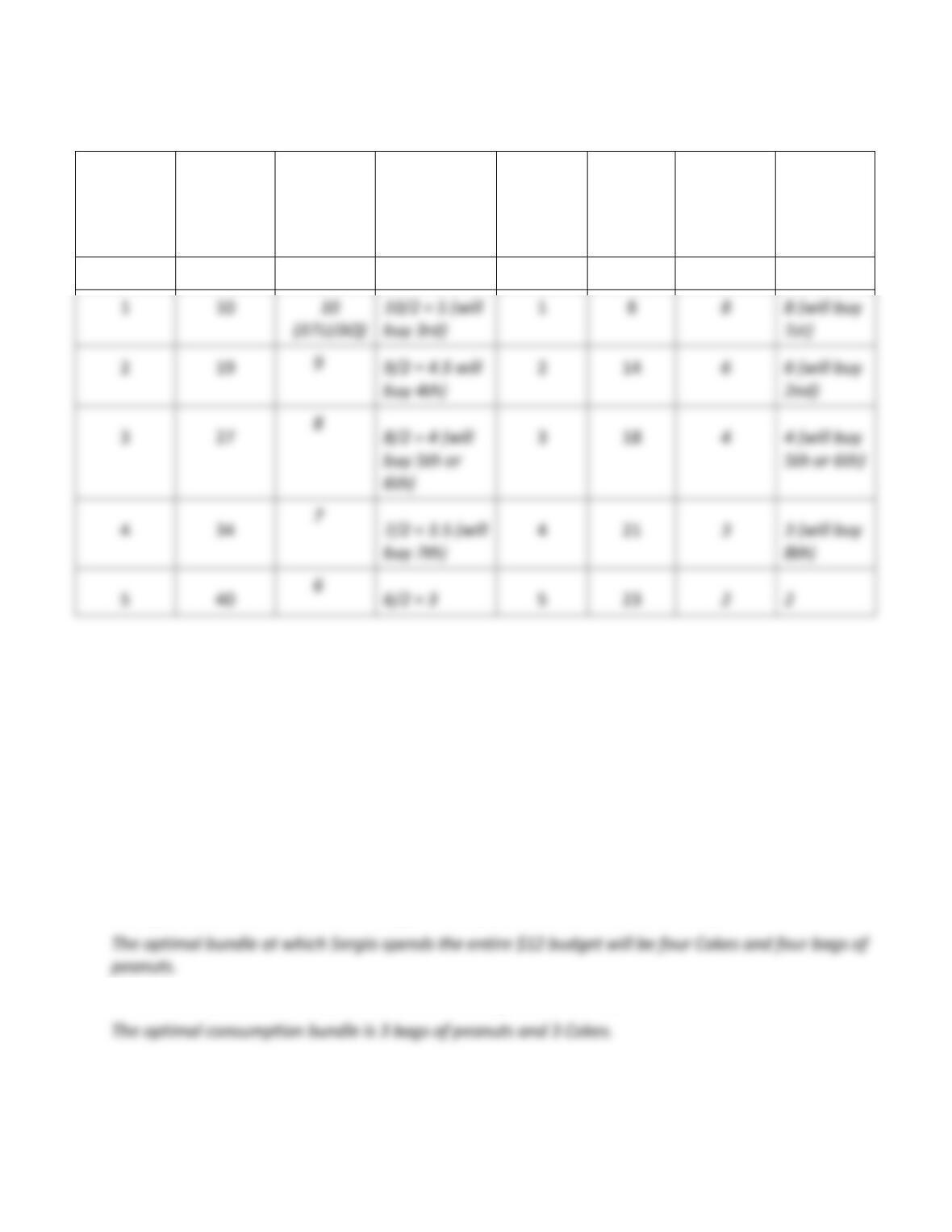
Use the following table to determine Sergio’s utility maximizing bundle of bags of peanuts and quantity
of Cokes. Sergio has a budget of $12. Follow the steps below.
(1)
Quantity
of bags of
peanuts
(2)
Total
utility
(3)
Marginal
utility
(4)
Marginal
utility per
dollar
(5)
Quantity
of Cokes
(6)
Total
utility
(7)
Marginal
utility
(8)
Marginal
utility per
dollar
0
0
—
—
0
0
—
—
1
10
1
8
2
19
2
14
3
27
3
18
4
34
4
21
5
40
5
23
1. Calculate the marginal utility (MU) of peanuts and the MU of Cokes. Record those numbers in
columns (3) and (6). What is happening to MU as the number of bags of peanuts consumed
increases?
2. Calculate the MU per dollar spent for each quantity of each good. Record those in columns (4) and
(7).
3. Now have Sergio choose among different combinations of bags of peanuts and Cokes. He has only
$12 to spend; the price of peanuts is $2, and the price of a Coke is $1. What is the optimal number
of bags of peanuts and Cokes that Sergio should purchase to maximize his utility?
4. What is the optimal consumption bundle when Sergio’s income is $9?
Module 19 krugman 7
Answers
(1)
Quantity
of bags of
peanuts
(2)
Total
utility
(3)
Marginal
utility
(4)
Marginal
utility per
dollar
(5)
Quantity
of Cokes
(6)
Total
utility
(7)
Marginal
utility
(8)
Marginal
utility per
dollar
0
0
—
—
0
0
—
—
1. Calculate the marginal utility (MU) of peanuts and the MU of Cokes. Record those numbers in
columns (3) and (6). What is happening to MU as the number of bags of peanuts consumed
increases?
See table above.
2. Calculate the MU per dollar spent for each quantity of each good. Record those in columns (4) and
(7).
See table above.
3. Now have Sergio choose among different combinations of bags of peanuts and Cokes. He has only
$12 to spend; the price of peanuts is $2, and the price of a Coke is $1. What is the optimal number
of bags of peanuts and Cokes that Sergio should purchase to maximize his utility?
4. What is the optimal consumption bundle when Sergio’s income is $9?
5
5

Module 19 krugman 8
Handout 19-2
Date_________ Name____________________________ Class________ Professor________________
Substitution and Income Effects
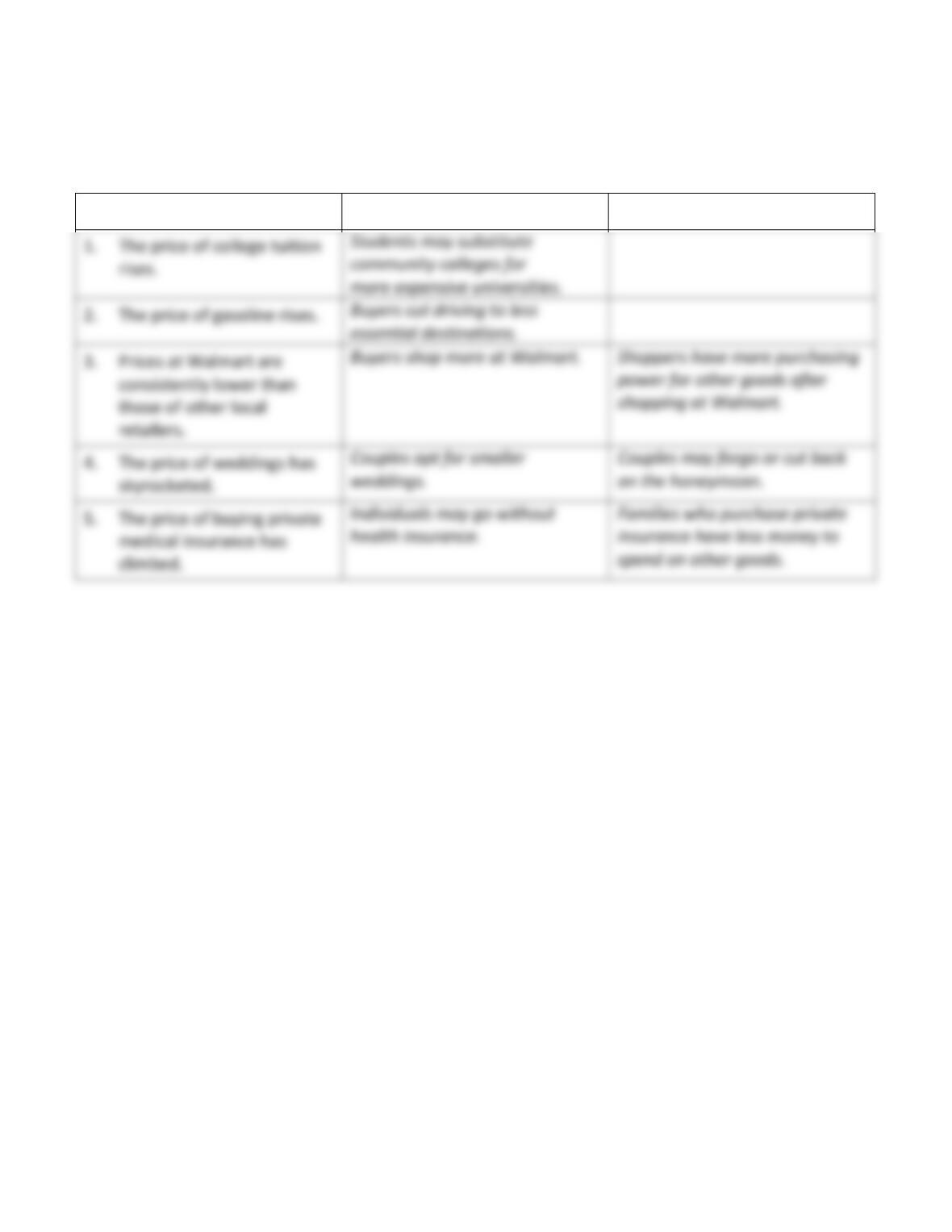
Describe the substitution effect and (if it is significant) the income effect of the following cases.
Situation
Substitution effect
Income effect
1. The price of college tuition
rises.
2. The price of gasoline rises.
3. Prices at Walmart are
consistently lower than
those of other local
retailers.
4. The price of weddings has
skyrocketed.
5. The price of buying private
medical insurance has
climbed.
Module 19 krugman 9
Answers
Describe the substitution effect and (if it is significant) the income effect of the following cases.
Situation
Substitution effect
Income effect