Constructing a Good Syllabus and Sample Syllabi
Constructing a Good Syllabus
and Sample Syllabi for Teaching
Public Speaking
Preview
In this section we provide three sample syllabi, including ones for
an honors section and one for a service-learning approach. First,
though, we review some basics about the syllabus and its construction.
Constructing a syllabus: Zooming in on the goals
The syllabus, when carefully constructed, facilitates up-front planning. Among other things, it helps the
instructor gain a better grasp of goals. As noted in part three below, we can use instructional goals to
determine lessons and their order, assignments along the way, and a final project that demands and
displays cumulative learning/development.
Once you’ve determined goals and lessons targeted towards the goals, draw up a calendar of available
days for teaching (some are taken away by holidays, etc.) and see how lessons and days reserved for
presentations fit into the calendar. If you run out of days, simplify! Simplification involves abbreviating
For more about the syllabus and its importance, see Wulff, D.H. & Nyquist, J.D. (1990). Instructional
tools. In J.A. Daly, G.W. Friedrich, and A.L. Vangelisti (Eds.), Teaching communication: Theory,
research, and methods (pp. 249–265). Hillsdale, NJ: Lawrence Erlbaum Associates, Inc.
Other aspects of the syllabus (while we’re on the subject)
In addition to using your goals to plan and list course objectives and to spell out how you will judge
performance, you will need to contemplate and include other elements on your syllabus. Many schools
“assist” by specifying what must appear on a syllabus. These guidelines likely include some version of the
following elements (not necessarily in this order):
(a.) The official title of the course along with its class code
(b.) The room where class will convene and the times for meeting
(c.) Instructor’s name, office location, office hours, phone, e-mail address, and so on
(d.) A statement of goals for the course (often in the form of Student Learning Outcomes)
(e.) A list of required text(s) and supplies (such as an SDHC card, note cards, etc.)
Constructing a Good Syllabus and Sample Syllabi
Segue
Now that we’ve reviewed some basic pointers, let’s examine several sample
syllabi. Use these sample syllabi for ideas and inspiration as you devise your
own.
The first is from me (Glen Williams), for my students in public speaking at
Southeast Missouri State University.
SC 105-01H (3 hrs.) Fundamentals of Oral Communication M-W-F: 8:00 a.m.
Spring 2016 Prof: Glen Williams AC 206
Course objective: To introduce students to the principles & theories of effective public
communication and nurture students’ abilities as speakers, listeners, researchers, & critical thinkers.
Student Learning Outcomes: SC 105 concentrates on five principal learning outcomes.
SLO 1: Relying upon the skills inherent to information literacy, the student will locate and gather credible information
utilizing the latest technology (such as library subscription databases and advanced searches of the Internet) as well as
traditional sources (such as interviews).
SLO 2: As a part of communicating effectively, the student will structure a speech with a well-stated thesis statement,
Text: J. Michael Hogan, Patricia Andrews, James Andrews, & Glen Williams, Public Speaking and
Civic Engagement, 4e. Boston: Pearson, 2017. [Note: You may opt for the e-book version.]
Assignments, exams, & total points possible: (Please keep up with your own grade.)
Written assignments Your scores
2) Speech II: Quick Introduction II 10 pts. 4 % ________
4) Proposal & Annotated Bibliography I 5 pts. 2 % ________
6) Proposal & Annotated Bibliography II 5 pts. 2 % ________
8) Computer-generated Visual Aid 10 pts. 4 % ________
10) Self-critique 5 pts. 2 % ________
Three Quizzes & A Final
Quiz I 15 pts. 6% ________
Quiz II 15 pts. 6% ________
Quiz III 15 pts. 6% ________
Final exam [cumulative written; group speech]: 10 pts. 4% ________
Total pts. poss. 250 pts. Your total = ________
Final grades will be calculated as follows:
Constructing a Good Syllabus and Sample Syllabi
Instructor information:
Office: AC 213a; Office phone (651–2247)*; Email: gwilliams@semo.edu (No attachments!)
Office hours: ______________________________________ Mailbox: AC 213: hand to staff.
Web: via Moodle Note: Also link to online exercises/resources.
The best way to contact me is by e-mail. I check it during regular office hours and frequently throughout
the day. I am generally “plugged in”/available from 8:00 a.m.–5:00 p.m. on weekdays.
_____________________
*The University discourages faculty from returning long-distance calls, due to the expense. Please use e-
mail. Note: “Local” calls have a 573 prefix.
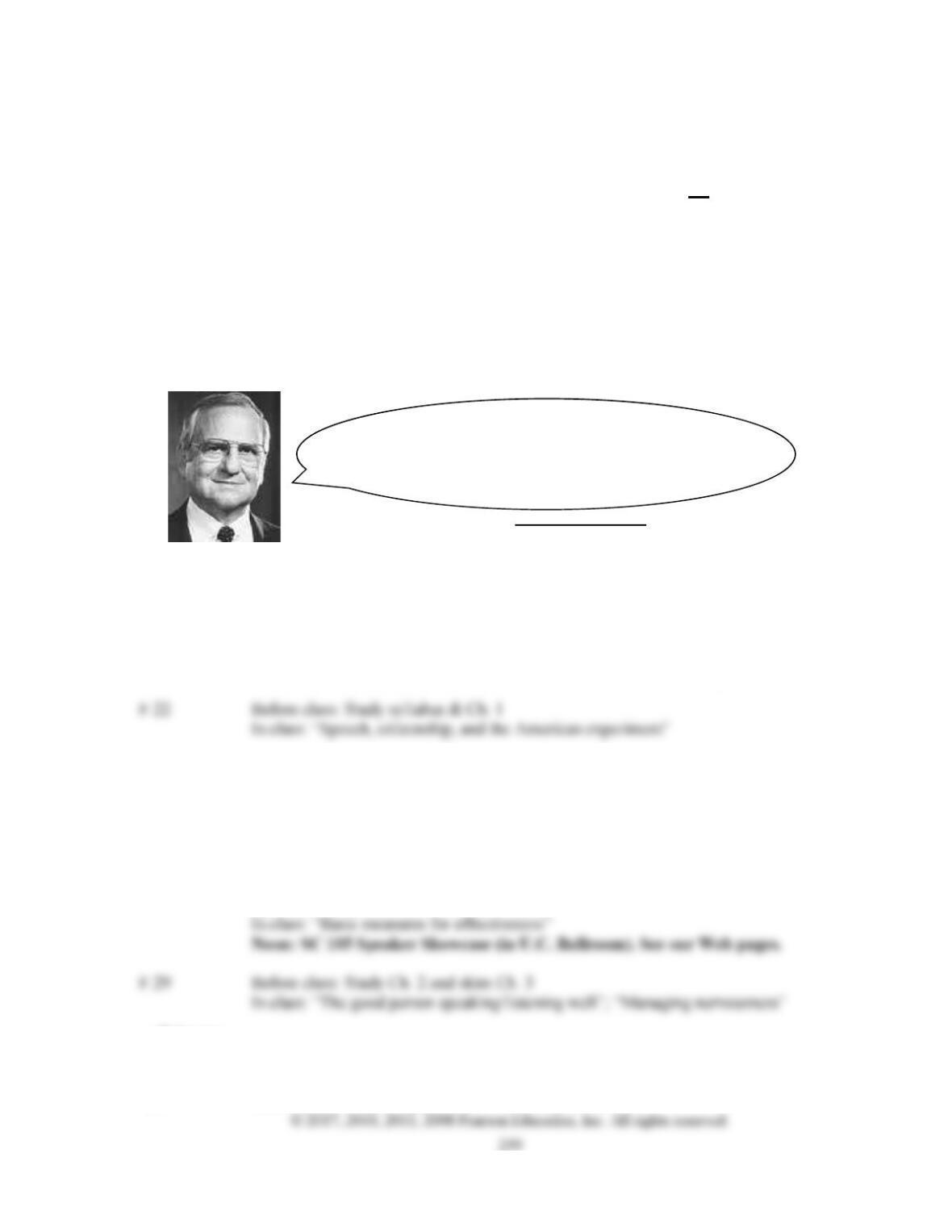
“You can have brilliant ideas,
but if you can’t get them across,
your brains won’t get you[/us ] anywhere.”
—Lee Iacocca, An Autobiography (New York: Bantam, 1984).
Daily schedule for SC 105 [including due dates for assignments]:
—January—
W 20 Before class: Download & read syllabus (via Moodle). Save, bookmark, or print.
In class: Introduction to the course, evaluation forms, classmates, & professor
M 25 Before class: Read Ch. 16: Intro, Ceremonial Speaking in a Free Society, and Social
Values in Ceremonial Speaking (pp. 326–33), “Tributes” (pp. 337–39), and “Assignment
One,” on syllabus (p. 8).
In class: “Tributes & other important occasions”; “Contemplating our first speech”
W 27 Before class: Ch. 9 as well as “Give your message structure” (Ch. 2, pp. 43–44), “Thesis”
(Ch. 5, pp. 100–03), “Sound organization” (Ch. 8, pp. 152–54), & “Transitions” (Ch. 8,
pp. 161–63).
— February —
M 1 Activity: Hold onto your hats! More fun than rollerbladin’ on ice! [impromptus]
W 3 Before class: Prepare Speech One; rehearse presentation
In class: Due: Formal Outline of Speech I plus evaluation form;
Presentations begin. Bring SD memory card!*
F 5 Presentations continued. Bring SD Card!
M 8 Presentations conclude. Bring SD Card !
W 10 Presentations conclude. Bring SD Card !
In class: “Providing adequate development in your speeches”
W 24 Special class: Meet in Kent Library’s Little Theatre (down hall from lobby)
>>>> Kent! Note: Access the form, SC 105: Finding Credible Information and complete item one.
(See our class Web pages for the link.)
F 26 Before class: Study Ch. 8 & Ch. 9
W 9 Prepare for Quiz II
In class: Quiz II (Ch. 4, 5, 6, 7, 8, 9 & 13, plus notes, esp. re: library exercise)
__________________________________
*You will need an SD (or SDHC) memory card, with a minimum capacity of 2 GB. You may share a card.
You may opt to record your speech via your cell phone, if you prefer.
Constructing a Good Syllabus and Sample Syllabi
F 25 No class: “Designated holiday.” A time for special reflection and celebration.
M 28 Before class: Refine & Practice Speech III: Speech to Inform
In class: Due: Formal Outline of Speech III plus evaluation form.
Presentations begin. Bring SD memory card (or cell phone)
W 30 Presentations continued. Bring SD card.
— April —
F 1 Presentations, continued. Bring SD card.
M 4 Presentations, continued. Bring SD card.
W 6 Presentations, continued. Bring SD card.
F 15 Before class: Review for Quiz III
In class: Quiz III (Ch. 10, 11, 12, 14, and 15, plus notes).
M 18 Before class: Finish Speech IV: Speech to Convince/Actuate
In class: Due: Formal Outline of Speech IV plus evaluation form;
Presentations begin. Bring SD memory card.
W 20 Presentations, continued. Bring SD card. [Note: Tomorrow is the last day to drop.]
In class (in Kent Library): Work with your group on your final exam, a mini symposium.
F 6 Before class: Review notes from our previous meeting.
In class (in Kent Library): Work with your group on your final exam, a mini symposium.
Final exam period: 8:00 a.m. on Monday, May 9, 2015
Note:I reserve the right to adjust the calendar and/or assignments/quizzes, if necessary.
A quick note about grades:
The university designates that average (i.e., “okay”) work merits a “C”—a good grade.
Work (speeches, papers, etc.) that is not “okay,” in any way, will earn less than a “C.”
Policies for the Course: (It is your responsibility to know & abide by these! )
Students will be expected to abide by the University academic honesty policies.
http://www.semo.edu/facultysenate/handbook/5d.html
Students will be expected to abide by University civility policies.
http://www.semo.edu/pdf/Conduct_Faculty_Resource_Guide.pdf
I will uphold University policies regarding Civil Climate; Academic Dishonesty; Attendance; Incompletes;
Withdrawal, Disruptive Behavior, etc. We will handle any issues or problems on a case-by-case basis,
documenting everything in writing. Consult the Undergraduate Bulletin for more information.
Attendance: Because of the experiential learning involved in both delivering and critiquing speeches,
attendance is mandatory. At the same time, I recognize that events may arise that necessitate your
absence, for example, you might be ill or need to tend to a sick child; you might need to attend a
If you miss on a date you are scheduled to speak, you will have to appeal for an excused absence in
order to make up the presentation. In making your case, please provide relevant documentation that will
Arriving on time to class also is important: tardiness is disruptive.
Assignments: In addition to complying with all assignment guidelines & specifications:
1) Students must complete all assignments in order to obtain credit for the course.
3) Submit by date due. Late submissions will result in a 10% grade reduction per 24 hrs. late, or fraction
4) Unless indicated otherwise, type (double-spaced) all assignments. Any work not typed will be returned
to be typed and will incur the usual late penalty.
5) When an assignment has been returned, carefully review and reflect upon all comments for 24 hrs.
7) No quizzes may be made up, unless your absence qualifies as excused (see “attendance,” above).
8) All quizzes must remain under my supervision. Any student who leaves the classroom with a quiz or
9) Due to our tight time parameter, speeches must be presented on the date scheduled. Only an excused
absence (see “attendance,” above) will permit a rescheduled presentation. In order to minimize
disruption of the class, the student should contact the instructor prior to missing the scheduled
10) In order to demonstrate thoughtful preparation and the ability to operate within constraints, students
must confine their speeches to the prescribed time limits. Students who fall below or exceed the target
11) No animals are allowed in the classroom/building other than those that are recognized and approved by
the university as your “service animal.” Hence, no “living” visual aids.
Students with special needs:
If a student has a special need addressed by the Americans with Disabilities Act (ADA) and requires
materials in an alternative format, please notify the instructor at the beginning of the course.
Constructing a Good Syllabus and Sample Syllabi
Final grades: Online reporting allows you to access your final, overall course grade immediately after I
have calculated/reported it. Note: Use the table on page one to keep up with your own grade.
Policy regarding food and drink in the classroom. Bottled water is permissible. All other beverages
(e.g., coffee) must be consumed from a spill-proof container. Soda bottles are not considered spill-proof
containers, nor are cups with flimsy plastic lids. Food is not allowed in the classroom but may be consumed
General expectations for performance in the course:
1) This course will require a lot of writing. The emphasis will be on quality, not quantity. Although an
assignment may not require a lot of pages, it will require a lot of thought and careful attention to how it is
written—including clarity, coherence of thought, structure, style, and so on.
Supplies needed for the course:
You will need an SD (or SDHC) memory card with a minimum capacity of 2 GB. You will bring the card
with you on the days you are scheduled to present your speeches, so that we can record your presentation.
You will use the video recording to review and critique your own delivery, one of the written assignments
in the course. SD (or SDHC) cards are widely available for around $10 for a 2 GB card. An adapter for your
computer’s USB port is around $5 at Target and other retailers. Note: Feel free to share an SDHC card.
Note: You may opt to record your presentations via your smartphone. If so, you’ll recruit an “assistant.”
Descriptions of assignments: It is your responsibility to follow all directions.
The descriptions are meant to clarify and assist. If you have any questions, please ask.
Constructing a Good Syllabus and Sample Syllabi
One: Speech I: Quick Introduction/Tribute (See Tributes, pp. 402–403 in the text)
Craft a speech that introduces us to one of the most impressive individuals you have known—someone
who has had an impact on you and the community through his or her example/actions. Your mission is to
help us see what is “impressive” about her or him, as is done in the sample speeches posted on my Web
pages. (Note: We’ll use the form on the last page of the syllabus, in class, to sketch out speech ideas.)
To write the speech, contemplate what is particularly “impressive” about the person. Then, on that
After you’ve got a complete draft, look back over everything and rework it until it’s all working
together and is smooth. Lay it aside for a day or so and come back to it to give it another going over. Read
it aloud, as you do. Lay it aside again and come back to it again. After a few revision sessions you should
be in pretty good shape.
To facilitate revision, copy and paste your thesis and points onto a separate page, so to bring them
into full view. I refer to this “tool” as a “skeleton.” (See the sample skeleton on p. 10, below).
Two: Speech II ( An analysis/revision of Speech I, plus abbreviated presentation ) :
This assignment consists of three parts: analysis, revision, and an abbreviated presentation.
1) Analyze what you did well in your first speech and what you could improve upon. Draft written
reflections upon my feedback, as well as your own thoughts. List concise entries, such as:
2) Revise your formal outline, correcting whatever is amiss and otherwise improving upon it.
3) You will present your revised introduction. Be certain to capture our attention, introduce
your thesis, and preview your points/areas. Be animated and don’t read!
Note: Submit your analysis and your revision with your graded/returned speech attached on top of it,
clearly labeled with your name. Be sure to include the evaluation form/my comments.
Three: Information Literacy Exercise:
We will discuss the particulars. You will use an online form which we’ll access the day of instruction.
Be sure to have a topic/focus in mind when you arrive that day, so you can work on your actual speech!
Four: Proposal & Annotated Bibliography I ( for Speech III ):
You’ve done some “recon.” The proposal will help you zero in on a suitable topic for your first
To find the ideal topic, consider the following:
1) (Target time: Six minutes). Your goal is to provide for your audience information that they need or
desire. Your purpose is to explain some concept, thing, operation, historical process, etc. The information
presented should not be disputed or controversial. If you do touch on controversial matters, you should
2) Consider: What should be of interest to our group that has a bearing on our (and our loved ones’)
lives? Keep in mind “who” we are—thoughtful, hardworking, ambitious types who are/will be pursuing
3) What is workable in terms of research? What is workable in terms of time allotted for presentation?
Format for the proposal:
Download & complete the topic proposal form posted on our Web pages. Attach an annotated bibliography
of three, high quality sources. (Impress me!) Be sure to place your name atop the bibliography. Indicate
which style guide you are using, such as APA or MLA or Chicago style.
For your reference, here is a sample entry for an annotated bibliography. Note that you are to
describe the contents of the source and how it contributes to your speech. Also note that only one of
Constructing a Good Syllabus and Sample Syllabi
your sources may be Web page material; the rest have to be from reputable publications.
Sample annotated entry: (formatted with APA style)
Williams, I. (1998, Sept. 7). Terrorism and retaliation. Nation, 267, 5.
This article examines factors leaders have considered when determining whether to
retaliate against an act of terrorism.
I will use this article to explain the circumstances considered in the aftermath
of the two embassy bombings during the Clinton administration.
Five: Speech III: The Speech to Inform: You = The Good Citizen, Informing Others
While discussing the proposal, I’ve acquainted you with the general aspects of this speech. Now let’s turn
to some specifics (which are also entered on the speech’s evaluation form that you will use).
Once you’ve hit upon the ideal topic, fashion a tentative thesis to guide your exploration (or fashion
the points first, as you explore, if that works better and then see what thesis they suggest). Continue
Include only the best informational materials. Use whatever is best-suited for explaining and
illustrating (e.g., statistics, examples, testimony, comparison). Use a combination of materials. Be sure to
disclose all sources of information. To do so well, see “Citing Sources During Your Presentation” (pp.
(continued on next page)
Provide the skeleton of your speech above your outline—the actual thesis and points of your speech.
(See the sample skeleton below.) The skeleton will assist you and it’ll help me, too.
Target time: Six minutes. Hence, this is to be a high quality briefing about your topic. Concentrate on
being highly informative, yet concise. You’ll want to get our attention from the “get go,” letting us know
Constructing a Good Syllabus and Sample Syllabi
Sample skeleton of a speech:
Thesis: Solar panels have come a long way in recent years.
I. There are a number of advances in their design.
II. They have grown increasingly efficient.
Six: Proposal & Annotated Bibliography II
You’ve already done this for an informative speech. Now propose a speech topic and conduct some
preliminary research for a speech in which you’ll attempt to have us adopt a certain perspective or position,
and/or do something specific with regard to a particular public controversy (see the assignment description,
below).
Seven: Speech IV: Speech to Convince/Actuate: You = The Good Citizen, Influencing Others
You’ve already conducted some initial research for your proposal & annotated bibliography. As a result of
that activity, you now have a better grasp of how we should regard and respond to that public controversy.
You will advocate that we adopt your perspective and/or take certain action(s) by sharing your findings
with us and structuring them into a compelling case.
Keep in mind that the purpose of this speech is to defend a specific position in a controversy. The
central materials of this speech will be arguments calculated to convince the audience to believe in alleged
facts, to embrace disputed judgments, or to support or oppose a proposed policy. The objectives of this
You know to draw upon a variety of high quality supporting materials, cite your sources well during the
presentation (see pp. 151–153 in the text), and provide your list of references at the end of your formal
outline (minimum of five sources, with no more than two from public Web page material—with each Web
source justified.) Indicate the style guide you have used for your bibliography (e.g., APA, MLA, or
Chicago).
You know to involve us from the start, keep us involved throughout, and firm up—even more—that
connection as you conclude. Employ an effective organizational strategy.
Constructing a Good Syllabus and Sample Syllabi
The target time for this full-blown speech (i.e., complete with introduction, body, transitions, and
Eight: Visual Aid
As discussed in Chapter 12, visual aids can help simplify and amplify information. They can also be very
motivational. Naturally, then, we should experience a few of these ourselves during our presentations.
Hence, I will require you to devise at least one for Speech IV, and I’ll evaluate its use and design in terms
of what we’ve covered.
Nine: Reaction Paper
You have two options: 1) Respond to what you experienced at the Speaker Showcase (based upon the notes
you took there) or 2) Analyze a specific persuasive speech I assign, answering a particular set of questions. If
Ten: Self-Critique
We will video-record (at minimum) your last two speeches, recognizing that the visual record may prove
more instructive than anything I could write in an evaluation or discuss with you in a conference. The old
sayings that “seeing is believing” and “a picture is worth a thousand words” hold true with regard to speech
instruction—and it’s what professional speech consultants utilize!