
143
Chapter 9: Managing Conflict in Relationships
Key Concepts
bracketing
contracting
exit response
games
grace
interpersonal conflict
kitchen-sinking
lose-lose
loyalty response
neglect response
passive aggression
voice response
win-lose
win-win
Chapter Outline
I. Conflict exists when individuals – –
views, interests, or goals and feel a need to resolve those differences.
A. Conflict is an expressed disagreement, struggle, or discord.
B. All parties involved in the conflict must depend upon each other.
C. There is a felt need for resolution.
II. There are basic principles of conflict.
A. Conflict is natural in most Western relationships.
B. Conflict may be open, explicit, or overt, or it may be hidden, implicit, or covert.
1. Passive aggression, a common form of covert conflict, occurs when
C. Social influences (cultural background, social communities, gender,
race/ethnicity, and sexual orientation) affect our orientation toward and responses
to conflict.
D. Conflict can be managed well or poorly. How conflicts are managed directly
III. There are three basic orientations people have toward conflict.
A. lose-lose approach assumes that expressing conflict is unhealthy for everyone
involved in the relationship.
IV. Most people have relatively consistent patterns they employ to respond to conflict.
A. We use exit responses when we leave the relationship, either physically or
psychologically.
B. We use neglect responses when we minimize or deny the conflict exists.
V. The communication pattern we choose during conflict can help or hinder the relationship.
A. Unproductive communication damages efforts to resolve the conflict, harms
individuals, and jeopardizes relational health.
1. Early in the process, we use communication that disconfirms the other
person.
B. Constructive communication is open, nonjudgmental, confirming, and non–
strategic.
1. In the early stages, people confirm each other by recognizing and
oncerns and feelings; when the conflict
145
2. In the middle stages, everyone focuses on the specific issues at hand and
3. In the later stages, both partners engage in contracting, or working to take
VI. There are several skills that are essential for effective conflict management, including
attending to the relationship level of meaning; communicating supportively; listening
mindfully; taking responsibility for your thoughts, feelings, and issues; checking
VII. Conflict management skills
A. Attend to the relationship level of the meaning. We need to focus on the entire
system in which communication occurs rather than just on the conflict or
disagreement.
B. Communicate supportively. Monitor your communication. If we care about the
other person and our relationship, we should aim for a win-win approach.
C. Listen mindfully.
VIII. Guidelines for effective communication during conflict.
A. Focus on the Overall communication system
B. Time conflict purposefully
C. Aim for win-win conflict
D. Honor yourself, your partner, and the relationship.
E. Consider whether it is appropriate to put aside our own needs, or show grace,
when there is no rule or standard that says we should or must grant the other
compassion.
146
Discussion Ideas
Understanding the difference between conflict and disagreement: Ask students to
generate a list of times they believe they have engaged in conflict within the last two weeks.
Improving Conflict Communication: Ask students for examples of each of the five
guidelines for improving conflict communication. Ask students to discuss whether they
believe those guidelines are important or not. In addition, ask students if they believe there
are any other guidelines that they would add or if there are any guidelines that they would
delete and why.
Examining realistic and unrealistic conflict: Choose two television clips or episodes, one
that illustrates constructive ways of dealing with conflict and one that illustrates destructive
Generating different responses to conflict: For each of the scenarios presented, ask
students to write a response that reflects each of the possible response types (exit, voice,
loyalty, and neglect). After they generate their response, you can have a discussion on what
aspects of the various responses indicate a supportive or defensive communication climate.
Possible student responses are placed in parentheses after the first four scenarios to illustrate
exit, voice, loyalty, and neglect responses to conflict).
ked
about commitment. You feel unready to discuss a serious relationship, but your
partner insists that she/he thinks the two of you need to talk about it. (An exit
147
You and your friend generally get together to watch the playoffs at his apartment.
This year, your friend suggests that the two of you go downtown to one of the
Identifying orientations to conflict: For each of the statements listed below, indicate which
orientation to conflict it most clearly reflects (win-lose, lose-lose, win-win). Answers are
included in parentheses after each statement.
olution to this problem. (Win-lose)
(Lose-lose)
We are never going to see eye to eye on this. I think my preference should prevail.
(Win-lose)
I think if we keep talking, we will figure out something that both of us can live
with. (Win-win)
-lose)
Divorce help online: The internet provides a wealth of resources made available to anyone with
internet access. One such resource is a web site that teaches people how to deal with reducing
conflict during a divorce. Visit Divorce Helpline (http://www.divorcehelp.com/) which is a site that
provides ways to stay out of court, reduce conflict, and negotiate agreements when marriages end.
148
Activities
Title Individual Partner/
Ethno
Group Demonstration/
Whole Class
Internet/
InfoTrac
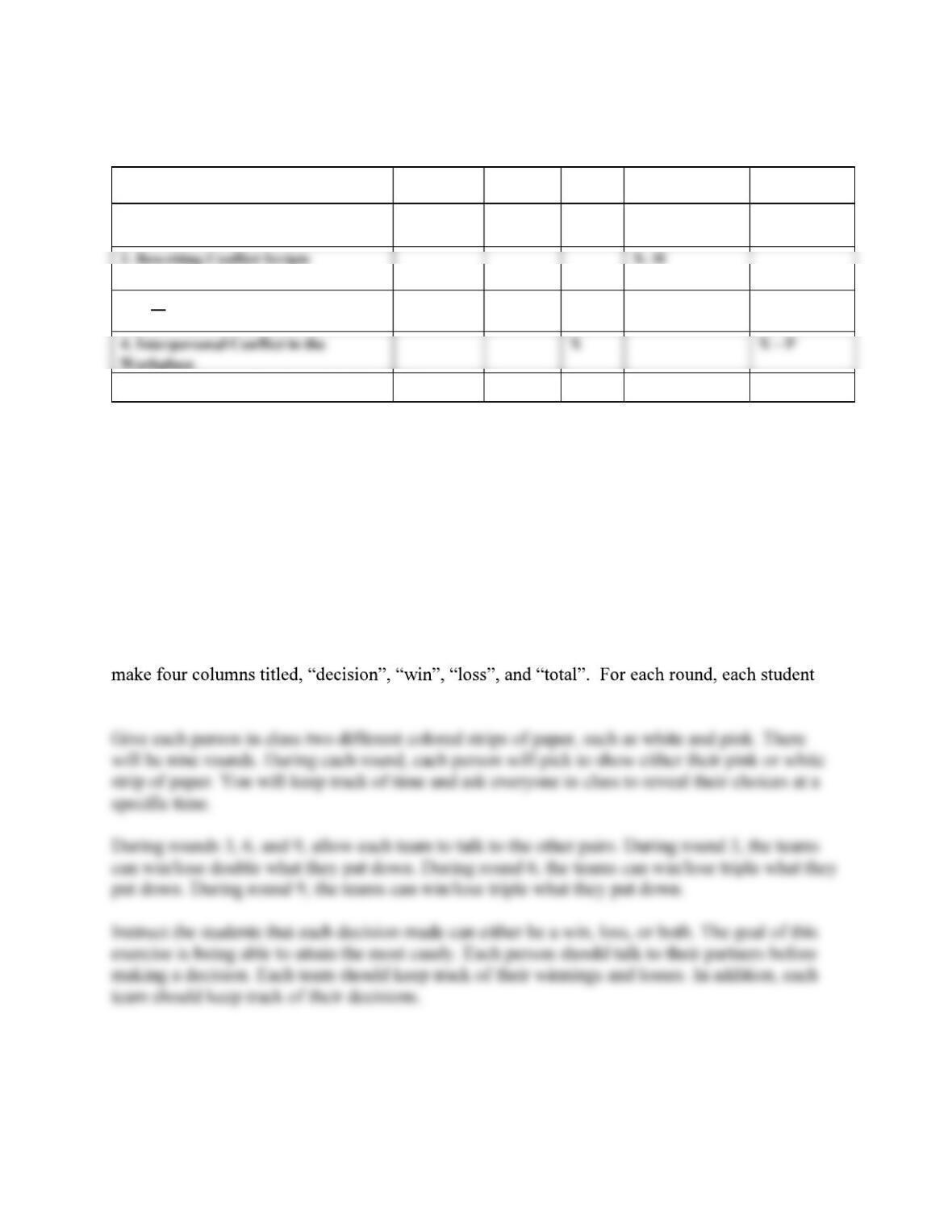
1. Conflict Resolution
X-P
3. It IS How You Play the Game
That Counts
X X
5. How did you resolve the conflict? X
X = Marks type of activity H = Handout P = Preparation required for students/teacher
Conflict Resolution
This exercise is used to illustrate different ways people resolve conflict. Bring in a bag of candy,
such as chocolate or jelly beans, and a stop watch. Ask students to form a team and find one
partner. Each team of two people will be communicating with other teams in class. Each team
should meet with a new team for each round. They should do this randomly. They can walk
around the class so that each team will meet with a new team.
Ask students to take out a sheet of paper and number down from 1-9. In addition, they should
should provide the information for each column.
149
Announce that there are four stipulations:
1. Teams cannot communicate (verbally and nonverbally) with other teams, except for
rounds 3, 6, and 9.
2. Each team must agree on one decision before the time limit.
4. If a team does not agree on a decision before the time limit, then your team will lose
during that round.
Each round will last for 1 minute, except for special rounds 3, 6, and 9. Rounds 3, 6, and 9 will
last for 2 minutes. Write on the board or on an overhead transparency, the value of each strip of
colored paper:
Condition A:
4 pink strips = wins 1 piece of candy
Condition B:
3 pink strips = wins 1 piece of candy
1 white strip = loses 3 pieces of candy
Rewriting Conflict Scripts
This exercise enlarges awareness of communication behaviors that promote destructive and
constructive conflict. Equally important, the exercise teaches students they can rewrite
unproductive scripts for managing conflict.
Ask two students to role-play romantic partners who are having an argument. Give each student
a copy of the dialogue in Conflict Role Play and tell them to begin with this dialogue and then
improvise on their own to demonstrate destructive methods of managing conflict.
150
It IS How You Play the Game That Counts
This activity gives students experience in and models of win lose, lose lose, and win win
orientations to interpersonal conflict.
Organize students into three groups (you may use six smaller groups if you have sufficient time
for six role plays to be presented to the class). Assign each group one of the orientations: win
win, win lose, and lose lose. Ask students to develop a two– to five-minute role play for
presentation to the class. The situation around which they should build the role play is this:
Interpersonal Conflict in the Work Place
The activity gives students the experience of addressing an actual conflict situation and
comparing their approach to a noted author on management and conflict in the workplace.
To prepare for this activity, visit the following web page:
http://www.smartbiz.com/article/articleview/50/1/8/. A case on Sma
Two experts comment on the case.
In class, divide the students into groups of 4-5 and then have the students act as consultants on
the case. First, ask the groups to decide if this scenario meets the definition of interpersonal
151
How did you resolve the conflict?
Ask students to write down a recent conflict situation. Have them write down how the conflict
was resolved and some possible ways that the conflict could have been resolved.
Have each student present their conflict situation to the class and ask them to figure out how the
conflict situation could have been resolved. Have them guess how the student addressed the
situation. Take a poll on which strategies were used. Discuss any similarities or differences.
Journal Items
Analyze your responses to conflict in terms of the exit-voice-loyalty-neglect model discussed in
the text. How often do you use each response style in your friendships and romantic
relationships? Which style do you use least? What are the results of the way(s) you respond
to conflict?
Responses will vary, but likely results of exit responses include not engaging in conflict and
Describe a situation in which you had a conflict with a close friend or romantic partner
and you managed to work it out constructively. Analyze what happened by discussing how your
the text.
Consider how conflict can be detrimental and/or beneficial to a relationship. Give examples and
how it applies to the basic principle of conflict.
152
Consider how you deal with conflict in relationships with people at work. Is it similar to how
you handle conflict in non-work relationships (or in non-work contexts if you are also a
friend/intimate with someone you work with)? In addition to noting any similarities or
differences, consider explanations for each.
Responses will vary based on individual experiences, but students may write that they
respond to conflict better in a work environment than they do in a romantic relationship or
Panel Ideas
Plan a panel that features volunteers or trained professionals who work with victims of domestic
violence. Ask the panel to explain to students how and why conflict sometimes crosses the line
to physical violence. Also ask panelists to discuss reasons why many victims of domestic
onomic constraints, as
153
Media Resources
Web Sites
Name: Addressing Interpersonal Conflict
Developer: Carter McNamara, MBA, PhD, and the Management Assistance Program
Name: Dealing with Worldviews in Interpersonal Conflict
Developer: Anne Giacalone DiDomenico
Name: Smart Moves
Developer: Smartbiz.com
Brief Description: In the Smart Moves section of the website (top of left side navigation bar),
SmartBiz provides cases grouped into five categories: management, marketing and PR, sales,
finance, and human resources. The management and human resources sections are most likely to
include cases associated with some sort of conflict in the workplace.
URL: http://www.smartbiz.com/
Name: A Short Divorce Course
Developer: Ed Sherman, Attorney and Nolo Press
Name: Violence, Aggression and Passive-Aggression in the Workplace Remedies
Developer: Rudy Nydegger, Graduate Management Institute at Union College
Brief Description: In this research article, the author defines and discusses how to handle violent

154
Name: Conflict Management Quiz
Developer: Natural University of Singapore
Name: Conflict Resolution Skills
Effective Approaches to Resolving Conflict in the Workplace
Developer: Office of Personnel Management
Name: Truth about Deception
Developer: TruthAboutDeception.com
Brief Description: A site offering advice, articles, and information on healthy and unhealthy
Name:
Name: Helpguide.org
Developer: The Rotary Club of Santa Monica
Brief Description: A non-profit website meant to help people understand, prevent, and resolve
Film Ideas
provides a compelling portrait of conflict of many different
sorts. It depicts both covert and overt forms of conflicts, and it dramatically illustrates the
implications of destructive conflict methods. Warning: This can be a very unsettling film.
The Story of Us provides the numerous conflicts that may occur in a relationship. It illustrates
many types of conflict. It also demonstrates how two individuals are able to resolve their
differences.
Anger Management gives a humorous look at anger and how to manage anger. It demonstrates
different ways that people deal with conflict.
155
Print Resources
Competence in Interpersonal Conflict by William R. Cupach, Daniel J. Canary. Ask students to
compare and contrast the guidelines for developing communication competence in conflict
situations discussed in the textbook with those discussed in this book.
Easy to Love, Difficult to Discipline: The Seven Basic Skills for Turning Conflict into
156
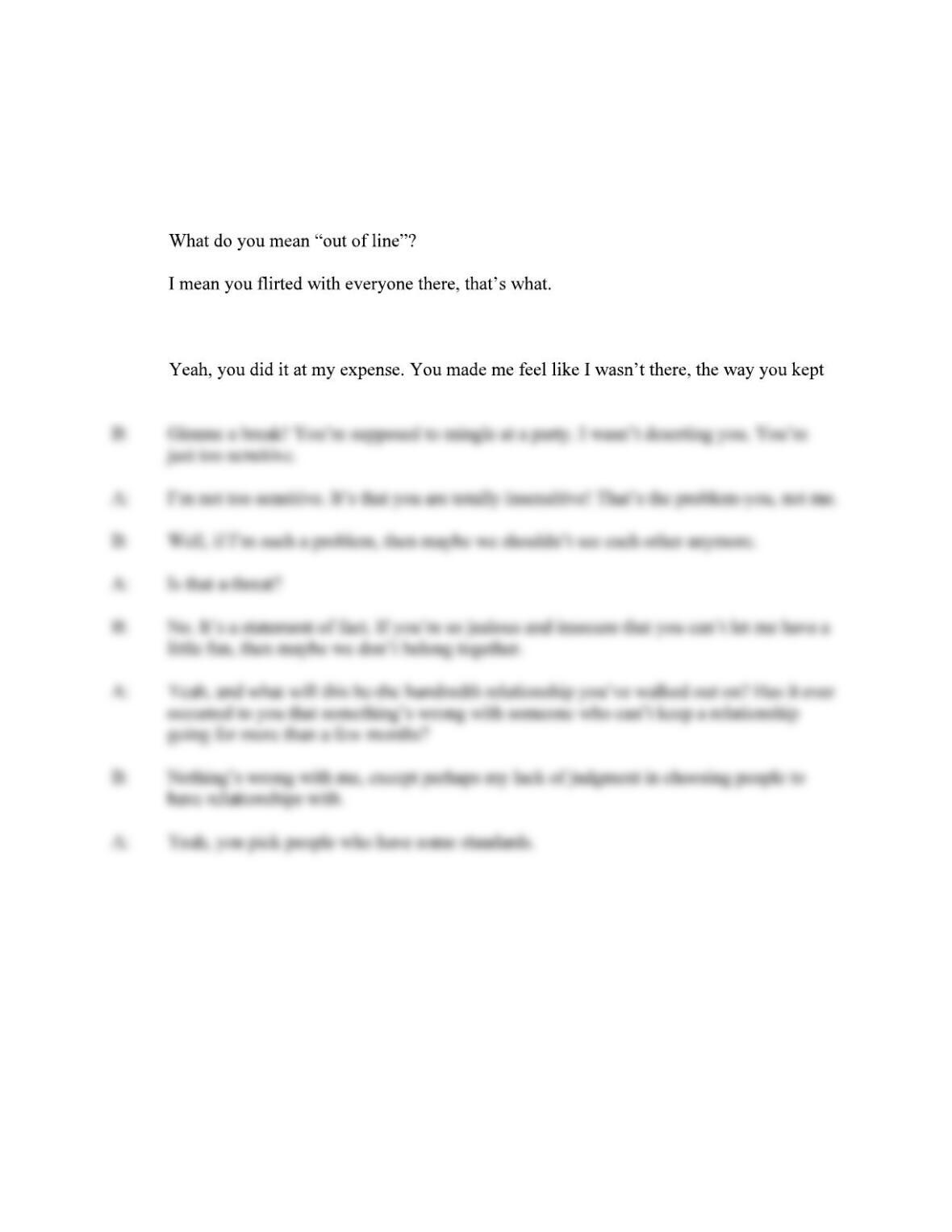
Conflict Role Play
A: You were really out of line tonight.
B:
A:
B: (disinterested tone) Sounds to me like you have a problem, but I had a good time tonight.
A:
deserting me at the party.