Chapter 9:
Communication and Family Conflict
Chapter Preview
• Family Conflict is a Communication Process
• Family Conflict Involves Patterns and Rules
• Destructive Conflict in Family Relationships
• Constructive Conflict in Family Relationships
Chapter Outline
I. Introduction
a. Communication plays a central role as families navigate conflict and negotiate
incompatible goals
b. Absence of conflict does not make a family function well; conflict avoidance can lead
to negative long-term consequences
II. Family Conflict is a Communication Process
a. Interpersonal conflict: An expressed struggle between at least two interdependent
parties, who perceive incompatible goals, scarce resources, and interference from the
other party in achieving their goals
i. Antagonistic discourses: One person advocates for one discourse or
b. Conflict in family systems
i. Because of their interdependence, a conflict between any two members of the
members and others, particularly as they get older
iii. Children are often socialized by their parents into particular conflict styles and
behaviors; varies by culture, context, and family form
1. Children of divorced parents may feel caught in the middle
2. In some cultures, open struggle is common and comfortable; in other
cultures, verbal expression of differences is avoided
c. Topics of conflict
iv. Stepfamilies are prone to unique struggles
1. Resources, space, privacy, and finances
2. Co-parenting, stepparent authority, stepsibling sharing
v. Change may trigger uneasiness and consequent conflict
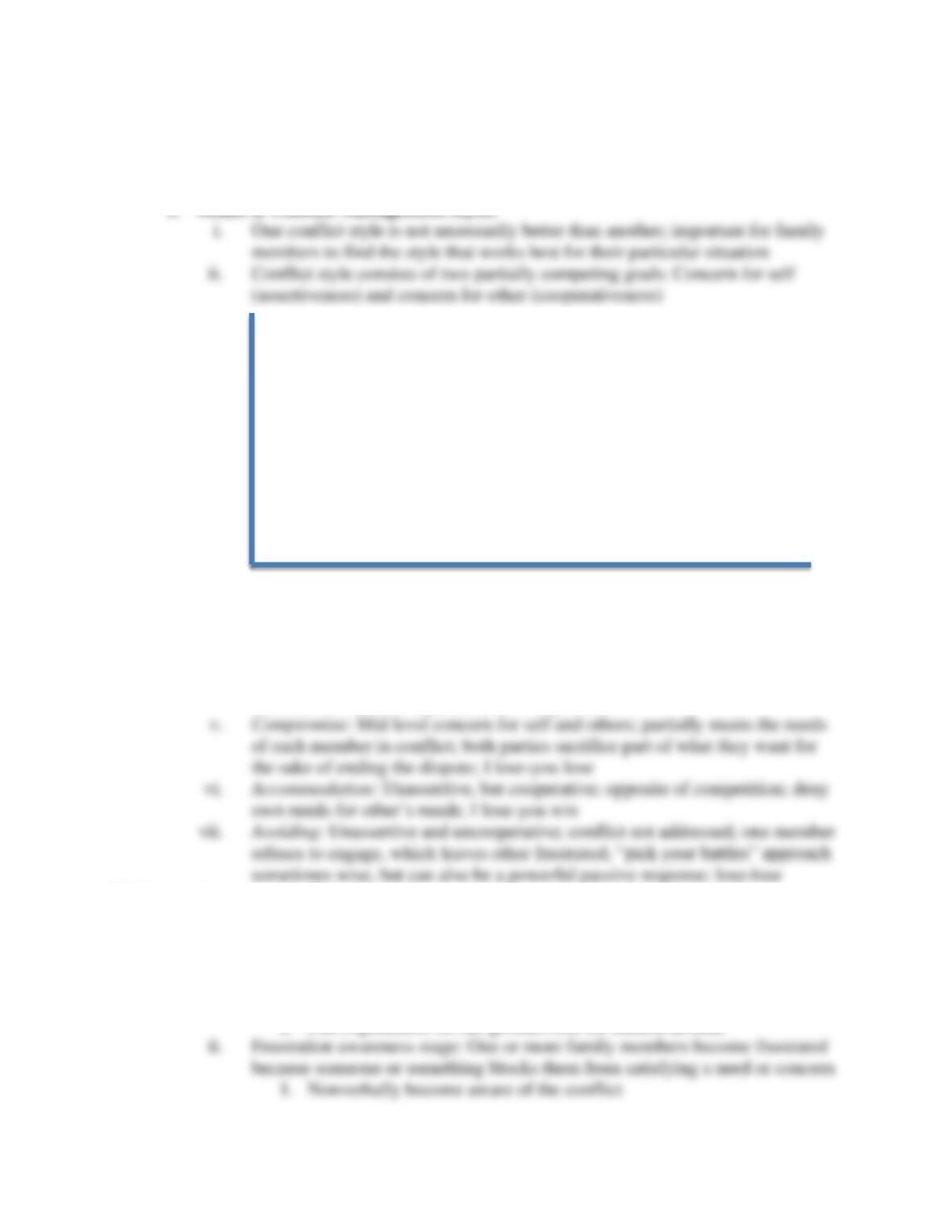
High assertive Competiveness Collaboration
(Self) Compromise
Low assertive Avoiding Accommodation
Low Cooperation (Others) High Cooperation
iii. Competitiveness: High assertiveness, low cooperativeness; conflict to get what
you need (high concern for self); can destroy cohesion; I win-you lose
iv. Collaboration: Show concern for self and others; often means finding
alternative solutions to please all; I win-you win
III. Stages of ongoing conflict
i. Prior conditions: Present in the absence of conflict but, under pressure or
stress, come into play (e.g., role expectations, competition over resources,
unhealthy dependency, problematic decision making)
1. Circumstances, such as holiday times, income tax time, drunken
episodes, or the arrival of in-laws
2. Certain code words or phrases heighten tensions
3. Inaccurate perceptions create conflict
iii. Active conflict stage: Conflict occurs in series of verbal/nonverbal messages
1. Family’s rules and style of fighting vary
2. Escalates from initial statements and queries to overt fighting,
bargaining, or giving an ultimatum
iv. Solution or nonsolution stage: How conflict episodes are managed or solved
determines the outcome and whether positive or negative results follow
1. Solution may range from creative, constructive, and satisfactory to
destructive, nonproductive, and disappointing
v. Follow-up stage: Aftermath stage; includes the reactions that follow active
conflict and affect future interactions
1. Grudges, hurt feelings, or physical scars may fester
2. House may be filled with silences, avoidance, or formal politeness
3. Outcomes may be positive, such as increased intimacy and self-esteem
or honest explorations of family values or concerns
vi. Resolution stage: Occurs when a recurring conflict no longer exists; it no
longer affects the family
IV. Family Conflict Involves Patterns and Rules
a. Feldman’s intimacy-conflict theory: Couples move away from intimacy when one
member becomes anxious or fearful, leading to conflict and separation; then one
b. Demand-withdraw pattern: Asymmetrical pattern of behavior; one partner
pressures other through emotional demands and complaints, while the other retreats
through withdrawal, avoidance, and passive inaction
i. Positively predicts marital dissatisfaction, stress during conflict, depression,
physical abuse, divorce, and mental health issues in young adult children
ii. More common for wives to assume the demanding role and husbands the
withdrawing role; there are instances of husband demand/wife withdraw
c. Serial arguments: Argumentative episodes that focus on a particular issue over time;
often arise from violated expectations, different perspectives on the relationship, or
different value/belief systems
d. Rules for family conflict have great variation
i. Rules governing consideration (e.g., don’t belittle me, don’t blame the other
unfairly, don’t make me feel guilty)
e. Couple and family types and conflict
i. Fitzpatrick couple types
1. Traditional couples seek stability and resist change by confronting
rather than avoiding conflict; may avoid conflict more than realize
2. Independent couples accept uncertainty and change by confronting
societal views on marriage in a more direct style than traditionals
3. Separates often avoid engaging in conflict altogether
ii. Family communication patterns: Conflict also varies depending on how much
family members use conformity orientation and conversation orientation
1. Families high on conformity orientation focus on avoiding conflict
while families high on conversation orientation often do not
iii. Gottman’s conflict types
1. Validating: Partners respect one another’s point of view on a variety of
2. Volatile: Comfortable with disagreement and lack of harmony;
question over roles leads to open conflict
(a) Fight often and not always fairly
(b) Conflict tends to be productive and energizes the relationship
(c) High on immediate persuasion attempts and low on listening or
validation before persuading their partner
3. Avoiders: Abhor negative messages and go to any length to keep from
engaging in conflicts
4. All couple types can all have lasting marriages; most important factor
is the couple has a five-to-one ratio of positive to negative messages
5. Marriages are in danger of divorce if marked by “four horsemen of the
apocalypse”
(a) Criticism: Differs from complaint of behavior (healthy); focus
is on other person (global/universal statements are bad)
f. Unresolved conflict
i. Some families can cope and live with unresolved conflicts without hurting
their relationships; for others it is negatively associated with satisfaction
ii. More likely to harm when critical issues
iii. When an issue is unresolvable, it may be more functional for the family to
avoid the issue and direct its communication to areas that bring cohesion
iv. Family members may learn over time to live with topics that are avoided
because the pain of addressing them is too great
v. Outside assistance can help
V. Destructive Conflict in Family Relationships
a. Covert destructive conflict: Passive conflict behaviors (e.g., burned dinner, not
showing up, leaving someone out of pictures)
need to find another route for venting emotion
iv. Disengagement: Avoid each other and express hostility through lack of
interaction
v. Pseudomutuality: Family appears perfect on outside because no conflict is
ever allowed to dispel image of perfection; anger remains below the surface
vi. Sex can be used alongside other covert actions
b. Overt destructive conflict: Aggressive/direct conflict behaviors
i. Direct messages of hostility, often in the form of verbal and/or physical
aggression, that can lead to violence
ii. Threats: Violent messages that warn family members they will be punished
c. Partner destructive conflict
i. Common couple violence: Conflict gets out of hand and leads to “minor”
forms of violence and sometimes escalates into more major violence
1. Abusive: Frequent (weekly) severe violence; one partner yields power
ii. Language used influences conflict outcomes
1. Put-downs heighten conflicts and slow the resolution process
2. One-up messages represents attempts to dominate or control others
iii. Conflict and abuse plague same-sex as well as heterosexual couples
iv. Power imbalance may affect how partners express or deal with conflict
1. Chilling effect: Less powerful partner hesitant to complain or express
grievances out of fear of punitive power and verbally or physically
aggressive messages
2. Chilling effect increases when the less aggressive partner feels more
aggressive partner is less committed, has more alternatives, or is less
dependent on their partner for love and affection
v. Divorce from a physically violent partner may not mark the end of the
relationship, especially in cases where there are children
d. Parent-child destructive conflict
i. In 2012, approximately 678,810 children were the victims of child abuse and
neglect in the United States; including neglect, physical abuse, sexual abuse,
psychological maltreatment, and medical neglect
VI. Constructive Conflict in Family Relationships
a. Children who see parents successfully resolve conflicts and share affection typically
feel more secure about the future of their family and about their own relationships
d. Couples exhibiting a collaborative conflict management style typically report higher
levels of marital satisfaction
e. Strategies for constructive conflict
i. Listening: Empathic, attentive listening serves to defuse conflict and helps
clarify and focus the issues being debated
1. Paraphrasing
2. Using humor, positive affect
ii. Fair fighting: Equal time must be provided for all participants; name-calling
or “below-the-belt” remarks are prohibited
1. Establish rules for how to disagree
2. Stay in the present and not bring up past fights or grievances
3. Avoid blaming; take responsibility
iii. Manage physical environment; be aware of what escalates a fight
1. Looking at each other so can see nonverbals
2. Appropriate place
3. Role of technology; it can be a source and channel for conflict
f. Elements of constructive conflict
i. Each participant perceives they have equal and ample time to express view
ii. Feelings are identified appropriately, not suppressed
VII. Discussion Questions
a. How well did your parents meet Gottman’s five–to-one ratio of positive to negative
messages in their marriage? If they met or exceeded his ratio, how did that help
model for you what it means to resolve conflicts in a constructive manner? If instead
they struggled to meet his ratio, how did that model ineffective and/or destructive
conflict behaviors?
b. What are the relational consequences of the chilling effect? In what movies/books
have you seen the chilling effect? Do these portrayals seem realistic?
c. Identify an ongoing family conflict or serial argument that your family of origin is
experiencing (or has experienced). How well do the six stages of ongoing family
conflict describe your family’s experience with this unresolved dispute? To what
extent can you identify key “markers” of each stage?
VIII. Case Study Questions
a. Looking back at the conflict between Callie and Peter over Callie’s friendship with
Kirby, what stage of ongoing family conflict would you say they are in right now?
What conflict management styles do you think Callie and Peter hold? And how might
Activities
Play/Film Analysis: Have students analyze the use of constructive or destructive conflict
strategies within a marital or family relationship in one of the following movies/plays:
Angels in America
August: Osage County
The Breakup
Mrs. Doubtfire
Close Ties
Driving Miss Daisy
The Normal Heart
Tony and Tina’s Wedding
Marvin’s Room
The Falsettos
The Descendants
The Story of Us
Nebraska
Who’s Afraid of V. Woolf?
Students should identify constructive and destructive strategies. Also, ask them to map the stages
of conflict development and to try to determine what “prior conditions” existed in the family that
served to predict movement toward actual conflict. You could also use the media sample to have
Family Observations or Role Playing the “Four Horsemen”: This activity will help reinforce
exhibit various “horsemen” or other destructive conflict strategies. Other students will observe
the role play to conduct the analysis. Questions for consideration:
• Which of Gottman’s “four horsemen” did you observe during the interaction? Who
exhibited these behaviors? How much?
• What was the reaction to the destructive communication behavior?
• Analyzing their conflict interaction overall, would you consider it functional? Why or
why not?
• How would you recommend this couple/family engage in healthier conflict? What tips,
from Gottman or the book, would you provide?
Self-Other Analysis: Have students select a relationship with a significant other, family
member, or close friend, and analyze the conflictual communication that occurs. Specifically, ask
each student to identify the development of the conflict as they relate to this particular
relationship.
• What prior conditions are likely to begin a conflictual process between you and _?
• What frustration awareness signs are you likely to see in each other?
Role Playing Reflective Listening: Have students demonstrate destructive and constructive
conflict around the same issue. Ask a pair of students to simulate an argument two separate times
around an issue about which they hold differing points of view. During the initial argument tell
them to use all the destructive strategies such as name calling, labeling, interrupting, yelling,
tangential responses, etc. During the second round, give them the following directions:
• After the first person (A) has stated his or her ideas, the other person (B) must restate to
A’s satisfaction A’s position before B can move on to his or her points. Then after B has
This reflective listening technique is taught in many marital enrichment programs as a fair-
fighting skill. Have students relate the above experience to their understanding of fair fighting.
What was the impact of moving from destructive to constructive conflict on the same issue?
How might this play out in real-life relationships?
Cross-Cultural Interview: Ask student to interview someone who was raised in, or has lived in,
another culture. Ask that person to describe how conflict is viewed in that culture and the ways
in which conflict is typically expressed (e.g., silence, screaming). How much influence does
culture – as opposed to personality, family tendencies, or intergenerational transmission –
contribute to one’s own cultural styles? Students should summarize interviews in a two-minute
oral report. You may also consider having an on-going journal for these cross-cultural interviews
across the course of the semester so students can reflect on cultural differences across topics.
Personal Conflict Strategies: Obtain a copy of the Kilmann and Thomas conflict style scale and
Analysis of Stage Model: Relying on the stages of conflict model, ask students to work through
a topic that reappears in their family or in a fictional family. With a partner, have them discuss
the conditions under which the issue arises and note the predictable behaviors among family
members as they proceed through the stages. They may wish to brainstorm ideas for breaking the
cycle. Suggest they include these ideas in their journal or a one or two-page paper. You may
compare and contrast the stages based on different topics the students addressed.