Chapter 8:
Power, Influence, and Decision-Making in Families
Chapter Preview
• The Development and Communication of Power in Family Relationships
• Influence Strategies in Family Relationships
• Decision-making Processes in Family Relationships
Chapter Outline
I. The Development and Communication of Power in Family Relationships
a. Power: Ability (potential or actual) to change the behavior of other family members
i. Property of a relationship between two or more persons
ii. Operates transactionally in a family; it does not belong to an individual
iii. Only have power if it is granted to you
b. Aspects of power in family systems
i. Power bases: Power emanates from resources that are used by family
members as they attempt to exert control in specific situations
1. Resources: Anything perceived as rewarding to individual or
relationship
(a) Normative resources refer to the family’s values and to the
cultural or societal expectations of where authority lies
(b) Economic resources refer to the monetary control exerted by
family members as persons designated to make financial
decisions
2. No family member possesses all five power bases equally or uses all of
them in a given situation or with a given person
ii. Power processes: How power is used in family interactions and how power
influences family discussions, arguments, and decision-making (e.g.,
iii. Power outcomes: Who makes decisions and influences others in the family
1. Outcomes include decisions, solutions, new rules or procedures,
emotional effects, and feelings about the decisions
2. Power bases influence power outcomes
3. Power outcomes may also be tied to rewards
4. Hierarchies in the family system also establish guidelines for power
processes that affect power outcomes
c. Power development
i. Marriage and power: Reflects extent to which one partner loves/needs another
1. Spouse with the strongest feelings of attachment is less powerful
because the person with less interest has more control
2. Men and women share more characteristics when it comes to power
3. Change over time as partners age, become more confident, achieve
education or economic power, increase trust, or have experiences that
alter the initial power balance and outcomes
4. Model of marital power identifies three types of families:
5. Heavily influenced by culture
6. Highly skewed relationships, such as extreme husband or wife
dominance, experience greater violence when the partners are
unskilled at communication and negotiating these issues
d. Children and power
i. Parents are expected to have more control than children, legally and socially
ii. Children are active power brokers in the family, sometimes using power plays
e. Communication and power
i. Confirming, disconfirming, and rejecting messages convey power when
family members attempt to separate and connect in one-up (asserting power
and control), one-down (accepts power and control from other) subsystems
1. Confirming messages: Messages that acknowledge and validate the
perspective of the receiver; used to gain power when one tries to get
another to identify with him or her, or give rewards to gain power
ii. Self-disclosure is a means to gain intimacy and power; information is power
II. Influence Strategies in Family Relationships
a. Influence: Occurs when family members use their power to try to change or modify
each other’s behavior or beliefs
b. Influencing other family members requires using interpersonal compliance seeking
messages targeted at getting someone to alter his or her behavior or opinions
c. 11 types of strategies that family members may use to influence others in their
everyday interactions (use varies by person and situation):
i. Direct requests: Asking for what is desired
ii. Bargaining: Offering to do something in exchange for what is desired
iii. Aversive stimulation: Behaving in a negative manner (e.g., complain, cry) to
achieve what is desired
d. Factors affecting strategy use
i. Gender
1. Men and women tend to be similar in types of influence strategies
2. Women are more likely to report using strategies that are more partner
oriented, such as offering trade-offs, whereas men are more likely to
make autonomous decisions and be less cooperative
ii. Culture
iii. Family/relational form (e.g., single parent, same-sex, multi-ethnic families)
III. Decision-Making Processes in Family Relationships
a. Decision making: Process by which family members make choices, reach judgments,
or arrive at solutions
i. Most decisions occur within family subgroups (e.g., husband and wife, adult
iv. Family decisions can be either instrumental or affective
1. Instrumental decisions: problem-solving about practical or functional
issues (e.g., getting a job to pay family bills, providing transportation)
2. Affective decisions: decisions made about family values or
relationships; often rely heavily on emotions or feelings
v. Adaptability and cohesion influence decision making
b. Types of decision-making processes
i. Consensus: Discussion until agreement is reached
1. May require compromise and flexibility
2. Goal is for a solution acceptable to all
ii. Accommodation: Some family members consent to a decision not because
they agree but because they believe further discussion will be unproductive
1. No one achieves what they desire
iii. De facto decisions: When discussion reaches a halt and one member acts in
the absence of a clear decision
1. Made without family approval, but made to keep family functioning
2. Commitment to the decision and family satisfaction often suffer when
decision-making is not shared among all who are involved
c. Phases in decision making: Problem-solving loop illustrates the phases of decision-
making developed in a somewhat circular path
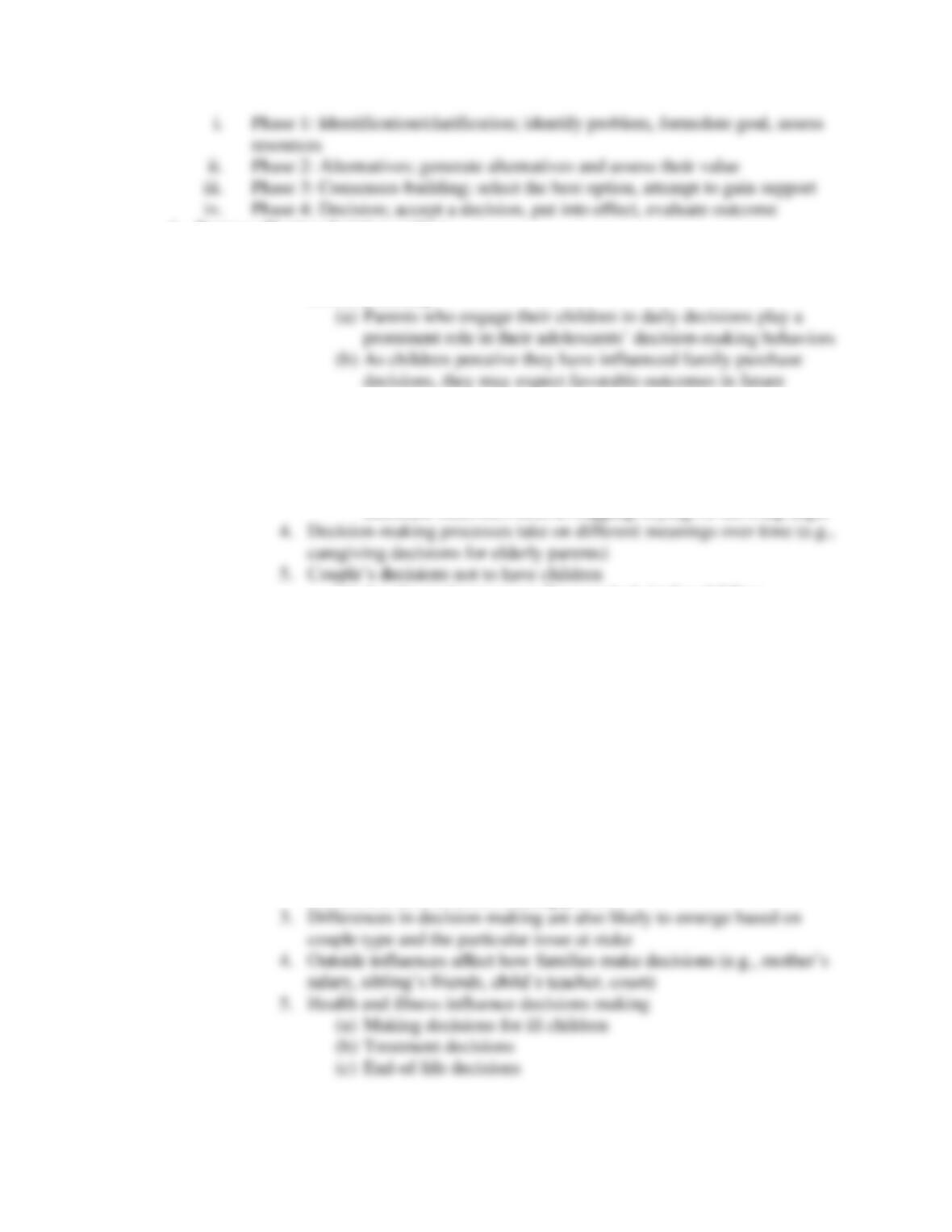
d. Factors affecting decision-making
i. The role of children and adolescents
1. Decision-making experiences as a child impact approach to adult
decision-making
2. Emotions and moods can affect decision-making
3. Children affect family’s decision-making processes
(a) Children influence purchasing decisions, especially technology
(b) Children may try to influence parents’ purchases through
coercive behavior: forceful or persistent verbal or nonverbal
(a) Accelerated-consensus: Spouses had similar childless
preferences, leading to a quick consensus
(b) Mutual negotiation: Conversations over time that led to the
decision not to have children
(c) Unilateral-persuasion: Spouse who preferred to remain
childless attempted to persuade an undecided spouse to come
to the childless decision
(d) Bilateral-persuasion: One spouse wanting children and the
other not wanting children; the one wanting children chooses
spouse over having children
ii. Individual investment and resources
1. If money or any other shared resource is scarce, decision-making can
become a more competitive process
2. Agenda-setting power is more closely associated with marital
satisfaction than decision-making power
(d) Family’s privacy rules, communication patterns, and
attributions and personal theories about disease and genetic risk
influence health-related decisions
e. Communication skills in decision making
i. Effective and competent communication forms the basis for responsible
family problem-solving and decision-making
ii. Principles to help guide family members in your decision-making
1. Create a sense of justice by treating family members equally,
regardless of sex or power resources
2. Create a sense of autonomy by respecting each family member’s rights
to free choices in order to carry out actions that enhance his or her life
IV. Discussion Questions
a. When you made a choice about where to enroll for or attend college, who was
involved in this decision? How involved was your family in your decision? In what
ways? How does your experience relate to dialectical tensions in the family?
b. How are power bases and power processes within families likely to change as
V. Case Study Questions
a. Looking back at Alberto and Michael’s decision to become parents, what types of
power bases might each of them draw upon as they negotiate who will be listed as the
child’s legal father? How might their understanding of marriage and power influence
their decision-making about what names each of them will be called by their child?
What types of communication skills are likely to ensure the most satisfying outcome
for both partners?
Activities
Problem Solving Loop: Prompt the student to think back to an important decision that they and
their family members had to make. Then, using the family problem-solving loop, ask them to
draw out their decision making process and answer the following questions: How well did you
and your family members address each phase of the problem-solving loop? Were there any
phases that your family skipped? If so, how did it affect the ultimate outcome or decision that
your family made, if at all?
Couple Power Patterns Discussion and Debate: Ask students to defend a couple type of power
pattern (father- or husband-dominated, mother- or wife-dominated, syncratic, or autonomic) as
the most effective power pattern. Have them describe what they see as un/desirable
communication behaviors within their selected pattern. You may encourage student debate about
the positive and negative traits of each couple type, and may have students research couple types
in order to support their arguments. This can be done as a class (divided) or in small groups.
Purchasing Decisions Role-Play: Invite students to role-play family conversations about
purchasing decisions. Assign students to play various family members (create a list) trying to
persuade each other to make a variety of purchases, such as a new car, a piece of furniture, a new
computer. Have students discuss how the strategies (and responses) differed based on different
family members. Debrief the role-playing process by discussing which influence strategies they
naturally tended toward and how the other “family members” responded to such influence
strategies. You could also discuss the role of power or family roles within these selections and
responses and how different family types enact influence strategies.
Personal Family Decision Journaling: Have students over a period of one week, make a list of
Decision-Making Interviews: Ask students to interview members of different types of families
to determine how decision-making occurs. Students may wish to develop a form categorizing
relevant issues: (1) importance of topic, (2) rules for talking about topic, (3) family roles that
affect topic, (4) family roles which affect decision making. Students may thematize responses
amongst their interviews to understand how certain “types” of families may tend to make
decisions in similar (or different) ways. These interviews and findings may inform in-class
discussion about differences in family decision-making, particularly in accordance with family
culture, family types, and culture.
Honey Do: Influence Strategies in Marriage: Ask students to interview a husband and wife
separately, asking them independently of one another which influence strategies they use when
they’re trying to get their spouse to do something their own way. Then the student should
analyze the responses based upon the following questions:
• To what extent do their responses align with research findings on gender differences in
influence strategy preferences?
• How effective are each of the influence strategies? (That is, is each spouse’s preferred
influence method successful?)
• How frequently are these influence strategies used? (These answers may vary based on
interviewee)
• How similar are their influence strategies to one another?
Discussion on Nagging: By show of hands, ask students to indicate whether nagging is a

Because I Said So?: Ask students to reflect upon the ways their parents gained their compliance
as a young child versus an adolescent versus a young adult.
• In what ways did the influence strategies change or stay the same?
• What is the most effective way for their parents to influence their behavior? How has this
changed over time?
• Do they appreciate the influence strategies or resent them? Why or why not?
Power Analysis: Using a fictional family, have students analyze the resources of power, giving