Chapter 8: Communication Climate:
The Foundation of Personal Relationships
Key Concepts
assertion
commitment
communication climate
ethnocentrism
investments
relational dialectics
self-disclosure
trust
Chapter Outline
I. Communication climate is the overall feeling or emotional mood between people
warm or cold, safe or anxious, comfortable or awkward, accepting or rejecting, open or
guarded that is shaped by verbal and nonverbal interaction between people. Four
features contribute to satisfying personal relationships.
A. Investments are the contributions (e.g., time, energy, emotions) that we make to
relationships without expecting to get them back if the relationship ends; in the
most satisfying relationships, everyone feels like the investments made by all
involved are roughly equal.
B. Commitment is the personal choice we make to keep a personal relationship alive
II. Relational dialectics are the opposing forces or tensions inherent in everyday relational
functioning.
2. We need to address our desire for what is familiar or habitual
(predictability) and what is new or different (novelty).
II. Different types of communication create supportive and defensive climates in personal
relationships.
A. Interpersonal climates occur on a continuum from confirming to disconfirming.
1. Recognition is the basic form of confirmation. It is where you
recognize that the other person exists.
3. Endorsement is involving ano
B. Confirming messages recognize that another person exists, acknowledge that another
matters to us, and endorse what we believe is true.
C.
not mat
D. There are six types of communication that create supportive and defensive
relational climates.
1. We create supportive climates when we describe behaviors and others; we
create defensive climates when we judge or evaluate others.
2. We create supportive climates when we communicate openness to a
3. We create supportive climates when our communication feels open,
4. We create supportive climates when we use communication to find ways
5. We create supportive climates when we demonstrate empathy or care
135
6. We create supportive climates when we use communication to indicate
III. There are at least six guidelines for building and sustaining healthy relational and
communication climates.
A. Actively use communication to build confirming climates.
B. We need to accept and confirm others while still being honest.
C. We need to make sure we affirm and assert (state what we need, feel, or want
Discussion Ideas
Supportive and defensive climates: Ask students to make a list of behaviors that teachers and
and asking questions when a point is not clear). Ask students to make a list of behaviors that
teachers and students exhibit in a class not conducive to learning (for example, implying that
someone personally rather than
their position on a matter). Compare and contrast these behaviors with what should create a
supportive or defensive climate. Generally, students need to be prompted to come up with
anything positive for the class not conducive to learning or anything negative for the class
conducive to learning. Defensive behaviors include evaluation, certainty, strategy, control,
indifference, and superiority. Supportive communication behaviors include description,
provisionalism, spontaneity, adopting a problem orientation, empathy, and equality.
Turning a defensive climate into a supportive climate: Ask students to alter the following
statements in the specified ways (as indicated in parentheses). Possible student responses are
included after the parentheses.
right thing to d
136
nge superiority to equality).
Relational dialectics: Ask students to list examples that occur in their relationship. Ask
students to provide examples for each of the dialectic tensions and how they manage them in
their relationships. Autonomy/Connection, Predictability/Novelty, and Privacy/Expression.
Electronic greeting cards and communication climate: Greeting cards represent a large
industry and have become an integral part of U.S. culture. Ask students how many send
Activities
Title Individual Partner/
Ethno
Group Demonstration/
Whole Class
Internet/
InfoTrac
2. Building healthy climates X
4. Climates in the Workplace X – P
5. Building Trust X
X = Marks type of activity H = Handout P = Preparation required for students/teacher
Creating Supportive Climates
This role-playing activity provides students with concrete examples of communication that helps
to create supportive and defensive interpersonal climates. The exercise also emphasizes our
capacity to use communication to improve unhealthy interpersonal climates.
Ask for four volunteers. The first two should be given Scene A of Communicating Climate. The
second two should be given Scene B of Communicating Climate. Instruct the role players to start
with the existing dialogue and then improvise to create defensive communication climates.
After each dyad presents its role play, have students in the class identify specific types of
communication that contributed to the defensive climate. They should be able to point out
examples of evaluation, strategy, superiority, neutrality, control, and certainty. Invite them to
explain how these forms of communication foster a negative climate.
137
Building Healthy Climates
Ask the students to find a partner in class. Ask each pair to number off from 1 to 6. Then, assign
each pair one of the six guidelines for building and sustaining healthy relational and
communication climates. The pair that is numbered one gets the first guideline; the pair that is
numbered two gets the second guideline, and so on.
Ask the students to come up with a skit that illustrates this guideline.
Give the students about 5 minutes to come up with their skits.
Once they have come up with their skits, have them randomly present their skits in front of the
class.
Have the other class members try to guess what their skit was illustrating and critic each skit.
Discuss the importance of building and sustaining healthy relational and communication
climates.
Classroom Climates
This is a demonstration that gives students a dramatic and personal sense of how communication
creates open or closed climates in the classroom.
Unlike other exercises in this resource manual, this one involves you, the teacher, as a role player
who demonstrates the power of communication to shape a classroom climate. Do not inform
students what you are doing.
Hold a discussion with your class on any topic you would normally discuss regarding
communication climate. Although you should be sure to include sound content in the discussion,
the content is not the focus in this instance. For the first five minutes of the discussion,
consistently use supportive behaviors to respond to students. You might foster equality by
138
After you are satisfied that you have created a defensive climate in the classroom, stop the
Climates in the Workplace
The purpose of this activity is to understand communication climates in the workplace. The
concept of interpersonal climate applies to relationships in the work place. Often times,
to work there.
For this activity, introduce the concept of interpersonal climate as the overall feeling or mood
between people, and talk about how it can also be used to assess the climate of a work place.
Next, visit organizational web sites in class (e.g., http://www.cisco.com/jobs/us/culture.shtml or
http://www.lucent.com/work/culture.html) and examine the types of climate that these
companies seek to cultivate.
typology of communication practices that lead to defensive and supportive climates. Be sure to
Building Trust
Ask students (individually) to generate a list of how a person can build or gain trust with other people.
Tell them to write as many as they can think of and try to be original. Then, ask students to share one
item on their list. They cannot repeat what other students say. They must go down the list until they do
not repeat what other people say. Ask the class to discuss if these are legitimate ways to gain trust.
Which methods are most effective and appropriate? Which methods would be more beneficial for males
or females? Why?
139
Journal Items
Identify one relationship in which you feel on-guard and defensive and one relationship in which
you feel comfortable and supported. Describe and analyze the communication behaviors in
each relationship. To what extent do the defensive and supportive communication behaviors
discussed in the text explain the climates of these two relationships?
Responses will vary, but defensive behaviors include evaluation, certainty, strategy, control,
indifference, and superiority. Supportive communication behaviors include description,
provisionalism, spontaneity, adopting a problem orientation, empathy, and equality.
Pick a situation in which someone with whom you are talking seems defensive. Consciously
engage in supportive communication behaviors and avoid ones likely to produce
Media Resources
Web Sites
Name: Assertiveness Skills
Developer: Dr. Tom Stevens
Brief Description: This web page explains how to create harmonious relationships and intimacy
Name: Life @ Lucent
Developer: Lucent Technologies
140
Name: Cisco Systems Culture
Developer: Cisco Systems
Name: Blue Mountain
Developer: Blue Mountain.com
Brief Description: This web site allows users to send free electronic greeting cards to anyone
Name: Ethnocentrism
Developer: Wikipedia
Name: Johari Window
Developer: University of San Francisco
Name: Defensive vs. Supportive Conversation: The Critical Differences
Developer: Loren Ekroth
Film Ideas
Workplace and Office Space. These films provide a humorous look at the culture and climate of
a corporate workplace. Ask students to analyze the film for the interpersonal climate that exists
in the company portrayed in these films.
American Beauty. This film offers a look at how some families are very unsupportive. The film
can be used to illustrate how to create more supportive climates in a relationship.
GrownUps. This film illustrates how different couples have various marriages. This film can
illustrate the some climates are defensive and others are confirming.
141
Print Resources
Family Communication: The Essential Rules for Improving Communication and Making
Your Relationships More Loving, Supportive, and Enriching by Sven Wahlroos. Ask students
to compare and contrast the guidelines for creating supportive and confirming climates discussed
in the textbook with those suggestions made in this book.
T by Richard Williams.
142
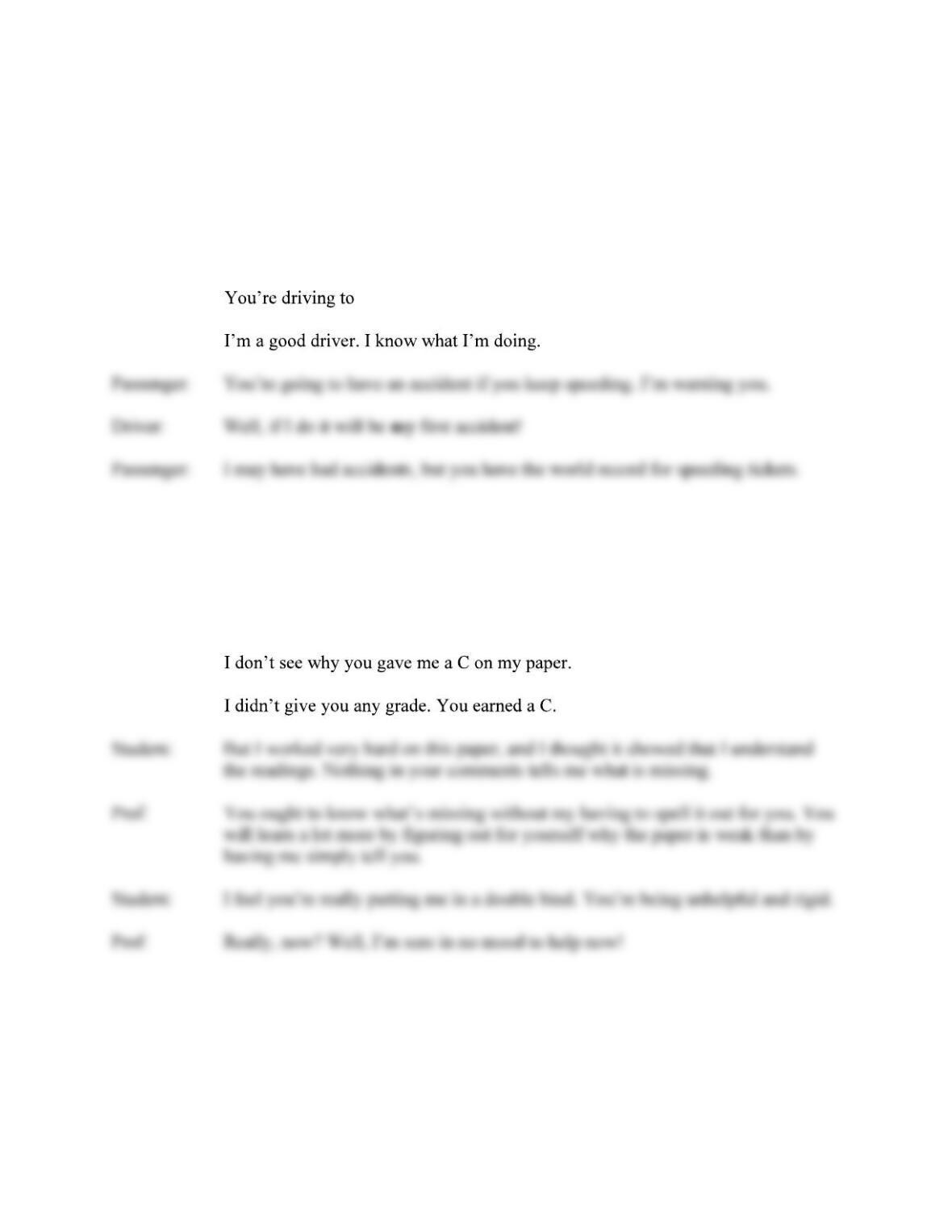
Script: Communicating Climate
SCENE A: A woman and her husband are driving in the late afternoon. They have been on
the road for four hours and still have three hours to drive to reach their
destination.
Passenger: o fast.
Driver:
SCENE B: A professor and student are discussing a paper that received a C – grade from the
professor.
Student:
Prof: