CHAPTER 7 Reporting with Numbers
Overview
Nearly everything journalists write about involves mathematics. Changes in budget figures
reflect changing priorities in government, in agencies and even in entire cultures. Per capita
spending (or saving) often tells a more accurate story of funding levels than total budgets do.
Percentages and percentage changes reflect proportions. Averages and medians can
sometimes reflect important comparisons and contrasts behind issues in the news.
Teaching Tips
uninterested in it. The way to get better at math, of course, is to do more of it. Taking time in
class to have students work through some relevant math exercises, alone or in pairs or groups,
is the best way to help students get past their math phobia. (You might want to go through
Lecture Notes
I. INTRODUCTION
A. Crunching the numbers in North Carolina s government jobs market, as reported by
WRAL News in Raleigh, North Carolina.
II. PROPORTION
A. Explaining things relative to the size or magnitude of the whole.
B. Percentages and percentage change proportion equals portion divided by the whole,
multiplied by 100 (shift decimal two places to the right).
1. Population is the basis for a percentage.
2. A sample is a smaller number of a population picked at random to represent the
whole.
3.
C. Averages and medians.
1. Average (arithmetic mean) is the total of the figures added together and then
divided by the number of figures.
2. Median is the midpoint when the figures are listed from high to low.
D. Rates are used to make comparisons of different populations i.e., per capita.
III. INTEREST AND COMPOUNDING
A. Simple interest amount borrowed or invested, multiplied by the interest rate
expressed as a decimal equals total owed or total balance.
B. Annual percentage rate allows for fair interest rate comparisons.
104
C. Compounding calculate by multiplying the amount borrowed times the interest rate
IV. INFLATION
A. Inflation is the increase in the cost of living over time.
B.
V. TAXES
A. Sales taxes also known as excise taxes.
1. To figure, multiply the price of the good times the tax rate.
B. Income taxes.
1. Tax deductions (value is dollar figure of the dedu
marginal tax rate).
2. Income taxes are based on adjusted gross income, and progressive rates (in other
words, taxpayers owe more dollars and pay a higher percentage of their income as
their income rises).
C. Property taxes.
1. In most jurisdictions, property taxes are calculated by taking the assessed value of
the property, dividing by 1,000 and multiplying by the millage rate (tax rate per
$1,000 of assessed value).
2. Appraisals, and public confusion over them.
VI. BUDGETS
A. Budget basics revenue and expenditures; line–item budgets vs. program budgets.
B. Finding stories in budget changes, trends and comparisons.
VII. FINANCIAL REPORTS
A. Fiscal year vs. calendar year, actual vs. budgeted spending and revenue.
B. Look for changes, compare trends, and ask for explanations.
VIII. PUBLIC OPINION POLLS
A. Margin of error.
B. Poll information to share.
1. Identity of the sponsor.
2. Exact wording of the questions.
3. Population sampled.
C. Caution in interpreting polls.
1. People interviewed must be selected in truly random fashion.
106
IX. MIXING NUMBERS AND WORDS
A. Check for accuracy; use the right numbers.
B. PolitiFact.com regularly checks the numbers.
Class Activities and Discussion Questions
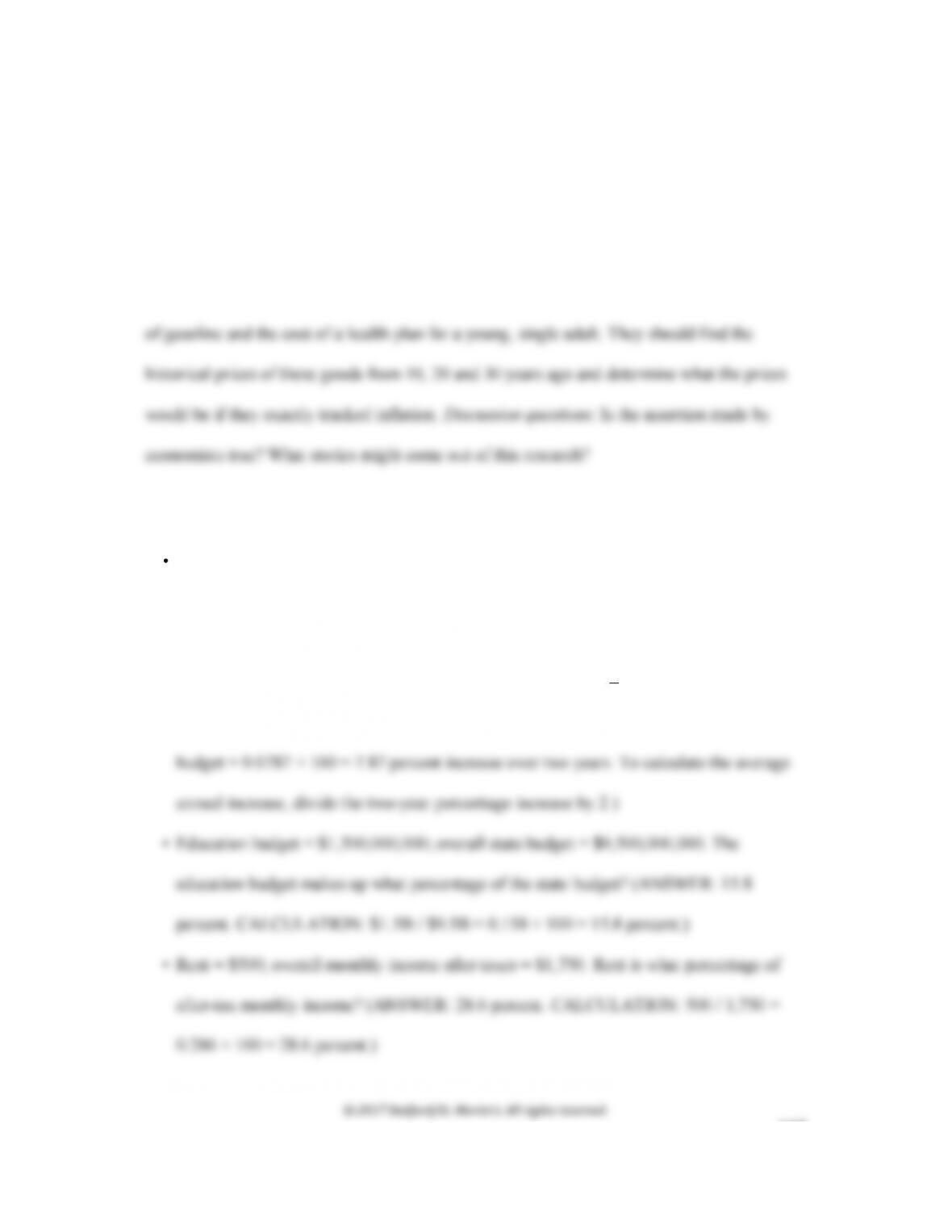
Activity 1: If you have access to a computer lab with Internet access, ask your students to go
to an inflation calculator to answer the following questions. (The Bureau of Labor Statistics
has a calculator at http://data.bls.gov/cgi-bin/cpicalc.pl that will calculate inflation values
back to 1913; you can also try the calculator at www.westegg.com/inflation, which allows
calculations back to 1800.) Online inflation calculators do the somewhat sophisticated
calculations for you and make it look deceptively simple. Students just need to be careful to
plug in the correct price and pick the correct year. You might want to try out a few of the
following questions before assigning them to your students.
107
Have students give the answers and present their calculations.
Activity 2: According to many economists, almost all consumer goods are cheaper today
than they were in the past, after inflation is factored in. The exceptions? Health care and
college tuition. Test this assertion. Ask students to work in pairs to come up with a list of 15
different consumer goods, including the tuition and fees on your campus, the cost of a gallon
Activity 3: Have students work alone or in teams to solve the following problems:
State budget 2011 = $25,488,300,000; state budget 2013 = $27,495,400,000. What is the
percentage increase in the budget from 2011 to 2013? What is the average annual
percentage increase in the budget? (ANSWER: 7.87 percent increase; 3.94 percent
average annual increase. CALCULATION: $27,495,400,000 $25,488,300,000 =
$2,007,100,000 increase in the budget over two years; divide the difference by the 2011
108
Number of errors by college baseball team last year = 33; number of errors by same team
this year = 72. What is the percentage increase in errors? (ANSWER: 118 percent.
Number of automobile fatalities in the county last year = 13; number of auto fatalities in
the county this year = 4. What is the percentage decrease in fatalities? (ANSWER: 69.2
Find the average and the median: 2, 4, 4, 5, 6, 6, 7, 8, 9, 10, 37. Given this list of
numbers, which number (average or median) is least biased? Why? (ANSWER: The
average is 8.91; the median is 6. The median is less biased because the average is skewed
City A has a police budget of $1.5 million and 50,000 citizens; city B has a police budget
of $12 million and 300,000 citizens. What is the per capita rate of police spending for
both cities? (ANSWER: City A spends $30 per capita on police services; city B spends
A student invests $1,200 with an annual interest rate of 6 percent. What is the investment
account worth in five years? (ANSWER: $1,605.87. CALCULATION: $1,200 × (1.06) ×
A student borrows $10,000 with an APR of 3.5 percent. If the loan term is 10 years, how
A city generates much of its budget through sales taxes. All sales (except food) in the
city are taxed at 8 percent (2 percent for the city and 6 percent for the state). If the city
the sales tax, what gross taxable sales does the city need to meet its budget? (ANSWER:
A house is assessed at $175,000. The millage rate is 4.35. How much must the owners
Have students give the answers and present their calculations.
Activity 4: Bring in copies of a newspaper story about a government budget (for a
department or agency, or for the entire city, county or state). Have students read the story in
small groups and answer the following questions together:

Have students share their answers to the questions. Focus the discussion on possible follow–
up stories.
Activity 5: Get multiple copies of the annual reports of several publicly traded companies.
Students, working in pairs or groups, should find out the following information about each
company:
Actual revenues compared with budgeted revenues.
Actual spending compared with budgeted spending.
Solutions to Textbook Exercises
1. PolitiFact.com is committed to testing the numbers often those cited by politicians
2. The best way to show the impact of an increase in the school tax from $3.21 to $3.33 per
$1,000 valuation is to first choose a home value that is reflective of typical homes for
111
3. Gallup (www.gallup.com) and the Pew Research Center (www.pewresearch.org) provide
4. Students should go to an inflation calculator site, such as the Minneapolis Federal Reserve
site listed in the textbook. They would find that 25 cents in 1938 is now worth about
5. The difference in percentage points is 4. The percentage difference is 8.33 percent (4
6. One website that students might use is http://www.spotrac.com/nfl/. The average NFL
7. Percentage increase: $203,020 $186,247 = $16,773. Divide $16,773 by the base
8. For a city with 219,000 residents: 103 divided by 219,000 = 0.00047 × 1,000 = 4.7
murders per 1,000 residents. For a city with 88,812 residents: 48 divided by 88,812 =
9. Your journalism blog. After students find the tuition figures for 1995, 2005, and 2015,
they should go to the Minneapolis Federal Reserve site or a similar site and use the
inflation calculator. The result is what the tuition would be today after it is adjusted for

112
will be better served if reporters use consistent numbers all adjusted for inflation to the
same year.
Solutions to Workbook Exercises
1. This is an increase of 5 percentage points but an 11.1 percent increase in the number of
students who meet the university admission requirements.
2. The city
3. The overall inflation rate from 1995 to 2013 was 52.6 percent (using the Bureau of Labor
Statistics inflation calculator: www.bls.gov/data/inflation_calculator.htm).
a. The average price of a new car rose from $17,959 in 1995
(www1.eere.energy.gov/vehiclesandfuels/facts/2008_fotw520.html) to $30,748 in
2013 (www.autoblog.com/2012/04/11/average-price-of-new-cars-hits-all–time-record),
a 71 percent increase and greater than the inflation rate for the period.
b. The average college tuition at four-year public universities rose from $2,860 in 1995
c. The average price of a pound of ground roast coffee rose from $4.08 to $5.67 from
113
d. The average price of a gallon of whole milk rose from $2.47 to $3.42 between 1995
e. The median price of a gallon of unleaded regular gasoline was $1.14 in 1995 and $3.59
f. The median price of a house rose from $127,900 in January 1995 to $271,600 in 2013
4. ck on the Republican congressional
representative does not reveal what proportion of the total votes cast during the last
legislative year the incumbent missed, nor does it compare her performance with those of
others.
a. To write a balanced story, a journalist would need to know what percentage of votes
cast during the last legislative year the Republican incumbent missed and how her
b. To find the number of roll–call votes and how each member of Congress voted,
students can visit http://clerk.house.gov/legislative/legvotes.html.
114
percentage increases in students and budgets shows that Springfield is adding just enough
money in the new budget to maintain its current level of spending per student.
a. Per capita spending = total budget ÷ number of students
2006 2007
Springfield $23,250,000 ÷ 4,650 $23,620,000 ÷ 4,724
$5,000/student $5,000/student
b. Percentage change in per capita spending.
Springfield No change

115
= 13.6 percent decrease in spending per student
Middletown $6,208 $7,500 = $1,292
6. a. To figure the percentage change in students:
Step 1: (new number of students old number of students) ÷ old number
Step 2: Move decimal point two spaces to the right.
Springfield 4,724 4,650 = 74
Newburg 2,362 2,325 = 37
Hampton 1,101 1,211 = 110
Middletown 1,213 1,004 = 209
b. To figure the percentage change in budgets:
Step 1: (new budget old budget) ÷ old budget
Step 2: Move decimal point two spaces to the right.
Springfield $23,620,000 $23,250,000 = $370,000
116
$370,000 ÷ $23,250,000 = 0.0159
= 1.6 percent increase in the budget
Hampton $3,496,000 $4,450,425 = $954,425
Middletown No change
7. Area school districts face a variety of circumstances. Springfield and Newburg are seeing
relatively small increases in their student bodies and are increasing their budgets just
enough to maintain the same level of spending as last year.
–financed school district, is experiencing an influx of
In Hampton, the student body is shrinking, but the budget is shrinking even more. The
number of students will fall by 110, a decrease of about 9 percent, and the budget will fall
117
It might be the addition of new housing developments in Middletown, the opening of a
factory or office center that is attracting a lot of families with children, or maybe even a
vote by Middletown to annex part of Hampton. Reporters would also like to know how
changes in per capita spending are going to be made up. Will class sizes increase? Will
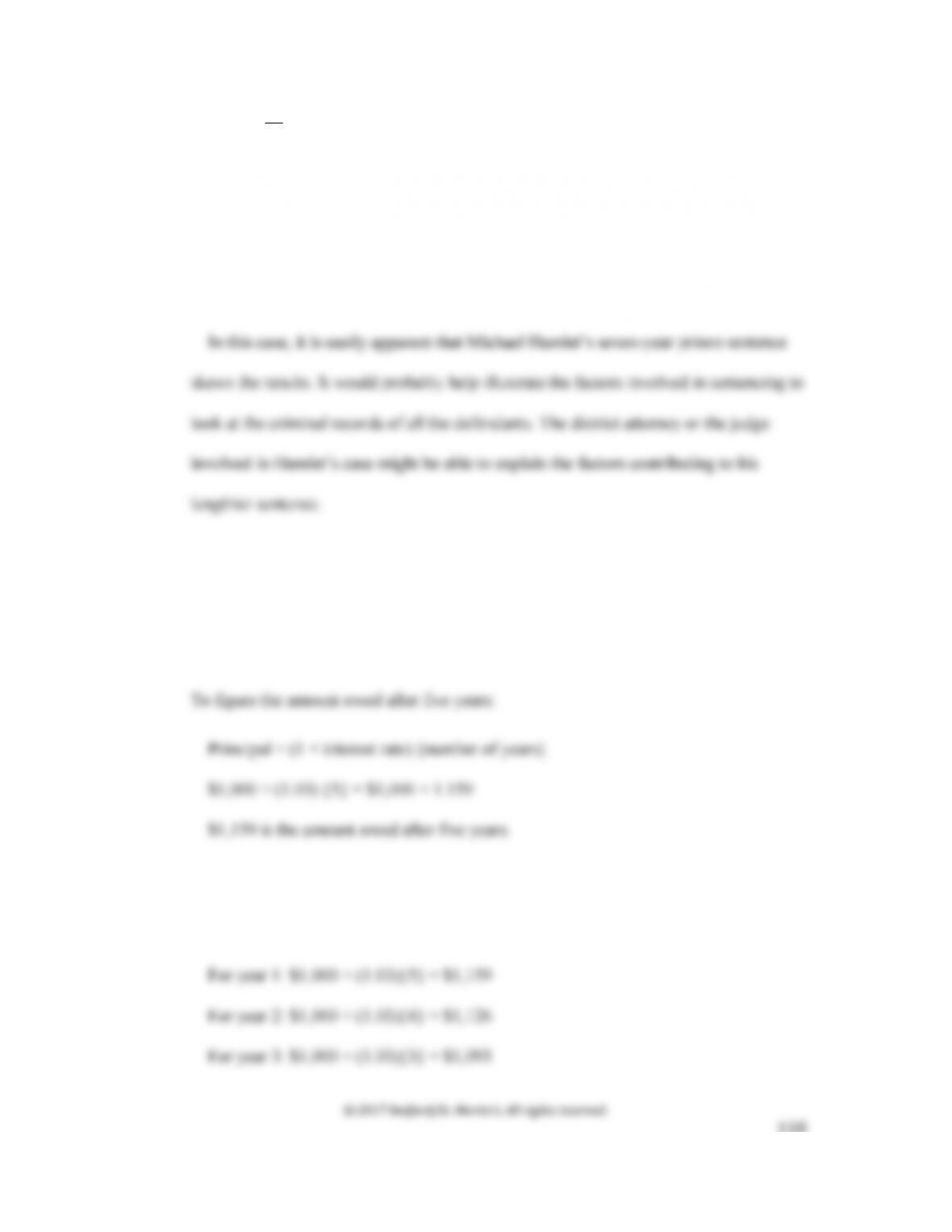
8. a. To calculate the arithmetic mean, or average, prison term, students should convert all
the prison sentences to months and then add all the prison terms together and divide by
the number of items.
Kimball 12 months
Smith 12 months
Rothstein 8 months
Hamlet 84 months
b. To calculate the median prison term, students need to plot the figures on a straight line
from lowest to highest and identify the figure where half fall above, and half fall
below.
118
8 12 12 12 12 14 84
The median prison term is 12 months.
c. The median prison term is far more accurate than the average, or mean, prison term.
The average works out to a little under two years, even though six of the seven people
were sentenced to a lot less than that.
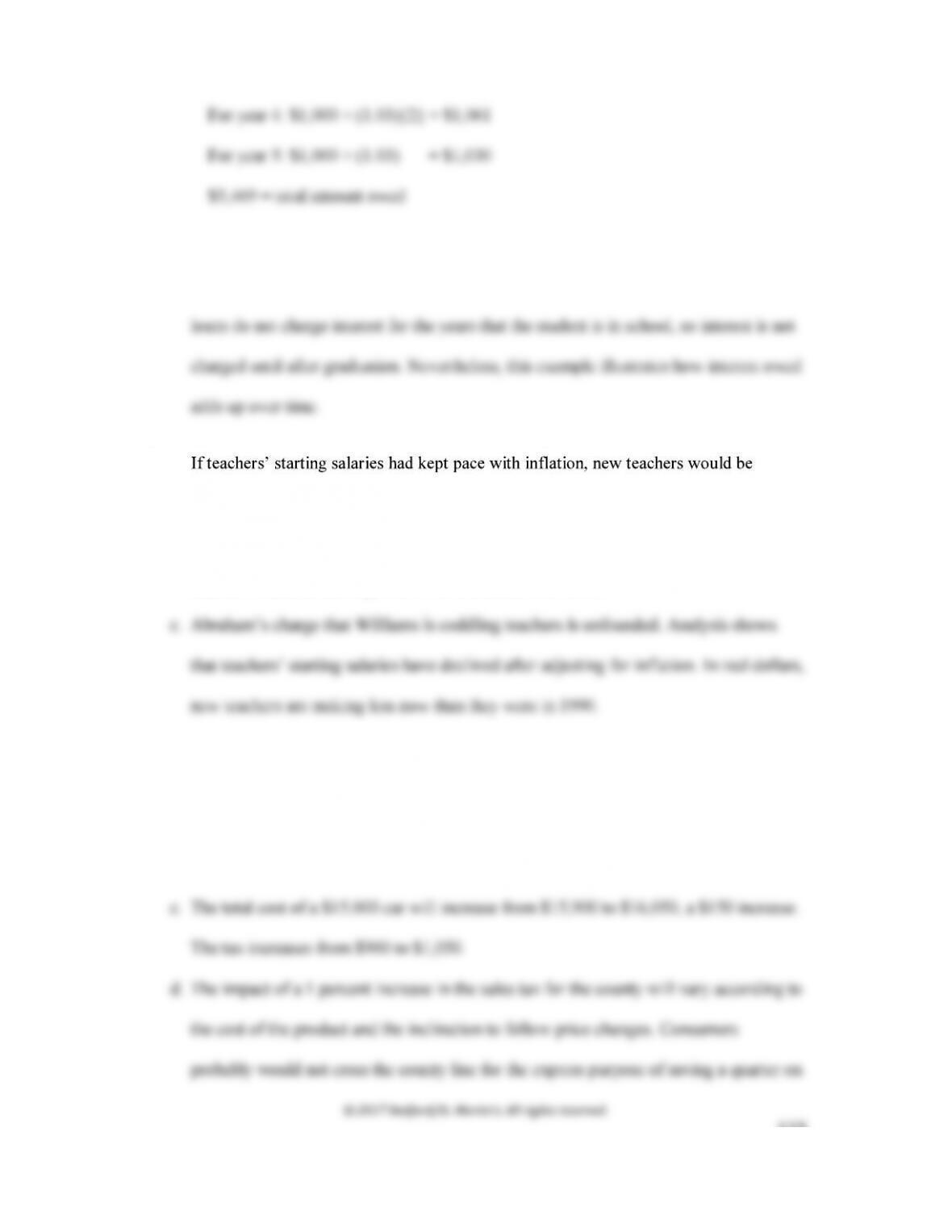
9. a. After one year, a student borrowing $1,000 will owe:
$1,000 × 0.03 = $30 in interest plus the principal
$1,030 is the amount owed after one year.
b. If the student accepts a $1,000 loan for each of her five years in college, she owes a
different amount of interest for each $1,000 loan.
119
Note that this calculation is based on simple interest, a method that will give far
different results than standard amortization formulas. Also, government–backed student
10. a.
earning $33,386.
b. Williams is almost right. If starting salaries were just keeping pace with inflation, new
teachers would be earning $3,386 more than current levels.
11. a. The total cost of the shirt and tax will increase from $26.50 to $26.75, a 25–cent
increase. The tax increases from $1.50 to $1.75.
b. The total cost of the computer will increase from $1,632.40 to $1,647.80, a $15.40
increase. The tax increases from $92.40 to $107.80.
a $25 shirt, but they might shop around to avoid an extra $150 tax on a new car.
However, a county may still be able to collect the tax when a consumer registers the
vehicle, so students should explore this possibility.
12. a. Assuming a state sales tax of 6 percent, a fast–food patron who spends $5 a week
would save 30 cents per week, or $15.60 in a year.
13. To determine a property tax:
Step 1: Find the assessed value, and move the decimal point three spaces to the left.
Step 2: Take the result from Step 1 and multiply by the millage rate.
Calculate current property taxes.
$136,000 × 23.80 = $3,236,800 in property taxes each year
121
14. a. 243 210 = 33 ÷ 210 = 15.7 percent
b. 280 220 = 60 ÷ 220 = 27.3 percent
c. 42 38 = 4 percentage points (a 10.5 percent increase).
CHALLENGE EXERCISE
16. This exercise again illustrates that adjusting for inflation is crucial to conveying an
accurate story.
a. To calculate property taxes:
three spaces to the left.
b. To adjust for inflation, students again need to go to an inflation calculator. There, they
will find that if home prices rose in step with the Consumer Price Index, the house