
Gathering Materials
Chapter Objectives
After reading this chapter, students should be able to:
2. Explain the major resources available for researching speeches in the library.
4. Delineate the three stages of interviewing and explain the responsibilities of the
interviewer at each stage.
5. Follow the four tips for doing research discussed in the chapter.
7
CHAPTER 7—GATHERING MATERIALS 117
Chapter Outline
I. A speaker’s own knowledge and experience can be a valuable resource for information
on a speech topic.
A. We usually speak best about topics with which we are familiar.
B. Supplementing facts and figures from books with personal experience can add color
and emotion to a speech.
II. Library research is an important source of material for speeches.
A. Librarians are an excellent resource.
B. The catalog lists all the books, periodicals, and other resources owned by the library.
C. Reference works contain a wealth of information about almost any topic.
2. Yearbooks are annual publications that are invaluable for current information.
4. Biographical aids provide information about people in the news.
D. Newspaper and periodical databases are invaluable for research on many topics.
E. Academic databases are the best way to find scholarly research.
III. When used responsibly and efficiently, the Internet can be a powerful tool for speech
research.
A. Search engines are the key to finding materials on the Internet.
B. In addition to search engines, there are specialized resources for finding materials on
the Internet.
1. Government resources allow instant access to an endless number of government
documents and publications.
C. There are three primary criteria for evaluating the quality of documents found on the
Internet.
2. If there is no identifiable author, one should assess the sponsoring organization
that produced the document.
3. Regardless of authorship or sponsorship, it is important to check the recency of
the document.
118 CHAPTER–BY–CHAPTER GUIDE TO THE ART OF PUBLIC SPEAKING
IV. Interviewing people with specialized knowledge is another way to gather materials for a
speech.
A. The first stage in the interviewing process takes place before the interview.
2. Once the purpose of the interview is clear, a speaker must decide whom to
interview and set up an appointment with that person.
4. The most important task before the interview is preparing the questions to be asked.
B. The second stage of the interview process takes place during the interview itself.
2. It is a good idea at the outset to restate the purpose of the interview so as to
refresh the interviewee’s memory.
4. The most important part of the interview is asking the questions.
6. Finally, the interviewer should try not to exceed the stipulated time period for the
interview.
C. The third stage of the interview process takes place after the interview.
1. While the interview is still fresh, the researcher should review her or his notes.
2. As soon as possible after the interview, the researcher should transcribe ideas and
information from the interview into the same format as the rest of her or his
research notes.
V. Regardless of which resources speakers rely on in gathering speech materials, there are
several ways to make their research more productive.
A. It is imperative that speakers begin their research early.
B. Speakers should create a preliminary bibliography of research sources.
C. Speakers can save time and energy by taking research notes efficiently.
2. They should record notes in a consistent format and make a subject heading for
each note.
4. They should distinguish among direct quotations, paraphrases, and their own ideas.
D. The research process is most productive when speakers think about their materials as
CHAPTER 7—GATHERING MATERIALS 119
Exercises for Critical Thinking
(from text page 133)
1. Using one of the periodical and newspaper databases discussed on page 118 of the textbook,
find three magazine or newspaper articles on the topic of your next speech. Prepare a prelim-
inary bibliography entry for each article. Read the full text of the articles and assess their val-
ue for your speech.
Discussion: It is astounding how many college students have never used a periodical and
newspaper database such as ProQuest, LexisNexis Academic, or World News Digest. This
2. Using Google or another search engine, find three high–quality documents on the topic of
your next speech. Prepare a preliminary bibliography entry for each article. Read the full text
of the documents and assess them in light of the criteria for evaluating Internet documents
discussed on pages 122–125 of the textbook.
Discussion: It is vital that students think critically about their research materials, especially
when found on the Internet. As explained on pages 122–125 of the textbook, students
3. Plan to conduct an interview for one of your classroom speeches. Be sure to follow the guide-
lines presented in this chapter for effective interviewing. Afterward, evaluate the interview.
Did you prepare for it adequately? Did you get the information you needed? What would you
do differently if you could conduct the interview again?
Discussion: This exercise is most applicable if you assign students to conduct a research
Using Public Speaking in Your Career
(from text page 124)
After receiving your master’s degree in education administration, you took a job at the state de-
partment of education. At the request of the governor, your section of the department has developed
a new early childhood intervention program for children from impoverished households.
Now you have been asked to help publicize the program and to build support for it. You will be
speaking to church groups, teachers’ associations, family advocacy groups, and others with an
120 CHAPTER–BY–CHAPTER GUIDE TO THE ART OF PUBLIC SPEAKING
interest in children’s welfare. You want to prepare a talk that makes good use of statistics and expert
testimony to demonstrate the value of early childhood education programs, especially for poor
children.
As part of your research, you decide to look on the Web for supporting materials. List three
reputable Web sites that provide useful statistics or testimony on the value of early childhood edu-
cation. Explain why each Web site is reputable and list one statistic or expert quotation you obtain
from each source.
Discussion: The purpose of this scenario is to help students see how the skills of Internet
Additional Exercises and Activities
1. Arrange for your students to take a tour of the campus library. Students should read Chapter 7
before the tour, and they should be assigned application exercises from the chapter after the tour.
Discussion: Because so many students do not know how to use the library efficiently, this
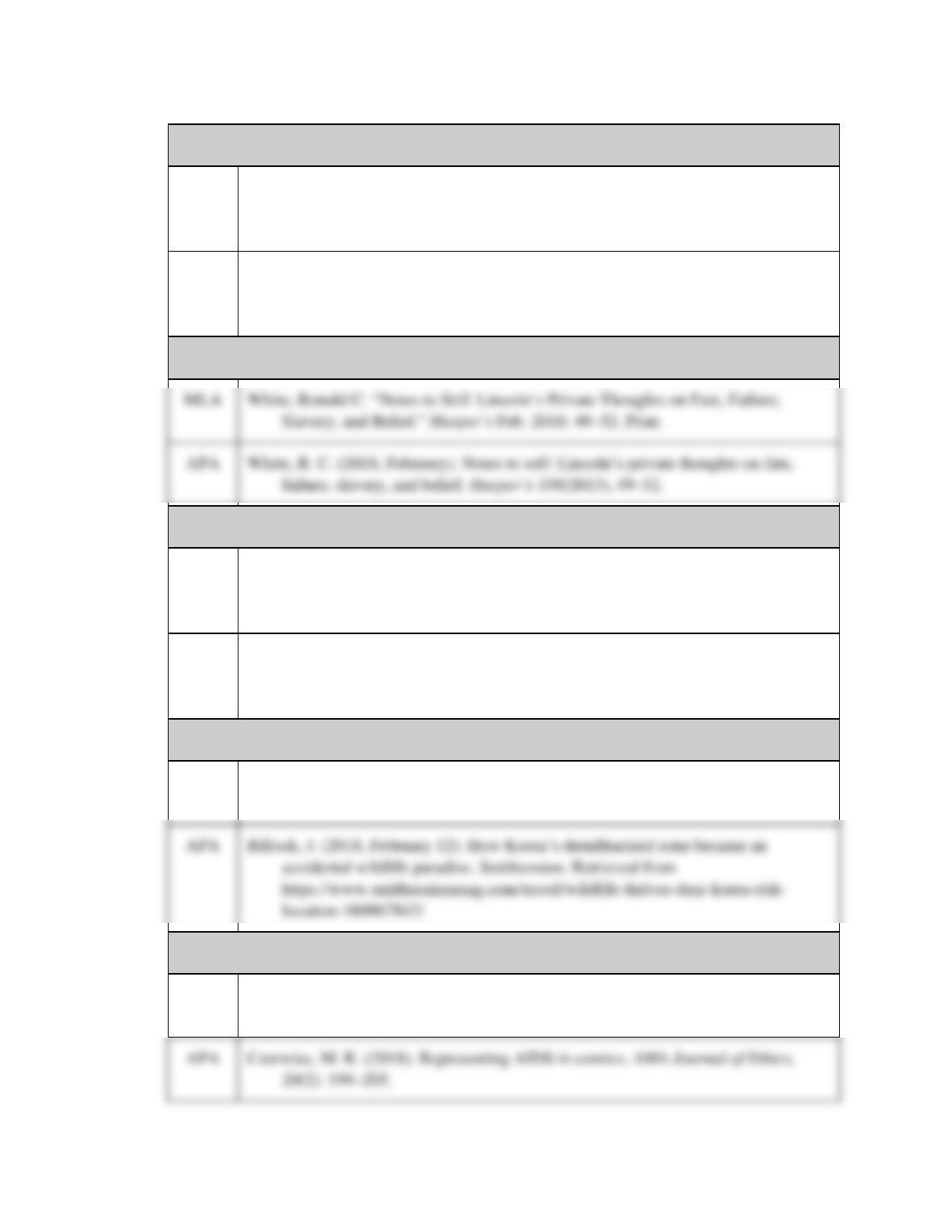
2. Distribute the “Bibliography Formats” guide, which appears on pages 124–129 of this manual.
This guide is an extended version of the sample bibliography formats that appear on page 130
of the textbook.
Discussion: Effective research and proper citation go hand in hand. The sample citations
CHAPTER 7—GATHERING MATERIALS 121
3. Using the Library Research Worksheet on page 122 of this manual, have students find three
articles on the topic of their next speech. The articles can be from periodicals or newspapers.
In addition to finding the articles, students should provide proper bibliographic citations and
answer the questions listed on the worksheet.
Discussion: This assignment offers an alternative to Exercise for Critical Thinking 1 and
4. Using the Internet Research Worksheet on page 123 of this manual, have students find two
Internet documents on the topic of their next speech. In addition to finding the documents,
students should provide proper bibliographic citations and answer the questions listed on the
worksheet.
Discussion: This assignment offers an alternative to Exercise for Critical Thinking 2 and
Library Research Worksheet
Name Section
Topic
Find three articles in the library on the subject of your next speech. The articles can be from period-
icals or newspapers. Provide a complete citation for each article following the bibliography format
required by your instructor and answer the questions about each article.
1. Article:
Did you locate this article through a periodical and newspaper database? Yes ! No !
If you answered yes, what is the name of the database?
2. Article:
Did you locate this article through a periodical and newspaper database? Yes ! No !
If you answered yes, what is the name of the database?
If you answered no, how did you locate the article?
Why will the article be useful for your speech? Be specific.
3. Article:
Did you locate this article through a periodical and newspaper database? Yes ! No !
If you answered yes, what is the name of the database?

123
Internet Research Worksheet
Name Section
Topic
Find two documents from the Internet on the subject of your next speech. Provide a complete
citation for each article following the bibliography format required by your instructor and an-
swer the questions about each document.
1. Document:
Did you locate this document through a search engine? Yes ! No !
If you answered yes, what is the name of the search engine?
If you answered no, how did you locate the document?
Why will the document be useful for your speech? Be specific.
2. Document:
Did you locate this document through a search engine? Yes ! No !
If you answered yes, what is the name of the search engine?
If you answered no, how did you locate the document?
Why will the document be useful for your speech? Be specific.
Association, 2018. Print.
American Bar Association. (2018). Zero tolerance: Best practices for combatting
Leitch, Vincent B., et al., eds. The Norton Anthology of Theory and Criticism. 3rd
APA
Leitch, V. B., et al. (Eds.). (2018). The Norton anthology of theory and criticism.
Bibliography Formats
Book: Single Author
MLA
Cantú, Francisco. The Line Becomes a River: Dispatches from the Border. New
York: Riverhead Books, 2018. Print.
APA
Book: Two or More Authors
MLA
Leavy, Patricia, and Anne Harris. Contemporary Feminist Research from Theory to
Practice. New York: Guilford Press, 2018. Print.
APA
Leavy, P., & Harris, A. (2018). Contemporary feminist research from theory to
practice. New York, NY: Guilford Press.
Book: Second or Later Edition
MLA
Carolan, Michael. The Real Cost of Cheap Food. 2nd ed. Abingdon: Routledge,
2018. Print
APA
Carolan, M. (2018). The real cost of cheap food (2nd ed.). Abingdon: Routledge.
Book: Corporate Author
MLA
American Bar Association. Zero Tolerance: Best Practices for Combatting Sex–
Based Harassment in the Legal Profession. Chicago, IL: American Bar
125
Chapter in Anthology or Compilation
MLA
Nijhuis, Michelle. “The Parks of Tomorrow.” The Best American Science and Na-
ture Writing 2017. Ed. Hope Jahren. Boston, MA: Houghton Mifflin Har-
court, 2017. 131–137. Print.
APA
Nijhuis, M. (2017). The parks of tomorrow. In H. Jahren (Ed.), The best American
science and nature writing 2017 (pp. 131–137). Boston, MA: Houghton Mifflin
Harcourt.
Signed Magazine Article
Unsigned Magazine Article
MLA
“How ‘Identitarian’ Politics Is Changing Europe.” The Economist, 28 Mar. 2018,
www.economist.com/news/europe/21739668–having–learned–identity–politics–
left–right–wingers–are–shaping. Accessed 2 Apr. 2018.
APA
How “identitarian” politics is changing Europe. (2018, March 28). The Economist.
Retrieved from www.economist.com/news/europe/21739668–having–learned–
identity–politics–left–right–wingers–are–shaping
Online Magazine Article
MLA
Billock, Jennifer. “How Korea’s Demilitarized Zone Became an Accidental
Wildlife Paradise.” Smithsonian. 12 Feb. 2018. Web. 25 Feb. 2018.
location–180967842/
Print Journal Article
MLA
Czerwiec, M. K. “Representing AIDS in Comics.” AMA Journal of Ethics 20.2
(2018): 199–205. Print.
126
Online Journal Article
MLA
Shiao, Jiannbin Lee. “A Comparative Approach to Social Differences.”
Contemporary Sociology 47.2 (2018): 132–136. ProQuest. Web. 5 April
2018.
APA
Shiao, J. L. (2018). A comparative approach to social differences. Contemporary
Sociology 47(2): 132–136. http://dx.doi.org/10.1177/0094306118755390a.
Retrieved from https://search–proquest–com/docview/2007288231
Print Newspaper Article
Online Newspaper Article
MLA
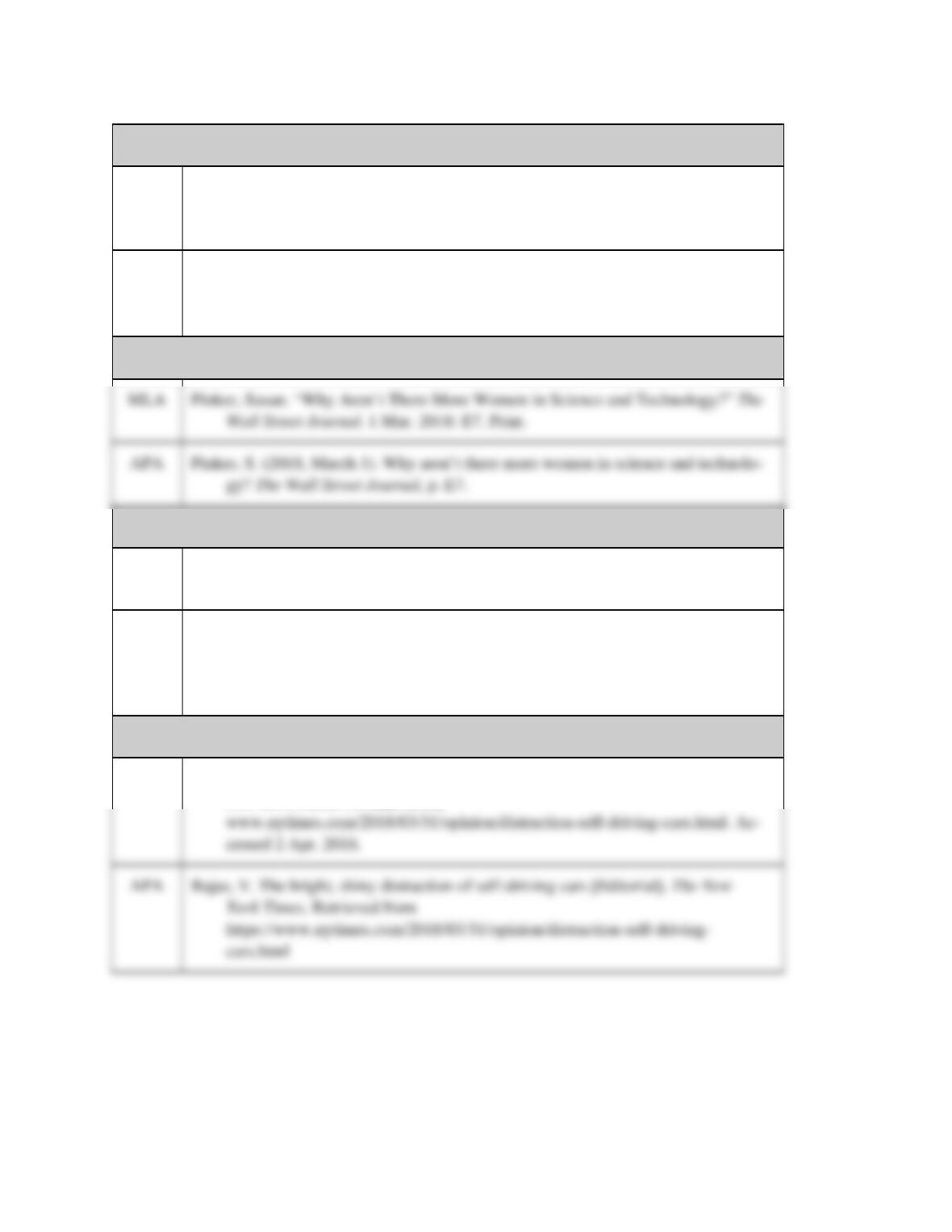
Pinker, Susan. “Why Aren’t There More Women in Science and Technology?” The
Wall Street Journal. 1 Mar. 2018. Web. 5 Mar. 2018.
APA
Pinker, S. (2018, March 1). Why aren’t there more women in science and technolo-
gy? The Wall Street Journal. Retrieved from
https://www.wsj.com/articles/why–arent–there–more–women–in–science–and–
technology–1519918657
Newspaper Editorial
MLA
Bajas, Vikas. “The Bright, Shiny Distraction of Self–Driving Cars.” Editorial. The
New York Times. 31 Mar. 2018,
Bajas, V. The bright, shiny distraction of self–driving cars [Editorial]. The New
127
Online News Source
MLA
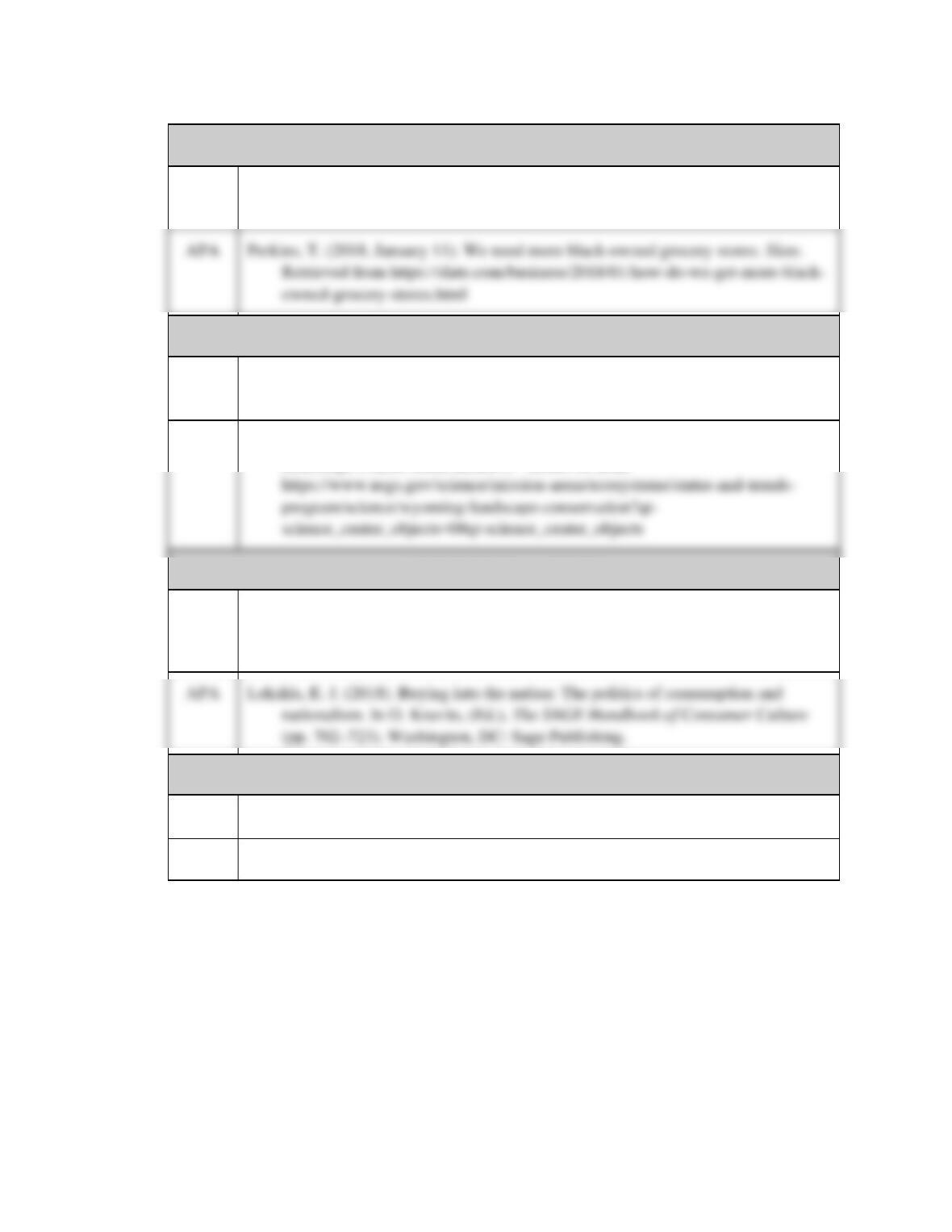
Perkins, Tom. “We Need More Black–Owned Grocery Stores.” Slate. Slate, 11 Jan.
2018. Web. 2 Mar. 2018.
Government Publication
MLA
United States Geological Survey, Status and Trends Program. “Wyoming Landscape
Conservation Initiative.” Jan. 2018. Web. 15 Feb. 2018.
APA
United States Geological Survey, Status and Trends Program. (2018). Wyoming
Landscape Conservation Initiative.” Retrieved from
Article in Reference Work
MLA
Lekakis, Eleftheria J. “Buying into the Nation: The Politics of Consumption and
Nationalism.” The SAGE Handbook of Consumer Culture. Ed. Olga Kravets.
Washington, DC: Sage Publishing, February 2018.
Personal Interview
MLA
Pasare, Liviu. Personal interview. 8 Mar. 2018.
APA
Pasare, L. (personal communication, March 8, 2018).
128
Letter or E–Mail Communication
MLA
Brzezicki, Liz. Message to the author. 13 Mar. 2018. Email.
APA
Brzezicki, L. (personal communication, March 13, 2018).
Speech or Lecture
MLA
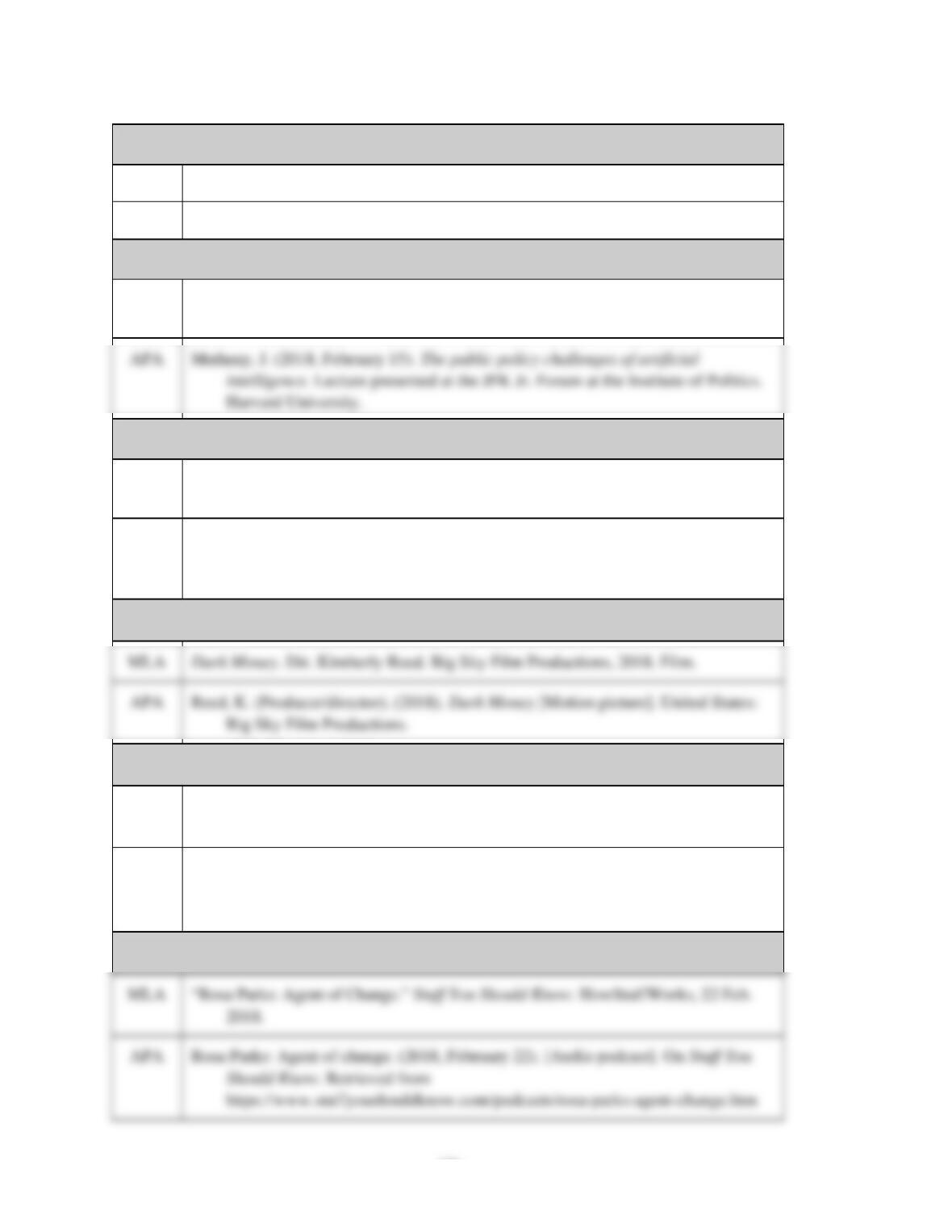
Matheny, Jason. “The Public Policy Challenges of Artificial Intelligence.” JFK Jr.
Forum at the Institute of Politics. Harvard University. 15 Feb. 2018. Lecture.
APA
Television Program
MLA
“The Gang Crackdown.” Narr. Will Lyman. Frontline. PBS. WMPB,
Baltimore, 13 Feb. 2018. Television.
APA
Lyman, W. (Narrator). (2018). The gang crackdown [Television series episode]. In
M. Gaviria, N. August–Perna, & V. Richards (Producers), Frontline. Baltimore,
MD: WMPB Educational Foundation.
Film
YouTube Video
MLA
Yeung, Isobel. The Monumental Effort to Rid the World’s Oceans from Plastic.
Vice News. YouTube. Web. 6 Feb. 2018.
APA
Yeung, I. Vice News (Producer). (2018, February 6). The monumental effort to rid
the world’s oceans from plastic [video file]. YouTube. Retrieved from
https://www.youtube.com/watch?v=74YQWthFz8g
Podcast
129
Blog
MLA
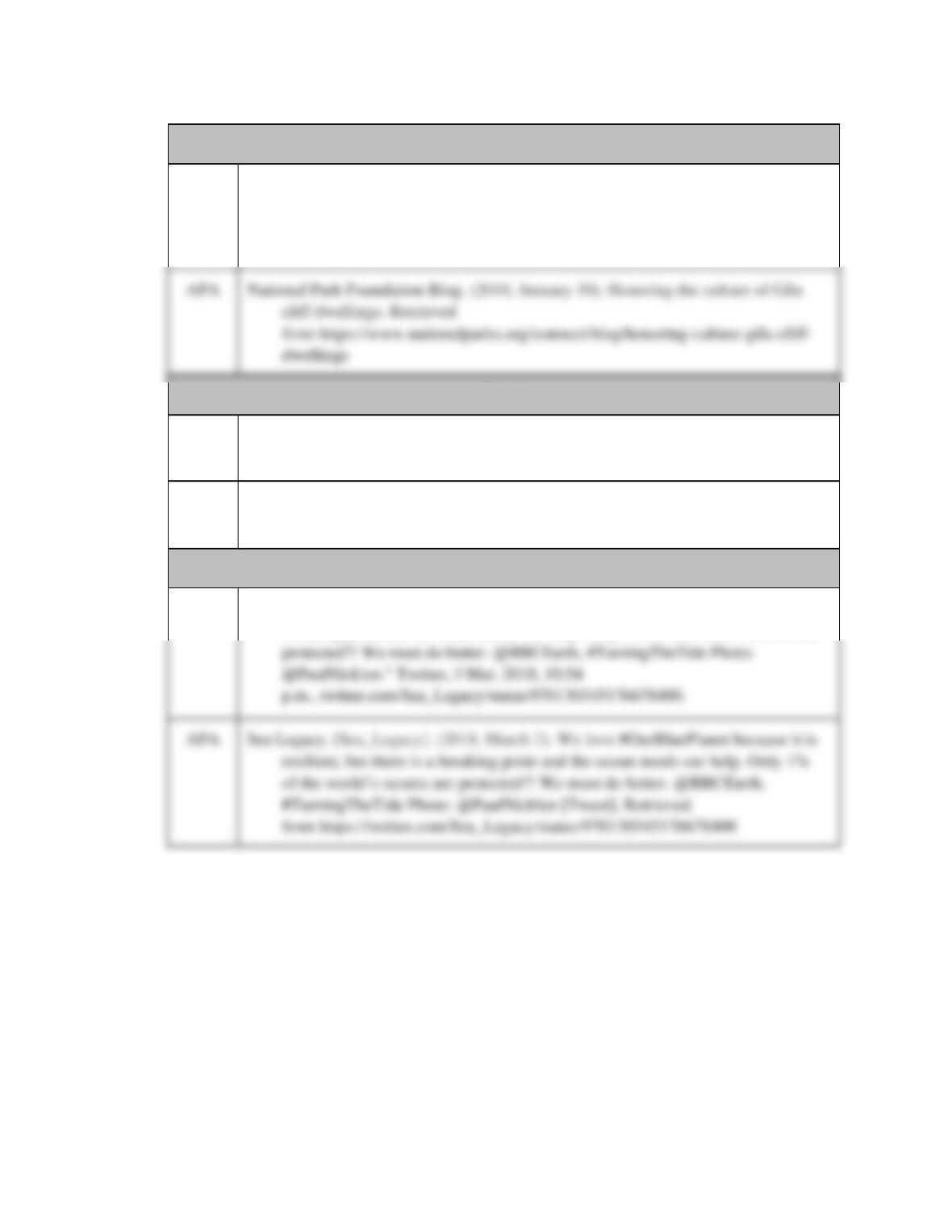
NPF Blog. “Honoring the Culture of Gila Cliff Dwellings.” National Park
Foundation Blog, 30 Jan.
2018, www.nationalparks.org/connect/blog/honoring–culture–gila–cliff–
dwellings. Accessed 14 Mar. 2018.
Ebook
MLA
Agrawal, Roma. Built: The Hidden Stories Behind Our Structures. New York:
Bloomsbury, 2018. Kindle Edition.
APA
Agrawal, R. (2018). Built: The hidden stories behind our structures. [Kindle
version]. Retrieved from Amazon.com
Tweet
MLA
@Sea_Legacy. “We love #OurBluePlanet because it is resilient, but there is a
breaking point and the ocean needs our help. Only 1% of the world’s oceans are