Chapter 7 Solutions to Activities
7.1 Document for Analysis: Wordy, Woeful E-Mail (Obj. 1)
Documents for Analysis are available at the student premium website (www.cengagebrain.com).
Weaknesses:
• Starts indirectly with an explanation instead of the main idea.
• Could include a friendlier opening.
• Suffers from long lead-ins (this is to inform you that, in view of the fact that) and other
wordiness.
• Does not provide helpful subject line.
Revision:
To: Department Managers
From: Mellanie Mankin <mmankin@rockstudios>
Subject: Interviewing Five Employment Candidates
Cc:
Bcc:
Good morning, department managers,
To prepare for the meetings, please study the candidates’ attached résumés. Send me your
ranking lists before May 1 so that we can work together to hire the top people you select.
Mellanie Mankin, Manager
[full contact information]
Chapter 7 Solutions 49
7.2 Document for Analysis: Poor Memo Describing Social Media Brown Bag Lunch Talk
Documents for Analysis are available at the student premium website (www.cengagebrain.com).
Weaknesses
• Fails to start with a direct statement of the purpose of the message.
• Opens with a trite business expression (As per your request).
• Places action information in the first paragraph instead of near the end.
• Contains two or more sentence fragments (But no mention of Facebook . . . ., Which has
always allowed . . . .).
Revision [formatted as memo]
Date: Current
To: Byron Hobbes
From: Amy Thompson
Subject: My Talk About Social Media Policy
As you requested, I have prepared a short program on using social media responsibly. A
summary of the program, scheduled for June 5, follows. As you know, Acton does have an
Internet policy, but it was written before social media became popular. I’m hoping the following
points will open a broader discussion of proper practices among our employees.
Follow Existing Company Policy. Our policy at Acton allows limited use of the Internet for
personal reasons. Although the policy doesn’t mention Facebook, Twitter, and other social media
specifically, my recommendation is to stay away from social media on company computers.
We’re not being paid to check our Facebook profile, peruse News Feeds, or send tweets.
50 Chapter 7 Solutions
[Note: Memo guide words (Date, To, From, Subject) may appear in all caps or as upper and
lowercase.]
7.3 Document for Analysis: Troubling Internship Program (Obj. 1)
Documents for Analysis are available at the student premium website (www.cengagebrain.com).
Weaknesses
• Fails to begin with the main idea.
• Suffers from repetition and wordiness throughout.
• Uses incorrect pronoun (alarmed my staff and (I) me; meet with the vice president and (I)
me)
• Contains sentence fragment (Which made us immediately begin . . . .).
• Uses redundancy (made us immediately begin . . .).
Revision
To: Joshua Turck <joshua.turck@bayside.com>
From: Sable Johnson <sable.johnson@bayside.com>
Subject: Meeting to Discuss Internship Program
Cc:
Bcc:
__________________________________________________________________________
Based on your inquiry, I would like to meet with you and the vice president to discuss our
internship program and how to make it comply with government regulations.
Your inquiry about the status of our interns caused my staff and me to look into this matter more
carefully. Our attorneys told us that all interns must be considered employees and paid at least
the minimum wage. College students are legitimate only if they receive real training. Interns are
not legitimate if they do any of the following:
Chapter 7 Solutions 51
Even if we have interns sign contracts saying they are willing to accept college credit in place of
wages, we are not protected. In addition, they must have a structured training program.
We certainly do want a strong internship program that can provide us with superior, well-trained
personnel; however, the program must meet government regulations.
7.4 Document for Analysis: Instant Messaging at Local Auto Dealer (Obj. 2)
Documents for Analysis are available at the student premium website (www.cengagebrain.com).
The flaws in this IM exchange are many. Just to name a few, Mark is unprofessional, too
informal, folksy, and chatty. He does not show the customer respect and asks inappropriate
questions or makes improper comments, for example, by inquiring about Mr. Kim’s name and
country of origin or by making a contemptuous remark when the customer asks about fuel
efficiency. In fact, the rep ignores the customer’s question about the electric BMW i ActiveE.
Instead, he flat out advises against buying that car. The rep’s entries are full of typing mistakes
Revision
Dealer Rep: Hello, I’m Mark. Welcome to Fields BMW South Orlando! How can I help
you?
Customer: ??
Dealer Rep: I am here to help you online. Do you have any specific questions?
52 Chapter 7 Solutions
Customer: Young Jae Kim
Dealer Rep: What kind of a car would you like? New or pre-owned?
Customer: BMW. 2015 model. for family, for business.
Dealer Rep: A new car, then. All right.
Customer: ?
Dealer Rep: We offer a full range of vehicles for you, the 3, 5, 6, or 7 series. Or are you
interested in an X3 or X5? A Z4 convertible?
Customer: BMW i ActiveE?
Dealer Rep: Our electric vehicle? We may get those in, but right now they are not in
stock. Only about 10 percent of our customers ask for the electric model. We can offer
you a great deal on two regular 550i, one for $69,895 and one for $72,020 available
immediately.
Customer: Eurepean delivery?
Chapter 7 Solutions 53
7.5 Reaching Consensus About Business Attire (Obj. 1)
To: Elizabeth Sommer <Elizabeth.Sommer@diago.com>
From: Student’s name and e-mail address
Subject: Your Request for Reaction to President Rebol’s Inquiry Regarding Casual Dress
Cc: [Other team members’ names and e-mail addresses]
Bcc:
At your direction, our team of interns consulted literature and discussed the casual-dress policy
questions posed by President Rebol. Here are our reactions to the first five questions in his e-
mail request.
Acceptable Wear for Women on Casual-Dress Days. After reading a number of articles and
Acceptable Wear for Men on Casual-Dress Days. For men, business casual means khakis,
chinos, or gabardine trousers and a collared shirt, either polo-style or button-down. Ties are
optional, with wool or cotton sweaters, trousers, and loafers with dark, coordinated trouser socks.
To be avoided are garish print sport shirts, sportswear t-shirts, sport team jackets, jeans, sweats,
athletic “tube” socks, hiking boots, athletic shoes, and sandals.
Restrictions on Body Art and Piercing. We believe that body art and piercing should not be
visible. Tattoos covered by clothing are not a problem. In regard to body piercing, we believe
Supervisors Reacting to Inappropriate Clothing. If someone comes to work in offensive,
tasteless, revealing, or sloppy clothing, we think that a supervisor has the right to send the
Definition of Casual Attire. Although it is difficult to define “casual attire,” we think that a
specific dress code spelling out what is acceptable and what is unacceptable should function as
the definition that staff members at Diago Enterprises understand and follow. It is critical that the
dress code define specifics, as we did in our previous remarks.
Advantages and Disadvantages of Dress Code. Proponents of casual dress say that it improves
employee communication by removing symbols that dictate differences between people. Casual
54 Chapter 7 Solutions
dress policy is a cheap “perk” for companies to offer.
7.6 E-Mail Simulation: Writeaway Hotels (Obj. 1)
The Writeaway Simulation encourages students to practice managing and writing e-mail
7.7 Chatting With Skyline Mobile Customer Service (Obj. 2)
Please note that this is an authentic transcript of an actual exchange between a company and a
customer. Only the names were changed and other slight adjustment made. In several instances
the same person sends two comments before the other party can reply. In a chat, exchanges do
not always appear in a neat “ABABAB” pattern.
The overall tone of the chat session is friendly although not genuine sounding or
sincere. The only sentence that sounds authentic is also one that contains a comma splice error:
Yes, I understand, it was just implemented last week on the 22nd. The other mistake suggesting a
spontaneous answer is an omitted verb: You may have the option of charging the $30 to your
account. As for the remainder of the chat, apparently May D. is resorting to stock replies, for
Chapter 7 Solutions 55
7.8 Instant Messaging: Practicing Your Professional IM Skills (Obj. 2)
This activity can also be accomplished with the help of Blackboard’s chat function, but Yahoo,
Skype and the other IM tools are often more versatile and sophisticated or have a more pleasant
7.9 Analyzing a Podcast (Obj. 3)
E-mail responses to this assignment would enable students to respond to the assignment more
fully and in greater detail. However, practicing professional texting or tweeting by making the
messages very concise yet informative is also a valuable skill. Summarizing is often not
students’ strong suit, and this activity may provide playful practice.
56 Chapter 7 Solutions
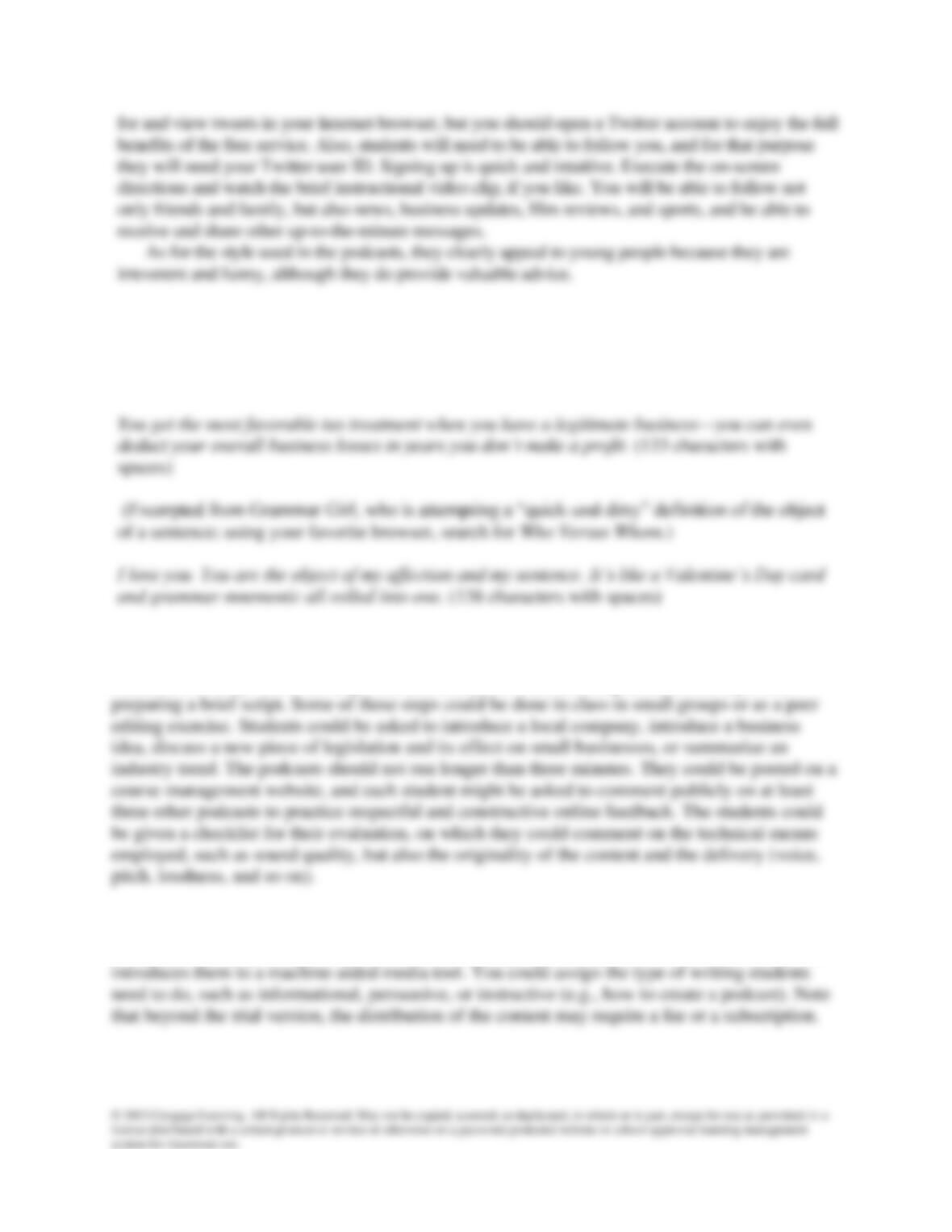
Example of a tweet or brief text message:
(Excerpted from Money Girl, who is discussing the advantages of turning one’s hobby into a
business; using your favorite browser, search for Money Girl: How to Turn a Hobby into a
Business for more information.)
7.10 Creating a Simple Business Podcast (Obj. 3)
Answers will vary. It will be helpful to assist students with selecting the business topic and
7.11 Podcast: Turning Text to Video in a Jiffy (Obj. 3)
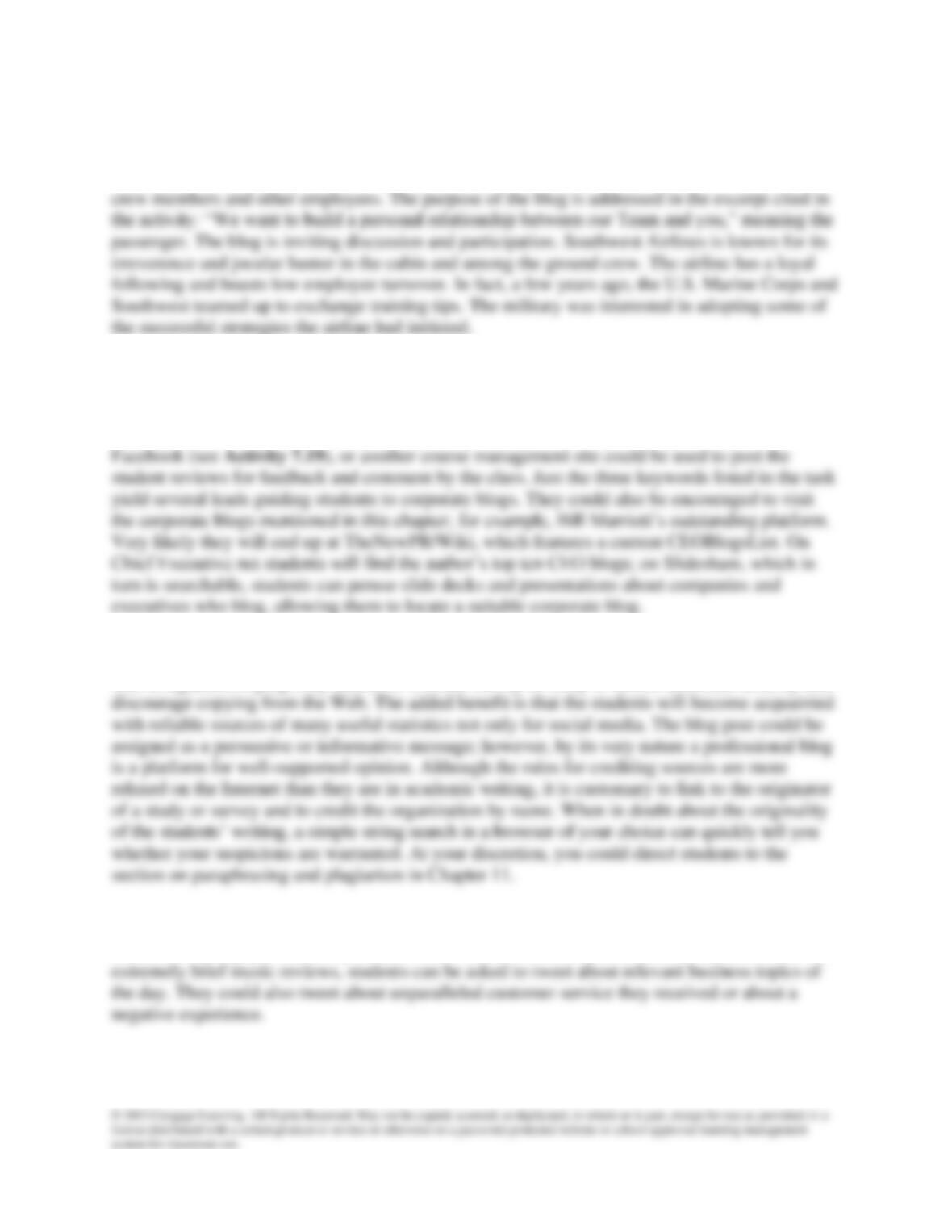
Although strictly speaking, students are not producing a podcast, Article Video Robot playfully
Chapter 7 Solutions 57
7.12 Analyzing the Nuts About Southwest Blog (Obj. 4)
The tone of the guidelines is friendly, irreverent, and deliberately not worded like the typical
“fine print.” The language is conversational and the writers present themselves as rank-and-file
7.13 Reviewing Corporate Blogs (Obj. 4)
This assignment allows for a variety of activities. Students could be asked to evaluate a blog
verbally or in writing—in memo form, by e-mail, or as a blog entry. Additionally, Blackboard,
7.14 Composing a Personal Blog Entry (Obj. 4)
This assignment is purposely limited to a recent survey or study to ensure academic honesty and
7.15 Writing Superefficient Tweets (Obj. 5)
Students may enjoy this activity because it invites their creativity in a familiar area. After the
58 Chapter 7 Solutions
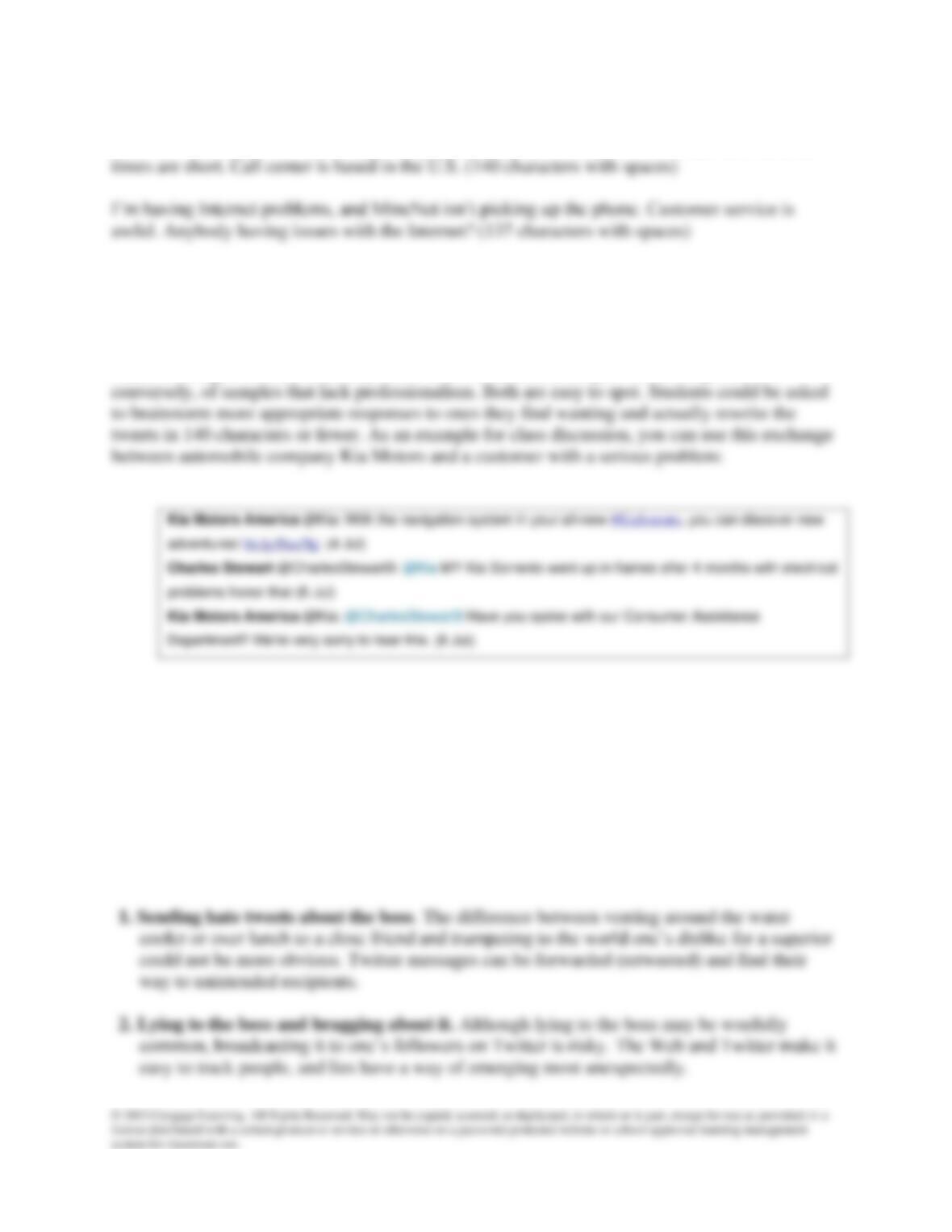
Examples:
AllComm’s customer service is super responsive. They often don’t know the answer, but hold
7.16 Twitter Communication Audit (Obj. 5)
This type of tweet analysis, or “Twitter audit,” can be accomplished in various ways. Students
could be tasked with examining the Twitter interactions of one particular company or several
organizations in the same industry (for instance, automobile companies, airlines, and
manufacturing). Alternatively, they could look for random examples of deft responses or,
Kia Motors replied to the customer’s tweet on the same day; however, the glaring grammar
mistake and lack of specific help (failure to indicate the link or phone number to contact
Consumer Assistance) does not make this an ideal response. Students could ponder questions
such as these: Can a company sufficiently address such a grave complaint in 140 characters? Can
such a post following a promotion for an automobile seriously affect sales or the car maker’s
image?
7.17 What? You Tweeted THAT? (Obj. 5)
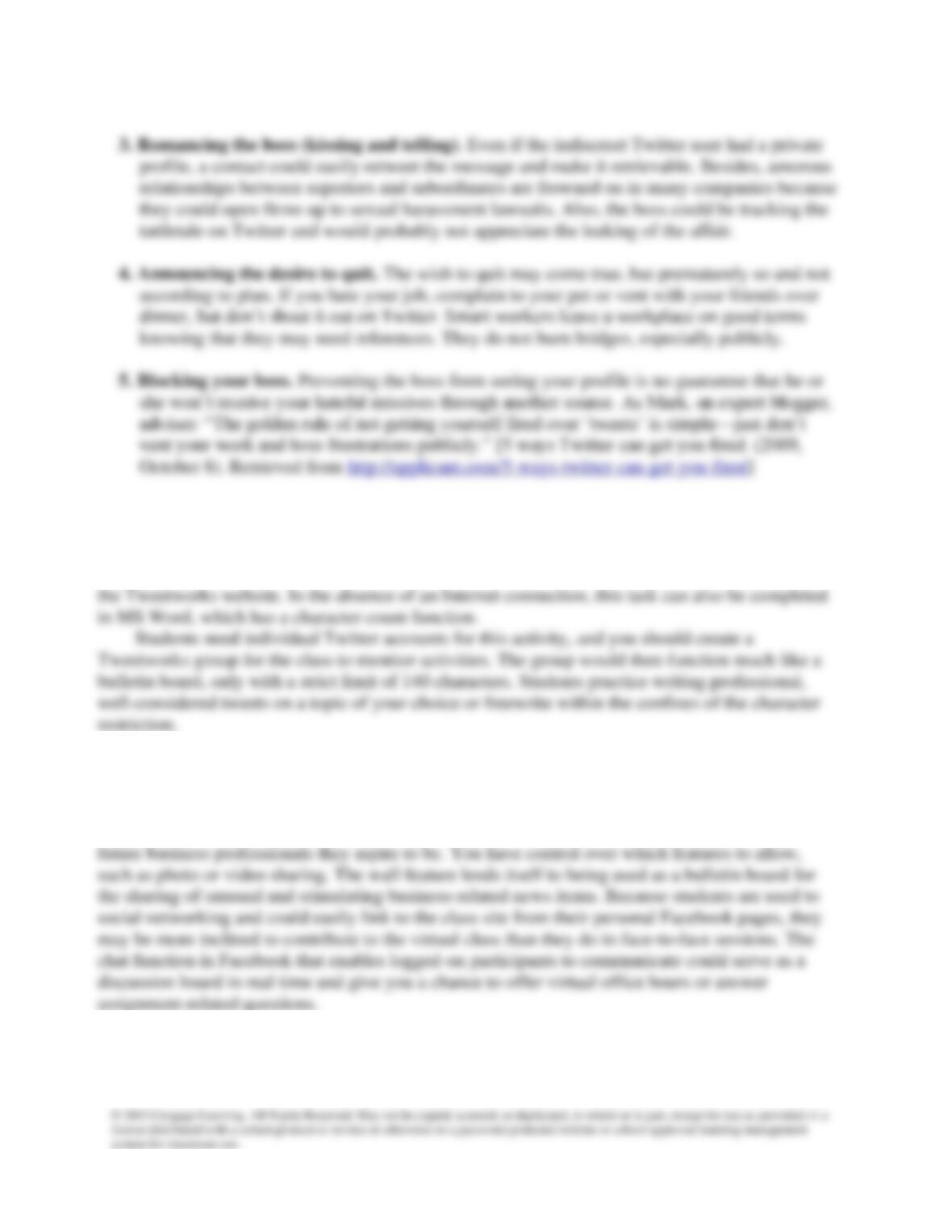
Answers will vary, but here are a few possibilities:
Chapter 7 Solutions 59
7.18 Creating a Twitter Group (Obj. 5)
This Twitter assignment requires that students write ultrabrief tweets on a predetermined topic or
communicate freely in 140 characters or fewer without abbreviations and grammatical errors on
7.19 Building an Online Community on Facebook (Obj. 5)
A business communication Facebook site could be a useful tool to teach students the responsible
use of social networking. The public setting of the site would demand that they behave like the
7.20 The Dark Side: Hooked on Social Media? (Obj. 5)
60 Chapter 7 Solutions
Answers will vary, but most students will probably agree that they would consider it a hardship
having to relinquish their cell phones even for a day. In the Maryland study, students felt that
7.21 Entrusting Your Data to the Cloud (Obj. 5)
Most students are likely to be using Facebook, Pinterest, and other social media networks daily.
Chances are that students are using Google Docs, Yahoo, or Gmail. They may be familiar with
Picasa, Flickr, and other photo-sharing applications on the Web. If students bring up file-sharing
networks, they should be warned that file sharing is taboo in the workplace and could lead to
prosecution. Being able to back up data to Dropbox, Barracuda, Carbonite, or one of the many
other online backup services is clearly an advantage, especially if users can access this information
from any device they choose.
Businesses are struggling with the security risks associated with the growing comingling of
personal and corporate apps on mobile devices. A recent Facebook snafu changed e-mail addresses
in people’s contact lists to the @facebook.com domain, and some messages never made it to their
intended recipients. Businesspeople may not even realize that they are sending sensitive company
data to someone’s Facebook account or a similar Internet service instead of a more secure
corporate address.
Chapter 7 Solutions 61
Clearly, not all information is created equal. Family photographs “leaked” on the Internet
are not as significant a breach as confidential company data. Embarrassment or worse could result
from the unwanted exposure of sensitive earnings or merger information to prying eyes.
7.22 Creating Fair Digital Media Policies (Obj. 5)
Many employers resign themselves to the fact that employees will spend a certain amount of time
during the workday online shopping and visiting social media sites. Some have accepted that
Arguments for allowing personal use of social media on the job:
Depending on the job, workers take their work home and on the road. Asking them to stay away
from the Internet at the office while also requiring them to work long hours away from the office
seems unreasonable. Even at the office, monitoring traffic to websites, chatting, texting, Facebook
Arguments against allowing personal use of social media on the job:
Recreational activities, as well as unintentional yet careless miscues, can gobble up precious
62 Chapter 7 Solutions
7.23 Discussing “Cool” Social Media Jobs (Obj. 5)
Answers will vary. The characteristics the individuals with exciting jobs share are that they have