Instructor Resource
Neuliep, Intercultural Communication, 8e
SAGE Publishing, 2021
Lecture Notes
Chapter 7: The Verbal Code
Learning Objectives
7.1. Explain the relationship between language and culture
7.2. Explain what makes the structure of the human language so unique
7.3. Compare and contrast elaborated and restricted codes
Chapter Outline
I. The Relationship Between Language and Culture
A. Sapir-Whorf Hypothesis
i. Sapir’s thesis: The language of a particular culture directly influences how
iv. The Sapir–Whorf hypothesis delineates two principles:
a. Principle of linguistic determinism: The way one thinks is
determined by the language one speaks.
b. Taken at its extreme, this principle means that if we don’t have a
word for it, then we can’t think about it.
c. Principle of linguistic relativity: Asserts that the world’s languages
are all very different and that these differences among languages
are reflected in the differences in the worldviews of their speakers.
v. Issues of cross-cultural communication: If how we think is a reflection of
the language we speak, then the speakers of two different languages must
Instructor Resource
Neuliep, Intercultural Communication, 8e
SAGE Publishing, 2021
think very differently. This could render effective and successful
intercultural communication extremely difficult, if not impossible.
vi. Languages reflect non-verbal elements: The reason the vocabulary and
grammar of a particular language differ from others is because languages
reflect nonverbal elements of culture.
II. The Structure of Human Language
A. Languages: Systematic sets of sounds, combined with sets of rules, for the sole
purpose of communicating.
B. These sounds are represented symbolically in the language’s alphabet.
C. Hangul: The Korean script, called Hangul, consists of 16 consonants—of which
there are five basic forms—and 10 vowels.
D. Japanese script: To be able to read a Japanese newspaper, you would need to know
and understand at least 2,000 basic characters.
i. The Japanese also have two phonetic alphabets, called hiragana and
katakana.
E. Sounds and Symbols
i. Phonemes: Smallest units of sound, as in consonants or vowels.
ii. Morphemes: Smallest meaningful units of sound; combinations of
phonemes.
iii. No intrinsic relationship: There is no natural or inherent relationship
between the sounds and their accompanying alphabet.
Instructor Resource
Neuliep, Intercultural Communication, 8e
SAGE Publishing, 2021
F. Syntax and Universal Grammar
i. Syntax: Along with a system of sounds, all languages have a set of rules for
combining the sounds to create meaning. The set of rules, or grammar, is
called syntax.
ii. Language is biological: Chomsky maintains that the languages spoken on
the planet today are all dialects of human language and that it has all the
properties of normal physical growth.
a. Thus, in essence, Chomsky and others are arguing that language is
biological.
v. Fundamental syntax is universal: The commonalities between different
languages are so striking that Chomsky and other linguists are convinced
that the fundamental syntax for all languages is universal and that the
particular languages of any given culture are simply dialects or subsets of
the universal grammar.
vi. Gleitman’s arguments: Lila Gleitman puts forward two additional
arguments in favor of the universality of language:
vii. All human languages are somewhat different: For example, the word
order for a sentence in most European languages is subject–verb– object, as
in the sentence, “I watch television.” In Japanese, however, the order is
subject– object–verb, as in the sentence, “I television watch”.
G. Universals of Language
Instructor Resource
Neuliep, Intercultural Communication, 8e
SAGE Publishing, 2021
b. Speech sounds are emitted in all directions from their source of
origin, making it possible to determine the location of the source.
f. Human speech has only a single function—that is, to communicate.
g. Speech can be displaced from time and space.
h. What a person may say can be completely false.
H. Generative Grammar: The idea that from a finite set of rules, a speaker of any
language can create or generate an infinite number of sentences, many of which
have never before been uttered.
i. Restriction of human thought: Human thought is restricted by the
vocabulary of one’s language.
I. The Gendering of Language: Are Languages Sexist?
i. All languages distinguish between genders.
III. Elaborated and Restricted Codes
A. High- and low-context cultures: Persons in high-context cultures generally rely
more on their nonverbal code than on their verbal code to communicate, whereas
members of low-context cultures rely extensively on the verbal code during
communication.
Instructor Resource
Neuliep, Intercultural Communication, 8e
SAGE Publishing, 2021
C. Social context of communication: It sets up the boundaries for the type of speech
that is preferred, obligated, or prohibited.
i. As the social context varies, the speakers of the language will generate
different kinds of speech, even if they speak the same language.
ii. The social system delimits the speaker’s options in terms of language use.
D. Bernstein identifies two types of linguistic/speech codes: elaborated and restricted.
i. Restricted code: It is one wherein the options are limited as to what the
speakers can say or do verbally.
ii. Elaborated code: A cultural context in which the speakers of a language
have a variety of linguistic options open to them to explicitly communicate
their intent via verbal messages.
IV. Cross-Cultural Communication Styles
A. Different language acquisition stages: Stella Ting-Toomey argue that at different
language acquisition stages, children learn not only the structure and lexicon of
their culture’s language but also the various styles of language interaction unique
to their culture.
B. A culture’s verbal style: Gudykunst and Ting-Toomey describe a culture’s verbal
style as its tonal coloring of a message, communicated through shades of tonal
qualities.
C. Four verbal communication styles:
D. Direct and Indirect Styles
i. Direct style: Manner of speaking in which one employs overt expressions
of intention.
Instructor Resource
Neuliep, Intercultural Communication, 8e
SAGE Publishing, 2021
b. In high-context cultures, there is no need to articulate every
message. True understanding is implicit, coming not from words
but from actions in the environment.
iii. Japanese communication:
a. Belief among Japanese that verbalizing deep feelings spoils their
value.
E. Elaborate, Exacting, and Succinct Styles
i. Levels of volume of talk:
a. Elaborate style: Mode of speaking that emphasizes rich, expressive
language.
ii. Related to contexts and codes: The use of an elaborated, exacting, or
succinct style is closely related to Hall’s high– and low-context
communication and Bernstein’s classification of restricted and elaborated
codes.
F. Personal and Contextual Styles
i. Personal style: Manner of speaking that relies on the use of personal
pronouns and stresses informality and symmetrical power relationships.
a. This style is often seen in individualistic cultures.
ii. Contextual style: Role-centered mode of speaking in which one’s choice
of messages is influenced by one’s relative status in the conversation.
Instructor Resource
Neuliep, Intercultural Communication, 8e
SAGE Publishing, 2021
b. According to Hooker, through most of Japanese history, learning
the language meant experiencing and reinforcing the social
differences that ordered society.
c. In addition, Hooker notes, Japanese honorifics are a gendered
system.
G. Instrumental and Affective Styles
a. Verbal expressions are insinuated and quite subtle.
b. Affective speakers often operate on an intuitive sense and are
nonverbally expressive.
iii. Chinese communication: It is also said to be more effective than
instrumental.
V. Gendered Language Style Across Cultures
A. Establishment of social identity: The members of any speech community conform
to the prescribed rules of their specific language or dialect to establish their social
identity.
B. Hillary Brass’ observation:
i. Japanese Women’s Language (JWL) is a clearly defined subset of Japanese
language.
ii. JWL, or joseego, is considered the ideal form of female communication.
C. Marjorie Chan’s observation:
i. Chinese men and women differ in their pronunciation of standard Mandarin
Chinese.
Instructor Resource
Neuliep, Intercultural Communication, 8e
SAGE Publishing, 2021
ii. Women, she notes, are more sensitive than men to proper pronunciation
because it may elevate their perceived status in the social hierarchy.
iii. Chan also notes that those who pay the least attention to proper
pronunciation are younger Chinese men who hold positions of power in the
Revolutionary Committees of the government.
VI. Language and Ethnic Identity
A. Yordin: A term with negative connotations that refers to Israelis living abroad.
B. Use of language intraculturally: Intraculturally, the use of language can mark a
person as a member of a particular group.
C. Shirley Weber asserts that Ebonics is critical in fostering Black identity in the
United States for at least three reasons:
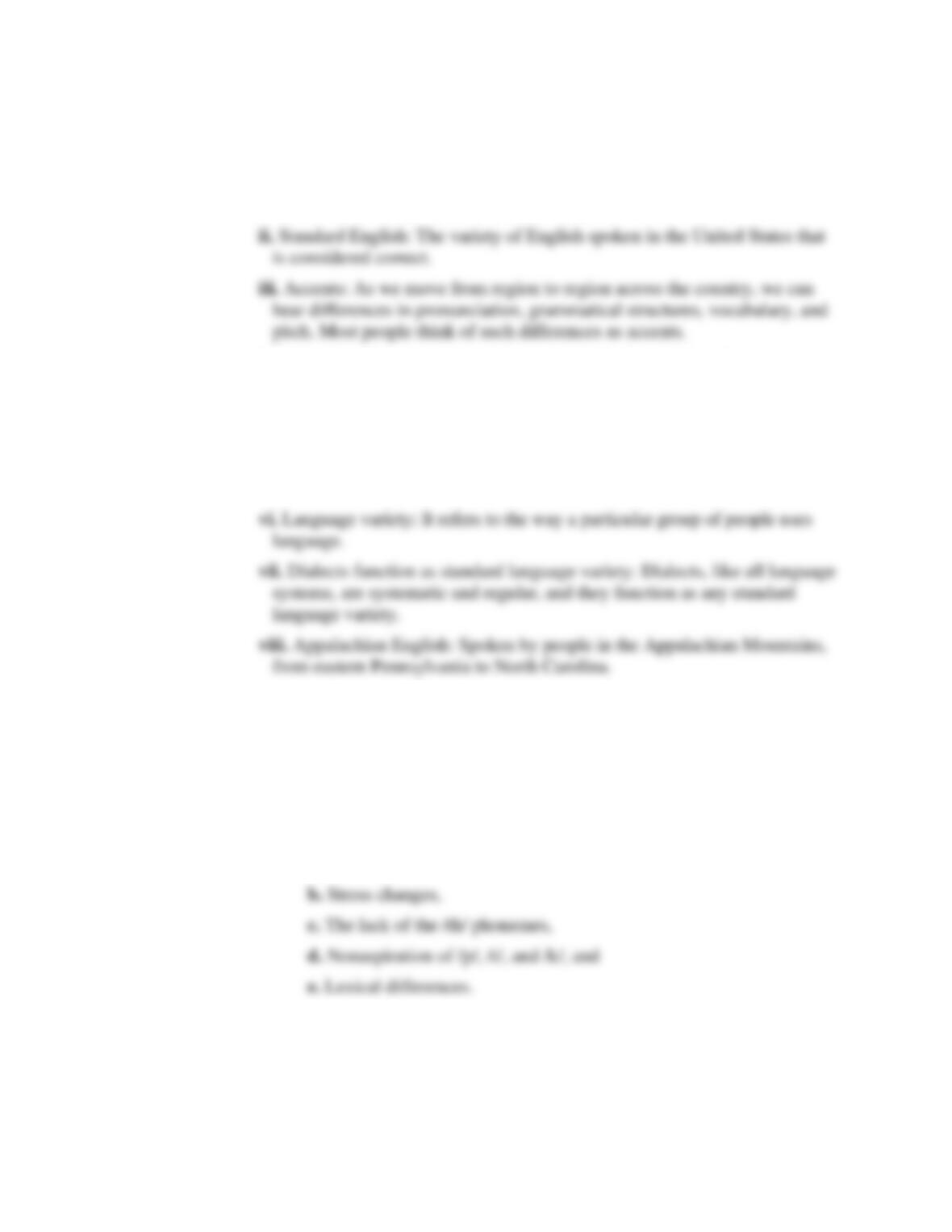
D. Dialect: A language variety associated with a particular region or social group.
E. Immigrants from Mexico: As immigrants from Mexico settled in California and
other parts of the Southwest, they soon formed communities of people who spoke
only Spanish.
F. Chicano English: It is one of the English dialects available in the United States for
native speakers to learn.
Instructor Resource
Neuliep, Intercultural Communication, 8e
SAGE Publishing, 2021
G. Do You Speak “American”?
i. English used in the United States: MacNeil discovered that the English
used in the United States differs considerably from region to region, among
ethnic and social groups, and by age and gender.
iv. Slang: It refers to words or expressions typically used in informal
communication.
a. Slang words often do not last long, and other slang replaces them.
v. Jargon: Jargon refers to the specialized or technical vocabulary used by
persons in the same group, such as doctors, lawyers, computer specialists,
and so on.
a. Perhaps the most distinctive feature of this dialect is a-prefixing.
b. The a-prefix can occur only with verb complements, not with -ing
participles that function as nouns.
ix. Cajun English: Describes the variety of French spoken in southern
Louisiana.
x. Five features distinguish Cajun English:
a. Vowel pronunciation,
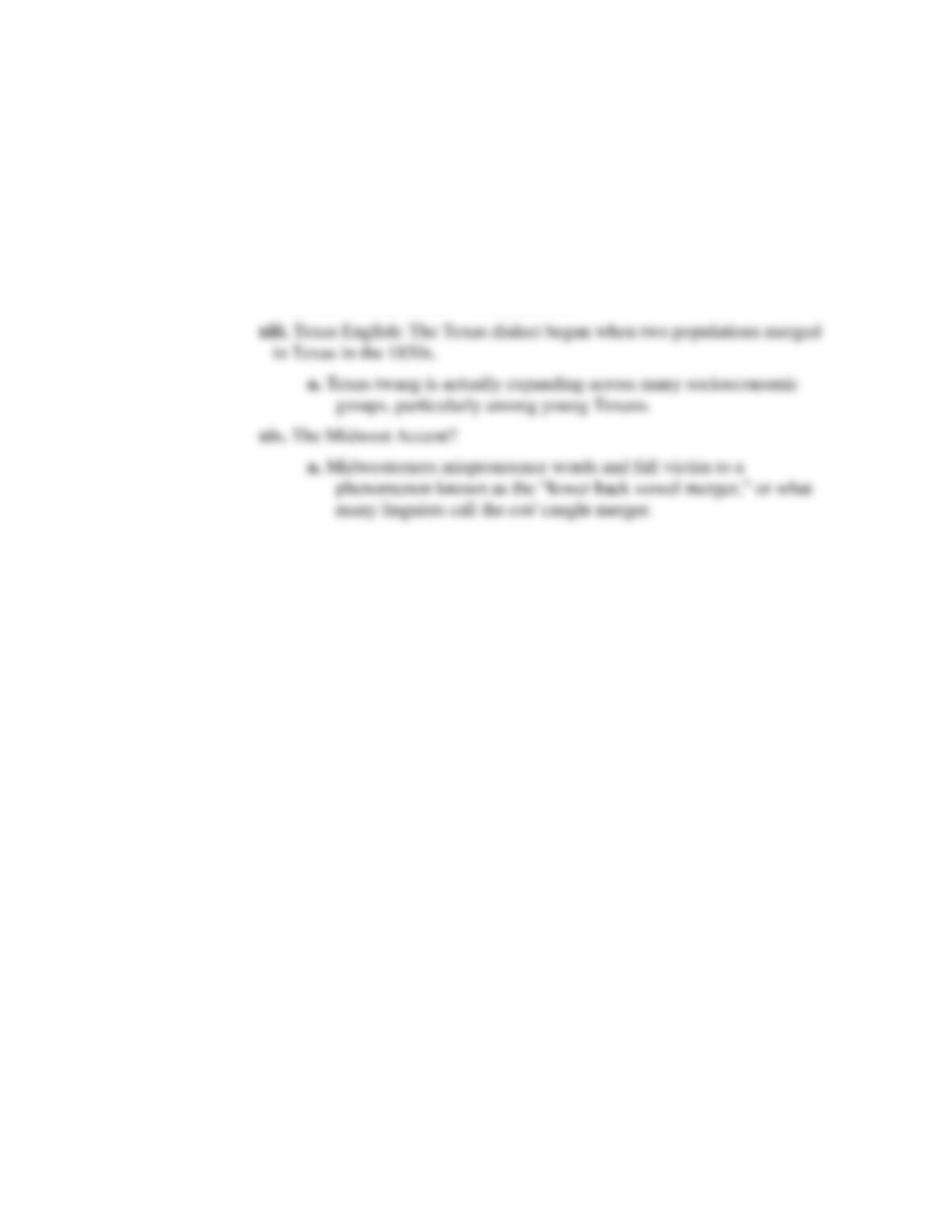
xi. R-Less or R-Dropping Dialects:
a. Regional differences in how the r sound is pronounced distinguish
one dialect from another.
Instructor Resource
Neuliep, Intercultural Communication, 8e
SAGE Publishing, 2021
b. The r sound before a vowel is pronounced much the same way
across the United States.
c. But in many dialects of the East Coast, the r sound before a
consonant is dropped and speakers of such dialects lengthen the
preceding vowel sound.
xii. California English: California is diverse ethnically, with substantial
Black and Hispanic populations; thus, the stereotypical Valley Girl dialect
is spoken mostly by the White population.