CHAPTER FIVE: MESSAGE: CONTENT AND ARGUMENT
The learning goal of this chapter is to teach students how to construct a crisp, clear, and well–
supported argument.
This chapter requires students to examine all the factors involved in defining and shaping the
core content of their argument. The suggested case, Cuttyhunk (A), offers a good opportunity to
Teaching CUTTYHUNK BANK (A)
Cuttyhunk offers a chance to teach message design from several angles. It captures the very
frequent business situation where, while we’re aware of the consequences of misguided or
misreported messages, we’re not sure who said exactly what to whom. It invites discussion of
message interpretation as well as message design, and this distinction can be an effective
closing for the class: How can you design your message so it’s heard?
Cuttyhunk leaves unclear exactly what Wilson said to Brock. Possibilities range from a mild
suggestion that stockholders shouldn’t be worked up to a direct order to discourage them from
attending the meeting. Key issues the class should address:
1. What message did Wilson give to Brock? How could Brock have thought through his
initial message more clearly?
This class allows the instructor to draw a number of students into the discussion, since everyone
will have an opinion of who’s at fault and what should be done. One approach: Assign several
students presentation responsibilities at the beginning of the case discussion. For example: have
the opener describe what went wrong, have a respondent comment on the opening, and assign
another student to follow this debate and speak later on “What should we do next?”
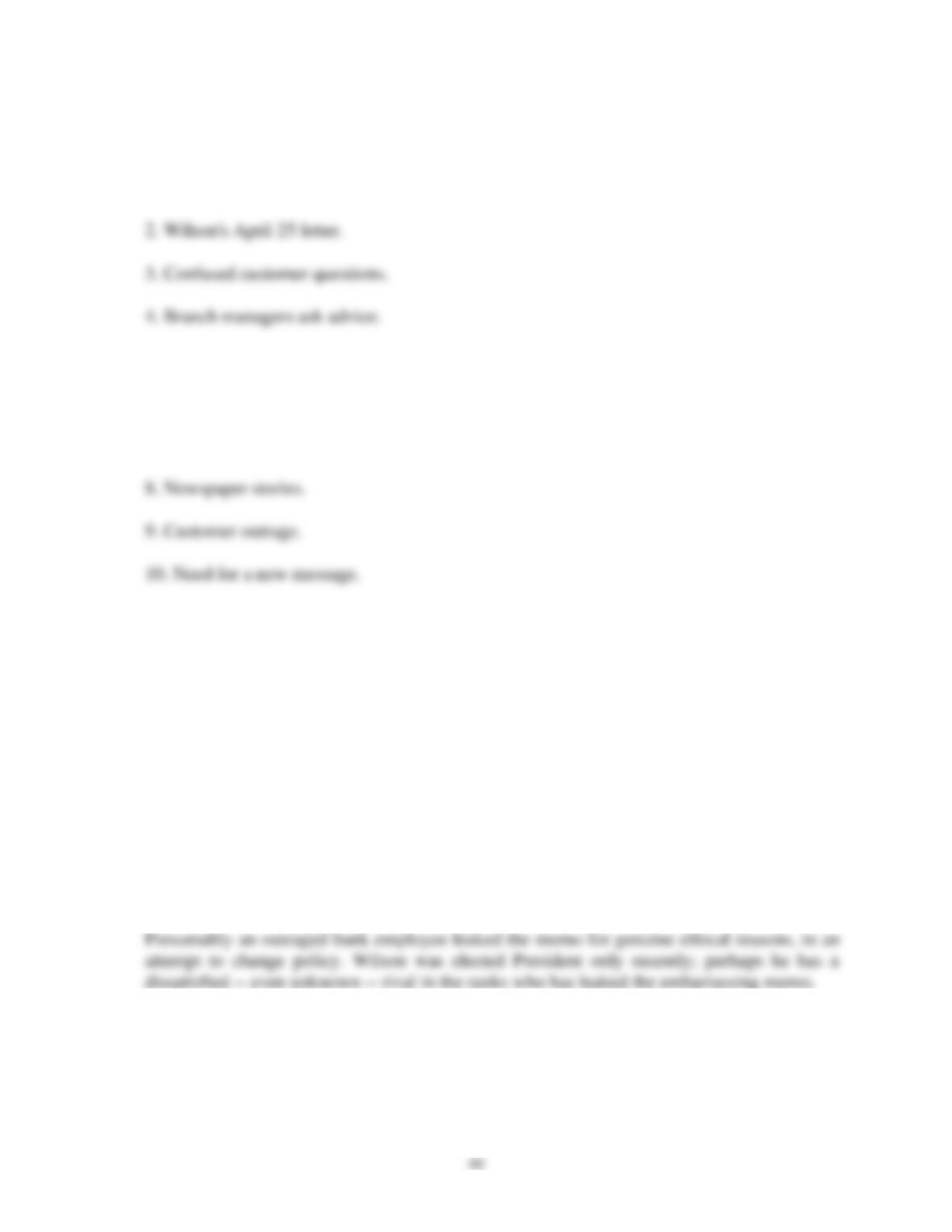
After the opening and response, ask the class to step back. Get the sequence of events up on a
chalkboard to set a frame of reference. After ten minutes of discussion, this might look like:
1. Legal Notice of Meeting.
2. Wilson’s April 25 letter.
5. Brock-Wilson conversation.
6. Brock memo.
7. Press leaks.
8. Newspaper stories.
Even this simple chronology makes the point that almost every message provokes a response and
creates the need for another message.
After the opening response and some initial discussion, look at the April 25 letter. What about it
caused the chain of problems? Among other faults, it’s passive, wordy, dictatorial, and, most
important, doesn’t make much use of logic, evidence, or argument. Then read Brock’s memo
aloud and ask, “What’s wrong with it? Is this what Wilson meant? Has anyone seen a similar
situation where a subordinate went too far in honestly trying to carry out the boss’s wishes?”
Other questions that can help students focus on the importance of message design include:
1. Is this a simple error, or an institutional climate?
2. How did the message leak? This can provoke some especially interesting discussion.
3. How can Wilson ensure this doesn’t happen again?
4. Should Wilson punish or fire Brock?

31
5. Are the proposed changes truly beneficial to stockholders?
6. Does this crisis actually offer Wilson an opportunity to create a new communication culture
for Cuttyhunk? How?
7. Have you seen a well-meaning piece of communication end up in the wrong hands? What
were the consequences?
During this discussion, the instructor can build a grid on the board to concentrate students’
attention on what message to design next, for example:
Goals
Audiences
Messages
Media
Feedback
calm
people
customers
benefits of
change
letters
response line
markets
Harbor State
please come
annual meeting
employee
briefings
achieve
merger
press
interviews
prevent run
on bank
government
regulators
Cuttyhunk’s
history of service
Now the instructor can hand out Cuttyhunk (B) (below), the May 14 letter. How well does it do
its job? Wilson will now have to speak at a no-doubt well-attended annual meeting. Based on
this analysis, how should he design his message? The discussion may invite some of the
following observations:
1. While Wilson clearly means well, he often buries important points in rather
bureaucratic language.
end bad
press
potential
customers
apology
speeches
meetings
financial
error
hot line
4. Wilson’s tone in explaining that customers haven’t been showing up at meetings risks
sounding accusatory.
5. Wilson might be clearer about why a reasonable 1983 business decision needs to be
In short, Wilson’s letter is directed at people who understand the banking industry as well as he
does. This offers the instructor an opportunity to stress that managers repeatedly make this sort
of mistake: failing to analyze their actual audience. Another point for the instructor to keep in
Suggested Assignments. This case can lend itself to several assignments: editing Brock’s memo
33
Cuttyhunk Bank (B)
From the desk of Richard G. Wilson, chairman and chief executive officer, came the following
letter, which was sent to all the customers of Cuttyhunk Bank:
May 14, l986
Dear Member:
As you have probably read in the Boston newspapers, a recent memo sent to branch
managers gave the impression that Cuttyhunk Bank’s management did not want members to
attend the May 27 special meeting. On the contrary, we hope that every member who is
Harbor State Bank is a small, state-chartered mutual savings bank located in Boston. It has
been determined by the management and Trustees of Harbor State Bank, with the encouragement
of state bank regulatory authorities, to pursue a merger with Cuttyhunk Bank. As I stated in my
April 25th letter, this will have no impact whatsoever on your relationship with Cuttyhunk Bank.
Members (depositors and borrowers) of a federal savings bank are entitled to attend the
annual meeting to hear a report on the bank’s progress in the previous year and its plans for the
When Cuttyhunk Bank converted to a federal charter in 1983 after more that 150 years as a
Massachusetts-chartered mutual savings bank, we genuinely believed the move would benefit the
34
Unfortunately, none of our expectations was realized. We no longer believe out-of-state
mergers are a necessary part of our strategic plan, because our own back yard is such a fertile
field and the Massachusetts banks may now expand to other New England states. Even more
important, we have found that the Home Loan Bank Board’s regulations and policies conflict
with our business strategies. Cuttyhunk Bank intends to expand both commercial real estate and
Federal Home Loan Bank Board regulations severely limit commercial lending to Trustees.
We, too, firmly oppose “sweetheart” insider deals, have made none, and will make none.
Nevertheless, Cuttyhunk Bank is prohibited from having the benefit of the business judgment
better.
These are the two principal ongoing reasons for our wanting to return to being a bank
35
Possible Assignment:
Argument Exercise: Cuttyhunk Bank (A) and (B)
Be ready to discuss the issues below and to compare your argument models
with those of other in a small group.
2. What should be the chief message and goals of the May 14 letter? In your view, will the
letter achieve those goals?
3. Identify the main arguments (explicit or implicit) of the May 14 letter. Display one in
5. In hindsight, how should the bank have announced and explained the Special Meeting of the