Chapter 5: Ideas & Materials for Instruction
CHAPTER 5: Developing Significant Topics
Overview Learning Objectives Ideas for Instruction
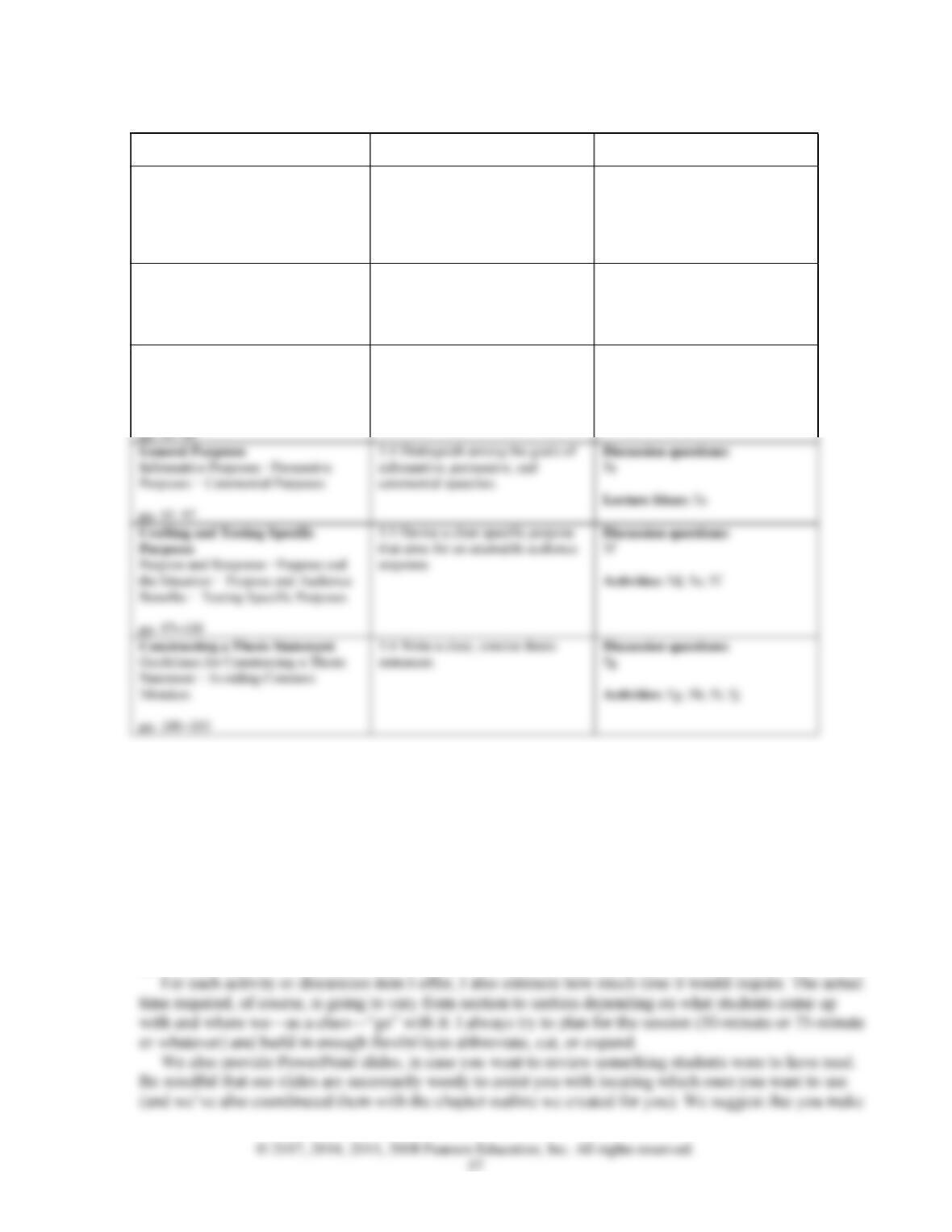
Finding a Suitable Topic
Finding Topics of Public Concern ·
What Matters to You? ·Conducting a
Personal-Inventory
pp. 87–91
5.1 Generate significant speech
topics.
Discussion questions: 5a ; 5b
Activities: 5a; 5b
Lecture Ideas: 5a
Narrowing the Topic
Consider the Situation ·Consider the
Audience
pp. 92–93
5.2 Revise and narrow your topic. Discussion questions: 5c
Activities: 5c
Ethical Obligations in Selecting a
Topic
Accuracy ·Objectivity versus
Subjectivity ·Taste and Judgment
5.3 Determine how ethical
considerations affect your choice of a
topic.
Discussion questions:
5d
Lecture Ideas: 5a
Ideas for Instruction
As noted elsewhere, you will not be able to cover everything in the text—nor should you attempt to (i.e.,
“The more we teach, the less they learn.”). I always “assume” students have read the assigned reading and
that my job as an instructor is to highlight a few, select ideas from the reading (or to introduce
supplemental material) for students to contemplate, reflect upon, and apply. My goal is to help them build
meaning and internalize what they have learned, retaining it for future use.
What follows are ideas for how some material might be treated through discussion and activity. My
selections are ones I typically highlight in my own classes—depending on how much time I have to
devote to a chapter. In light of larger class sizes (which require more days per speech round), I rarely can
spend more than 50 minutes per chapter. There are only so many days in the semester, after all.
Chapter 5: Ideas & Materials for Instruction
the slides “your own” by editing them down to select words and phrases. We recommend, as well, that
you adhere to the various principles outlined in Chapter 12 (pp. 247 & 252–54) for effective use of
PowerPoint. Not only will you remain consistent with the text, but you’ll be modeling best practices for
your students.
Discussion Questions. Use these to stimulate discussion and prompt reflection. As students process the
Discussion Question 5a
Approximate time required: 3–5 min.
Why is it a good habit to read widely about the issues that affect your community, the nation, and the
world?
With such exposure, a speaker is better equipped and more able to identify a good potential speech
topic and focus. In addition, he or she will already have some understanding of the topic and the
Discussion Question 5b
Approximate time required: 3–5 min.
Based upon what you’ve read thus far in the text (e.g., “Preparing for Critical Listening: Your
Responsibility as a Citizen” in Ch. 2), as well as in this chapter’s readings, how would you evaluate this
statement? “Following local, national, and world news is just as essential to your development as a public
speaker as completing assignments and attending class.”
Discussion Question 5c
Approximate time required: 3–5 min.
According to the text, “Any topic must be appropriate for the audience and the occasion. It must stretch
listeners’ present understanding or perception of your topic or add to their knowledge of your topic” (p.
110). Why must a speaker adhere to this principle?
If a speech expands an audience’s knowledge and assists their contemplation of a subject, they should
find the speech interesting and worthy of their time and attention. They should also think more highly
Chapter 5: Ideas & Materials for Instruction
Discussion Question 5d
Approximate time required: 5–7 min.
What are three ethical considerations one should take into account when choosing a topic? Identify and
explain each.
Accuracy—choose a topic you can learn about. You will need to read widely and otherwise consult
quality sources so that you will know what you are talking about and will not mislead listeners or
provide false information.
Objectivity versus Subjectivity—as you gather information about your topic, you must be willing to
suspend your own biases and to remain open to competing ideas. You have an ethical obligation to be
open to the possibility that what you learn in your research may lead you to modify your initial point of
view.
Discussion Question 5e
Approximate time required: 2–3 min.
Public speaking is always purposeful—aiming to get a response from listeners. What are the general
purposes speakers pursue?
To have an audience better understand something (speech to inform)
To influence listeners’ beliefs, values, and actions (speech to persuade)
To uplift, comfort, and reinforce our common values (ceremonial speech)
Discussion Question 5f
Approximate time required: 5 min.
What is a specific purpose and what is its value to the speaker?
The specific purpose is the response a speaker wants from the audience. It is the target the speaker
identifies, allowing him or her to aim for something, rather than talk aimlessly. By formulating a
specific purpose, the speaker achieves focus.
Discussion Question 5g
Approximate time required: 3 min.
What is a thesis statement and what is its value to the speaker and to the audience?
The thesis statement articulates, in a single, simple declarative sentence, the central idea of the speech.
The thesis statement assists a speaker by allowing her or him to judge whether the points do, indeed, fit
with the idea being advanced overall. If they do not, then one or more points may need to be revised, or
Chapter 5: Ideas & Materials for Instruction
perhaps the thesis statement, itself, needs to be revised so that it will align with the points. In this
manner, the thesis statement imparts the collective idea of the points and helps create a coherent whole.
(Development, in turn, is judged similarly against the point under which it falls, and the point is judged
against the development for its accuracy and precision.)
were to have learned from other chapters.
Activity 5a
Approximate time required: 5–7 min.
Have students work in small groups to produce a list of topics they do not want to hear about in a
classroom speech. Have students rank their entries, with “one” designating the most repulsive topic.
After 2–3 minutes (which is all it should take!), have each group contribute its top three, and keep a
quick, running inventory on the board. Discuss each item and how it might be problematic. Also entertain
whether any topic area might be salvageable if given a different focus or bent. Proceed until all entries
have been contributed and discussed.
This lively activity (which is best done toward the end of a class period) can help sensitize students to the
Activity 5b
Approximate time required: 5 min.
Reserve the last five minutes of class for students to brainstorm, in writing, various topics that might work
well for their next speech. If it is an informative speech, have them answer the following question: “What is
a matter of public interest that I need to learn more about and my classmates likely do, too?” If it is a
persuasive speech, have them answer one of the following: “What is happening outside my immediate
world that is unfair, unjust, or in need of reform?” or “What good things going on in the world deserve
more support?” Instruct them to justify, in a single line or two, why the topic is suitable. Collect their papers
as they leave.
Read through the papers prior to the next class period, adding quick comments about appropriateness or
what a possible alternative might be to something they have identified—even if it is a slight modification to
narrow or redirect the focus.
Chapter 5: Ideas & Materials for Instruction
Activity 5c
Approximate time required: 12–15 min.
The following in-class exercise will help students learn to narrow and focus a topic.
Have students work in groups of four and choose one of the following broad topics:
Security for our schools The environment Political campaigns
Activity 5d
Approximate time required: 15–18 min.
Briefly review the specific purpose, as discussed in the text (see Discussion Question 5f). Next, review
the criteria for what constitutes a good specific purpose (as discussed in the chapter). The following
bulleted items can help facilitate this review (which we also provide on PowerPoint slides).
A good specific purpose:
designates a desired response
After allowing seven minutes or so, proceed through the list, item by item, having a group offer its
critique and suggested revision. Allow other groups to react, and provide some feedback yourself as well.
Rotate among the groups so that each group will take the lead on an item.
I want to talk with my audience about graduated licensing laws for beginning drivers.
I want my audience to understand how the new procedures for obtaining a passport serve
the greater good by improving security.
Chapter 5: Ideas & Materials for Instruction
Activity 5e
Approximate time required: 18–20 min.
After providing the sort of review indicated in Activity 5d, assemble students into groups of four and
have them examine a list of speech topics, such as the following:
Mileage standards for American automobiles
Have each group choose any one of these topics. For each topic have them:
(2) construct a specific purpose statement, making sure it is clear, realistic, & ethical
Instruct each group to have one member record their work on paper, which you will collect later. (Their
work can provide good samples to use in future classes.)
Return to the list of topics and have each group who addressed a particular topic present the specific
purpose they have constructed and why they believe it to be good. Discuss and critique each specific
purpose offered, utilizing the same criteria specified above (i.e., clear, realistic, & ethical).
Activity 5f
Approximate time required: 18–20 min.
After providing the sort of review indicated in Activity 5d, assemble students into groups of four and
have them read a short article, such as “The Doctor Will Skype You Now: Telemedicine Apps Aim to
Activity 5g
Approximate time required: 10–12 min.
As a follow-up to activity 5f, have groups transform one or two of the specific purpose statements they
Activity 5h
Approximate time required: 18–20 min.
Provide an in-class review of the thesis and thesis statement (see Discussion Question 5g). Along with
what is presented in the textbook, you may wish to note that the thesis statement (as with each main point
Chapter 5: Ideas & Materials for Instruction
in a speech) is a generalization. A generalization consists of a subject plus the belief/opinion about that
subject. For example, a generalization regarding the tax code, which could function as a thesis statement,
could be:
Subject Belief/Opinion
The tax code needs only minor revision.
Main points for this sample thesis could include:
I. The current code strikes a decent balance between regressive and progressive elements.
II. Rolling back tax cuts for the wealthiest Americans would improve the balance.
Once you have provided this quick review, assign each student a partner and have them construct a thesis
statement for one of the following topics along with two or three main points to develop the thesis.
Remind them that the thesis statement (as well as a main point) is formulated as a generalization. You
may also instruct students to provide a few, quick specifics to support each main point they’ve offered.
Commuting via mass transit Protecting our borders
After allowing eight minutes, or so, have each pair/group share its work with the class. Critique each
sketch after it’s presented to diagnose the integrity of the thesis statement and the overall coherence of
what is offered. (And you could note, further, how keeping up with news would make this activity easier! See
Discussion Questions 5a and 5b.)
To provide closure, remind students to proceed similarly when they construct their own thesis statements
and sketch out their main points. Remind them to construct each one (i.e., the thesis and each point) as a
Activity 5i
Approximate time required: 12–15 min.
Prepare a handout that contains five flawed thesis statements, such as the ones we provide below. The
flaws should be typical of the violations we see students make:
(1) a statement written as a question
(3) a statement that is complex and hard to follow
(5) a statement that presents several ideas, too many for a single speech
Divide the class into five groups and assign each group a number. Have them diagnose the flawed
Chapter 5: Ideas & Materials for Instruction
new, correct thesis statement. The one they devise should be written as if it were for the next type of
speech to be presented in class.
1. Is health care working well in our country?
2. After examining how our health care system is broken, let’s see what we should do about it.
3. The number of citizens in our country that have health insurance lags behind other industrialized
5. Millions of Americans have no health insurance and others are underinsured and although Canada’s
system of health care is attractive in many ways our best policy would be a mix of government and
private industry along with reforms in education that would promote healthier lifestyles among our
citizens.
Allow seven minutes or so for students to complete the task. Then, have each group report its diagnosis
and recommendation to the class. Note: Follow up (or precede, if you prefer) with a quick review of the
components of a good thesis statement (see Discussion Question 5g). Emphasize that students should allow these
criteria to guide the construction of the ones they will devise for their own speeches.
Activity 5j
Approximate time required: 8–15 min. Relevant pages: 120–123.
Provide an in-class review of the thesis and thesis statement (see Discussion Question 5g). Then have
students work individually to identify their specific purpose and construct a tentative thesis for their next
speech. Remind them that they will be including both on their formal outline. After five minutes or so of
Lecture 5a: Use one or more of the slides from the PowerPoint slideshow that accompanies this chapter
and prepare your own examples as illustrations of the concepts featured on the slide(s). Break up the
Exam Items. Testing, of course, can be an important part of instruction. We provide numerous, high-
Chapter 5: Ideas & Materials for Instruction
**********************************************************
Chapter Outline: Chapter 5: Developing Significant Topics
Chapter Intro:
Randomly choosing a topic can prove disastrous. One must take into account the audience’s
knowledge and interests. One must also come up with a clear focus for the speech.
I. Finding a Suitable Topic
Learning Objective 5.1—Generate significant speech topics.
A. Deciding what to talk about may or may not be one of your initial concerns as
a speaker.
1. In some situations, the topic of your speech will be predetermined.
2. Many times, however, you will be asked to determine your own
topic.
a. In class, you are often assigned a type of speech and you
B. Brainstorming Topics of Public Concern
1. Keeping up with the news and reading widely about important
issues are ways to identify potential speech topics.
3. Your library may have a Library Research Guide available which
can suggest resources and research strategies for developing public
presentations.
C. What Matters to You?
1. The fundamental question is: What do I already know and care
about?
a. This does not mean, “What can I already give a speech
about?”
2. Research is essential to support your personal knowledge,
D. Conducting a Self-Inventory
1. By doing a self-inventory—taking a thoughtful look at what you
2. Begin by brainstorming. Then, proceed to evaluate possible topics
critically.
3. Personal Concerns and Community Issues
a. What is going on in my life that bothers or concerns me
that might have social significance?
4. Intellectual and Educational Interests
a. What do I like to read?
b. What interesting things have I learned from television or
movies?
5. Career Goals
a. What do I hope to do with my life? Does my future career
suggest a viable speech topic?
6. Leisure Activities and Interests
a. Things you do for pleasure or enjoyment may be a source
of topics.
b. However, speeches that some audiences might find useful
or interesting may seem ordinary or trivial to others.
II. Narrowing the Topic
Learning Objective 5.2—Revise and narrow your topic.
A. The first step is to consider your audience carefully and to decide more
precisely what you hope to accomplish.
B. Consider the situation
1. Does the topic I’m considering relate to recent events that may be
C. Consider the audience
1. What does my audience already know?
2. What common experiences has my audience had?
3. What do my listeners and I have in common?
4. How diverse is my audience?
III. Ethical Obligations in Selecting a Topic
Learning Objective 5.3—Determine how ethical considerations affect your choice
of a topic.
Section Intro:
Chapter 5: Ideas & Materials for Instruction
As a speaker, you will draw on your own ethical code in choosing a topic, as well
as in making decisions about how to approach a topic. A good speaker integrates
ethical concerns into the whole process of preparing to speak. Some ethical
considerations when choosing a topic include your responsibility for accuracy,
fair-mindedness, good taste, and sound judgment.
A. Accuracy
2. You owe it to your audience to know as much as possible about
your topic.
4. Speaking to influence people carries with it the ethical obligation
to know what you’re talking about and to believe in what you say.
6. Any speech that contains information that is misleading or untrue
is considered unethical.
7. Just as important as the quantity and quality of your information is
the credibility of your sources.
8. Urging people to take actions or modify their behavior in ways that
could have negative consequences is clearly unethical.
B. Objectivity versus Subjectivity
2. As a speaker, you cannot erase your past and approach any topic as
if it had no relationship to your life.
4. You have an ethical obligation to be open to the possibility that
5. Once you have thoroughly researched your topic and come to a
thoughtful and fair conclusion, you can be more confident in
taking a strong, well-reasoned stand on an issue.
C. Taste and Judgment
1. Generally you should avoid topics that audiences might find
embarrassing or offensive.
2. The likelihood of offense increases when the audience is a captive
3. This does not mean that you should avoid controversial topics.
4. You should simply be sensitive to contrary opinions and aware of
the limits imposed by those opinions.
IV. General Purposes
Learning Objective 5.4—Distinguish among the goals of informative, persuasive,
and ceremonial speeches.
Section intro:
As you refine your topic, you try to translate it into a specific statement of the
audience response you desire. The first step in crafting a purpose is to determine
A. Informative Purposes
2. Your goal is to help your listeners understand something that they
did not understand before.
3. After you finish speaking, listeners will not have just heard
something new, they will have learned something new.
B. Persuasive Purposes
2. Persuasive speakers do not just want us to understand their point of
view; they want to influence our beliefs, values, and actions.
4. Persuasive speakers want listeners to feel more strongly about an
issue, to agree with them, or to take some definite action.
C. Ceremonial Purposes
1. Many speaking occasions offer the opportunity for building
community.
2. We may be called upon to honor someone, celebrate an event of
4. When our speaking purpose is ceremonial, we articulate and
reinforce shared values.
V. Crafting and Testing Specific Purposes
Learning Objective 5.5—Devise a clear specific purpose that aims for an
attainable audience response.
Chapter 5: Ideas & Materials for Instruction
A. Purpose and Response
1. Successful speakers think carefully about the desired audience
2. An informative speech should state specifically what you want
your audience to understand.
3. A persuasive speech might take a specific position on any number
of controversies.
B. Purpose and Situation
1. The specific purpose is also shaped by the demands of the
situation, such as recent events.
C. Purpose and Audience Benefits
2. The benefits to the audience should be apparent in the speech.
D. Testing Specific Purposes
1. There are four questions you can ask yourself to determine whether
you have a sound specific purpose statement.
a. Does your purpose statement call for a response from the
audience?
b. Does your specific purpose reflect the realities of the
situation?
c. Several factors should be considered in crafting a realistic
specific purpose:
(2) The probability that your listeners can actually respond
the way you want them to
(4) What kind of impact the setting or occasion may have
on the outcome of the speech
d. Is your specific purpose clear?
e. Is the purpose ethically sound?
VI. Constructing a Thesis Statement
Learning Objective 5.6—Write a clear, concise thesis statement.
Section Intro:
After you have determined your specific purpose, you need to formulate a
declarative statement that sums up the thesis of your speech, sometimes called the
central idea or thesis statement of the speech. This thesis statement will help you
Chapter 5: Ideas & Materials for Instruction
focus your research and plan your speech. If you are successful, the thesis
statement is what listeners will carry away with them—what they will remember
as the heart of your speech.
A. The thesis statement is a single, complete declarative sentence that embodies
the idea that you want the audience to understand or accept in order to
accomplish your specific purpose.
1. It is important that the thesis be declarative—not a question or a
B. The thesis statement should be clear and specific without being so detailed as
to include all your main ideas.
1. The thesis statement is not a summary of all the main points in a
statement.
C. The thesis statement should be focused and limited in scope.
1. You want to be sure that you don’t try to accomplish too much or
too many different things in one speech.
D. Avoiding Common Mistakes
1. Your thesis statement should:
a. not be written as a question or a topical phrase.
e. not present too many ideas for a single speech.
E. Highlighting the Process: From Topic to Purpose to Thesis
2. Consider situational and audience factors.
4. Determine the general purpose.
6. Write a thesis statement.

Chapter 5: Ideas & Materials for Instruction
**********************************************************
Instructional ideas for Chapter Five
___________________________________________________________
___________________________________________________________
___________________________________________________________
___________________________________________________________
___________________________________________________________
___________________________________________________________
___________________________________________________________
___________________________________________________________
___________________________________________________________
___________________________________________________________
___________________________________________________________