77
Chapter 4: The World of Words
Key Concepts
abstract
ambiguous
arbitrary
communication rules
constitutive rules
hate speech
I-language
Indexing
linguistic determinism
loaded language
punctuation
regulative rules
speech community
static evaluation
symbols
totalizing
you-language
Chapter Outline
I. The Symbolic Nature of Language. Our language and many of our nonverbal behaviors
are symbolic.
A. Symbols are arbitrary; there is no natural connection between the symbol and
what it represents so at any point in time, the symbol or what it represents could
change.
II. The principles of verbal communication give us an understanding of how symbols work.
A. Because language and culture reflect each other, we learn a set of values,
perspectives, and beliefs when we learn to speak or read.
B. The Meanings of Language are Subjective–
Because there are no single definitions for symbols, we must interpret them in the
78
2. Constitutive rules define what messages mean in a particular situation by
specifying how to count or interpret specific kinds of communication.
D. Punctuation creates outer limits for what constitutes the beginning and ending of
an interpersonal interaction.
1. A common pattern of conflict involving two people punctuating
interaction differently is the demand-withdraw cycle.
2. Punctuation depends on subjective perceptions.
III. The ability to use and understand symbols has an impact on the lives we lead.
A. Language shapes meaning – We use symbols to define experiences, people,
relationships, feelings, and thoughts.
2. When we totalize someone, our names or labels highlight just one aspect
of a person, object, or event.
B. Language evaluates. Language is value laden and not neutral.
2. Loaded language strongly affects our perceptions, usually by creating
inaccurate negative connotations.
3. Language can degrade others because we are influenced by the names we
have for things.
C. Language organizes perceptions. Symbols help us organize information and
perceptions into categories so that we do not have to remember every aspect of
every person, object, and event we encounter.
1. Language Allows Abstract Thought
2. Language Can Stereotype
79
In categorizing information and perceptions, language can stereotype,
which distorts thinking.
D. We can use symbols to think hypothetically or beyond concrete situations.
E. We can use symbols to label things that have happened in the past, are happening
IV. When a group of people share a set of norms about how to talk and the purposes talk
serves, they form what is called a speech community.
A. Different speech communities use symbols in different ways.
B. Speech communities are defined by shared ideas of how to communicate, not by
geographic locations.
C. Gender is a prominent speech community.
a. From a young age, men and women are socialized into specific gender
speech communities.
V. We can use a set of guidelines for making our verbal communication more effective.
A. Engaging in dual perspective
create and interpret messages with both our view
B. Own your feelings and thoughts.
as describe rather than blame others.
80
1. Awareness of the levels of abstraction can help make our communication
more accurate.
Discussion Ideas
Language shapes and reflects culture: If students are required to take a foreign language at
your university, ask them to find examples of words that do not have a direct translation into
English. What do these words demonstrate about what that culture values that our culture
Speech communities and meaning are subjective: As a class, generate a list of three to five
terms that you are going to use in conversation between now and the next class period. Have
Gender speech communities: As a class, divide into males and females. In each group,
develop words and symbols that you use to define the opposite sex. Have students make a
Labels shape perceptions: If your courses are labeled based upon when students are
expected to take them (e.g., 100 is first year, 200 is second year), ask students to generate a
Symbols evaluate: Ask students to generate a list of neutral symbols/words in our language.
Chances are they will list articles (a, an, the), prepositions (over, under, with), and
Symbols organize: Ask students to describe the campus library or classroom in which you
are sitting if we could not use organizing labels such as chalkboard, stacks, and hallway.
Slang Language: Ask students to interview other individuals of various ages. Ask them to
Rules of the Net, or Netiquette: Use of the internet has acquired its own rules and
conventions for interaction known as netiquette. Lead a discussion about how to apply the
Activities
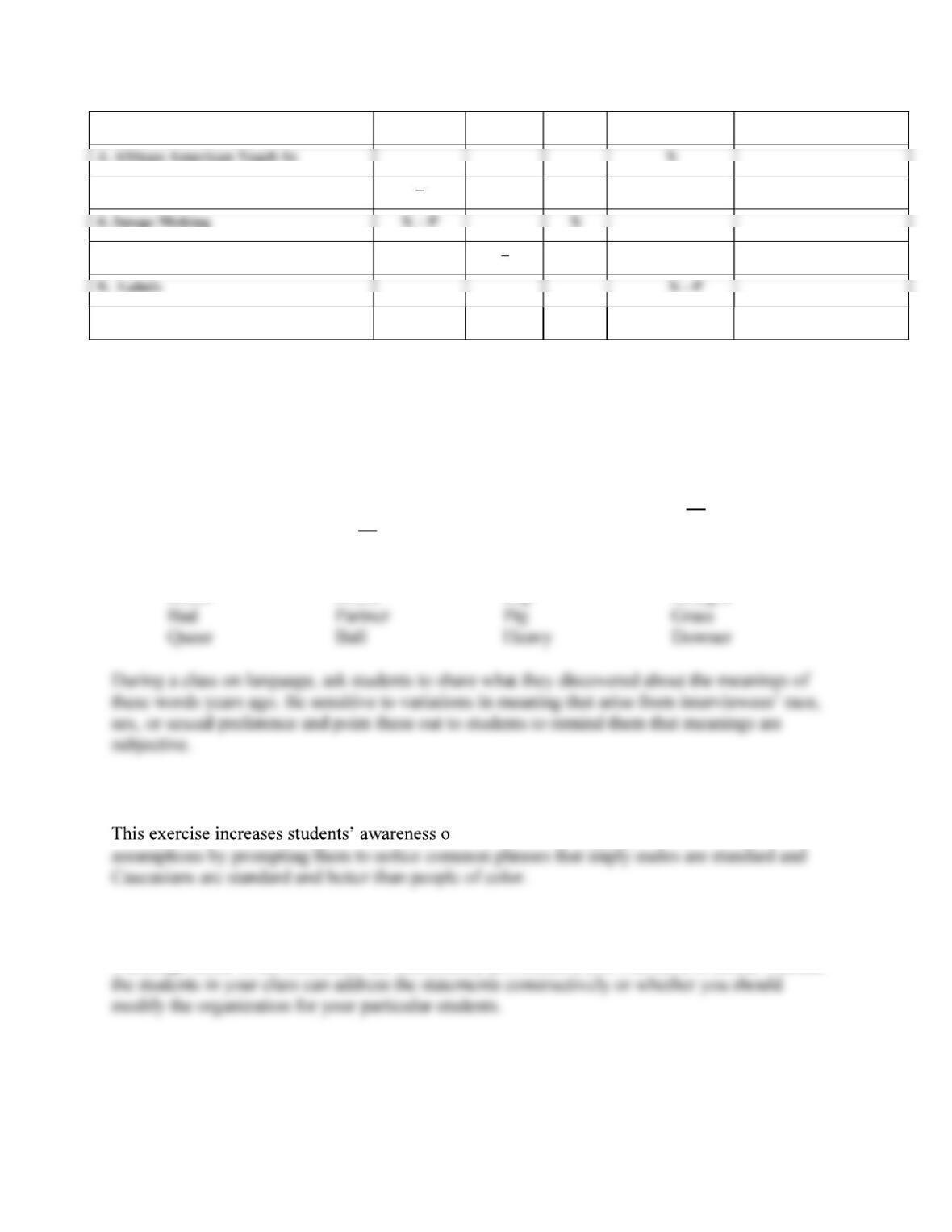
Title Individual Partner/
Ethno
Group Demonstration/
Whole Class
Internet
2. Is Our Language Sexist and Racist? X – H
82
X = Marks type of activity H = Handout P = Preparation required for students/teacher
Then and Now
This assignment gives students insight into meanings and how they change over time. One week
prior to the class period you will discuss the principle that meanings change, and give students
the list of words below. Assign them the task of interviewing two individuals one between 40
and 50 and one over 60 years old to find out what the words meant to them when they were 20.
Black Girl Gay Pot
Chick Crash Rap Straight
Is Our Language Sexist and Racist?
f ways in which language reflects cultural
Give students a copy of the handout titled Is Our Language Sexist and Racist?
Warning: Some of the statements are deliberately provocative; you will need to decide whether
3. Euphemisms X
5. Breaking the Rules X P
7. Chat Room Rules X P X – P
9. Another word for X
83
Here are some of the biases in the statements that you might wish to point out to your students:
1.
husband.
2. Many English terms associate whiteness with goodness and blackness or darkness with
badness (items two and four).
3. Are any women in the street giving interviews?
4.
5. Have you ever heard it described as babysitting when a mother takes care of her child?
is
6.
7.
Euphemisms
connotative meanings of language.
Create groups of five to seven students. On the chalkboard, write the following words:
84
Death Sex Prostitute
Vomit Fight Bathroom
group for other examples of euphemisms. Discuss with students why we use euphemisms what
value do they serve?
African American Teach-In
This activity should enhance non-
communication styles used by African Americans.
Ask four or five African Americans to lead a 20-minute workshop in your class. The African
Americans may be students in your class or on the campus, or non-students. Explain to the guests
Breaking the Rules
It also illustrates the principle that communication is rule guided.
After students have read Chapter 4, instruct them to select one gender prescription for verbal
behavior and to violate it intentionally. Women might interrupt, give minimal responses, not
Image Making
media
shapes our perceptions of people and social groups.

85
Prior to the day you plan to conduct this exercise, either tell students to bring a newspaper to
class on the day of the exercise or save enough newspapers yourself to give at least one and
preferably several to each group.
Assign students to groups of five to seven members. Give each group one or more newspapers if
students were not required to bring their own newspapers. Tell groups they will have twenty
minutes to read and discuss the language used by newspapers to represent women, men, and
racial groups. At the end of that time, each group should have a representative who will explain
such as these: Are men and women news figures described in parallel ways? How often is
marital status and appearance mentioned in stories about members of each sex? When is race
noted in newspaper articles? Is race identified only when the person in the story is not
Cauca
contests given equal coverage? Are women and men athletes described in parallel ways? How
much of each story on women and on men is devoted to athletic accomplishments, appearance,
and personal details?
Chat Room Rules
The purpose of this activity is to learn about regulative and constitutive rules in face-to-face
Before class, go to your favorite search engine, such as www.altavista.com or www.google.com
students distinguish between regulative and constitutive rules. If your class room does not have
internet access, then save the web page to a disk beforehand.
86
students about more formal discussions they may have had (such as a group meeting or in a class
room) and how rules for interaction are communicated.
Variation: When searching for web sites that display their chat rules, pick three different sites
by term: chat
Labels
The purpose of this activity is to show how language can affect our perceptions of other people.
In turn, the labels that we give people can also affect our communication behaviors with others.
Before class, write the following words on note cards or you may type the words on the
computer then print them out and cut them into little note cards: nerd, weirdo, depressed, strange,
retarded, snob, manic, smelly, psychotic, shy, rude, quiet, talk-active, scary, nosy, bossy, pushy,
pretentious, shallow, boring, angry, silly, stupid, argumentative, domineering, needy, defense,
Instruct the students to put a hand over their forehead. In a few moments, each student will
receive a note card, but they are NOT allowed to look at the card. Shuffle the note cards so that
they are random. Tell the students that they will be interacting with a variety of people. Each
87
This activity works for smaller classes. Ask each student to take out a sheet of paper. Have each
student write one word and five words that can be used to describe that one word. For instance, if
Journal Items
Analyze what happened and how you felt when you violated the verbal communication
rules for your gender.
Responses will vary, but students may receive perplexed or confusing looks from others,
Attend a religious service in a church, synagogue, or temple that is attended primarily by
individuals whose race differs from yours. Do not take notes or otherwise appear
disrespectful while in the service, but do observe the communication of both leaders and
the congregation. Afterward, analyze how communication differs in your normal church
and the one you attended.
88
Attend a foreign grocery store, such as an Asian or Indian market in your town. Observe
the communication behaviors that occur among people in the store. Analyze how the
communication patterns are different among people who are Asian/Indian and people
who are a different race.
Answers will vary, but some students will notice various differences regarding language use
Describe verbal communication between you and a close friend or romantic partner of the
other sex. Analyze the extent to which you and the other person follow patterns typical of
women and men in general.
Answers will vary, but students often notice that women tend to provide more verbal
Identify at least one regulative and constitutive rule for interacting in face-to-face
situations, and one of each type of rule when communicating over e-mail. Reflect on
how you learned each of these rules.
Look for students to distinguish between regulative rules and constitutive rules in general.
Identify a situation where there was a huge misunderstanding and how it could have been
prevented.
Answers will vary, but students should be able to identify how words can have a huge impact
89
Panel Idea
Invite one or more relationship counselors to talk with your class. Ask the guest(s) to describe
use to improve verbal communication between partners in romantic relationships.
Invite two or more international students. Ask the guests to describe common language
problems that occurred when they came to the university regarding things such as slang
words and misunderstandings. Ask the guest to describe how they began to understand
the language and what is still hard for them to comprehend.
Invite person who is a leadership position. Asks the guests to talk about how they need to be
clear and concise with their communication with others. Have them talk about how they
communicate in their position.
Media Resources
Web Sites
Name: Careful — The Baby Is Listening
Developer: Detroit Free Press
Brief Description: This article discusses how learning words happens as early as eight months
old.
Name: TechDictionary.com
Developer: TechDictionary.com and a lengthy list of international contributors
Name: SYMBOLS.com
Developer: HME Media.

90
Name: American Sign Language Browser
Developer: Michigan State University Communication Technology Library
Brief Description: Uses QuickTime videos to teach people how to produce certain signs through.
Name: – `Hate-
Developer: Electronic Frontier Foundation
Name: Sensitive Language
Developer: Words@Random
Brief Description: This site has categorized the different topics to avoid when writing or
Name: A Way with Words: Language and Human Nature
Developer: Steven Pinker
Brief Description: This site gives a brief insight into Psychologist Steven Pinker’s book. In his
Name: Before Words: The Link between Praxis and Language Development
Developer: Valarie Dejean
91
Film Ideas
Films such as Ordinary People, Fools Rush In, When Harry Met Sally, and Mr. and Mrs.
Bridge provides extended illustrations of gendered communication styles. You might show all or
parts of either or both films and ask students to take notes on the specific ways in which women
and men embody cultural expectations for gender in their communication.
Tootsie, Mrs. Doubtfire, and To Wong Foo is an excellent film to supplement teaching about
both verbal and nonverbal communication. In Tootsie, Dustin Hoffman does a superb job of
embodying masculine verbal and nonverbal style when he is Michael and feminine verbal and
nonverbal style when he is Dorothy. In Mrs. Doubtfire, Robin Williams also does a great job of
Days of Thunder. This film is essentially Top Gun, but in stock cars rather than Navy fighter
haracter (Cole, a stock car driver) is talking with his
pit crew captain. Cole does not know the technical vocabulary of racing. Look to see how the
Print Resources
He Said, She Said: Exploring the Different Ways Men and Women Communicate, You Just
and Talking from 9 to 5: Women and Men in the Workplace: Language,
Sex, and Power are three books written by Deborah Tannen that deal with gender issues. Both
make excellent books for students to include as part of their popular press book analysis paper.
What theory of gender differences does Tannen base her claims on in these books? How does it
relate to how the issue of gender is discussed in the textbook?
Do You Speak American? is a book that is written by Robert MacNeil and William Cran. This
book illustrates how different parts of the United States use many different linguistic variations
on words. It discusses how American English may be on the decline.
92
Handout: Is Our Language Sexist and Racist?
Read the following 10 statements and discuss each one with the other members of your group.
Determine if each statement contains language that is racist (suggests one race is BEST or the
standard) or sexist (suggests one sex is better or the standard). Propose alternative language for
any sentences you consider sexist or racist in their current form.
2. -w
4.
6.
8.