Chapter 4: Ideas & Materials for Instruction
CHAPTER 4: Diverse Audiences in a Democratic Society
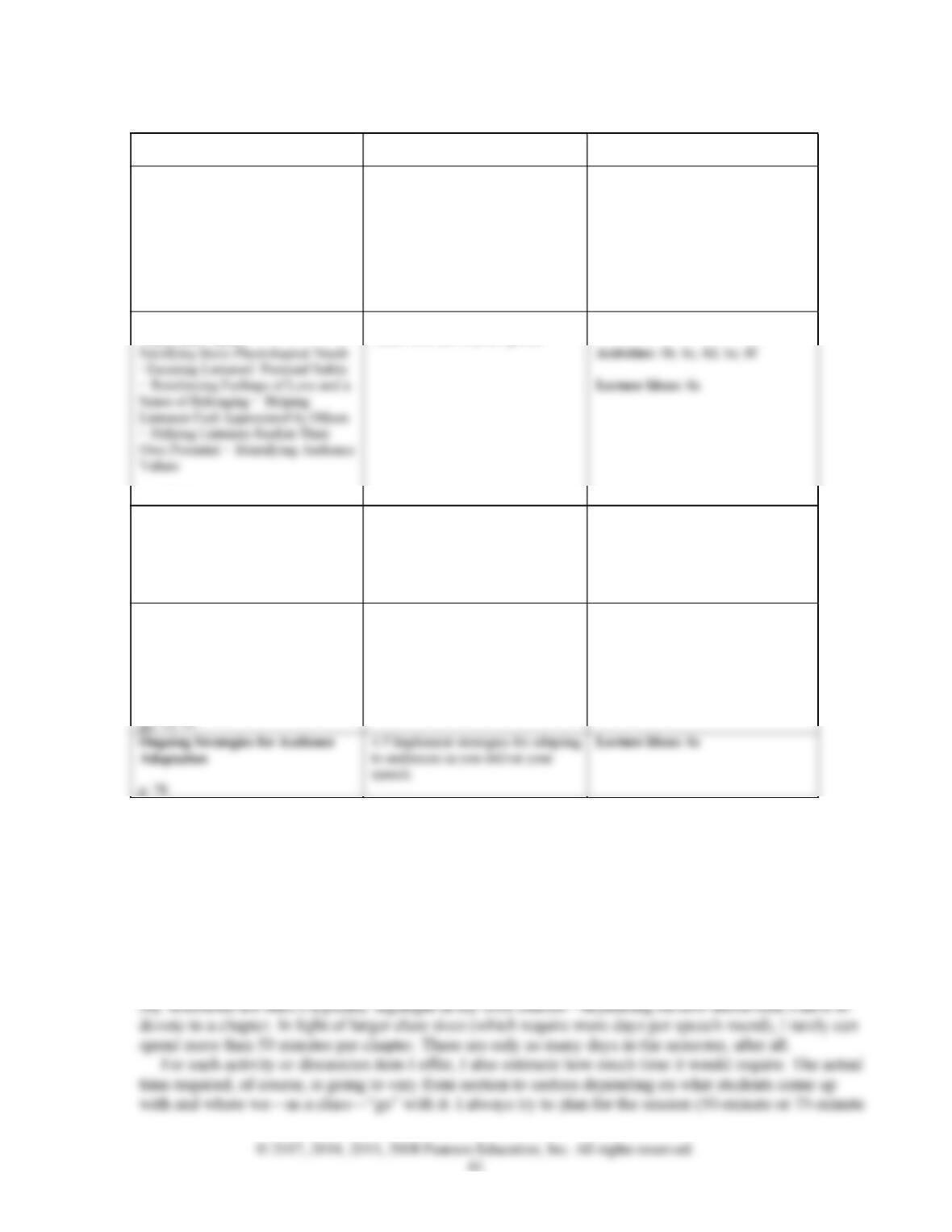
Overview Objectives Ideas for Instruction
Understanding Diverse Audiences
Age and Values ·Gender Roles and
Stereotypes ·Race and Ethnicity ·
Cultural Differences ·Religion ·
Geographical Environment ·
Education ·Occupation or Profession
·Economic Status
pp. 60–68
4.1 Describe the audience
characteristics you need to consider as
you prepare your speech.
Discussion
questions
:
4a; 4b; 4c; 4d;
4e; 4f
Activities: 4a; 4b; 4c; 4d; 4e
Lecture Ideas: 4a
Identifying Individual Listener
Needs and Values
pp. 68–71
4.2 Identify individual needs and
values relevant to your speech.
Discussion questions: 4g
Identifying Communal Needs and
Values
The Saliency of Key Group
Memberships
pp. 71–73
4.3 Identify communal needs and
values that might impact your speech.
Activities: 4b; 4c; 4d; 4e; 4g
Lecture Ideas: 4a
Gathering Information for
Audience Adaptation
Internet Research ·Interviewing for
Information ·Administering an
Audience Survey ·Devising Good
Questions for an Audience Survey
4.4 Know how to gather relevant
information about an audience.
Activities: 4h
Lecture Ideas: 4a
Ideas for Instruction
As noted elsewhere, you will not be able to cover everything in the text—nor should you attempt to (i.e.,
“The more we teach, the less they learn.”). I always “assume” students have read the assigned reading and
that my job as an instructor is to highlight a few, select ideas from the reading (or to introduce
supplemental material) for students to contemplate, reflect upon, and apply. My goal is to help them build
meaning and internalize what they have learned, retaining it for future use.
What follows are ideas for how some material might be treated through discussion and activity.
Chapter 4: Ideas & Materials for Instruction
or whatever) and build in enough flexibility to abbreviate, cut, or expand.
We also provide PowerPoint slides, in case you want to review something students were to have
read. Be mindful that our slides are necessarily wordy to assist you with locating which ones you want to
use (and we’ve also coordinated them with the chapter outline we created for you). We suggest that you
make the slides “your own” by editing them down to select words and phrases. We recommend, as well,
Discussion Question 4a
Approximate time required: 3–5 min.
When considering audience demographics as a part of audience analysis, one thing to keep in mind is that
demographics represent tendencies, not absolute predictors of behavior. Why must we be mindful of the
limitations of demographic information? What examples can you provide?
When using demographic information, we risk overgeneralizing. We risk assuming everyone who
meets a general profile will respond in the same way. In other words, we might stereotype. (e.g.,
“teenage girls,” to use the text’s example). Our faulty assumptions might obstruct our ability to connect
with individuals belonging to that group, and they may even find our remarks shortsighted or offensive
if we have formed a faulty impression of who they are.
Examples of overgeneralizing that students might provide could be similar to that provided in the text,
such as stereotyping persons of the Muslim faith as being fanatical. Common examples students
Discussion Question 4b
Approximate time required: 5–7 min.
Are there issues that would be of greater relevance (i.e., saliency) to women than to men? What about the
opposite? How might we broaden the appeal of a topic associated with either sex?
Topics and ideas will vary, of course. You may need to stimulate their thinking with an example, such
as “supporting victims of domestic violence.” Women are the usual victims, but does that make it a
Chapter 4: Ideas & Materials for Instruction
“woman’s issue?” Not exactly. Children too are often affected, and so are some men. Regardless of
who is victimized, though, victims need our concern and our help to ensure their safety and recovery.
Discussion Question 4c
Approximate time required: 10–15 min.
While campaigning for President in 2008, Barrack Obama spoke on race and racial tensions following some
highly publicized inflammatory remarks made by his former pastor. Obama titled his speech “A More
Perfect Union.” The speech is widely available online—as is contextual information about it along with
critiques of it.
Discussion Question 4d
Approximate time required: 7–10 min.
How do you define yourself in terms of race/subculture? What current issues might you view with a
relatively unique perspective in light of your racial/subcultural identity? What common values exist across
subcultures with regard to the issue, and how might those values illuminate concerns/interests we all can
share? What actions/policies have been proposed, or what might we propose?
Answers will vary, of course. The text provides some good examples to get students thinking. For
example, the authors note how some African Americans may not trust police officers. Community
Discussion Question 4e
Approximate time required: 7–10 min.
During the presidential campaign of 1960, some Americans were leery of electing “a Catholic.” John F.
Kennedy addressed the issue in a speech he delivered at Rice University to the Greater Houston Ministerial
Association. What can we learn from Kennedy’s remarks in terms of the place of religion in public affairs?
What might we learn in terms of how to talk about an issue related to religion?
Here, in part, are Kennedy’s remarks:
Contrary to common newspaper usage, I am not the Catholic candidate for President.
I am the Democratic Party’s candidate for President who happens also to be a Catholic.
Chapter 4: Ideas & Materials for Instruction
Discussion Question 4f
Approximate time required: 3–5 min.
How does education assist us in becoming an informed citizen?
A formal education provides us with much information, and (very important!) it simultaneously helps
illuminate what else we need to know. As we attend classes and study, we encounter many facts that we
Discussion Question 4g
Approximate time required: 3–5 min.
What is meant by the following statement, and what are the implications for public speech? “All of us
possess a network of interlocking values, some of which are in conflict with others.”
Some of our values may seem to contradict other values. For example, we value competition, but we
also value cooperation. What we call for in a particular speech will likely be one or the other, and we
Chapter 4: Ideas & Materials for Instruction
Suggested Activities. Use these “hands-on” applications to get students actively involved with the material.
What we suggest often requires students to synthesize what is covered in the chapter, as well as what they
were to have learned from other chapters.
Activity 4a
Approximate time required: 10–12 min.
Have students work in groups of four or five to discuss the following:
1) Which contemporary issues have saliency (great personal relevance) for you now? Why?
2) What are some issues that will grow more salient to you as you age? Why? In what ways are they
salient to you now?
3) In what ways are “your” issues salient to older generations?
Responses, of course, will vary, but students will see how we all have personal interests, many of which
Activity 4b
Approximate time required: 15–18 min.
Supply students with a brief, high-quality magazine article addressing a topic that should have broad appeal.
Have students read through the article and supply them the following directions on-screen or in a handout:
Various groups of individuals should be interested in the findings reported/discussed in the article.
Identify two distinct groups and what, in particular, merits their attention.
For each group you have identified, answer the following questions:
1) How would you adapt your remarks in a speech about the topic to each audience?
2) What additional research would you need to conduct about the topic?
Activity 4c
Approximate time required: 15–18 min.
Bring in various magazine ads or use ad content found online from the Ad Council (or another group) that
address a social issue and attempt to change behaviors or generate action (e.g., be a mentor). Have
students work in small groups to identify and analyze the following:
(1) Who is the target audience implied by the ad?
(2) What content choices seem good? Why?
(3) What content choices seem questionable? Why?
(4) How might the ad be altered to improve its adaptation? Explain/justify recommendations.
(5) What other overall strategy might work well? Why?
If time permits, have the students construct an ad for an alternative audience and present it to the
class, with each member taking part in the presentation. Have them explain the following:
Activity 4d
Approximate time required: 8–10 min.
You could do this as a small group activity, or as a quick-response, in-class writing assignment. Have
students identify an issue upon which he or she might have strong convictions, e.g., abortion, gay rights,
the death penalty, stem cell research, gun laws, and so on. Ask the student to imagine that he or she has
been asked to address an audience who is strongly opposed to his or her stance. Have students answer the
following question:
What are some ways you might speak effectively with this audience without compromising your
integrity? That is, how might you “adapt?”
Either conduct a general discussion with each group reporting, or quickly read through some/all of the
quick-response writings, briefly contemplating each one as you proceed and also inviting comments.
Activity 4e
Approximate time required: 25 min.
Teresa Palmitessa created the basis for this activity while a graduate student at Indiana University. She
explains: “I developed this exercise to demonstrate the importance of audience adaptation and to allow
students to be creative as they are learning.” We have modified it slightly.
Have students devise a television public service announcement. Have them do something “unusual” so
they cannot copy something they have seen (e.g., implore viewers NOT to spay or neuter their pet;
Activity 4f
Approximate time required: 15 min.
Have students individually list five general values they believe to be highly important to their
Chapter 4: Ideas & Materials for Instruction
classmates. Have them rank order each item on the list.
Next, place students in small groups to compare their lists and rankings. Have each group decide what
they would designate the top five values, and rank them. The group should justify each value selected,
Activity 4g
Approximate time required: 8–10 min.
Provide the following instructions for students for a quick, in-class writing. Collect and respond briefly in
writing to what they have written—returning the papers in the next class period. Or, you might respond
orally during class as a prompt for brief, general discussion of each one.
What group affiliations or identifications are you aware of for members of our class that will
have an impact on how they respond to a speech you are thinking of presenting? Describe the
potential responses and how they will affect your treatment of the topic.
Activity 4h
Approximate time required: 8–10 min.
Have students generate two “scale questions” following the text’s instructions for their design, in order to
gauge classmates’ opinion/beliefs regarding the topic they will address in their next speech. Instruct them
to devise the questions as “homework” prior to the next class meeting. At that next class meeting, have
Lecture Ideas. Some elements in the chapter lend themselves to careful review and/or some supplemental
material. Either way, you’ll amplify something that deserves amplification. We’ll offer some suggestions,
often providing one or more corresponding PowerPoint slides.
Lecture 4a: Use one or more of the slides from the PowerPoint slideshow that accompanies this chapter
and prepare your own examples as illustrations of the concepts featured on the slide(s). Break up the
“lecture” by including some of the discussion questions we provide and/or an activity or two. Any
individual slide can function as either a preview or review of an activity or discussion item.
As noted previously, feel free to edit down the slides, observing the various principles outlined in
Chapter 4: Ideas & Materials for Instruction
**********************************************************
Chapter Outline: Chapter 4: Diverse Audiences in a Democratic Society
Chapter Intro:
I. Audiences come together to hear about important matters they are concerned
about.
II. Sometimes an audience is required to listen to a speech.
A. Classroom speeches are one example.
B. Job training is another example.
I. Understanding Diverse Audiences
Learning Objective 4.1—Describe the audience characteristics you need to
consider as you prepare your speech.
A. Various audience demographics can influence listeners’ responses.
2. Knowing more about an audience will help a speaker determine how best
to appeal to them.
3. Understanding demographics, along with the individual and community
4. Every speaker must consider these factors.
a. Age
b. Gender
c. Race and Ethnicity
g. Education
h. Occupation or Profession
i. Economic Status
6. Demographics represent tendencies, not absolute predictors of behavior.
a. Too much reliance on assumed demographics can lead to faulty
assumptions and missed opportunities.
Chapter 4: Ideas & Materials for Instruction
B. Age and Values
1. Although two people of exactly the same age can have widely divergent
experiences, they also share certain experiences and memories that
2. Different issues have different degrees of saliency, or personal relevance,
for people of difference ages.
3. Shared experiences, social mores, and personal concerns related to age all
have their impact on values.
C. Gender Roles and Stereotypes
2. The ways men and women behave, what they value, and what they believe
3. It is important to remember that gender, along with many of the
4. As ideas about gender roles and attitudes toward sexuality change,
listeners will respond differently to gender-related issues.
6. Gender may influence how salient a particular topic might be.
7. We must constantly remind ourselves that no demographic category
automatically predetermines an individual listener’s responses, interests,
or life experiences.
8. Although men and women do have concerns and experiences that are
unique to their sex, there are also aspirations, attitudes, and aptitudes
common to all humans regardless of gender.
D. Race and Ethnicity
1. People who fall within subculture groupings share characteristics with the
2. Race is not biological and genetic, but it is a product of politics, social
definitions, and personal preferences.
4. Listeners identify with their own heritage. Therefore, their own national
history, customs, and experiences shape their reactions to messages.
6. Speakers should respect differences in customs, practices, and beliefs
E. Cultural Differences
1. Those who grow up in cultures outside the U.S. may hold values and
2. Cultural differences affect all of our efforts to communicate, and we need
to make sincere efforts to bridge cultural divides and emphasize what we
have in common.
F. Religion
1. A listener’s religion, or a lack of religious beliefs, can influence that
listener’s reception and evaluation of a speech.
3. When choosing to talk about religious issues, speakers should remember
4. It is important to remember that your audience may hold fundamentally
different religious beliefs.
G. Geographical Environment
1. Where a listener lives can make a difference in how he or she reacts to a
speech.
3. Different sections of the country have developed unique ways of looking
at things.
H. Education
1. The educational level of a listener—their acquired knowledge—influences
reactions to messages.
3. How well audience members have been educated will influence how they
evaluate the message.
5. Having an educated response means suspending judgment until you have
listened to arguments, read more material, and assembled the facts before
reaching a decision.
I. Occupation or Profession
1. The job you have can make a difference in the attitudes you hold and the
way in which you grasp specific information.
us.
3. One’s job or profession will affect one’s perspective.
4. Listeners will be influenced by their special job-specific concerns.
J. Economic Status
1. The income of listeners may influence their response, depending on the
speaker’s subject and purpose.
3. The financial resources available to listeners may determine their response
to any idea or proposals involving money.
II. Identifying Individual Listener Needs and Values
Learning Objective 4.2—Identify individual needs and values relevant to your
speech.
A. Psychologist Abraham Maslow described basic human needs in terms that
help us understand and develop tactics for listener involvement.
1. Satisfying Basic Physiological Needs
a. We all need food and drink, clothing, shelter, and sexual gratification.
2. Ensuring Listener’s Personal Safety
3. Reinforcing Feelings of Love and a Sense of Belonging
a. There is a distinct human need to be loved, accepted, wanted, or
4. Helping Listeners Feel Appreciated by Others
5. Helping Listeners Realize Their Own Potential
a. The “self-actualization” need recognizes that human beings want to
realize their own potential and make the most of themselves.
B. Identifying Audience Values
1. All of us possess a network of interlocking values, some of which conflict
3. Speakers can establish common ground by emphasizing values they share
with an audience.
Chapter 4: Ideas & Materials for Instruction
III. Identifying Communal Needs and Values
Learning Objective 4.3—Identify communal needs and values that might impact your
speech.
A. The Saliency of Key Group Memberships
1. No single group membership is foremost in all our decisions.
3. As a speaker, we must realize that our listeners’ salient group
memberships can greatly influence their opinions.
5. A further complication arises when our audience identifies with two
groups whose goals conflict.
IV. Gathering Information for Audience Adaptation
Learning Objective 4.4—Know how to gather relevant information about an
audience.
A. Internet Research
1. You can learn much about the organization or group by conducting
research on the Internet.
B. Interviewing for Information
1. Gather information by interviewing the person who asked you to speak.
2. Regardless of the specific topic, here are some of the questions you might
want to ask:
a. How many listeners will likely be present when I speak?
b. How diverse is the audience in terms of age, sex, and other
d. How knowledgeable is the audience about my topic?
e. What relevant experiences might audience members have had?
f. How likely are they to be open to the sort of information I’m
discussing or the proposal I’m making?
g. Are there likely to be great differences of opinion or experience within
the audience? If so, explain.
h. How much time is available for my presentation?
i. Will there be a question and answer period after the speech?
C. Administering an Audience Survey
2. There are some basic principles to follow as you design your audience
survey.
a. Use the survey to collect relevant demographic information about the
audience.
Chapter 4: Ideas & Materials for Instruction
c. Use different kinds of questions to gather the kind of information you
need.
D. Devising Good Questions for an Audience Survey
1. Begin the survey with closed, fixed-choice questions relevant to your topic
to collect basic demographic and other factual information.
2. Use scale questions to acquire more precise information from respondents
4. Finally, avoid leading or loaded questions. Make sure you phrase your
questions with neutrality and objectivity.
V. Ongoing Strategies for Audience Adaptation
Learning Objective 4.5—Implement strategies for adapting to audiences as you
deliver your speech.
A. You may choose to make minor adjustments in your presentation once you
actually see and interact with the audience and/or space.
B. It is even possible to adapt to your audience while you are speaking.
C. From the moment you learn you are to make a speech until the moment you
stop interacting with listeners, you can continue to adjust your strategy, style, and
response. response.
********************************************************
Instructional ideas for Chapter Four
___________________________________________________________
___________________________________________________________
___________________________________________________________
___________________________________________________________
___________________________________________________________
___________________________________________________________
___________________________________________________________