Chapter 3: Perception and Communication
Key Concepts
Attribution
cognitive complexity
constructivism
culture
empathy
fundamental attribution error
implicit personality theory
inattention blindness
interpretation
mind reading
Müller-Lyer illusion
perception
personal construct
prototype
script
self-serving bias
standpoint
stereotype
Chapter Outline
I. Perception is an active process of creating meaning by selecting, organizing, and
interpreting people, objects, events, situations, and other phenomena.
A. Selection – We consciously select which of the infinite number of stimuli around
us is most relevant at any point in time.
2. We influence what we select by noticing things we had not noticed before.
4. The culture in which we grow up also influences what we select to
perceive.
B. Organization – Constructivism is a theory that states that we organize and interpret
experience by applying cognitive structures called schemata. We use four
schemata to make sense of interpersonal phenomena:
1. Prototypes represent the clearest or most representative example of some
2. Personal constructs are
3. Stereotypes are generalizations about people and situations that allow us to
.
4. Scripts are guides for action. They consist of sequences of activities that
are expected of us and others in particular situations.
C. Interpretation is the process of attaching meaning or explanations to phenomena
we have noticed and organized.
2. Attributional errors occur when we attach distorted meanings to what
happens around us.
a. A self-serving bias occurs when we take excessive personal credit
for our successes and assume someone or something else is
responsible for our poor performances.
b. A fundamental attribution error occurs when we overestimate the
II. Influences on Perception Individuals differ in how they perceive situations and people
At least six factors affect our perception process.
A. Physiology – people differ in their sensory abilities, which can also be impacted
by biorhythms or medical conditions.
B. Expectations – our expectations affect what we notice. This explains the self-
fulfilling prophecy.
C. Age and the number and complexity of life experiences alter our views or
interpretations of particular communication situations.
D. Our culture provides each of us with a particular set of beliefs, values,
understandings, practices that influence our perception.
1. Social Location – The social groups to which we belong in a particular
2. Roles – The training we receive to fulfill a role and the actual demands of
the role affect what we notice and how we interpret and evaluate the role.
67
E. Our Cognitive abilities influence the number of different interpretations we can
create for a situation.
1. People who have more schemata for organizing and interpreting situations
2. Person-centeredness is the ability to interact with another individual as a
unique human being.
F. Self – We have implicit personality theories, which are collections of assumptions
III. Social Media and Perception
A. Our choices of social media shape our perceptions of events, issues, and people.
B. Cultural memberships influence the content of digital and online communication.
C. Social media have altered how we perceive time and space.
IV. Guidelines for improving perception and communication. Seven guidelines can help us
improve the accuracy of our perceptions.
A. Recognize that all perceptions are partial and subjective. We need to understand
that all of our perceptions occur at a single point in time, represent only a portion
of the stimuli we could notice, and cannot be determined to be true or false.
B. Avoid mind reading, assuming we understand what another person thinks, feels,
or perceives. We need to avoid assuming that we know what another person
thinks or how she or he perceives a particular situation.
C. Check perceptions with others by asking others to what extent our perceptions are
D. We need to distinguish between facts (those things we can verify based on
observation) and inferences (those things we create by interpreting what we have
observed).
E. Guard against the self-serving bias because it can distort our perceptions.
F.
actions and internal motivations for your own.
68
G. Monitor labels. We need to remember that the labels we attach to particular
Discussion Ideas
Selection process: Ask students to make a list of three things they saw, heard, felt,
smelled, and tasted prior to class today. Chances are they will have the most difficulty
with taste. Why is taste the sense to which we pay the least attention? Why do we pay
Personal constructs: Ask students to make a list of ten adjectives they would use to
describe someone they like. Then ask them to make a list of ten adjectives for someone
they dislike. Chances are there will be no negative adjectives on the like list and no
positive adjectives on the dislike list. Why is that the case? What are the most common
mental yardsticks we use to judge those we like? Those we dislike?
$50. Now ask them to write a letter asking their parent or guardian to give them $50.
Compare and contrast the tactics used in their two letters. Why are we usually in a
position to use more person-centered, I-thou communication with parents and guardians?
Stereotyping: What stereotypes can you think of? Where did you get these stereotypes?
How are stereotypes developed? How can stereotypes be changed?
Empathy: To what extent do you believe that you can truly feel what another person is
Shaping perceptions: A spin doctor is a person, often a political aide, who is responsible
for ensuring that others interpret an event from a particular point of view (visit the
Merriam-Webster on-line dictionary at http://www.merriam-
webster.com/dictionary/spin%20doctor for the complete definition). From news reports
other side. This activity provides an excellent segue into verbal communication and how
symbols shape perceptions.
Distinguish between facts and inferences: Use this story about Chris. Ask students to
assess whether each of the statements that follows the story is a fact or inference. Another
interesting question to ask students is whether they believe Chris is male or female and why?
money to pay for it, Chris really wanted the CD. After looking in several stores and
comparing prices, Chris found the least expensive CD, but it still cost $30. Chris knew it
was not affordable. Later when Chris was playing a new CD for friends, they all
complimented Chris on such great taste in music.
Chris bought the $30.00 compact disc.
Only statement four is factual. The others are inferences that go beyond the facts
presented in the story. We know only that Chris went to the mall to get a compact disc
If you made mistakes, why do you think you made them? If you got all of them correct,
what kept you from making mistakes?
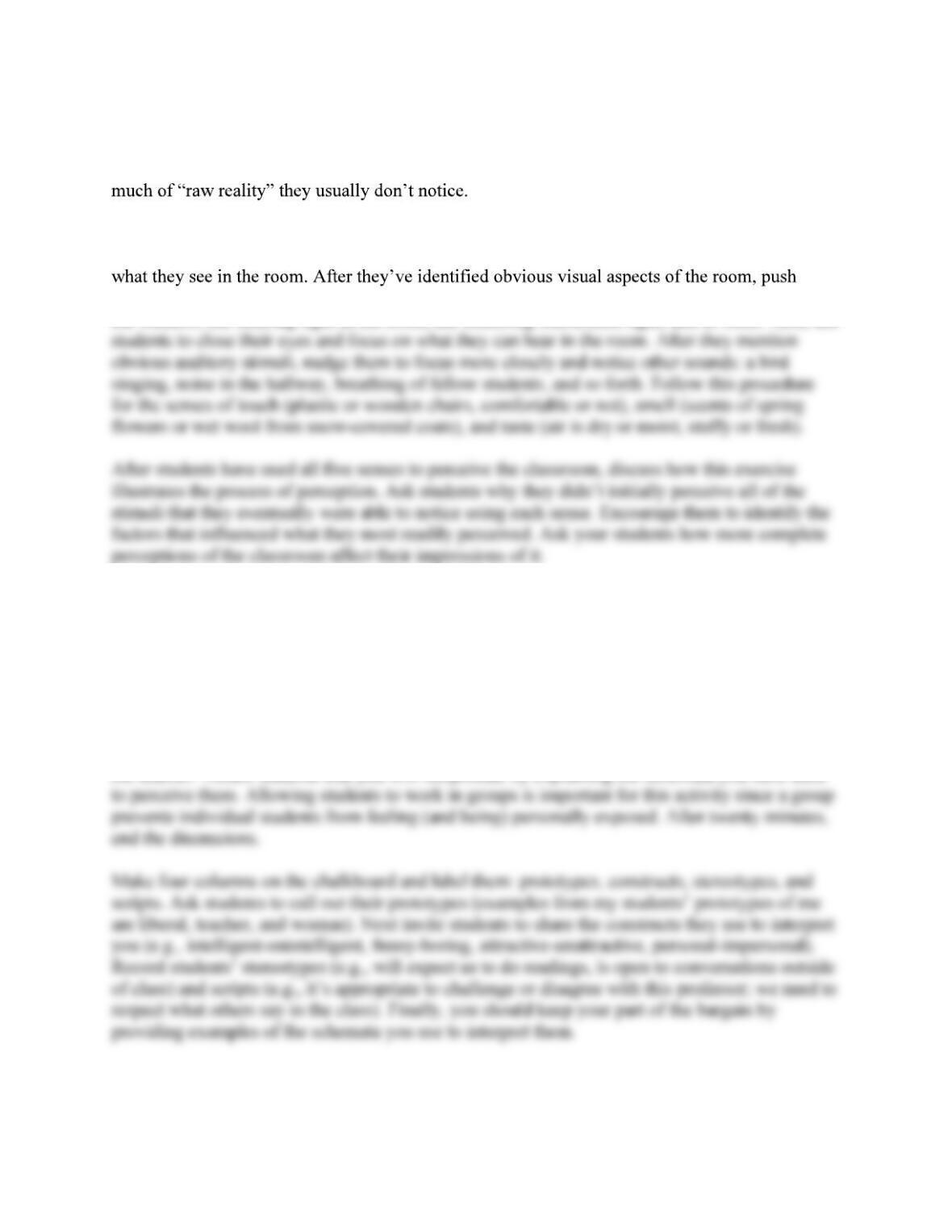
Activities
Title Individual Partner/
Ethno
Group Demonstration/
Whole Class
Internet
2. How I See You X
4. What did you see X
6. Color Perception and Symbolism X – P
8. What do you remember? X
70
Selective Perception
The goal of this activity is to make students aware of how selectively they perceive and how
Tell students you want to help them perceive the classroom more fully than they have so far by
letting them concentrate on each of the five senses. Begin with vision. Ask students to describe
students to be more observant. Point out chipped paint, a scene outside that can be seen through
the window, the filtering light in the room, the flickering fluorescent light, and so forth. Next, tell
How I See You
The purpose of this activity is to provide students with a concrete understanding of how they use
cognitive schemata to organize their perceptions of others.
Begin the exercise with a brief review of the four kinds of cognitive schemata: prototypes,
constructs, stereotypes, and scripts. Then create small discussion groups in which students are
asked to provide examples of each of the four schemata as applied to their perceptions of you,
the teacher. Assure students that you will reciprocate by explaining the schemata you have used
71
Perceiving Differences
The goal of this activity is also to make students aware of how selectively they perceive and how
ice. This activity is designed to increase their
awareness of how they perceive others and how others may perceive them. If you have a student
with a physical disability, you may want him/her to discuss his or her experiences afterwards.
Before class, try to rent or borrow two wheel chairs, two canes with blindfolds, two old big
sunglasses (with lots of scratches on it or you can rub Vaseline on the outside of the lenses), two
pairs of professional earphones/ear plugs, and two pairs of crutches. Then, on slips of paper write
down the different items.
The objective is to let students perceive their world differently if all of a sudden they had a
and the other s
randomly for a slip of paper that has the different items.
o
allowed to walk on their legs anywhere.
Give the students about 15 minutes of class time with their partner to perform 2 basic tasks, such
as:
2. Go to the nearest water fountain and have a drink.
4. Try finding the nearest bathroom and wash your hands.
5. Go to the next classroom and sit in the very back.
72
Each participant should try as much as possible to do each task by themselves. The
observers/helpers should assist only if the participant might be in danger or they might hurt
themselves. The observers/helpers should also note how other students or other people react to
the participant.
What Did You See?
The goal of this activity is to illustrate the selection process. It will demonstrate that people do
not always perceive the same things.
Before class, find one person to come into the front of the classroom, take an item that you have
already identified with this person to take, and then have that person leave the room. Tell
Remaking the Social World
and classify people. It also heightens their awareness of factors other than race, sex, class, and
sexual orientation that describe individuals.
Assign students to groups of five to seven members. Groups should be as diverse as possible in
terms of race, gender, sexual orientation (if known), religion, class, and so forth. Remind
students that perception involves selectively noticing and labeling certain (and not other) aspects
73
If time allows, work with students to probe the implications of the classification systems they
What Do You Remember?
Ask students to pair up with another student. Ask the students to write down things that they
remember from the last class period. Ask them if they remember what the instructor wore? What
was discussed? What major incidents occurred? What the other students wore and said in class?
Tell them to be specific as possible. Give them about ten minutes to complete the assignment.
Then, ask the pairs to share what they observed.
Journal Items
Describe the steps in the abstraction process that you followed in a particular instance. Be
sure to identify each inferential move and analyze what was eliminated with each step up or
down the ladder of abstraction.
Responses will vary, but one example might be: someone might claim that Al acted strange
in a particular situation, which implies that the strange behavior was something specific to
Al. Someone else might argue that Al is a student, and students would generally act that
Analyze the attributional patterns you use to explain a mean or disappointing behavior by a
good friend and by someone whom you do not like. Analyze how differences in your feelings
about the two individuals affect your attributional tendencies.
Responses will vary, but for people we like, we tend to make external, unstable, and specific
74
Describe specific advertisements that stood out to you this week. Fully discuss how you
perceived some stimuli around you and may have ignored other things around you. What was
it about these stimuli that stood out? Why did you pay more attention to certain
advertisements compared to others? Explain how this relates to concepts discussed in the
text.
Identify a situation where stereotypes (as a schemata used in organizing perceptions) may be
useful and helpful in a communication situation. Next, identify a situation in which that
same stereotype becomes unproductive and perhaps damaging.
Responses to the issue will vary, but look for students to see both the useful and necessary
aspects of stereotyping, as well as the negative connotations this term often carries. That is,
Describe what you noticed in class last week. Fully discuss how you perceived some stimuli
around you and may have ignored other things around you. Why did you pay more attention
to certain things compared to others? What was it about these stimuli that stood out to you?
How does this relate to concepts that were discussed in the book?
Responses will vary, but students should mention that they select stimuli that stands out
Media Resources
Web Sites
Name: Interpersonal Perception and Communication Lab
Developer: Interpersonal Perception and Communication Laboratory, Harvard University
Brief Description: This web site is a center of research aimed at understanding the ways in which
social factors interplay with perception, cognition, and behavior.
URL: http://www.wjh.harvard.edu/~na/
75
Name: Communication, Cognition, and Community
Developer: David C. Smith, University of Washington, published in Orange
Brief Description: An article in Orange: An Online Journal of Technical Communication and
Information Design that links cognitive processes, communication, and human community.
URL: http://tc.eserver.org/orange/2-1/dsmith.htm
Name: Perception in Communication
Name: Perception and Communication- The Psychological Viewpoint
Developer: Dr. Khaleel Isa
Name: Fundamentals of Communication
Developer: Dr. Lee McGaan
Film Ideas
Forrest Gump. A 1994 film, provides many examples of how actively humans shape their
realities by the ways they perceive and label what exists and what it means. Excerpts from this
film gives students a solid understanding of how perceptions differ and how our perceptions
shape our thoughts and feelings. For example, how is Forrest perceived differently while at
college when the football coach finds out how fast Forrest can run?
What Women Want.
Through this, he is purportedly ab
Addams Family. This film is about a family that has very different perceptions about the world.
Several parts of the film can be used to illustrate how one family culture varies from other family
cultures. For example, when the children go to summer camp, Wednesday is disgusted by the
camp traditions and activities, but the other children adore the camp.
76
At First Sight. This film is about a man who is blind and falls in love with a woman. Then, he is
given the chance to get a radical surgery to get his sight. Once he gets his sight, it is different
from what he perceived.
Print Resource
A Natural History of the Senses by Diane Ackerman. In this fascinating book, the author
discusses the physiological, sociological, and cultural dimensions for each of the five primary
senses (smell, touch, taste, hearing, and vision.) What are the metaphors we use to describe our
senses and how are our senses culturally constructed?
The Spell of the Sensuous: Perception and Language in a More-Than-Human World by
David Abram.