Chapter 3: Ideas & Materials for Instruction
CHAPTER 3: Speaking with Confidence
Overview Learning Objectives Ideas for Instruction
Understanding Communication
Apprehension
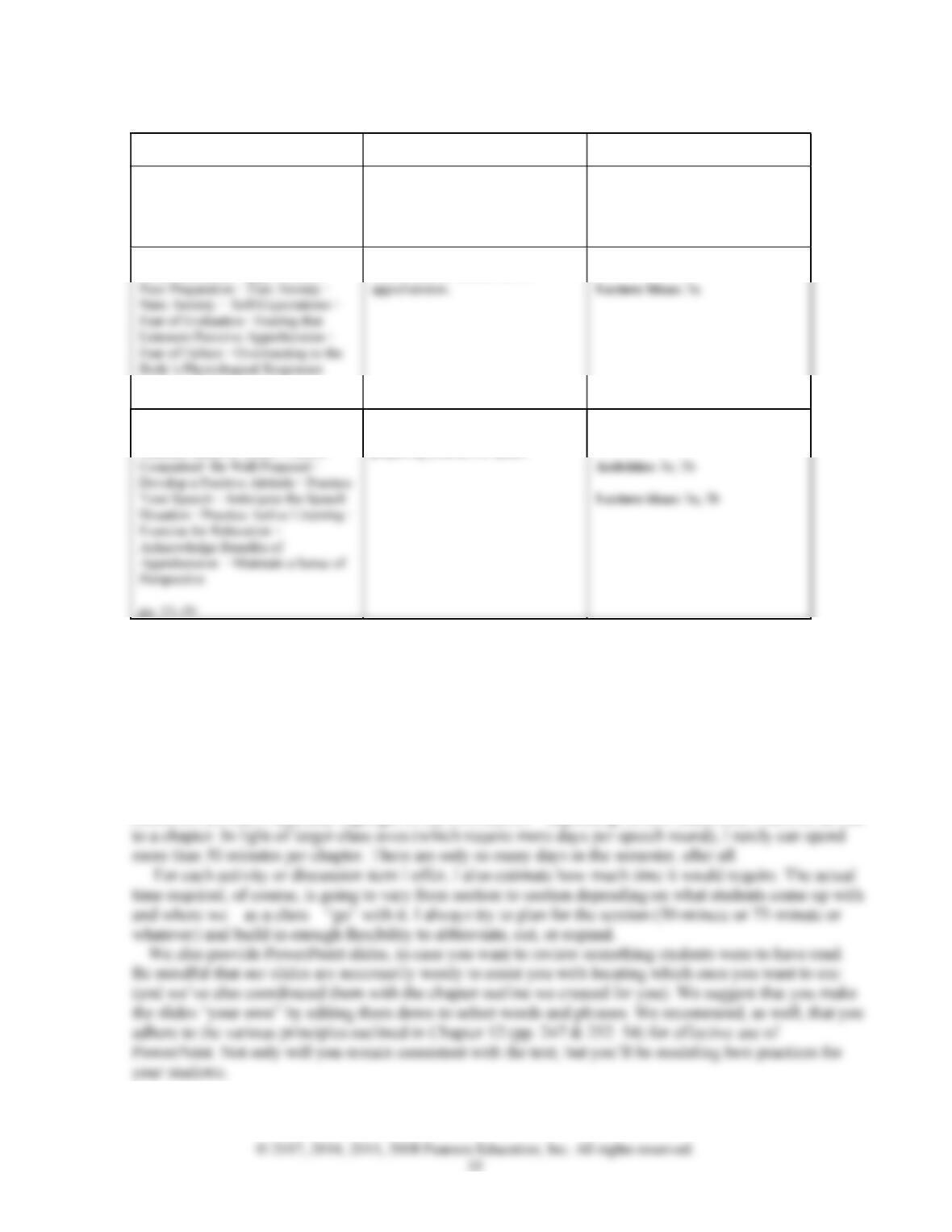
pp. 47–49
3.1 Define communication
apprehension.
Discussion questions:
3a
Activities: 3a
Lecture Ideas: 3a
Factors that Contribute to
Communication Apprehension
pp. 49–53
3.2 Describe underlying factors that
contribute to communication
Activities:
3a
Managing Communication
Apprehension
Address Issues to Which You are
3.3 Employ strategies for managing
communication apprehension while
preparing yourself to speak.
Discussion questions:
3b; 3c
Ideas for Instruction
As noted elsewhere, you will not be able to cover everything in the text—nor should you attempt to (i.e.,
“The more we teach, the less they learn.”). I always “assume” students have read the assigned reading and
that my job as an instructor is to highlight a few, select ideas from the reading (or to introduce
supplemental material) for students to contemplate, reflect upon, and apply. My goal is to help them build
meaning and internalize what they have learned, retaining it for future use.
What follows are ideas for how some material might be treated through discussion and activity. My
selections are ones I typically highlight in my own classes—depending on how much time I have to devote
Discussion Questions. Use these to stimulate discussion and prompt reflection. As students process the
Chapter 3: Ideas & Materials for Instruction
material at a deeper, more meaningful level, they likely will offer interesting observations or pose
provocative questions of their own. Make note of these, literally! Let students know when you’re
Discussion Question 3a
Approximate time required: 3 min.
Why is it important that we manage our communication apprehension?
Discussion Question 3b
Approximate time required: 3–5 min.
Why is it important to know that many of our greatest leaders struggled with communication
apprehension?
Discussion Question 3c
Approximate time required: 5–7 min.
Why is a genuine commitment to one’s topic so important for a speaker?
A genuine commitment, as the text notes, can help the speaker “overcome the anxiety” he or she may
feel. The authors provide examples, and you can likely generate one or two of your own and/or have
students do so.
It may be, for instance, that you have seen—firsthand—in your own life or in the life of person(s)
you care about, the harms of a sedentary lifestyle and you elect to address the matter in a speech.
Chapter 3: Ideas & Materials for Instruction
Activity 3a
Approximate time required: 10–12 min.
Have students converse with a neighbor for a few minutes, answering the following questions, which you
Activity 3b
Approximate time required: 10–12 min.
After using Lecture Idea 3b, have students work with a partner or group to answer the following: “What
are some additional tactics, not covered in the textbook, that might help a nervous speaker manage her or
his anxiety?” Have them work quickly—allowing only a couple of minutes. Have each group offer and
explain their top two tactics. Critique their offerings as they are introduced.
For instance, one group might suggest finding a friendly face or two to focus on as one begins
speaking and then branch out, establishing eye contact with other listeners. They might suggest further
Lecture Ideas. Some elements in the chapter lend themselves to careful review and/or some
supplemental material. Either way, you’ll amplify something that deserves amplification. We’ll offer
some suggestions, often providing one or more corresponding PowerPoint slides.
Lecture 3a: Use one or more of the slides from the PowerPoint slideshow that accompanies this chapter
Lecture 3b
Approximate time required: 15 min.
Using the PowerPoint slides for “Managing Communication Apprehension,” provide elaborations akin to
Chapter 3: Ideas & Materials for Instruction
what is offered below for each of the items (the same items as on the slides).
Be “into” your topic
Visualize success
As you imagine how your speech will go over with the audience and how well you will do presenting it,
think positive thoughts. Imagine the appreciation animating your listeners’ faces, and imagine how
Practice
Go over your speech, numerous times, in part and in whole—and begin practicing a few days prior to
the speech. Practice aloud, with your notes and with your visual aids. Become familiar with your ideas,
their development, and their order. Doing so will help you relax and grow more confident. Putting off
practice or avoiding it altogether will only fuel anxiety.
Know the audience and setting
Learn about the audience and the place and setting in which you’ll speak. When you know whom you’ll
“Listen” to your audience
Tune into the small talk prior to your speech, and engage in some small talk yourself—if possible.
Exercise
Deep breaths can help—and can be done subtly while you’re waiting to speak. Isometric exercise can
Chapter 3: Ideas & Materials for Instruction
Deal with mishaps
No matter how prepared you are, something can go wrong, and it might throw you for a minute. That is
okay. We have all been there ourselves or have seen it happen. Your audience will be very
understanding, and they’ll be quite impressed with how you handle the mishap. Remain calm, collect
Anxiety is the hand maiden of creativity. —Chuck Jones
There are more things to alarm us than to harm us, and we suffer more often
in apprehension than reality. —Seneca
Exam Items. Testing, of course, can be an important part of instruction. We provide numerous, high-
quality multiple-choice items in our test bank. We also offer several short-answer items and essay items.
**********************************************************
Chapter Outline: Chapter 3: Speaking with Confidence
Chapter Intro:
I. Great leaders such as George Washington and John Adams were nervous
about speaking in public.
II. As professionals and as citizens, we will need to speak.
III. We must rise to the occasion if we hope to have an impact.
I. Understanding Communication Apprehension
Learning Objective 3.1—Define communication apprehension.
A. Many important historical figures, such as George Washington, John Adams, and
King George VI, suffered from communication apprehension.
B. One survey even discovered that more people are afraid of public speaking than they
are of dying.
1. Communication apprehension is defined as “an individual’s level of fear or
Chapter 3: Ideas & Materials for Instruction
anxiety associated with either real or anticipated communication with another
person or persons.”
2. Research shows that high communication apprehension is associated with a
number of negative outcomes.
a. Students with high communication apprehension often learn less and
receive lower grades.
b. They are also less likely to seek assistance when they feel they need
help.
II. Factors That Contribute to Communication Apprehension
Learning Objective 3.2—Describe underlying factors that contribute to communication
apprehension.
A. Poor Preparation
1. Speakers feel apprehensive when they know they are ill-prepared.
B. Trait Anxiety
2. Speakers with trait anxiety do all they can to avoid speaking in public.
4. They have speaking anxieties no matter what the context, topic, or audience.
C. State Anxiety
2. A particular audience, context, or topic could trigger their apprehension.
D. Self-Expectations
2. These speakers perceive the slightest mistake as failure and are their own
harshest judge.
3. Other speakers’ self-expectations may be so low that they stop caring or
Chapter 3: Ideas & Materials for Instruction
preparing.
E. Fear of Evaluation
2. They do not realize that listeners typically want to see speakers succeed.
3. Even an instructor evaluating a student hopes that the student will demonstrate
learning and improvement.
F. Fearing That Listeners Perceive Apprehension
2. Studies show that listeners are typically poor judges of the level of a speaker’s
anxiety.
G. Fear of Failure
1. Feeling anxious about speaking does not necessarily lead to failure.
2. History is full of outstanding public speakers who often suffered from
communication apprehension.
H. Overreacting to the Body’s Physiological Responses
1. When speakers become apprehensive, their bodies respond in a variety of ways.
2. There are many common physiological reactions to anxiety.
a. Parched mouth
3. Overreacting to these physical symptoms can aggravate your anxiety.
5. We can all learn strategies to help us better manage our fears of public speaking.
III. Managing Communication Apprehension
Learning Objective 3.3—Employ strategies for managing communication
apprehension while preparing yourself to speak.
Section Intro:
Because we all have some degree of apprehension, we have to find ways to
overcome it.
The two most critical factors in dealing with communication apprehension are
thorough preparation and a firm belief in what you have to say.
A. Address Issues to Which You Are Committed
1. You are more likely to speak with confidence if you address a topic that really
B. Be Well Prepared
1. Do your homework. Devote significant time and effort to gathering information
Chapter 3: Ideas & Materials for Instruction
2. Carefully organize your speech, so you can reassure yourself that you are well
3. Fine-tune your ideas, so you can reassure yourself that you are well prepared.
C. Develop a Positive Attitude
1. Research has clearly shown that people with high speech anxiety tend to have
2. Developing more positive thoughts may help in managing or reducing anxiety.
D. Practice Your Speech
2. It is always a mistake to put off rehearsing your speech until the last minute.
E. Anticipate the Speech Situation
1. Gathering information about your audience and the speaking situation before
2. Figure 3.3 may help guide these aspects of speech preparation.
F. Practice Active Listening
1.Listening closely to other speakers will draw your attention away from your own
G. Exercise for Relaxation
1. Breathe deeply.
3. Aerobic exercise can reduce tension.
H. Acknowledge the Potential Benefits of Moderate Communication Apprehension.
1. A little anxiety can be a good thing, keeping you alert and contributing to a
more dynamic delivery.
I. Maintain a Sense of Perspective
2. Regardless of how well or how poorly you think you performed, view each
speech as a chance for personal growth.
J. By employing any or all of the strategies discussed in this chapter, you can
become a more poised and confident speaker.

Chapter 3: Ideas & Materials for Instruction
**********************************************************
Instructional ideas for Chapter Three
___________________________________________________________
___________________________________________________________
___________________________________________________________
___________________________________________________________
___________________________________________________________
___________________________________________________________
___________________________________________________________
___________________________________________________________
___________________________________________________________
___________________________________________________________