
Speaking in
Small Groups
Chapter Objectives
After reading this chapter, students should be able to:
2. Identify the four kinds of leadership that may occur in a small group.
4. Explain the five major responsibilities of every participant in a small group.
6. Explain the methods for presenting orally the findings of a small group.
20

CHAPTER 20—SPEAKING IN SMALL GROUPS 289
Chapter Outline
I. Speaking in small groups is an important form of communication.
A. Small groups exist in virtually every area of life, including business, education,
government, religion, community organizations, and volunteer associations.
B. As its name implies, a small group has a limited number of members.
1. The minimum number is three.
2. Most experts set the maximum number at eight, but some go as high as twelve.
C. Members of a small group assemble for a specific purpose.
D. This chapter deals with a particular kind of small group—the problem–solving small
group.
2. Speaking in a problem–solving small group involves many skills similar to those
used in public speaking.
II. To be productive, a small group needs effective leadership.
A. There are several kinds of leadership in a small group.
1. In some groups, there is no specific leader.
3. In some groups, there is an emergent leader—someone who, by ability or
personality, takes on a leadership role.
4. Some groups have a designated leader—someone who is assigned or elected as
leader when the group is formed.
B. Small groups have three kinds of leadership needs.
2. Task needs are substantive actions that help the group complete its project.
3. Maintenance needs involve interpersonal relationships within the group.
III. Regardless of a small group’s leadership, every member of a group has five
responsibilities.
A. Members should commit themselves to the goals of the group.
2. Hidden agendas—in which individuals put personal goals over those of the
group—are especially damaging.
B. Members should fulfill their individual assignments.
1. A group can only be effective if each member fulfills his or her specific duties.

290 CHAPTER–BY–CHAPTER GUIDE TO THE ART OF PUBLIC SPEAKING
2. No matter what other assignments they may have, all members of a small group
have one vital assignment—listening.
C. Members should avoid interpersonal conflicts.
D. Members should encourage full participation in the group.
2. A second way to encourage participation is by inviting quiet members to speak.
3. A third way to encourage participation is by offering supportive comments to
other members.
E. Members should work to keep the group’s discussion on track.
IV. The reflective–thinking method is an effective procedure for organizing discussion in a
problem–solving small group.
A. The first step in the reflective–thinking method is defining the problem.
2. A group should follow four guidelines when phrasing the question for discussion.
a. It should make the question as clear and specific as possible.
b. It should phrase the question so as to allow for a wide variety of answers.
c. It should avoid biased or slanted questions.
d. It should pose only a single question.
B. The second step in the reflective–thinking process is analyzing the problem.
1. If a group analyzes the problem thoroughly, it will be in a much better position to
devise a workable solution.
2. When analyzing the problem, a group should pay special attention to two questions.
a. How severe is the problem?
b. What are the causes of the problem?
C. The third step in the reflective-thinking method is establishing criteria for the solution.
2. Setting up criteria gives the group a way to judge the appropriateness and
practicality of potential solutions.
D. The fourth step in the reflective–thinking method is generating potential solutions.
1. At this stage, the group’s goal is to come up with the widest possible range of
solutions.
2. Brainstorming is an effective way to generate potential solutions.
E. The fifth step in the reflective–thinking method is selecting the best solution.
1. The group should assess each potential solution in light of the criteria established
for an ideal solution.
2. In doing so, the group should try to reach consensus.

CHAPTER 20—SPEAKING IN SMALL GROUPS 291
V. Once a group has reached a decision, it needs to present its recommendations clearly and
convincingly.
A. Although a group’s recommendations are usually presented formally in writing, the
written report is often supplemented with—or sometimes replaced by—an oral
presentation.
B. One kind of oral presentation is an oral report.
C. A symposium is a second kind of oral presentation.
D. A panel discussion is a third kind of oral presentation.
Exercises for Critical Thinking
(from text page 389)
1. Identify the flaw (or flaws) in each of the following questions for a problem–solving group
discussion. Rewrite each question so it conforms with the criteria discussed in the chapter for
effective discussion questions.
a. What should be done to control the utterly ridiculous amount of money paid to college
football coaches?
Discussion: This question is biased or slanted. It should be rewritten more objectively.
b. What should be done about child abuse?
Discussion: This question is too broad and ambiguous. It should be rewritten so as to be
c. What should our state government do to reduce homelessness and to combat drunk driv-
ing?
Discussion: This question poses two questions. It should be rewritten to ask a single
d. Should the federal government institute a national sales tax to help reduce the national
debt?
Discussion: This question can be answered with a simple yes or no. It should be rewritten
2. If possible, arrange to observe a problem–solving small group in action. You might attend a
meeting of your city council, the school board, the zoning commission, a local business, a

292 CHAPTER–BY–CHAPTER GUIDE TO THE ART OF PUBLIC SPEAKING
church committee. To what extent does the discussion measure up to the criteria for effective
discussion presented in this chapter? What kind of leadership does the group have, and how
well does the leader (or leaders) fulfill the group’s procedural needs, task needs, and mainte-
nance needs? How do the other members meet their responsibilities? What aspects of the
meeting are handled most effectively? Which are handled least effectively?
Discussion: This exercise gives students the opportunity to observe a small group in ac-
3. Identify a relatively important decision you have made in the last year or two. Try to recon-
struct how you reached that decision. Now suppose you could remake the decision following
the reflective–thinking method. Map out what you would do at each stage of the method. Do
you still reach the same decision? If not, do you believe the reflective–thinking method would
have led you to a better decision in the first place?
Discussion: This exercise requires students to sort out the steps of the reflective–thinking
method and to apply them to the students’ own decision making. Not only does this help
4. Attend a symposium or panel discussion on campus. Prepare a brief analysis of the proceed-
ings. First, study the role of the moderator. How does she or he introduce the topic and partic-
ipants? What role does the moderator play thereafter? Does she or he help guide and focus
the panel discussion? Does she or he summarize and conclude the proceedings at the end?
Second, observe the participants. Are the speeches in the symposium well prepared and
presented? Which speaker (or speakers) do you find most effective? Least effective? Why?
Do participants in the panel discussion share talking time? Does their discussion appear well
planned to cover major aspects of the topic? Which panelist (or panelists) do you find most
effective? Least effective? Why?
Additional Exercises and Activities
1. Have students perform the exercise “Lost on the Moon,” as follows:*
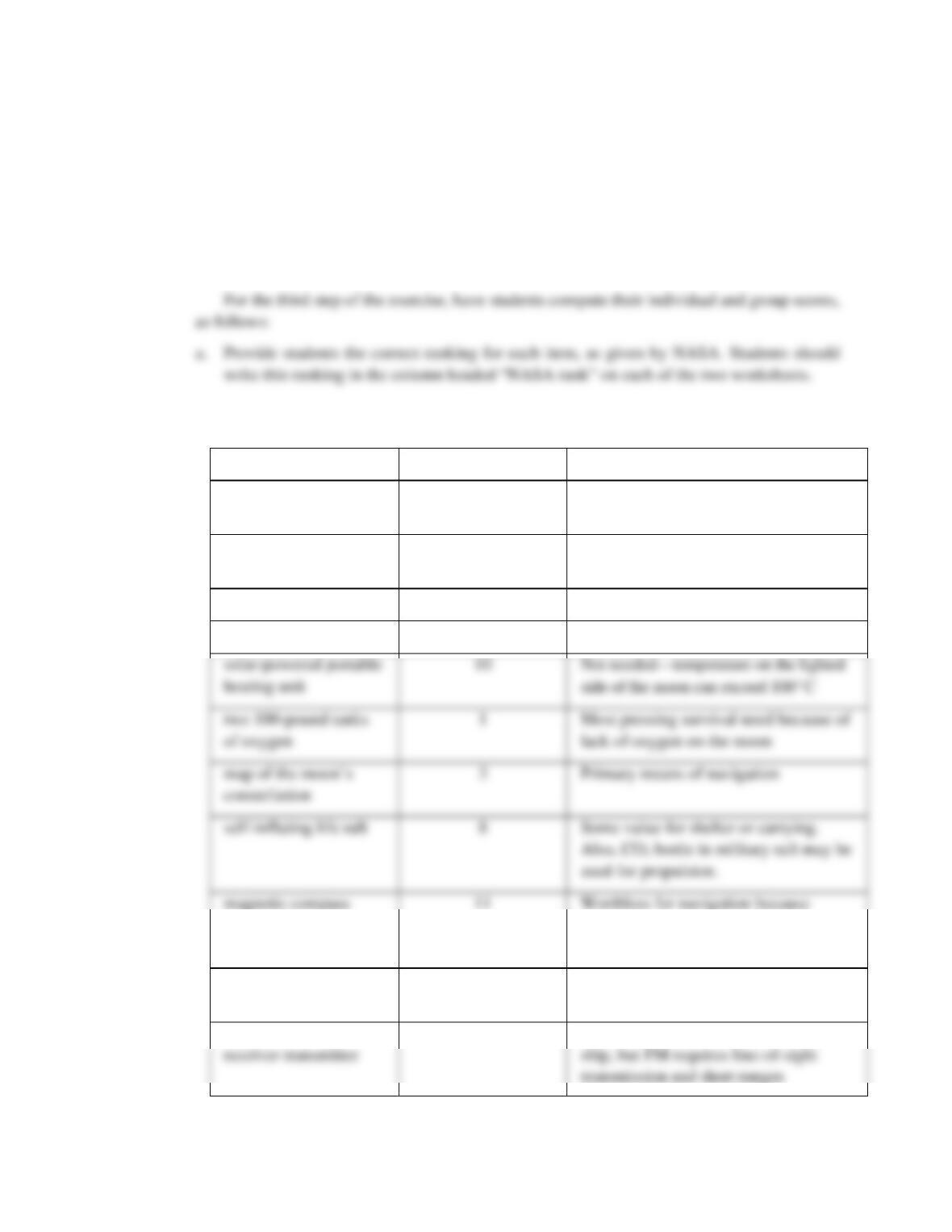
CHAPTER 20—SPEAKING IN SMALL GROUPS 293
First, divide the class into groups of 4 to 6 members, and have each member complete the
“Lost on the Moon” Individual Worksheet on page 298. Allow 10 minutes for this part of the
exercise.
Second, have each group discuss their individual answers and try to reach a consensus
ranking of the 12 items. Each group should complete the “Lost on the Moon” Group Work-
sheet on page 299. Allow 25 minutes for this portion of the exercise.
Item
NASA rank
NASA’s rationale
box of matches
12
No oxygen on moon to sustain flame
food concentrate
4
Efficient means of supplying energy
requirements
50 feet of nylon rope
6
Useful in scaling cliffs, tying injured
together
parachute silk
7
Protection from sun’s rays
two .45 caliber pistols
9
Possible means of self–propulsion
1
lack of oxygen on the moon
map of the moon’s
3
Also, CO2 bottle in military raft may be
magnetic field on the moon is not
polarized
five gallons of water
2
Replacement for tremendous loss of
liquid on lighted side of moon
solar–powered FM
5
For communication with command

294 CHAPTER–BY–CHAPTER GUIDE TO THE ART OF PUBLIC SPEAKING
b. For each item on both worksheets, students should enter the difference between their indi-
vidual ranking or group ranking and the NASA ranking. It makes no difference which rank-
c. The total score for each worksheet is figured by adding all the numbers in the “Differ-
ence” column on each sheet.
Fourth, have students compare their individual scores with the group score. Also have
students compare the average individual score of all members of each group with the group
score. In almost every case the group’s score will be better—closer to NASA’s rankings—
than either the individual scores or the average individual score of the group’s members.
Fifth, conduct a general class discussion of the results and of the decision–making proce-
dures used in the groups.
Discussion: This is an excellent exercise to acquaint students with the processes and
benefits of small–group discussion. Students see how a small group can provide resources
2. Have students perform the “Hostages” exercise, as follows:*
First, divide the class into groups of 4 to 6 members, and have each member complete the
“Hostages” Individual Worksheet on pages 300–301. Allow 10 minutes for this part of the
exercise.
Second, have each group discuss their individual answers and try to reach a consensus
ranking of the eight hostages. Each group should complete the “Hostages” Group Worksheet
on page 302. Allow 20 minutes for this part of the exercise.
Third, have each group report its rankings to the rest of the class. Afterward, conduct a gen-
eral class discussion of the results and of the decision-making procedures used in the groups.
Discussion: Like “Lost on the Moon,” this is an excellent exercise to acquaint students with
the processes of small-group discussion. But whereas “Lost on the Moon” deals with scien-

3. Assign students the Twelve Angry Men group consultation project, as follows:*
First, divide the class into groups of 5 to 6 members. The task of each group is to view
the classic film Twelve Angry Men, which revolves around the efforts of eleven members of a
jury in a murder trial to convince one member to change his “not guilty” vote to “guilty.” The
film dramatizes many of the aspects of small–group discussion covered in the textbook, in-
cluding the kinds and functions of leadership, interpersonal conflict, hidden agendas, and the
creation of consensus. Because the film is 96 minutes long, each group will have to arrange a
time to view it out of class.
Second, give each group the following instructions: For this assignment, your group is to
act as a consultant to the jury in the movie Twelve Angry Men. The purpose of this assign-
ment is for you to demonstrate your knowledge of group processes by evaluating a group’s
decision making. There is no single correct answer to this assignment. Your task as a group is
to demonstrate that you understand and can apply the concepts of small–group discussion pre-
sented in the textbook and in class.
Third, have each group consider the following questions in its analysis:
a. What are the strengths of the group portrayed in Twelve Angry Men?
b. What are the weaknesses of the group?
c. What kinds of leadership does the group demonstrate?
d. What role do hidden agendas play in the deliberations of the group?
e. If you were the leader of the group, what would you do to eliminate some of its interper-
sonal conflict?
f. Who are the most effective communicators in the group? The least effective? Why?
g. How could the group improve its decision making and problem solving?
Fourth, conduct a general class discussion in which each group reports a summary of its
deliberations and recommendations. Use the discussion to illustrate points about speaking in
problem–solving s mall groups.
Discussion: This assignment is particularly valuable in helping students understand the
dynamics of the group process. It can also be used as an alternative to the major problem–

296 CHAPTER–BY–CHAPTER GUIDE TO THE ART OF PUBLIC SPEAKING
4. Divide the class into groups of 5 to 6 students each and distribute the Classroom Speech
Deliberation Worksheet from page 303 of this manual. The task of each group is to review
the previous round of classroom speeches according to the questions on the worksheet and to
provide constructive suggestions to help improve the next round. Have each group present its
thinking in a panel discussion.
Discussion: This assignment can be a helpful way to integrate group discussion into a public
speaking class. Groups should be assigned before the start of the round of speeches they
are to analyze. Be sure to tell the groups that this assignment will require them to meet out-
5. If you assign students a major group project that requires work outside of class, have them
prepare a 2– to 3–page written report on the deliberations of their group. To guide their writ-
ing of the report, students should follow the Group Discussion Self–Assessment, which ap-
pears on page 304 of this manual.
Discussion: This assignment helps students think critically about their small–group expe-
rience in light of the principles discussed in Chapter 20. The Group Discussion Self–
Assessment guides students through their reports by focusing on leadership, the respon-
6. As in the preceding assignment, encourage students to keep a journal of their group’s deliber-
ations. The journal should note what happens at each meeting and what developments take
place over time as the group works on its project. When the project is completed, have each
student turn in a Group Discussion Participant Evaluation Worksheet (page 297) assessing
the work of each participant in the group other than himself or herself.
Discussion: This is an alternative to the detailed evaluation called for in the preceding Addi-
tional Exercise/Activity. Because this evaluation focuses on individual group members, it usu-

Group Discussion Participant Evaluation Worksheet
Person being evaluated
Your name Group
For each item, circle the number that best reflects your evaluation of the participant’s contribu-
tion to the group.
P F A G E Appeared committed to the goals of the group
P F A G E Participated frequently in group deliberations
P F A G E Comments were clear, relevant, and helpful
P F A G E Carried out individual assignments promptly
P F A G E Assisted with procedural leadership functions
poor
fair
average
good
excellent

__________
__________
__________
__________
__________
__________
__________
__________
__________
__________
__________
__________
__________
__________
__________
“Lost on the Moon” Individual Worksheet
Instructions:
Your spaceship has just crash–landed on the lighted surface of the moon. You were scheduled to
rendezvous with a command ship 200 miles away, also on the lighted side of the moon, but the
rough landing has ruined your ship and destroyed all the equipment on board, except for the 12
items listed below.
Your crew’s survival depends on reaching the command ship, so you must choose the most
__________
__________
__________
__________
__________
__________
__________
__________
__________
__________
__________
__________
two .45 caliber pistols
__________
__________
__________
solar–powered portable
heating unit
__________
__________
__________
two 100–pound tanks of oxygen
__________
__________
__________
map of the moon’s

299
“Lost on the Moon” Group Worksheet
Instructions:
Your task is to reach a consensus ranking of the 12 items needed to survive the journey to the
command ship 200 miles away. This means that the ranking for each of the 12 items should be
agreed upon by each member of the group before it becomes a part of the group’s decision. Here
are some guides to use in reaching consensus:
2. On the other hand, don’t change your mind simply to avoid disagreement. Seek out differences
3. Avoid such techniques as majority vote, averaging, flipping coins, and bargaining.
After your group has reached consensus on how to rank the 12 items, fill in the “Group rank”
column below. You have 25 minutes to complete this phase of the exercise.
Item
Your rank
NASA rank
Difference
box of matches
__________
__________
__________
50 feet of nylon rope
__________
__________
__________
parachute silk
__________
__________
__________
heating unit
__________
__________
__________
__________
__________
__________
magnetic compass
__________
__________
__________
five gallons of water
__________
__________
__________
solar–powered FM receiver–
transmitter
__________
__________
__________

“Hostages” Individual Worksheet
Instructions:
A plane has been hijacked! The hijackers offer to release four passengers to the U.S. embassy. In
return for this gesture, the government of a neutral country will agree to allow the plane to land at
its airport and refuel.
The captors insist, however, that U.S. authorities select the four to be released from the fol-
lowing list. The president has given your group the job of making the selection. If you do not
select the people, the hijackers are perfectly willing to allow the plane to run out of gas and crash,
killing all passengers. You must reach a decision by consensus, and you must do so within the
next half hour.
You may assume the terrorists are honest about releasing those who are chosen to be re-
leased. You do not know what will happen to those who remain on the plane, but given what is
known about this particular terrorist group, you expect most or all of the remaining hostages
probably will die.
Quickly rank the following passengers in the order in which you would choose them to be
Hostages
Your rank
1. Brenda Jones, age 27, has three children by three different fathers, none of
2. Fr. John O’Brien, 65 years old, is in excellent health. A Roman Catholic priest,
he has dedicated his life to working with the poor in an inner–city ghetto. He is
3. Juan Garcia is 45. He has a history of heart trouble and might not survive the
stress of a prolonged hostage situation. He is a wealthy businessman whose

Hostages
Your rank
4. Elijah Brown is 52. He did time in jail for armed robbery. Since his release
5. Betsy Bates, 29, is a well-known and successful model. Married a little over a
6. Congresswoman Jan Perkins is 47. Widowed young, when her husband died
in the crash of an Air Force plane while on a diplomatic mission for the State
7. D. B. Calhoun is 43. Little is known about him, except that he is a very
bigoted person with an unstable employment history. He reads Soldier of
8. Andrea Ohms, at 19, is already a distinguished pianist, having started per-
forming professionally at age 8. Her performances give immense pleasure to
thousands of people around the world. She is engaged to be married.
_________

302
“Hostages” Group Worksheet
Instructions:
Your task is to reach a consensus ranking of the four hostages to be released by the terrorists. This
means that the ranking for each of the four should be agreed upon by each member of the group
before it becomes part of the group decision. Here are some guidelines to use in reaching consensus.
1. Don’t argue stubbornly for your own point of view just because it is yours. Listen to other
members of the group and be willing to change your views on the basis of reason and logic.
2. On the other hand, don’t change your mind simply to avoid disagreement. Seek differences of
3. Avoid such techniques as majority vote, averaging, flipping coins, and bargaining.
After your group has reached consensus on how to rank the hostages, fill in the “group rank”
column below. You have 20 minutes to complete this phase of the exercise.
Hostage Group Rank
2. Fr. John O’Brien ___________
4. Elijah Brown ___________
6. Jan Perkins ___________
8. Andrea Ohms ___________
303
Classroom Speech Deliberation Worksheet
Your group’s task is to review the previous round of classroom speeches by answering the questions
below. Try to reach consensus in your answers, and make sure you provide constructive suggestions
to help improve the next round of speeches. Present your group’s recommendations in a panel–
discussion, which is described on page 387 of your textbook.
a. How well did the class as a whole perform in narrowing their topics and adapting their speeches
to this audience?
• Were specific purposes sharply defined? Were they too broad? Too narrow? Too technical?
Too trivial?
b. How well did the class as a whole perform in the area of speech organization?
• Which introductions worked especially well? Why?
• Which conclusions were particularly effective? Why?
• Did speeches follow a clear method of organization? Which speeches were especially
c. How well did the class as a whole use supporting materials in this round of speeches?
• Which speakers made especially good use of examples? What made their use of exam-
ples so effective?
• Which speakers made especially good use of statistics? What made their use of statistics
so effective?
d. How well did the class as a whole deliver this round of speeches?
• Did speakers sound fluid, confident, and conversational?
• Did speakers manage their notes effectively and establish strong eye contact with listeners?

Group Discussion Self–Assessment
Your task is to reach a full, objective assessment of the major strengths and weaknesses of your
small group and of your performance in the group. Write a thoughtful, objective evaluation in
full–sentence and paragraph form with an introduction and a conclusion.
Use the following questions to guide your self–assessment, though you do not need to answer
each question individually in your paper. Be specific and concrete in your comments.
Leadership
Did your group have a designated leader?
If you did not have a designated leader, what kind of leadership developed in the group?
Responsibilities of Group Members
How fully did members commit themselves to the goals of the group?
How well did members carry out their individual assignments?
Use of the Reflective–Thinking Method
Did the group define the question for discussion clearly?
Did the group analyze the problem thoroughly before attempting to map out solutions?
Did the group establish criteria for an ideal solution?
Overall Evaluation
Are you satisfied with the work of the group and with your role in the group?
If the group were to start its project over again, what changes would you recommend to help
the group work more effectively? Be specific.