Chapter 2: Ideas & Materials for Instruction
CHAPTER 2: Listening and Speaking in a Democratic Society
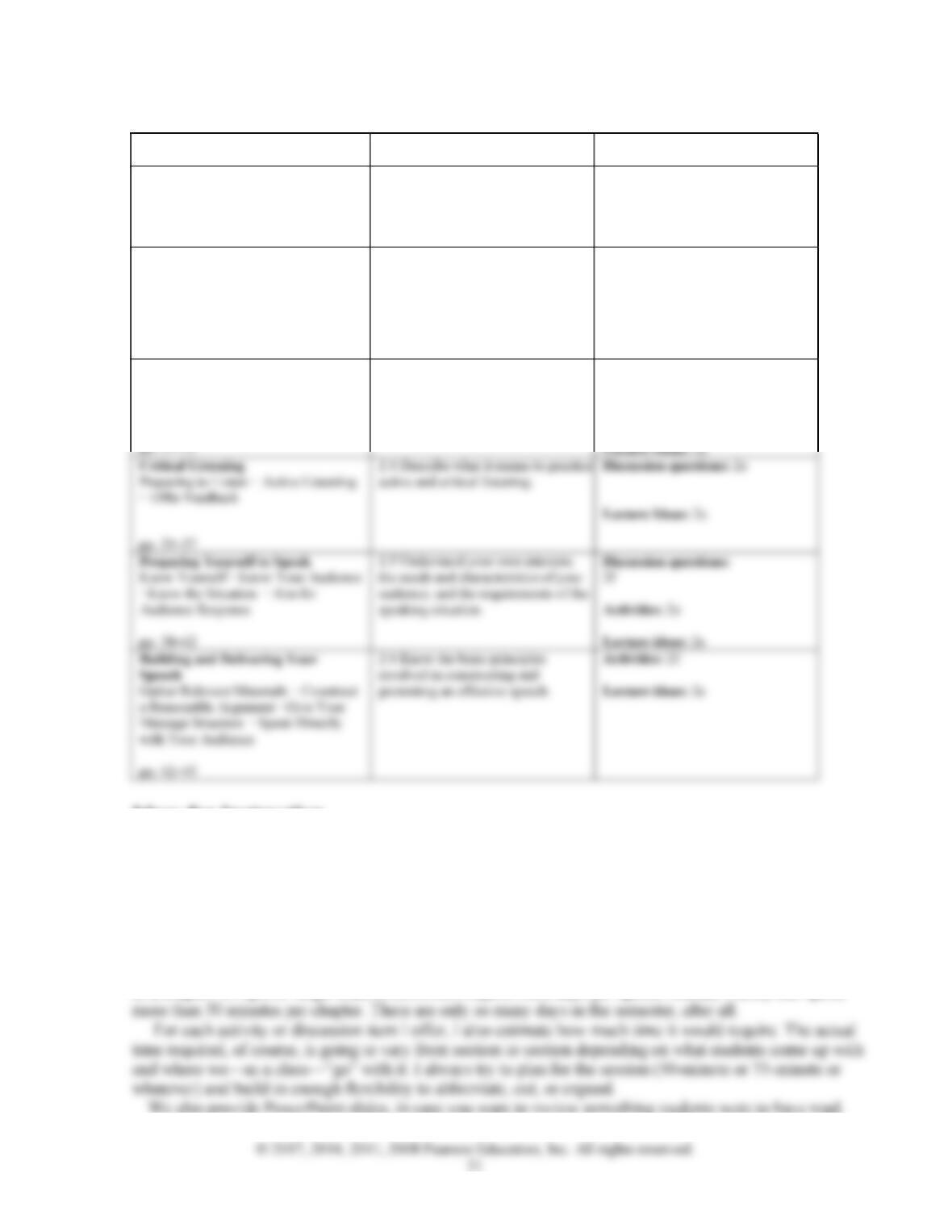
Overview Learning Objectives Ideas for Instruction
The Speaker-Listener Partnership
pp. 26–28
2.1 Explain the nature and
significance of the speaker-listener
partnership.
Discussion questions:
2a
Activities: 2a
Lecture Ideas: 2a
The Engaged Listener
Positive Outcomes of Effective
Listening ·Preparing for Critical
Listening: Your Responsibility as a
Citizen
pp. 28–30
2.2 Understand the meaning and
benefits of engaged listening.
Discussion questions: 2b; 2c
Activities: 2b
Lecture Ideas: 2a
Barriers to Good Listening
Passivity Syndrome ·Automatic
Rejection ·Short Attention Span ·
Stereotyping ·Distractions
pp. 31–35
2.3 Understand the barriers that
prevent you from listening
effectively.
Discussion questions:
2d
Activities: 2c; 2d
Ideas for Instruction
As noted elsewhere, you will not be able to cover everything in the text—nor should you attempt to (i.e.,
“The more we teach, the less they learn.”). I always “assume” students have read the assigned reading and
that my job as an instructor is to highlight a few, select ideas from the reading (or to introduce
supplemental material) for students to contemplate, reflect upon, and apply. My goal is to help them build
meaning and internalize what they have learned, retaining it for future use.
What follows are ideas for how some material might be treated through discussion and activity. My
selections are ones I typically highlight in my own classes—depending on how much time I have to devote
to a chapter. In light of larger class sizes (which require more days per speech round), I rarely can spend
We also provide PowerPoint slides, in case you want to review something students were to have read.

Chapter 2: Ideas & Materials for Instruction
Be mindful that our slides are necessarily wordy to assist you with locating which ones you want to use
(and we’ve also coordinated them with the chapter outline we created for you). We suggest that you make
the slides “your own” by editing them down to select words and phrases. We recommend, as well, that you
adhere to the various principles outlined in Chapter 12 (pp. 47 & 252–54) for effective use of PowerPoint.
Not only will you remain consistent with the text, but you’ll be modeling best practices for your students.
Discussion Question 2a
Approximate time required: 5 min.
Why is it important to view public speaking as a process?
Students should recall that speakers and listeners must both be involved in the communication
process. Both must take their roles seriously—speakers addressing matters of public concern and
Discussion Question 2b
Approximate time required: 10 min.
What is effective listening? What are the positive outcomes of effective listening for us, as individuals,
and for society?
To listen effectively, students should recall, is to take in information accurately and—as a result—
expand our knowledge (i.e., learn something) about a subject. At the same time, we think critically
about what we’ve encountered, analyzing and evaluating the content, judging such things as the
accuracy and validity of the message.
As for the benefits, these are many. We provide PowerPoint slides of the following bullets, in case
you want to use them, bearing the title: “Positive Outcomes of Listening.” You could provide similar
elaborations to what we provide here.
Become better informed
To make effective decisions requires a good knowledge base. Fortunately, as we noted in Chapter 1’s
discussion topics, we have quality news reports to which we can listen and learn. We also can get in

Chapter 2: Ideas & Materials for Instruction
Meet your responsibility
To listen to someone is to convey respect for them and their views. Listening to them allows us to
better understand their point of view and to respond more thoughtfully and intelligently to their
concerns. We also communicate a desire for dialogue and collaboration, and we demonstrate our faith
in the democratic process and our conviction that every citizen should be respected and heard.
Better know “you” and your values
Perhaps you’ve heard of Social Comparison Theory—the idea that individuals learn about and assess
themselves by comparison with other people. That’s what listening allows us to do. As we compare
and contrast our beliefs and values with those of others, we gain a better sense of who we are and how
our views compare to others. Are we mainstream? If not, what explains our unique perspective? Why
might others see something differently?
By contemplating others’ views and behaviors, we can better contemplate our own. An example I
Develop/sustain better relationships
We’ve already noted how listening to someone conveys respect. It shows we care about them. When
we respect others, they generally respond in kind—listening and considering what we have to say
Improve your speaking
Listening with our ears and our eyes allows us to gain insights into what is effective and ineffective
speech. As noted above, we also better understand others’ views and concerns and the basis for those
–Kenneth A. Wells, Guide to Good Leadership
Discussion Question 2c
Approximate time required: 5 min.
Why is it important to prepare to listen? How does one prepare to listen responsibly and effectively?
Chapter 2: Ideas & Materials for Instruction
Many of us have likely thought little if any about preparing to listen, but when you stop and think
about it, it becomes obvious that we should prepare and have some responsibility to do so. If we learn
about a topic area prior to listening to other people’s views on the matter, we can better understand
and evaluate what they are saying.
Discussion Question 2d
Approximate time required: 5 min.
Do you ever practice automatic rejection? Who is a person you have trouble listening to who might have
something insightful to say? What instances of people giving one another a chance come to mind? When
have you been surprised to find that you agree with someone you typically “dismiss?”
Responses will vary. Some will grab for the television remote whenever Dick Durbin or Barbara
Boxer appears. For others, it may be Paul Ryan or Marco Rubio that prompts them to change the
Discussion Question 2e
Approximate time required: 5 min.
In what ways does note taking assist listening? How does it serve us “after” a speech? How should one
take notes?
Note taking assists listening because it helps focus our attention. We are more actively involved in
our role as listener. It also slows down our thinking and can help synchronize our listening with the
tempo of the speaker.
After the speech, note taking helps us remember what we have encountered. It also provides a record
that helps us ask better questions. The record also provides a greater store of information that we can
continue to ponder and/or use. In addition, reviewing the notes may very well yield our best analysis
and reflection of the material, since it is another exposure to that information—and the earlier
exposure has had time to incubate.

Chapter 2: Ideas & Materials for Instruction
Discussion Question 2f
Approximate time required: 5 min.
What constitutes a significant topic?
Students will likely recall the text’s definition: “Your speeches ought to be about things that matter;
things that are important on your campus or in your community; things that affect you and your
audience locally, nationally, or globally.”
Suggested Activities. Use these “hands-on” applications to get students actively involved with the
material. What we suggest often requires students to synthesize what is covered in the chapter, as well as
what they were to have learned from other chapters.
Activity 2a
Approximate time required: 8 min.
Have students take out pen and paper and, working quickly, answer the following questions: What is
something people in your home community would understand better than most people? Why would they
have that special understanding? Provide the examples, entered below, to help stimulate their thinking.
After allowing only a few minutes, go around the room, having students share what they identified. Ask
them to do so without using their notes, and to be as brief as possible.
Activity 2b
Approximate time required: 8 min.
Have students work with a neighbor or two and, working quickly, respond to the following: “Identify
some issues you are interested in but are not fully prepared to deliberate about.” You might stimulate their
thinking with an illustrative example, such as the issue of whether we should raise the minimum wage.
How many would feel that they know enough to deliberate about the matter? Have they fully informed
any opinion they have?
Activity 2c
Approximate time required: 15 min.
Have students enter, in their notes, a response to the following: “What barriers to good listening do you
commonly experience?” To help them do so, quickly review the common barriers, using the PowerPoint
slides we provide for “Barriers to Good Listening.”

Chapter 2: Ideas & Materials for Instruction
These slides consist of the following bullets. Briefly elaborate on each bullet (akin to what we provide
below).
This activity will have students contemplate their own listening behaviors and see how others also
struggle with listening.
passivity syndrome
This entails thinking that we know how to listen, and that if there’s a problem, it’s the speaker’s fault
for not being clear, dynamic, and so on. In other words, we don’t recognize that we have to be
actively involved. We have to want to listen and work at it, recognizing we’re a co-equal partner in
the communication process.
automatic rejection
short attention span
stereotyping
If we are preoccupied with a speaker’s gender, race, age, or other characteristic, we are not focused
properly on the message.
distractions
Activity 2d
Approximate time required: 10 min.
To help sensitize students to the problems with stereotyping, have students contemplate how they,
themselves, may be stereotyped. To do so, have them answer the following three questions, working solo
or with a partner.
1) How might others stereotype you?
2) In what ways is the stereotype accurate?
3) In what ways is it misleading?
Ask for a few volunteers to share their responses. You might also offer your own.

Chapter 2: Ideas & Materials for Instruction
Activity 2e
Approximate time required: 10 min.
Have students work with a neighbor (or in a small group) and, working quickly, identify some issues that
people think about differently these days. Their examples will help illustrate how public opinion evolves
and how what we say and how it is received is impacted by the temporal context. You might jump start
their thinking with the examples in the text or examples such as these:
Awareness of the harms of secondhand smoke and a greater appreciation of the rights of
nonsmokers has made us more receptive to bans on smoking in public places.
Reports of how particulate matter in the air kills people prematurely (and, in the interim, creates
health problems—especially for children) coupled with concerns over global warming have
Activity 2f
Approximate time required: 10 min.
Have students take out pen and paper and, working quickly, answer the following question: “What is a
personal story or experience you (or a family member or a friend) have had that would work well in a
speech?” After a few minutes, have students share what they have written. Offer an example or two of
your own, to help stimulate their thinking. Here are some examples:
Someone used my credit card number, and the company called to check whether I had made the
purchase. This experience could work well in a speech about the prevalence of such crimes and
what policies exist (or should exist) to protect us.
Lecture Ideas. Some elements in the chapter lend themselves to careful review and/or some
supplemental material. Either way, you’ll amplify something that deserves amplification. We’ll offer
some suggestions, often providing one or more corresponding PowerPoint slides.
Lecture 2a: Use one or more of the slides from the PowerPoint slideshow that accompanies this chapter

Chapter 2: Ideas & Materials for Instruction
As noted previously, feel free to edit down the slides, observing the various principles outlined in
Exam Items. Testing, of course, can be an important part of instruction. We provide numerous, high-
quality multiple-choice items in our test bank. We also offer several short-answer items and essay items.
These often can double as in-class discussion items or activities or lecture material (and it is a good idea
to cover something in class, if you are going to test on it later with a short-answer or essay item!).
**********************************************************
Chapter Outline: Chapter 2: Listening and Speaking in a Democratic Society
Chapter Intro:
I. In a democratic society, the true value of a speech must be judged by the outcome for
all parties involved: the speaker and the listener.
II. Effective listening is fundamental to the communication process.
III. Listening well is an important responsibility.
IV. An effective speaker must respect listeners’ needs, sensitivities, and rights.
V. Public speaking should be mutually beneficial for both speaker and listener; it is a
way to promote the common good and is governed by shared ethical principles.
I. The Speaker-Listener Partnership
Learning Objective 2.1—Explain the nature and significance of the speaker-listener
partnership.
A. All communication, including public speaking, should be viewed as a process.
1. The process is transactional, an exchange between the sender and the receiver.
Communication is a process in which speakers and listeners continuously
exchange messages and negotiate meanings.
2. The transactional model differs from the idea of simply sending a message out to
an audience.
a. The speaker encodes a message, taking his or her ideas and putting

Chapter 2: Ideas & Materials for Instruction
nonverbal aspects of the message so as to give them meaning.
c. The listener sends back verbal and nonverbal messages to the speaker.
d. As messages are sent, there is the possibility of interference or “noise.”
2) A speaker may create “noise” that distracts, such as a boring
delivery.
4) A good speaker will anticipate and take account of these
influences. Speeches always take place in a context.
e. Where and when you speak can make a big difference.
f. A speech must be designed not only for specific audience, but also for
a particular place and time.
3. Viewing public speaking as a process is important.
a. Both speakers and listeners must be involved in the process.
II. The Engaged Listener
Learning Objective 2.2—Understand the meaning and benefits of engaged listening.
A. Depending on your goals, you may approach listening differently in differing
situations.
1. Listening for enjoyment
2. Empathic listening
3. Informational listening
4. Critical listening
a. We analyze and evaluate the speaker’s message, making
B. Positive Outcomes of Effective Listening
1. Society benefits as whole when people listen carefully and
respectfully.
2. Everyone should strive to become better listeners for several reasons.
a. Listening carefully helps you become better informed.

3. Effective listening is both practical and ethical.
C. Preparing for Critical Listening: Your Responsibility as a Citizen
1. In order to listen critically to a presentation, the listener needs to be as
well informed as possible.
3. Poorly prepared listeners often cannot tell the difference between good
4. Good listening promotes improved democratic deliberation.
III. Barriers to Good Listening
Learning Objective 2.3—Understand the barriers that prevent you from listening
effectively.
A. Passivity Syndrome
1. With this syndrome, the listener believes that listening is a one-way
2. Listening is an active process.
a. We have to want to listen, and we have to be willing to work
B. Automatic Rejection
1. Listening is more difficult when a speaker challenges our existing
beliefs or values.
3. The effective and ethical listener should allow the speaker to state his
or her whole case before jumping to conclusions.
4. After listening to the speaker’s whole argument, you are in a better
position to respond to those ideas with which you disagree.
C. Short Attention Span
2. Modern technology has contributed to our shorter attention spans.
3. As listeners we need to overcome our short attention spans and train
ourselves to listen actively, even in challenging communication
contexts.
D. Stereotyping
1. Stereotypes are a barrier to effective listening.
a. When we stereotype, we observe a few members of a
particular category and draw conclusions about all others
2. One way to overcome stereotypes is to think about how others may
stereotype us.
a. Many different stereotypes exist.
E. Distractions
1. Distractions are often real as well as imagined.
2. Speakers themselves may create distractions.
a. A listener’s first impression of the speaker is often based on
the speaker’s physical appearance.
3. Visual images often serve as distractions.
a. Visual images can elicit feelings or establish moods, even
when the listener is unaware of their impact.
IV. Critical Listening
Learning Objective 2.4—Describe what it means to practice active and critical
listening.
A. Preparing to Listen
1. Be informed.
3. Identify your goals.
5. Consider the speaker’s purpose.
B. Active Listening
1. Take notes as you listen.
a. Write down the ideas and key points of the speech.
b. Use keywords to record main ideas.
3. Be aware of the potential influence of the speaker’s ethos.
C. Offer Feedback
1. Use nonverbal communication to show the speaker that you are
V. Preparing Yourself to Speak
Learning Objective 2.5—Understand your own interests, the needs and characteristics of
your audience, and the requirements of the speaking situation.
A. Know Yourself
1. Your own beliefs, ability, knowledge, and potential are the foundation on
which any speech is built.
3. Credibility, or ethos, describes how an audience perceives the character,
intelligence, and motives of a speaker.
5. You should consider how you will be perceived and what you might do to
improve your own ethos as you prepare to speak.
B. Know Your Audience
1. You must consider your specific audience‘s needs, interests, beliefs, and
knowledge.
3. It is possible to make limited generalizations about listeners based on their
group characteristics.
5. Adapting to your audience does not mean pandering to what your listeners
might want to hear.
6. While you never set out to deliberately alienate your audience, you will
C. Know the Situation
1. The setting of a speech can significantly influence how your audience
Chapter 2: Ideas & Materials for Instruction
responds to you.
3. You face the challenge of recognizing and adapting to what is going on in
your listeners’ world.
D. Aim for Audience Response
1. Your goal is to bring about some specific response from your audience.
3. One of the first things you should do in preparing yourself to speak is to
VI. Building and Delivering Your Speech
Learning Objective 2.6—Know the basic principles involved in constructing and
presenting an effective speech.
A. Gather Relevant Materials
1. Once you have decided on a specific purpose, you should explore relevant sources
2. Sources must be authoritative, reliable, and correctly cited.
3. All speakers, no matter how knowledgeable, can benefit from learning more about
their topic.
B. Construct a Reasonable Argument
2. Seek information that will connect your topic with your audience’s feelings,
3. Remember that public speaking is a process: your purpose may change as you
gather more information.
5. Consult several different kinds of sources for differing perspectives to help you
build the most compelling argument.
C. Give Your Message Structure
1. Well-organized speeches make it easy for the audience to follow and remember
the speaker’s argument.
3. An introduction relates your topic to an audience, gains their attention and
4. The body is built around main ideas, each supported with evidence.
5. Transitions reinforce the sense of structure, helping listeners move smoothly from

Chapter 2: Ideas & Materials for Instruction
7. The speech should follow an organizational pattern that is clear to the audience.
9. A clear organizational pattern also makes clear how everything in the speech fits
D. Speak Directly with Your Audience
1. Choose language that is suitable to the audience and the occasion.
3. Use language that is clear, precise, interesting, and appropriate.
5. Recognize that different situations call for different delivery styles.
a. Impromptu speaking happens when a speaker is asked to speak on the spur of
the moment, with little preparation.
6. Regardless of the situation, a conversational and relaxed delivery is usually best.
a. Be mindful that the best delivery does not call attention to itself.
**********************************************************
Instructional ideas for Chapter Two
___________________________________________________________
___________________________________________________________
___________________________________________________________
___________________________________________________________
__________________________________________________________
___________________________________________________________
___________________________________________________________
___________________________________________________________