Constructing a Good Syllabus and Sample Syllabi
Descriptions of quizzes:
Quiz One: This quiz will cover Chapters 1, 2, 3, 9, & 16. It will also cover “Pointers for
Writing” (from the syllabus) and notes from class as well as regarding the Speaker Showcase.
The format will be a combination of short answer and multiple choice.
Quiz Two: This quiz covers Chapters 4, 5, 6, 7, 8, 9, & 13, plus class notes (esp. library stuff
from our information literacy unit!) Same format.
Format for submissions:
In order to be more environmentally friendly and to reduce bulk, please use neither title pages
nor folders for your submissions. Instead, simply type the following information atop
the first page:
sample:
Your name > Jenny Chang
Constructing a Good Syllabus and Sample Syllabi
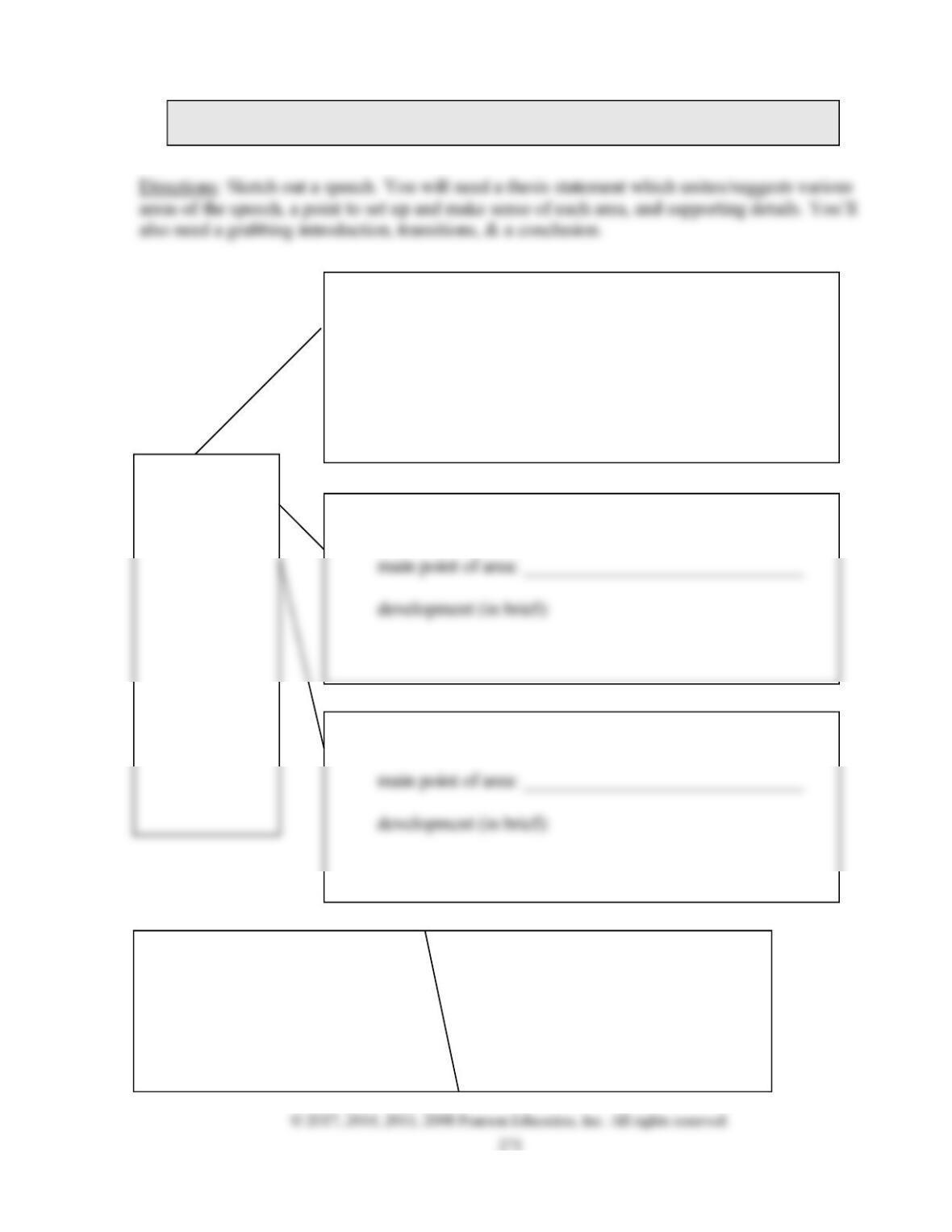
Sketching Out Your Speech GW
Area one’s subject: ____________________________
main point of area: ______________________________
development (in brief):
Thesis:
Area two’s subject: ____________________________
Area three’s subject: ____________________________
Ideas for Ideas for
introduction: conclusion:
Constructing a Good Syllabus and Sample Syllabi
Public Speaking
Service-Learning Syllabus
This syllabus is based on one developed by one of the authors, Patricia Hayes Andrews. A version of it
was used recently to teach a service-learning section of a public speaking course at Indiana University.
The course was organized around a specific theme. You will notice that the chapters are assigned in an
order that differs from their presentation in the book. The book is intended to be adaptable to diverse
ways of organizing the course.
The syllabus assumes a 15-week semester, with two 75-minute class sessions each week.
Course Description
This service–learning section of the public speaking course is organized around the topic of Homelessness
and Poverty in Our Community. During the course of the semester, you will volunteer for at least 25–30
hours at the Shalom Community Center (a day shelter and resource center for those experiencing
Speaking assignments will ask each of you to assume the role of “voices for the voiceless.” For example, by
giving a community action team presentation, you and your fellow group members will explore some of the
factors that contribute to poverty in the Bloomington community. You will also give a speech of tribute in
Course Requirements
2. Volunteer for at least 25–30 hours during the semester at the Shalom Community Center.
4. Prepare and give speeches on the day assigned and within the time limits of the assignment. Details
of each speaking assignment will be presented later.
6. Devise & execute an advocacy project (e.g., letter to the editor, letter to a state representative, public
service announcement, advocacy brochure, etc.). This may be done individually, or as a group.
8. Take short exams based on assigned reading.
9. Maintain an informal journal—to reflect on/process your experiences volunteering at Shalom.
Constructing a Good Syllabus and Sample Syllabi
Attendance:
You are expected to attend class every day. There are occasions, however, when it is necessary to miss
class, so two absences are permitted. Absences in excess of two will affect your grade negatively. If you
have some special emergency—a medical or personal problem—discuss this with me. Perfect attendance
will affect your grade positively.
Required Readings and Resources:
Hogan, J. Michael; Andrews, Patricia Hayes; Andrews, James R.; and Williams, Glen, Public Speaking and
Civic Engagement, 4e. Boston: Allyn & Bacon, 2017.
Ehrenreich, Barbara, Nickel and Dimed. New York: Henry Holt and Company, 2001.
Grading Procedures:
Speech of Introduction 5%
Speech of Tribute 15%
*The participation grade will reflect my assessment of the quality of your in-class contributions,
Special Instructions on Speaking Assignments
2. Prepare a manila folder with your name on the tab. Place your outline in this folder and give it to the
3. Speeches will be recorded. Bring a flash drive or a DVD to class on the day you speak, with your
4. Arrive in class early on the day you are to speak so that the Chair can collect the folders and
5. Speakers and Chairs are responsible for communicating about each speech before the day speeches are
scheduled. Chairs must have sufficient time and information to be prepared to introduce each speaker.
Constructing a Good Syllabus and Sample Syllabi
Course Outline
Day 1:Topic: Course requirements, goals, and procedures; service learning and civic engagement.
Introduce the first speaking assignment (the Speech of Introduction). Assignment: Some time
will be allotted during class to talking with the classmate you will introduce on Day 3.
Day 2:Topic: Public speaking and democratic citizenship: its history, challenges, and implications in
contemporary society. Assignment: Read Chapter 1 in Hogan, Andrews, Andrews, and
Williams (HAAW).
Day 4:Topic:Speeches of Introduction
Assignment: Come to class prepared to introduce a classmate. The speech should last about 3–4
minutes. Be sure that you have practiced the speech out loud enough times so that you adhere to
this limit.
Day 5:Topics: Advocacy, public communication, and civic engagement. We will have a formal
orientation to the Shalom Community Center—to prepare you for your volunteer experiences this
semester. The Shalom volunteer coordinator will show the Shalom DVD and conduct a volunteer
training session.
Assignment: Visit the Shalom website: www.shalomcommunitycenter.org.
Anticipate questions you might want to ask about Shalom.
Day 8: Topic: Listening critically, effectively, and ethically. Consider the centrality of effective listening
to the speaker-listener partnership in a democratic society.
Assignment: Read Chapter 2 in HAAW, including a review of pages assigned earlier (36–45).
Day 9:Topics: Developing significant topics for public speeches. Examine purposive communication,
including the development of specific purpose and thesis statements.
Constructing a Good Syllabus and Sample Syllabi
Day 12:Topics: Conducting responsible and productive research. Focus on the importance of becoming
an informed citizen as central to effective public speaking.
Assignment: Read HAAW, Chapter 6. Come to class prepared to share tentative thesis and
specific purpose statements based on the topics you have previously generated.
Day 16:Topics: Delivering the speech effectively, with an emphasis on extemporaneous delivery.
Focus on the role and importance of the question-and-answer period.
Assignment:Read HAAW, Chapter 11. Continue working on the speech of tribute—refining
the outline, developing the bibliography, and practicing the speech aloud.
Day 17:Topic: Speeches of Tribute
Assignment: Give your outline (in a folder) to the chair for the day at the beginning of the
computer-generated graphics.
Assignment: Read HAAW, Chapter 12. Come to class prepared to examine and critique the
way speakers use visual reinforcement as part of their presentations. We will also discuss
presentational aid options for the final two presentations.
Day 21:Topic: Deliberating in groups as citizens in a democracy. Consider formal public discussion
the chair for the day at the beginning of class. You may choose to submit a group outline. Each
team will have 25–30 minutes to present their symposium. A forum period of 5–10 minutes will
follow each presentation.
Day 24:Topic: Community Action Group Presentations
Assignment: See Day 23—we will follow the same procedures.
Day 25:Topic: Persuasive speaking and public controversy—with an emphasis on ethos and emotional
appeals.
Assignment:Read HAAW, Chapter 14. After briefly processing the team presentations, we
will critically examine portions of several persuasive speeches.
Day 27:Exam #2, covering HAAW, Chapters 8, 9, 10, 11, 12, 14, 15, and 17.
Day 28:Topic:Speeches of Advocacy
Assignment: Students will present their persuasive speeches. As in the past, give your folder
(with accompanying outline) to the chair of the day at the beginning of the class.This speech
should be 10–12 minutes long, to be followed by a forum period.
Constructing a Good Syllabus and Sample Syllabi
CAS 100H—01 Effective Speech (Honors) TR 11:15-12:30
Fall 2016 Professor J. Michael Hogan 171 Willard
Course Description
This is an honors section of Effective Speech. In this class, our goal will be not only to improve
your communication skills, but also to develop an understanding and appreciation of the importance of
public speaking in a democratic society. Since ancient Greek and Roman times, public speaking has been
taught both as the foundation of a liberal education and as an essential skill of democratic citizenship.
Whatever special expertise or talents a person may have, the ability to speak effectively in public,
drawing upon a broad range of perspectives and sources of information, remains fundamental to one’s
In order to develop an appreciation of the importance of public speaking in our personal,
professional, and civic lives, this class will focus throughout the semester on actual, ongoing political and
social controversies. In this class, you will investigate those public issues in depth, and you will learn how
to effectively communicate what you have learned to others. Not only will you write and deliver your
Office and Office Hours
Office: Room 211 Sparks Building. Office hours: 10:00–11:00 TR and by appointment. Phone
numbers: 865–1003 (office) or 364–3296 (home, no later than 5:00 p.m.). You also may leave a message
on my voice mail at the office number or on the answering machine at the home number. E-mail is the
best way to contact me with a simple message or question. My e-mail address is: jmh32@psu.edu.
Textbook
The required textbook for this class is: J. Michael Hogan, Patricia Hayes Andrews, James R.
Speech Assignments
1. Speech of Self-Introduction (Target time: 4 minutes). In this initial speech, you will introduce yourself
to the class and discuss whatever academic or personal interests you have that might be relevant to your
projects in this class. In addition to your biographical information (your name, where you’re from, your
2. Informative Speech (Target time: 8 minutes). Your purpose is to explain some concept, thing,
operation, historical process, etc. Your aim is to convey to your audience information that they need or
desire. The information presented should not be disputed or controversial. If you do touch on
controversial matters, you should acknowledge the existence of controversy and do your best to give
3. Persuasive Speech (Target time: 8 minutes). The purpose of this speech is to defend a specific position
in a controversy. The central materials of this speech will be arguments calculated to convince the
4. Epideictic or Ceremonial Speech (Target time: 8 minutes). For this speech, you will select from a genre
of speech that includes tributes, commemorations, dedications, eulogies, and the like. Your purpose will
not be to persuade an audience to new points of view. Rather, you will seek to give vivid and effective
expression to the beliefs, values, and emotions already held by your audience. The objectives of this
Written Assignments
1. Reaction Papers. On the specific dates indicated below on the Course Calendar, you will turn in a short
(no more than one typewritten page) paper applying some concept from the reading or evaluating one of
2. Speech Critiques. On days when you are not speaking but your classmates are delivering speeches, you
will complete a brief, in-class critique of one of the speeches delivered that day. The specific speech you
Grading
All grading will be on a numerical scale, and the final course grade will be computed according to the
following scale:
A 93+ B+ 87–89 B– 80–82 C 70–76 F 0–59
A– 90–92 B 83–86 C+ 77–79 D 60–69
Individual assignments will be weighted as follows:
Self-Introduction Speech 10%
Informative Speech 20%
Attendance
Attendance will not be taken, but each day you will have a speech to deliver, a critique of another speaker
to write, or a “reaction paper” to hand in. These assignments cannot be made up or turned in outside of
class without a legitimate excuse for your absence. Requests for excused absences should be made in
advance, in writing, and must be accompanied by appropriate documentation. Generally, only
unavoidable absences due to illness or family emergencies will be excused. Social functions (e.g.,
fraternity or sorority events, weddings, etc.) will not qualify as excused absences.
Policy on Plagiarism and Academic Dishonesty
The University Faculty Senate Policies for Students, in Section 49-20, defines academic dishonesty as
follows: “Academic dishonesty includes, but is not limited to, cheating, plagiarizing, fabricating of
information or citations, facilitating acts of academic dishonesty by others, having unauthorized
possession of examinations, submitting work of another person or work previously used without
Constructing a Good Syllabus and Sample Syllabi
Student Disabilities
Penn State encourages qualified persons with disabilities to participate in its programs and activities. If
you anticipate needing any type of accommodation in this course or have questions about physical access,
please let me know as soon as possible.
Course Calendar and Assignments
Aug. 24: Public Speaking and Civic Engagement
Textbook: Chapters 1 and 2
Aug. 26: Delivering the Speech
Textbook: Chapters 11 and 12
Aug. 31: Audiences and Occasions
Textbook: Chapters 4 and 5
Reaction Paper 2: Prepare an audience analysis of this class, based upon the
readings for today and whatever you think you might know already about your classmates.
Sept. 2: Topics and Purposes
Textbook: Chapter 6, and review Chapter 5
Sept. 7: Self-Introduction Speeches: Groups 1 and 2.
Speech Critique 1: All students not speaking today will complete a brief in-class assessment of one
of the speeches delivered in class.
Sept. 9: Self-Introduction Speeches: Groups 3 and 4.
Speech Critique 1: All students not speaking today will complete a brief in-class assessment of one
of the speeches delivered in class.
Sept. 14: Speaking to Inform.
Textbook: Chapter 13
Constructing a Good Syllabus and Sample Syllabi
five possible main ideas, for your informative speech.
Sept. 21: Supporting Materials
Textbook: Chapter 7.
Reaction Paper 6: From stories you have read in the newspaper or from published research
Sept. 23: Sample Informative Speeches
Read: Lester M. Crawford, “Speech before World Pharma IT Congress,” available at:
http://www.fda.gov/oc/speeches/2005/worldpharma0606.html; Dr. Bernd Pischetsrieder, “Keynote
Speech from the L.A. Auto Show,” available at:
Sept. 28: Informative Speeches: Group 3
Speech Critiques 2-4: All students not speaking today will complete a brief assessment of
one of the speeches delivered in class.
Sept. 30: Informative Speeches: Group 4
Oct. 5: Informative Speeches: Group 1
Speech Critiques 2-4: All students not speaking today will complete a brief assessment of
one of the speeches delivered in class.
Oct. 7: Informative Speeches: Group 2
Oct. 12: Speaking to Persuade
Textbook: Chapter 14.
Reaction Paper 8: Read the sample speech at the end of Chapter 10 by President Obama.
Do you consider this a good persuasive speech? Why or why not?
Oct. 14–15: Fall Break
Constructing a Good Syllabus and Sample Syllabi
Oct. 21: The Modes of Proof
Textbook: Chapter 15.
Reaction Paper 10: Read the letters to the editor in several issues of the New York
Times or the Centre Daily Times and identify two or three examples of any of the fallacies in
reasoning described in today’s reading.
Oct. 26: Sample Persuasive Speeches
Oct. 28: Persuasive Speeches: Group 4
Speech Critiques 5-7: All students not speaking today will complete a brief assessment of
one of the speeches delivered in class.
Nov. 2: Persuasive Speeches: Group 1
Speech Critiques 5-7: All students not speaking today will complete a brief assessment of
one of the speeches delivered in class.
Nov. 4: Persuasive Speeches: Group 2
Nov. 9: Persuasive Speeches: Group 3
Speech Critiques 5-7: All students not speaking today will complete a brief assessment of
one of the speeches delivered in class.
Nov. 11: Epideictic Speaking
Textbook: Chapter 16.
Nov. 16: Language and Stylistic Devices
Textbook: Chapter 10.
Reaction Paper 13: From the newspaper, other class readings, or your own imagination,
give me one example of each of the following figures of speech: simile, metaphor, antithesis,
Constructing a Good Syllabus and Sample Syllabi
irony, alliteration, personification, and oxymoron.
Nov. 18: Sample Epideictic Speeches
Reading: President Barack Obama, “Notre Dame Commencement Speech,” May 17, 2009,
online; John McCain, “Liberty University Commencement Address,” May 13, 2006,
Nov. 23: Epideictic Speeches: Group 1
Speech Critiques 8-10: All students not speaking today will complete a brief assessment of one of
the speeches delivered in class.
Nov. 25: No class. Holiday observed.
Nov. 30: Epideictic Speeches: Group 3