
Instructor Resource
Northouse, Introduction to Leadership, 4e
SAGE Publishing, 2018
1
Class Activities
Chapter 13: Overcoming Obstacles
Guide to the Class Activities
Each activity is designed based on Fink’s Learning Taxonomy and is tagged with the following
tags under the taxonomy’s learning and assessment structure:
2. Application (A)
4. Human Dimension (H)
6. Learning How to Learn (L)
These activities may be used in either small-group or large-group settings, depending on class
size and time available. Some may also be suitable as homework.
Activities
Mouse Trap Exercise (A)
There are many variations of this exercise available on the web. This one focuses on giving
effective directions as a leader. You will need three mousetraps, three pencils and three
blindfolds. Do not show the supplies to the class until later. Divide the class into three groups.
Within each group ask one person to volunteer to be the leader and the other to volunteer to be
the blind-folded follower. Once the follower is blindfolded, group members will learn what the
exercise involves, while the follower remains “in the dark.” Place a set mousetrap somewhere in
the room (with three different groups, the traps should be quite a distance apart from each other.
The easiest location is on top of a desk, but the trap could also be placed on the floor, on top of a
backpack, etc. In addition, hide a pencil somewhere in the room where the follower needs to
exert some effort in seeking it. Do this for every group. Then ask leaders to give clear directions
to the followers on how to spring the hidden mousetraps, without telling them this is the goal.

Instructor Resource
Northouse, Introduction to Leadership, 4e
SAGE Publishing, 2018
2
different leadership styles evident? Should employees ever be kept in the dark? Is it possible to
give employees too many directions?
Motivational Quotes (A, H)
Ask students to bring a selection of motivational quotes to class. These should include quotes
they have found personally effective, as well as quotes they disagree with or find objectionable
Motivational Speech (F, A)
This skill-building exercise focuses on creating messages that address the low motivation of
hypothetical followers. Give each person in the class two slips of paper on which they should
write a specific real-life example of an obstacle that hinders productivity in the workplace, e.g.
“My boss is a micro-manager” or “I have a co-worker who is chronically late for work.” Collect
all the examples in a small bag. For this exercise, assume the obstacles are associated with low
motivation (e.g. the boss micro-manages because she feels ill-equipped to use any other
leadership style)
• Option 1 – Impromptu Speech: Have a student draw three slips of paper from the bag,
choose one of the examples and put the other two back in the bag. The student then goes
out in the hallway and has 5 minutes to prepare a 1 minute speech for the class, from the
perspective of the supervisor, motivating the worker to change his or her attitude or
• Option 2 – Group script: In small groups, have students select an example from the bag
and write a brief script for what a supervisor might say to help the employee feel
Group Juggling (A, I)
This activity requires several students who are able to juggle three or more balls. These students
will be asked to teach the rest of the class how to juggle three balls. Each juggling teacher should

Instructor Resource
Northouse, Introduction to Leadership, 4e
SAGE Publishing, 2018
3
be responsible for teaching at least three others how to juggle. Bring enough small balls to class
for many people to juggle simultaneously. Allow 15 minutes for instruction. Afterwards debrief:
• How difficult was it to learn this task?
• What was most difficult (e.g. hand-eye coordination)?
• How can this skill be developed?
• Are there some students who think they will never learn how to juggle? Why?
Show, Don’t Tell (A, I)
An alternative to teaching juggling to the class is having students re-read Mick Wilz’s
Leadership Snapshot from chapter 5. Wilz used Legos to share with employees his mental
picture of a manufacturing redesign. As homework, ask students to find a new way to teach
How-To Speech (A, I, H)
This activity can be spread over several class periods. Ask students to prepare a 4-5 minute
presentation that teaches the rest of the class how to do something. The task should not be
something obvious like, “How to bake chocolate chip cookies” (since most of us already know
how to do this) but something novel and useful, like how to set up a wiki, how to find the best
credit card rate, or how to fold an origami crane. Speakers should use the following guidelines in
preparing their presentations:
1. Be sure the topic is precise and the purpose of the speech is clear to the class
3. Give a simple preview of the process (“This involves three steps”)
5. Offer a brief summary at the end
6. Practice giving the speech aloud, paying attention to the time allotment
After the speech, class feedback should include questions for clarification, suggestions for how
to improve clarity of certain points, and recognition of specific strengths of the presentation.
Course Timeline (A)
Instructor Resource
Northouse, Introduction to Leadership, 4e
SAGE Publishing, 2018
4
A way for students to practice their own organizational skills and to overcome obstacles such as
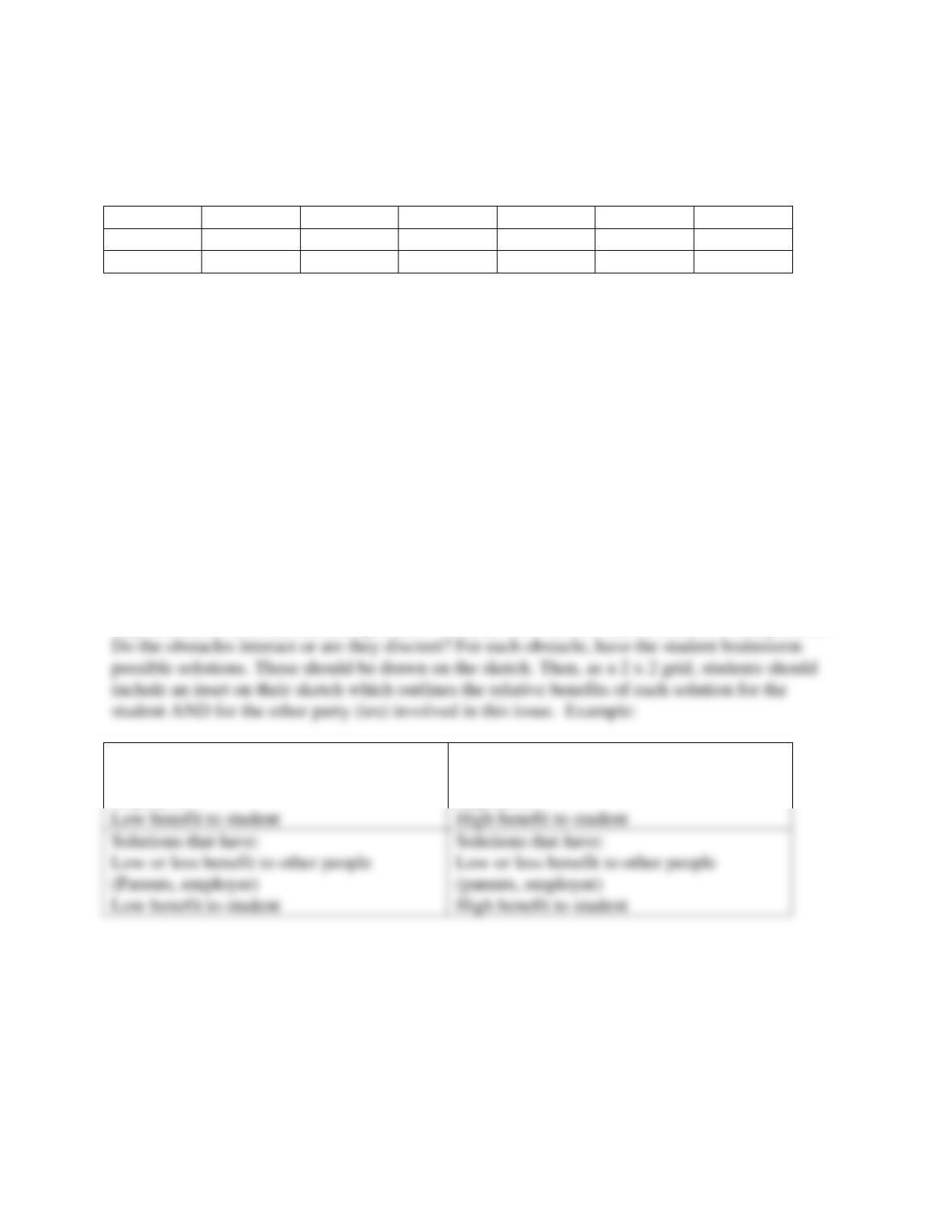
unclear direction is to create a timeline for their required reading and homework in the course.
This is best done early in the term, but can still be useful for a shorter time period. Example:
Week 1
Week 2
Week 3
Week 4
Week 5
Week 6
Task 1
Task 2
Writing Assignments
Sketch-noting (A, I)
Sketch-noting is described in the Class Activities from chapter 1. Making sketch notes is not
about drawing, or artistry, but about making marks on paper (or a white board) to help oneself
think. There is no right or wrong way to do this. Everyone will do it differently. This exercise
helps students practice identifying and overcoming obstacles
Ask students to sketch out a problem they are having at school or work, that involves other
people, such as how to get a promotion, how to do better on the next performance review, what
college courses to take to prepare for a desired career, and so on. After identifying the problem,
they can sketch in (with lines, shapes and words) all the obstacles that contribute to the problem.
Low benefit to student
High benefit to student
Low benefit to student
High benefit to student
Solutions that have:
High benefit to other people (Parents,
employer)
Solutions that have:
High benefit to other people (Parents,
employer)
Leadership Coaching (A, I, H)
Using their results on the Path-Goal Styles Questionnaire, have students write a 3 page plan for
how they can strengthen or improve their leadership skills in the weaker areas. First, they should
assess how well their dominant styles serve them in their current occupations or roles. How will
developing additional styles help them in the roles they aspire to in the future? What would they

Instructor Resource
Northouse, Introduction to Leadership, 4e
SAGE Publishing, 2018
5
need to practice in order to strengthen the weaker areas? The improvement plan should identify
weekly and monthly goals. How will growth be measured? How will they keep themselves
motivated to change?
Effective Job Descriptions (A, I, C)
This activity is designed to help students understand the importance of clear goals in the
workplace. It involves job descriptions, which are often overlooked as a means of
communicating the expectations and goals for positions in an organization.
Option One:
Have students form groups of 3-4 and then assign each group the task of writing a job
description for one of the following positions:
• Executive secretary to the CEO of a Fortune 500 corporation
• First grade public school teacher
Option Two:
Provide sample job descriptions for a variety of positions to the students, but first remove the job
title from the description. Ask students to see if they can identify the position based on the
description.
For either option, discuss as a class the implications of clearly defining and communicating the
goals of positions. What are the challenges for leaders in this process?
Looking Back (A)
Instructor Resource
Northouse, Introduction to Leadership, 4e
SAGE Publishing, 2018
Two or Three Birds with One Stone (F, A)
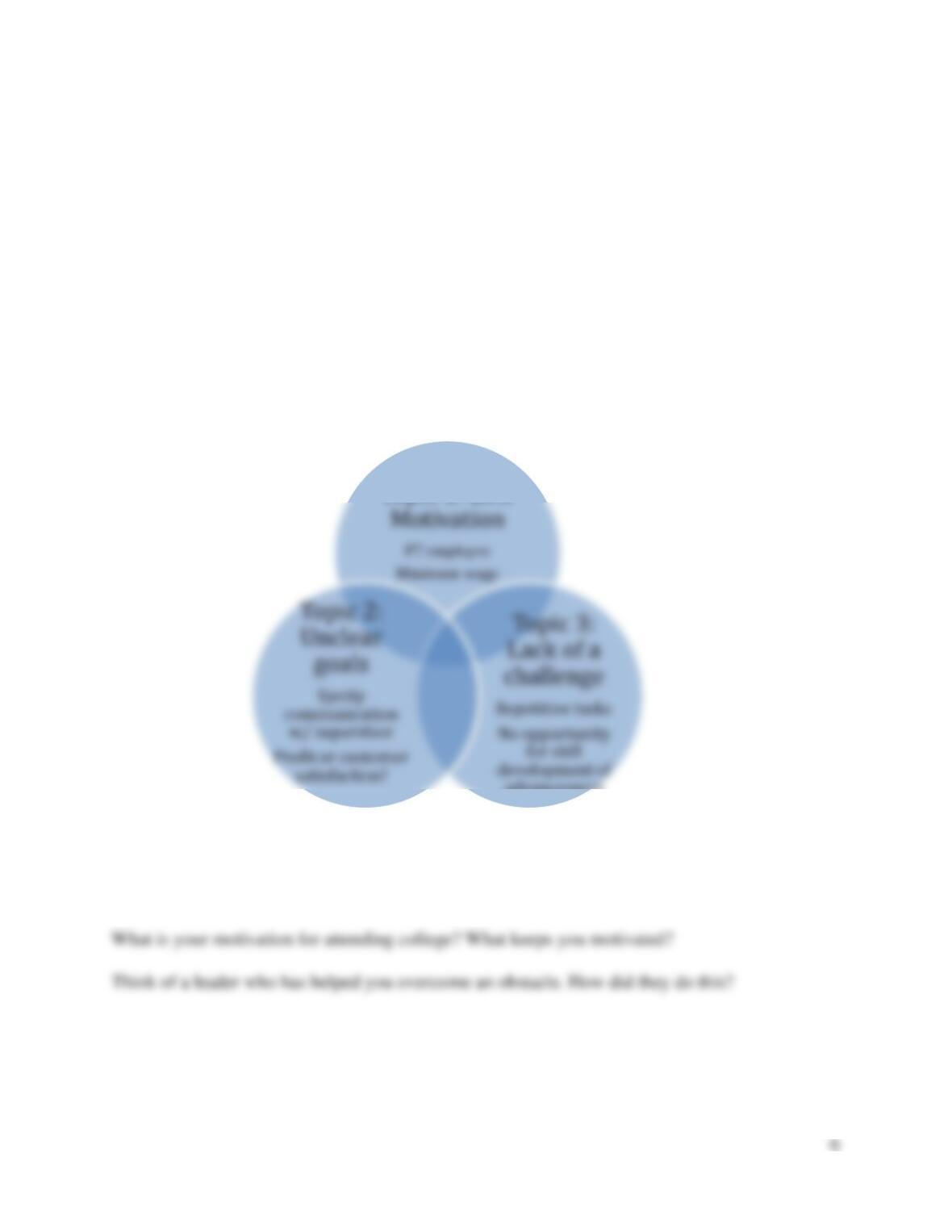
The seven types of obstacles explained in chapter 13 are not always discrete. They may well
overlap in real-life settings as in the Venn diagram below. Ask students to identify a real or
hypothetical situation involving two or more obstacles to goal accomplishment. These can be
drawn as overlapping circles. For each obstacle, students should identify the (suspected or
known) reason or cause of the obstacle, as per the example below. In the overlapping parts of the
circles, how do the obstacles combine and interact? What opportunities are there in the
overlapping areas to alleviate or remove two obstacles at the same time? In the example below,
offering a PT employee the chance for additional training, for which he would be paid extra,
could address both the low motivation obstacle and the lack of challenge obstacle.
One Minute Paper Topics (F, A, I)
What have you learned from one of the obstacles in your life?
Topic 1: Low
advancement