Instructor Resource
Northouse, Introduction to Leadership, 4e
SAGE Publishing, 2018
Class Activities
Chapter 11: Managing Conflict
Guide to the Class Activities
Each activity is designed based on Fink’s Learning Taxonomy and is tagged with the following
tags under the taxonomy’s learning and assessment structure:
1. Foundational Knowledge (F)
2. Application (A)
4. Human Dimension (H)
6. Learning How to Learn (L)
These activities may be used in either small-group or large-group settings, depending on class
size and time available. Some may also be suitable as homework.
Activities
Conflict Scenarios (A, I)
After students have taken the Conflict Style Questionnaire, have them form groups according to
their dominant style. Ask students to share what they like about their dominant conflict style and
when it works well for them. What situations are typically more challenging for them to handle?
Then have each group discuss the conflict scenarios below and the ways they would naturally
respond.
• You have graduated from college, have found a job, and are renting an apartment with a
friend. You agree to share all rent and utility expenses, share cleaning duties, and
purchase your own food. In addition, the landlord has a stipulation that overnight guests
are allowed no more than 4 nights per month. Within the first two months, your
• You’ve been in your new job for 8 months. During this time, various co-workers have
collected money from the staff for baby shower gifts, wedding gifts, and birthday
presents for the boss and other employees. Now they are collecting money for a
Instructor Resource
Northouse, Introduction to Leadership, 4e
SAGE Publishing, 2018
Christmas present for the boss. They are asking for a $20 contribution per person.
Money is tight for you and you really can’t afford the $20. On the other hand, you don’t
want to be perceived as unfriendly, or not part of the group. What do you do?
Conflict Bingo (F)
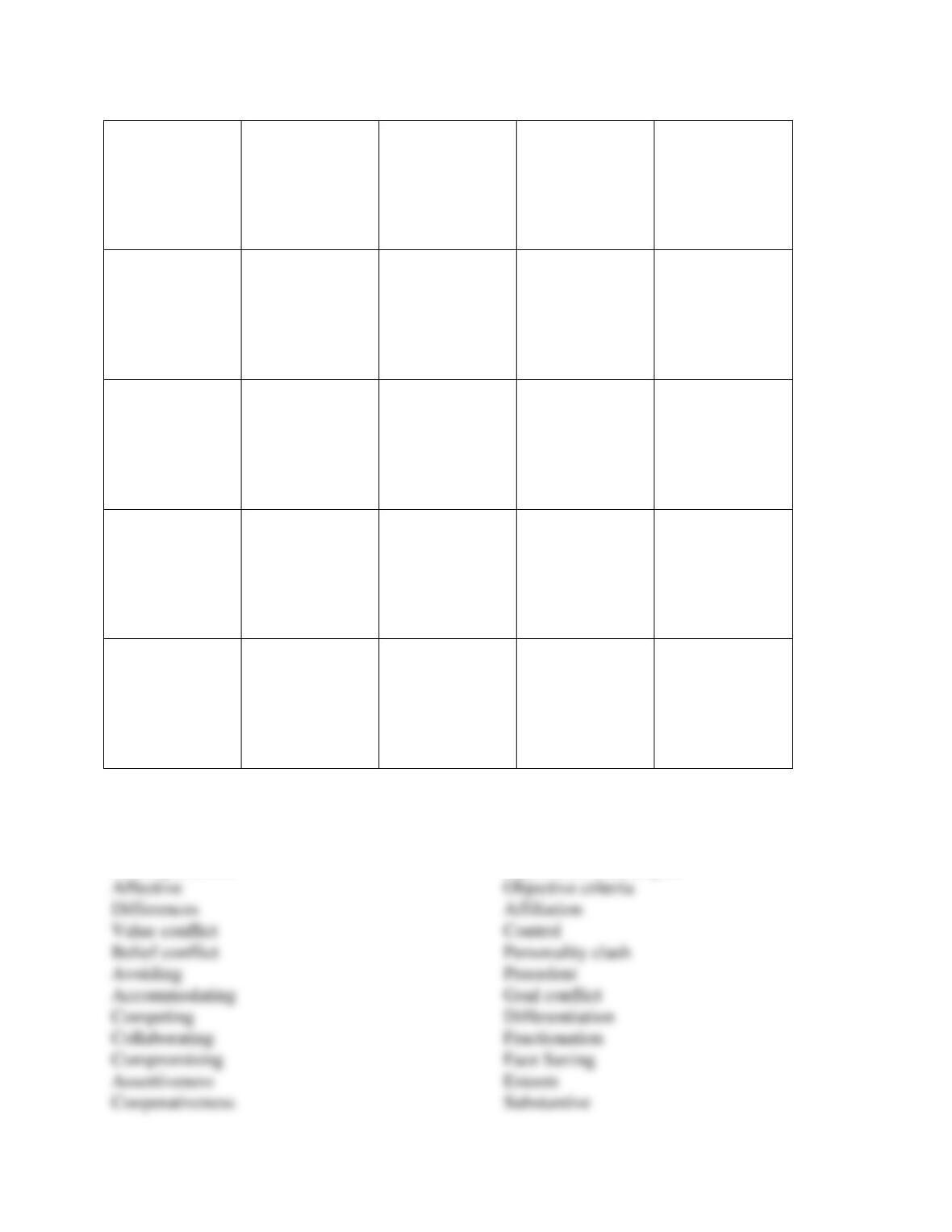
This is a fun way of reviewing the core concepts of the chapter. Ask students to fill in their
choice of concepts from the list provided onto the bingo board. (Students will not all write down
the same concepts). As the instructor then reads off the definitions or explanations from the
master list, students find the appropriate square on their bingo board (if it’s there) and mark it
with an X. The first student to cross out five squares in a row (in any direction) calls out
“bingo.” The instructor should check to make sure the correct squares have been marked.
Master List of Terms and Definitions
Intrapersonal – This discord occurs within an individual
Interpersonal – This conflict occurs between individuals
Struggle – This is the result of opposing forces coming together
Interdependence – This is when parties mutually influence each other
Affective – This occurs when org. members have incompatible feelings about an issue
Avoiding – Style that withdraws from conflict
Accommodating – Style that gives in to another’s demands
Competing – Style that wants to get its own way
Collaborating – Style that seeks to maximize benefits for self and others
Compromising – Style that seeks the middle ground
Differences – This is another term for incompatibilities
Value conflict – Ex. Should sex education be offered by parents or by the schools?
Belief conflict – Ex. Each of us thinks our group project is superior to the other’s
Esteem – The desire to feel significant, useful and worthwhile
Control – Desire to impact other people and situations
Instructor Resource
Northouse, Introduction to Leadership, 4e
SAGE Publishing, 2018
Separating people from problem – This is the first principle of Principled Negotiation
Options for mutual gain – This principle encourages seeking creative solutions to conflict
Objective criteria – A means of settling different interests in an unbiased way
Precedent – Looking at how an issue has been resolved previously
Personality clash – Another way of describing relational conflict
Key Quotes (A, H)
Have students meet in small groups and select quotes from the chapter that they found
compelling or questionable. Each group should select one quote to share with the class and to
lead discussion on it. Discussion can involve debate, application, brainstorming or whatever
form the group thinks is most productive.
Create a Skit (A)
Have students form small groups. Assign each group a different type of conflict (beliefs, values,
goals, esteem, control, affiliation) and ask them to develop a two-part skit. The first version
Daily Dilbert (A)
Project the daily Dilbert cartoon strip for the class; it appears on the site’s homepage
(www.dilbert.com). What type of conflict is represented there: content, relationship, or both? If
content, is the conflict about beliefs, values, goals or something else? If relationship, does the
conflict involve the character’s self-esteem, need for control, or desire to affiliate? Ask students
to change the scenario into one involving a different type of conflict. Discuss: Why is it hard
sometimes to identify what a conflict is really about?
Storyboarding (I, H)
Storyboarding is a way of graphically representing information in consecutive steps that lead to a
desired outcome, or answer a specific question. This planning strategy was explained in the
chapter 1 Class Activities.
For chapter 11, ask students to reflect on a significant conflict they were part of in the past and to
map its path in a way that makes sense to them. This can be done in class or as homework. What
precipitated the conflict? How did it continue? What efforts were made to manage it? Which
Instructor Resource
Northouse, Introduction to Leadership, 4e
SAGE Publishing, 2018
After students have completed their individual storyboards, class discussion can positively
address:
• What are common themes in these conflict narratives?
• Are most of the conflicts relational, content-based, or both?
• How can we encourage the people we are in conflict with to use the resolution
Personas in Conflict (A, I, H)
The chapter 3 Class Activities describe a common technique used in marketing, which is
developing personas or user profiles of potential customers and clients. The profiles are then
used as “target audiences” for developing new products and testing marketing campaigns. If
students have developed their personas previously, have them bring their visual representations
to class. Sample profile:
Photo
Jim, American
Age 30
Retail manager
Baseball fan
Strengths: Achiever, Command, Self-Assurance, Futuristic
Weakness: Includer
Likable: Handles stress well, self-deprecating humor
Defining Your Role (A)
One of the causes of conflict is that the parties involved are interdependent and may perceive
incompatible differences on some level – in desires for esteem, control, or connectedness. Have
students recall a current or past relational conflict. Can they clarify their personal boundaries in
this interdependent relationship? What do or don’t they want from the other party? What are
their respective roles? For example, a college instructor may define her role as an educator (to
students who want many different things from her), as, “I’m not your mom. And I’m not your
Instructor Resource
Northouse, Introduction to Leadership, 4e
SAGE Publishing, 2018
boss. I’m not your adversary, either. You’re not my customer or my client. I don’t work for you.
I work with you. We are partners in this class.” This may affect student perceptions of her and
how they can interact with her in the future.
Writing Assignments
Your Conflict Style (A, H)
People or Problems (A, H)
According to Fisher and Ury, conflicts are comprised of a problem factor and a people factor.
Have students reflect on the common conflicts they experience. In a 2-3 page paper, have
students explain which factor is harder for them to manage and what skills they need to practice
in order to increase their chances for achieving positive conflict outcomes.
Learning from Others (A, I, H)
Have students write a brief (1-2 pages) paper on this prompt: Think of a person you know
personally who is effective at managing conflict with others. What makes them effective and
what might you learn from them?
Fractionation (A, I)
Ask students to reflect on a current conflict at school or work. How could the problems be
broken down into smaller pieces? How could each of the pieces be addressed? In this instance
how likely is fractionation to produce the four positive outcomes described in the text?
One Minute Paper Topics (F, A, I)
The type of conflict I most try to avoid is…
Instructor Resource
Northouse, Introduction to Leadership, 4e
SAGE Publishing, 2018
FREE
Intrapersonal
Interpersonal
Struggle
Interdependence
Interests
Positions
Separate people and problem
Options for mutual gain