
Chapter 11: Committed Romantic Relationships
Key Concepts
Agape
commitment
committed romantic relationships
environmental spoiling
eros
intimacy
ludus
mania
passion
placemaking
pragma
relational culture
storge
Chapter Outline
I. Committed romantic relationships are between individuals who assume that they will be
primary and
A. Committed romantic relationships are created and sustained by unique people
who cannot be replaced.
B. Generally, romantic love involves passion (intensely positive feelings and desires
C. Romantic relationships develop based upon the love styles the partners exhibit.
1. There are three primary love styles.
a. Eros is an intense love that usually includes early self disclosure,
2. There are three secondary love styles.
a. Pragma combines storge and ludus love styles; people who exhibit
this love style usually have clear criteria for partners that must be
met before they fall in love.
b. Mania combines eros and ludus love styles; people who exhibit
II. Like friendships, the development of romantic relationships in Western societies tend to
follow a relatively predictable path.
A. Growth stages begin a romantic relationship.
1. We are individuals before we ever meet our potential romantic partner.
2. Invitational communication is where we indicate to the other person that
we are interested in interacting. Proximity and similarity are major
4. Intensifying communication occurs when we express more personal
thoughts and feelings as well as begin to create our own relational culture.
5. Revising communication indicates the possible problems and
6. Commitment involves the decision to stay with the relationship over the
long haul and arrange other aspects of their lives around this relationship.
B. Navigation maintains a relationship by adjusting, working through new problems,
revisiting old problems, and accommodating changes in both individual and
relational lives.
1. Relational culture is the private world of rules, understandings, meanings,
169
C. Deterioration stages signal a possible end to a romantic relationship.
1. Dyadic breakdown occurs when romantic partners gradually stop engaging
2. In the intrapsychic phase, we focus on perceived declines in
4. Telling outsiders that the relationship is ending is part of the social phase.
6. Grave dressing is burying the relationship and accepting that it has come
III. There are four guidelines for communicating in romantic relationships.
A.
perspective, thoughts, feelings, and needs, is very important in romantic
relationships.
B. With the rise of HIV/AIDS comes the responsibility of talking about and
practicing safer sex, two things we are not always comfortable talking about or
doing.
170
Discussion Ideas
Defining committed romantic relationships: Have students generate a list of movies and/or
television shows from the early years (prior to 1980s), the 1980s, 1990s, and 2000s depicting
different types of committed romantic relationships. If they are having difficulty coming up
Relationship stages: In groups, ask students to develop a guidebook of what verbal,
nonverbal, listening, and relational climate behaviors are most common at each stage in the
relational evolution process (these stages include going from individuals to invitational
HIV/AIDS: Generally speaking we know that college students are the most educated when it
comes to HIV/AIDS and also the most likely to engage in behaviors that put them at risk to
become HIV positive (e.g., engaging in unprotected sex with multiple partners). Ask
students to make a list of what they know about HIV/AIDS and then lead a discussion about
why they believe it is so difficult to talk about this issue (often times people are more
Identifying styles of loving: Listed below are 15 statements that might be made by a person
about romance or a romantic partner. Identify the style of love reflected in each of the
statements. (Answers are included in parentheses).
I want to tell my partner everything about me as soon as I fall in love. (Eros)
My partner is my best friend. (Storge)
171
All I can think about is this relationship. Nothing and nobody else matters to me. (Mania)
I am happiest when my partner is happy. (Agape)
What I like best about my relationship is that it is so steady and peaceful–-none of those dramatic
Deterioration stages: Break-ups are extremely hard. What are some reasons why people
determine whether or not to end a relationship? Ask students to determine what types of
phases they go through when they want to break up with someone? Ask for some examples
Relationship resumes: When applying for jobs, job-seekers create resumes that list their past
accomplishments and credentials for why they would make a good candidate for a particular
position. What if we had to do the same for our romantic relationships? Ask students to
explore the implications of such an approach (for example, people would include previous
romantic partners as references, people might organize their relationships in chronological
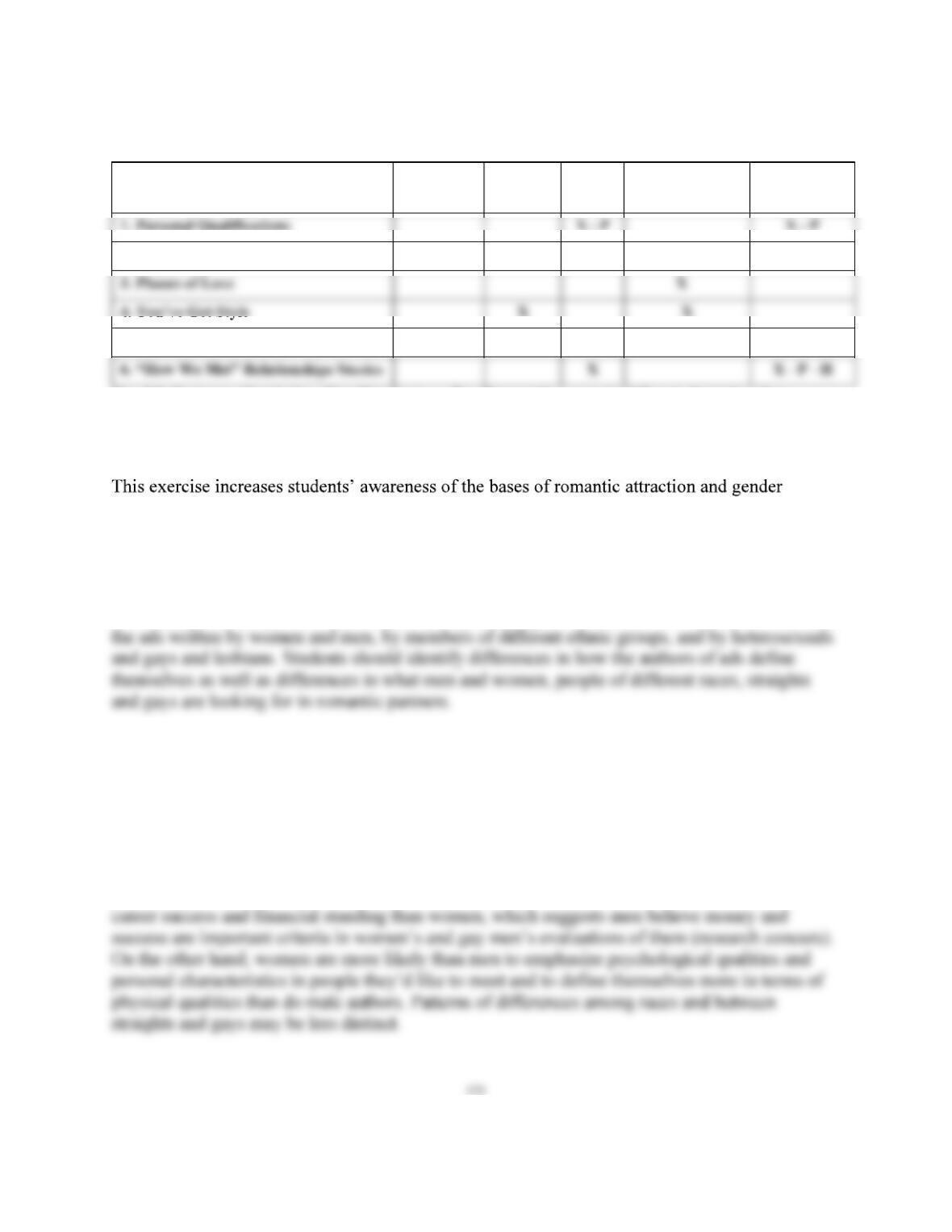
Activities
Title Individual Partner/
Ethno
Group Demonstration/
Whole Class
Internet/
InfoTrac
2. Getting to Know You X
5. The Music of Love X X – P
X = Marks type of activity H = Handout P = Preparation required for students/teacher
Personal Qualifications
differences in preferences for romantic partners. Either tell students to bring to class a paper with
a large section of personal ads or provide students with papers (you need not use the same
newspaper or date of publication).
Organize students into five- to seven-person groups. Instruct the groups to take twenty minutes
to analyze personal ads for romantic partners by focusing on similarities and differences between
After 20 minutes have elapsed, lead a discussion of similarities and differences in how
individuals define themselves to prospective partners and in what individuals seek in romantic
partners. First, focus on similarities. For example, most personal ads emphasize bases of
attraction that are more important early in a relationship than later.
Then collaborate with students to identify differences in personal ads. For example, my classes
routinely find that men are more likely than women to emphasize physical attractiveness and
physical qualities in prospective partners. Typically, men define themselves more in terms of

Getting to Know You
stages in the evolution of romantic intimacy. It parallels the exercise in Chapter 10 on stages in
friendship.
Assign students to groups so that there is one group for each stage in the model of romantic
relationships discussed in the textbook. Tell the groups they will have 15 minutes to construct a
Phases of Love
This exercise illustrates the different phases of a romantic relationship and the ways individuals
communicate in each of these phases.
Ask for two individuals to play a couple. Ask the students to stand in front of the class and act
out different stages of a relationship. Be sure to have the students act the different stages:
174
interact in particular relationships.
Organize students into dyads. Allow 15 minutes for the dyads to develop a 1-2 minute
The Music of Love
This activity allows students to realize how popular culture reflects stages in the evolution of
romance.
On the chalkboard, write the name of each stage in romance discussed in Chapter 11 of the
textbook. Leave space beside or beneath each stage. Ask students to think of songs about
romance that are currently popular and to identify which stage or stages each song depicts.
The purpose of this activity is to analyze relationship stories of how two people met and began
their romantic relationship.

175
they would tell the story the same or differently if posting their story on the dateable.com web
site.
Journal Items
Describe a current or past romantic relationship in terms of the stages of romance discussed in
your textbook. Analyze the extent to which your relationship followed or deviated from the
typical pattern ident
you think it did not.
Responses will vary, but typical patterns of romantic relationship development include going
If you are in a long-distance relationship, explain how communication in it differs from a
romantic relationship in which you and your partner are geographically together.
Consider the four guidelines for communicating in romantic relationships. Discuss how you have
used each of these guidelines in your romantic relationships.
Consider the advantages and disadvantages of meeting someone on-line for a potential romantic
relationship. If you have never met someone on-line, consider why you have not.
Advantages of meeting someone on-line is that physical appearance, race, different abilities,

176
committed relationship in which they met the person face-to-face, there may be a stigma
associated with meeting someone on-line, they may not be comfortable with e-mail or chat
rooms, etc.
Panel Ideas
Invite three dual-career couples to talk about their relationships and especially the ways they
communicate. Ideally, couples should represent some diversity in structure (marriage versus
Invite members of several non-Western cultures to discuss romantic relationships in their
Invite four or more gay men and lesbians to talk with the class about their romantic relationships.
Caution both panelists and class members that the discussion is not about sex, but about
Invite four couples, who have been married to each other for a very long time, from a nearby
retirement home to talk to the class about their marriage. Discuss ways in which they met,
Set up a panel that features individuals who are in committed long-distance romantic
177
Media Resources
Web Sites
Name: All Acts of Love and Pleasure: Promiscuity, Romance, and Respect
Deve
Name: Making Committed Relationships Work
Developer: Institute of Agriculture and Natural Resources
Name: La Chaise Longue
Developer: Queendom.com
Name: The Effects Of Parental Di
Developer: Hope College Psychology Department
Name: Jewish Dating Revolutionized
Developer: Aish HaTorah
Name: Lesbian.com
Developer: Lesbian.com

178
Name: Gay.com
Developer: Gay.com
Brief Description: Available in several languages, this website includes information on
Name: Long Distance Relationships
Developer: Geraldine Voost
Name: Same Sex Marriage: A Selective Bibliography
Developer: Paul Axel-Lute, Rutgers Law Library, Newark
Name: Domestic/Dating Violence
Developer: Counseling Center, University of Massachusetts at Lowell
Name: Lovestories.com
Developer: Lovestories.com
Name: Aspects of healthy romantic relationships
Developer: University of Texas
Name: Interpersonal Communication
Developer: Terrence A. Doyle, Ph. D., Northern Virginia Community College

179
Film Ideas
The Four Seasons depicts several romantic relationships over the course of time. It provides
insight into different ways in which couples coordinate their lives and the kinds of
communication that prevail in romantic relationships at different junctures in their evolution.
Sleepless in Seattle is another film that depicts the development of romance, in this case a single
romantic relationship. This film can be used to teach about human needs that are met through
relationships, bases of attraction, and the fears and challenges of working out a relationship that
can endure.
The American President. This film is a love story about the U.S. President (played by Michael
Douglas) and a political action (PAC) group consultant (Annette Benning). Play the Christmas
party scene where the President and his Chief of Staff ask the PAC consultant about her day. In
The Notebook. This film depicts a wonderful love story of two unlikely characters. Play the
scenes of how they met, how they fought, and eventually became a couple. The film also
illustrates the hardships that the couple had to face in order to develop their relationship.
This film have several interconnecting stories that deal with the
challenges of communication and misunderstandings in relationships.
The Ugly Truth. This film illustrates what men and women want in a relationship. It is a great
example of battle of the sexes.
Print Resources
The following books are excellent candidates for students to critique based on the topics and
concepts discussed in the textbook and class.
Men Are from Mars, Women Are from Venus: A Practical Guide for Improving
in this book and the claims of a speech communities approach.

180
The Rules: Time Tested Secrets for Capturing the Heart of Mr. Right by Ellen Fein, Sherrie
The Mastery of Love: A Practical Guide to the Art of Relationship
by Miguel Ruiz. The author discusses fear-based beliefs and ideas that individuals have when
Love Talk: Speak Each Other’s Language Like You Never Have Before by Les Parrott &