
Instructor Resource
Northouse, Introduction to Leadership, 4e
SAGE Publishing, 2018
1
Class Activities
Chapter 10: Listening to Out-Group Members
Guide to the Class Activities
Each activity is designed based on Fink’s Learning Taxonomy and is tagged with the following
tags under the taxonomy’s learning and assessment structure:
1. Foundational Knowledge (F)
2. Application (A)
4. Human Dimension (H)
6. Learning How to Learn (L)
These activities may be used in either small-group or large-group settings, depending on class
size and time available. Some may also be suitable as homework.
Activities
The Class Climate (A, H, C)
These activities can be used to foster an inclusive class climate.
(1) Change the seating in the room occasionally to encourage quieter students to participate
more, or to be heard more often. Try seating the class (a) in one large circle; (b) in groups
(2) Throughout the semester create a “hot seat” in the center of the room, with each student
taking a turn being asked questions from classmates that are relevant to the day’s topic.
The instructor should model this exercise the first time around. For chapter 10, questions
could include:
Where did you grow up?
How big was your high school?
What did you like best about high school?
What kinds of kids were in the out-groups at your high school?

Instructor Resource
Northouse, Introduction to Leadership, 4e
SAGE Publishing, 2018
2
How did group members make you feel included?
This should take no more than 10 minutes. Each question could have a follow up.
Seeing and Walking Fresh (A, H)
One way to learn to see beneath the stereotypes we create about individuals, groups, or
communities, is to expose ourselves to new experiences and perspectives. Ask students – before
the next class period – to walk through a different part of campus or town, shop in a different
grocery store than usual, eat at an ethnic restaurant they haven’t tried before, drive to campus via
Take 5 (A, L)
This can be done as an individual or group assignment, as homework, or at the beginning or end
of class. Ask students to come up with a “burning question” about the chapter, for class
discussion. Questions should be written anonymously, on slips of paper and turned in to the
instructor. The instructor should anticipate some questions in advance, such as:
Sketch-noting (A, I)
Sketch-noting is explained in the Class Activities for chapter 1. Making sketch notes is not about
drawing, or artistry, but about making marks on paper (or a white board) to help oneself think.
There is no right or wrong way to do this. Everyone will do it differently.
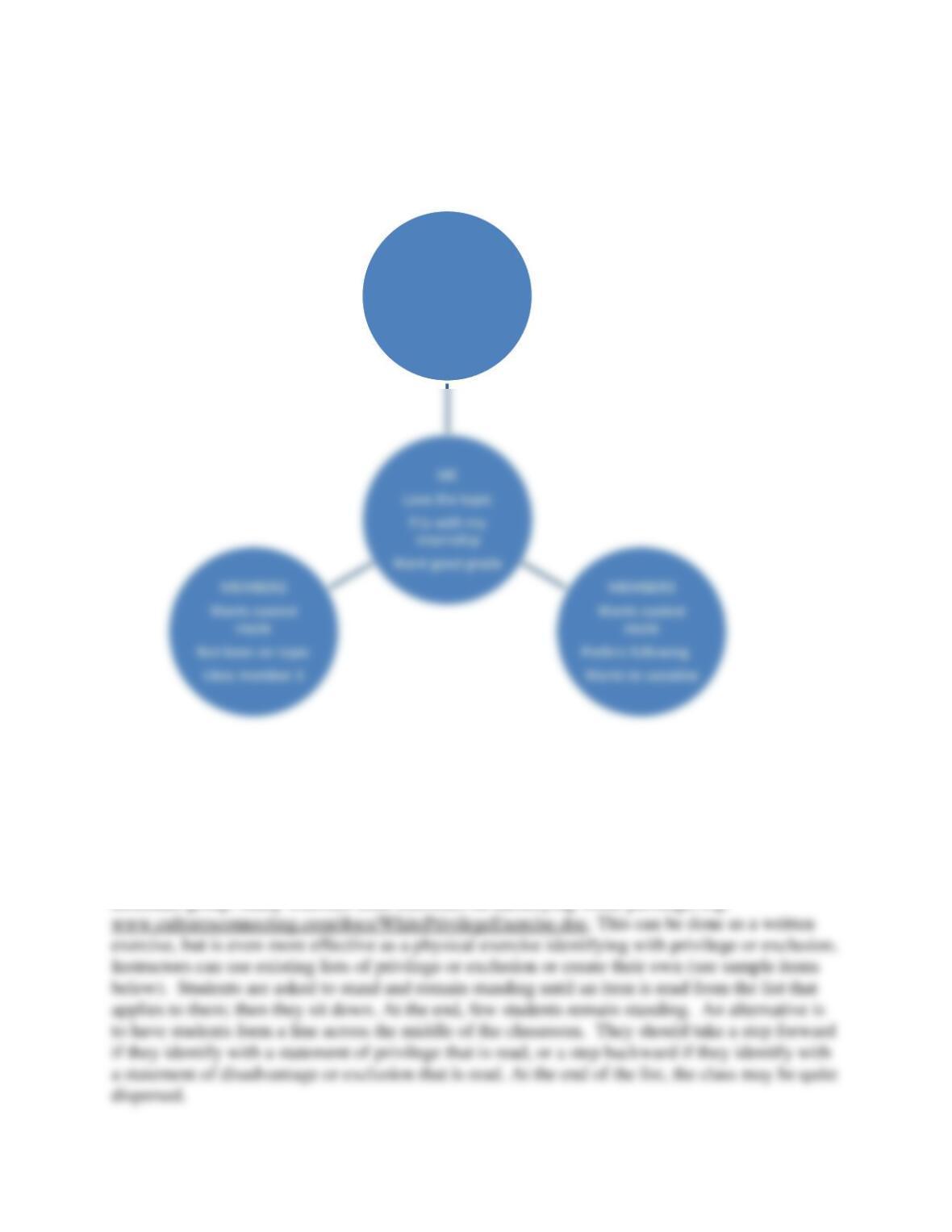
Have students think about a group they are involved with, whose members vary in commitment
to the group. Commitment could be measured by attendance, input, reliability, quality of work,
Instructor Resource
Northouse, Introduction to Leadership, 4e
SAGE Publishing, 2018
3
In-Group Privilege (A, H, C)
The concept of white privilege was first proposed in 1935 and has since become a central
concept of critical race theory. It relates to our consideration of out-groups because it
conceptualizes racial inequality not just as disadvantages experienced by people of color, but
also as advantages that white people gain from North American society simply by being in the
dominant group. Many websites offer exercises on identifying white privilege, e.g.
MEMBER1
Wants good grade
Likes member 3
Wants easiest
route

Instructor Resource
Northouse, Introduction to Leadership, 4e
SAGE Publishing, 2018
Out-group questions can be formulated along different demographic lines (gender, ethnicity, age,
physical ability, etc.). Some examples:
Gender: Ask students to stand up (sit down, or take a step backward) if…
You have ever been told to “act like a man”
Ethnicity
You attended elementary or high school comprised of students with the same
ethnic background as yourself
Film Analysis and Class Debate (A, H, C)
There are many good social documentaries available depicting in-groups and out-groups. Three
are suggested here.
(1) The Garden. This film depicts the struggles of the South Central Farmers in Los
Angeles, to preserve their 13 acre urban garden. Students can analyze and compare
the leadership of six different persons or groups: Doris Bloch, the visionary; Mr.
Horowitz, the property owner; Tezo and Rufina, representing the Hispanic farmers;
City council politicians, including Jan Perry and Mayor Villaraigosa; legal counsel
Dan Stormer and Pat Dunlevy; and celebrity advocates like Darryl Hannah and Willie
Nelson. In a written assignment or class discussion, have students deconstruct the
process of marginalizing groups in society. What does it mean to act “in good faith”?
Who “lost” in the final decision? Discussion can also be structured as a debate or role
play, with groups of students assigned to represent each of the different perspectives.
(2) Waiting for Superman. This film follows a group of promising kids through an
educational system that inhibits their academic growth rather than encouraging it, and
exposes “drop out factories” and “academic sinkholes” in public education. By

Instructor Resource
Northouse, Introduction to Leadership, 4e
SAGE Publishing, 2018
5
(3) Heart Broken in Half. This ethnographic film by Dwight Conquergood profiles male
Role Play for Skill Development (F, A, H)
In class have students brainstorm the many different ways employees can become marginalized
in an organization, giving specific examples of being in opposition to the larger group, not
identifying with the larger group, being excluded by the larger group, or lacking necessary social
Jenga Visualization (F, A)
This exercise is adapted from an article on how to use Jenga blocks to teach systems theory in a
family communication class (the article can be downloaded from the web). Instructors should set
up the tower of wooden blocks on a table or desk in the center of the room. Each student is
asked to come forward, state one way a person can become a member of an out-group in an

Instructor Resource
Northouse, Introduction to Leadership, 4e
SAGE Publishing, 2018
6
Rebels with a Cause (A, C, L)
This activity the effects of leaders who are actually out-group members. Put sheets of newsprint
up around the room. Then ask students to write on these sheets the names of leaders who were
“mavericks,” opposed the majority, or led without a formal organizational position. Then ask
students to write adjectives underneath each name which describes her or him. Finally, invite
students to select one or more individuals that they would emulate as a leader. In discussion,
consider the following questions:
Writing Assignments
Why Out-Groups are Necessary (F, A)
Have students write a 1-2 page argument for why out-groups are necessary for an organization or
community.
Out-Group Profile (A, H)
Have students select a well-known out-group they are interested in and report on the group’s
One Minute Paper Topics (F, A, I)