
Instructor Resource
Treadwell and Davis, Introducing Communication Research: Paths of Inquiry, 4e
SAGE Publishing, 2020
Lecture Notes
Chapter 10: Experiments: Researching Cause and Effect
Learning Objectives
10-1 Identify the advantages and disadvantages of experiments as research methods.
10-2 Describe the basic experimental design.
Chapter Summary
This chapter begins by identifying the advantages and disadvantages of experiments as research
methods. Then, the chapter describes the basic experimental design. Next, the chapter explains
the concept of control in experimental design. In addition, the chapter discusses the concept of
Annotated Chapter Outline
I. Introduction: Advantages and Disadvantages of Experiments
A. Advantages
1. Purpose of experimental design is to determine which variables have an
Instructor Resource
Treadwell and Davis, Introducing Communication Research: Paths of Inquiry, 4e
SAGE Publishing, 2020
3. To be satisfied that A (the independent variable) does cause B (the dependent
variable) to change, we need to be assured of three things.
a. A must precede B in time.
B. Disadvantages
1. Artificiality of the experimental conditions.
II. Field Experiments and Ex Post Facto Designs
A. Ex post facto design
1. Ex post facto design: observed after the fact that something seemed to have
B. Field experiment
1. Field experiment or simple observation.
III. Basic Experimental Design
A. One-group pretest-posttest design
1. Baseline observation (O1).
B. Problems
1. Other variables may be playing a part.
IV. Designing for Control
A. Two-group pretest-posttest design
Instructor Resource
Treadwell and Davis, Introducing Communication Research: Paths of Inquiry, 4e
SAGE Publishing, 2020
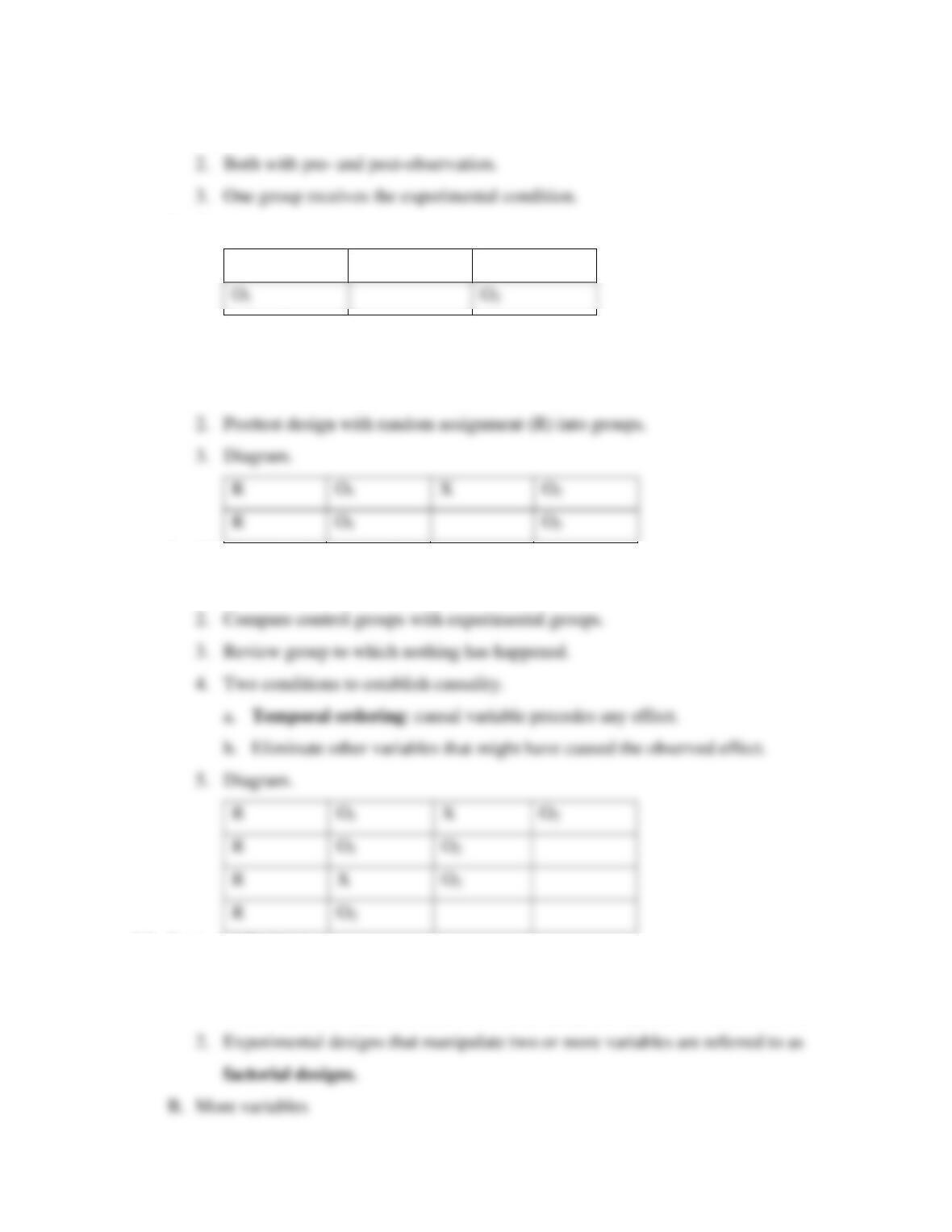
1. Two groups.
B. Diagram
O1
X
O2
V. Designing for Random Assignment
A. Two-group random assignment pretest-posttest design
1. Same as two-group pretest.
B. The Solomon four-group design
1. Compare pretest with posttest results.
R
O1
X
O2
R
O2
VI. Factorial Designs
A. Multivariate analysis
1. Multivariate analysis examines the relationship among three or more variables.
Instructor Resource
Treadwell and Davis, Introducing Communication Research: Paths of Inquiry, 4e
SAGE Publishing, 2020
1. It offers the opportunity to explore the interaction of all three independent
variables.
VII. Between-Subjects and Within-Subjects Design
A. Between-subjects design
1. One problem with experimental design is the number of participants that may be
needed.
VIII. Time Series Analysis
A. Time series analysis
1. Experiments typically run over a short period of time.
2. Don’t know if the results will be true in the future.
IX. Validity and Experimental Design
A. Internal validity
1. Internal validity relates to questions of experimental design.
2. Seven threats to internal validity.
a. Spurious relationships between variables has been found, but it is not the
Instructor Resource
Treadwell and Davis, Introducing Communication Research: Paths of Inquiry, 4e
SAGE Publishing, 2020
B. External validity
1. External validity relates to whether the experiment has, in fact, captured the
external world that the researcher is investigating.
C. Manipulation checks
1. Manipulation check how participants interpreted the manipulated variable.
IX. Online Experiments
A. Advantages and disadvantages of online experiments
1. Advantages
a. Online experiments offer automated administration of experiments.
2. Disadvantages
a. Multiple submissions by the same individuals.
b. Loss of experimental control.
c. Self-selection of participants based on computer competencies.

Instructor Resource
Treadwell and Davis, Introducing Communication Research: Paths of Inquiry, 4e
SAGE Publishing, 2020
X. Running Online Experiments
A. Attention to technology
1. Present content equally across platforms.
B. Participant retention
1. Dropouts minimized by running an experiment on the least-sophisticated