Preface
My intent with this manual is to provide you with quality information, ideas, and resources that will assist
your teaching and enhance your professional life. The manual consists of four parts.
Instructional materials, including ideas for discussion, activities, and lectures
(with page numbers on the chapter-by-chapter grid for those using a paper desk copy)
Sample syllabi and pointers for syllabus construction
Author profiles and contact information
Parts one, two, and three are common features and are self-explanatory.
Part four, an e-book titled: Teaching Public Speaking 4e, is unique in coverage and depth to what one
generally finds in an instructor’s manual. The book responds to questions and concerns about teaching
(commonly posed by instructors) as well as pedagogical and administrative issues that frequently surface
at conferences and conventions. I have kept my responses concise, and I cite the relevant literature. In
addition, various scholars offer their insight and assistance in “spotlights” placed throughout the book.
I’ve set up Teaching Public Speaking 4e with brief entries, hoping you’ll be able to read through it during
convenient moments. If you are a newcomer to the profession, I hope it will help prepare you to teach and
We provide, separately, a test bank featuring multiple–choice, short-answer, and essay items
As always, my coauthors and I would appreciate your comments, suggestions, or other feedback.
There are various people I’d like to acknowledge. First, I owe special thanks to the various
contributors to this collection, identified in the various Spotlights. Thanks, also, to Karon Bowers,
Anne Ricigliano, Kristen Jobe, and Maggie Barbieri—all part of the Pearson team. I appreciate
their commitment to this project and to the field. Thanks, too, to my coauthors and special
friends, Michael Hogan and Patty & Jim Andrews.
Special thanks to Michael Simmons who did the heavy lifting with our PowerPoint package, and to
Wendy Rieger, who drafted the outlines for our chapters. They both exhibited any number of heroics to
get the job done well and on time.
The manual by Dr. Glen Williams that accompanies the textbook
Public Speaking and Civic Engagement integrates significant
insight regarding teaching public speaking. Dr. Williams has
incorporated the best of recent scholarship in order to help basic
Chapter 1: Ideas & Materials for Instruction
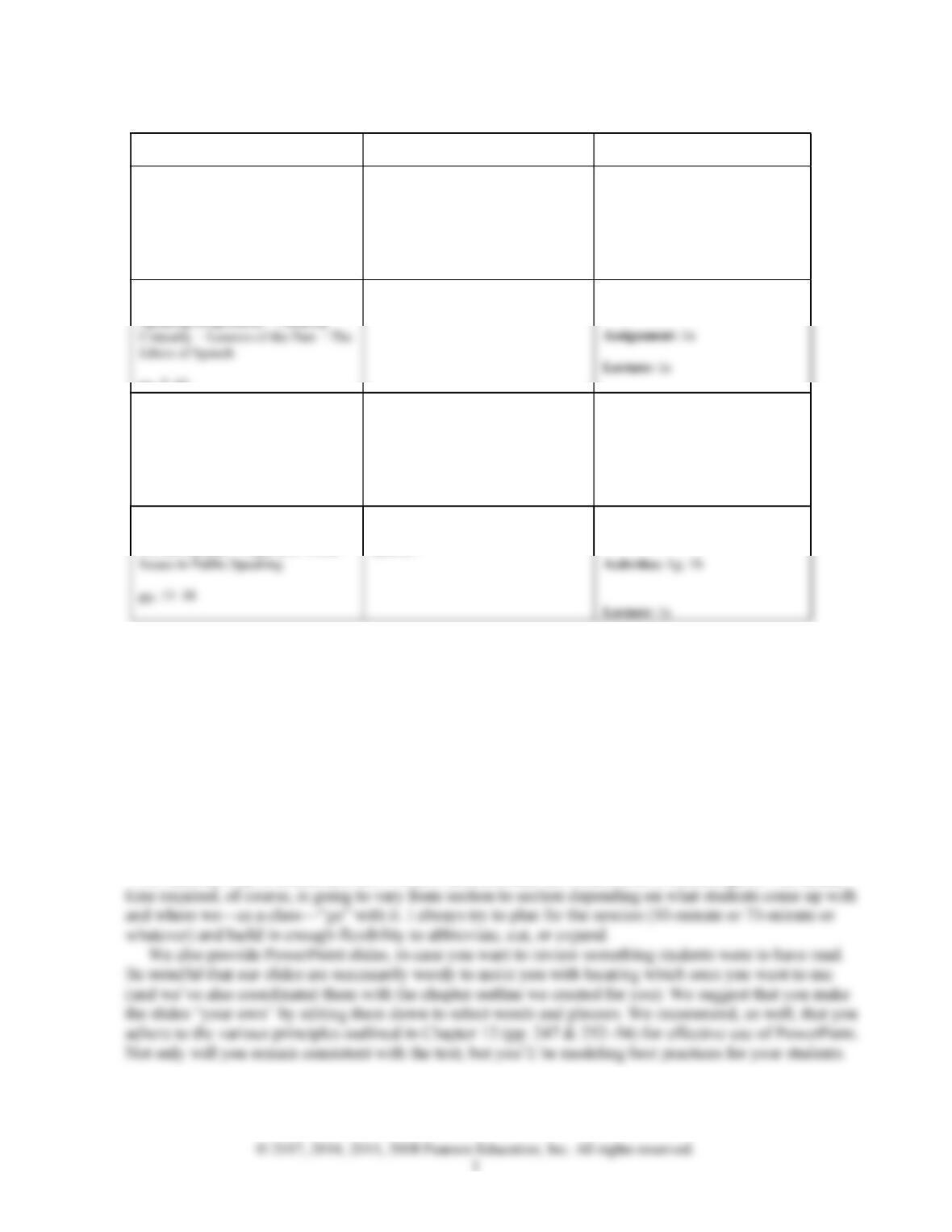
CHAPTER 1: Democratic Citizenship and the Ethics of Public Speaking
Overview Learning Objectives Ideas for Instruction
Public Speaking and Civic
Engagement
The Challenges of Democratic
Citizenship ·The Engaged Citizen ·
pp. 2–7
l.1
Discuss what it means to be a “good
citizen.”
Discussion questions:
1a; 1b; 1c; 1d; 1e; 1f
Activities: 1a; 1b; 1c
Lecture: 1a
The Rhetorical Tradition and the
Ethics of Speech
Speaking Responsibly ·Thinking
pp. 7–12
1.2
Explain how the rhetorical tradition
relates to civic engagement.
Discussion questions:
1g; 1h; 1i; 1j; 1k; 1l
Deliberation and Demagoguery in
the Twenty-first Century
Deliberating in Good Faith ·
Demagoguery and the Ethics of
Emotional Appeal
pp. 13–15
1.3 Distinguish between ethical
persuasion and demagoguery.
Discussion questions:
1m; 1n
Activities: 1d; 1e; 1f
Lecture: 1a
The Responsible Citizen-Speaker
Characteristics of the Responsible
Citizen-Speaker ·Legal and Ethical
1.4 Discuss the legal and ethical
obligations of the responsible citizen-
speaker.
Discussion questions:
1o; 1p; 1q; 1r
Ideas for Instruction
Let’s face it, you will not be able to cover everything in the text—nor should you attempt to (i.e., “The
more we teach, the less they learn.”). I always “assume” students have read the assigned reading and that
my job as an instructor is to highlight a few, select ideas from the reading (or to introduce supplemental
material) for students to contemplate, reflect upon, and apply. My goal is to help them build meaning and
internalize what they have learned, retaining it for future use.
What follows are ideas for how some material might be treated through discussion and activity. My
selections are ones I typically highlight in my own classes—depending on how much time I have to devote
to a chapter. In light of larger class sizes (which require more days per speech round), I rarely can spend
more than 50 minutes per chapter. There are only so many days in the semester, after all.
For each activity or discussion item I offer, I also estimate how much time it would require. The actual
Chapter 1: Ideas & Materials for Instruction
Discussion Question 1a
Approximate time required: 5 min.
The text underscores the importance of “paying attention to the news” and following “what’s going on,”
noting that “good citizens keep up with current events, and they recognize the difference between an
informed opinion and one grounded in ignorance or prejudice.”
Supplement the text by having students contemplate, more fully, the role of journalists. Students
likely will note that journalism is vital in the life of a democracy, something the framers of the
Constitution recognized and provided for in the First Amendment. At its best, journalism serves as a
watchdog to government, alerts and instructs the public, offers a voice for the powerless (at home and
abroad), represents the views of varied constituencies, monitors and protects the environment and public
resources, and provides a common memory for a people.
Journalists, too, are a special breed. Many endure hazards, hardships, and inconveniences to
provide us the information we need to understand events. Without this information, how would we know
how to address a matter? How would we be able to evaluate the performance of our leaders? How would
“Where the press is free, and every man able to read, all is safe.”
—Thomas Jefferson to Charles Yancey, 1816.
Discussion Question 1b
Approximate time required: 10 min., working in groups followed by general discussion.
The authors of the text suggest that a responsible citizen does not simply claim his or her right to an
opinion, but rather earns that right. How does one earn the right to her or his opinion?
Students should recall what the text discusses. One earns the right by developing an informed
opinion. A person should base his or her convictions on a careful survey of the facts, the testimony of
Chapter 1: Ideas & Materials for Instruction
Discussion Question 1c
Approximate time required: 2 min.
Public speaking is “an important part of citizenship.” In what ways is this so?
Public speaking is an opportunity to share our knowledge, life experiences, and ideas with others, and
Discussion Question 1d
Approximate time required: 5 min.
What explains why some people prefer community service over more “traditional” political activities, like
circulating petitions or supporting political candidates?
Reasons, of course, will vary. Some students likely will say they view politics in a very negative
sense, which may also explain any aversion to keeping up with current events as reported in the news.
You could note how it is up to us to monitor the activities of politicians and communicate with them
Discussion Question 1e
Approximate time required: 8 min
To really make a difference, you must be politically engaged. What is the basis for this assertion?
Many of the problems we face are, at bottom, political problems. We can trace them back to
something not being dealt with effectively by elected leaders, who—for whatever reason—have not
made the matter a priority or otherwise have not addressed the matter adequately or at all. By utilizing
traditional or unconventional ways of expressing your political views, you can make a difference.
Note: As a quick, follow-up question, you might ask students to identify ways they (or others they know) have expressed
themselves politically, as well as any “success stories” from doing so. For example, cities—such as Kansas City,
Discussion Question 1f
Approximate time required: 5 min.
Who was one of your favorite radicals from history? What role did the person play? Who are some
contemporary radicals and what role are they playing?
Answers will vary. Some students will recall the examples in the text of those “giving voice to the
powerless” and “calling attention to injustices that were being ignored.” One example cited was
Susan B. Anthony, whose boldness was necessary to help push reforms.
Chapter 1: Ideas & Materials for Instruction
after countless reports began appearing, detailing how the scientific community agreed that global
warming is real, on the rise, and quite problematic. Amidst those reports came the release of Gore’s
Discussion Question 1g
Approximate time required: 10 min., working in groups followed by general discussion.
Why should students today be familiar with the rhetorical tradition? What can it teach us that we need to
know?
Among other things, the classical rhetorical tradition teaches that public speaking must be grounded
in a strong code of ethics (a commitment to tell the truth, to believe sincerely in our causes, and to
serve our communities by promoting the common good rather than our own selfish interests). It
teaches us how we must deliberate with others in search of solutions to our common problems and
how we must demand a strong code of ethics from any who would be our leaders.
Discussion Question 1h
Approximate time required: 2 min.
If we, as citizens, do not add our voice to the public dialogue, who will speak for us? Who will decide our
interest and affairs? What are the implications for democracy?
Students will likely recall and elaborate upon what is discussed regarding “selfish interests” and
“conflict of interest” and how not all who speak have as their motive the common good. Why cede
Rather than “waiting for the world to change,” we should each have a hand in generating positive change.
A quotation from Gandhi springs to mind: “You must be the change you wish to see in the world.”
In this case, we must all aspire to be an informed, thoughtful, active/vocal citizen.
Discussion Question 1i
Approximate time required: 5 min.
If we are to protect and nurture democracy, what must we do?
Citizens need training (such as that which this class provides) as well as familiarity with history—
including the history of American public address which closely examines advocacy and ideas.
One of the penalties for refusing to participate in politics is that you end up
being governed by your inferiors. —Plato
Chapter 1: Ideas & Materials for Instruction
Discussion Question 1j
Approximate time required: 5 min.
How does one become a citizen-critic?
The authors note that this skill is acquired “by learning how to evaluate claims, weigh all the
Discussion Question 1k
Approximate time required: 10 min., working in groups followed by general discussion.
What good does it do to study “great speakers” and speeches of the past?
We can learn about the origins of contemporary controversies, understanding better—for example—
concerns over imperialism, women’s rights, and a host of other, enduring issues. We can also better
understand the principles of public advocacy and democratic deliberation by examining, close up, the
Discussion Question 1l
Approximate time required: 5 min.
The authors write: “As a public speaker, you have an ethical obligation to be well informed and fully
prepared. You likely have discussed the former. Now ask students what the latter entails: what does it
mean to be ‘fully prepared’?”
Being “fully prepared” extends beyond the careful investigation that yields an informed opinion.
Discussion Question 1m
Approximate time required: 5 min.
Why is it important to cite sources as you deliver your speech? How should you do so, in order to do so
most effectively? Note: Also see the last section of Chapter 6.
Students should recall that citing sources is the ethical thing to do, in order to avoid plagiarism. They
might also note that by citing sources you can also demonstrate how well you did your homework,
Discussion Question 1n
Approximate time required: 8–10 min.
What is the goal of democratic deliberation? What is “deliberating in good faith”? What does it entail?
Students should recall that the goal is not about winning or losing a debate, but it is about airing our
differing opinions and reconciling our disagreements. “Good faith” means acknowledging that even
Chapter 1: Ideas & Materials for Instruction
though we cannot be completely objective, we will provide sound reasoning and evidence to back up
Discussion Question 1o
Approximate time required: 5 min.
What are the ethics of democratic deliberation?
Any contribution you make to deliberations should be useful. It should be information or a point of
view based upon a careful investigation, and it should be something that others find noteworthy.
People also generally expect that you’ll maintain the boundaries of decency and good taste.
Discussion Question 1p
Approximate time required: 5 min.
What are the implications of the growing diversity of American society for our democratic form of
government?
It is more important than ever that we learn to communicate effectively and responsibly. We may be
more diverse, but we still face many of the same problems and share common dreams and aspirations.
We must learn to resolve our competing interests and work together for the common good.
Discussion Question 1q
Approximate time required: 5 min.
The right of free speech in a democratic society carries with it certain responsibilities. What are those
responsibilities?
Students likely will note that these are the same sort of responsibilities as spelled out in the classical
Discussion Question 1r
Approximate time required: 5 min.
The classroom is a public forum. What does this imply for you as a speaker?
You will want to choose a topic of real significance and do your best to live up to the standards of the
responsible citizen-speaker—grounding your speech in the best available information, supporting it
Chapter 1: Ideas & Materials for Instruction
Suggested Activities. Use these “hands-on” applications to get students actively involved with the
material. What we suggest often requires students to synthesize what is covered in the chapter.
Activity 1a
Approximate time required: 10 min.
In order to begin some healthy introspection, as well as some healthy comparison, have students work
with their neighbor, for just a couple of minutes, to discuss the extent to which they are “involved” as a
citizen. After a couple of minutes, have students divulge a few of their involvements and the common
Activity 1b
Approximate time required: 8–10 min.
In order to help students appreciate the impact of everyday citizens and their importance, have them work,
quickly, in groups of four or five, to discuss and then report on the following (Also be ready with a quick
example or two of your own!):
1) What are some benefits of civic involvement that you see in your community?
2) What are some examples from news reports you’ve heard?
3) What is needed in your community that citizens could make happen?
One good example worth noting is provided by communication scholar J. Kevin Barge in his article,
“Hope, Communication, and Community Building,” which appeared in The Southern Communication
Journal, Fall 2003, pages 63–81.
The article includes an inspirational story about Tina Brumfeld, a young woman who was unemployed,
living in public housing in Chicago, and who had just finished an alternative high school. Tina was
concerned about all the young men in her neighborhood who didn’t have jobs and often joined gangs. She
knew they needed something worthwhile to do, so she set out to create a basketball league. The response
Activity 1c
Approximate time required: 5–10 min.
Have students take out pen and paper and identify one or more issues they have formulated a premature
opinion about. Also have them identify what they might do to learn more. Note that you will collect and
Chapter 1: Ideas & Materials for Instruction
read them, with authors remaining anonymous. You might also participate, divulging one or more issues
upon which you, yourself, have rushed to judgment and what you will do as a corrective.
For example, many citizens advocate net metering when it comes to remaining on the electrical grid,
saying that the electric company should have to credit households that produce electricity the same
amount as the electric company would charge the households for the electricity. On the surface this
arrangement seems fair. Did, however, the electric company build the lines across which the electricity
travels, and do they maintain them? If so, how might the cost and maintenance of that infrastructure be
factored in to produce a fair arrangement for households and the electric company?
Another example could be the issue of whether the President of the United States or the governor of a
Activity 1d
Approximate time required: 5–10 min.
What are some examples of emotional appeals that are bad? What are some examples of emotional
appeals that are good? What distinguishes the two?
Note: You might use activities 1.4, 1.5, and 1.6 at the same time, assigning them to different groups. Perhaps create
six groups, and have two groups tackle the same question. After 7–8 minutes, have the groups report to the class,
adding your own comments and reactions.
Students should recall that there is nothing inherently wrong with appealing to the emotions. Any
Activity 1e
Approximate time required: 5–10 min.
What are some examples of name-calling? What is the result of name-calling?
Search any prominent issue, advocate, or candidate via Google (or other search engine) and you will
find example after example of name-calling. Nancy Pelosi was termed a “jihadist darling” after
meeting with the Syrians. Mitt Romney was referred to as an “unrepentant liar” and a “flip-flopper”
Note: To jump-start this activity, bring in some fresh examples covered in recent news reports.
People generally quarrel because they cannot argue.
—G.K. Chesterton
He who establishes his argument by noise and command shows that his reason is weak.
—Michel de Montaigne
Chapter 1: Ideas & Materials for Instruction
Activity 1f
Approximate time required: 5–10 min.
What distinguishes the demagogue? How do we safeguard against demagoguery?
Students should recall that the demagogue habitually uses tactics such as oversimplification of
complex issues, excessive emotional appeals, name-calling, and an emphasis on who they are and
how great they are rather than focusing on the issues. They rarely show a concern for truth. They
attempt such manipulation and deception to promote their own selfish interests over the public good.
The price good men pay for indifference to public affairs is to be ruled by evil men.
—Plato
The death of democracy is not likely to be an assassination from ambush. It will be a slow extinction
from apathy, indifference, and undernourishment.
Activity 1g
Approximate time required: 8–10 min.
Using the white board or smart board, generate a list of well-known people who frequently speak in
public. Once a quick list is made, have the class contemplate how they would assess a few of the
individuals listed in terms of their ethics as a public speakers. For instance, do their goals seem worthy?
Can we consider them fair-minded and well-informed? Do any of their speeches raise questions about
plagiarism or the ethics of ghostwriting? Do they deliberate in “good faith?” Do any of them employ the
techniques or tactics of a “demagogue”?
In the past we have had glowing reviews of such individuals as Colin Powell, Condoleezza Rice, and
Jon Stewart. We have had students make less positive judgments of Karl Rove, Rachel Maddow, and
Sarah Palin.
Activity 1h
Approximate time required: 8 min.
The text notes that “the news media nowadays seem more interested in voices from the extremes of the
political spectrum.” Assemble students into groups (four or five) and have them “answer” the following:
Which television news programs promote “serious speech?” That is, speech motivated by a search for the