Teaching Public Speaking 4e: Part One
Fulwiler’s comments also suggest shorter speeches, rather than lengthy ones.
7) Fulwiler reminds us to “put directions clearly and comprehensively in writing” because “it’s
surprising how often poor writing results from inadequate student understanding of what is
expected.”
Goals that underlie written assignments
There are many ways writing can function. We can assign writing, for example, when our goal
for our students is one of the following:
(1) To have students write as a tool of inquiry, i.e., when we want them to
investigate something beyond what is covered in the textbook or in class
In any case, the primary goal of having students write is to make their thinking visible and allow
us to engage them, one-on-one, as we respond to what they’ve written and how they’ve written it.
Karla K. Jensen is one scholar of communication who has described how writing can be a central
instructional strategy in the public speaking course.
Spotlight on . . . Writing as a means to teach speaking, & vice versa
—Karla K. Jensen, Nebraska Wesleyan University
“Using writing as a tool for teaching public speaking” appeared in the Basic
Teaching Public Speaking 4e: Part One
Written assignments: Opening the mind’s eye
Writing is more than a way to gauge understanding; it is a way to promote understanding.
We can help students realize this and appreciate it, simply by requiring them to write—if we go
Written assignments: Asking less and demanding more
We’re all familiar with the research paper. Chances are you wrote your first in high school. Then
you wrote others throughout college—one for every class it seemed. What did you gain by it? As
for me, I often found myself writing them at the last minute, gluing them together, and hoping all
the parts would fit. By the time I had a draft, I had wearied of the task and could tell you little
about what I had written.
When the instructor trudged into class with the stack ready to return, we could tell she or he
(1) Enhanced learning—Shorter papers means students have to trim and not “pad.” They
learn to think more critically about what to include and to write with a more concise,
active voice.
(2) Less frustration—Students face smaller, less overwhelming tasks rather than a
colossal production. Plus, they have multiple chances to improve; it’s not a one-shot
affair.
Teaching Public Speaking 4e: Part One
Individual conferences
Some students need the one-on-one, “let’s sit down and think through it together” approach.
When you’re meeting face-to-face, one-on-one, you can give them your complete attention,
individualizing the instruction as you become more aware of what they understand and what
baffles them. In addition, they may find it more comfortable to ask questions and make
disclosures when meeting privately rather than during class.
Even though the one-on-one may be what an individual needs, he or she may be reluctant to
make the first move. Even though you’ve gone out of your way to encourage students to see you
One-on-one: Is it worth it?
Perhaps the best way to consider this question is to recall a time or two when you learned
something while working one-on-one with someone—a teacher, a coach, or some other “mentor.”
What did you learn? How did the one-on-one compare to other ways you might have been
instructed?
According to Wilbert J. McKeachie (1999), “every teacher has occasions in which skills in
tutoring or one-on-one teaching are needed” (p. 172). As a teacher coaching the development of
students as writers and speakers, working one-on-one with some of them likely will be necessary
and desirable.
Office hours: An opportunity to teach one-on-one
Office hours, of course, are a perfect time to schedule one-on-one meetings. Getting students to
visit you during office hours, though, is not as simple as saying “come see me.” That’s much like
the polite, but noncommittal: “We really must do lunch sometime,” uttered after bumping into an
Teaching Public Speaking 4e: Part One
The enduring impact of one-on-one
Our positive interactions with students and the help we provide them individually does more than
assist their learning and help fuel their motivation and so forth. The impact lingers. Rebecca B.
Leach & Tiffany R. Wang (2015) discuss recent findings that “graduates who had a caring,
engaging, and encouraging professor were twice as likely to be engaged at work and thriving in
their well-being postgraduation” (p. 325). Those findings bear repeating, so I encourage you to
read it again! “Graduates who had a caring, engaging, and encouraging professor were twice as
It’s on video! We provide a scenario about office hours in our video collection accompanying the
course supervisor’s manual, along with a discussion of what is enacted on the video.
Overly dependent students: What to do?
Some students may find the one-on-one so helpful that they seem to develop too much
dependence, dropping in every time your door is open. Accommodate them during office hours
and whenever else you can, but feel free to let them know when you have other priorities (e.g., a
pressing deadline) and will need to schedule another time to meet.
If students want you to do too much of their work for them, simply point them in the right
direction. For example, if they are trying to cover too much in their speech, you might say: “This
To tweet or not to tweet
Colleagues and I have occasionally had a student who wants us to network via Twitter and/or be
their friend on Facebook. Some schools have a policy governing how we are to conduct ourselves
Teaching Public Speaking 4e: Part One
place, there are unwritten expectations that we will maintain a healthy professional distance.
As for me, I limit my accessibility. E-mail exchanges, phone calls to my land line, and face-
to-face conferences should allow sufficient contact. I avoid giving students my cell phone
Recording students on video as an instructional strategy
When I took an undergraduate class in public speaking, I learned more about my delivery from
viewing a videotape than anything the instructor wrote or told me afterwards. The videotape
allowed me to see things for myself, and it allowed me to understand my instructor’s comments
because I could see what he was talking about.
Video recording: What the studies suggest
Cassandra L. Book (1985) reviews studies that explore the outcomes of recording students on
video. These studies suggest that if video content is included to help provide feedback, the
moving images and accompanying audio “will have a more powerful impact on improving
speaking performance when accompanied by feedback from peers or the teacher” (p. 22). The
students in the studies “had positive attitudes about the use of videotapes in class” (p. 19).
Students in a subsequent study likewise responded positively to use of video recording. J.S.
Teaching Public Speaking 4e: Part One
Group assignments
After covering the material in Chapter 17, you may wish to include a group assignment, such as a
symposium. Professor Abran Salazar, University of Rhode Island, provides insights and
suggestions on how to do so. See “The Group Presentation,” below.
Developing students’ investigative skills
A student’s ability to construct a solid speech depends, to a great extent, on her or his ability to
research the topic. Time is of the essence, so students will need to identify potential sources
quickly and be able to access and retrieve relevant information efficiently. We provide pointers in
the text, but they may need more specialized assistance to tackle a particular topic and to tap into
the particular resources available in their immediate environment.
Librarians are important research partners for both students and instructors.
From searching online databases to locating obscure pieces of data to effectively
finding authoritative information on the Internet, librarians can help ease the
research process so the best information is readily found in the least amount of time.
To find out about research assistance and instructional opportunities, talk to
someone at the library’s Reference Desk. Most librarians are happy to meet with

Teaching Public Speaking 4e: Part One
References
Ayres, J., Chen, T.K.P., & Edwards, P.A. (1998). Communication apprehension and
employment interviews. Communication Education, 47, 1–17.
Book, C. (1990). Extended discourse. In J.A. Daly, G.W. Friedrich, and A.L.
Vangelisti (Eds.), Teaching communication: Theory, research, and methods (pp. 279–
291). Hillsdale, NJ: Lawrence Erlbaum Associates, Inc.
Cashin, W.E. (1985). Improving lectures (Idea Paper No. 14). Manhattan, KS:
Kansas State University, Center for Faculty Evaluation and Development.
Corporation for Public Broadcasting. (1997). Study of school uses of television and
video. (ERIC Document Reproduction Service No. ED 410 755)
DeGroot, J.M., Young, V.J., & VanSlette, S.H. (2015). Twitter use and its effects on
student perception of instructor credibility. Communication Education, 64, 419–437.
Frederick, P.J. (1984). The lively lecture—8 variations. College Teaching, 34, 43–50.
Gorg, R. (1993). The use of model speeches on videotape (or See, your friends can
do this too!). The Speech Teacher, 7, 11–12.
Hinton, J.S. & Kramer, M.W. (1998). The impact of self-directed videotape feedback
on students’ self-reported levels of communication competence and apprehension.
Communication Education, 47, 151–161.

325–343.
LeFebvre, L. LeFebvre, L., Blackburn, K., & Boyd, R. (2015). Student estimates of
public speaking competency: The meaning extraction helper and video self-evaluation.
Communication Education, 64, 261–279.
Lucas, S.E. (1990). Teaching public speaking. In J.A. Daly, G.W. Friedrich, and A.L.
Vangelisti (Eds.), Teaching communication: Theory, research, and methods (pp. 67–76).
Hillsdale, NJ: Lawrence Erlbaum Associates, Inc.
McKeachie, W.J. (1991). Learning, teaching, and learning from teaching. In J.D.
Nyquist, R.D. Abbott, D.H. Wulff, & J. Sprague (Eds.), Preparing the professoriate of
tomorrow to teach: Selected readings in TA training (pp. 223–231). Dubuque, IA:
Kendall/Hunt Publishing.
Sollitto, M., Johnson, Z.D., & Myers, S.A. (2013). Students’ perceptions of college
classroom connectedness, assimilation, and peer relationships. Communication
Education, 62, 318–331.
Timmerman, C.E. and Kruepke, K.A. (2006). Computer-assisted instruction, media
richness, and college student performance. Communication Education, 55, 73–104.
Teaching Public Speaking 4e: Part One
Proposal of Topic (and Instructor’s Evaluation Form)
Name ________________________________ Section __________
Propose a topic for your researched presentations. To do so, answer the following questions.
Instructor’s Comments:
What topic (& angle) would you like to research? __________
___________________________________________________
Why is the topic of interest to you? ______________________
___________________________________________________
___________________________________________________
How/why is the topic worthy of our attention? (What’s the news
and how is it relevant/salient/needed?)
___________________________________________________
___________________________________________________
___________________________________________________
What is the inherent controversy that will allow you to take a stance?
___________________________________________________
___________________________________________________
___________________________________________________
___________________________________________________
___________________________________________________ points earned/points possible:
Teaching Public Speaking 4e: Part One
Evaluating Student Performance
and
Providing Feedback
Preview
Feedback is vital for learning and growth. It can also motivate performance
if it is based upon criteria that are clearly aligned with the specified
goals/outcomes of the course, is communicated effectively, and targets a
few specific areas for improvement. This section discusses oral and written
critique as well as grading and how to determine grades.
Feedback: Does it really matter?
Quality feedback is essential to students’ growth and development. Summarizing the scholarly
literature about feedback, Cassandra L. Book (1985) writes: “Students improve in their speech
performance more if they have assistance in identifying their strengths and weaknesses than if they are
left to their own devices to critique their performance” (p. 20).
Know what you’re looking for (and let it be known)
Knowing what you are looking for is the first step towards evaluating and providing feedback. Just as
students need to know what you’re looking for so they can do well, you must know what you’re
looking for so you can evaluate them and provide constructive critique.
Criterion-based evaluation
This type of evaluation assesses student performance according to established criteria. Students are not
judged in comparison to their peers (i.e., norm-based evaluation); they are judged solely on how well
they meet specified criteria (see Richmond & Gorham, 1992).
Teaching Public Speaking 4e: Part One
The criteria can also reinforce learning since they provide a quick overview of central principles
covered in class. And when the criteria are presented to students up front, they can be used to guide their
The use of general criteria
To acquaint students with what contributes to excellence in speaking, instructors often identify what
comprises an “A” speech, versus a “B” speech, versus a “C” speech, and so on. When presented early
on, the overview provides a preview of what will be studied in depth. The overview remains useful
during the course, assisting review and reflection of what has been studied and what must be done. I use
the following traditional specifications as a general guide for myself and my students.
A “C” Speech:
–satisfies the specific requirements of the assignment
–offers unique, original treatment of a topic
–is appropriate for the audience, providing purposeful communication
A “B” Speech:
–meets all criteria for the “C” speech
–displays impressive research, going beyond the minimal number of sources required
An “A” Speech:
–meets all criteria for the “B” speech
–creatively and imaginatively selects, explores, and develops the topic
Teaching Public Speaking 4e: Part One
Fine-tuning general criteria to create an evaluation form
In order to grade students’ speeches, instructors often establish a detailed checklist to serve as an
evaluation form. To do so, they simply transform general criteria into precise statements of what students
are to do.
A note for first-time instructors:
Have confidence as a critic
Robert Carlson & Deborah Smith-Howell (1995) studied how adept novices are at
providing criticism about student speeches. Here are their findings: “Novices . . . may
tend to grade a little more inconsistently and harshly than experienced evaluators at
It’s on video: We discuss feedback and critique on the videotape that accompanies the
supervisor’s manual.
An alternative to checklists
Teaching Public Speaking 4e: Part One
Spotlight on . . . Written Critiques of Student Speeches
—James Arnt Aune, Texas A&M University
After listening to the speech, and reviewing my notes on the outline, I type up an
evaluation, using the headings that reinforce the theory I have been teaching. I often
use these headings:
Invention: Audience adaptation, use of evidence, use of clarifying support
Arrangement: Introduction, conclusion, outline form, simplicity of structure and
labels
Style: Grammatical usage, word choice, figurative devices
Delivery: Vocal performance, physical performance
I then include concrete examples of strengths and weaknesses under each heading.
Giving Aune’s approach a try
For several years I have used an Aune-like approach, with good results. Below is a copy of the master
file I’ve created for feedback to students regarding their first speech. You’ll note that I use slightly
different language than Aune and slightly different criteria for the first speech.
Teaching Public Speaking 4e: Part One
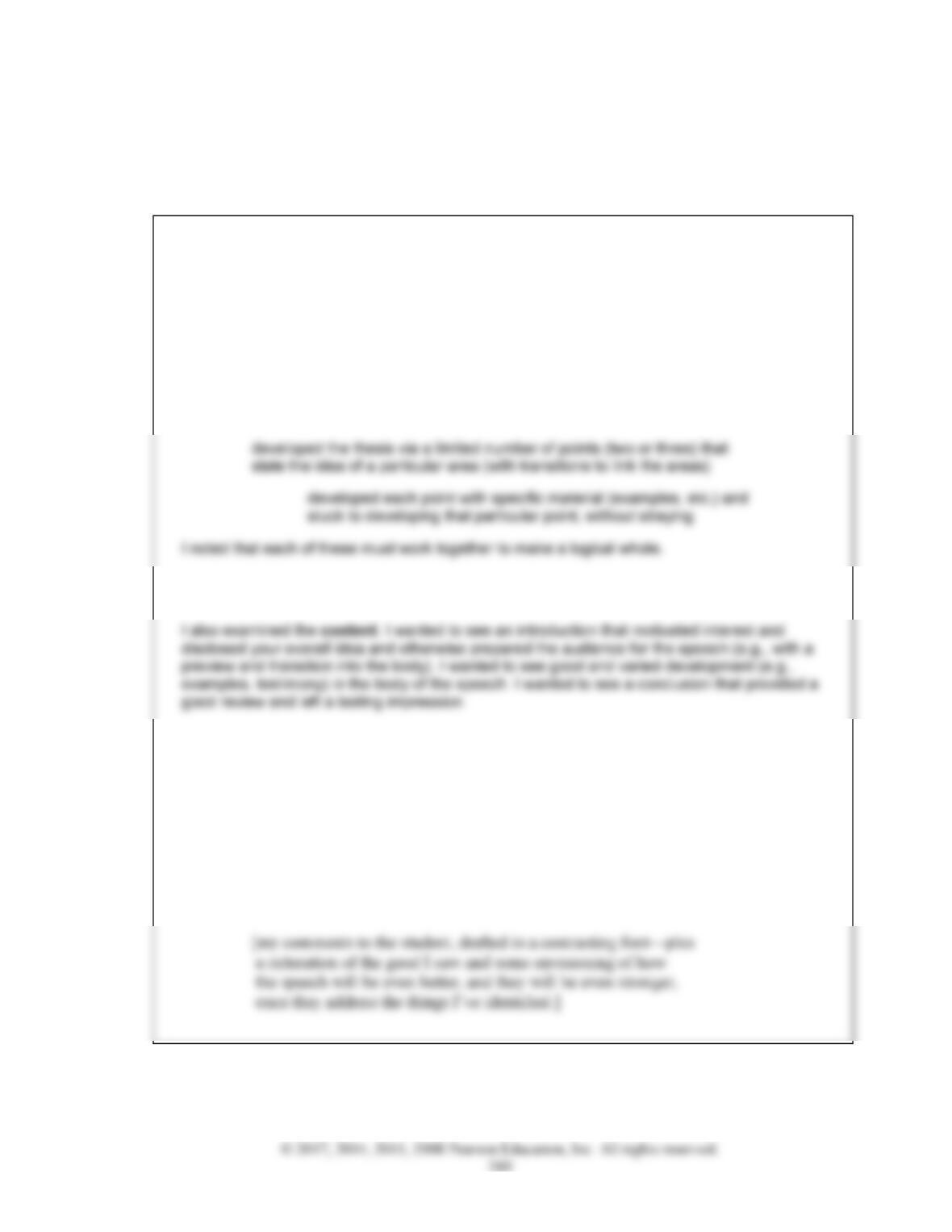
A master file that serves as a template for providing feedback:
[Student’s first name]
[Something about how I enjoyed their speech—whatever good I saw in it.]
As we discussed in class, I evaluate speeches in terms of structure,content, and delivery.
Let’s zoom in on each.
For structure, I looked to see whether (and how well) you had
operated with a thesis
[my comments to the student, drafted in a contrasting font]
[my comments to the student, drafted in a contrasting font]
For delivery, I wanted to see that you could speak from a set of notes—abbreviated from your
complete outline. Instead of merely reading to us, I wanted ample eye contact and a
conversational style.
[my comments to the student, drafted in a contrasting font]
What to concentrate on during your revision:
several times over.
Doing so is easy. Once I have opened the file containing this item, I “select” the whole document
and copy it several times, one after another, until I have multiple copies within the same document. To
determine how many copies I need, I simply count how many outlines I have to grade and reproduce it
accordingly.
I have drafted the template using a different font than that which I’ll use for the comments I will
write. I do so in order for students to distinguish between the two and be able, as a result, to process the
information more easily. I also try to limit my comments to one or one-and-a-half pages, unless I’m
illustrating something at length (such as how the speech might have been better framed up with thesis
and points or how something might have been more adequately developed). Doing so forces me to be
concise and safeguards against overwhelming students.
entry about “Facework,” below.)
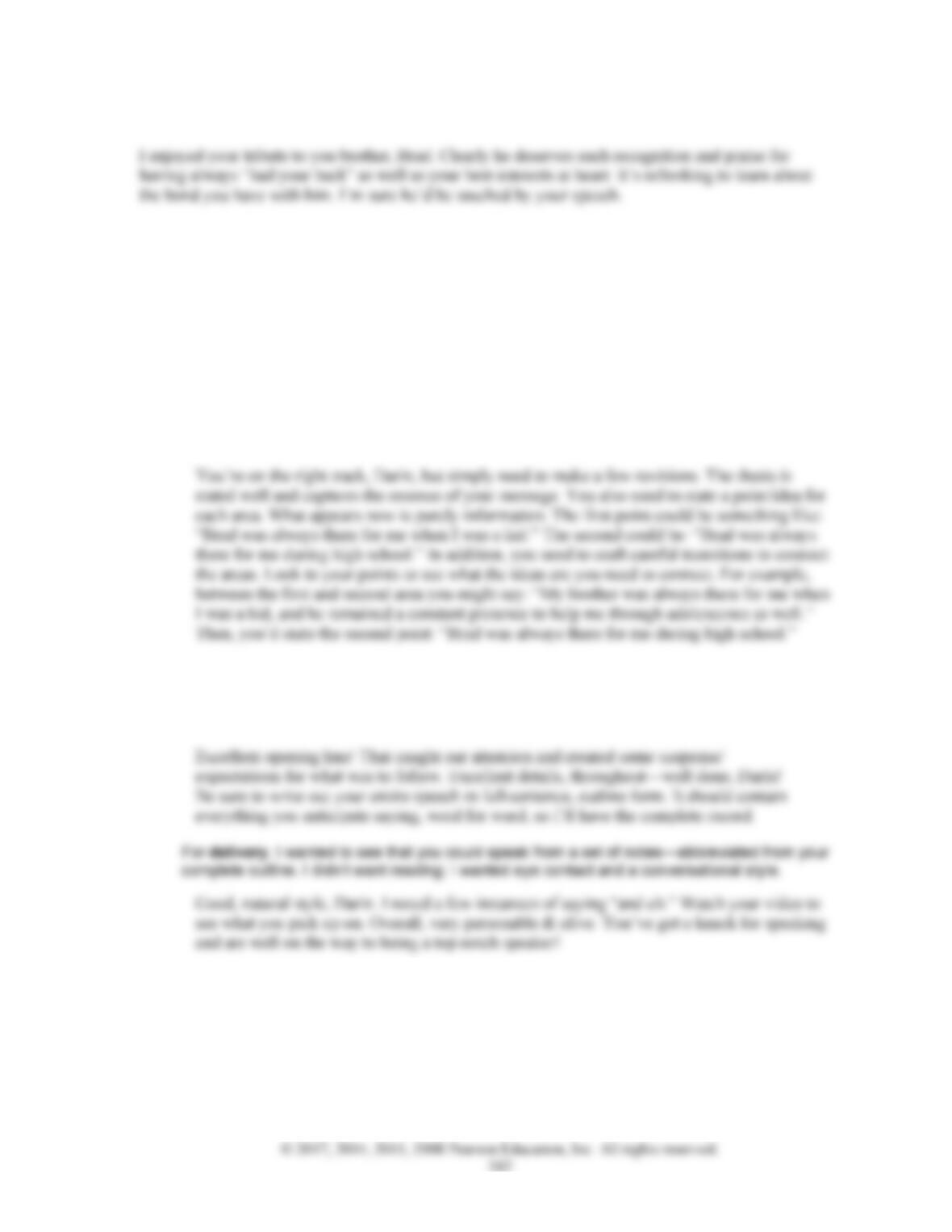
Like Aune, I find that students are quite impressed with the attention they receive. My end-of-the-
semester evaluations by students always yield numerous comments praising my feedback, often noting
that they have never had a teacher so attentive. Many add that my careful instruction reveals that I’m
genuinely “into” what I teach and genuinely desire that they learn/succeed.
The drafted comments help me ensure their success. As Aune observed, you’ll have a good record of
each student’s performance readily available for future reference, and you can refer to what they did in
an earlier speech during comments on a later speech, bragging on their progress or illuminating an issue
that persists, or whatever.
Drafted comments can serve another function as well. You can use the critiques you produce as
evidence of your teaching that you can place in your promotion and tenure files, a professional portfolio,
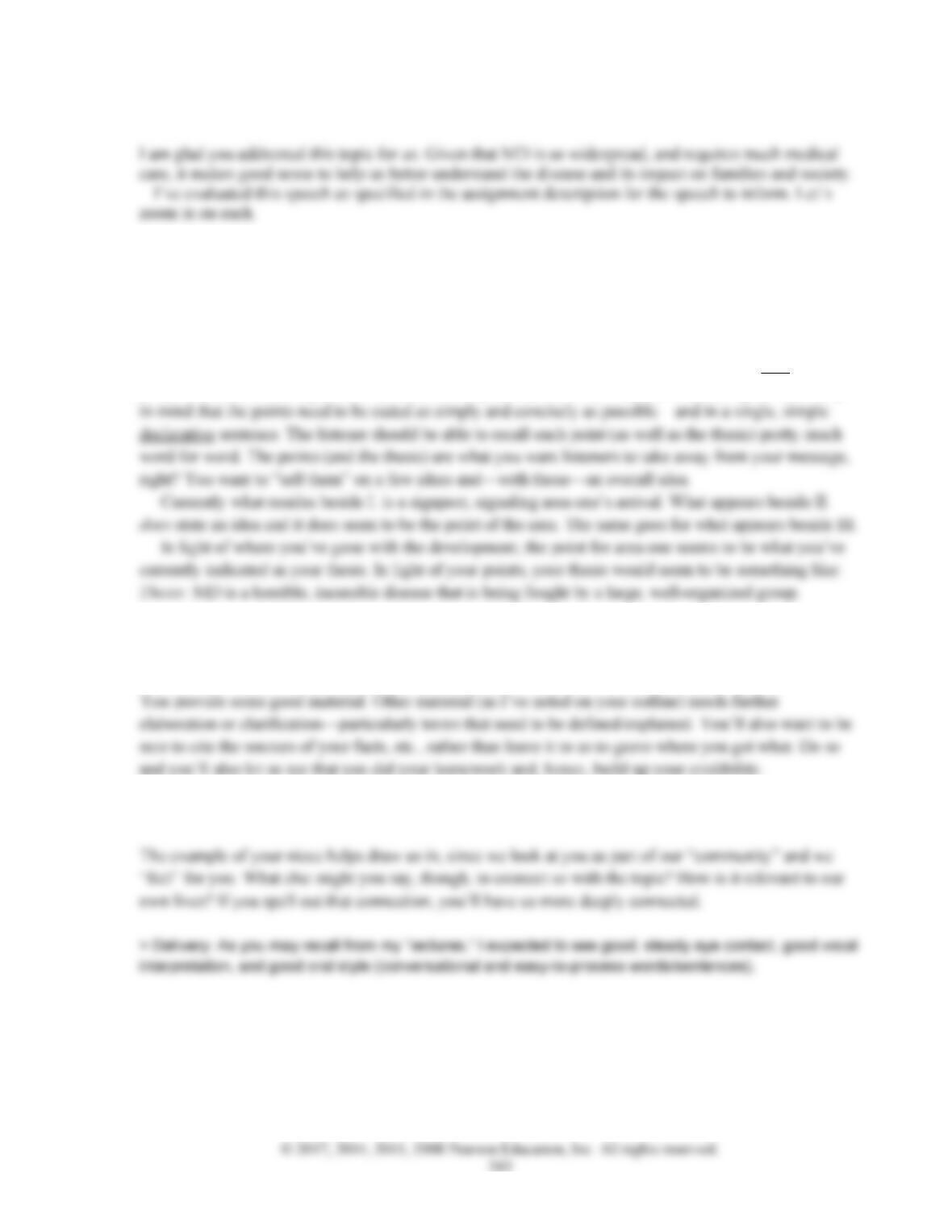
and so on. (See actual examples of feedback I’ve provided on the following two pages.)
Teaching Public Speaking 4e: Part One
Darin,
As we discussed in class, I evaluated this first speech (a speech of tribute) in terms of structure,
content,and delivery.Let’s zoom in on each.
For structure, I looked to see that you had
operated with a thesis
developed the thesis via a limited number of points (two or three), that
state the idea of a particular area (with transitions to link them)
developed each point with specific material (examples, etc.) and
stuck to developing that particular point, without straying
I noted that each of these must work together to make a logical whole.
I also examined the content. I wanted to see an introduction that motivated interest and
disclosed your overall idea and otherwise prepared the audience for the speech (e.g., with a
preview and transition into the body). I wanted to see telling examples, in the body of the
speech. I wanted to see a conclusion that provided a good review and left a lasting impression.
What to concentrate on during your revision:
Revamp the writing as I’ve noted above and as I’ve marked on your outline.
This was a good start, Darin. I look forward to the revision. [sign with my initials]
Teaching Public Speaking 4e: Part One
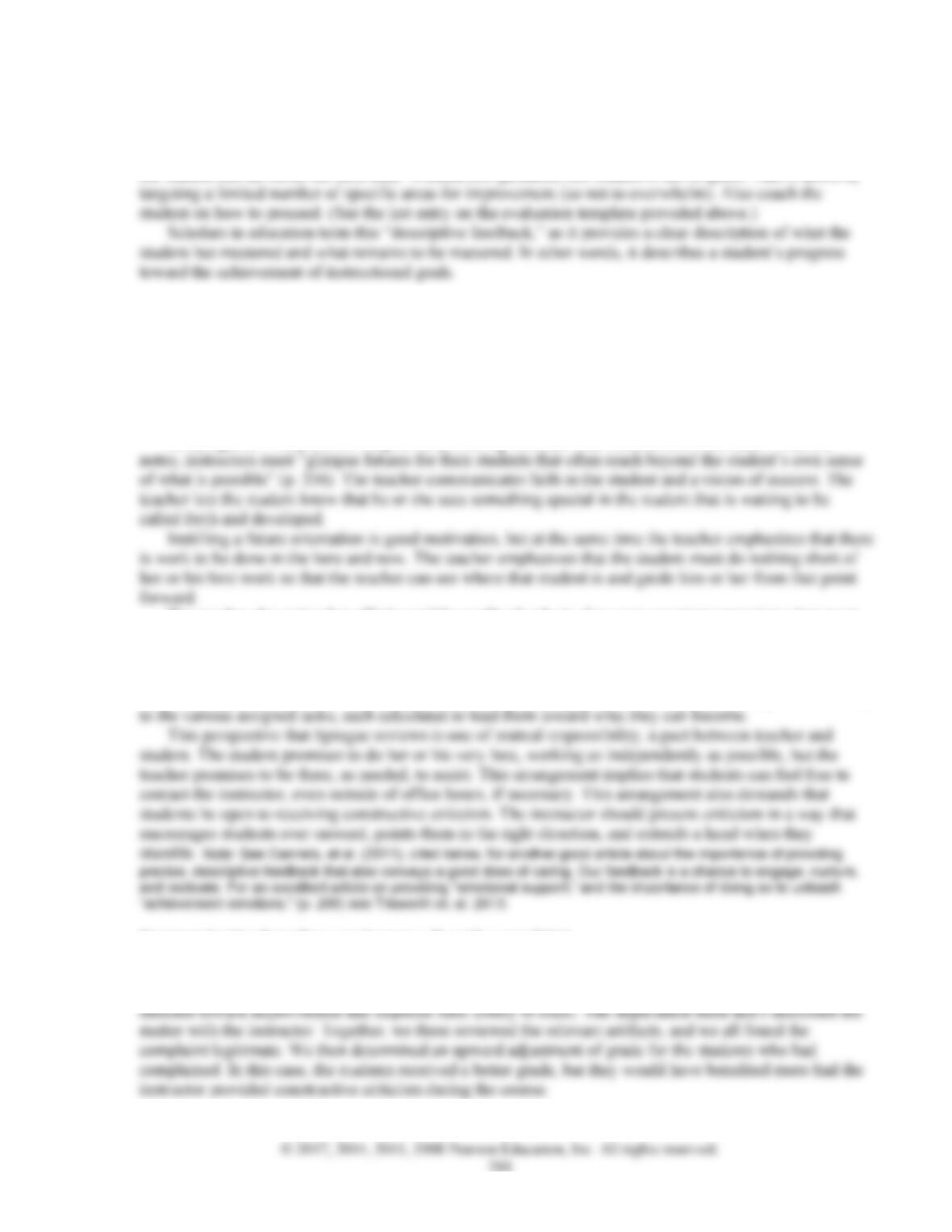
Julia,
1) Thesis and points that work together to form a good framework and a coherent whole.
The structure needs some work. A skeleton (as described in the assignment description) could have
illuminated the problems for you. That’s why I specify creating/using one for our speeches. (See the
sample one on the syllabus, please.)
Let’s examine the points first and then consider the thesis.
Remember that each point (as with the thesis) should state an idea. The point states the idea of its
area, while also reflecting the overall idea of the speech (the thesis). In addition to stating an idea, keep
2) Adequate development for each point made—a combination of materials (e.g., testimony, statistics,
examples), each from a quality source.
3) An introduction and a conclusion that establish the saliency of the topic and treatment to us.
You had some good vocalics, but (as you’ll see on video) you largely looked at your notes rather than
make eye contact with us. Eyes can be quite expressive. You’ll want to use them to your advantage,
right?
Score for outline: _____ Score for Delivery: _____ [sign with my initials]
Teaching Public Speaking 4e: Part One
Communicating how they can improve: It’s vital!
Whatever method you employ for providing feedback, one thing to include is specific suggestions for how
the student can do better the next time. Without this guidance, the student is left to guess. Nail it down by
Feedback that nurtures and motivates
Virginia P. Richmond and Joan Gorham (1992) note the importance of providing descriptive feedback
because it can reinforce learning. At the same time, they underscore the need to communicate corrective
(i.e., “negative”) comments in an encouraging manner. They explain: “Students who know that the teacher
is pulling for them, who know that the teacher is trying to help them succeed, will have enhanced affect for
the teacher and the learning environment and may well translate that affect into greater effort” (p. 73).
Jo Sprague (1993) presents insights for providing feedback that nurtures and motivates. First, she
The teacher also notes that efforts can’t be confined only to class or to constant supervision but must,
in large measure, be undertaken alone. Students, in other words, must understand that the teacher is the
guide, but they have to make the journey. They have to accept accountability for their learning plus
understand that the extent of their effort is central to the extent of their progress. The instructor will be
there when guidance is needed, but students must diligently apply themselves (and what they have learned)
Communicating how they can improve: It curbs complaints
Communicating how a student can improve is not only vital to his or her learning, but it can also thwart
complaints. I once handled such a complaint. A group of students complained that a lack of feedback

Teaching Public Speaking 4e: Part One
A note for first-time instructors: Determining a score
Once you have a set of criteria, you can use them as a guide to evaluate students. You can
also use the criteria to determine grades. Simply decide how much each criterion should
impact the overall grade. Some instructors decide specific points for every criterion while
others prefer to grade more holistically, perhaps assigning points to various general areas,
such as content, structure, and delivery. Some prefer to grade by gestalt, simply using
criteria as an overall guide.
Experiment to see which works best for you. There are advantages and
disadvantages to each. The chief concern, of course, is what will promote consistency in
Spotlight on . . . Assigning Grades for Speeches
—James Arnt Aune, Texas A&M University
On grading, I just set a baseline of what an average score is. Some places I have taught
there is an expectation of a C+ average in a public speaking course; at other places the
norm was more like a B. So, for example, on an informative speech, in order to get the
“average” grade, students would need to display:
Mastery of the key aspects of organization: interesting intro, thesis, preview,
signposting, transitions, and an effective conclusion
vocalized pauses, etc.
So, if they missed one of these that would kick the speech from, say, a B to a B–; two
would kick it down to a C, etc. (assuming a B mean).
Then, an A speech would have:
Excellent research/quality of information
So I try to zero in on roughly three criteria unique to the speech, and then these build on
one another for the rest of the assignments. So, the persuasive speech then presumes
these criteria, but I add:
Effective use of supporting material/evidence
Anticipation of objections from opponents
Teaching Public Speaking 4e: Part One
Feedforward about feedback
Let students know you’ll be scribbling a lot while they speak. Reassure them that this is normal and your
hurried hand doesn’t necessarily mean you’re making negative comments. Let them know that you’ll also
Helping students read between the lines: What our feedback implies
In an attempt to empathize with my students, I recall my first semester in graduate school when I was
handed back a paper that “bled.” Not only did the paper drip crimson, but the professor had also typed three
The Power of Facework
It was in graduate school (as I’ve discussed above) where a classmate helped me understand that my heavily
marked up paper and lengthy typed comments about what I needed to do differently didn’t mean that I was
stupid or a lost cause. It was quite the opposite, he reassured me. The professor was telling me, between the
lines, that I was worthy of his time and attention.
Once I understood that I had potential and was valued, I could better focus on the feedback and view it
as nurturing and not outright condemnation. I was no longer devastated but, instead, uplifted. I was more
Unfortunately, not all students have a peer to provide such reassurances who’s wise to the implicit
meaning of comprehensive critique. Certainly, such peer power can be quite effective (see Thompson &
Mazer, 2009), but it’s not always available. Students receiving feedback, though, shouldn’t have to rely on
their peers for such moral support and healthy perspective. As instructors, we should not leave it to peers