Communication in Family Relationships
Professor: Dr. Kelly Rossetto Office: Location
Email: Name@university.edu Office Phone: xxx-xxxx
Office Hours: Drop in Mondays 11:45-12:45, Wednesdays 4:30-5:30, and by Appointment
Course Materials:
Galvin, K. M., Braithwaite, D. O., & Bylund, C. L. (2015).
Family communication: Cohesion and change
.
New York, NY: Routledge. Available for purchase online or at the bookstore.
Additional readings/articles provided on Blackboard under Files (see course schedule for details).
Course Description and Objectives:
This course is designed to explore studies related to interpersonal communication, with a focus on family
relationships. Throughout the semester we will examine definitions of family, family roles and types,
theories of family communication, and communication behaviors specific to family relationships. More
specifically, we will discuss communication theories and research addressing the following: societal changes,
family systems, family functions, intimacy, maintenance, stories, disclosure/secrets, divorce, conflict, family
development and stages, stress, coping, and repair. The goal of the course is to provide you with
Course Requirements and Evaluation: Points Earned/Possible
Participation/Activities _____________/100 pts
Quizzes _____________/100 pts
Application Essays (choose 2) _____________/100 pts
Media Representations _____________/25 pts
Total: ____________*/500 points
*Final Grade Scale: Grades are computed according to university policy as follows:
A = 93% and above, A- = 90-93%,
B+ = 87-90%, B = 83-87%, B- = 80-83%
C+ = 77-80%, C = 73-77%, C- = 70-73%
D+ = 67-70%, D = 63-67%, D- = 60-63%
F: below 60%
2
Course Assignments: Further details will be provided in class and on Blackboard
Activities and Participation
(100 pts): In class, you are expected to be an
active
participant. This class relies
on participation, as discussions and activities will promote interest and understanding. Classes will include
lectures, application of readings (+ media presentations), and discussion, interaction, and questions. Before
class, you should read the required reading and come prepared with questions and comments related to the
material. Through the semester, there will be in-class or assigned activities related to concepts from the
Quizzes (100 pts)
: Throughout the semester we will have short quizzes. You must be on time and in class to
complete the quiz. Quizzes are meant to assess your level of understanding of the readings and discussions.
Quizzes will not be cumulative.
Media Representations
(25 pts): You will be assigned one week where you and a peer will bring a media
representation to discuss in class. You will also develop an activity to enhance discussion. During class, you
will ask questions and prepare discussion points to illustrate how your media representation (e.g., movie,
TV show, blog, popular magazine article) help us understand the theories/concepts we are discussing (e.g.,
conflict, intimacy, etc.).
Top 5 List
(100 pts):
For your final paper, you will create a Buzzfeed (or Greatist) style “TOP 5” list. After
uncovering various research topics and their importance and consequences through your topical essays and
readings, you will choose one key topic to research further. For this paper, you will give five
recommendations, in blog-style format, to relevant readers (e.g., families, parents, couples, counselors).
Your papers should be 3-5 pages (it’s most important that your “top five” are cohesive and well-supported).
You will use at least 3 scholarly articles to develop your list. The purpose of this assignment is to help you:
1) understand your contemporary family issue with greater depth, 2) interpret the research in a way that is
translatable to the general population, 3) craft a succinct list appropriate to your audience, and 4) share this
list in a creative and accessible format.
The following assignments will help build your final paper:
Course & Campus Policies:
3
Communicate with professor early and often.
Come to office hours, email me, and schedule appointments.
Please note that emails sent after 6pm may not be answered until the next day and may take longer over the
weekend. Do not wait until the night before a due date or exam to ask important questions. I’ll do my best
to always meet with you and respond to questions ASAP!
considered valid excuses (do not procrastinate!).
Be present, prepared, and engaged
. Complete assigned readings before class and be prepared to participate.
Attendance is an important aspect of the course.
If you must miss class
, I suggest getting the notes and
talking with your peers or me about what you missed. You cannot make up in-class exercises or quizzes,
and homework must be turned in on time. To benefit most from class, you should: (1) contribute to
discussion – adding comments and responding to others, (2) demonstrate knowledge of reading and an
ability to apply material in a thoughtful manner, and (3) actively contribute to in-class activities without
distractions. To ensure the most productive and inclusive class environment, we will respect each other’s
viewpoints, honor each other’s uniqueness, and build from each other’s knowledge and experience.
If you must miss class for a University sanctioned activity
, please: (1) provide your documentation/schedule
as soon as possible, (2) find out what you will miss (or missed) in class before you return, and (3) turn in
missed assignment on the day you return. Late work will not be accepted. You must turn in pre-scheduled
assignments (e.g., project portions) on the due date.
Academic integrity is expected of every student
. The Student Code of Conduct states, “The University
upholds the values of honesty, trust, fairness, civility, respect, and responsibility as the foundation for a
successful academic environment. As a tool, the Student Code of Conduct will help promote growth and
learning as students interact with their environment and accept responsibility for decision-making…” A
range of acts can be considered academic dishonesty or misconduct, including cheating, plagiarism,
collusion (working together on individual work), and fabrication (making up data, citations, etc.). The
Student Code of Conduct states, “All assignments submitted by a student must represent her/his own work,
ideas, concepts, and current understanding or must cite the original source.” Academic dishonesty also
includes submitting substantial portions of the same academic work to more than one course for credit.
To uphold a fair academic environment, I will evaluate any case of academic misconduct on its own basis
and apply appropriate sanctions. Such sanctions may be, but are not limited to, rewriting the paper for
4
reduced credit, a zero for the assignment, or failure of the course. All instances of misconduct will be
reported to the Student Conduct Office – no exceptions.
On a Personal Note:
I am looking forward to this class and getting to know you all. If you have any questions or concerns at any
point, please do not hesitate to contact me. I believe in an open-door policy, so you are welcome to stop by
5
Course Schedule (subject to change)
CLASS
TOPICS AND READING ASSIGNMENTS
Activities/Assignments
1/9
1/16
2/13
2/20
2/27
3/6
3/13
3/20
3/27
Introduction to Students, Course, and Syllabus
Defining Family and Communication: GBB Ch. 1
No Class: Martin Luther King Day
Watch Theory Application Movie
Family Patterns and Meanings: GBB Ch. 4
Family Stories and Memorable Messages (Bb)
No Class: Presidents’ Day
Conduct Ritual/Story Interviews
Relational Maintenance: GBB Ch. 5
Sibling and Family Maintenance (Bb)
Intimacy in Relationships: GBB Ch. 6
Intimacy, Maintenance, and Technology in Families (Bb)
Dark Side of Family Communication & Barriers to Intimacy:
Infidelity, Jealousy, Deception (Bb)
Spring Break
Managing Family Conflict: GBB Ch. 9
Destructive Conflict and Hurtful Messages (Bb)
Memorable Messages &
Family Stories
Do you Know?
Ritual Essay
Conflict Top 5 Lists
6
COMM 40223:
FAMILY COMMUNICATION
Professor: Dr. Paul Schrodt
Contact Information: Office: XXX
Phone: xxx-xxxx
E-mail: name@university.edu (best way to reach me)
Office Hours: 2pm to 3:15pm TR and by appointment
Class Hours: 12:30pm to 1:50pm TR, BLDG 314S
Required Texts
Galvin, K. M., Braithwaite, D. O., & Bylund, C. L. (2014). Family communication: Cohesion and
change (9th ed.). Boston, MA: Pearson Education.
Braithwaite, D. O., & Wood, J. T. (2011). Casing interpersonal communication: Case studies in personal
and social relationships. Dubuque, IA: Kendall-Hunt.
Selected outside readings as provided by the instructor throughout the semester.
Course Description
An important aspect of becoming a more competent communicator is the ability to understand the
various communication patterns that characterize those individuals with whom we relate to on a daily
basis. Since the family is the first “communication classroom” that we all attend, this course is designed
to investigate the nature of family communication. Specifically, this course focuses on family
This is a senior-level class, designed for undergraduate students who are at the later stages of the study of
communication. The overall objective of this course is to provide you with an opportunity to reflect upon
your family’s communication patterns, to think critically about how these patterns influence your own
communication tendencies, and to compare and contrast the patterns in your family with those
represented in other family forms. In other words, our primary goal this semester will be to expand your
understanding of how different communication patterns emerge in different people, and thus make you a
more competent communicator. Upon successful completion of this course, you will be able to:
• Describe the changing nature of “family” and use at least four different communication
theories to describe family interaction.
• Analyze the family as a system, distinguishing between family members as individuals and
the family system as an integrated whole.
7
Course Expectations, Policies, & Procedures
READING: I expect you to come to class prepared to discuss the assigned materials. This means that
you have completed the reading assignments for that day and have given some thought as to how this
material relates to your professional and academic pursuits. Given that participation and critical thinking
is essential to success in this course, it is extremely important that you keep pace with the assigned
readings.
Given the importance of class participation, 2 free/unexcused absences will be allowed. Each additional
unexcused absence will result in a letter-grade reduction of your final semester grade (i.e., a student
who finishes with an ‘A’ and has three unexcused absences will receive a ‘B’ in the course). Students are
responsible for completing any missed assignments and for obtaining missing notes. Attendance sheets
requiring student signatures will be administered at the beginning of each class – thus, it is your
responsibility to make sure that you sign the attendance sheet each class period. For clarification, two
types of absences are defined below:
Excused absences – include medical emergencies, family emergencies, excused athletic events, and
academic events such as professional conferences. In order to have an absence excused, 2 conditions
must be met: 1) You must provide me with written documentation verifying the emergency/event, and 2)
You must notify me in advance of the absence and arrange to complete any assignments on time.
ACADEMIC (DIS)HONESTY: It is extremely important that you avoid plagiarism in this course. For
all written assignments, I expect you to cite your sources according to the 6th edition of the American
Psychological Association’s (APA) Style Manual. More importantly, be very clear when you are quoting
vs. paraphrasing sources. The use of any uncited sources, using someone else’s words or ideas without
quoting, using falsified sources, or turning in work that is not yours and/or is not original for this course
will result in immediate failure of the course and a referral to the appropriate campus authorities.
Claiming academic ignorance about standards for writing is not an acceptable excuse for plagiarism
committed. If you are unsure about APA guidelines on cited materials, please see me to avoid any
problems.
8
UNIVERSITY REMINDERS
Americans with Disabilities Act
Texas Christian University complies with the Americans with Disabilities Act and Section 504 of the
Rehabilitation Act of 1973 regarding students with disabilities. If you require accommodations for a
disability, please contact the Coordinator for Students with Disabilities in the Center for Academic
Services, located in Sadler Hall 11. Please inform me of the disability at the beginning of the semester
and provide me with documentation authorizing the specific accommodation. Further information can
be obtained from the Center for Academic Services, TCU Box 297710, Fort Worth, TX 76129, or at
817-257-7486.
Student Support Services
COURSE REMINDERS
1. Please TURN OFF ALL CELL PHONES AND LAPTOPS DURING CLASS. The use of text-
messaging and laptop computers is a distraction to both the instructor and to other students during
class. Students who cannot abide by this course policy will be asked to leave class for the day.
2. Class members must complete all assignments and exams to receive credit for the course.
3. Exams must be taken before or on the test date. There will be NO make-up exams unless authorized
ASSIGNMENTS (briefly described below)
1) Quizzes – on Tuesdays of most weeks, there will be one quiz at the beginning of class over the
assigned readings covered for that week. Each quiz will consist of 10 multiple choice and/or true-
false questions covering the materials read since the last quiz. There will be a total of 9 quizzes, and
students will have an opportunity to drop their lowest quiz grade. Any quizzes missed because of
unexcused absences will result in a grade of 0 for that particular quiz – no make-up quizzes will be
given.
2) Exams – students will complete two exams on all lectures, handouts, and readings covered in class.
The exams will consist of a variety of items (multiple choice, true/false, and essay).
9
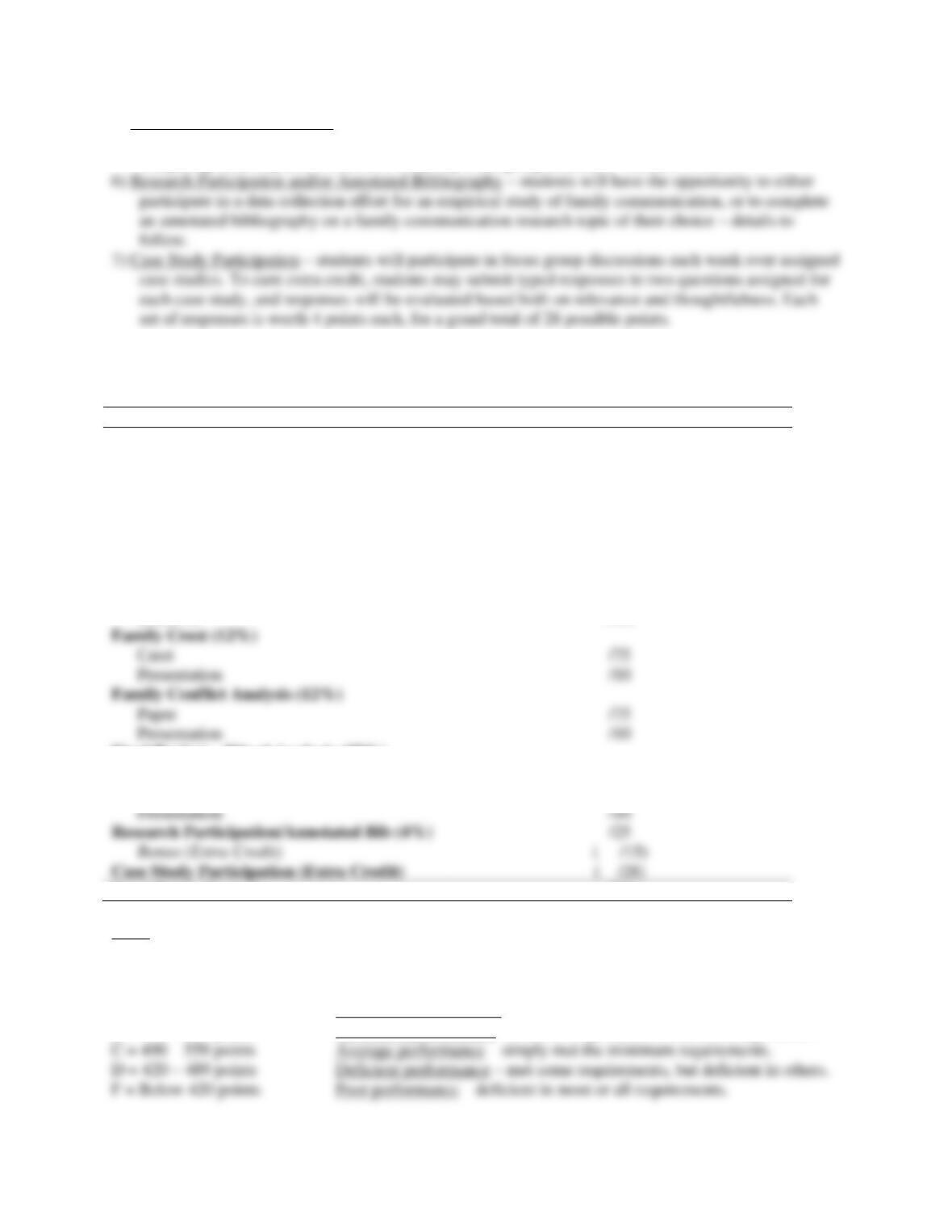
5) Final Project: Ritual Analysis – in groups of no more than three to four members each, students will
learn about family rituals by talking about rituals with members of two different families and
comparing their responses with those found by other group members – details to follow.
COMM 40223 Grade Sheet
Use this chart to keep track of your grade in the class.
Type of Assignment
Points Received/Points Possible
Quiz (remember to drop lowest quiz)
#1 = /10
#5 = /10
#2 = /10
#6 = /10
#3 = /10
#7 = /10
#4 = /10
#8 = /10
#9 = /10
Quiz Total (11%)
/80
Exams (34%)
Exam #1
/120
Exam #2
/120
Family Crest (12%)
Crest
Presentation
/10
Family Conflict Analysis (12%)
Paper
/75
Presentation
/10
Final Project – Ritual Analysis (27%)
Transcripts
/25
Paper
/150
Presentation
/10
Research Participation/Annotated Bib (4%)
/25
Bonus (Extra Credit)
Case Study Participation (Extra Credit)
Total Points Earned
/700
Note. To determine your final grade, simply add up your point total for the semester and compare the
points you earned to the following grade scale listed below. The +/- system will not be used in this course.
(Final grades will not be rounded)
A = 630 – 700 points Exemplary performance – greatly exceeds requirements; exceptional.
B = 560 – 629 points Advanced performance – exceeds requirements; above average effort.
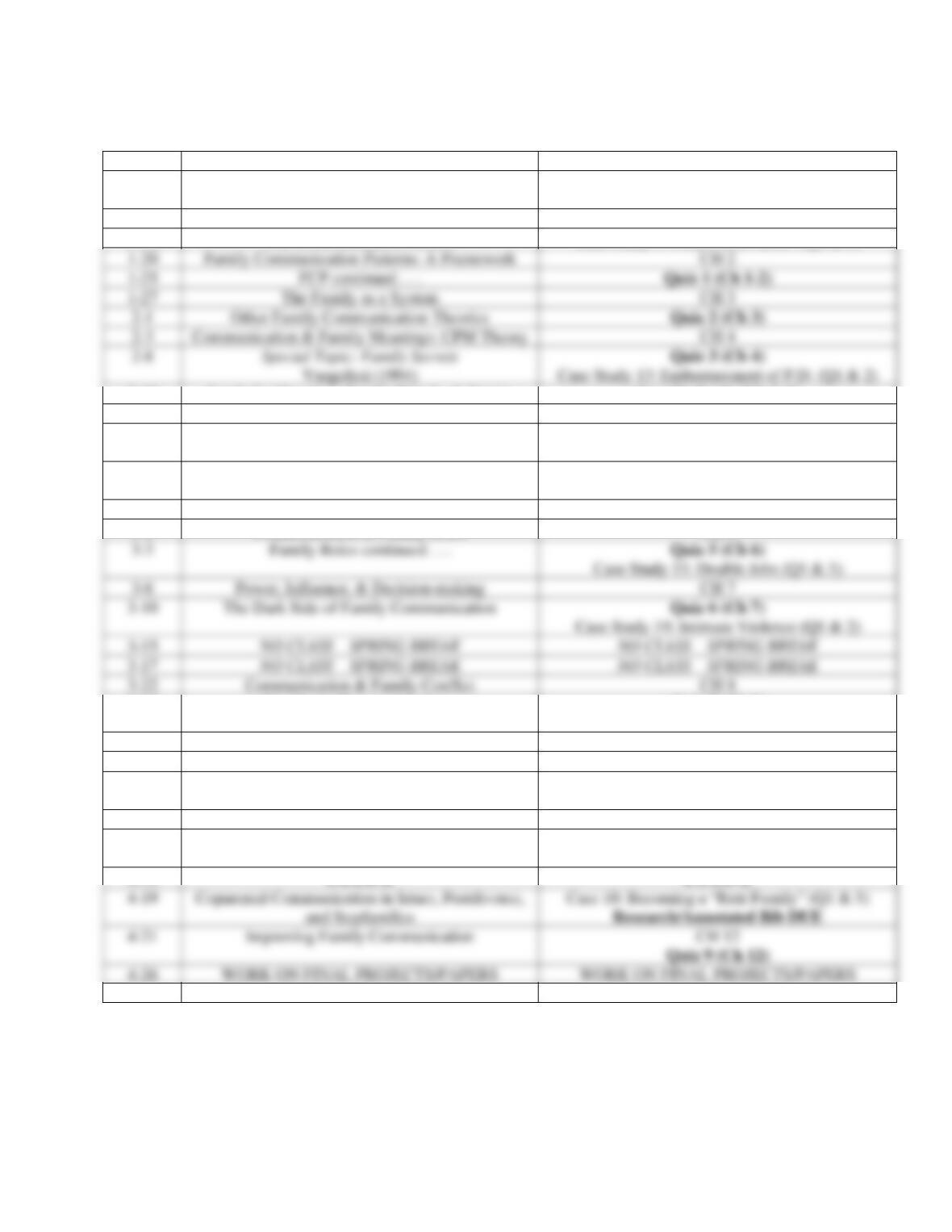
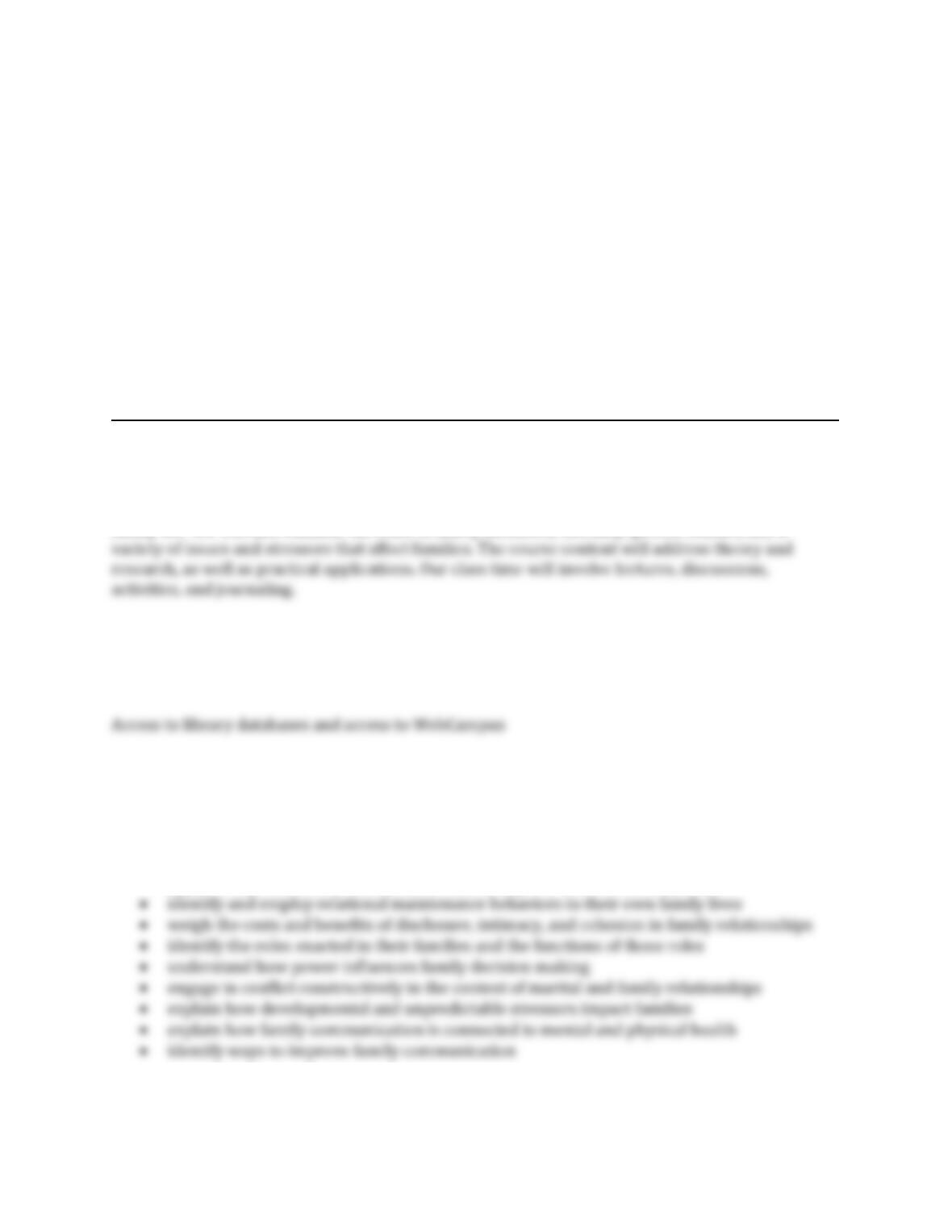
TENTATIVE SCHEDULE
Date
Course Content
Assignments/Readings Due
1-11
Course Introduction
Family Metaphors
Cover Syllabus
1-13
Defining the “Family”
CH 1
1-18
The Communication Process
Case Study 1: What’s in a Name? (Q2 & 3)
1-20
CH 2
1-25
1-27
CH 3
2-1
2-3
CH 4
2-8
2-10
Symbolic Meanings, Family Rituals, & Stories
Case Study 16: (Q1 & 3)
2-15
Present Family Crests
DUE: Assignment 1 – Crests
2-17
Intimacy and Closeness within Families
Special Topic: Topic Avoidance in Families
CH 5
2-22
Jeopardy I Review for Exam I
Quiz 4 (Ch 5)
Jeopardy I
2-24
EXAM I
EXAM I
3-1
CH 6
Quiz 5 (Ch 6)
3-8
CH 7
3-10
Quiz 6 (Ch 7)
3-15
3-17
3-22
CH 8
3-24
Family conflict continued . . .
Quiz 7 (Ch 8)
Primetime Video on Family Conflict
3-29
Present Family Conflict Analysis
DUE: Assignment 2
3-31
Communication and Family Stress
CH 9,10
4-5
Developmental Issues & Change
Quiz 8 (Ch 9-10)
Case Study 24: Big Changes (Q3 & 4)
4-7
NO CLASS – CSCA CONVENTION
NO CLASS – CSCA CONVENTION
4-12
Jeopardy II Review for Exam II
Jeopardy II Review
Transcripts DUE to Group Members
4-14
4-21
4-26
5-3
FINAL PROJECT PRESENTATIONS
PROJECT PRESENTATIONS
11
COURSE SYLLABUS
COM 415: Communication in Marital & Family Relationships
Spring 2016
Instructor: Dr. Lisa Menegatos Email: NAME @University.edu
Office: Location Office Phone: xxx-xxxx
Office Hours: Mondays 2:30pm – 3:30pm; Tuesdays 1:15pm – 2:15pm; Wednesdays 8:45am – 9:45am; Thursdays
12noon – 1pm; and by appointment
Class Meeting Times: Tuesdays & Thursdays 2:30pm – 3:45pm
Location: BEH 221
Course Description:
In COM 415 we will focus on describing, analyzing, and understanding marital and family
interaction processes. We will examine definitions of the family and current trends in American
Required Materials:
Galvin, K. M., Braithwaite, D. O., & Bylund, C. L. (2015). Family communication: Cohesion and change
(9th ed.). Boston: Pearson.
Specific Course Objectives/Learning Outcomes:
By the end of the semester students should be able to:
• define family and identify current trends in American family life today
• explain how shared meanings are created within families
• describe the major theoretical approaches used in studying family communication
• apply family communication theories and concepts to their own family lives
University Undergraduate Learning Outcomes (UULOs):
Additionally, this course is intended to meet two of the five UULOs:
12
• Communication
o “1. Demonstrate general academic literacy, including how to respond to needs of
audiences and to different kinds of rhetorical situations, analyze and evaluate reasons and
• Global/Multicultural Knowledge and Awareness
o “2. Respond to diverse perspectives linked to identity, including age, ability, religion,
politics, race, gender, ethnicity, and sexuality, both in American and international
contexts.”
COURSE REQUIREMENTS
Midterm Exam 55 points
Final Exam 55 points
Family Metaphors: Group Worksheet & Presentation 35 points
GENERAL DESCRIPTION OF REQUIREMENTS:
Exams: There are two exams in this class—a midterm and a final— that cover material from the
textbook, assigned articles, class lectures/discussions (including media clips), and activities. The
exams will primarily consist of multiple choice questions; however, it is possible some short answer
items will also be on the exams. Both exams will be taken in class. You will need to bring a scantron
form and a pencil on the exam dates. A study guide will be provided for each exam.
Reflection Paper: Circumplex Model: This is a 3-5 page reflection paper in which you will apply the
Circumplex Model of Marital and Family Systems to your family. Detailed instructions for this
assignment, including the evaluation form, are posted on WebCampus under “Assignments.”
13
Synthesis Workshop: This workshop is designed to help you organize and write your research
paper. You will need to attend class (see course schedule below for workshop date) and do the in-
class assignment. You’ll also need to bring your articles and article summaries to class.
Journal: Over the semester, you will be randomly assigned 7 in-class journal assignments. Each
journal entry is worth 10 points for a total of 70 points. Since these are in-class assignments, they
will be hand-written. As such, you’ll need to bring a pen and paper to each class meeting. Generally,
you will not receive advance warning of journals. Also, if you miss class, journal assignments cannot
be made up, regardless of whether your absence is excused or unexcused. The only exception to
this is if you are missing class for a religious observance OR for a university sanctioned event OR for
service in the U.S. Armed Forces AND you have followed the proper procedures. Please note that
some journals will be completed over two different class periods.
GRADE DISTRIBUTION:
LETTER
GRADE
POINTS
A
465-500 points
A-
450-464.5 points
B+
435-449.5 points
B
415-434.5 points
B-
400-414.5 points
C+
385-399.5 points
C
365-384.5 points
C-
350-364.5 points
335-349.5 points
D
315-334.5 points
D-
300-314.5 points
F
0-299.5 points
**Semester grades will NOT be rounded up.**
CLASSROOM POLICIES
Student Conduct: It is important that we have a comfortable and considerate classroom climate. As such, I
expect you to treat me and your peers with respect. I also expect you to pay attention to and participate in all
class discussions and activities. You should avoid unnecessary disruption during class time (e.g., having
private conversations, text messaging, surfing the internet, doing work for other classes, making/receiving
cell phone calls, etc.). Additionally, you should avoid racist, sexist, homophobic or other negative language
that may unnecessarily exclude members of our campus and classroom. You should also avoid cursing in class