73
Chapter 9: Mass and Mass-Related Variables in Engineering
9.2 The density of standard air is a function of temperature and may be approximated
using the ideal gas law according to
RT
P
where
= density (kg/m3)
P = standard atmospheric pressure (101.3 kPa)
R gas constant, and its value for air is 286.9 ( Kkg
J
)
T air temperature in Kelvin
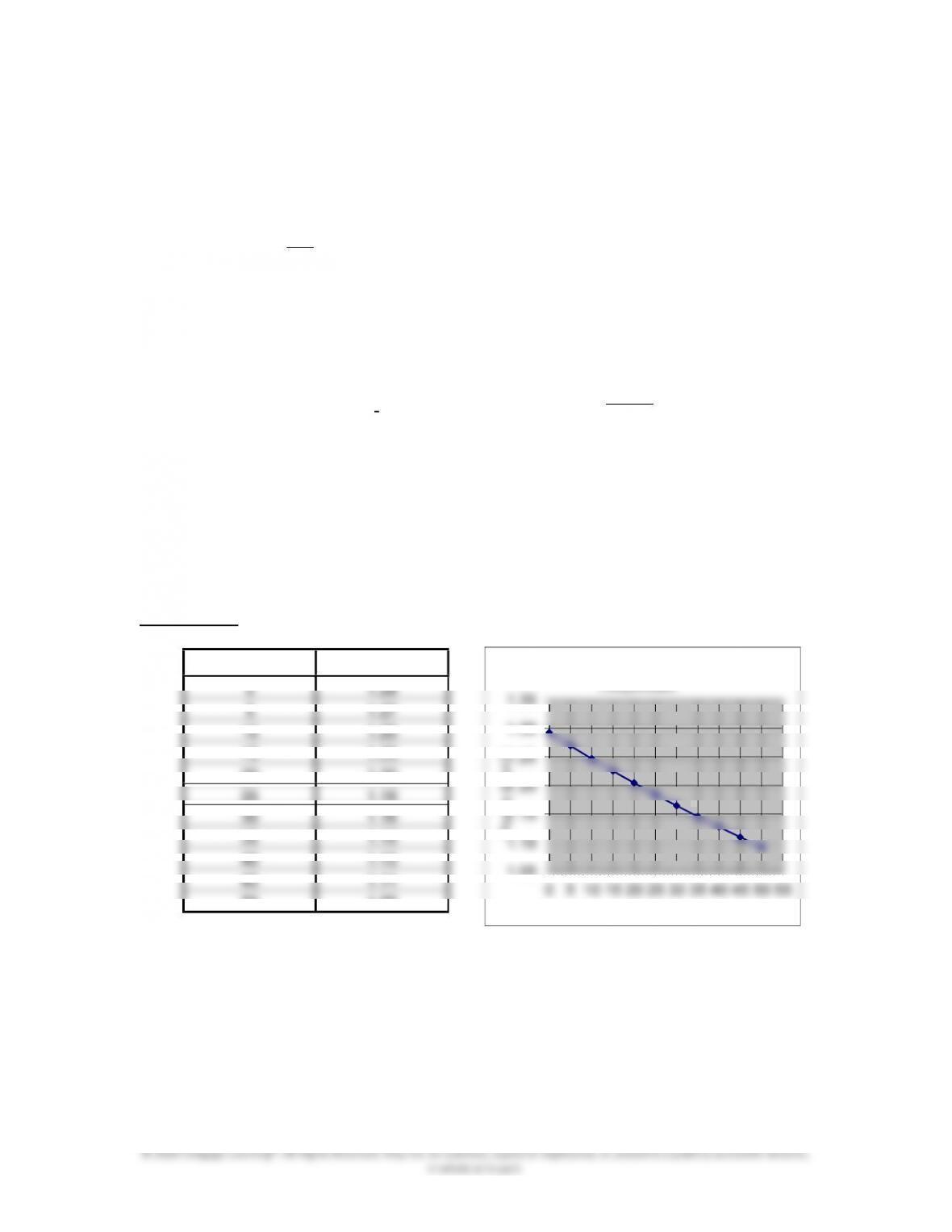
Create a table that shows the density of air as a function of temperature in the
range of 0 C (273.15 K) to 50 C (323.15 K) in increments of 5 C. Also, create
a graph showing the value of density as a function of temperature.
SOLUTION
Temperature (C) Density (kg/m3)
20 1.20
25 1.18
50 1.09
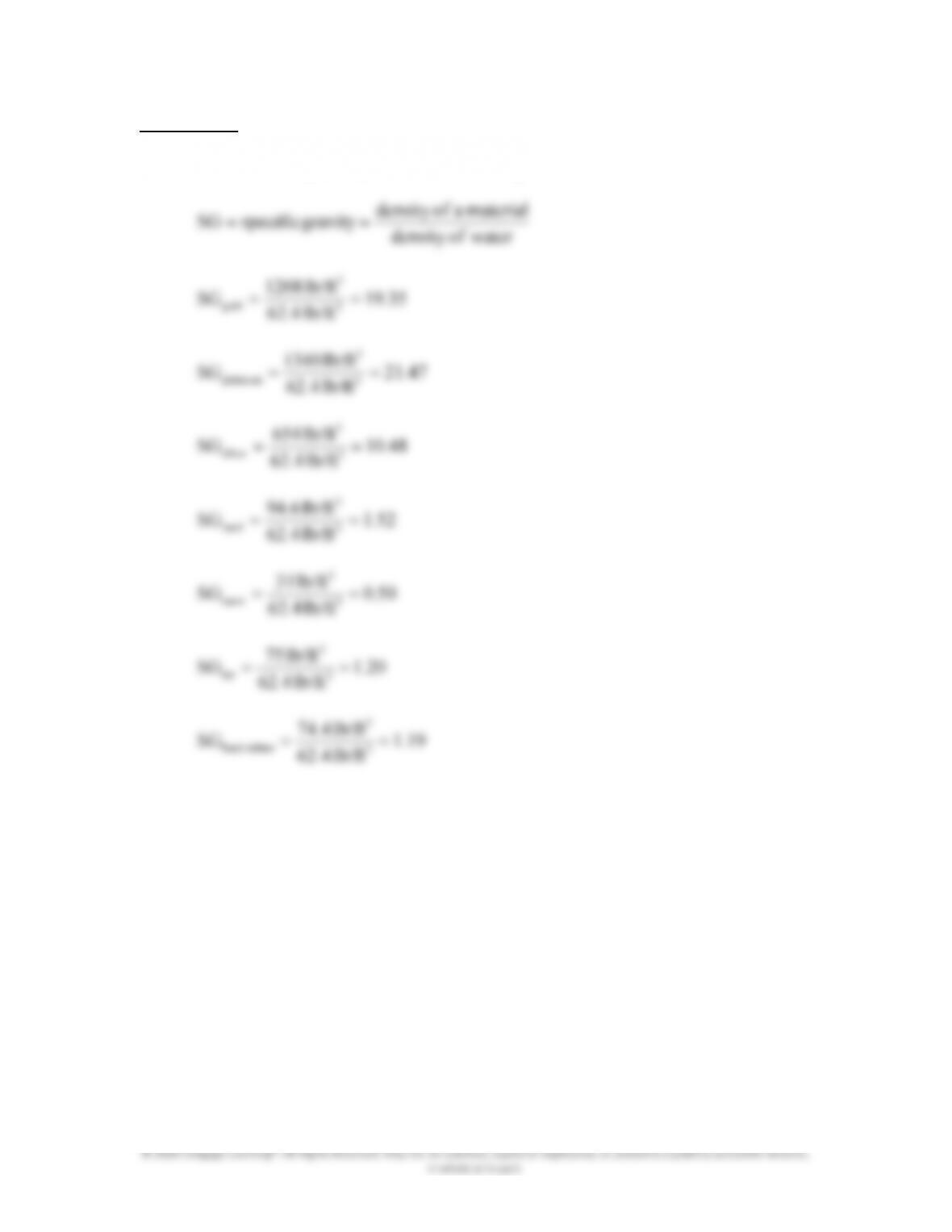
9.3 Determine the specific gravity of the following materials: gold ( = 1208 lb/ft3),
platinum ( = 1340 lb/ft3), silver ( = 654 lb/ft3), sand ( = 94.6 lb/ft3), freshly
fallen snow ( = 31 lb/ft3), tar ( = 75 lb/ft3), and hard rubber ( = 74.4 lb/ft3).
1.20
Temperature (C)
Density of Air as a Function of
Temperature
74
SOLUTION
We will use Equation (9.3) to answer this question.
9.4 Show that the specific weight and density are related according to:
gravity) todueon accelerati(density)( weight specific
75
© 2020 Cengage Learning®. All Rights Reserved. May not be scanned, copied or duplicated, or posted to a publicly accessible website,
in whole or in part.
SOLUTION
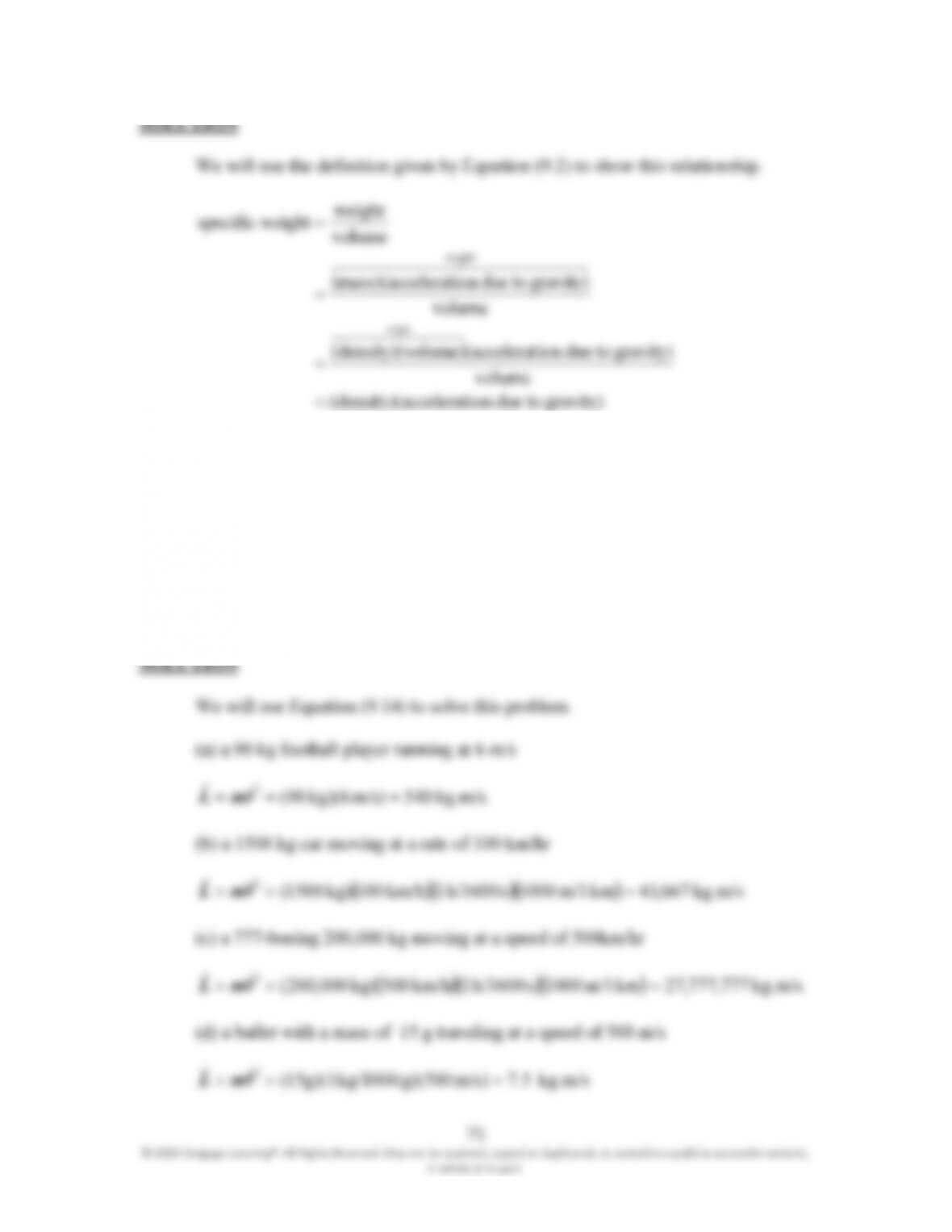
We will use the definition given by Equation (9.2) to show this relationship.
gravity) todue onaccelerati(density)(
volume
gravity) todue ion(acceleratvolume)(density)(
volume
gravity) todue eleration(mass)(acc
volume
weight
weight specific
mass
weight
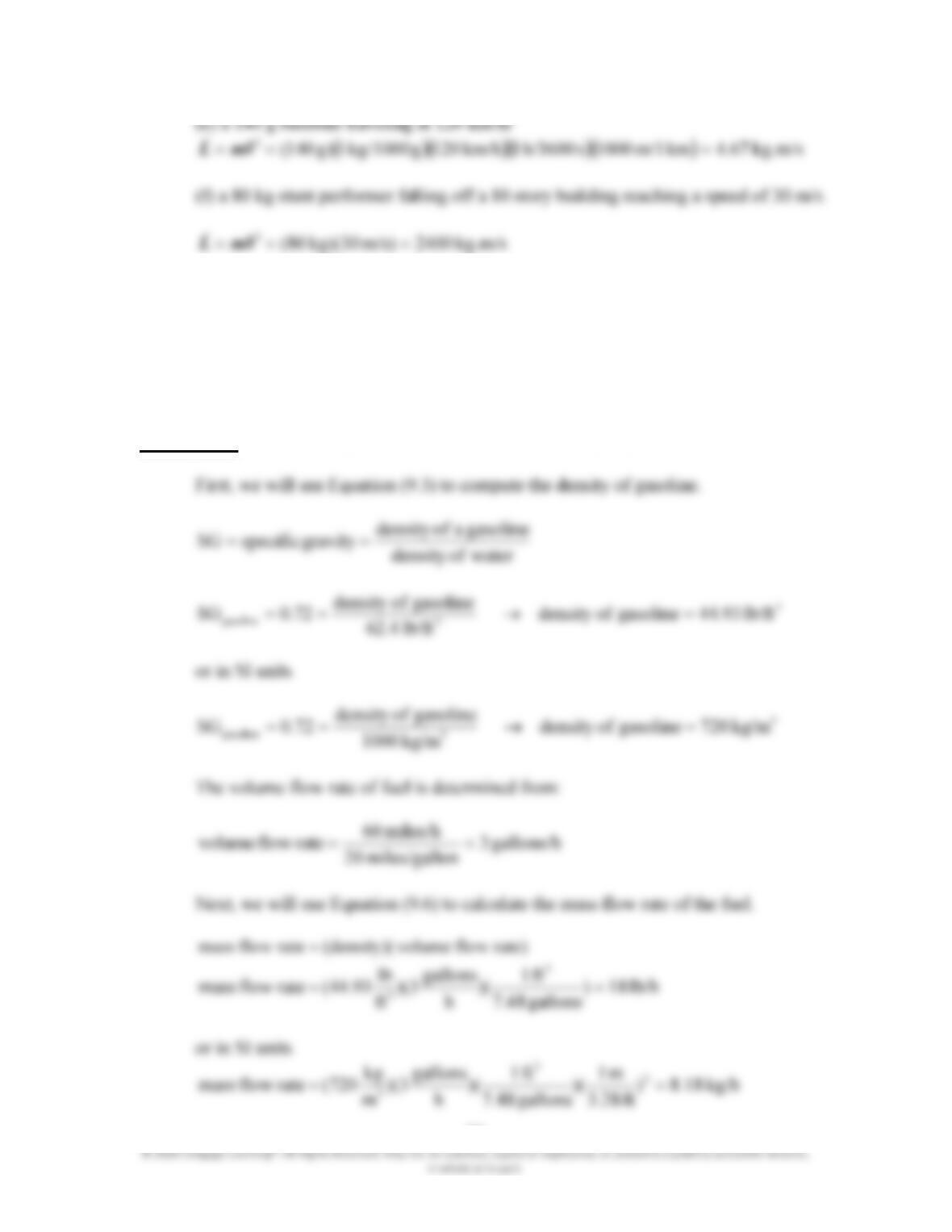
9.5 Compute the values of momentum for the following situations: (a) a 90-kg
football player running at 6 m/s; (b) a 1500-kg car moving at a rate of 100 km/h;
(c) a 200,000 kg Boeing 777 moving at a speed of 500 km/h; (d) a bullet with a
mass of 15 g traveling at a speed of 500 m/s; (e) a 140-g baseball traveling at
120 km/h; (f) a 80 kg stunt performer falling off a ten story building reaching a
speed of 30 m/s.
76
© 2020 Cengage Learning®. All Rights Reserved. May not be scanned, copied or duplicated, or posted to a publicly accessible website,
in whole or in part.
(e) a 140 g baseball traveling at 120 km/hr
kg.m/s 67.4km m/1 1000s h/3600 1km/h 120g kg/1000 1g) 140( VmL
(f) a 80 kg stunt performer falling off a 10 story building reaching a speed of 30 m/s.
kg.m/s 2400m/s) kg)(30 80( VmL
9.9 Determine the mass flow rate of fuel from the gasoline tank to the car’s fuel
injection system. Assume that the gasoline consumption of the car is 20 mpg
when the car is moving at 60 mph. Use the specific gravity value of 0.72 for the
gasoline.
SOLUTION
ft 3.28
gallons 7.48
h
m
77
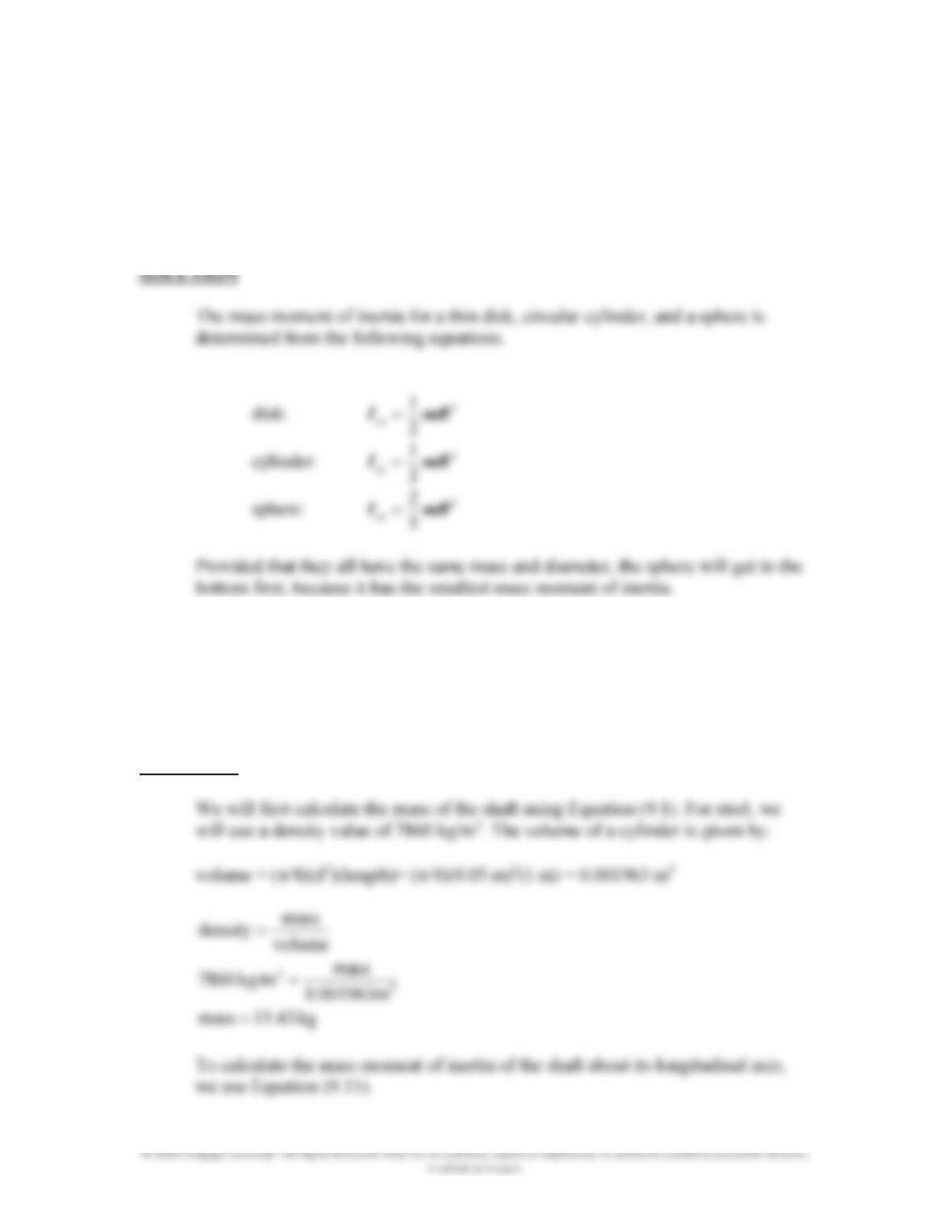
9.10 Determine the mass moment of inertia for the following objects: a thin disk,
circular cylinder, and a sphere. Refer to Equations (9.10) through (9.13) for
appropriate relationships. If you were to place these objects alongside of each
other on an inclined surface, which one of the object would get to the bottom first,
provided that they all have the same mass and diameter?
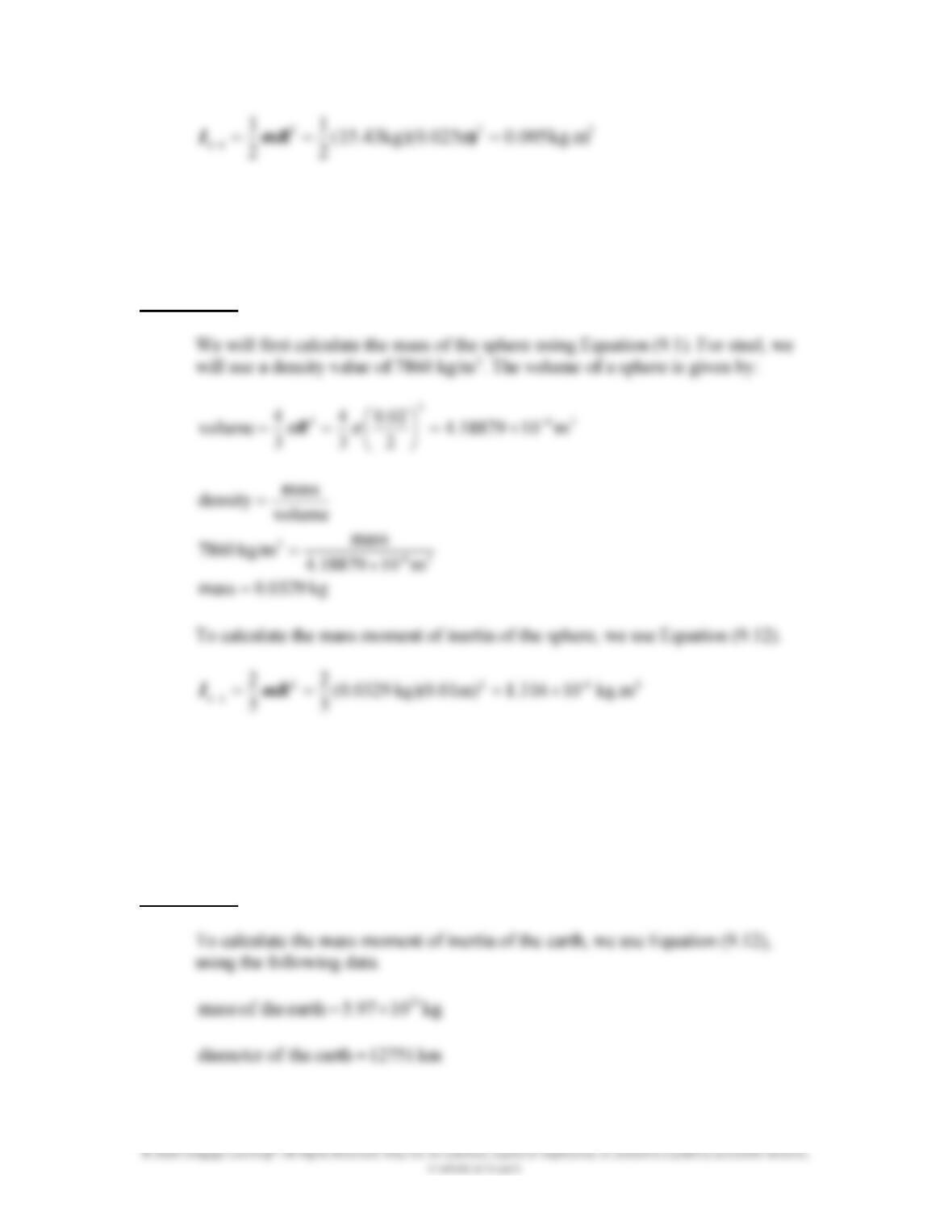
9.12 Determine the mass moment of inertia of a steel shaft that is 1-m long and has a
diameter of 5 cm. Determine the mass of the shaft using the density information
provided in Table 9.1.
SOLUTION
78
© 2020 Cengage Learning®. All Rights Reserved. May not be scanned, copied or duplicated, or posted to a publicly accessible website,
in whole or in part.
222 kg.m 0.005)kg)(0.025m (15.43
2
1
2
1
mRI zz
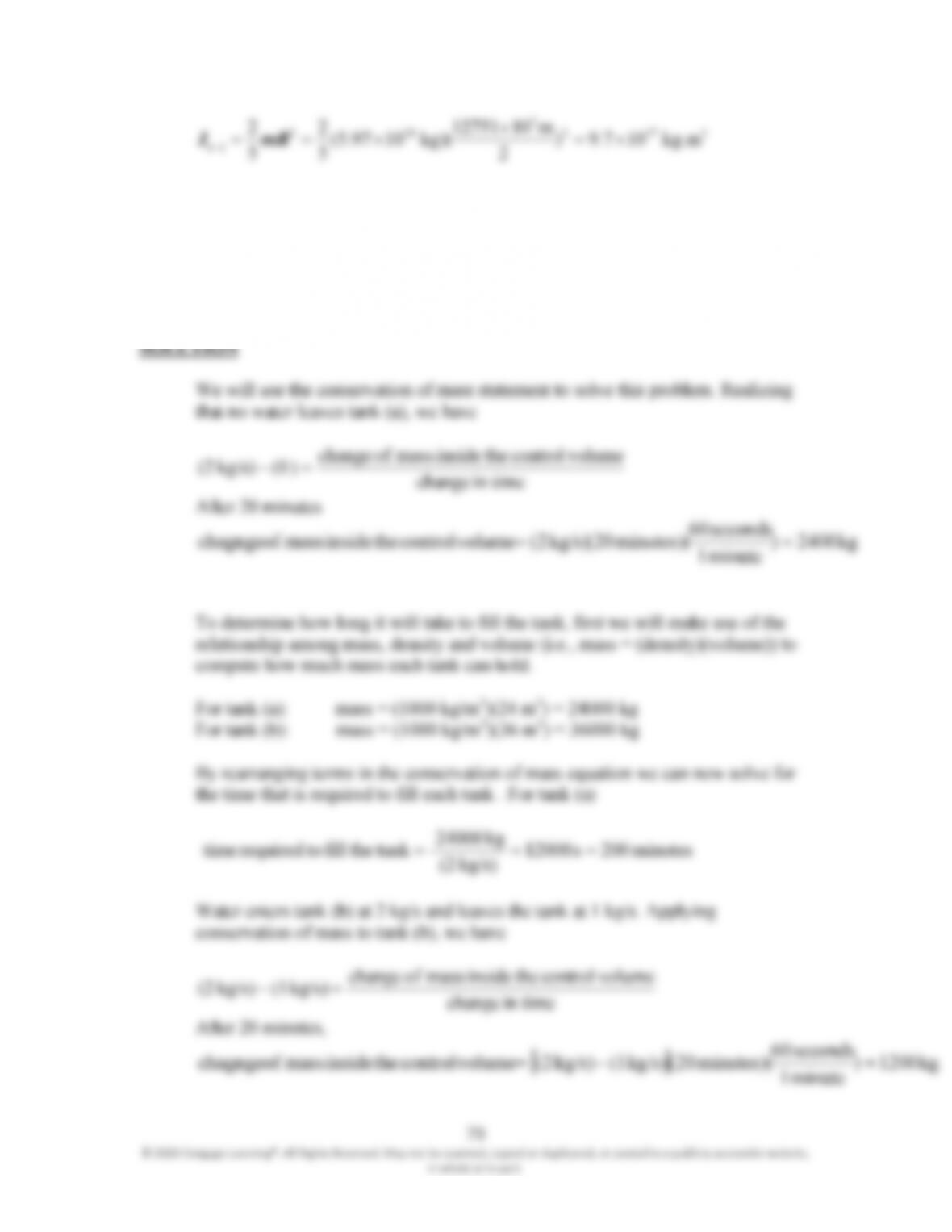
9.13 Determine the mass moment of inertia of steel balls used in ball bearings. Use a
diameter of 2 cm.
SOLUTION
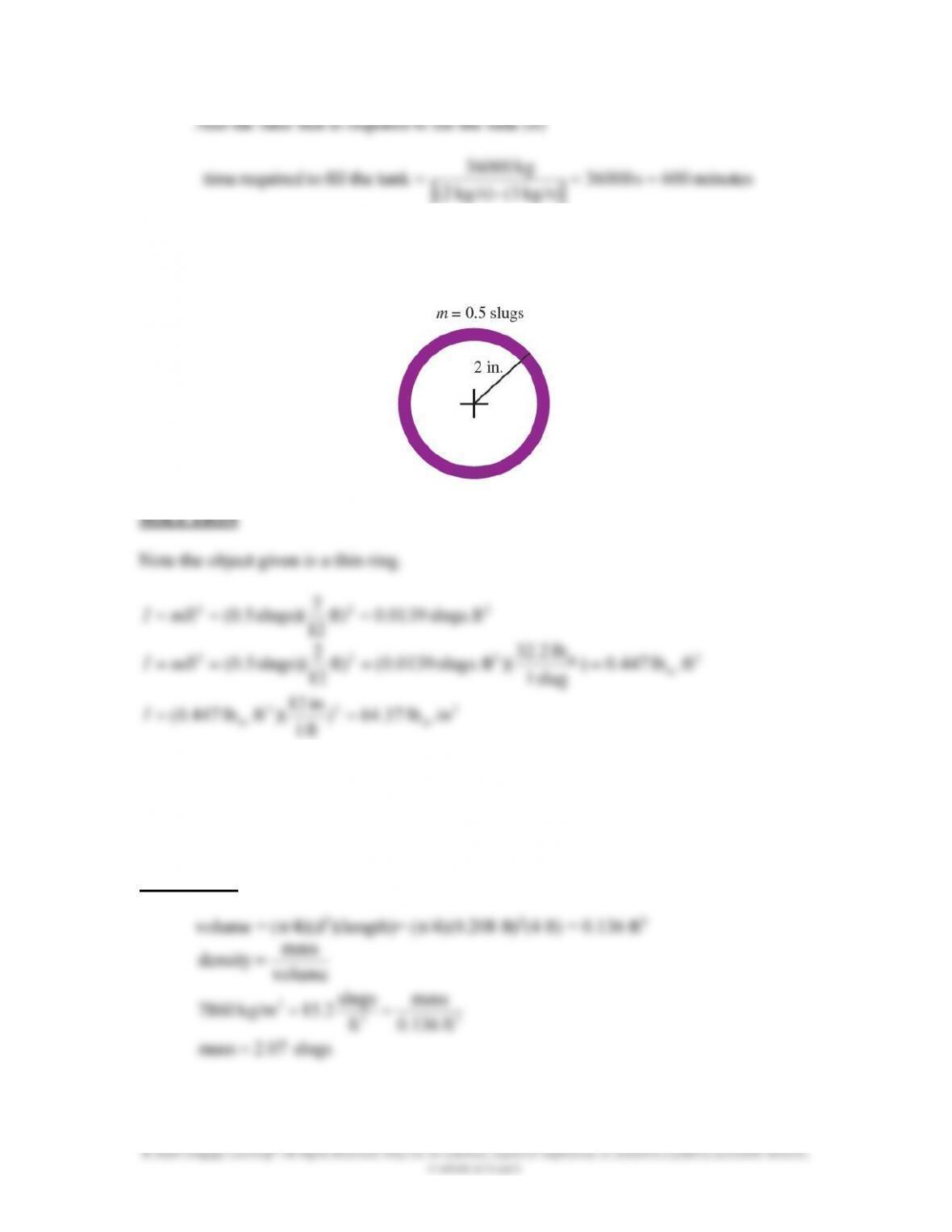
9.14 Determine the mass moment of inertia of the earth about its axis of rotation, going
through the poles. Assume the shape of the earth to be spherical. Look up
information such as the mass of the earth and the radius of the earth at the
equatorial plane.
SOLUTION
79
© 2020 Cengage Learning®. All Rights Reserved. May not be scanned, copied or duplicated, or posted to a publicly accessible website,
in whole or in part.
2372
3
242 kg.m 109.7)
2
m1012751
kg)( 10(5.97
5
2
5
2
mRI zz
9.22 Referring to Figure 9.5, how much water is stored after 20 minutes in each of the
tanks. How long will it take to fill the tanks completely provided that the volume
of tank (a) is 24 m3 and tank (b) has a volume of 36 m3? Assume density of water
is 1000 kg/m3.
80
© 2020 Cengage Learning®. All Rights Reserved. May not be scanned, copied or duplicated, or posted to a publicly accessible website,
in whole or in part.
And the time that is required to fill the tank (b)
minutes 600s 36000
kg/s) (1–kg/s) (2
kg 36000
tank thefill torequired time
9.24 Calculate the mass moment of inertia of the thin ring shown in the accompanying
diagram. Express your answer in lbm·ft2, lbm·in2, and slugs·ft2.
m
m.inlb 64.37)
ft
1
9.25 Determine the mass moment of inertia of a steel shaft that is 4 ft long and has
diameter of 2.5 in. Express your answer in lbm·ft2, lbm·in2, and slugs·ft2.
SOLUTION
12
81
© 2020 Cengage Learning®. All Rights Reserved. May not be scanned, copied or duplicated, or posted to a publicly accessible website,
in whole or in part.
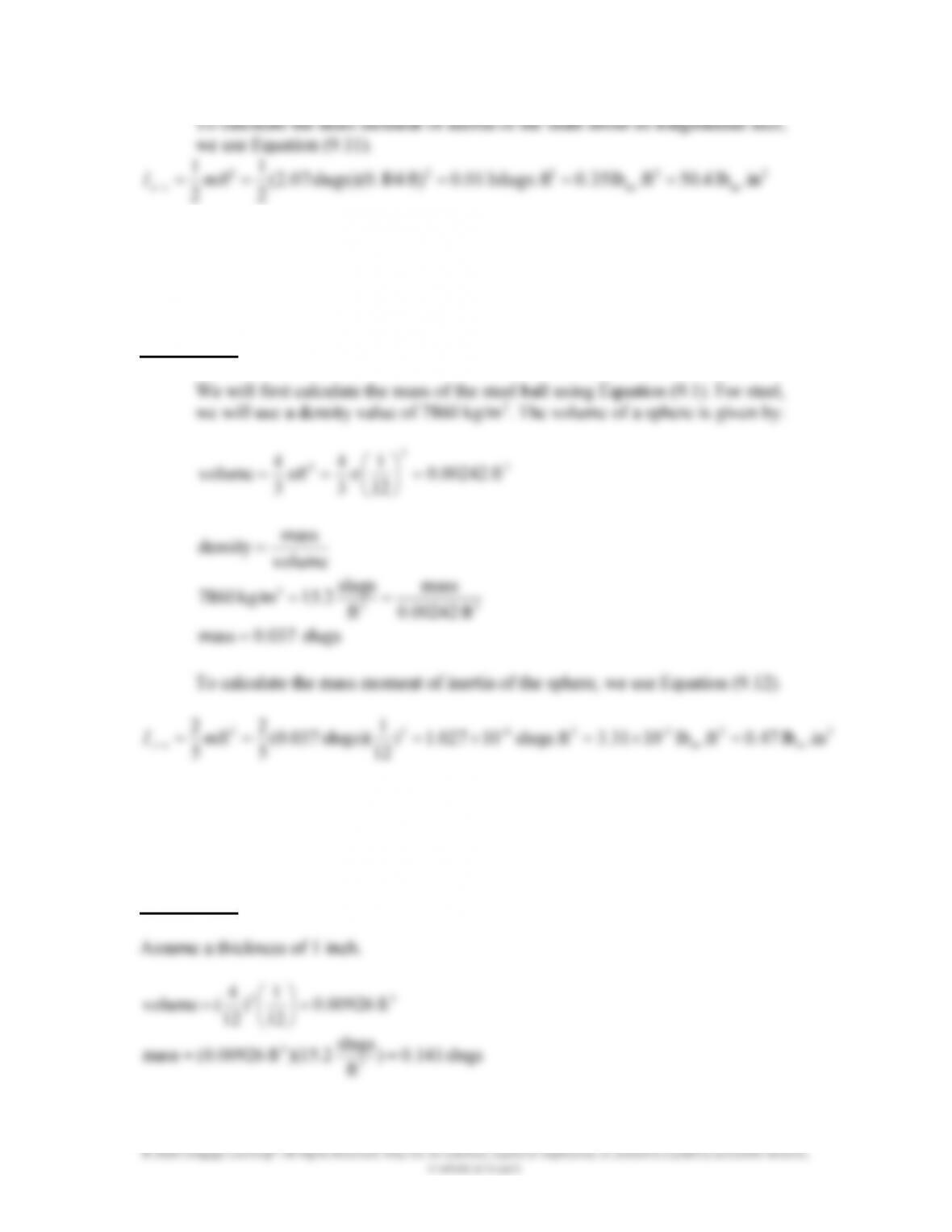
To calculate the mass moment of inertia of the shaft about its longitudinal axis,
we use Equation (9.11).
2
m
2
m
222 .inlb 4.50.ftlb 0.35slugs.ft 0.011ft) 04slugs)(0.1 (2.07
2
1
2
1
mRI zz
9.26 Determine the mass moment of inertial of a steel ball with a diameter of 2 in.
Express your answer in lbm·ft2, lbm·in2, and slugs·ft2.
SOLUTION
12
5
5
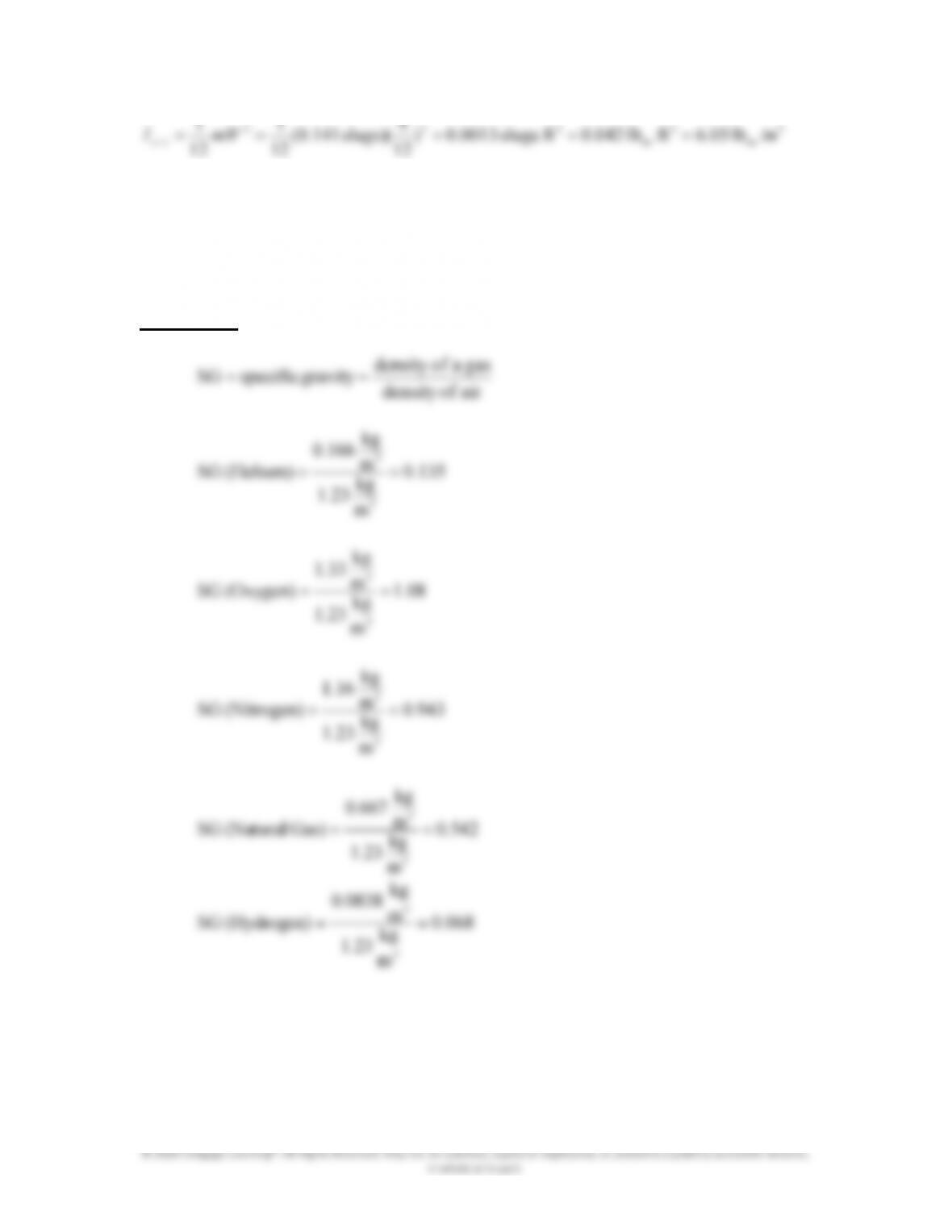
9.27 Determine the mass moment of inertia of a 4-in-square steel plate. Use Equation
9.13. Express your answer in lbm·ft2, lbm·in2, and slugs·ft2.
SOLUTION
slugs 141.0)
ft
2.15)(ft 00926.0( mass 3
82
© 2020 Cengage Learning®. All Rights Reserved. May not be scanned, copied or duplicated, or posted to a publicly accessible website,
in whole or in part.
2
m
2
m
222 .inlb 05.6.ftlb 0.042slugs.ft 0.0013)
12
4
slugs)( (0.141
12
1
12
1
mWI zz
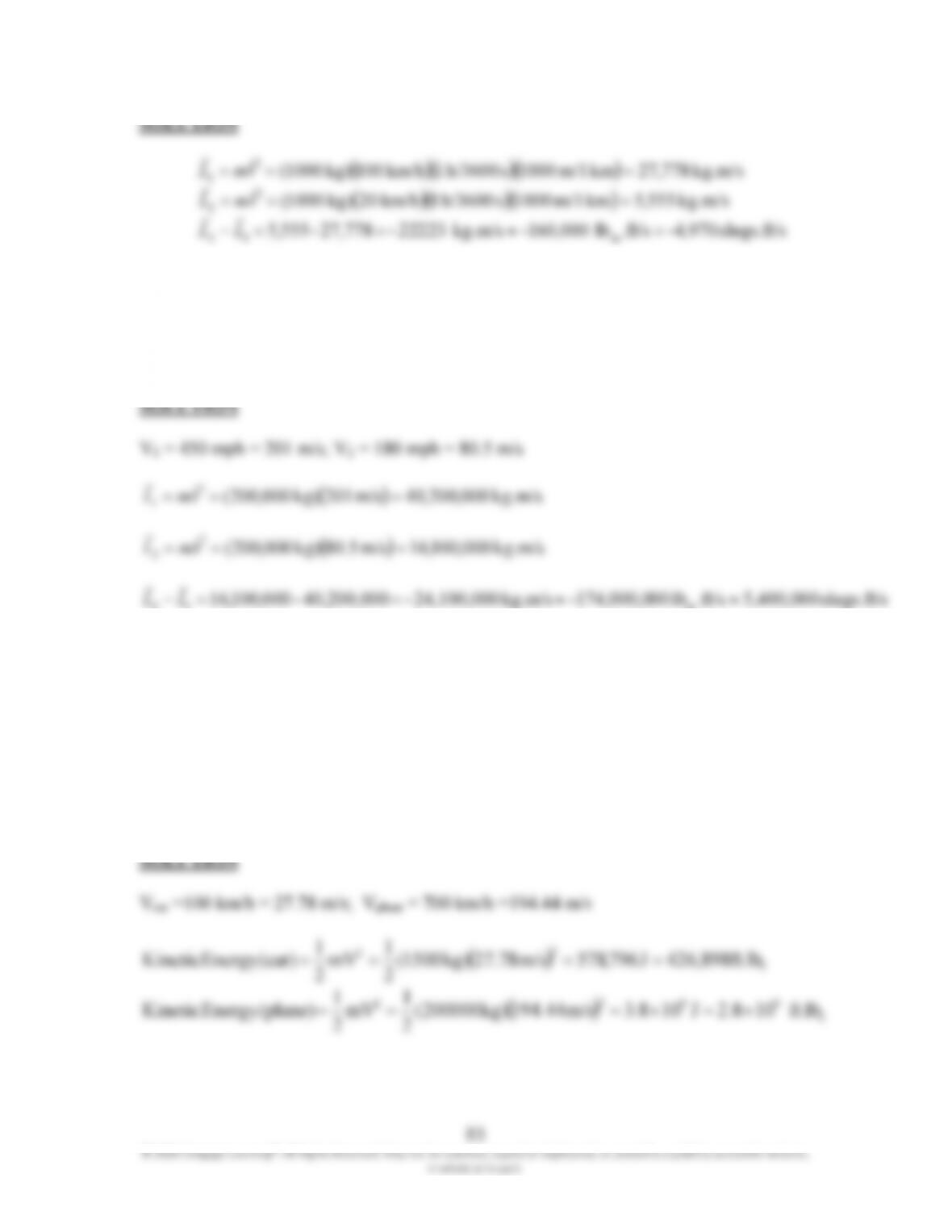
9.28 Determine the specific gravity of the following gasses by comparing their
densities to air at 1.23 kg/m3. Helium: 0.166 kg/m3, Oxygen: 1.33 kg/m3,
Nitrogen: 1.16 kg/m3, Natural gas: 0.667 kg/m3, and Hydrogen: 0.0838 kg/m3.
SOLUTION
068.0
m
kg
1.23
m
(Hydrogen) SG
3
9.29 Calculate the change in the momentum of a car, whose speed changes from 100
km/h to 20 km/h. The car has a mass of 1000 kg and is moving along a straight
line. Express your answer in SI, BG, and U.S. Customary units.
m
m
m
m
SOLUTION
kg.m/s 778,27km m/1 1000s h/3600 1km/h 100kg) 1000(
1 VmL
kg.m/s 555,5km m/1 1000s h/3600 1km/h 20kg) 1000(
2 VmL
slugs.ft/s -4,970.ft/slb -160,000kg.m/s 22223– 27,778 – 555,5 m12 LL
9.30 Calculate the change in the momentum of a 200,000 kg Boeing 777, whose speed
changes from 450 mph to 180 mph. Express your answer in SI, BG, and U.S.
Customary units.