Problem 9.1
Briefly explain what is meant by the defender/challenger concept.
Problem 9.2
List three reasons why a replacement study might be needed.
Problem 9.3
In conducting a replacement study of assets with different lives, can the annual worth
values over the asset’s own life cycle be used in the comparison, if the study period is
(a) unlimited, (b) limited and the study period is not an even multiple of asset lives, and
(c) limited wherein the period is a multiple of asset lives? Explain your answers.
Problem 9.4
An entrepreneurial civil engineer who owns his own design/build company purchased a
small crane 2 years ago at a cost of $71,000. At that time, it was expected to be used for
10 years and then traded in for its salvage value of $10,000. Due to increased
construction activities, the company would prefer to trade for a new, larger crane now
which will cost $93,000. The company estimates that the old crane can be used, if
necessary, for another 4 years, at which time it will have a $25,000 estimated market
value. Its current market value is estimated to be $39,000, and if it is used for another
4 years, it will have M&O costs of $17,000 per year. Determine the values of P, n, S, and
AOC that should be used for the existing crane in a replacement analysis performed
today.
Problem 9.5
A mechanical engineer who designs and sells equipment that automates manual labor
processes is offering a machine/robot combination that will significantly reduce labor
costs associated with manufacturing garage-door opener transmitters. The equipment has
a first cost of $170,000, an estimated annual operating cost of $54,000, a maximum
useful life of 5 years, and a $20,000 salvage value anytime it is replaced. The existing
equipment was purchased 12 years ago for $65,000 and has an annual operating cost of
$78,000. At most, the currently-owned equipment can be used two more years, at which
time it will be auctioned off for an expected amount of $6000, less 33% paid to the
company handling the auction. The same scenario will occur if the currently-owned
equipment is replaced now. Determine the defender and challenger estimates of P, n, S,
and AOC in conducting a replacement analysis today at an interest rate of 20% per year.
Problem 9.6
A machine tool purchased two years ago for $40,000 has a market value that can be
described by the relation $40,000 – 3000k, where k is the number of years from time of
purchase. Experience with this type of asset has shown that its annual operating cost is

described by the relation $30,000 + 1000k. The asset’s salvage value was originally
estimated to be $10,000 after a predicted 10-year useful life. Determine the current
estimates for P, S, and AOC for a replacement study, assuming it will be kept only one
more year, which will be the third year of ownership.
Problem 9.7
The AW values for retaining a presently-owned machine for additional years are shown
in the table. (Note that the values are the AW amount per each of the n years that the
asset is kept.) A challenger has an economic service life of 7 years with an
AWC = $−86,000 per year. Assuming future costs remain as estimated for the
replacement study, what is the economic service life of the defender, if the company’s
MARR is 12% per year? Assume used machines like the one presently owned will
always be available.
Retention Period, AW Value,
Years $ per Year
1 −92,000
2 −86,000
3 −85,000
4 −89,000
5 −95,000
Problem 9.8
To improve package tracking at a UPS transfer facility, conveyor equipment was
upgraded with RFID sensors at a cost of $345,000. The operating cost is expected to be
$148,000 per year for the first 3 years and $210,000 for the next 3 years. The salvage
value of the equipment is expected to be $140,000 for the first 3 years, but due to
obsolescence, it won’t have a significant value after that. At an interest rate of 10% per
year, determine the economic service life and equivalent annual worth of the equipment.
Use tabulated factors or a spreadsheet, as requested by your instructor.
Problem 9.9
From the data shown, determine the ESL of the defender and challenger.
Years AW of AW of
Retained Defender, $ Challenger, $
1 -145,000 -136,000
2 -96,429 -126,000
3 -63,317 -92,000
4 -39,321 -53,000
5 -49,570 -38,000
Problem 9.10

From the data shown, determine the economic service life of the asset.
Years AW of AW of AW of
Retained First Cost, $ Operating Cost, $ Salvage Value, $
1 -165,000 -36,000 99,000
2 -86,429 -36,000 38,095
3 -60,317 -42,000 18,127
4 -47,321 -43,000 6,464
5 -39,570 -48,000 3,276
Problem 9.11
In trying to determine the economic service life of a new piece of equipment, an engineer
made the calculations shown below. She forgot to enter the annual worth of the salvage
value for two years of retention. Determine the following to make the ESL equal two
years: (a) minimum AW of the salvage value. (b) estimated salvage value for year two if
i = 10% per year.
Years AW of AW of AW of
Retained First Cost, $ Operating Cost, $ Salvage Value, $
1 -88,000 -45,000 50,000
2 -46,095 -46,000 ?
3 -32,169 -51,000 6,042
4 -25,238 -59,000 3,232
5 -21,104 -70,000 1,638
Problem 9.12
A general manager wants to know the economic service life of currently-owned
machines. The market value of the machines is $30,000, but this value is expected to
decrease as shown in the table below. The maintenance and operating cost associated
with each additional year of retention is also shown. Use the company’s MARR of 15%
per year to determine the ESL.
Year Market Value, $ M&O cost, $
0 30,000 —-
1 25,000 -49,000
2 20,000 -51,000
3 15,000 -53,000
4 10,000 -55,000
Problem 9.13

A construction company bought a 180,000 metric ton earth sifter at a cost of $65,000.
The company expects to keep the equipment a maximum of 7 years. The operating cost is
expected to follow the series described by 40,000 + 10,000k, where k is the number of
years since it was purchased (k = 1, …, 7). The salvage value is estimated to be $30,000
for years 1 and 2 and $20,000 for years 3 through 7. At i = 10% per year, determine the
economic service life and equivalent annual worth of the sifter using (a) tabulated factors,
and (b) a spreadsheet.
Problem 9.14
Cetec Aviation Services has cost estimates associated with operating and maintaining the
currently-owned filter analysis system as shown below. It is considering the acquisition
of a replacement system that can identify residual particles in industrial filters, report its
findings, and archive images and information for future retrieval. Determine the cost of
keeping the current system one more year at an interest rate of 10% per year.
Year Market value, $ Operating cost, $
0 30,000 –
1 25,000 -15,000
2 14,000 -15,000
3 10,000 -15,000
Problem 9.15
An engineer with Haliburton calculated the AW values shown for retaining a presently-
owned machine additional years. A challenger has an economic service life of 7 years
with AW = $-86,000 per year. Assuming all future costs remain as estimated for the
analysis, (a) when should the company replace the defender and with what machine, and
(b) when should the company purchase the challenger? The MARR is 12% per year.
Assume used machines like the one presently owned will always be available.
Retention Period, Defender AW,
Years $ per Year
1 -92,000
2 -81,000
3 -85,000
4 -89,000
5 -95,000
Problem 9.16
A presently-owned machine can last for three more years, if properly maintained at a cost
of $15,000 per year. Its operating cost will be $31,000 per year. After three years, it can
be sold for an estimated $9000. A replacement costs $80,000 with a $10,000 salvage
value after three years and an operating cost of $19,000 per year. Different vendors have
offered $10,000 and $20,000, respectively, for the current system in trade for the
replacement. At 12% per year interest, perform a replacement study for the two trade-in
offers.
Problem 9.17
A piece of imaging equipment was purchased two years ago for $50,000 with an
expected useful life of 5 years and a $5000 salvage value. Since its installation
performance was poor; it was upgraded for $20,000 one year ago. Increased demand now
requires another upgrade for an additional $22,000 so that it can be used for 3 more years.
Its new annual operating cost will be $27,000 with a $12,000 salvage after the 3 years.
Alternatively, it can be replaced with new equipment costing $65,000, operating costs of
$14,000 per year and a expected salvage of $23,000 after 3 years. If replaced now, the
existing equipment will be sold for $7000. Determine whether the company should keep
or replace the defender at an MARR of 10% per year.
Problem 9.18
The plant manager asked you to do a cost analysis to determine when currently- owned
equipment should be replaced. The manager stated that under no circumstances will the
existing equipment be retained longer than two more years It can be replaced any year
with an outside contractor at a cost of $97,000 per year. The market value of the
currently-owned equipment is estimated to be $37,000 now, $30,000 in one year, and
$19,000 two years from now. The operating cost is $85,000 per year. Using an interest
rate of 10% per year, determine when the defending equipment should be retired.
Problem 9.19
A small company that manufactures vibration isolation platforms is trying to decide
whether it should immediately upgrade the current assembly system D, which is rather
labor-intensive, with the more highly-automated system C one year from now. Some
components of the current system can be sold now for $9000, but they will be worthless
hereafter. The operating cost of the existing system is $192,000 per year. System C will
cost $320,000 with a $50,000 salvage value after four years. Its operating cost will be
$68,000 per year. If you are told to do a replacement analysis using an interest rate of
10% per year, which system do you recommend?
Problem 9.20
A critical machine in the Phelps-Dodge copper refining operation was purchased 7 years
ago for $160,000. Last year a replacement study was performed with the decision to
retain for 3 more years. The situation has changed. The equipment is estimated to have a
value of $8000 if “scavenged” for parts now or anytime in the future. If kept in service, it
can be minimally upgraded at a cost of $43,000 to make it usable for up to 2 more years.

Its operating cost is estimated at $22,000 the first year and $25,000 the second year.
Alternatively, the company can purchase a new system that will have an equivalent
annual worth of $54,063 per year over its ESL. The company uses a MARR of 10% per
year. Use annual worth analysis to determine when the company should replace the
machine.
Problem 9.21
A biotech company planning a plant expansion is trying to determine whether it should
upgrade the existing controlled-environment rooms or purchase new ones. The presently-
owned rooms were purchased 4 years ago for $250,000. They have a current “quick sale”
value of $30,000. However, for an investment of $100,000 now, they can be adequate for
another 4 years, after which they could be sold for an estimated $40,000. Alternatively,
new controlled-environment rooms cost $300,000, have an expected 10-year economic
life, and a $50,000 salvage value after that time. Determine whether the company should
upgrade the existing controlled-environment rooms or purchase new ones. Use an MARR
of 12% per year and assume that used controlled-environment rooms will always be
available.
Problem 9.22
From the data shown below, determine the trade-in value of machine X that will render
its AW the same as that of machine Y. Use an interest rate of 8% per year.
Machine X Machine Y
Market value, $ ? -80,000
Annual cost, $ per year -60,000 -40,000 year 1,
increasing by 2000
per year thereafter
Salvage value, $ 15,000 20,000
Life, years 3 5
Problem 9.23
A company that makes micro motion compact coriolis meters purchased a new packaging
system for $600,000. The estimated salvage value was $28,000 after 10 years. Currently
the expected remaining life is 7 years with an AOC of $27,000 per year and an estimated
salvage value of $40,000. The company is considering early replacement of the system
with one that costs $370,000 and has a 12-year economic service life, a $22,000 salvage
value, and an estimated AOC of $50,000 per year. If the MARR for the corporation is
12% per year, find the minimum trade-in value necessary now to make the replacement
economically advantageous.
Problem 9.24

Hydrochloric acid, which fumes at room temperatures, creates a very corrosive work
environment. A mixing machine, working in this environment, is deteriorating fast and
can be used for only one more year, at which time it will be scrapped. It was purchased
3 years ago for $88,000 and its operating cost for the next year is expected to be $63,000.
A more corrosion-resistant challenger will cost $226,000 with an operating cost of
$48,000 per year. It is expected to have a $60,000 salvage value after its 10-year ESL. At
an interest rate of 15% per year, what minimum trade-in value will make the challenger
economically attractive?
Problem 9.25
Machine A was purchased 5 years ago for $90,000. Its operating cost is higher than
expected, so it will be used for only 4 more years. Its operating cost this year will be
$40,000, increasing by $2000 per year through the end of its useful life. The challenger,
machine B, will cost $150,000 with a $50,000 salvage value after its 10-year ESL. Its
operating cost is expected to be $10,000 for year 1, increasing by $500 per year
thereafter. What is the market value for machine A that would make the two machines
equally attractive at an interest rate of 12% per year?
Problem 9.26
The market values and M&O costs associated with a presently-owned machine and a
possible replacement are shown below. The plant manager has told you that he is
interested only in what happens over the next three years and that if the defender is to be
replaced, it must be replaced now or kept for the entire 3-year study period. Using an
interest rate of 10% per year, determine whether or not the defender should be replaced. .
Defender________ Challenger_____
Market Market
Year value, $ M&O cost, $ value, $ M&O cost, $
0 40,000 80,000
1 32,000 -55,000 65,000 -37,000
2 23,000 -55,000 39,000 -37,000
3 11,000 -55,000 20,000 -37,000
4 19,000 -38,000
5 11,000 -39,000
Problem 9.27
An engineer at a fiber optic manufacturing company is considering two robots to reduce
costs in a production line. In-place robot X has a current market value of $82,000, an
annual maintenance and operation (M&O) costs of $30,000, and salvage values of
$50,000, $42,000, and $35,000 if retained 1, 2, and 3 more years, respectively. The
challenging robot Y has a first cost of $97,000, an annual M&O costs of $27,000
whenever it is purchased, and salvage values of $66,000, $51,000, and $42,000 after 1, 2,
and 3 years, respectively. What is the best economic plan if a 2-year study period is used
at an interest rate of 12% per year?
Problem 9.28
A machine purchased 3 years ago for $140,000 is now too slow to satisfy increased
demand. The machine can be upgraded now for $70,000 or sold to a smaller company for
$40,000. The current machine will have an annual operating cost of $85,000 per year and
a $30,000 salvage value in 3 years. If upgraded, the presently-owned machine will
definitely be retained for 3 more years. The replacement, which will serve the company
now and for at least 8 years, will cost $220,000. Its salvage value will be $50,000 for
years 1 through 5; $20,000 after 6 years; and $10,000 thereafter. It will have an estimated
operating cost of $65,000 per year. The company asks you to perform an economic
analysis at 15% per year using a 3-year planning horizon. Should the company replace
the presently- owned machine now, or do it 3 years from now? What are the AW values?
Problem 9.29
Two processes can be used for producing a polymer that reduces friction loss in engines.
Process K will use a presently-owned machine that has a current market value of
$160,000, an operating cost of $7000 per month, and a salvage value of $50,000 after
1 year and $40,000 after its maximum 2-year life. Used machines for this type can be
purchased and the same estimates can be used for a period of 1 or 2 years. Process L will
utilize a new machine that has a first cost of $210,000, an operating cost of $5000 per
month, and salvage values of $100,000 after 1 year, $70,000 after 2 years, $45,000 after
3 years, and $26,000 after its maximum 4-year life. You have been asked to determine
which process is better using a study period of (a) 1 year, (b) 2 years, and (c) 3 years. The
company’s MARR is 12% per year compounded monthly.
Problem 9.30
Excelon is looking for cost-cutting measures. One of the engineers determined that the
equivalent annual worth of an existing machine over its remaining useful life of 1 or
2 years will be $-70,000 per year. The engineer also determined that used machines like
the one currently in use are no longer available. However, the machine can be replaced
with one that is more advanced that will have an AW of -$80,000 if it is kept for 2 years
or less, -$75,000 if it is kept between 3 and 4 years, and -$65,000 if it is kept for 5 to
10 years. If the company uses a 3-year planning period and an interest rate of 15% per
year when should the company replace the machine – now or in 2 years – and at what AW
for the next 3 years?
Problem 9.31
In a replacement study, the correct value for the first cost of the challenger is:
a. the cost when it is purchased .
b. the first cost minus the trade-in value of the defender.
c. its first cost plus the trade-in value of the defender.
d. the book value of the defender.
Problem 9.32
A replacement analysis is most objectively conducted from the viewpoint of:
a. an outsider.
b. a consultant.
c. a non-owner.
d. any of the above.
Problem 9.33
The economic service life of an asset is:
a. the length of time required to recover the first cost of the asset.
b. the time when the operating cost is at a minimum.
c. the time when the salvage value goes below 25% of the first cost.
d. the time when the AW of the asset is at a minimum.
Problem 9.34
In a one-year-later replacement analysis, if all estimates are still current and the
year is nD, the action that should be taken is:
a. keep the defender one more year.
b. replace the defender with the challenger.
c. look for a new challenger and calculate its AW.

d. keep the defender until its market value is equal to the estimated salvage value
of the challenger.
Problem 9.35
For the data shown, the economic service life of the challenger is:
a. 2 years
b. 3 years
c. 4 years
d. 5 years
Years AW of AW of
Retained Defender, $ Challenger, $
1 -145,000 -136,000
2 -96,429 -126,000
3 -63,317 -92,000
4 -39,321 -53,000
5 -49,570 -38,000
Problem 9.36
A milling machine with enhanced CNC controls that allow for high-speed machining of
free-form parts was purchased two years ago for $195,000. The company wants to
purchase a recently available faster model with 8-axis control for $240,000. The
presently-owned machine can be sold today for $105,000. Its operating costs over the
past 2 years have been $30,000 per year. The value that should be used as P for the
presently-owned machine is:
a. $240,000
b. $195,000
c. $105,000
d. $30,000
Problem 9.37

An industrial engineer with an MBA degree is trying to get the company’s stock to rise
by cutting costs. He determined that the equivalent annual worth of an existing machine
over its remaining useful life of 1 or 2 years will be -$74,000. The IE also determined
that the machine can be replaced with a more advanced model that will have
AW = -$84,000 if it is kept for 2 years or less, -$73,000 if it is kept between 3 and
4 years, and -$65,000 if it is kept for 5 to 10 years. The company uses a 3-year planning
period. At an interest rate of 15% per year, the IE should recommend that the existing
machine be replaced:
a. now.
b. one year from now.
c. two years from now.
d. it should not be replaced.
Problem 9.38
At an interest rate of 10% per year, the economic service life of an asset that has a current
market value of $15,000 and the expected cash flows shown is:
a. 1 year
b. 2 years
c. 3 years
d. 4 years
Salvage Value Operating
Year at End of Year, $ Cost, $__
1 10,000 -50,000
2 8,000 -53,000
3 5,000 -60,000
4 0 -68,000
Problem 9.39
In trying to decide whether or not to replace a sorting/baling machine in a solid waste
recycling operation, an engineer calculated the annual worth values for the in-place
machine and a challenger. On the basis of these costs, the defender should be replaced:

a. now.
b. 1 year from now.
c. 2 years from now.
d. 3 years from now.
AW of AW of
Defender, Challenger,
Year $ per year $ per year
1 -24,000 -31,000
2 -25,500 -28,000
3 -26,900 -25,000
4 -27,000 -25,900
5 -28,000 -27,500
Solution 9.1
The defender refers to the currently-owned, in-place asset while the challenger refers to
Solution 9.2
Solution 9.3
Solution 9.4
P = market value = $39,000
Solution 9.5
Defender:
Challenger:
Solution 9.6
Solution 9.7
Solution 9.8
(a) Using tabulated factors
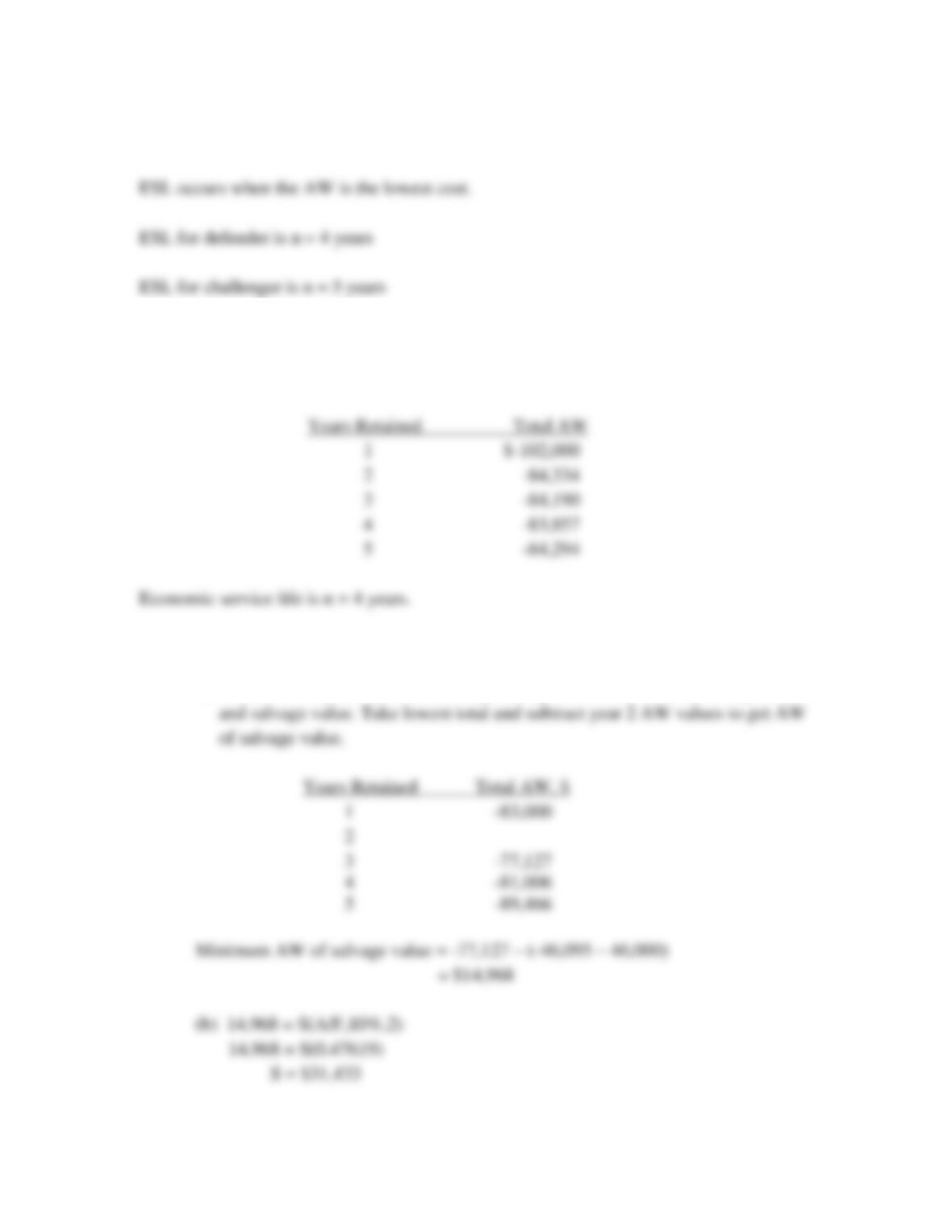
(b) Using a spreadsheet, AW = $-244,434 is minimum at n = 3 years.
Solution 9.9
Solution 9.10
Add AW values for first cost, operating cost, and salvage value; select lowest AW.
Solution 9.11
(a) Find AW for years 1, 3 , 4, and 5 by adding AW of first cost, operating cost,
Solution 9.12
AW1 = -30,000(A/P,15%,1) – 49,000 + 25,000(A/F,15%,1)
Solution 9.13
(a) Tabulated factors
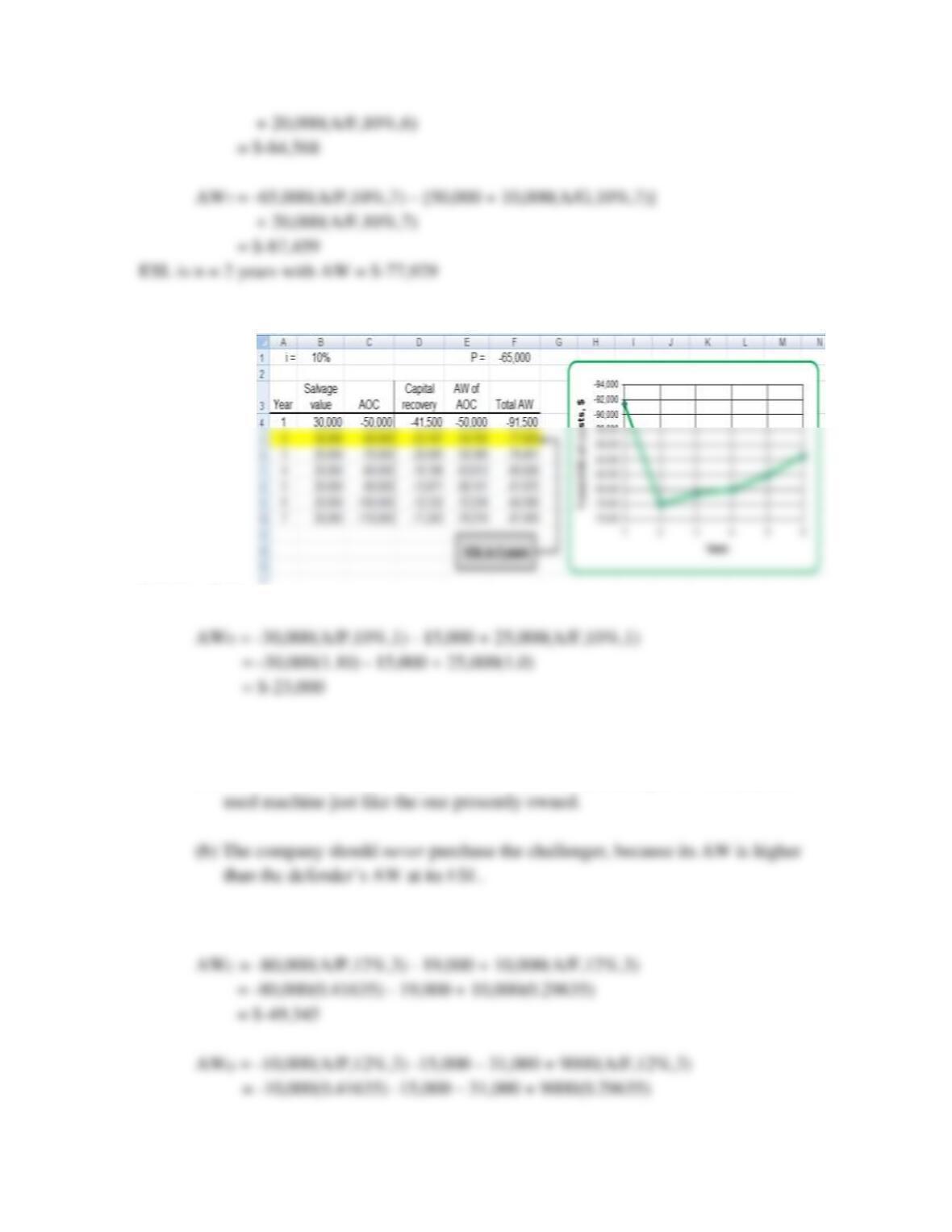
(b) Spreadsheet solution shows ESL is n = 2 years with AW = $77,929
Solution 9.14
Solution 9.15
(a) The defender should be kept for 2 more years and then replaced with another
Solution 9.16
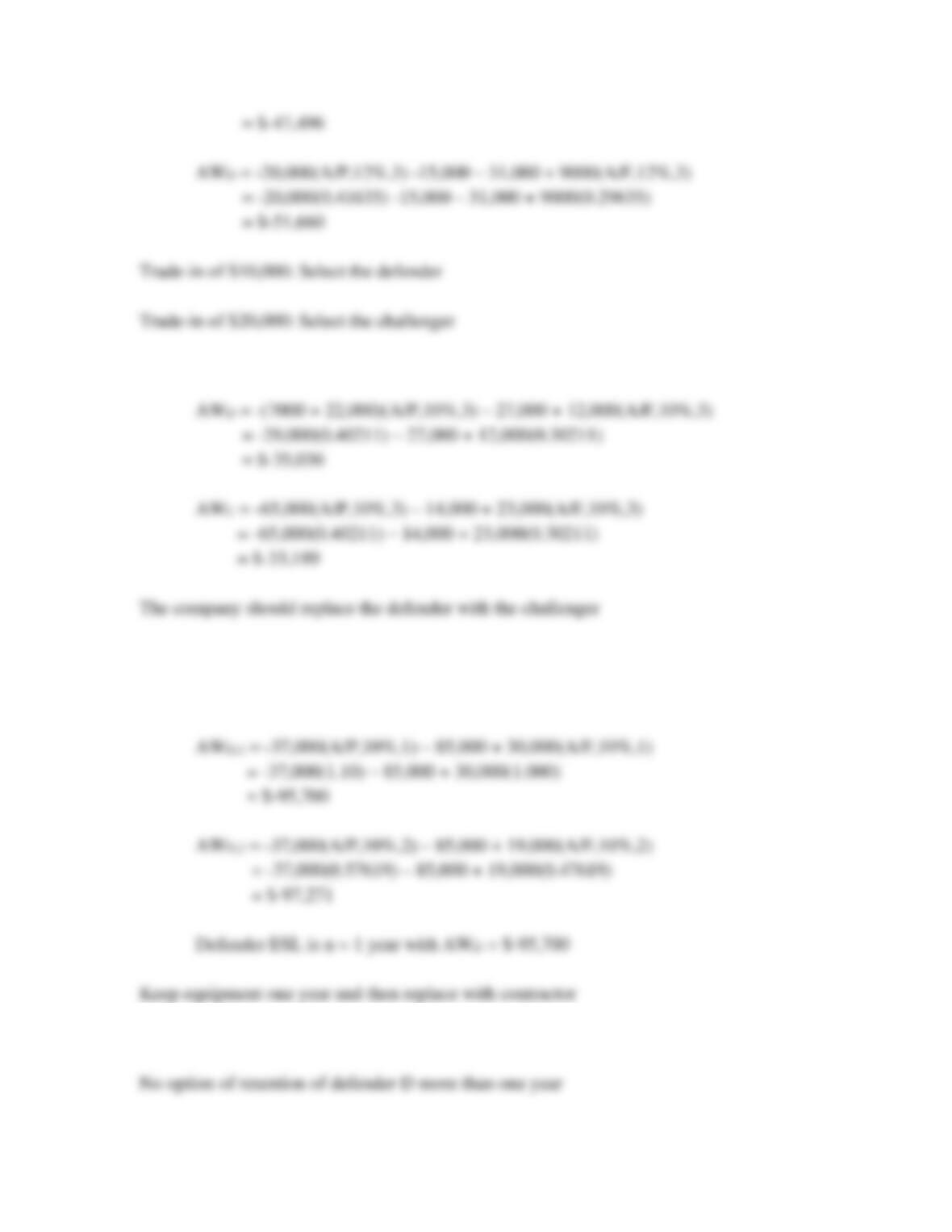
Solution 9.17
Solution 9.18
Find defender ESL; compare with AWC = $-97,000
Solution 9.19
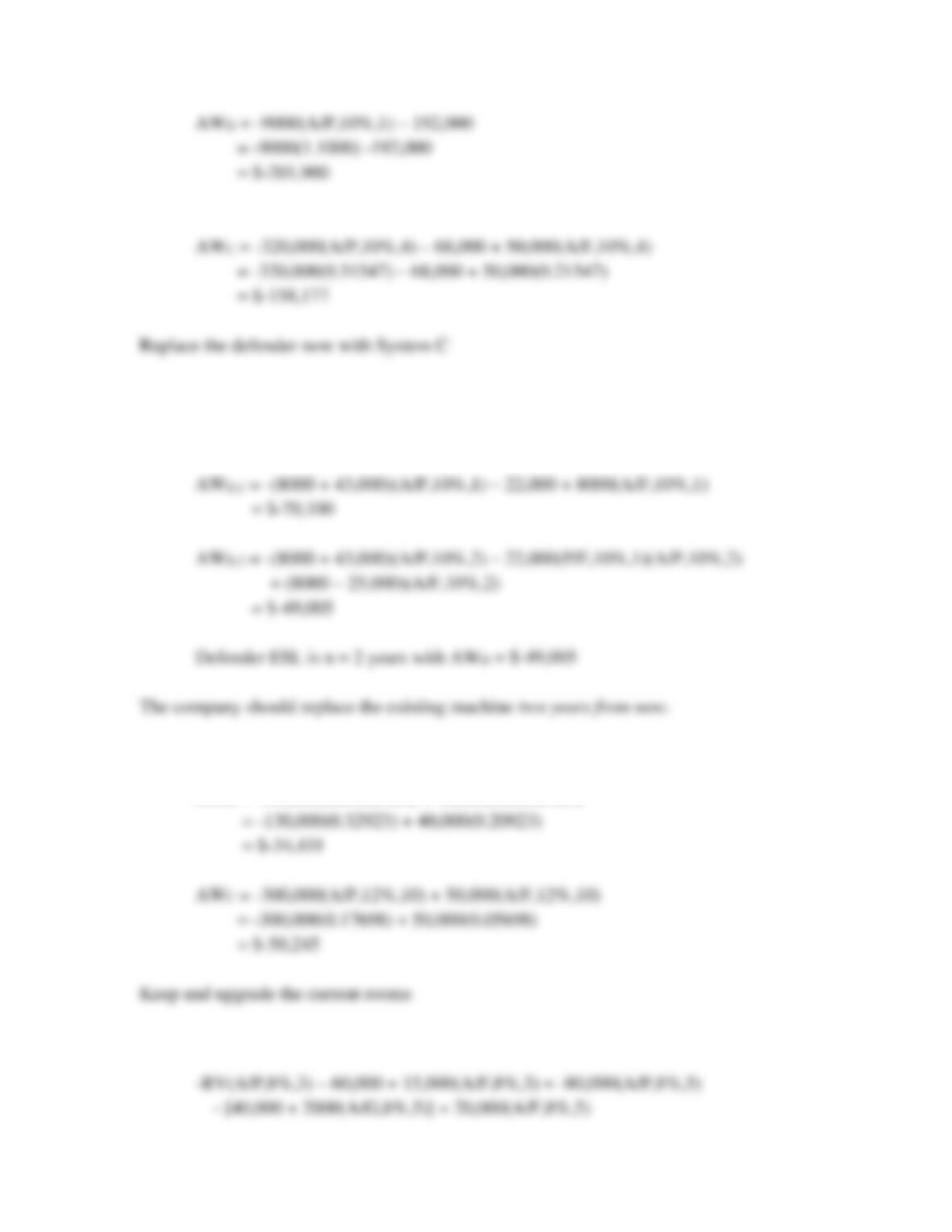
Solution 9.20
Find defender ESL; compare with AWC = $-54,063
Solution 9.21
AWD = -130,000(A/P,12%,4) + 40,000(A/F,12%,4)
Solution 9.22
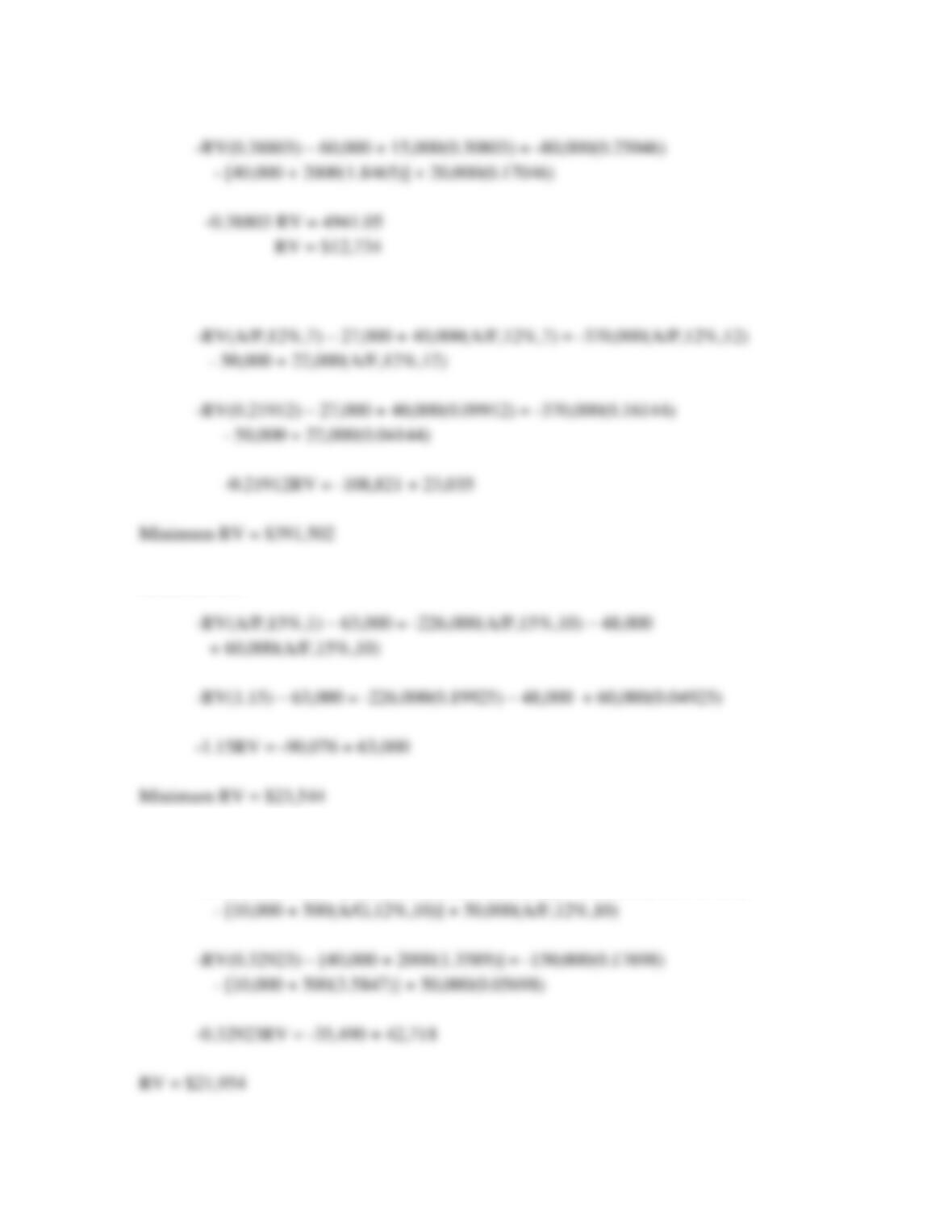
Solution 9.23
Solution 9.24
Solution 9.25
-RV(A/P,12%,4) – [40,000 + 2000(A/G,12%,4)] = -150,000(A/P,12%,10)
0 years
2 years
Solution 9.26
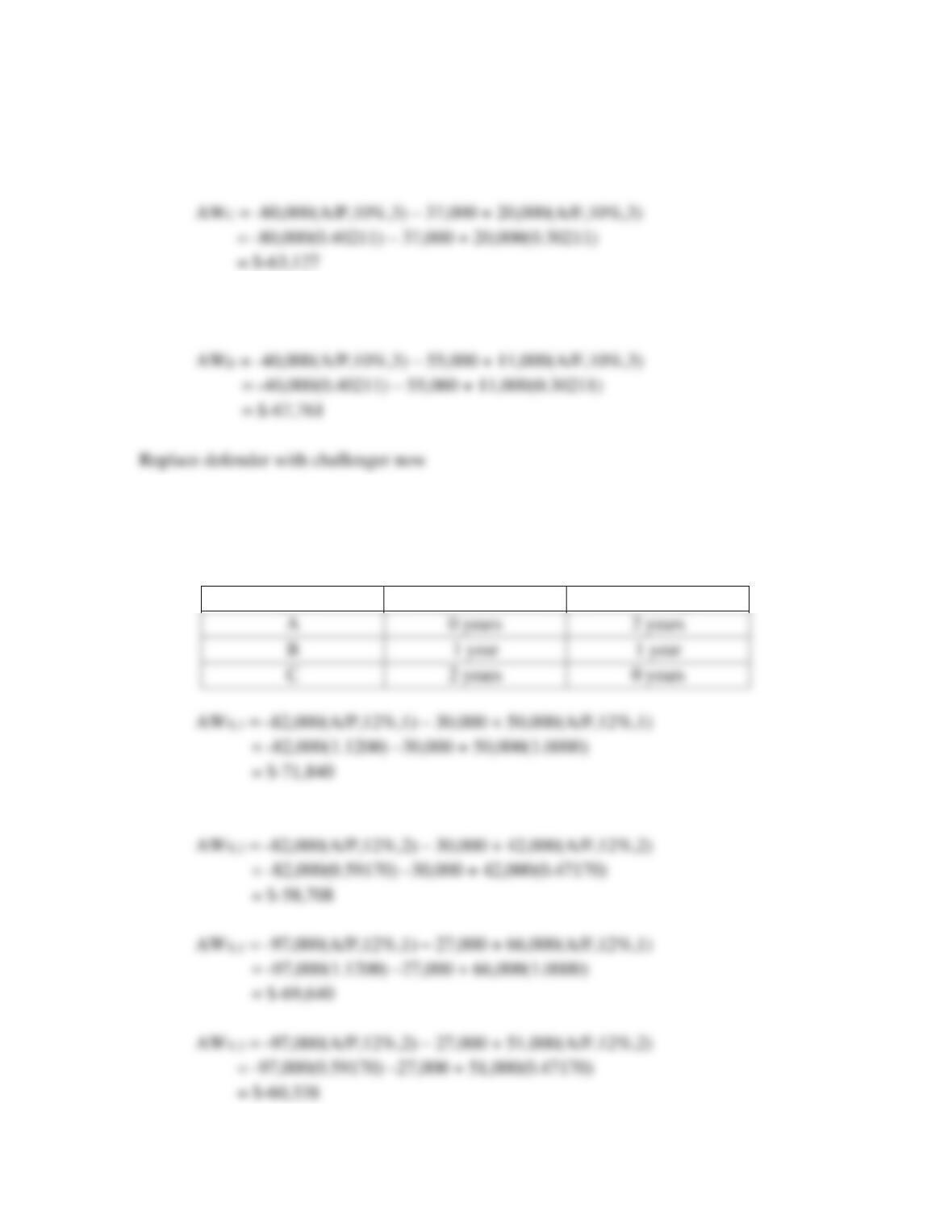
Option 1: replace now with challenger for 3 years
Option 2: replace defender in 3 years
Solution 9.27
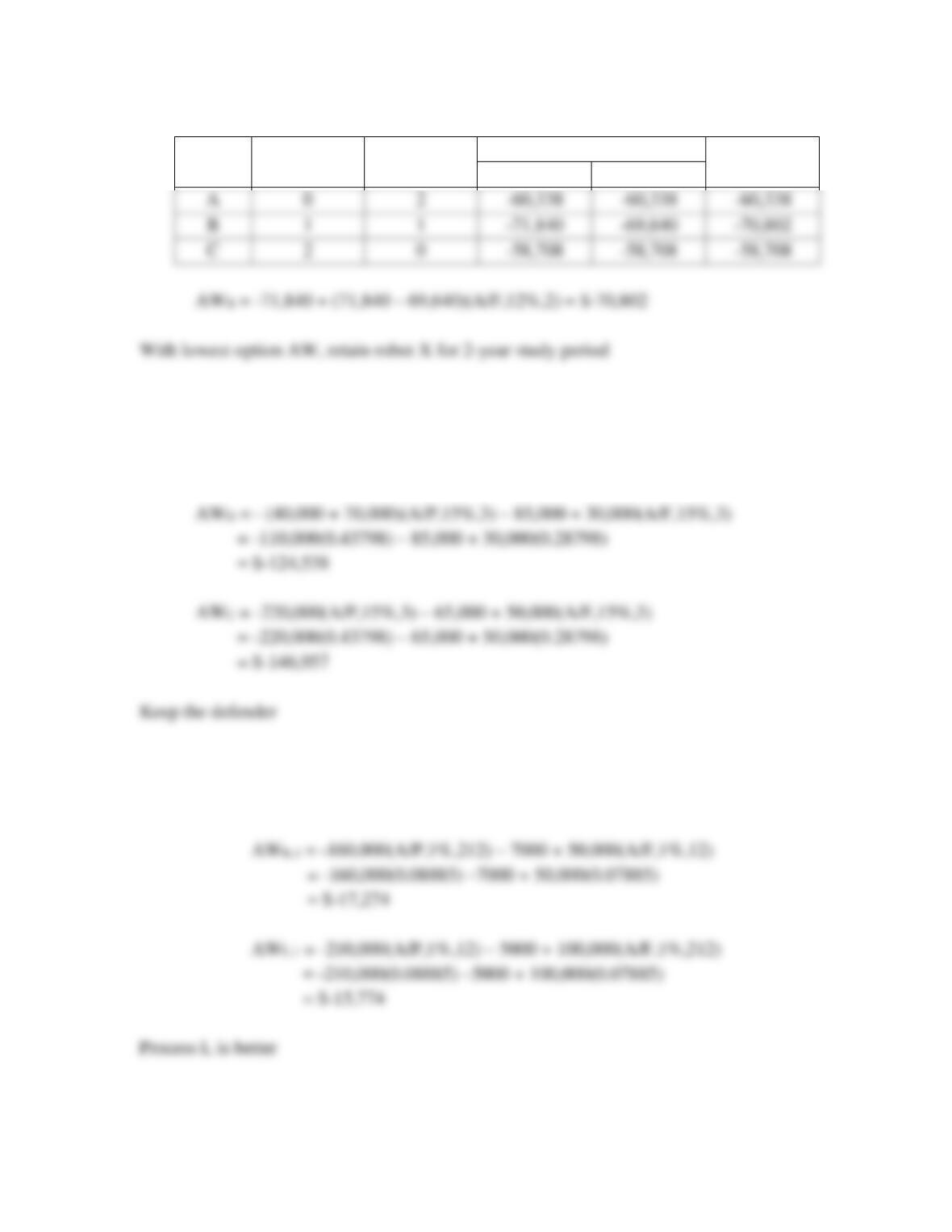
There are three options for a 2-year study period
Option
Keep defender X
Use challenger Y
Option
Years for X
Years for Y
AW cash flows, $ per year
Option AW,
$ per year
Year 1
Year 2
Solution 9.28
Only 2 options; replace defender, buy challenger now or retain defender for 3 years.
Solution 9.29
(a) For 1-year study period
(b) For 2-year study period
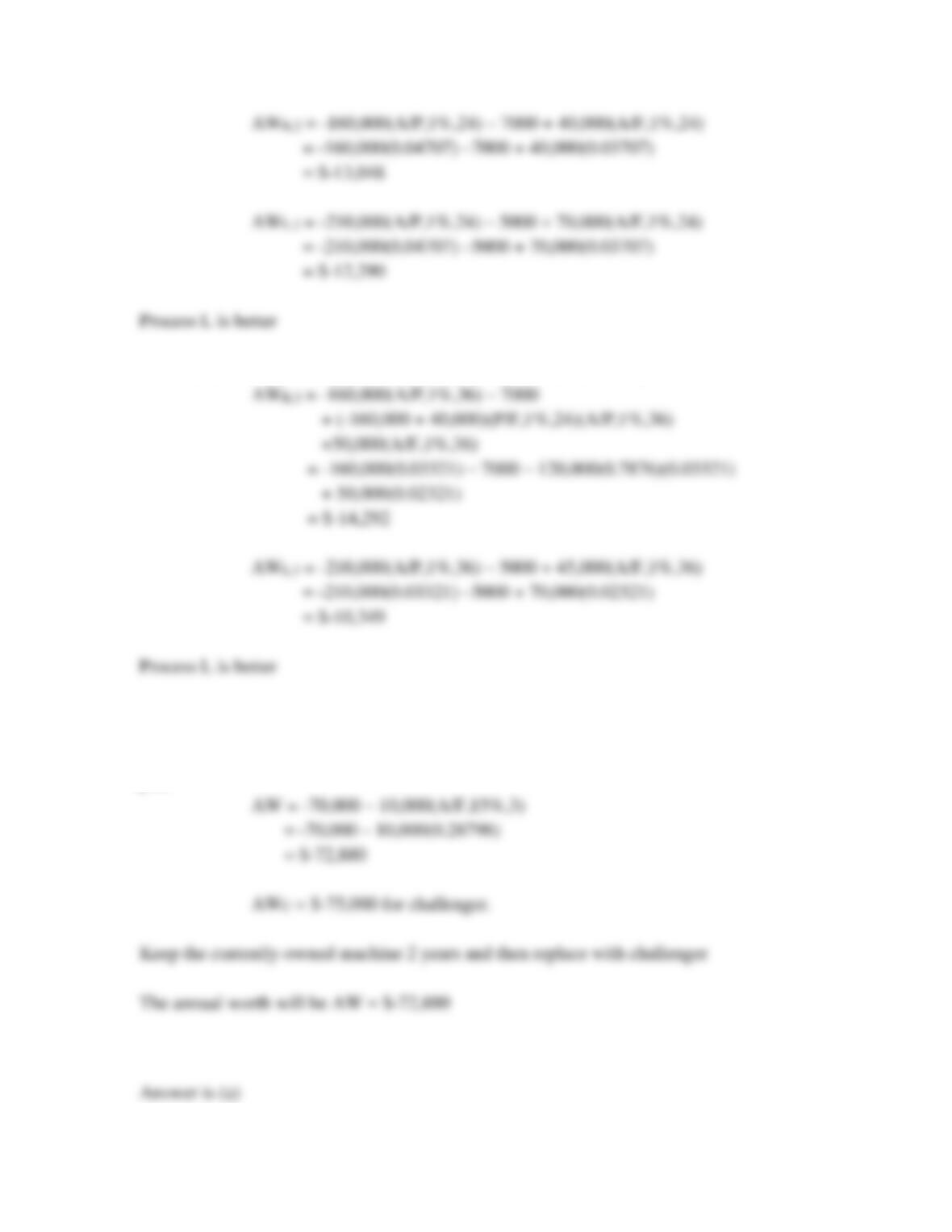
(c) For 3-year study period, repurchase used machine for 1 year
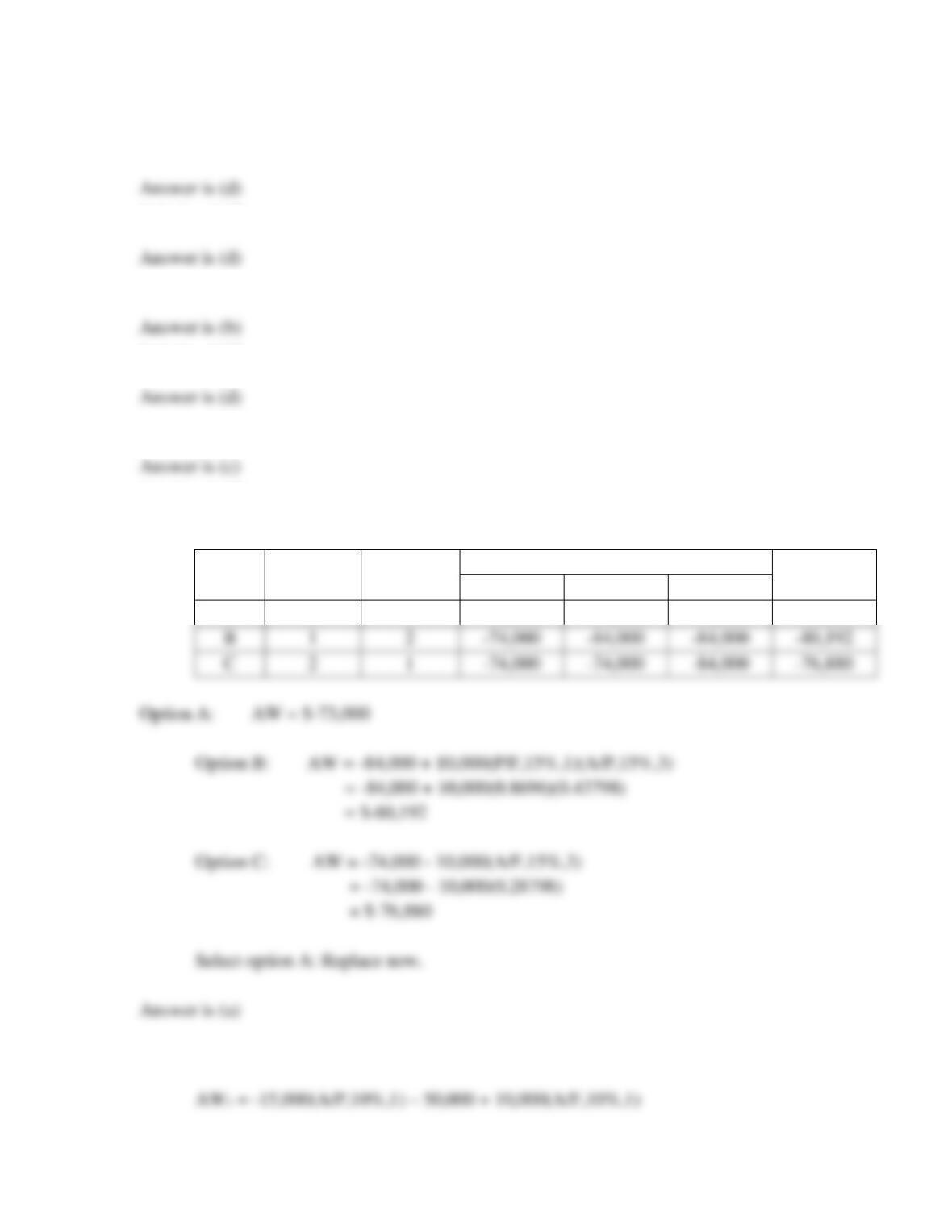
Solution 9.30
Must find AW of keeping machine for 2 years and then replacing it with challenger for 1
year
Solution 9.31
Solution 9.32
Solution 9.33
Solution 9.34
Solution 9.35
Solution 9.36
Solution 9.37
Option
Years for
Defender
Years for
Challenger
AW, cash flows, $ per year
Option
AW, $/year
Year 1
Year 2
Year 3
A
0
3
-73,000
-73,000
-73,000
-73,000
Solution 9.38
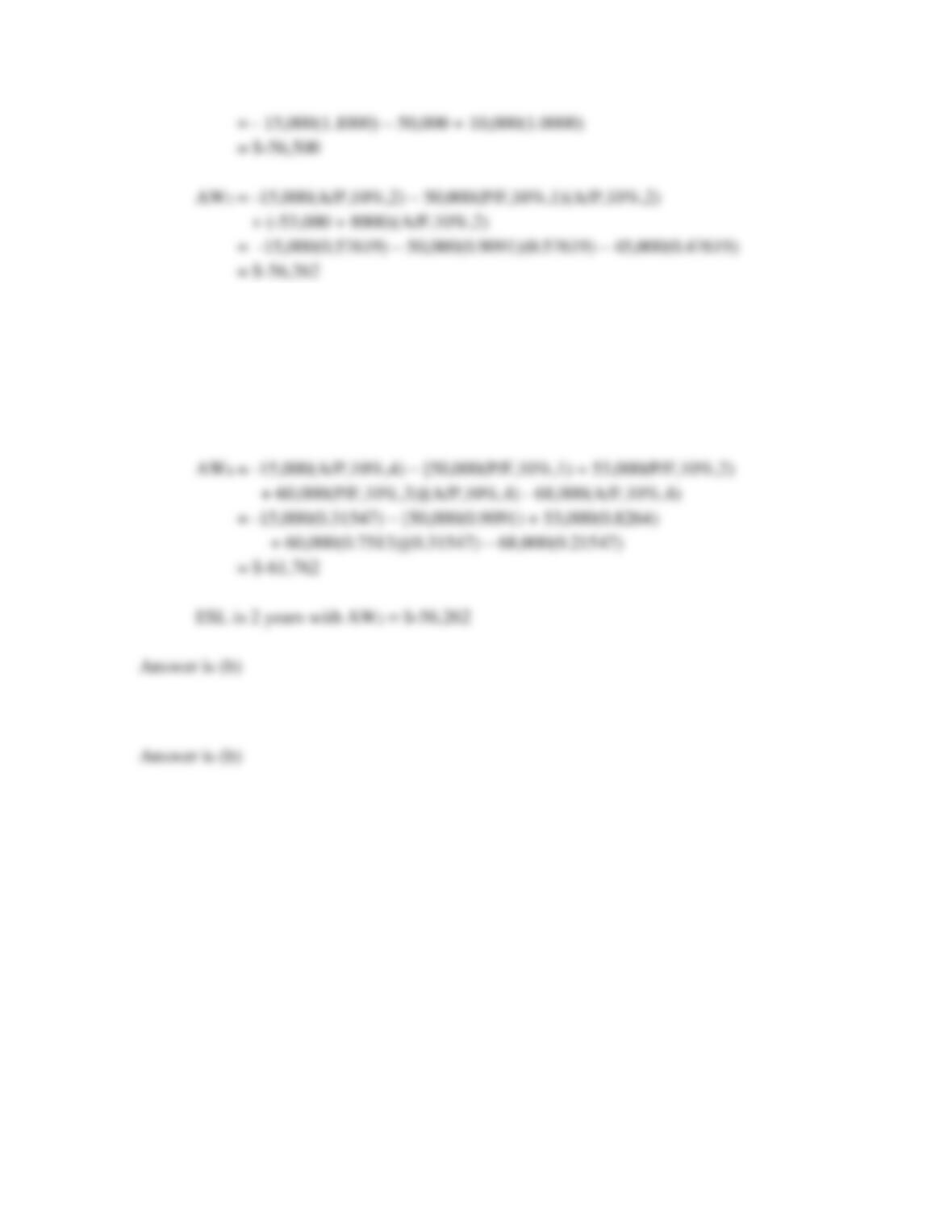
AW3 = -15,000(A/P,10%,3) – 50,000(P/F,10%,1)(A/P,10%,3)
-53,000(P/F,10%,2)(A/P,10%,3) + (-60,000 + 5000)(A/F,10%,3)
= -15,000(0.40211) – 50,000(0.9091)(0.40211) – 53,000(0.8264)(0.40211)
– 55,000(0.30211)
= $-58,538
Solution 9.39