Problem 8.1
The fixed costs at Harley Motors are $1 million annually. The main product has revenue
of $9.90 per unit and $4.50 variable cost. Determine the following:
a. Breakeven quantity per year
b. Annual profit if 150,000 units are sold
c. Annual profit if 480,000 units are sold
Problem 8.2
A professional photographer who specializes in wedding-related activities paid $16,000
for equipment that has a $2000 estimated salvage value after five years. He estimates that
his costs associated with each event amount to $65 per day. If he charges $300 per day
for his services, how many days per year must he be employed in order to break even at
an interest rate of 8% per year?
Problem 8.3
An independent over-the-road (OTR) truck driver-owner paid $98,000 for a used tractor-
trailer. The salvage value of the rig after five more years of use is expected to be $66,000.
The operating cost is $0.60 per mile and the base mileage rate(revenue) is $0.71 per mile.
(a) How many miles per year must the owner drive just to break even at an interest rate of
10% per year?
(b) If the owner drives 550 miles per day, how many days per year will be required for
breakeven?
Problem 8.4
A small consulting engineering company bought an office building for $900,000. The
company has ten engineers and eight support staff. Monthly expenses for salaries,
utilities, grounds maintenance, etc. are $1.1 million. If the average billing rate per
engineer is $90 per hour, how many hours per month must be billed in order for the
company to make a profit of $15,000 per month? Use an interest rate of 1% per month
and assume the building will have a market value of $1.5 million after 10 years.
Problem 8.5
How long will it take to recover an investment of $245,000 in enhanced CNC controls
that include axis control to 8 axes (on the milling model) if the associated income is
$92,000 per year, expenses are 38,000 per year, and the salvage value is assumed to be
15% of the first cost. Use a MARR of 15% per year.
Problem 8.6
A call center in India used by U.S. and U.K. credit card holders has a capacity of
1,500,000 calls annually. The fixed cost of the center is $850,000 with an average
variable cost of $1.95 and revenue of $3.25 per call. Find the percentage of the capacity
that must be placed each year to break even.
Problem 8.7
Benjamin used regression analysis to fit quadratic relations to monthly revenue and cost
data with the following results:
R = -0.007Q2 + 32Q
TC = 0.004Q2 + 2.2Q + 8
(a) Plot R and TC. Estimate the quantity Q at which the maximum profit should occur.
Estimate the profit at this quantity.
(b) The profit relation Profit = R – TC and calculus can be used to determine the quantity
Qp at which the maximum profit will occur, and the amount of this profit. The equations
are:
Profit = aQ2 + bQ + c
Qp = -b/2a
Maximum profit = -b2/4a + c
Use these relations to confirm the graphical estimates you made in (a). (Your
instructor may ask you to derive the relations above.)
Problem 8.8
Brittany is cooping this semester at Regency Aircraft, which customizes the interiors of
private and corporate jets. Her first assignment is to develop the specifications for a new
machine to cut, shape, and sew leather or vinyl covers and trims. The first cost is not
easy to estimate due to many options, but the annual revenue and M&O costs should net
out at $15,000 per year over a 10-year life. Salvage is expected to be 20% of the first
cost. Determine what can be paid for the machine now and recover the cost and an
MARR of 8% per year under two scenarios:
I: No outside revenue will be developed.
II: Outside contracting will occur with estimated revenue of $10,000 the first year,
increasing by $5000 per year thereafter.
Solve using (a) tabulated factors, and (b) a spreadsheet and the GOAL SEEK tool.
Problem 8.9
The National Potato Cooperative purchased a deskinning machine last year for $150,000.
Revenue for the first year was $50,000. Over the total estimated life of 8 years, what
must the annual revenue for years 2 through 8 equal to recover the investment, if costs
are constant at $42,000 and a return of 10% per year is expected? A salvage value of
$20,000 is anticipated.
Problem 8.10
ABB purchased fieldbus communication equipment for a project in South Africa for
$3.15 million. If net cash flow is estimated at $500,000 per year, and a salvage value of
$400,000 is anticipated, determine how many years the equipment must be used to just
break even at interest rates ranging from 8% to 15% per year. Solve using (a) tabulated
factors, and (b) a spreadsheet.
Problem 8.11
A semiautomatic process has fixed costs of $40,000 per year and variable costs of
$30 per unit. An automatic process has fixed costs of $88,000 per year and variable costs
of $22 per unit. At what production level per year will the two alternatives break even?
Problem 8.12
Rent-A-Wreck car rental agency has a contract with PM Warranty, Inc to do major
repairs for $700 per car. The car rental agency estimates that it could repair its own cars
for $300 each if it acquires a facility for $300,000 now. A salvage value of $40,000 after
15 years is estimated for the facility. What is the minimum number of cars that must be
repaired each year to make the acquisition attractive at an interest rate of 10% per year?
Problem 8.13
A rural 2-lane road can be surfaced with concrete for $2.3 million per mile. If signing,
mowing and winter maintenance are not included, the basic maintenance costs for
concrete and asphalt roadways are $483 and $774 per mile per year, respectively. If
concrete lasts 20 years, what is the maximum amount that should be spent on asphalt that
will last only 10 years? Use an interest rate of 8% per year.
Problem 8.14
A land development company is considering the purchase of earth moving equipment.
The equipment will have a first cost of $190,000 and a salvage value of $70,000 when
the company sells it in 10 years. A service contract for maintenance on the equipment
will cost $40,000 per year. The operating cost is expected to be $260 per day.
Alternatively, the company can rent the necessary equipment for $1100 per day and hire
a driver at $180 per day. If the company’s MARR is 10% per year, how many days per
year must the company need the equipment in order to justify its purchase?
Problem 8.15
The Ascarate Fishing Club, a non-profit organization dedicated to teaching kids how to
fish, is considering two options for providing a heavily stocked pond for kids who have
never caught a fish before. Option 1 is an above- ground swimming pool made of heavy
vinyl plastic that will be assembled and disassembled for each quarterly event. The
purchase price will be $400. Leaks from hooks piercing the fabric will be repaired with a
vinyl repair kit at a cost of $70 per year, but the pool will have to be replaced when too
many repairs have been made. Option 2 is an in-ground pond that will be excavated by
club members at no cost and lined with fabric that costs $1 per square foot. The pond
will be 15 feet in diameter and 3 feet deep. Assume 300 ft2 of liner will be purchased. A
chain link fence at $10 per lineal foot will be installed around the pond (100 ft of fence).
Maintenance inside the fence is expected to cost $20 per year. The park where the pond
will be constructed has committed the land for only 10 years. At an interest rate of 6%
per year, how many years will the above-ground pool have to last for the two options to
just break even?
Problem 8.16
Microsurfacing is part of a pavement restoration and maintenance program that seals the
surface of a street that has minor cracking to prevent water from penetrating into the base
material. The annual cost of the equipment (truck, tank, valves, etc.) is $109,000 per year
and the material cost is $2.75 per square yard. Alternatively, regular street resurfacing
requires equipment that has a first cost of $225,000 with a 15-year life and no salvage
value. The variable cost for regular resurfacing is $13 per square yard. At an interest rate
of 8% per year, how many square yards per year must be resurfaced for the two methods
to break even?
Problem 8.17
Two membrane systems are under consideration for treating cooling tower blowdown to
reduce its volume. A low pressure seawater reverse osmosis (SWRO) system will
operate at 500 psi and produce 720,000 gallons of permeate per day. It will have a fixed
cost of $465 per day and an operating cost of $485 per day. A higher pressure SWRO
system operating at 800 psi will produce 950,000 gallons per day at an operating cost of
$1280 per day. The fixed cost of the high pressure SWRO system will be only $328 per
day because fewer membranes will be required. How many gallons of blowdown water
must require treatment each day for the two systems to break even?
Problem 8.18
Three methods can be used for producing heat sensors for high-temperature furnaces.
Method A will have a fixed cost of $140,000 per year and a production cost of $62 per
part. Method B will have a fixed cost of $210,000 per year and a production cost of $28
per part. Method C will require the purchase of equipment costing $500,000 that will
have a life of five years with a 25% salvage value. The production cost will be $53 per
part. At an interest rate of 10% per year, determine the breakeven annual production rate
between the two lowest cost methods.
Problem 8.19
A Yellow Pages directory company must decide whether it should compose the ads for its
clients in-house or outsource them to a production company. To develop the ads in-
house, the company will have to purchase computers, printers, and other peripherals at a
cost of $12,000. The equipment will have a useful life of 3 years, after which it will be
sold for $2000. The employee who creates the ads will be paid $55,000 per year. In
addition, each ad will have an average cost of $5. Alternatively, the company can
outsource ad development at a flat fee of $21 per ad. At an interest rate of 10% per year,
how many ads must the company sell each year for the alternatives to break even?
Problem 8.20
A plant manager has received two estimates from contractors to improve traffic flow and
repave the parking areas. Proposal A includes new curbs, grading, and paving at an
initial cost of $250,000. The life of the parking lot surface constructed in this manner is
expected to be 4 years with an annual cost of $3000 for maintenance and repainting of
strips. According to proposal B, the pavement has a higher quality and an expected life of
12 years. The annual maintenance cost will be negligible for the paved parking area, but
the markings will have to be repainted every 2 years at a cost of $5000, except in the
final year 12 of ownership. If the company’s current MARR is 12% per year, how much
can it afford to spend on proposal B so the two estimates will break even?
Problem 8.21
Alfred Home Construction is considering the purchase of five dumpsters and the
transport truck to store and transfer construction debris from building sites. The entire rig
is estimated to have an initial cost of $125,000, a life of 8 years, a $5000 salvage value,
an operating cost of $40 per day, and an annual maintenance cost of $2000.
Alternatively, Alfred can obtain the same services from the city as needed at each
construction site for an initial delivery cost of $125 per dumpster per site and a daily
charge of $20 per day per dumpster. An estimated 45 construction sites will need debris
storage throughout the average year. If the minimum attractive rate of return is 12% per
year, how many days per year must the equipment be required to justify its purchase?
Problem 8.22
Process X is estimated to have a fixed cost of $40,000 per year and a variable cost of $60
per unit in year 1, decreasing by $5 per unit per year. Process Y will have a fixed cost of
$70,000 per year and a variable cost of $10 per unit, increasing by $1 per unit per year.
At an interest rate of 12% per year, how many units must be produced in year 3 for the
two processes to break even?
Problem 8.23
An effective method to recover water used for regeneration of ion exchange resins is to
use a reverse osmosis system in a batch-treatment mode. Such a system involves
recirculation of the partially-treated water back into the feed tank, causing the water to
heat up. The water could be cooled using a single-pass heat exchanger or a closed-loop
heat exchange system. The single-pass system would require a small chiller costing
$920, plus stainless steel tubing, connectors, valves, etc. costing $360, and it could be
used for 3 years. The cost of water, sewer charges, electricity, etc. will be $3.10 per hour.
The closed-loop system will cost $3850 to buy, have a useful life of 5 years, and will
cost $1.28 per hour of operation. The interest rate is 10% per year and the salvage values
are negligible (a) What is the breakeven number of hours per year that the cooling system
must be needed to justify purchase of the closed-loop system? (b) What is the difference
in annual costs if 400 hours per year is the expected usage level?
Problem 8.24
An engineering practitioner can lease a fully equipped computer and color printer system
for $800 per month or purchase one for $8500 now and pay a $75 per month maintenance
fee. If the nominal interest rate is 15% per year, determine the months of use necessary
for the two to break even using (a) tabulated factors, and (b) a single-cell spreadsheet
function.
Problem 8.25
The Ecology Group wishes to purchase a piece of equipment for various metals
recycling. Machine 1 costs $123,000, has a life of 10 years, an annual cost of $5000, and
requires one operator at a cost of $24 per hour. It can process 10 tons per hour. Machine
2 costs $70,000, has a life of 6 years, an annual cost of $2500, and requires two operators
at a cost of $24 per hour for each operator. It can process 6 tons per hour.
(a) Determine the breakeven tonnage of scrap metal at i = 7% per year and select the
better machine for a processing level of 1000 tons per year.
(b)Calculate and plot the sensitivity of the breakeven tons per year to ± 15% change in
the hourly cost of an operator.
Problem 8.26
Donny and Barbara want to join a sports and exercise club. The HiPro plan has no
upfront charge and the first month is free. It then charges a total of $100 at the end of
each subsequent month. Bally charges a membership fee of $100 per person now and $20
per person per month starting the first month. How many months will it take the two
plans to reach a breakeven point? Solve by hand or spreadsheet, as request by your
instructor.
Problem 8.27
Balboa Industries’ Electronics Division is trying to reduce supply chain risk by making
more responsible make/buy decisions through improved cost estimation. A high-use
component (expected usage is 5000 units per year) can be purchased for $25 per unit
with delivery promised within a week. Alternatively, Balboa can make the component
in-house and have it readily available at a cost of $5 per unit, if equipment costing
$150,000 is purchased. Labor and other operating costs are estimated to be $35,000 per
year over the study period of 5 years. Salvage is estimated at 10% of first cost and
i = 12% per year. Neglecting the element of availability (a) determine the breakeven
quantity, and (b) recommend making or buying at the expected usage level.
Problem 8.28
Claris Water Company makes and sells filters for public water drinking fountains. The
filter sells for $50 per unit. Recently a in-house/outsource analysis was completed based
on the need for new manufacturing equipment. The equipment first cost of $200,000 and
$25,000 annual operation cost comprise the fixed cost, while Claris’s variable cost is $20
per filter. The equipment has a 5-year life, no salvage value, and the MARR is 6% per
year. The decision to make the filter was based on the breakeven point and the historical
sales level of 5000 filters per year.
(a) Determine the breakeven point. Should the filters be made in-house?
(b) An engineer at Claris learned that an outsourcing firm offered to make the filters for
$30 each, but this offer was rejected by the president as entirely too expensive. Perform
the breakeven analysis of the two options and determine if the in-house decision was
correct.
(c) Develop and use the profit relations for both options to verify the preceding answers.
Note: Solve all three parts using a single spreadsheet if requested by your instructor.
Problem 8.29
Josaline, the owner of a construction company, is planning to purchase specialized
equipment to complete a contract awarded to her company. The first cost of the
equipment is $250,000 with a life of 3 years at which time she will not need the
equipment anymore. The operating cost is expected to be $75,000 per year.
Alternatively, a subcontractor can perform the work for $175,000 per year. Because the
equipment is specialized, Josaline is not sure about the salvage value. She estimates a
likely salvage of $90,000, but in might have to be scrapped for as little as $10,000 in
three years. The MARR is15% per year.

(a) Is her decision to buy the equipment sensitive to the salvage value?
(b) Determine the salvage value at which the two alternatives break even.
Problem 8.30
A company planning to borrow $10.5 million for a plant expansion is not sure what the
interest rate will be when it applies for the loan. The rate could be as low as 10% per
year or as high as 12% per year. The company will only move forward with the project if
the annual worth of the expansion is below $5.7 million. If the M&O cost is fixed at
$3.1 million per year and the salvage will be $2 million if the interest rate is 10% and
$2.5 million if it is 12%, is the decision to move forward with the project sensitive to the
interest rate? Use a 5-year study period.
Problem 8.31
A company that manufactures clear PVC pipe is investigating two production options
with the following cash flow estimates.
Batch Continuous
First cost, $ -80,000 -130,000
Annual cost, $/year -55,000 -30,000
Salvage value, $ 10,000 40,000
Life, years 3 to 10 5
The chief operating officer (COO) has asked you to determine if the batch option would
ever have a lower annual worth than the continuous flow system using interest rates over
a range of 5% to 15% for the batch option, but only 15% for the continuous flow system.
The batch process can be used anywhere from 3 to 10 years. (Note: The continuous flow
process was previously determined to have its lowest cost over a 5-year life cycle.)
Problem 8.32
Home Automation is considering an investment of $500,000 in a new product line. The
company will make the investment only if it will result in a rate of return of 15% per
year or higher. If the revenue is expected to be between $138,000 and $165,000 per year
for 5 years, use a present worth analysis to determine if the decision to invest is sensitive
to the projected range of revenue.
Problem 8.33
Amphenol manufactures motor power connectors and is considering upgrading the
production equipment to reduce costs over a 6-year planning horizon. The company can
invest $80,000 now (year 0), 1 year from now, or 2 years from now. Depending on when
the investment is made, the savings will vary. The savings estimates are $25,000,
$26,000, and $29,000 per year for investing now, year 1, and year 2, respectively. If the

company’s MARR is 20% per year, use an FW analysis to determine if the timing of the
investment will return at least 20% per year.
Problem 8.34
The equivalent annual worth of the process currently used in manufacturing motion
controllers is AW = $-62,000 per year. A replacement process is under consideration that
will have a first cost of $64,000 and an operating cost of $38,000 per year for the next
3 years. Three different engineers have given their opinion about what the salvage value
of the new process will be 3 years from now as follows: $10,000, $13,000, and $18,000.
Is the decision to replace the process sensitive to the salvage value estimates at the
company’s MARR of 15% per year?
Problem 8.35
Emerson Electric is considering the purchase of equipment that will allow the company
to manufacture a new line of wireless devices for home appliance control. The first cost
will be $80,000, and the life is estimated at 6 years with a salvage value of $10,000.
Three different salespeople have provided estimates regarding the added revenue the
equipment will generate. Salespersons 1, 2 and 3 have made estimates of $10,000,
$16,000, and $18,000 per year, respectively. If the company’s MARR is 8% per year, use
a PW-based relation to determine if these different estimates will change the decision to
purchase the equipment.
Problem 8.36
MAG Industrial needs 1000 square meters of storage space. Purchasing land for $80,000
and then erecting a temporary metal building at $70 per square meter is one option. The
president hopes to sell the land for $100,000 and the building for $20,000 after 3 years.
Another option is to lease space for $30 per square meter per year payable at the
beginning of each year. The MARR is 20%. Perform a present worth analysis of the
building and leasing alternatives to determine the sensitivity of the decision if the
construction cost decreases by 10% to $63 per square meter and the lease cost remains at
$30 per square meter per year.
Problem 8.37
Consider the two air conditioning systems detailed below.
___________________ System 1 System 2
First cost, $ -10,000 -17,000
Annual operating cost, $ -600 -150
Salvage (disposal) value, $ -100 -300
New compressor and motor
cost at midlife, $ -1,750 -3,000
Life, years 8 12

Use AW analysis to determine the sensitivity of the economic decision to MARR
values of 4%, 6%, and 8%. Work this problem (a) by hand and (b) by spreadsheet.
Problem 8.38
Ned Thompson Labs performs tests on superalloys, titanium, aluminum, and most
metals. Tests on metal composites that rely upon scanning electron microscope results
can be subcontracted or the labs can purchase new equipment. Evaluate the sensitivity of
the economic decision to purchase the equipment over a range of ±20% (in 10%
increments) of the estimates for P, AOC, R, n, and MARR (range on MARR is 12% to
18%). Use the AW method and plot the results on a sensitivity graph. For which
parameter(s) is the AW most sensitive? least sensitive?
First cost, P = $-180,000
Salvage, S = $20,000
Life, n = 10 year
Annual operating cost, AOC = $-30,000 per year
Annual revenue, R = $70,000 per year
MARR = 15% per year
Problem 8.39
Determine if the selection of system 1 or 2 is sensitive to variation in the return required
by management. The corporate MARR ranges from 8% to 16% per year on different
projects. Use tabulated factors or a spreadsheet, as requested by your instructor.
____________ System 1 System 2
First cost, $ -50,000 -100,000
AOC, $ per year -6,000 -1,500
Salvage value, $ 30,000 0
Rework at midlife, $ -17,000 -30,000
Life, years 4 12
Problem 8.40
Titan manufactures and sells gas-powered electricity generators. It can purchase a new
line of fuel injectors from either of two companies. Cost and savings estimates are
available, but the savings estimates are unreliable at this time. Use an AW analysis at
MARR = 10% per year to determine if the selection between company A and B changes
when the estimated savings varies as much as ±40% from the best estimates. Use
tabulated factors or a spreadsheet, as requested by your instructor.

______________________________Company A Company B
First cost, $ -50,000 -37,500
AOC, $ per year -7,500 -8,000
Savings best estimate, $ per year 15,000 13,000
Salvage, $ 5,000 3,700
Life, years 5 5
Problem 8.41
A Civil Engineer involved in construction management must decide between two ways
to pump concrete up to the top floors of a seven-story office building under construction.
Plan 1 requires the purchase of equipment for $6000 which costs between $0.40 and
$0.75 per metric ton to operate, with a most likely cost of $0.50 per metric ton. The asset
is able to pump 100 metric tons per day. If purchased, the asset will last for 5 years, have
no salvage value, and be used 50 days per year. Plan 2 is an equipment-leasing option and
is expected to cost the company $2500 per year for equipment with a low cost estimate
of $1800 and a high estimate of $3200 per year. In addition, an extra $5 per hour labor
cost will be incurred for operating the leased equipment each 8-hour day. Use I = 12%
per year. (a) Which plan should the engineer recommend on the basis of the most likely
estimates of costs?(b) Will the decision above change if the pessimistic estimates are
used?
Problem 8.42
When the country’s economy is expanding, AB Investment Company is optimistic and
expects a MARR of 15% for new investments. However, in a receding economy the
expected return is 8%. Normally a 10% return is required. An expanding economy
causes the estimates of asset life to go down about 50%, and a receding economy makes
the n values increase about 20%. Which plan should be selected if the company president
expects the economy to be (a) expanding, and (b) receding.
Plan M Plan Q
Initial investment, $ -200,000 -240,000
Net cash flow, $/year 65,000 71,000
Life, years 10 10
Problem 8.43
In evaluating two environmental chambers at Holly Farms, the AW of the 409G model is
determined to be $-135,143 with a high degree of certainty. The cost estimates for the

D103 model are less certain. The manager requested a ‘worst case’ analysis with three
estimates for P and n as shown below. The annual operating cost is fixed at $4000 and the
salvage value of the chamber is expected to be 10% of the first cost. Perform the analysis
using (a) tabulated factors, and (b) a spreadsheet to determine if D103 is favored under
any of the first cost and life scenarios indicated? The company’s MARR is 10% per year.
__________________Pessimistic Most Likely Optimistic
First cost, $ -500,000 -400,000 -300,000
Life, years 1 3 5
Problem 8.44
State why payback analysis is best used as a supplemental analysis tool when an
economic study is performed.
Problem 8.45
The process for producing a fruit-tree pesticide has a first cost of $200,000 with annual
costs of $50,000 and revenue of $90,000 per year. What is the payback period at
(a) i = 0%, and (b) i = 12% per year?
Problem 8.46
Two machines can be used to produce an aircraft part from titanium. The costs and other
cash flows associated with each alternative are shown. The salvage values are zero
regardless of when the machines are replaced. Use the estimates to preliminarily
determine which alternative(s) should be selected for further analysis provided they must
pay back in 5 years or less. Perform the analysis with (a) i = 0% and (b) i = 10% per year.
Machine 1 Machine 2
First cost, $ -40,000 -90,000
Net cash flow, $ per year 10,000 15,000
Maximum life, years 10 10
Salvage value, $ 0 0
Problem 8.47
Laura’s grandparents helped her purchase a small self-serve laundry business to make
extra money during her five college years. When she completed her electrical
engineering degree, she sold the business and her grandparents told her to keep the
money as a graduation present. For the net cash flows (NCF) listed, determine:

(a) if the total income exceeded the total amount invested in 5 years (i = 0%).
(b) the actual rate of return over the 5-year period.
(c) how long it took to pay back the $75,000 investment plus a 7% per year return.
(d) answers to all three questions above using a spreadsheet.
Year 0 1 2 3 4 5
NCF, $1000 per year -75 -10.5 18.6 -2 28 105
Problem 8.48
A company that manufactures diaphragm seals has identified the cash flows shown
below with a certain part of the manufacturing and sales functions. Determine the no-
return payback period.
First cost of equipment, $ -130,000
Annual expenses, $/year -45,000
Annual revenue, $/year 75,000
Problem 8.49
In desalting ground waters that contain a significant amount of sulfates, the concentrate
that is generated during the desalting process can sometimes be treated with lime to
recover gypsum and other salts. Because the high pH process is tough on equipment, the
equipment’s useful life is uncertain. A treatment train with an initial cost of $90,000 has
an operating cost of $20,000 per month. The revenue from the sale of calcium sulfate is
$22,000 per month. Determine how many months the equipment must last to recover the
investment at i = 0.5% per month using (a) hand solution, (b) a calculator, and (c) a
single-cell spreadsheet function.
Problem 8.50
Ellis Equipment sold a used Massey Ferguson tractor for $55,000 to a South- Kansas
farmer 10 years ago. (a) What is the uniform net cash flow that the farmer had to receive
each year to realize payback and a return of 5% per year on his investment over a period
of 3 years? 5 years? 8 years? All 10 years? (b) If the net cash flow was actually $6000
per year, what is the amount the farmer should have paid for the tractor to realize
payback plus the 5% per year return over these 10 years?
Problem 8.51
CMS Express has historically owned and maintained its own delivery trucks. Leasing is
an option being seriously considered because costs for maintenance, fuel, insurance, and
some liability issues will be transferred to United Leasing, the truck leasing company.
The study period is no more than 24 months for either alternative. The annual lease cost
is paid at the beginning of each year and is not refundable for partially used years.
Purchase: P = $30,000 now; monthly cost = $1200; monthly revenue = $4500
Lease: P = $10,000 at the beginning of each year (months 0 and 12);
monthly cost = $2800; monthly revenue = $4500
(a) Use the first cost and net cash flow estimates to determine the payback in months with
a nominal 9% per year return for the purchase and lease options.
(b) Spreadsheet question: Write the single-cell NPER function, including the optional
‘type’ entry, that will display payback for the lease option, where lease costs are paid at
the beginning of the year. Explain how you developed the function.
Problem 8.52
Fidelity Life Insurance has a document imaging system that needs replacement. A local
salesperson quoted a cost of $10,000 with an estimated salvage of $900 after 5 or more
years. If the system is expected to save $1700 per year in clerical time, find the payback
time at 8% per year. As a practice, the office manager purchases equipment only when
the payback is less than 6 years. Otherwise, he prefers to lease. Should the imaging
system be purchased or leased?
Problem 8.53
Darrell, an engineer with TAGHeuer Watches, is considering two alternative processes to
waterproof the new line of scuba-wear watches. Estimates follow.
Process 1: P = $50,000; n = 5 years; NCF = $24,000 per year; no salvage value.
Process 2: P = $120,000; n = 10 years; NCF = $42,000 for year 1, decreasing by
$2500 per year thereafter; no salvage value.
Darrell first decided to use no-return payback to select the process, because his boss told
him most investments at TAGHeuer must pay back in 3 to 4 years. Determine which
process Darrell will select.
Problem 8.54
Darrell, an engineer with TAGHeuer Watches, is considering two alternative processes to
waterproof the new line of scuba-wear watches. Estimates follow.
Process 1: P = $50,000; n = 5 years; NCF = $24,000 per year; no salvage value.
Process 2: P = $120,000; n = 10 years; NCF = $42,000 for year 1, decreasing by
$2500 per year thereafter; no salvage value.
Next Darrell decided to use the AW method at the corporate MARR of 12% per year that
he used previously on another evaluation. Now what process will he select?
Problem 8.55
Darrell, an engineer with TAGHeuer Watches, is considering two alternative processes to
waterproof the new line of scuba-wear watches. Estimates follow.
Process 1: P = $50,000; n = 5 years; NCF = $24,000 per year; no salvage value.
Process 2: P = $120,000; n = 10 years; NCF = $42,000 for year 1, decreasing by
$2500 per year thereafter; no salvage value.
Finally, Darrell decided to calculate the rate of return for the cash flows of each process
over its respective life. (a) What process does this analysis indicate as better? (b) Explain
the fundamental assumptions and errors made when this approach is used. (Hint: Before
answering, review Sections 6.3 and 6.4 on ROR.)
Problem 8.56
Darrell, an engineer with TAGHeuer Watches, is considering two alternative processes to
waterproof the new line of scuba-wear watches. Estimates follow.
Process 1: P = $50,000; n = 5 years; NCF = $24,000 per year; no salvage value.
Process 2: P = $120,000; n = 10 years; NCF = $42,000 for year 1, decreasing by
$2500 per year thereafter; no salvage value.
Of the evaluations presented in problems 8.53 through 8.55 (see below), which is the
correct method upon which to base the final economic decision? Why is this method the
only correct one?
8.53 Darrell first decided to use no-return payback to select the process, because his boss
told him most investments at TAGHeuer must pay back in 3 to 4 years. Determine which
process Darrell will select.
8.54 Next Darrell decided to use the AW method at the corporate MARR of 12% per
year that he used previously on another evaluation. Now what process will he select?
8.55 Finally, Darrell decided to calculate the rate of return for the cash flows of each
process over its respective life. (a) What process does this analysis indicate as better?
(b) Explain the fundamental assumptions and errors made when this approach is used.
(Hint: Before answering, review Sections 6.3 and 6.4 on ROR.)
Problem 8.57
In linear breakeven analysis, if a company expects to operate at a point below the
breakeven point, the alternative to select is:
a. the one with the lower fixed cost.
b. the one with the higher fixed cost.
c. the one with the lower variable cost.
d. the one with the higher variable cost.
Problem 8.58
A process can be completed using either Alternative X or Y, where Y is an automated
version of X. X has fixed costs of $10,000 per year with a variable cost of $50 per unit. If
the process is automated, the fixed cost for Y will be $5,000 per year and its variable cost
will be only $30 per unit. The minimum number of units that must be produced each year
for alternative Y to be favored is closest to:
a. Alternative Y will be favored for any level of production
b. 125
c. 375
d. Alternative X will be favored for any level of production
Problem 8.59
A company is considering two alternatives for automating a certain process.
Alternative A will have fixed costs of $42,000/year and will require 2 laborers at $48/day
each. Together, these laborers can generate 100 units of product.
Alternative B will have fixed costs of $56,000/year, but with this alternative, the 3
laborers will generate 200 units of product. In determining the breakeven number of units
Q, the total cost per year for Alternative B is represented as:
a. [2(48)/100]Q
b. [3(48)/200]Q
c. [3(48)/200]Q + 56,000
d. [2(48)/100]Q + 42,000
Problem 8.60
The price of a car that you want is $70,000 today. Its price is expected to increase by
$3300 per year. You now have $35,000 in an investment which is earning 15% per year.
The number of years before you have enough to buy the car without borrowing any
money is closest to:
a. 3 years
b. 5 years
c. 7 years
d. 9 years
Problem 8.61
In conducting a sensitivity analysis, the only parameter that represents a measure of
worth is:
a. the future worth.
b. the breakeven point.
c. a cost index.
d. a sinking fund equation.
Problem 8.62
When conducting a sensitivity analysis using multiple estimates, the three estimates are
usually:
a. probabilistic, authentic, most likely
b. deterministic, most likely, optimistic
c. pessimistic, strategic, realistic
d. optimistic, pessimistic, most likely
Problem 8.63
A process for making a laboratory-grade sodium phosphate will have a first cost of
$320,000 with annual costs of $40,000 and revenue of $98,000 per year. At a return
requirement of 20% per year, the payback period is closest to:
a. 3 years
b. 5 years
c. 7 years
d. ∞; it will never pay off
Problem 8.64
When the variable cost is reduced for linear total cost and revenue lines, the breakeven
point decreases. This is an economic advantage because:
a. the revenue per unit will increase.
b. the two lines will now cross at zero.
c. the profit will increase for the same revenue per unit.
d. the total cost line becomes nonlinear.
Problem 8.65
The profit relation for the following estimates at a quantity that is 10% above
breakeven is:
Fixed cost = $500,000 per year
Cost per unit = $200
Revenue per unit = $250
a. Profit =200(11,000) – 250(11,000) – 500,000
b. Profit =250(11,000) – 500,000 – 200(11,000)
c. Profit =250(11,000) – 200(11,000) + 500,000
d. Profit =250(10,000) – 200(10,000) – 500,000
Problem 8.66
For these two AW relations, the breakeven point QBE in miles per year is closest to:
AW1 = -23,000(A/P,10%,10) + 4000(A/F,10%,10) – 5000 – 4QBE
AW2 = -8,000(A/P,10%,4) – 2000 – 6QBE
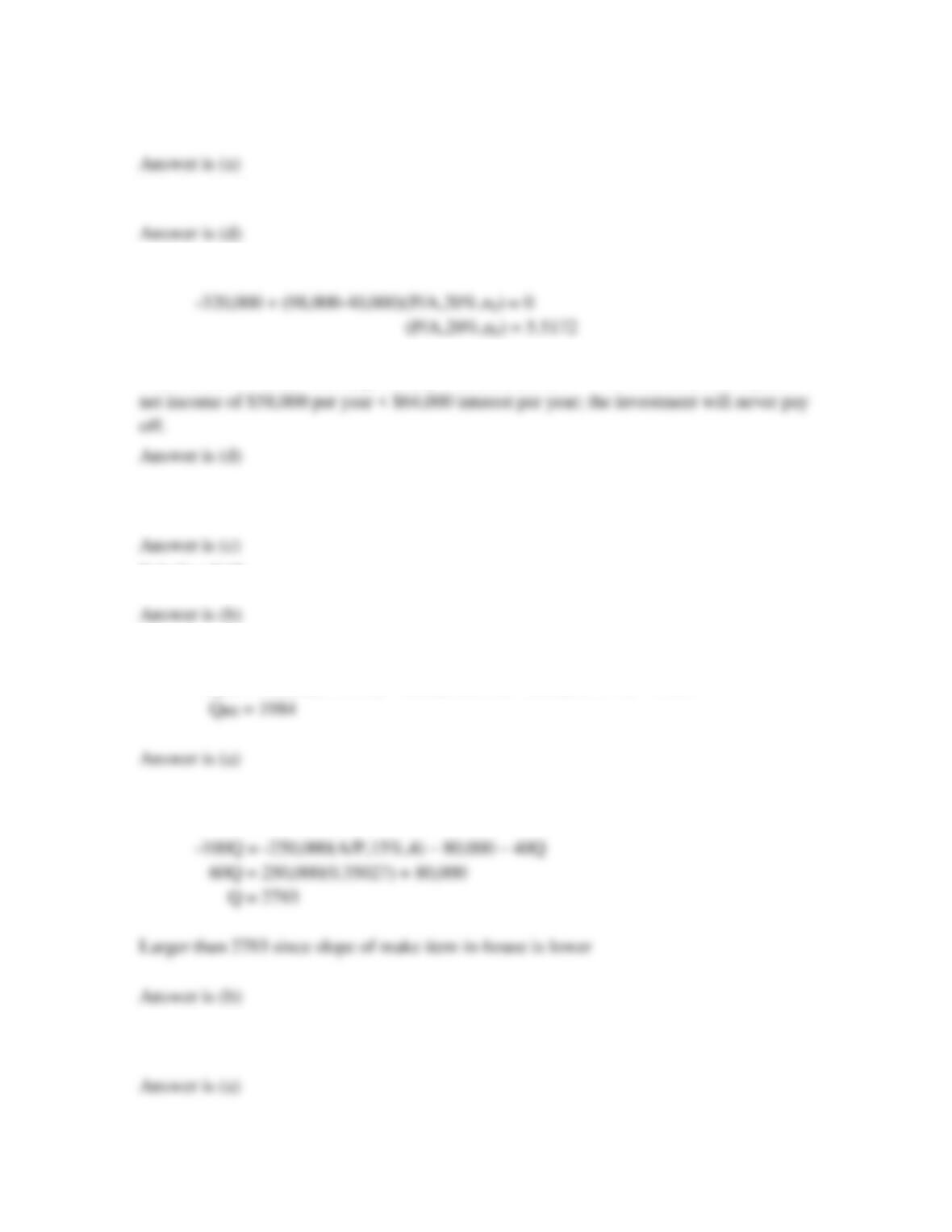
a. 1984
b. 1224
c. 1090
d. 655
Problem 8.67
To make an item in-house, equipment costing $250,000 must be purchased. It will have a
life of 4 years, an annual cost of $80,000, and each unit will cost $40 to manufacture.
Buying the item externally will cost $100 per unit. At i = 15% per year, it is cheaper to
make the item in-house if the number per year needed is:
a. above 1047 units
b. above 2793 units
c. equal to 2793 units

d. below 2793 units
Problem 8.68
The sensitivity of two parameters (P and n) for one project is evaluated by graphing the
AW values versus percentage variation from the most likely estimates. The curve for n
has a slope very close to zero, while the P curve has a significant negative slope. One
good conclusion from the graph is that:
a. both PW and AW values are more sensitive to variations in P than n.
b. the project should be rejected, since AW values vary with P and n.
c. a better estimate of P needs to be made.
d. the ROR is equally sensitive for both parameters.
Problem 8.69
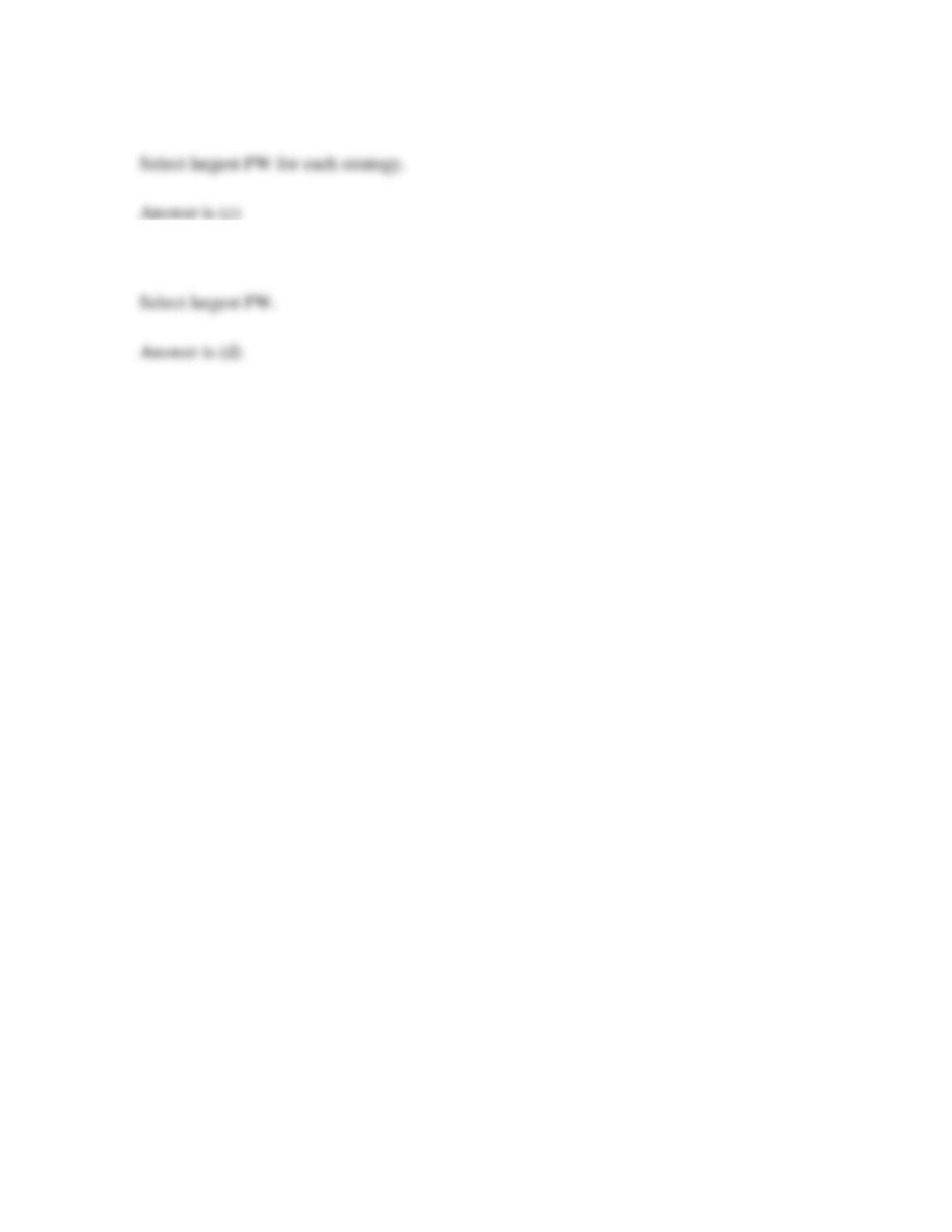
Four mutually exclusive alternatives are evaluated using three estimates or strategies
(pessimistic, most likely, and optimistic) for several parameters. The resulting PW values
over the LCM are determined as shown.
PW Values Over LCM, $ ___
Strategy 1 2 3 4__
Pessimistic (P) 4,500 -6,000 3,700 -1,900
Most likely (ML) 6,000 -500 5,000 -100
Optimistic (O) 9,500 2,000 10,000 3,500
The best alternative to select under the stated condition is:
a. pessimistic: select alternative 2
b. optimistic: select alternative 2
c. pessimistic: select alternative 1
d. optimistic: select alternative 4
Problem 8.70

Four mutually exclusive alternatives are evaluated using three estimates or strategies
(pessimistic, most likely, and optimistic) for several parameters. The resulting PW values
over the LCM are determined as shown.
PW Values Over LCM, $ ___
Strategy 1 2 3 4__
Pessimistic (P) 4,500 -6,000 3,700 -1,900
Most likely (ML) 6,000 -500 5,000 -100
Optimistic (O) 9,500 2,000 10,000 3,500
If no one of the strategies is more likely than any other strategy, the alternative to
select is:
a. 2
b. 1 and 2 are equally acceptable
c. 1
d. 3
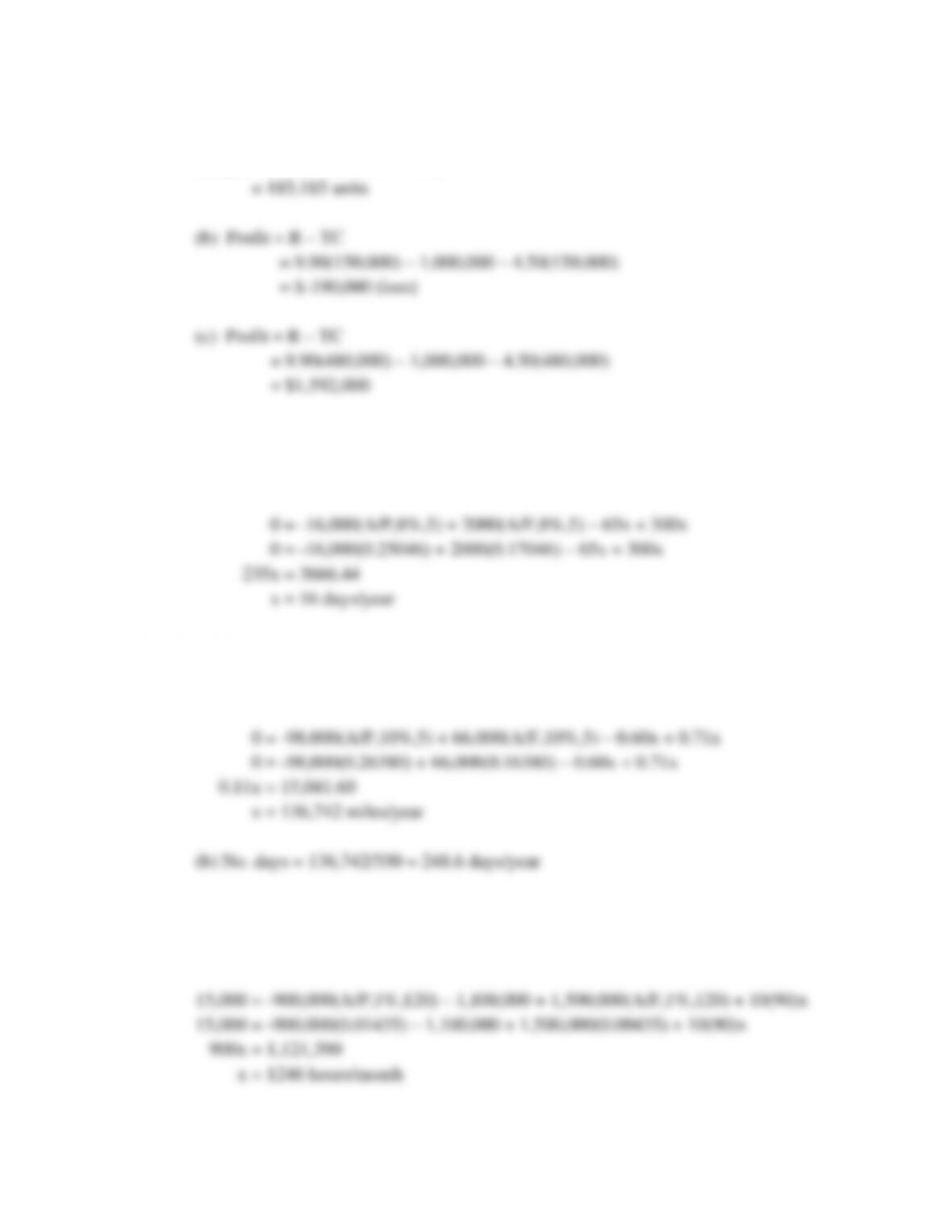
Solution 8.1
(a) QBE = 1,000,000/(9.90 – 4.50)
Solution 8.2
Let x = days per year to break even
Solution 8.3
(a) Let x = miles per year to break even
Solution 8.4
Let x = hours per month billed to realize a profit of $15,000
Solution 8.5
Solution 8.6
Solution 8.7
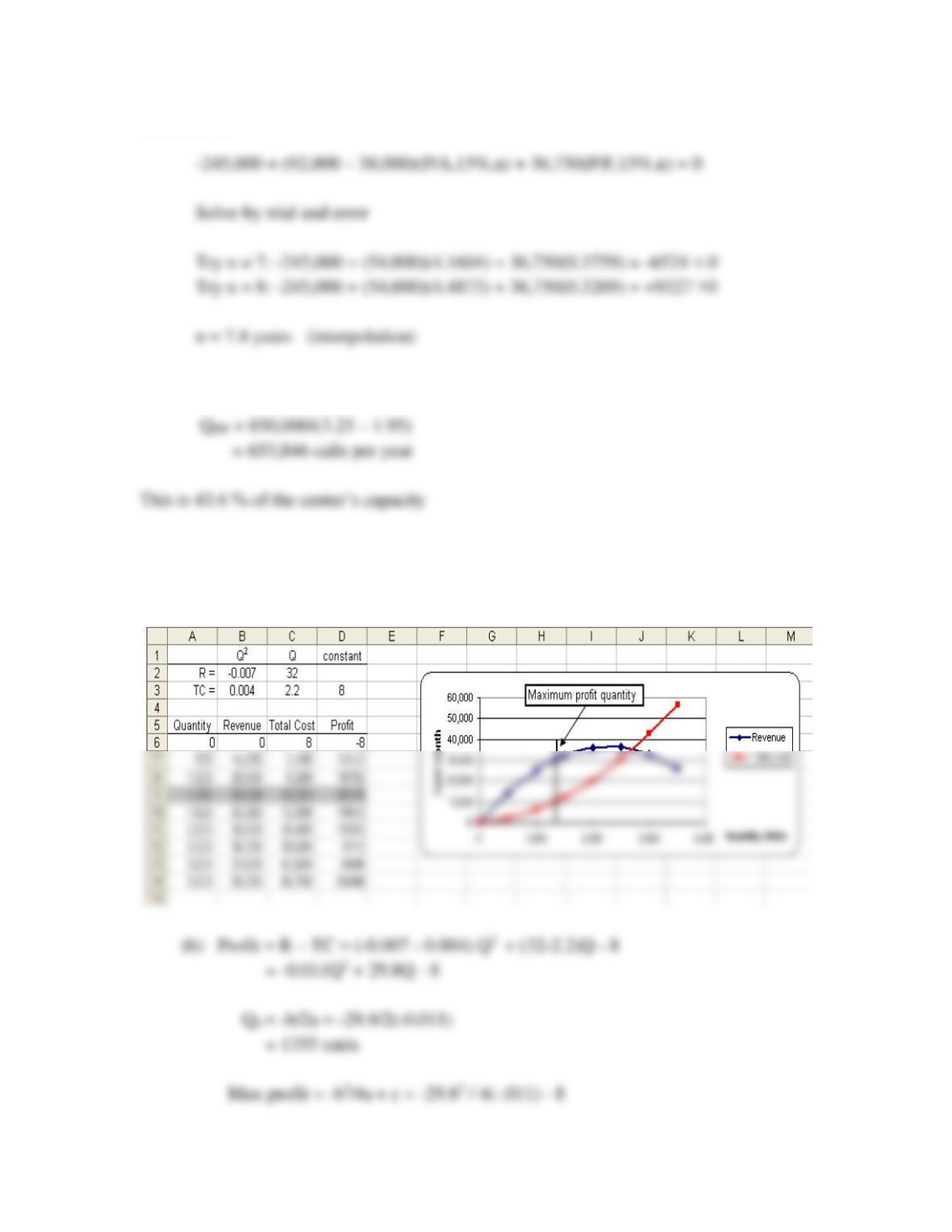
(a) Plot shows maximum quantity at about 1350 units. Profit is about $20,000.
Solution 8.8
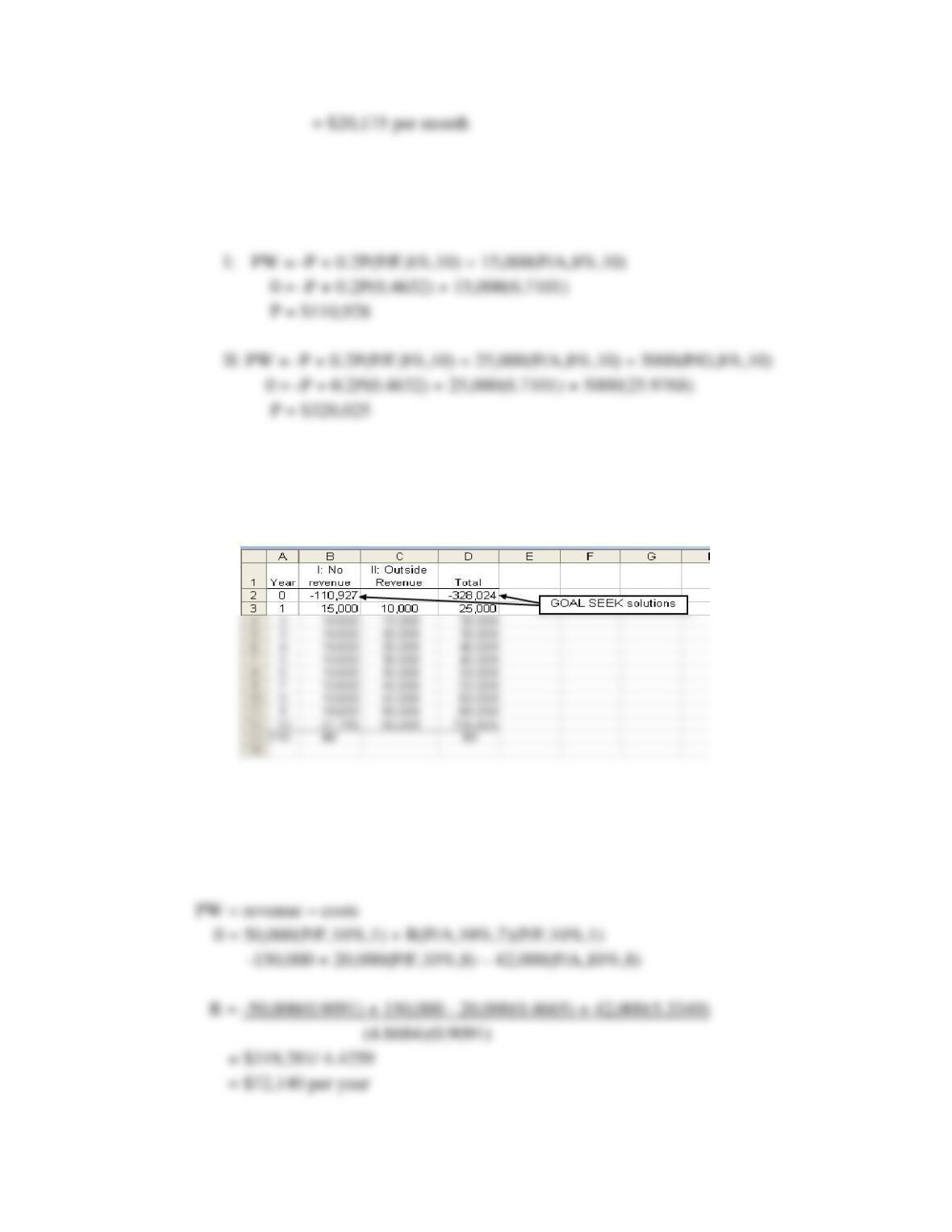
(a) Develop PW = 0 relation and solve for first cost P.
(b) Spreadsheet solution uses GOAL SEEK for each scenario to find P. Set PW
values (cells B13 and D13) to 0 and change values in cells B2 and D2.
Solution 8.9
Let R = revenue for years 2 through 8. Set up PW = 0 relation.
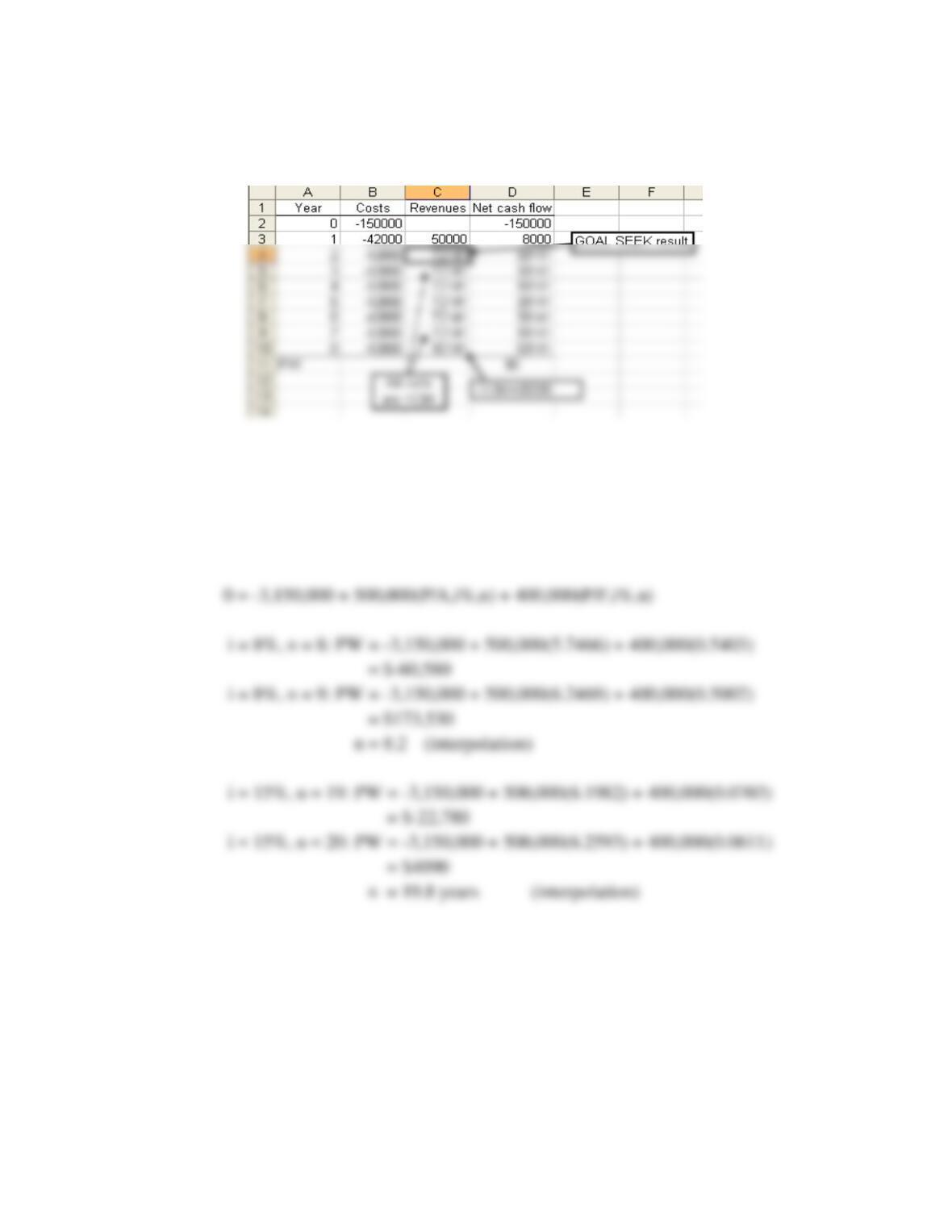
(Extra: Spreadsheet solution uses GOAL SEEK to find R = $72,141 with
remaining revenue cells set equal to this value.)
Solution 8.10
(a) Using the relation PW = 0, select different i values and solve for n. Details for
i = 8% and 15% are shown.
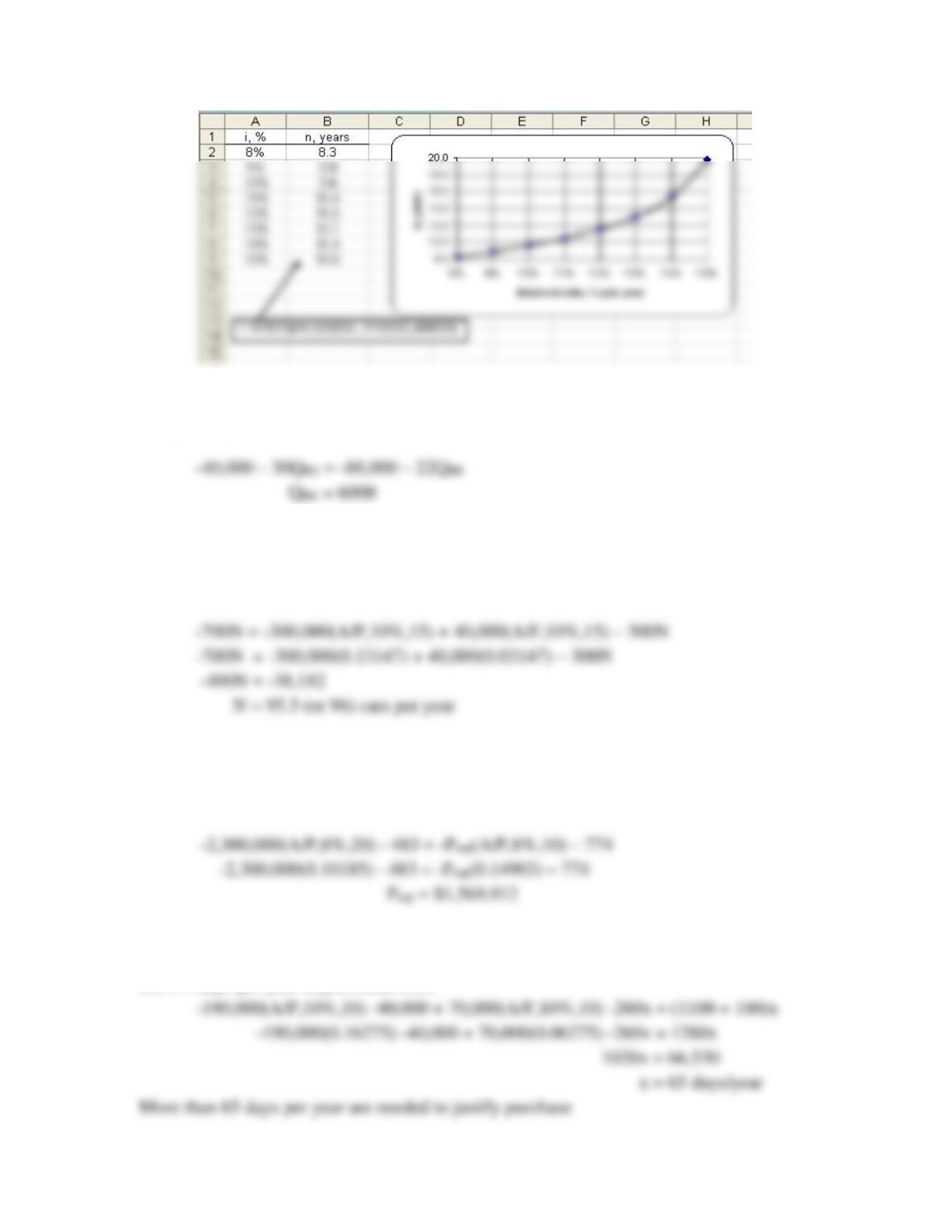
(b) Retention ranges from 8 to 20 years for varying i values. This is a perfect
example where the spreadsheet is easier. Use the NPER function.
Solution 8.11
Solution 8.12
Let N = number of cars per year
Solution 8.13
Let Pasp = maximum $/mile for asphalt
Solution 8.14
Let x = days per year to just break even
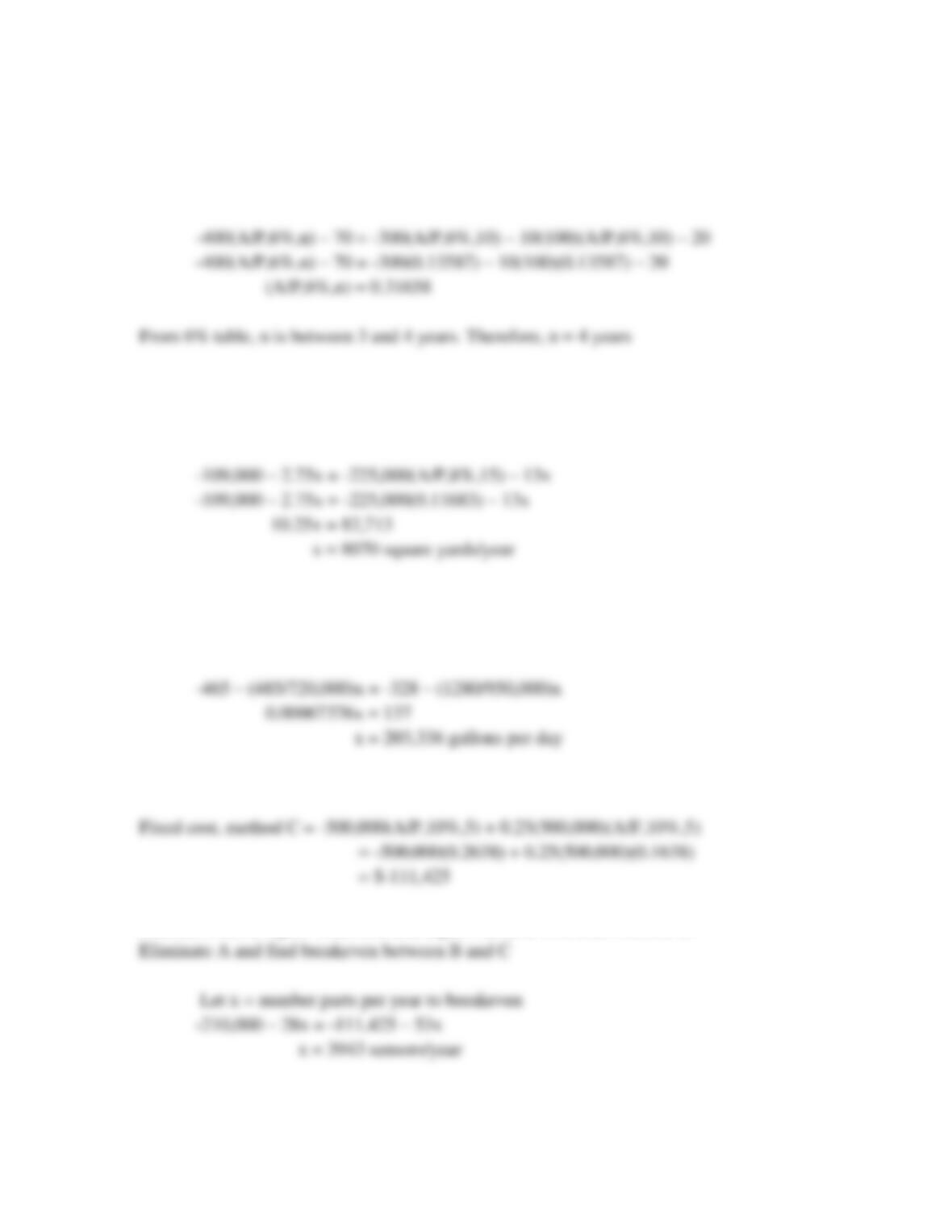
Solution 8.15
Let n = number of years for pool to last for breakeven
Solution 8.16
Let x = square yards per year to break even
Solution 8.17
Let x = gallons per day to breakeven
Solution 8.18
Method A has a higher fixed cost and higher variable cost than Method C.
Solution 8.19
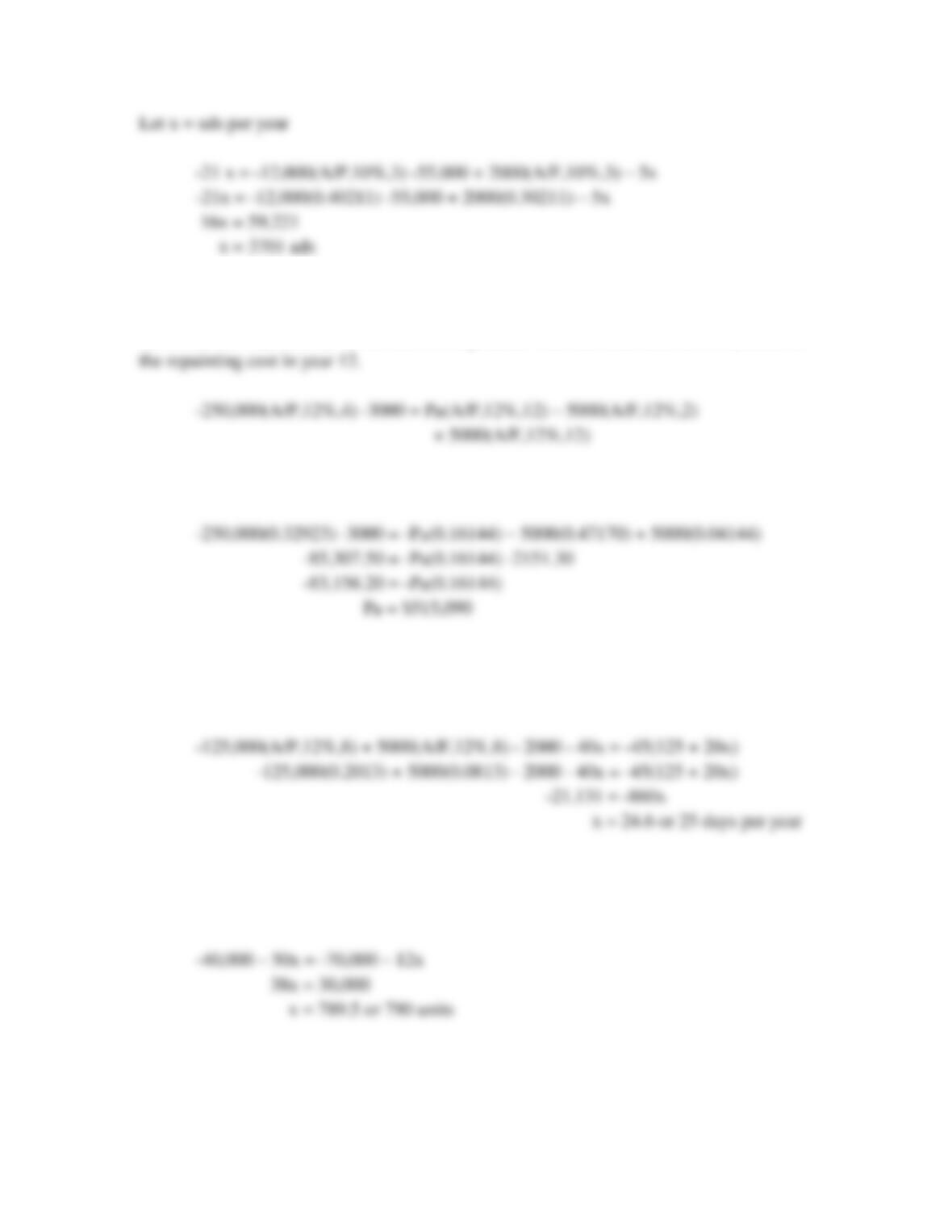
Solution 8.20
Set AWA = AWB, with PB = first cost of Proposal B. The The final term in AWB removes
Solution 8.21
Let x = breakeven days per year
Solution 8.22
Let x = production in year 3
Solution 8.23
(a) Let x = number of hours per year
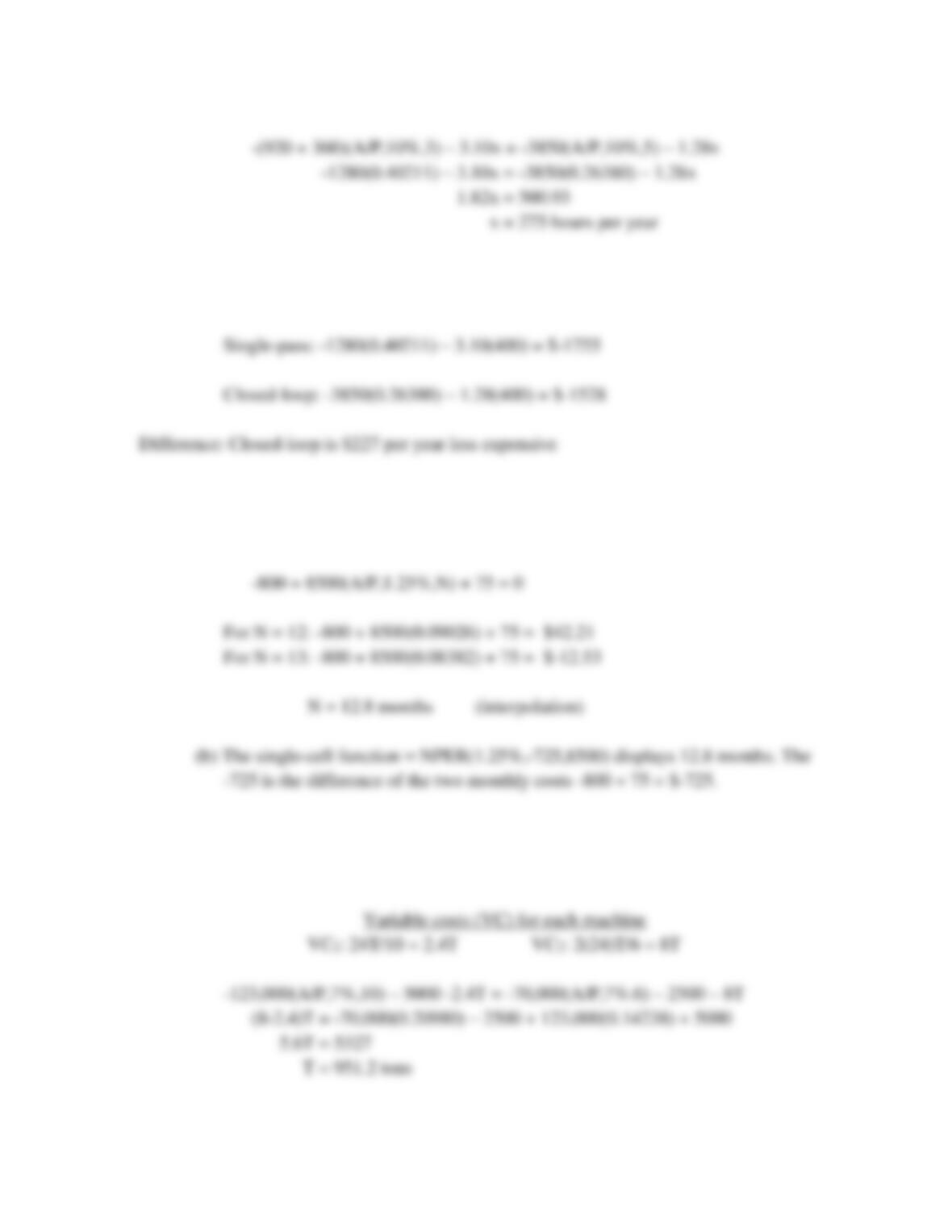
(b) At x = 400 hours per year, select the closed-loop system. Determine difference
in annual costs.
Solution 8.24
(a) Solve AWlease – AWbuy = 0 for N = number of months. Monthly i = 1.25%
Solution 8.25
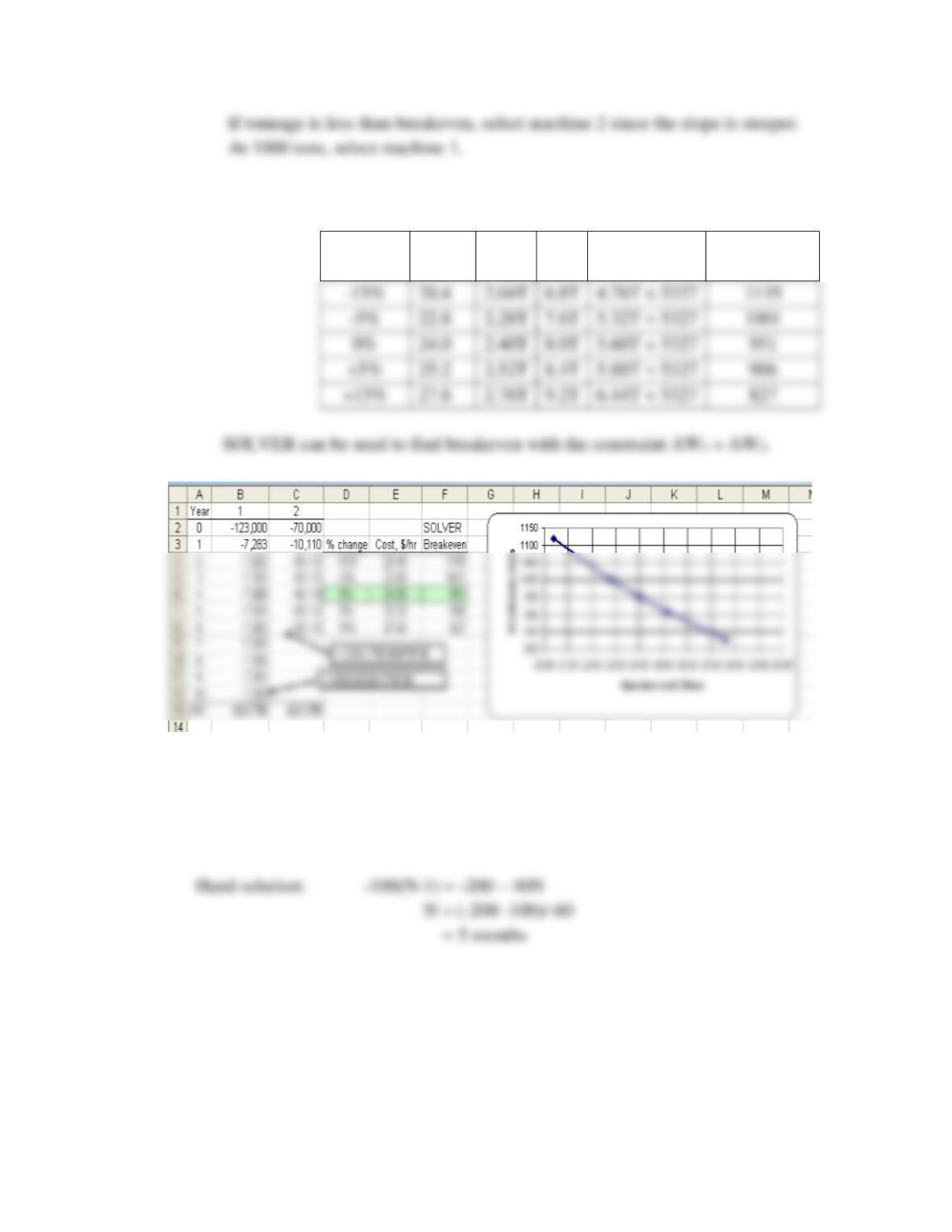
(a) Let T = number of tons. Solve relation AW1 = AW2 for T.
20.4
2.04T
6.8T
4.76T = 5327
27.6
2.76T
9.2T
6.44T = 5327
(b) Set up the VC relation for each machine and solve for T in AW1 = AW2 .
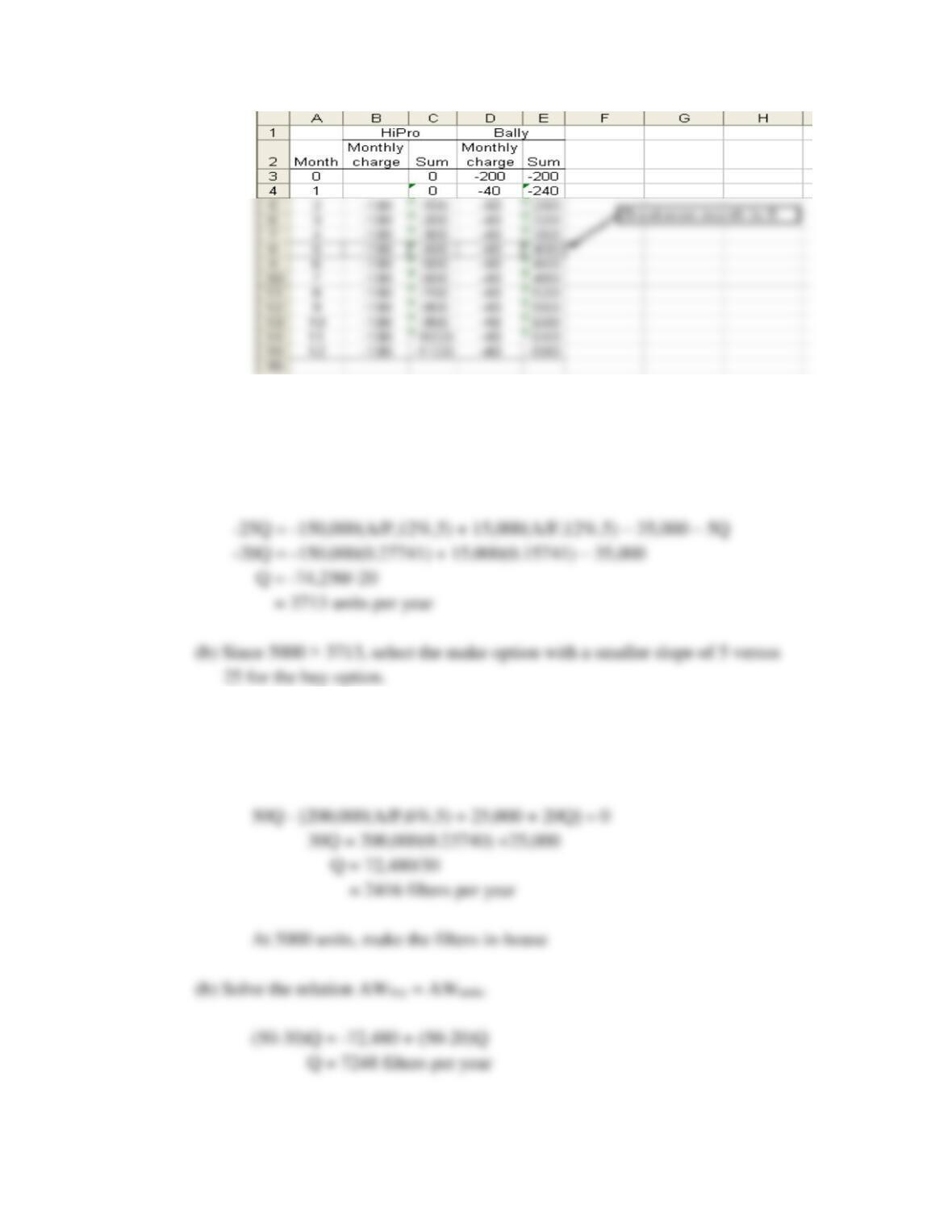
Solution 8.26
Let N = number of months
Spreadsheet solution:
% change
Cost,
$/hour
VC1
VC2
AW1 = AW2
relation
Breakeven
T value, tons
Solution 8.27
(a) Solve AWbuy = AWmake for Q = breakeven number of units per year.
Solution 8.28
(a) Solve relation Revenue – Cost = 0 for Q = number of filters per year
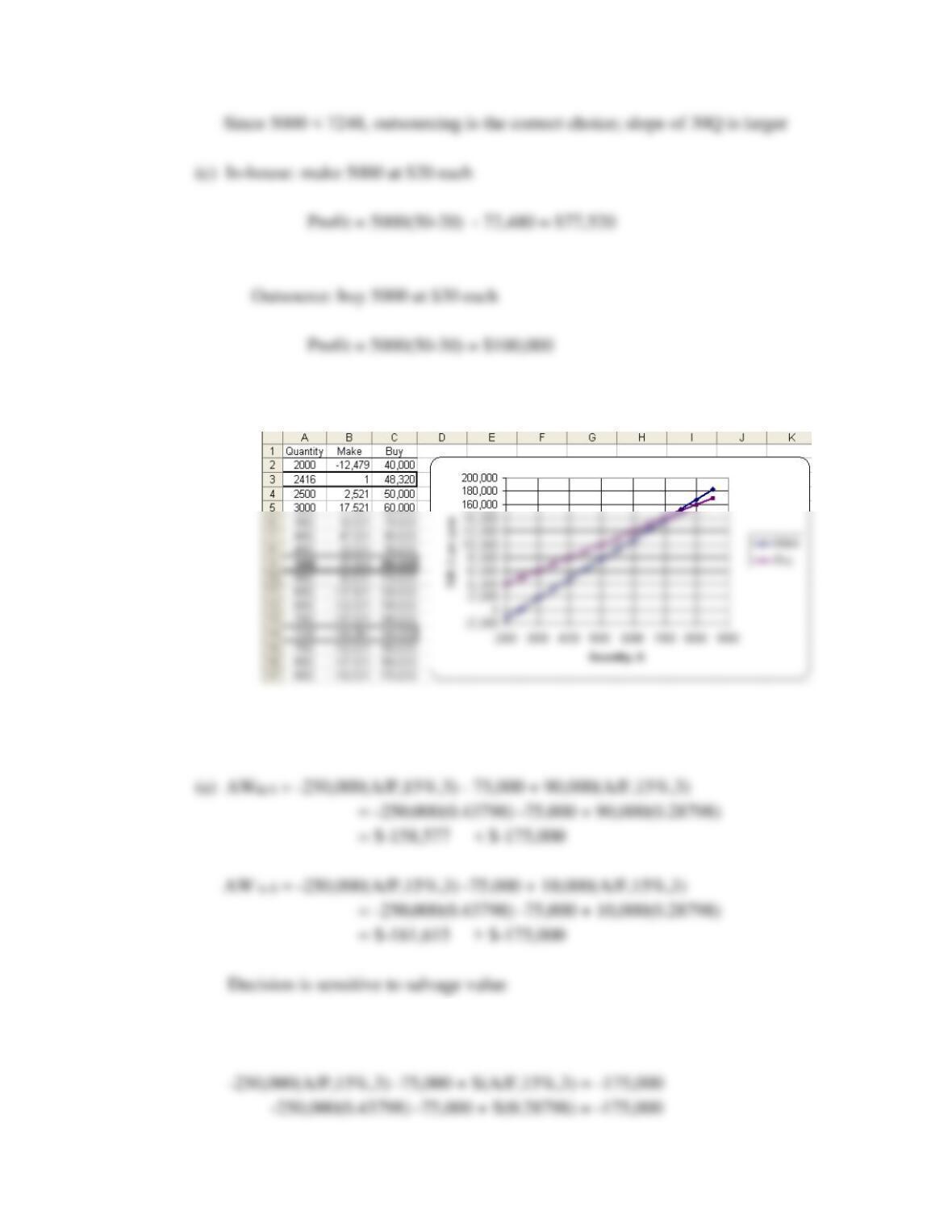
A spreadsheet can be used to answer all three questions.
Solution 8.29
(b) Let S = salvage value; set AW = $ -175,000
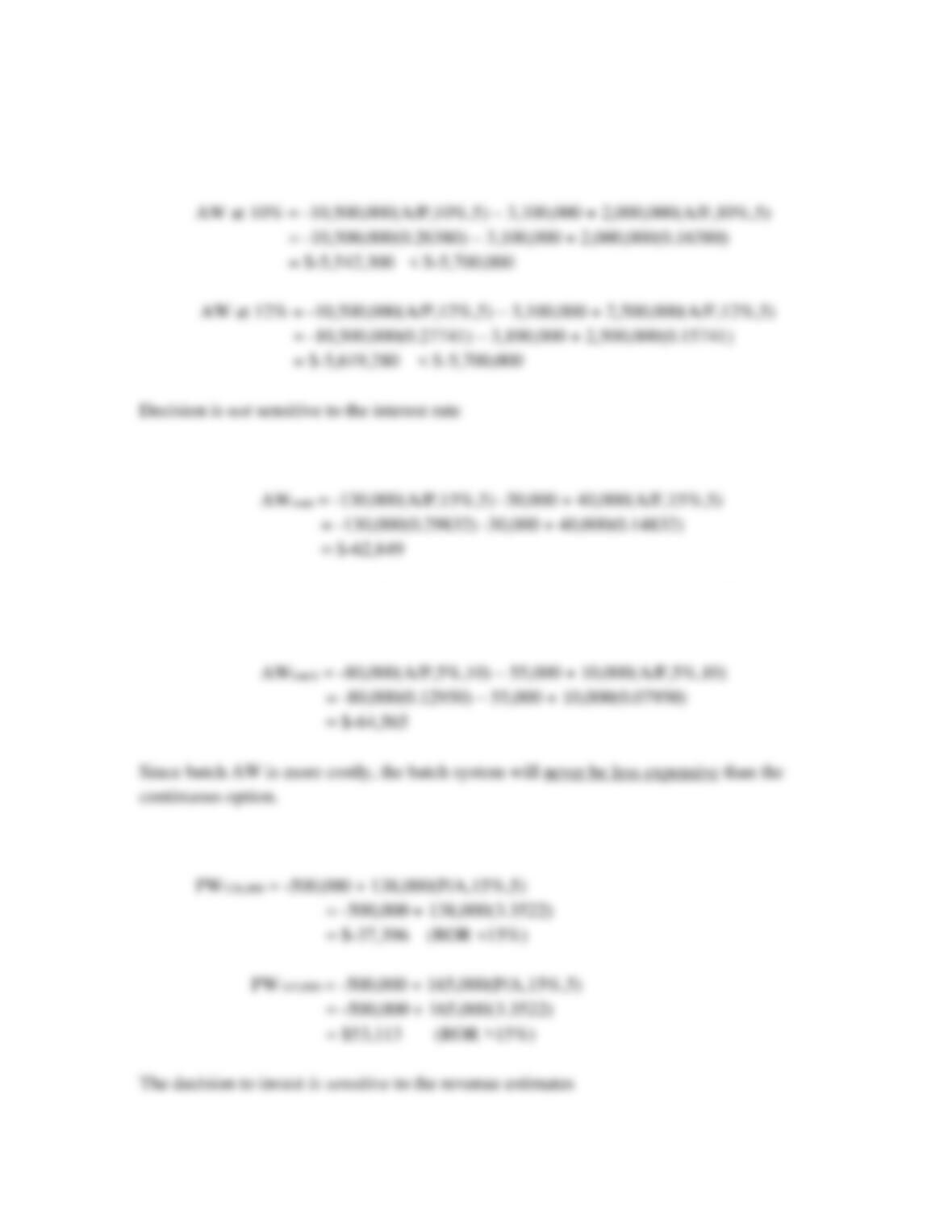
S = $32,971
Solution 8.30
Solution 8.31
Lowest cost for batch will occur when the interest rate is the lowest (5%)
and life is longest (10 years)
Solution 8.32
Solution 8.33
Invest now: FW25,000 = -80,000(F/P,20%,6) + 25,000(F/A,20%,6)
Solution 8.34
AWcurrent = $-62,000
Solution 8.35
SP1: PW1 = –80,000 + 10,000(P/F,8%,6) + 10,000(P/A,8%,6)
Solution 8.36
PWLease = – 30(1000) – 30(1000)(P/A,20%,2)
Solution 8.37
(a) AW1 = -10,000(A/P,i%,8) – 600 – 100(A/F,i%,8) – 1750(P/F,i%,4)(A/P,i%,8)
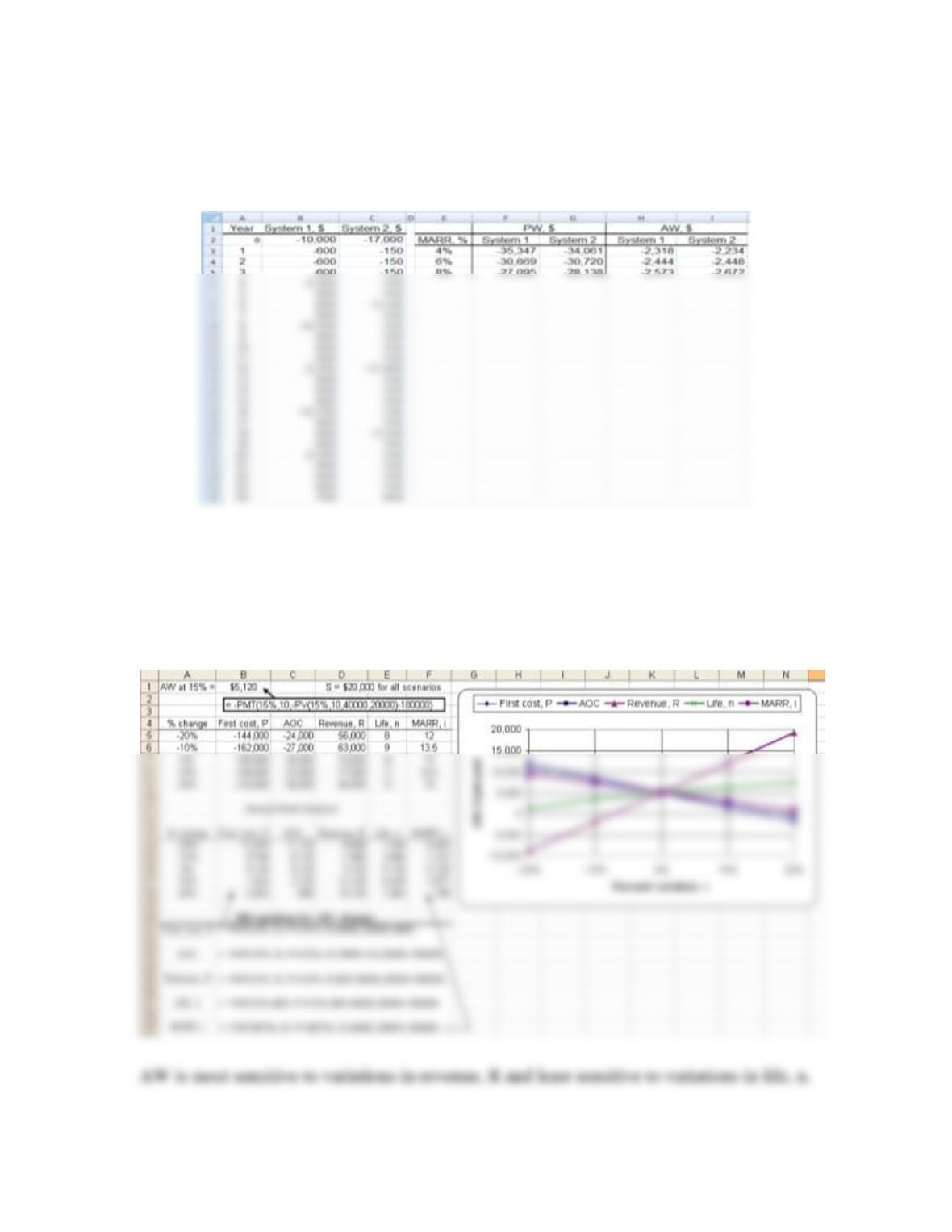
(b) Spreadsheet solution requires that the PW value is first determined using the
NPV function over the LCM of 24 years and then converting it to an AW value
using the PMT function. Spreadsheet follows.
Solution 8.38
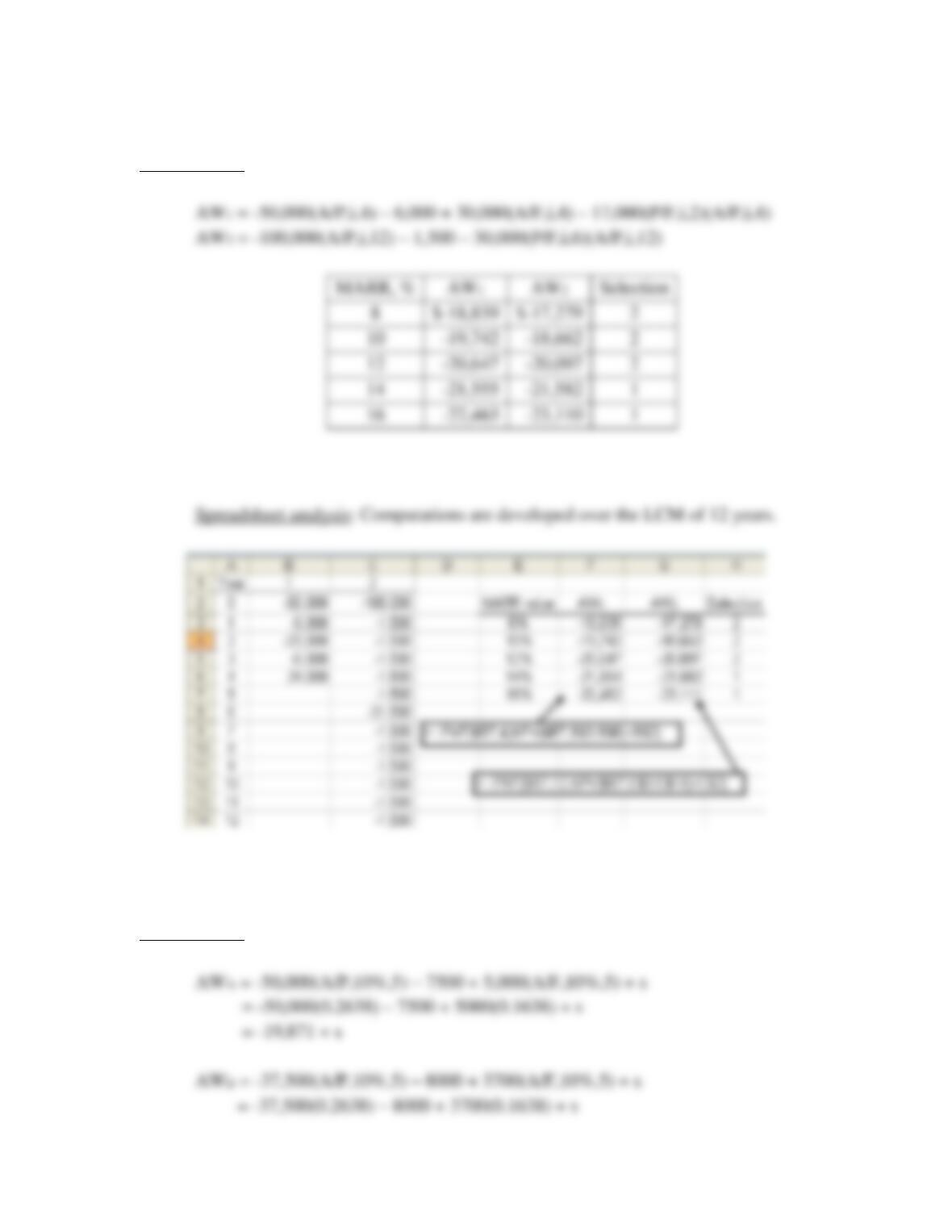
Spreadsheet for -20% to +20% changes in P, AOC, R, n and MARR follows. The PMT
function for a +20% change is detailed at the bottom of the spreadsheet.
Solution 8.39
Hand analysis: Determine AW at different MARR values between 8% and 16%.
Selection changes for MARR values of 14% and 16%.
Solution 8.40
Hand solution: Determine AW values at different savings, s.
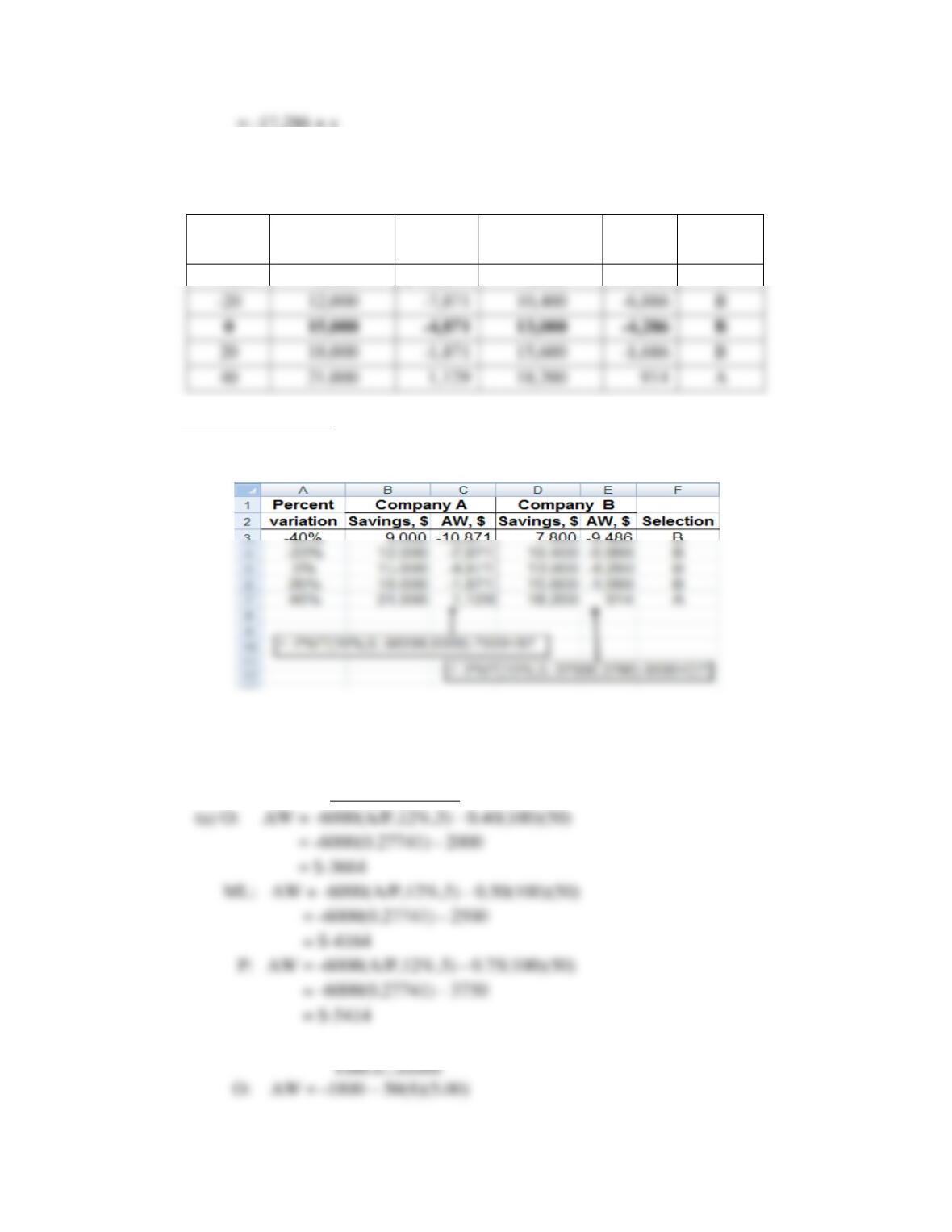
= -17,286 + s
Selection changes when s is +40% of best estimate. Table follows:
Spreadsheet solution: PMT functions display AW values with savings variation
added to end of function.
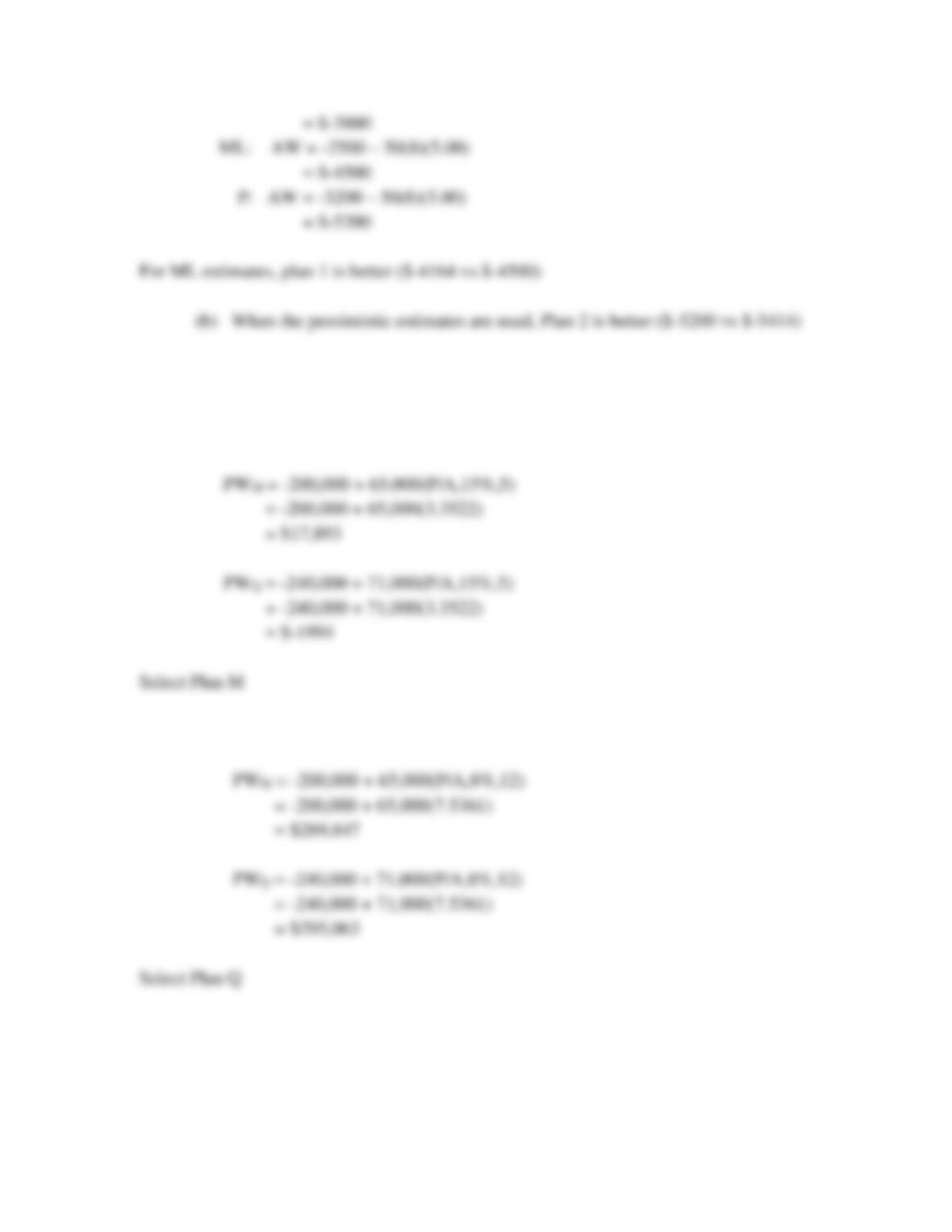
Solution 8.41
Plan 1 – Purchase
Percent
variation
Savings for A,
$ per year
AWA
Savings for B,
$ per year
AWB
Selection
-40%
9,000
$-10,871
7,800
$-9,486
B
18,000
-1,871
15,600
-1,686
B
21,000
1,129
18,200
914
A
Solution 8.42
(a) Expanding: MARR = 15%; n = 0.5(10) = 5 years
(b) Receding: MARR = 8%; n = 1.2(10) = 12 years
Solution 8.43
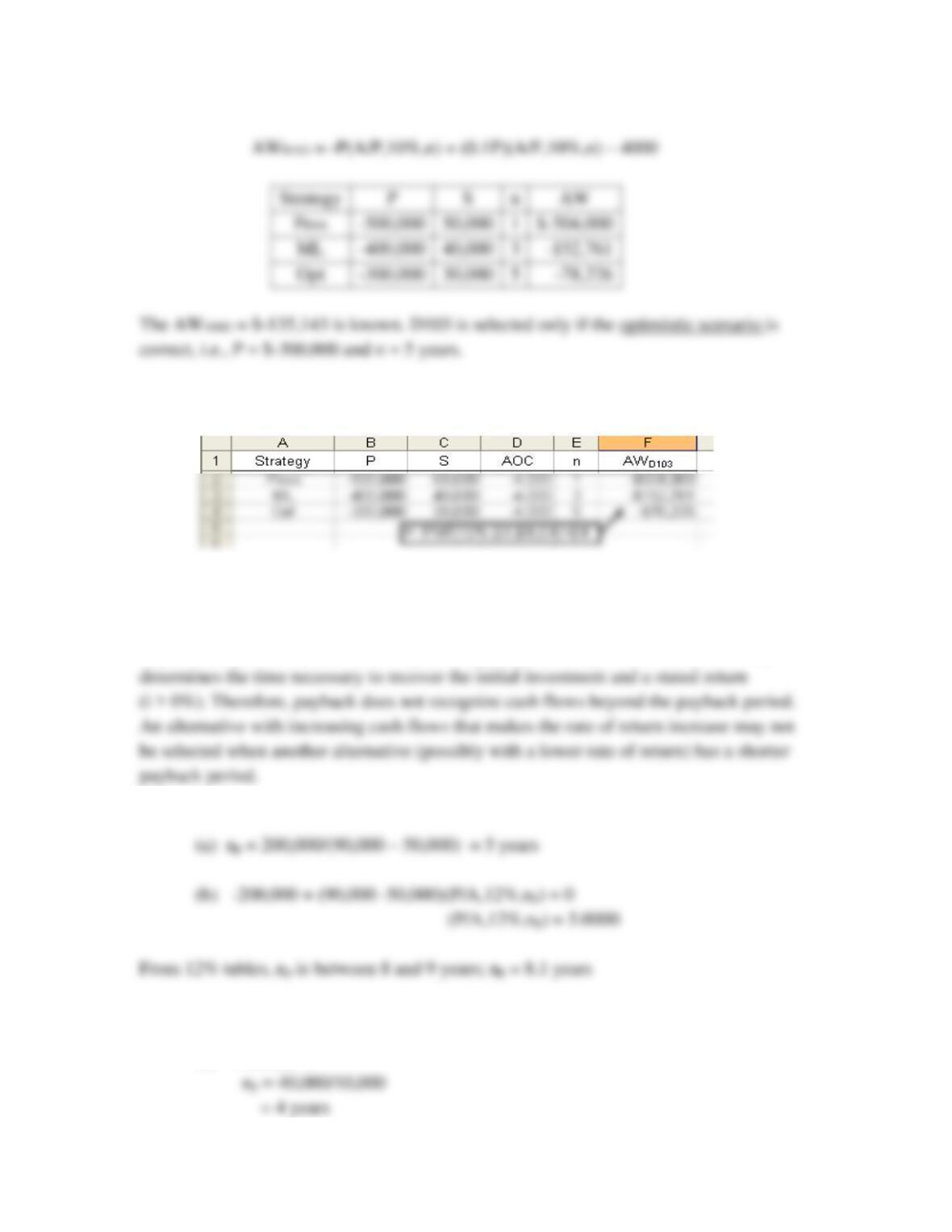
(a) Set up the general AW relation for D103 and determine AW for the three
scenarios.
(b) Spreadsheet solution.
Solution 8.44
Payback analysis should be used only as a supplemental analysis tool because it only
Solution 8.45
Solution 8.46
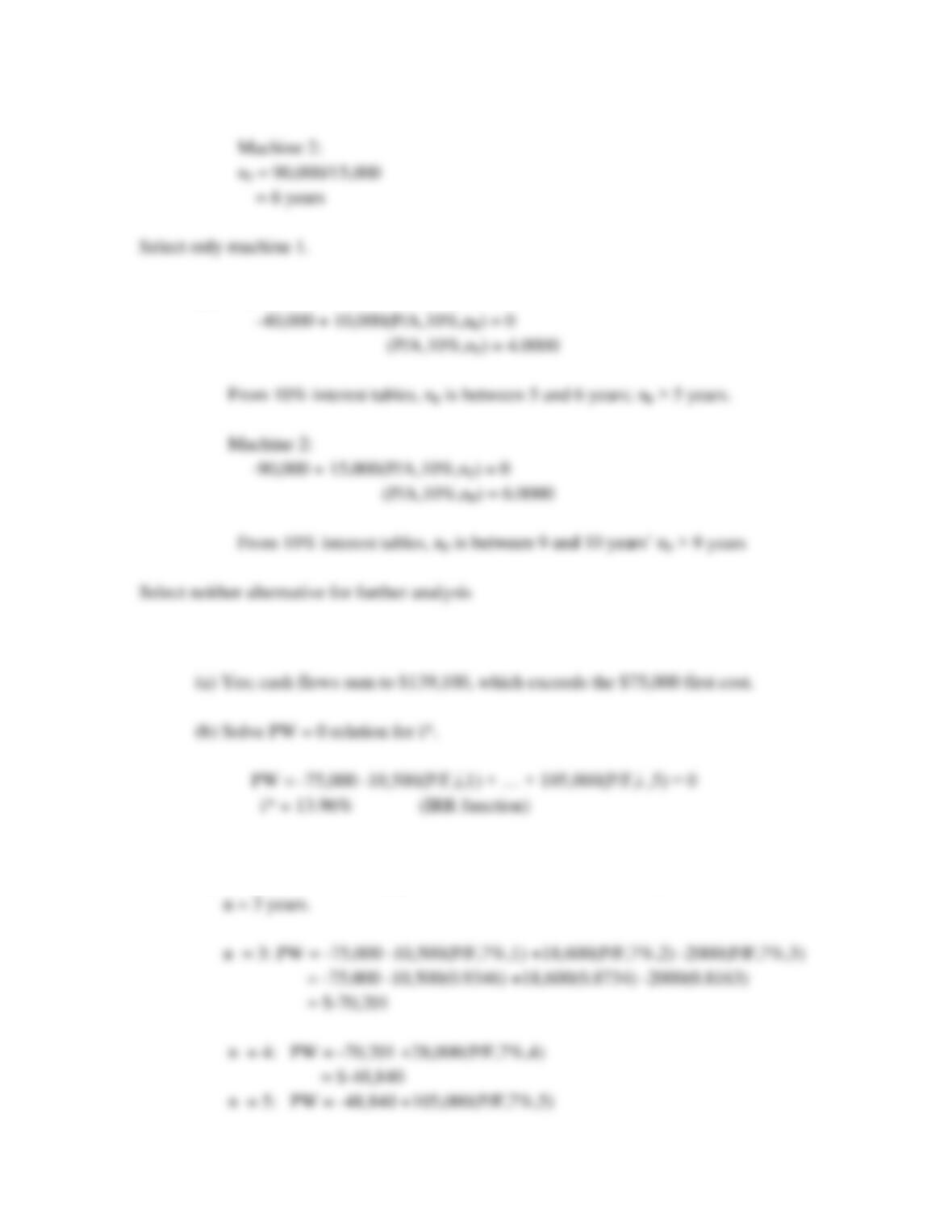
(a) Machine 1:
(b) Machine 1:
Solution 8.47
(c) Calculate PW at 7% by year to determine when PW turns positive. Start with
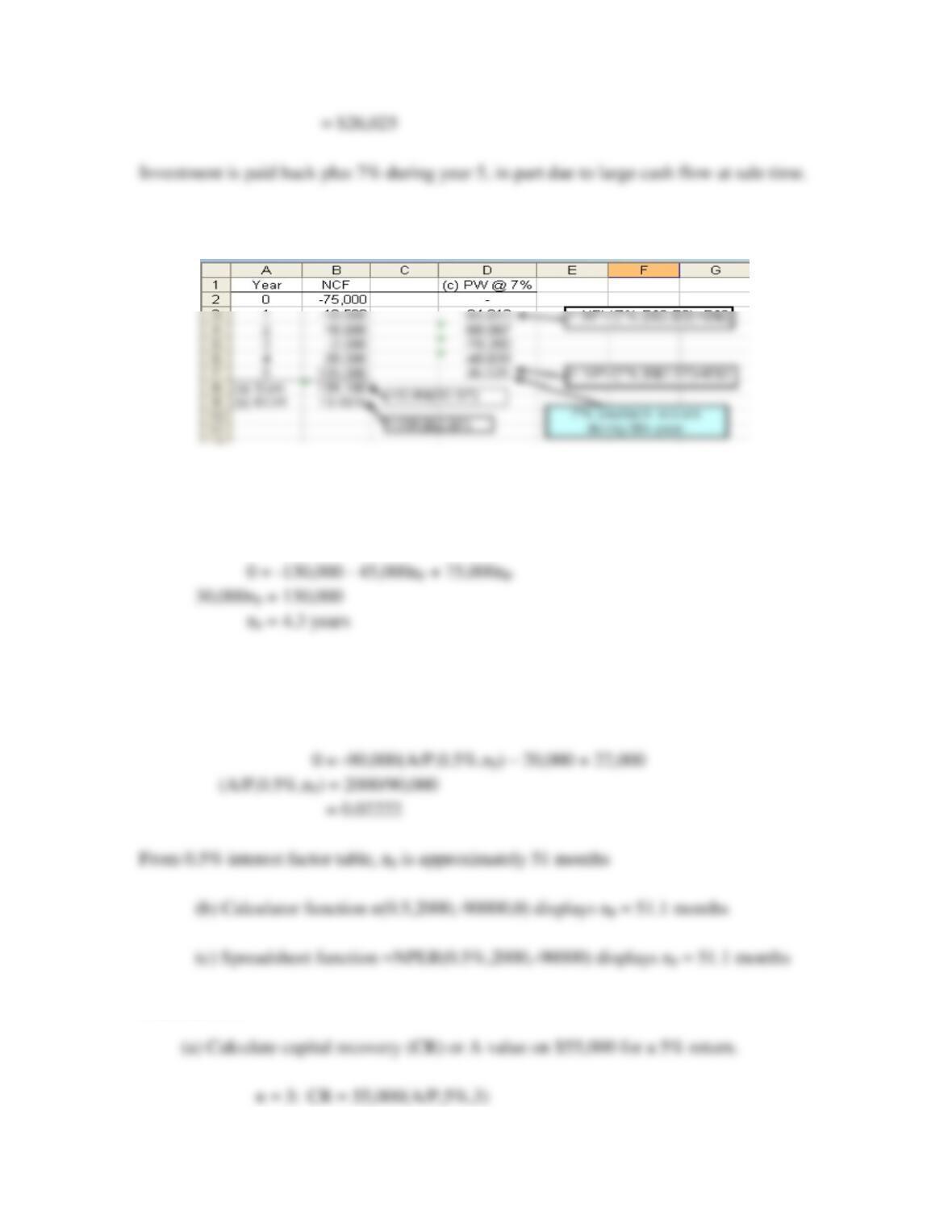
(d) A spreadsheet solution for all three parts follows.
Solution 8.48
Let np = number of years until payback at 0%
Solution 8.49
(a) Let np = number of months at 0.5% per month
Solution 8.50
(b) For payback with 5% return in np = 10 years, find PW. He should have paid
Solution 8.51
Monthly i = 9/12 = 0.75%. Solve PW relations for np
Solution 8.52
Set up the PW relation and use trial and error or spreadsheet for np.
Solution 8.53
Process 1: np = 50,000/24,000 = 2.1 years
Process 2: Interpolate for np = 3.04 years
Solution 8.54
Solution 8.55
(a) Determine i* from AW relations
(b) First of all, an ROR analysis always requires an incremental analysis over the
Solution 8.56
The AW method with evaluation at MARR = 12% is correct. Problem 8.54 correctly
Solution 8.57
Solution 8.58
Solution 8.59
Solution 8.60
Solve for n by trial and error or spreadsheet
Solution 8.61
Solution 8.62
Solution 8.63
There is no P/A factor this large for any n value, that is, n → ∞. From observation,, the
Solution 8.64
Solution 8.65
Solution 8.66
2QBE = 23,000(0.16275) – 4000(0.06275) – 8000(0.31547) + 3000
Solution 8.67
Solution 8.68
Solution 8.69
Solution 8.70