Problem 7.1
In conducting a B/C analysis, why is it best to take a limited viewpoint in determining
benefits and disbenefits?
Problem 7.2
Identify the following as primarily public or private sector projects.
a. Bridge across Ohio River
b. Coal mine
c. Baja 1000 race team
d. Consulting engineering firm
e. County courthouse
f. Flood control project
g. Endangered species designation
h. Freeway lighting
i. Antarctic cruise
j. Crop dusting
Problem 7.3
Identify the following as primarily public or private sector undertakings: eBay, farmer’s
market, state police department, car racing facility, social security, EMS, ATM, travel
agency, amusement park, gambling casino, and swap meet.
Problem 7.4
What are the primary financial responsibilities of a contractor and the government when
operating under a DBOMF contract?
Problem 7.5
Identify the following funding sources as primarily public or private.
a. Municipal bonds
b. Retained earnings
c. Sales taxes
d. Automobile license fees
e. Bank loans
f. Savings accounts
g. Engineer’s retirement plan
h. State fishing license revenues
i. Entrance fees to Disneyland
j. State park entrance fees
Problem 7.6
Identify the following as primarily private or public sector characteristics:
a. Large investment
b. No profits
c. Funding from fees
d. MARR-based selection criteria
e. Low interest rate
f. Short project life estimate
g. Disbenefits
Problem 7.7
Calculate the conventional B/C ratio for a county government project that is projected to
have the following cash flows: costs of $2,000,000 per year; benefits of $2,740,000 per
year; disbenefits of $380,000 per year.
Problem 7.8
The Hawaii Department of transportation has planned a bypass loop that is expected to
cost $9,000,000 and save motorists $820,000 per year in gasoline and other automobile-
related expenses. However, local businesses will suffer sales losses estimated at $135,000
each year. (a) Calculate the conventional B/C ratio using a discount rate of 6% per year
and a 20-year study period. (b) Is the project economically justified if disbenefits are
considered? If disbenefits are not considered?
Problem 7.9
A southwestern city that has 170,000 households is required to install treatment systems
for the removal of arsenic from drinking water. The annual cost is projected to be $50 per
household per year. Assume that one life will be saved every three years as a result of the
arsenic removal system and that the EPA values a human life at $4.8 million. Use a
discount rate of 8% per year and assume the life is saved at the end of each three-year
period. Utilize a conventional B/C ratio to determine if the project is economically
justified.
Problem 7.10
The following estimates (in $1000 units) have been developed for a new security system
at Chicago O’Hare Airport.
First cost, $ 13,000
AW of benefits, $/year 3,800
FW (in year 20) of disbenefits, $ 6,750
M&O costs, $/year 400

Life of project, years 20
(a) Calculate the conventional B/C ratio at a discount rate of 10% per year.
(b) Determine the minimum first cost necessary to make the project economically
unjustified.
Problem 7.11
An Army Corps of Engineers project for improving navigation on the Ohio River will
have an initial cost of $6,500,000 and annual maintenance of $130,000. Benefits for
barges and paddle wheel touring boats are estimated at $820,000 per year. If the project
is assumed to be permanent, use the conventional B/C ratio to determine if it is
economically justified at 8% per year.
Problem 7.12
The sheriff of Los Lunas county along the Arizona-Mexico border asked the county to
build a new minimum security detention facility for persons caught while attempting to
enter the United States illegally. The construction cost will be $22 million, with annual
operating costs of $2.1 million. The new facility will create jobs that produce benefits for
many local businesses including realtors, restaurants, etc. The benefits are estimated to
be $5 million in years 1 and 2, $2.8 million in year 3, and $1.12 million per year
beginning in year 4 and continuing through the 30-year life of the facility. At a discount
rate of 8% per year, does the conventional B/C ratio indicate that the project is
economically justified?
Problem 7.13
The cash flows associated with a public works project in Buffalo, NY are shown.
Calculate the modified B/C ratio at a discount rate of 5% per year.
First cost, $ 35,000,000
AW of benefits, $/year 6,500,000
AW of disbenefits, $/year 1,700,000
M&O costs, $/year 900,000
Life of project, years 30
Problem 7.14
Determine the B/C ratio for a project that has an infinite life and the following estimates.
Use an interest rate of 8% per year.
To the people To the government___
Annual benefits = $180,000/year First cost = $950,000
Annual disbenefits = $30,000/year Annual cost = $60,000/year
Annual savings = $25,000/year
Problem 7.15
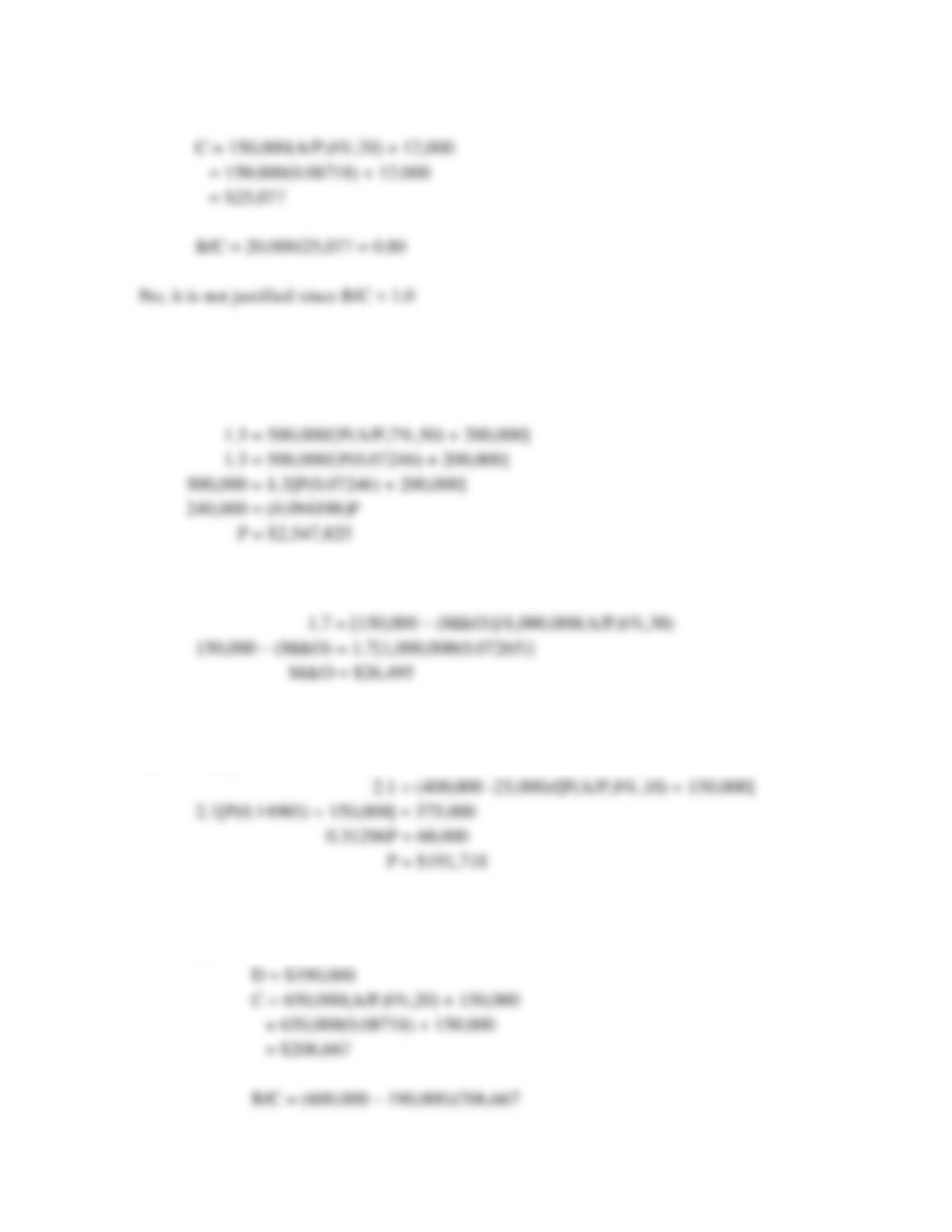
As part of the rehabilitation of the downtown area of a northwestern Florida city, the
Parks and Recreation Department is planning to develop the space below several
overpass bridges into basketball, handball, miniature golf, and tennis courts. The initial
cost is expected to be $150,000 for improvements which are expected to have a 20-year
life. Annual maintenance costs are projected to be $12,000. The department expects
20,000 people per year to use the facilities an average of 2 hours per person. The value of
the recreation has been conservatively set at $0.50 per hour. At a discount rate of 6% per
year, does the conventional B/C ratio indicate economic justification?
Problem 7.16
The conventional B/C ratio for a flood control project along the Mississippi River was
calculated to be 1.3. The benefits were $500,000 per year and the maintenance costs were
$200,000 per year. What was the initial cost of the project if an interest rate of 7% per
year was used and the project was assumed to have a 50-year life?
Problem 7.17
The modified B/C ratio for a city-owned hospital heliport project is 1.7. The initial cost is
$1 million, annual benefits are $150,000, and the estimated life is 30 years. What is the
amount of the annual M&O costs used in the calculation at a discount rate of 6% per
year?
Problem 7.18
The conventional B/C ratio estimate of 2.1 was reported to the County Commissioners
for a proposed mosquito control program. The person who prepared the report stated that
the health benefits were estimated to be $400,000 per year, and that disbenefits of
$25,000 per year were used in the calculation. She also stated that the costs for chemicals,
machinery, maintenance, and labor were estimated at $150,000 per year. However, she
forgot to list the cost for initiating the program (trucks, pumps, tanks, etc.). If the project
has a 10-year study period and an 8%-per-year discount rate, determine the estimated
initial cost.
Problem 7.19
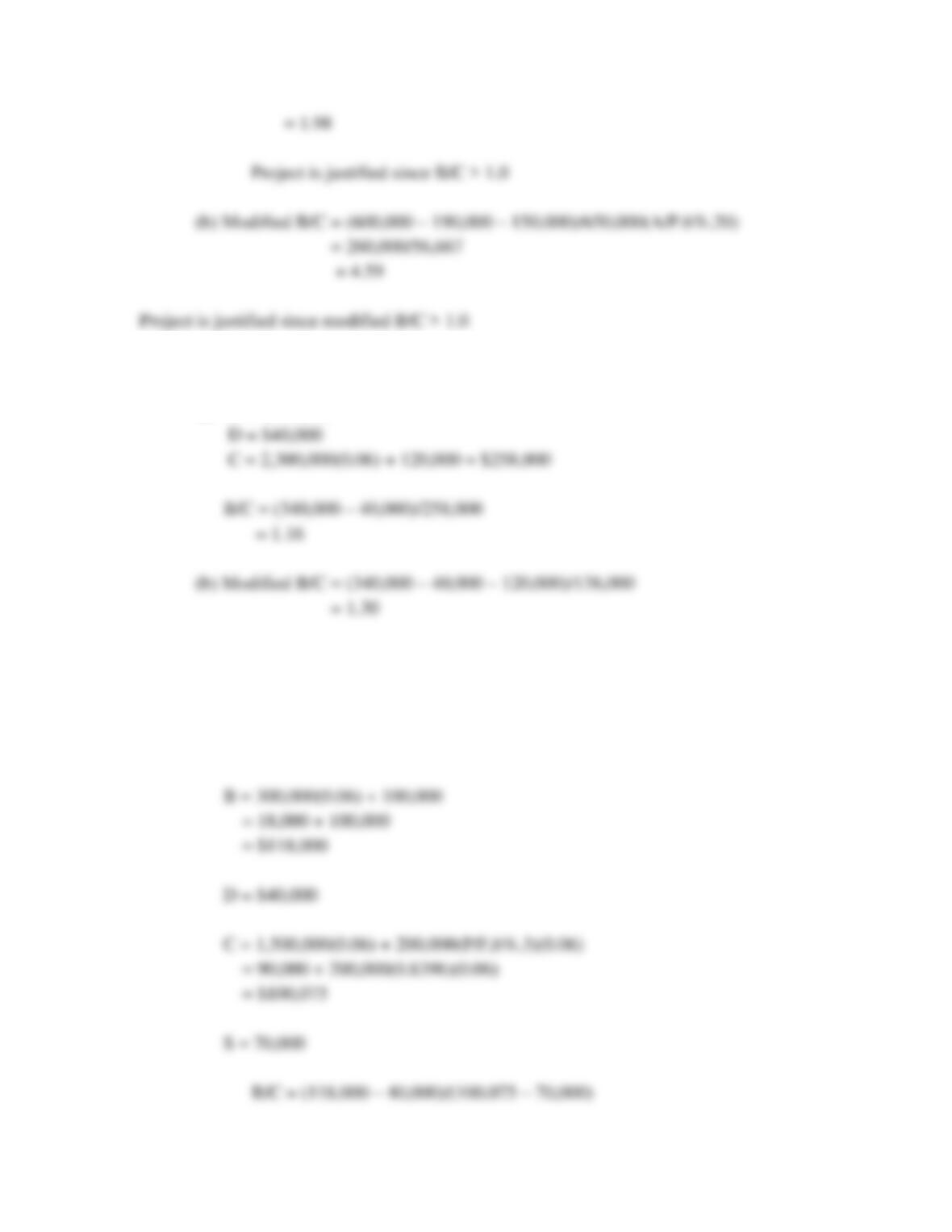
The cash flows associated with a Death Valley County arroyo improvement project are as
follows: initial cost $650,000; life 20 years; annual maintenance cost $150,000 per year;
benefits $600,000 per year; disbenefits $190,000 per year. The discount rate is 6% per
year. Determine if the project is justified using (a) the conventional B/C ratio, and (b) the
modified B/C ratio.

Problem 7.20
The Parks and Recreation Department of Burkett County estimates that the initial cost of
a “barebones” permanent river park will be $2.3 million. Annual upkeep costs are
estimated at $120,000. Benefits of $340,000 per year and disbenefits of $40,000 per year
have also been identified. Using a discount rate of 6% per year, calculate (a) the
conventional B/C ratio and (b) the modified B/C ratio.
Problem 7.21
From the following data, calculate the (a) conventional and (b) modified benefit/cost
ratios using a discount rate of 6% per year and a very long (infinite) project life.
To the People To the Government
Benefits: $300,000 now Costs: $1.5 million now
and $100,000 and $200,000 three
per year thereafter years from now
Disbenefits: $40,000 per year Savings: $70,000 per year
Problem 7.22
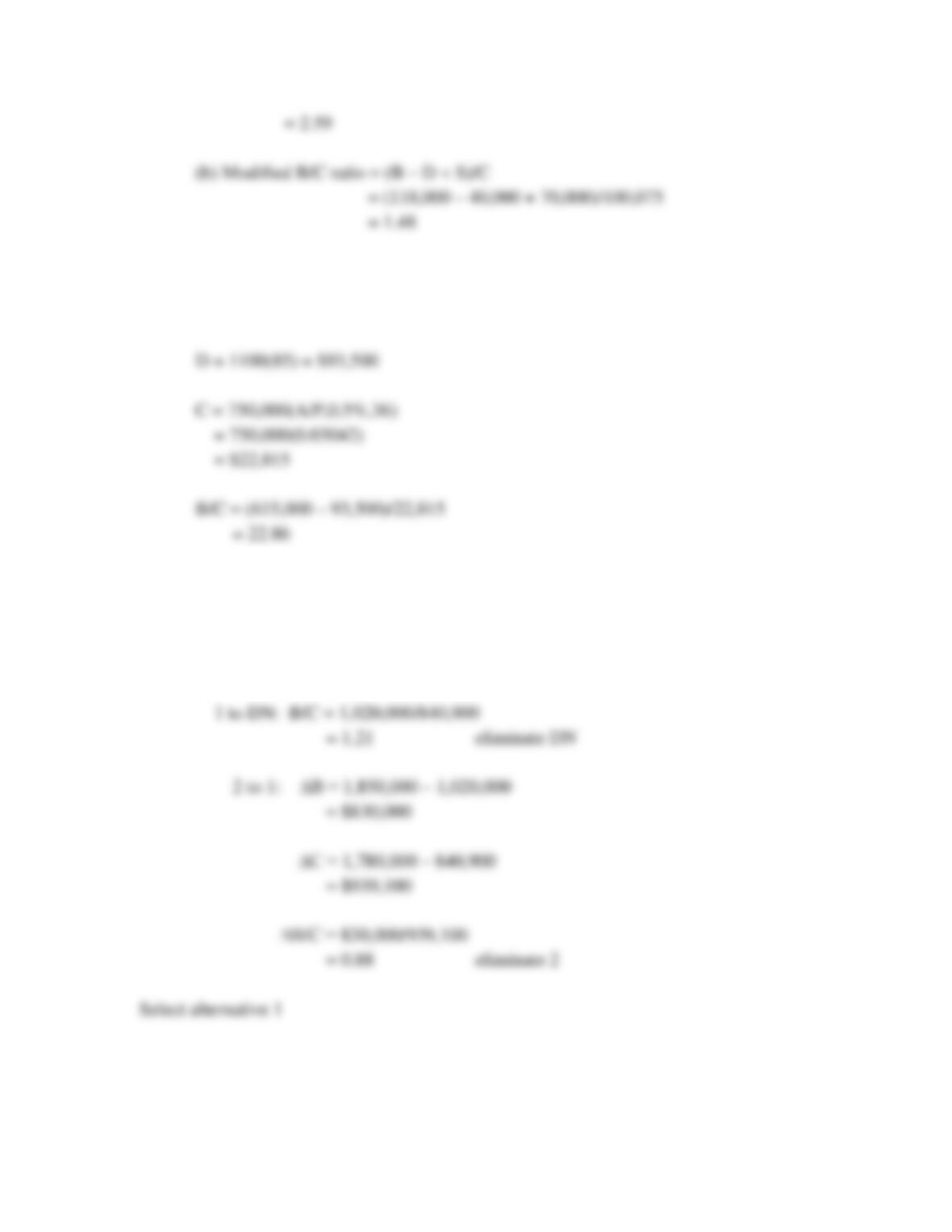
When red light cameras are installed at high-risk intersections, rear-end collisions go up,
but all other types of accidents go down, including those involving pedestrians. Analysis
of traffic accidents in a northwestern city revealed that the total number of collisions at
photo-controlled intersections decreased from 33 per month to 18. At the same time, the
number of traffic tickets issued for red light violations averaged 1100 per month at an
average cost to violators of $85 per citation. The cost to install the basic camera system at
selected intersections was $750,000. If the cost of a collision is estimated at $41,000 and
traffic ticket costs are considered disbenefits, calculate the B/C ratio for the camera
system. Use a discount rate of 0.5% per month and a 3-year study period.
Problem 7.23
A state agency is considering two mutually exclusive alternatives for upgrading the skills
of its technical staff. Alternative 1 involves purchasing software that will reduce the time
required to collect background information on each client. The total cost for the
purchase, installation, and training associated with the new software is $840,900. The
present worth of the benefits from increased efficiency is expected to be $1,020,000.
Alternative 2 involves multimedia training to improve the performance of the staff
technicians. The total cost to develop, install, and train the technicians will be
$1,780,000. The present worth of the benefits from increased performance due to

training is expected to be $1,850,000. Use a B/C analysis to determine which alternative,
if any, the agency should undertake.
Problem 7.24
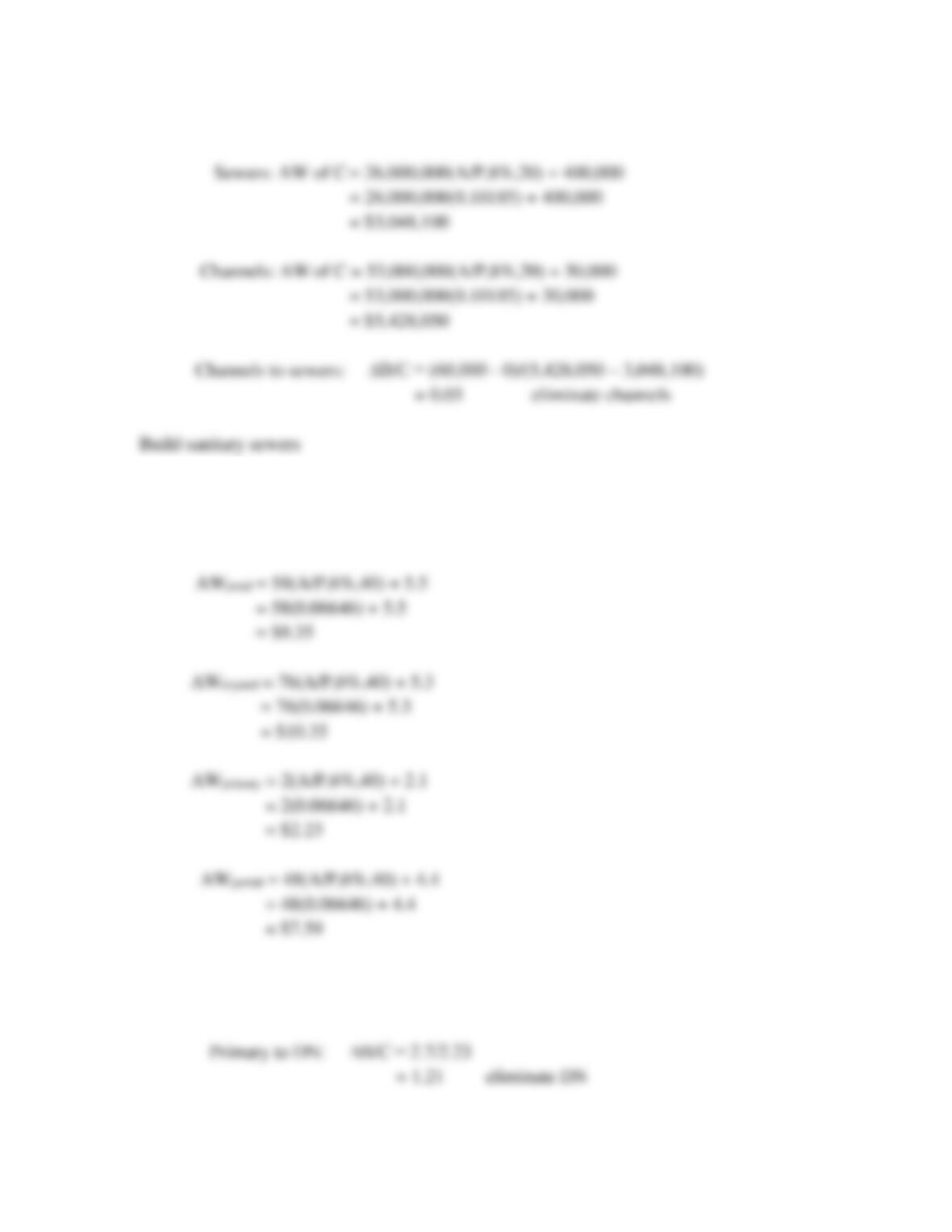
A project to control flooding from rare, but sometimes heavy, rainfalls in the arid
southwest will have the following cash flow estimates. Determine which project should
be selected on the basis of a B/C analysis using an interest rate of 8% per year and a 20-
year study period.
Sanitary
Sewers Open Channels
First cost, $ (millions) 26 53
M&O cost, $/year 400,000 30,000
Homeowner cleanup costs, $/year 60,000 0
Problem 7.25
In order to safeguard the public health, environment, public beaches, water quality, and
economy of south San Diego County, California, and Tijuana, Mexico, federal agencies
in the United States and Mexico developed four alternatives for treating wastewater prior
to discharge into the ocean. The project will minimize untreated wastewater flows that
have caused chronic and substantial pollution in the Tijuana River valley, Tijuana River
National Estuarine Research Reserve, coastal areas used for agriculture and public
recreation, and areas designated as critical habitat for federal and state-listed endangered
species. If the costs and benefits are as shown, which alternative should be selected on
the basis of a B/C analysis at 6% per year and a 40-year project period? All monetary
amounts are in $ million units.
Pond Expand Advanced Partial
System Plant Primary Secondary
Capital cost, $ 58 76 2 48
M&O cost, $/year 5.5 5.3 2.1 4.4
Benefits, $/year 11.1 12.0 2.7 8.3
Problem 7.26
The present worth of cash flows associated with developing oceanfront property
for commercial use are estimated. Determine which plan, if any, should be

selected on the basis of a B/C analysis at 8% per year.
Present Worth ($1000)
Plan Costs Benefits
A 1,400 1,246
B 2,220 2,560
C 4,680 4,710
Problem 7.27
Use the B/C method to compare four mutually exclusive alternatives for recycling plastic
bottles. Make any additional calculations as necessary to determine which alternative
should be selected.
PW of ∆B/C when Compared
Total Costs, Overall with Alternative__
Alternative $ Millions B/C Ratio M N O P
M 10 0.91 — 1.69 0.96
N 21 1.32 1.69 —
O 44 1.25 —
P 52 0.95 0.96 0.80 0.08 —
Problem 7.28
Two sites for suspension bridges are under consideration for crossing the Allegheny
River in Pittsburgh, PA. Use the B/C ratio method at a discount rate of 6% per year to
determine which bridge, if either, should be built.
Site N Site S__
Initial Cost, $ 11 x 106 27 x 106
Annual M & O, $/year 100,000 90,000
Benefits, $/year 990,000 2,100,000
Disbenefits, $/year 120,000 300,000
Life, years ∞ ∞
Problem 7.29
Two alternatives are under consideration for providing energy at a remote research
station, one of which must be selected: goethermal and solar. The benefits and costs
associated with each alternative are shown. Use the B/C method to determine which
should be selected at an interest rate of 6% per year over a 20-year study period.

Geothermal Solar
Initial cost, $ 200,000 50,000
Annual M&O costs, $/year 31,000 9,000
Annual benefits, $/year 39,500 16,000
Problem 7.30
Two relatively inexpensive alternatives are available to reduce potential earthquake
damage at a top secret government research site. The cash flow estimates for each
alternative are shown. At an interest rate of 8% per year and a 20-year study period, apply
the B/C ratio method to select an alternative. Assume the damage costs would occur in
the middle of the study period, that is, year 10.
Alternative 1 Alternative 2
Initial cost, $ 600,000 1,100,000
Annual maintenance, $ per year 50,000 90,000
Potential damage costs, $ 950,000 350,000
Problem 7.31
There are two methods under consideration for improving security at a county jail. Select
one based on a B/C analysis at an interest rate of 7% per year and a 10-year study period.
Extra New
Cameras (EC) Sensors (NS)
First cost, $ 38,000 87,000
Annual M&O, $ per year 49,000 74,000
Benefits, $ per year 110,000 130,000
Disbenefits, $ per year 26,000 18,000
Problem 7.32
The public utility in a medium-sized city is considering two cash rebate programs to
improve water conservation. Program 1, expected to cost an average of $60 per
household, offers a rebate of 75% of the purchase and installation costs of an ultra low-
flush toilet ($100 maximum). This program is projected to achieve a 5% reduction in
overall household water use over a 5-year evaluation period. This will benefit the
citizenry to the extent of $1.25 per household per month. Program 2 is the replacement of
turf grass with xeriscape landscaping. This is expected to cost $500 per household, but it
will result in an average reduced water cost estimated at $8 per household per month. At
a discount rate of 0.5% per month, use the B/C method to determine which program(s)

the utility should undertake if the programs are (a) mutually exclusive, and
(b) independent.
Problem 7.33
A consulting engineer is currently evaluating 4 projects for the US government. The
present worth values of the costs, benefits, disbenefits, and savings are shown. Assuming
the discount rate is 10% per year compounded continuously, determine which projects, if
any, should be selected if they are (a) independent, and (b) mutually exclusive.
Fair Good Better Best_
PW of costs, $ 10,000 8,000 20,000 14,000
PW of benefits, $ 15,000 11,000 25,000 42,000
PW of disbenefits, $ 6,000 1,000 20,000 31,000
PW of cost savings, $ 1,500 2,000 16,000 3,000
Problem 7.34
From the data below for projects regarding campgrounds and lodging at a national park,
determine which one, if any, should be selected from the 6 mutually exclusive projects.
If the proper comparisons have not been made, state which one(s) should be performed.
Project Identification
_____________ G H I J K L__
Cost, $ 20,000 45,000 50,000 35,000 85,000 70,000
Project B/C 1.15 0.89 1.10 1.11 0.94 1.06
Selected incremental B/C ratios:
Comparison ∆B/C Comparison ∆B/C
H to G 0.68 L to H 1.36
I to G 0.73 K to J 0.82
J to H 0.10 L to J 1.00
I to J 1.07 K to L 0.40
J to G 1.07 L to G 1.02
K to H 1.00
Problem 7.35
The 4 mutually exclusive alternatives shown are compared by the incremental B/C
method. What alternative, if any, should be selected?

∆B/C when Compared
First Cost, Overall with Alternative_____
Alternative $ Millions B/C Ratio X Y Z ZZ
X 20 0.75 —
Y 30 1.07 1.70 —
Z 50 1.20 1.50 1.40 —
ZZ 90 1.11 1.21 1.13 1.00 —
Problem 7.36
All of the following are primarily associated with public sector projects, except:
a. profits
b. taxes
c. disbenefits
d. infinite life
Problem 7.37
All of the following cash flows should be identified as benefits, except:
a. longer tire life because of smooth pavement
b. $200,000 annual income to local businesses because of tourism created by a
water reservoir
c. expenditure of $20 million for construction of a highway
d. fewer highway accidents because of improved lighting.
Problem 7.38
In a modified B/C ratio:
a. disbenefits and M&O costs are subtracted from benefits
b. disbenefits are subtracted from benefits, and M&O costs are added to costs
c. disbenefits and M&O costs are added to costs

d. disbenefits are added to costs, and M&O costs are subtracted from benefits
Problem 7.39
If two mutually exclusive alternatives have B/C ratios of 1.4 and 1.5 for the lower and
higher cost ones, respectively,
a. the B/C ratio on the increment between them is equal to 1.5
b. the B/C ratio on the increment between them is between 1.4 and 1.5
c. the B/C ratio on the increment between them is less than 1.5
d. the higher cost alternative is definitely the better one
Problem 7.40
From the PW, AW, and FW values below, the conventional B/C ratio is closest to
a. 1.27
b. 1.33
c. 1.54
d. 2.76
PW, $ AW, $/year FW, $__
First cost $100,000 $16,275 $259,370
M&O cost $68,798 $11,197 $178,441
Benefits $245,784 $40,000 $637,496
Disbenefits $30,723 $5,000 $79,687
Problem 7.41
The first cost of grading and spreading gravel on a short rural road is expected to be
$700,000. The road will have to be maintained at a cost of $25,000 per year. Even though
the new road is not very smooth, it allows access to an area that previously could only be
reached with off-road vehicles. This improved accessibility has increased the property
values along the road from $400,000 to $700,000. The conventional B/C ratio at a
discount rate of 6% per year for a 10- year study period is closest to:

a. 2.5
b. 3.3
c. 4.1
d. 5.8
Problem 7.42
A permanent flood control dam is expected to have an initial cost of $2.8 million and an
annual upkeep cost of $20,000. In addition, minor reconstruction will be required every
5 years at a cost of $200,000. As a result of the dam, flood damage will be reduced by an
average of $180,000 per year. Using an interest rate of 6% per year, the conventional
B/C ratio will be closest to:
a. 0.46
b. 0.81
c. 0.97
d. 1.06
Problem 7.43
If the two independent projects shown are evaluated using an interest rate of 10%
per year and the B/C ratio method, the decision is to:
a. select do nothing
b. select X
c. select Y
d. select X and Y
Project X Project Y
Annualized first cost, $/year 60,000 90,000
Annual M & O cost, $/year 45,000 35,000

Annual benefits, $/year 110,000 150,000
Annual disbenefits, $/year 20,000 45,000
Life, years ∞ ∞
Problem 7.44
The four mutually exclusive alternatives shown are compared using the B/C method. The
alternative to select is:
a. J
b. K
c. L
d. M
∆B/C when Compared
Cost, B/C Ratio with Alternative__
Alternative $ millions Compared to DN J K L M
J 20 1.1 —
K 25 0.96 0.40 —
L 33 1.22 1.42 2.14 —
M 45 0.89 0.72 0.80 0.08 —
Problem 7.45
The Corps of Engineers compiled the following data to determine which one of two flood
control dams should be constructed in a flood-prone residential area.
Mountain Valley_
Flood damage, $/year 220,000 140,000
Disbenefits, $/year 30,000 10,000
Costs, $/year 300,000 450,000
In conducting an incremental B/C analysis of this data:
a. the DN alternative is not an option
b. the DN alternative is an option
c. there is not enough information given to know if DN is an option or not
d. DN is an option only if the alternatives are mutually exclusive

Problem 7.46
The Corps of Engineers compiled the following data to determine which one of two flood
control dams should be constructed in a flood-prone residential area.
Mountain Valley_
Flood damage, $/year 220,000 140,000
Disbenefits, $/year 30,000 10,000
Costs, $/year 300,000 450,000
The conventional ∆B/C ratio between alternatives Mountain and Valley is closest to:
a. 0.33
b. 0.40
c. 0.53
d. 0.73
Problem 7.47
The Corps of Engineers compiled the following data to determine which one of two flood
control dams should be constructed in a flood-prone residential area.
Mountain Valley_
Flood damage, $/year 220,000 140,000
Disbenefits, $/year 30,000 10,000
Costs, $/year 300,000 450,000
If the flood damage estimates for both alternatives ware reduced to zero and replaced
with benefits of $310,000 per year and $470,000 per year for the two alternatives,
respectively, the B/C ratio for the Valley alternative is closest to:
a. 0.93
b. 1.02
c. 1.23
d. 1.56
Problem 7.48
If benefits are $10,000 per year forever, starting in year 1, and costs are $50,000 at time
zero and $50,000 at the end of year 2, the B/C ratio at i = 10% per year is closest to:
a. 1.1
b. 1.8
c. 0.90
d. less than 0.75
Problem 7.49
If the first cost of a permanent national monument is $2 million with annual benefits and
disbenefits estimated to be $360,000 and $42,000, respectively, the B/C ratio at 6% per
year is closest to:
a. 0.16
b. 0.88
c. 1.73
d. 2.65
Solution 7.1
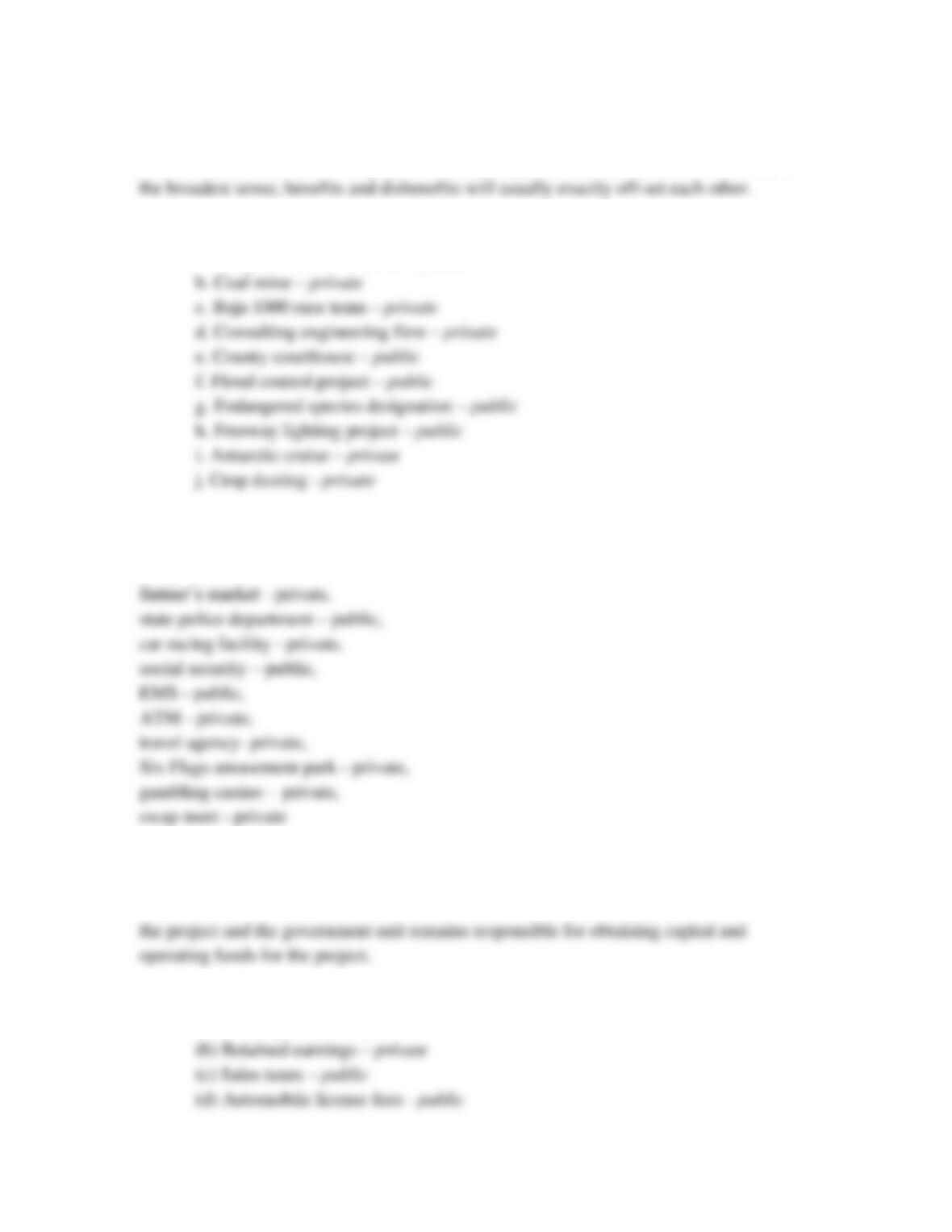
It is best to take a limited viewpoint in determining benefits and disbenefits. Because, in
Solution 7.2
a. Bridge across Ohio River – public
Solution 7.3
eBay – private,
Solution 7.4
Under a DBOMF contract, the contractor is responsible for managing the cash flows for
Solution 7.5
(a) Municipal bonds – public
Solution 7.6
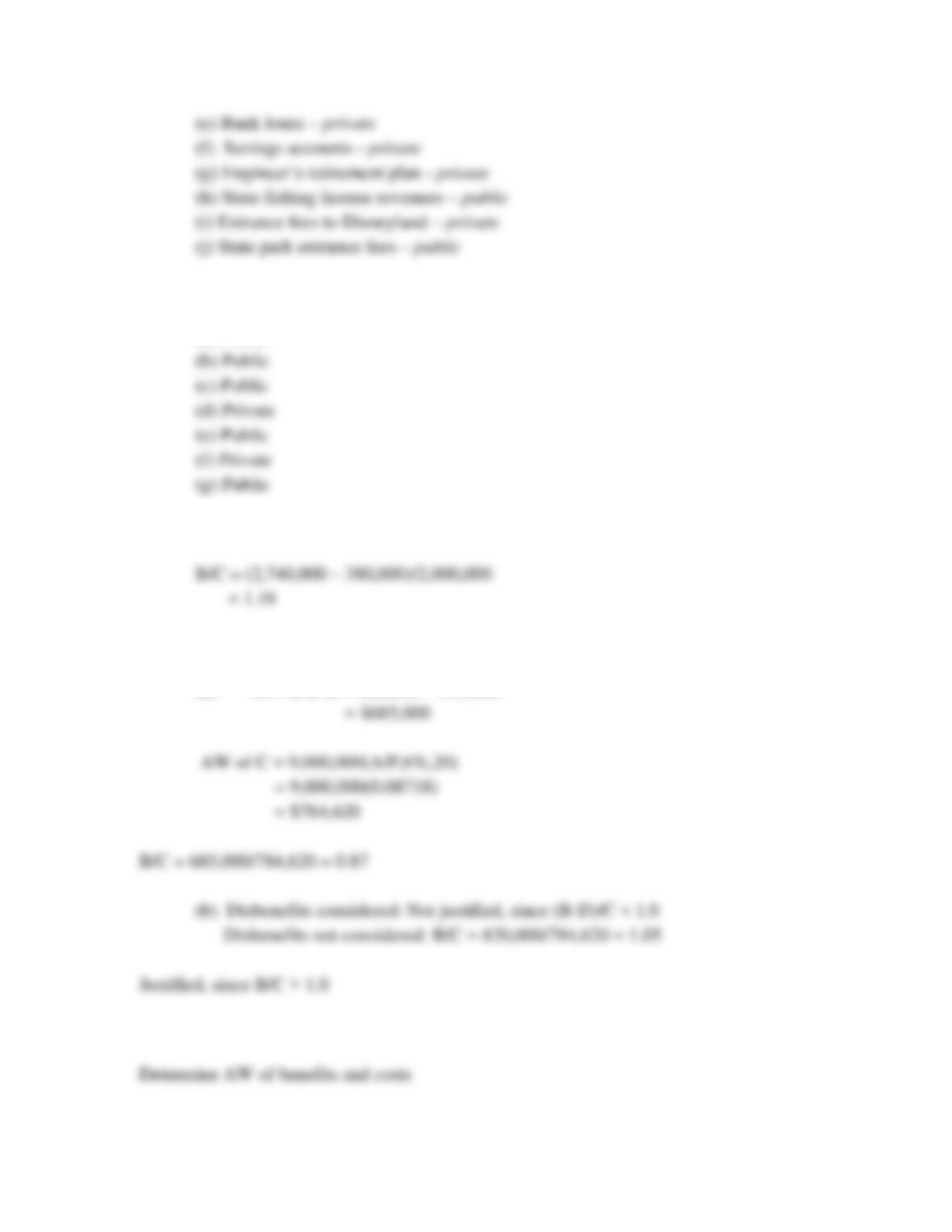
(a) Public
Solution 7.7
Solution 7.8
(a) AW of B-D = 820,000 – 135,000
Solution 7.9
Solution 7.10
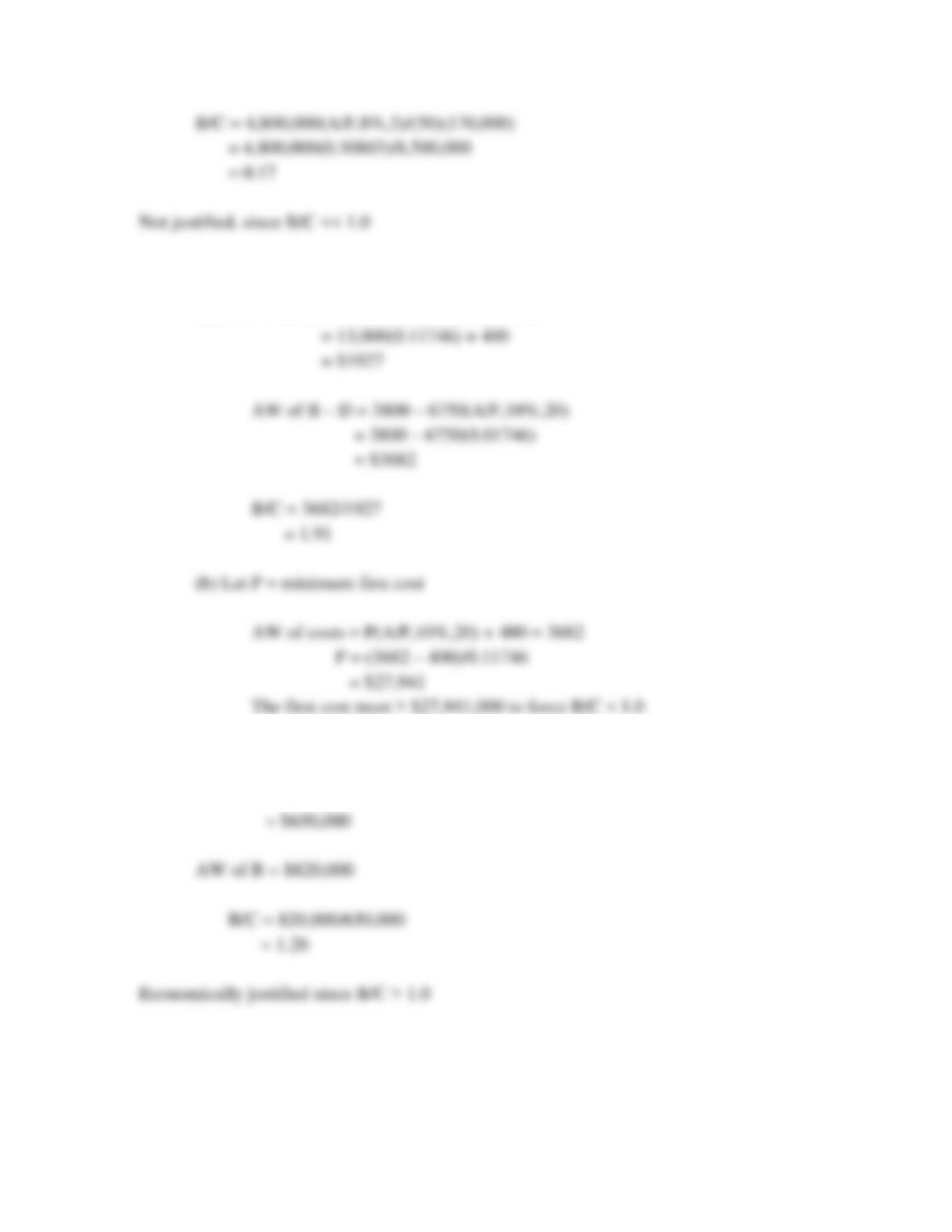
(a) AW of Costs = 13,000(A/P,10%,20) + 400
Solution 7.11
AW of C = 6,500,000(0.08) + 130,000
Solution 7.12
In $ million units,
Solution 7.13
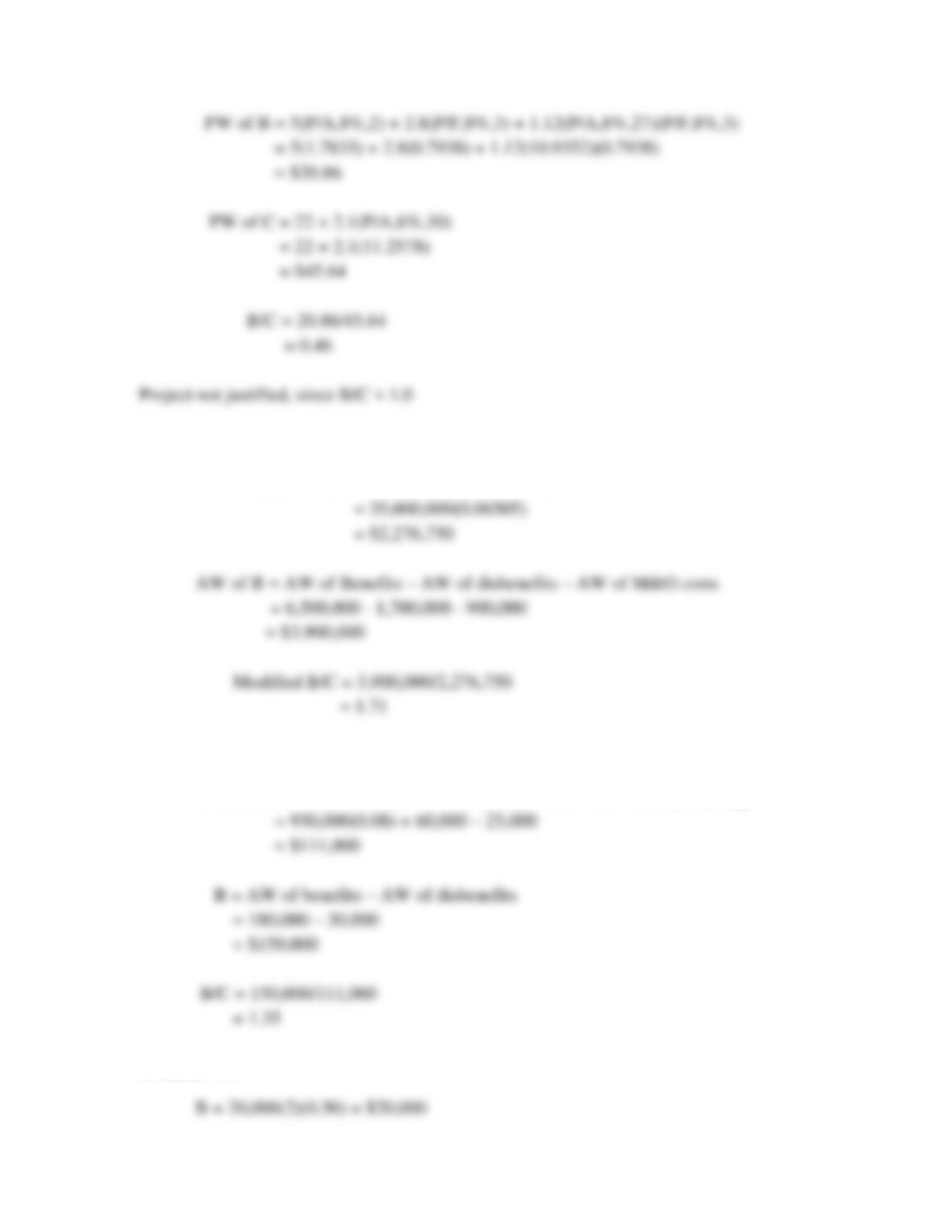
AW of initial cost, C = 35,000,000(A/P,5%,30)
Solution 7.14
AW of C = AW of first cost + AW of annual cost – AW of annual savings
Solution 7.15
Solution 7.16
Let P = initial cost
Solution 7.17
Solution 7.18
Let P = initial cost
Solution 7.19
(a) B = $600,000
Solution 7.20
(a) B = $340,000
Solution 7.21
Use annual worth, since most of the cash flows are in annual dollars.
(a) Conventional B/C ratio with S = savings
Solution 7.22
B = 41,000(33 –18) = $615,000
Solution 7.23
Benefits are directly estimated; DN is first alternative. Rank alternatives by increasing
PW of total costs: DN, 1, 2
Solution 7.24
The alternatives involve usage costs; DN is not an option
Solution 7.25
Calculate AW of total cost and rank according to increasing cost.
Benefits are directly estimated; DN is first alternative
Ranking is as follows: DN, Primary, Partial, Pond, Expand
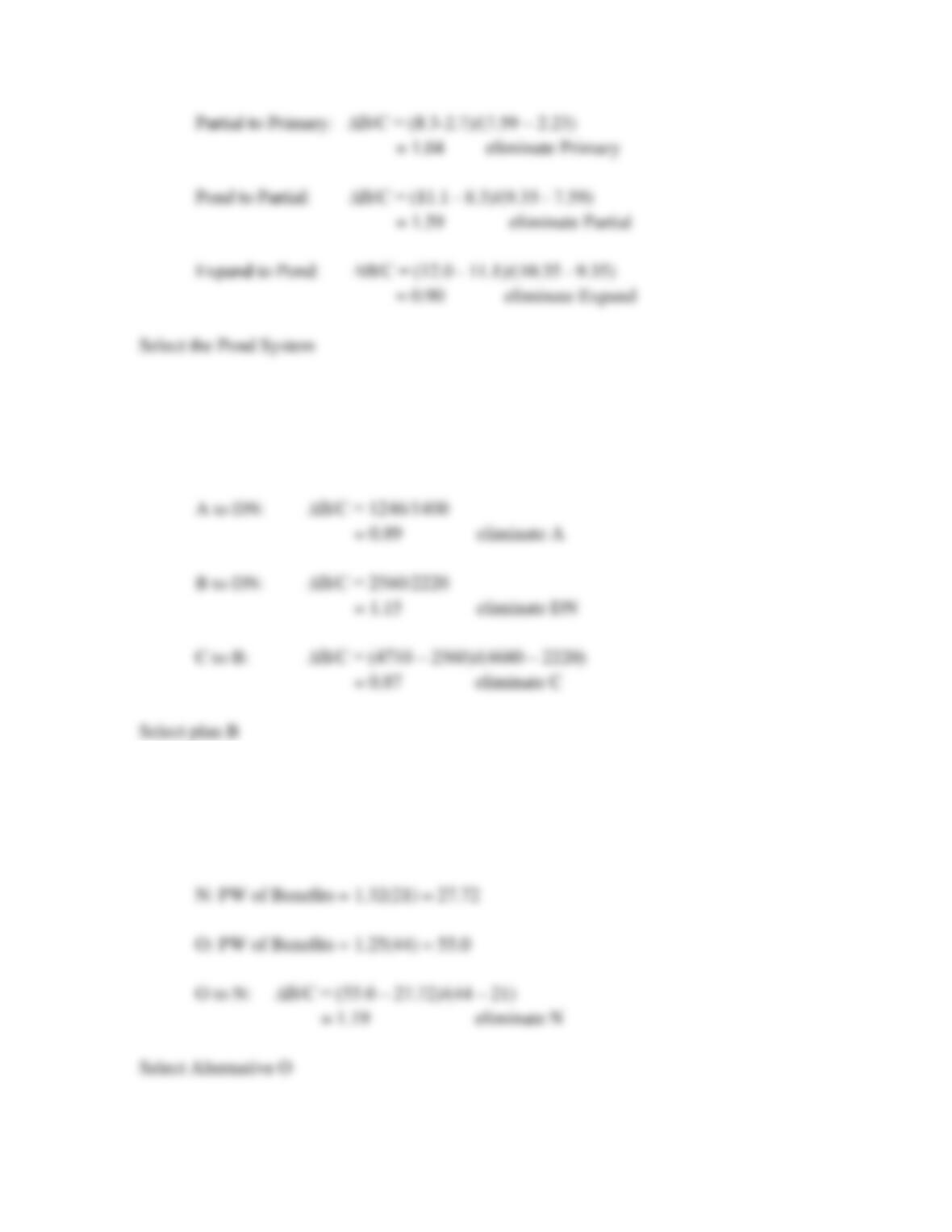
Solution 7.26
Benefits are directly estimated; DN is first alternative. Rank by increasing PW of cost:
DN, A, B, C. In $1000 units,
Solution 7.27
Eliminate alternatives M and P based on overall B/C ratios < 1. Compare N and O
incrementally after calculating their PW of benefits
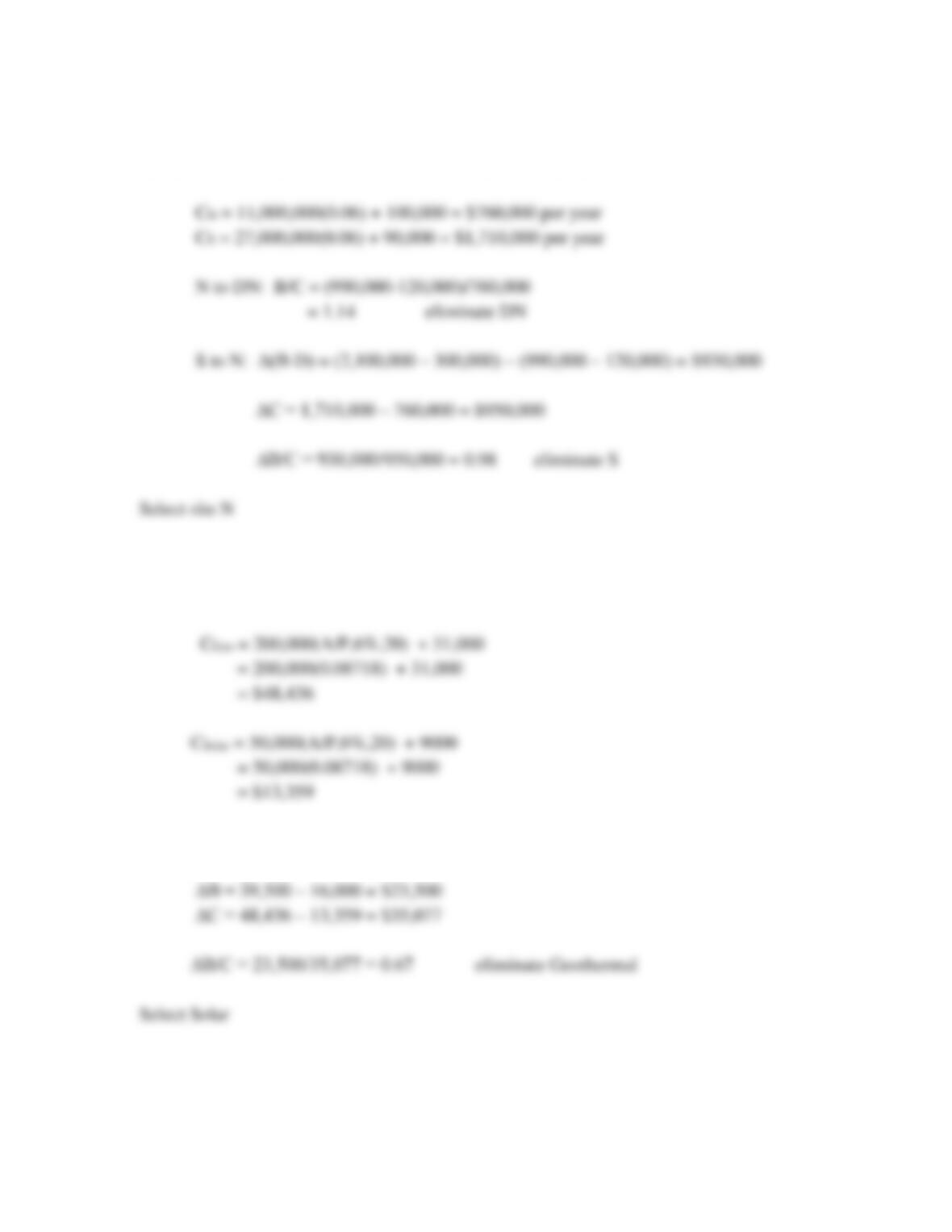
Solution 7.28
Benefits are direct; determine AW of costs; order is DN, N, S
Solution 7.29
DN is not an option since one of the alternatives must be selected.
Compare geothermal vs solar incrementally
Solution 7.30
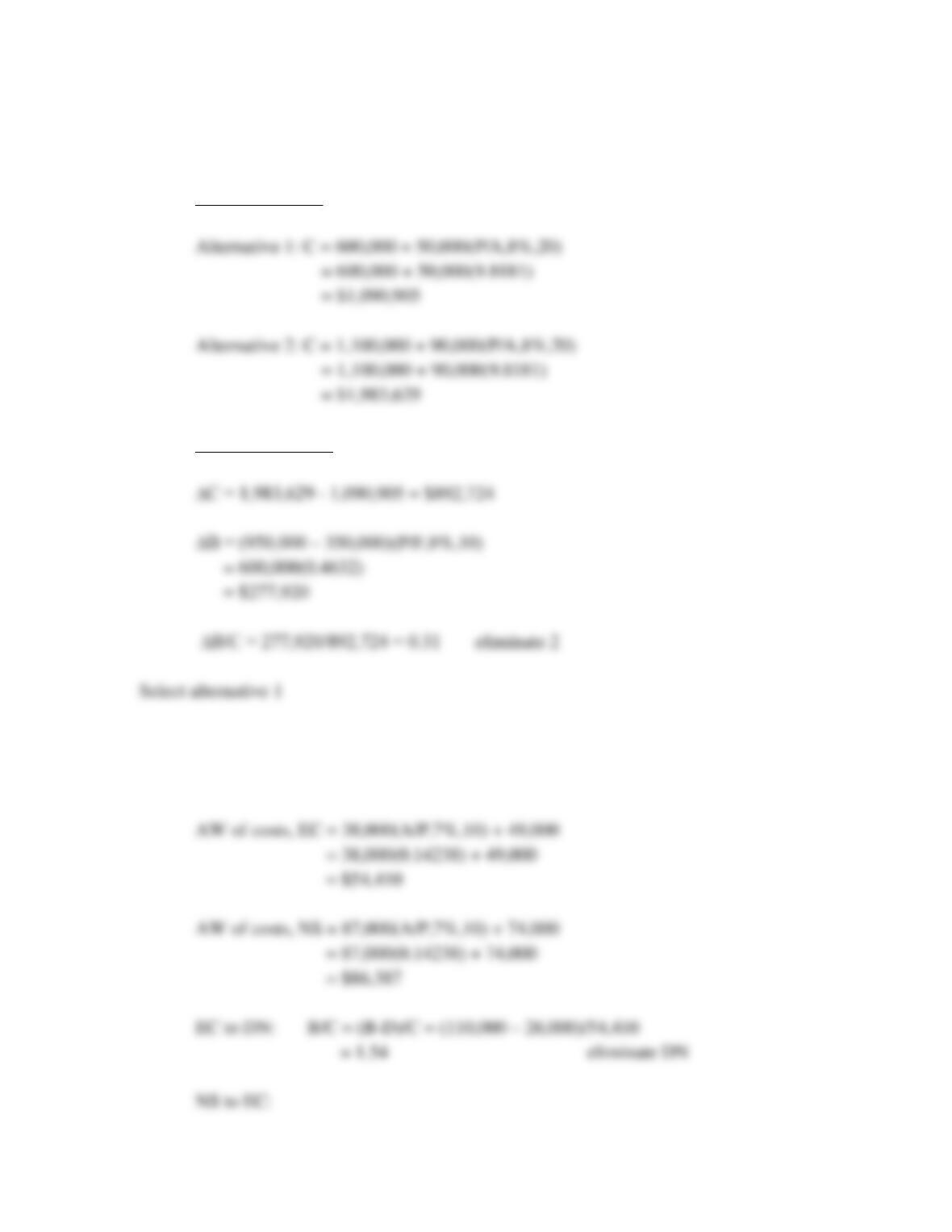
Base benefits on damage cost difference; DN not considered; rank by increasing PW of
total costs; order is: 1, 2
PW of total costs
Comparison 2 to 1
Solution 7.31
Rank by increasing AW of total costs; order is: DN, EC, NS
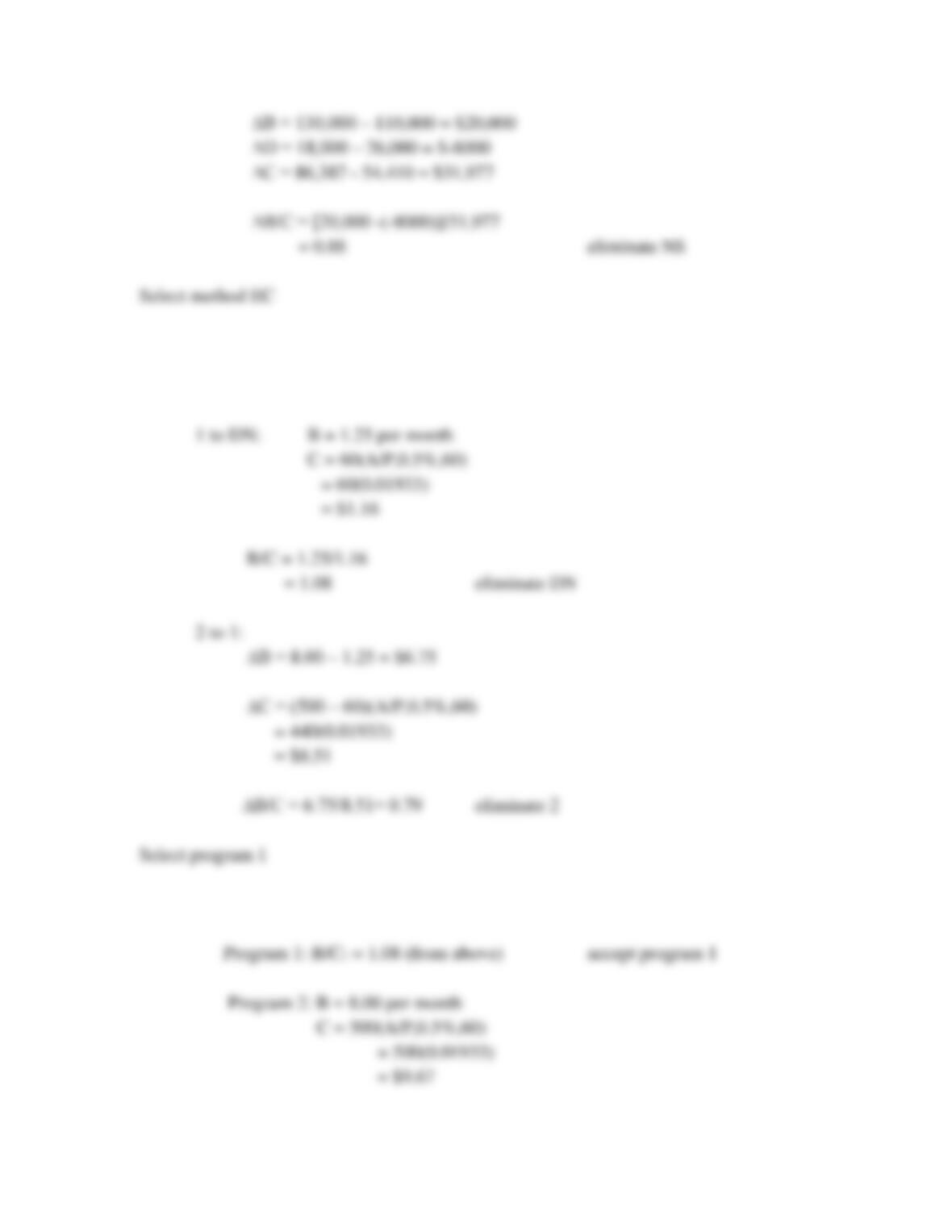
Solution 7.32
(a) Rank by initial cost; order is: 1, 2
(b) Determine overall B/C values
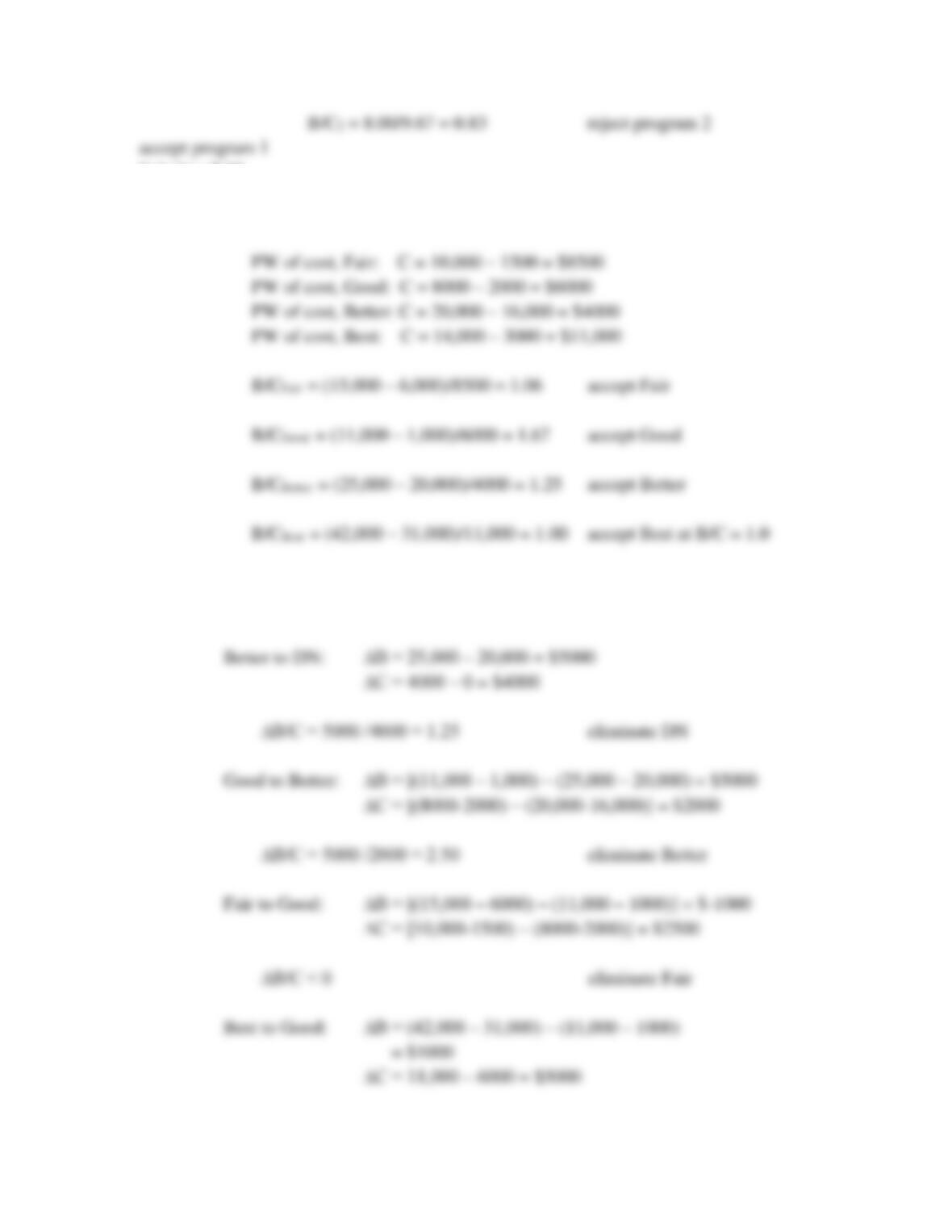
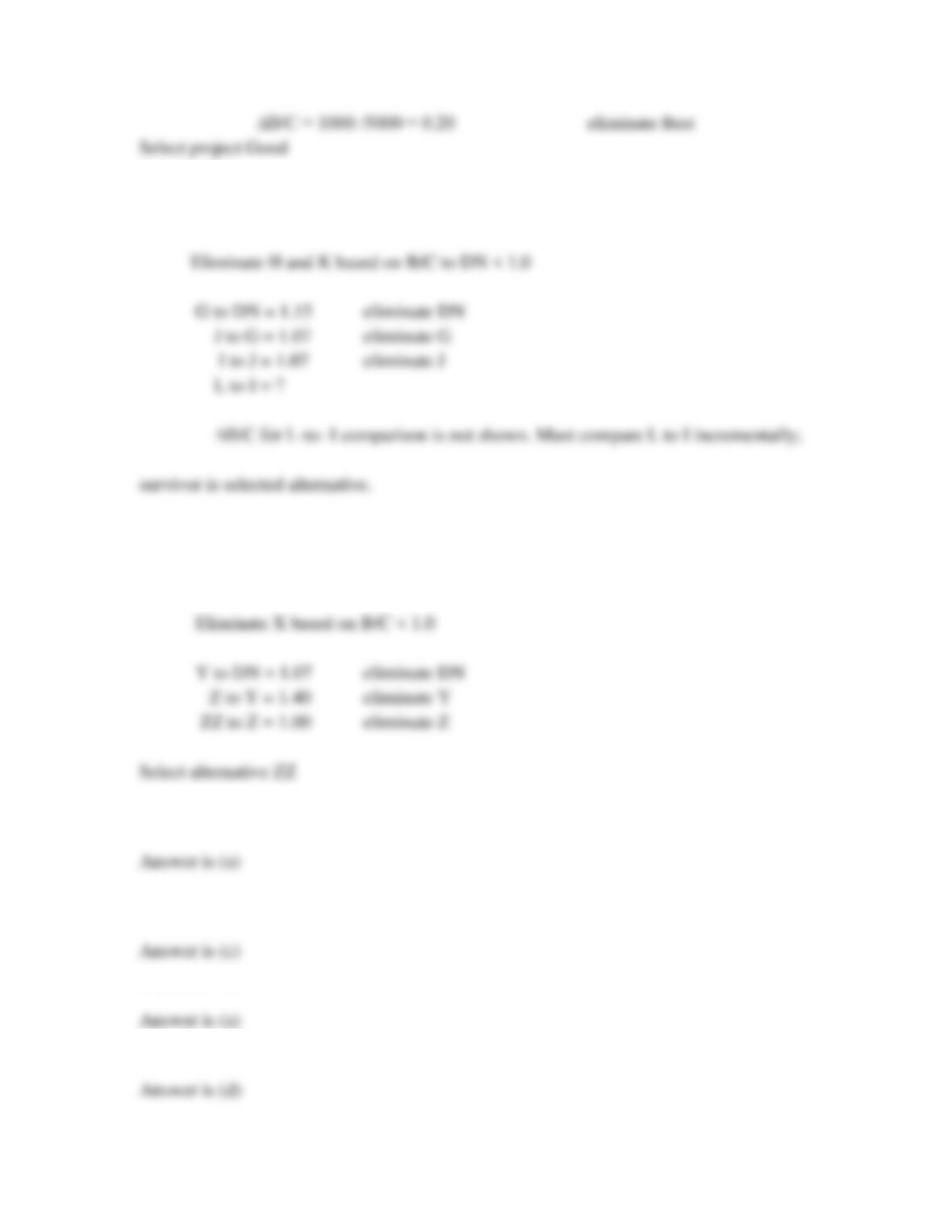
Solution 7.33
(a) Independent projects: Calculate overall (B-D)/C ratios
(b) Mutually exclusive alternatives: Rank by increasing PW of costs; DN is
considered; order is: DN, Better, Good, Fair, Best
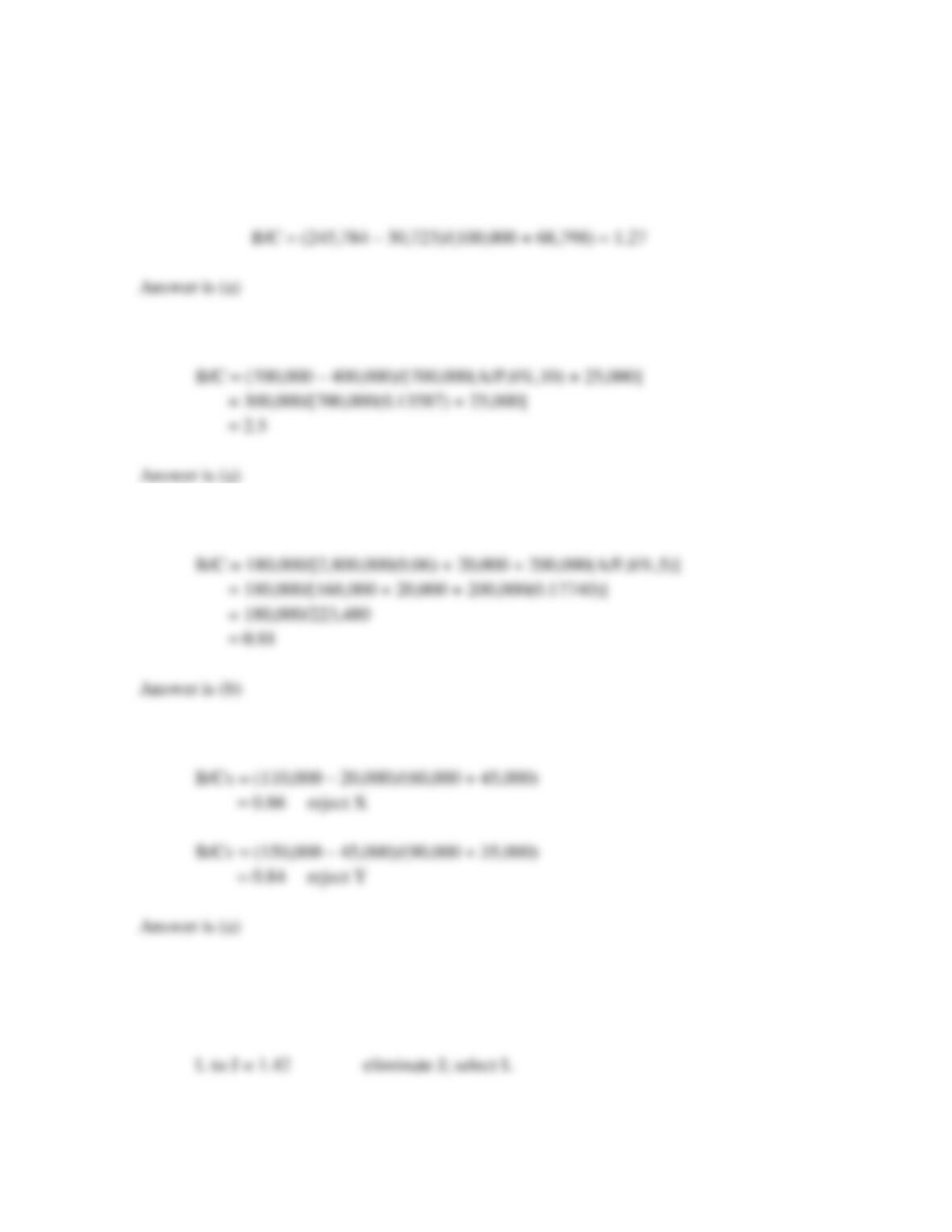
Solution 7.34
Rank alternatives by increasing cost: DN, G, J, H, I, L, K
Solution 7.35
Rank alternatives by increasing cost: DN, X, Y, Z, ZZ
Solution 7.36
Solution 7.37
Solution 7.38
Solution 7.39
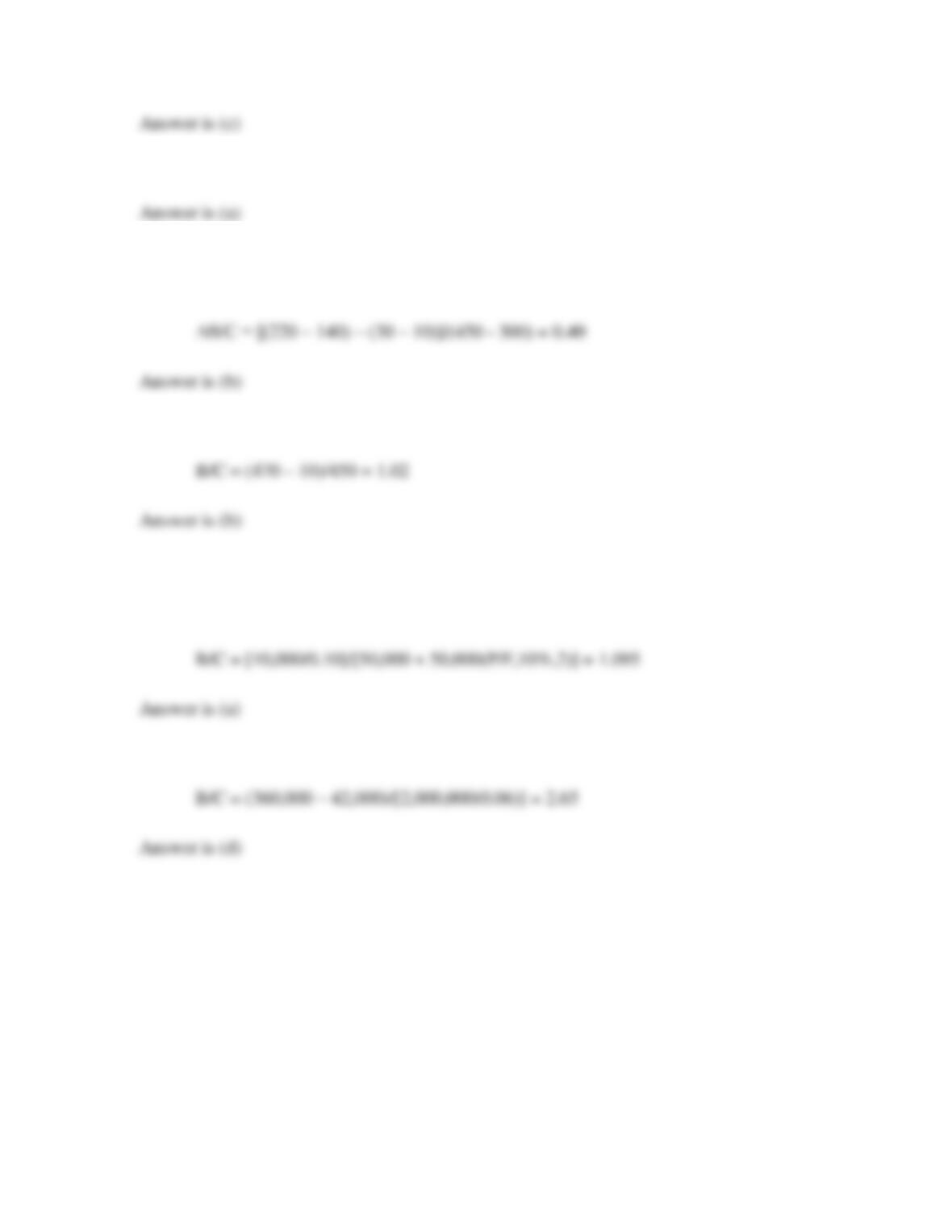
Solution 7.40
Can use either PW, AW, or FW values; For PW,
Solution 7.41
Solution 7.42
Solution 7.43
Solution 7.44
Alternatives are ranked according to cost; eliminate K and M since B/C <1.0
Solution 7.45
Solution 7.46
In $1000 units,
Solution 7.47
Solution 7.48
In terms of P = A/i
Solution 7.49