
Problem 6.1
In percent, what is (a) the highest, and (b) the lowest rate of return that is possible?
Problem 6.2
When interest is charged on the unrecovered balance, if you borrow $10,000 at 10% per
year interest and repay the loan in equal payments over a 5-year period the payment
amount is $2638 per year. How much will the annual payment be if the interest rate is
charged on the initial loan amount instead of the unrecovered balance?
Problem 6.3
Spectra Scientific of Santa Clara, CA manufactures Q-switched solid state industrial
lasers for LED substrate scribing and silicon wafer dicing. The company got a
$60 million loan, amortized over a 5-year period at 8% per year interest. What is the
amount of the unrecovered balance (a) immediately before the payment is made at the
end of year 1, and (b) immediately after the first payment?
Problem 6.4
The production of polyamide from raw materials of plant origin, such as castor oil,
requires 20% less fossil fuel than conventional production methods. Darvon Chemicals
borrowed $6 million to implement the process. If the interest rate on the loan is 10% per
year for 10 years, what is the amount of interest for year 2?
Problem 6.5
General Dynamics obtained a 0.5%-per-month $100 million loan to be repaid over a
5-year period. (a) What is the difference in the amount of interest in the second month’s
payment if interest is charged on the original principal of the loan rather than on the
unrecovered balance? (b) As months pass, for which basis – principal only or
unrecovered balance – does the monthly interest decrease in amount?
Problem 6.6
Use tabulated factors and a spreadsheet to determine the interest rate per period for the
following rate of return equation: 0 = – 40,000 + 8000(P/A,i*,5) + 8000(P/F,i*,8).
Problem 6.7
Determine the rate of return per year for the cash flows shown below. Use (a) tabulated
factors, and (b) a spreadsheet.
Year 1 2 3 4
Cash Flow, $ -80,000 9000 70,000 30,000
Problem 6.8
A company that manufactures brushless blowers invested $650,000 in an automated
quality control system for blower housings. The resultant savings was $160,000 per year
for 5 years. If the equipment had a salvage value of $50,000, what rate of return per year
did the company make?
Problem 6.9
A University of Massachusetts study found that married women who work outside the
home do about one hour less of housework per week for every $7500 they earn outside
the home. Assume that they hire a housekeeper one time per week for $120; that the
$7500 is received in uniform amounts of $625 per month; and, that the housekeeper is
paid weekly with these payments made before the $625 is received. What rate of return
are they making per week on their “investment” in the housekeeper?
Problem 6.10
A 473-foot, 7000 ton World War II troop carrier (once commissioned as the SS
Excambion) was sunk in the Gulf of Mexico to serve as an underwater habitat and diving
destination. The project took 10 years of planning and cost $4 million, which was spent
equally at $400,000 in years 1 through 10.Fishing and recreation activities, estimated at
$270,000 per year, will begin in year 11 and are expected to continue in perpetuity.
Determine the rate of return on the venture using (a) tabulated factors, and (b) the GOAL
SEEK tool.
Problem 6.11
The Closing the Gaps initiative by the Texas Higher Education Coordinating Board
established the goal of increasing the number of students in higher education in Texas
from 1,064,247 in 2000 to 1,694,247 in 2015. If the increase occurs uniformly and is
compounded annually, what rate of increase is required each year to meet the goal?
Problem 6.12
When Hurricane Katrina struck New Orleans, there was a significant loss of aquarium
fish at the Audubon Aquarium of the Americas. FEMA originally stated that the
aquarium needed to buy the fish from commercial vendors, a method the agency said
would cost $616,849 but would comply with disaster aid laws. FEMA later reversed
their decision and allowed the aquarium staff to catch the fish themselves at a total cost
of $99,766. If it is assumed that the aquarium staff spent the $99,766 equally over a
12 month period of time, what rate of return per month did their effort represent?
Assume FEMA would have given the Aquarium the $616,849 at the end of month 12.
Problem 6.13
Texas Governor Rick Perry promised to put hundreds of cameras on the Texas-Mexico
border and broadcast the video over the Web so that anyone, anywhere could become a
border patroller, helping root out border crime and illegal crossings. As part of that
project, Texas secured a federal grant for $3 million that paid for 200 mobile cameras in
strategic high-traffic areas. If the 200 cameras are considered to be equivalent to
20 border patrol agents, each with an annual salary of $75,000, what is the rate of return
over a 3-year project period?
Problem 6.14
The University of California at San Diego is considering a plan to build a 8- megawatt
cogeneration plant to provide for part of its power needs. The cost of the plant is
expected to be $41 million. The university consumes 55,000 megawatt-hours per year at
a cost of $120 per megawatt-hour. (a) If the university will be able to produce power at
half the cost that it now pays, what rate of return will it make on its investment for an
expected power plant life of 30 years? (b) If, in addition, the university can sell an
average of 12,000 megawatt-hours per year back to the utility at $90 per megawatt-hour,
what rate of return will it make?
Problem 6.15
The Camino Real Landfill was required to install a plastic liner to prevent leachate from
migrating into the groundwater. The fill area was 50,000 m2 and the installed liner cost
was $8 per square meter. In order to recover the investment, the owner charged $10 for
pick-up loads, $25 for dump truck loads, and $70 for compactor-truck loads. The annual
distribution is 2400 pick-up loads, 600 dump truck loads, and 1200 compactor-truck
loads. What rate of return will the landfill owner make on the investment if the fill area
is adequate for 4 years?
Problem 6.16
U.S Census Bureau statistics show that the annual earnings for a person with a high-
school diploma are $35,220 versus $57,925 for someone with a bachelor’s degree. If the
cost of attending college is assumed to be $30,000 per year for four years and the
foregone earnings during those years is assumed to be $35,220 per year, what rate of
return does earning a bachelor’s degree represent? Assume a 35-year study period.
Problem 6.17
Rubber sidewalks made from ground-up tires are said to be environmentally friendly and
easier on peoples’ knees. Rubbersidewalks, Inc. of Gardena, CA, manufactures the small
rubberized squares that are installed where tree roots, freezing weather, and snow
removal require sidewalk replacement or major repairs every three years. The District of
Columbia spent $60,000 for a rubber sidewalk to replace broken concrete in a residential
neighborhood lined with towering willow oaks. If a concrete sidewalk costs $28,000 and
lasts only 3 years versus a 9-year life for the rubber sidewalks, what rate of return does
this represent?
Problem 6.18
Steel cable barriers in highway medians are a low cost way to improve traffic safety
without busting state department of transportation budgets. Cable barriers cost $44,000
per mile, compared with $72,000 per mile for guardrail and $419,000 per mile for
concrete barriers. Furthermore, cable barriers tend to snag tractor-trailer rigs, keeping
them from ricocheting back into same-direction traffic. The state of Ohio spent $4.97
million installing 113 miles of cable barriers. (a) If the cables prevent accidents totaling
$1.3 million per year, determine the rate of return that this represents over a 10-year
study period. Use all three methods — tabulated factors, a calculator, and a spreadsheet.
(b) Now, determine the rate of return for 113 miles of guardrail if accident prevention is
$1.1 million per year over a 10-year study period. To do so, first write the ROR relation
and then find i* using a single-cell spreadsheet function.
Problem 6.19
A broadband service company borrowed $2 million for new equipment and repaid the
loan in amounts of $200,000 in years 1 and 2 plus a lump sum amount of $2.2 million at
the end of year 3. What was the interest rate on the loan?
Problem 6.20
A new permanent endowment at the University of Alabama will award scholarships to
engineering students twice per year (end of June and end of December). The first awards
are to be made beginning 5-½ years after the $20 million lump sum donation is made. If
the interest from the endowment is intended to fund 100 students each semester in the
amount of $5000 twice per year, what semiannual rate of return must the endowment
fund earn?
Problem 6.21
An Indium-Gallium-Arsenide-Nitrogen alloy developed at Sandia National Laboratory is
said to have potential uses in electricity-generating solar cells. The new material is
expected to have a longer life, and it is believed to have a 40% efficiency rate, which is
nearly twice that of standard silicon solar cells. The useful life of a telecommunications
satellite could be extended from 10 to 15 years by using the new solar cells. What rate of
return could be realized if an extra investment now of $950,000 would result in extra
revenues of $450,000 in year 11, $500,000 in year 12, and amounts increasing by
$50,000 per year through year 15?
Problem 6.22
Barron Chemical used a thermoplastic polymer to enhance the appearance of certain RV
panels. The initial cost of one process was $130,000 with annual costs of $49,000.
Revenues were $78,000 in year 1, increasing by $1000 per year. A salvage value of
$23,000 was realized when the process was discontinued after 8 years. What rate of
return did the company make on the process?
Problem 6.23
Why is an incremental analysis necessary when conducting a rate of return evaluation of
cost alternatives?
Problem 6.24
What is the overall rate of return on a $100,000 investment that returns 20% on the first
$30,000 and 14% on the remaining $70,000?
Problem 6.25
Alternatives X and Y have rates of return of 10% and 18%, respectively. What is known
about the rate of return on the increment between X and Y if the investment required in Y
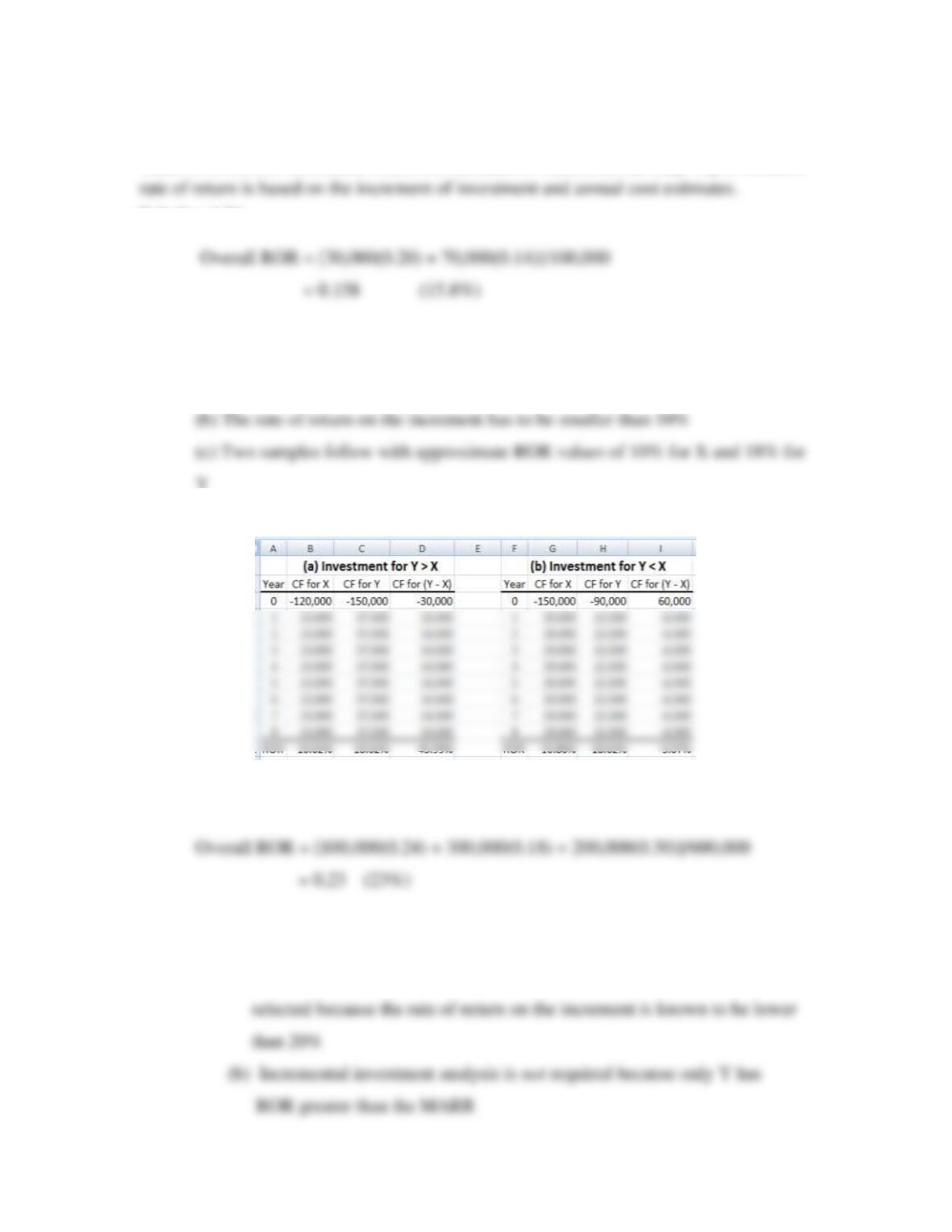
is (a) larger than that required for X, and (b) smaller than that required for X? (c) Develop
two spreadsheet examples that illustrate your responses to parts (a) and (b).
Problem 6.26
A company that manufactures rigid shaft couplings has $600,000 to invest. The company
is considering three different projects that will yield the following rates of return:
Project X iX = 24%
Project Y iY = 18%
Project Z iZ = 30%
The initial investment required for each project is $100,000, $300,000, and $200,000,
respectively. If the company’s MARR is 15% per year and the company invests in all
three projects, what overall rate of return will the company make?
Problem 6.27
For each of the following scenarios, state whether an incremental investment analysis is
required to select an alternative and state why or why not. Assume that alternative Y
requires a larger initial investment than alternative X and that the MARR is 20% per year.
a. X has i* = 22% per year, and Y has i* = 20% per year.
b. X has i* = 19% per year, and Y has i* = 21% per year.
c. X has i* = 16% per year, and Y has i* = 19% per year.

d. X has i* = 25% per year, and Y has i* = 23% per year.
e. X has i* = 20% per year, and Y has i* = 22% per year.
Problem 6.28
For the cash flows shown and in preparation for a PW-based rate of return analysis,
determine the incremental cash flow between machines B and A for (a) year 0, (b) year 3,
and (c) year 6.
Machine A Machine B
First cost, $ -15,000 -25,000
Annual operating cost, $ per year -1,600 -400
Salvage value, $ 3,000 6,000
Life, years 3 6
Problem 6.29
Determine the sum of the cash flows in the incremental difference column (i.e., Y-X) for
systems X and Y.
System X System Y
First cost, $ -45,000 -65,000
Annual operating cost, $ -21,800 -14000
Salvage value, $ 3,000 6,000
Life, years 5 5
Problem 6.30
For the alternatives shown, determine the sum of the cash flows in the Z-X difference
column.
System X System Z
First cost, $ –40,000 –95,000
Annual operating cost, $/year –12,000 –5,000
Salvage value, $ 6,000 14,000
Life, years 3 6
Problem 6.31

The incremental cash flows for alternatives P and Q are shown. Determine which should
be selected using a FW-based rate of return analysis. The MARR is 15% per year and
alternative Q requires the larger initial investment.
Incremental
Year Cash Flow (Q-P)
0 $–250,000
1–8 +50,000
8 +30,000
Problem 6.32
The Chem-Tex Chemical company is considering two additives for improving the dry-
weather stability of its low-cost acrylic paint. Additive A will have a first cost of
$110,000 and an annual operating cost of $60,000. Additive B will have a first cost of
$175,000 and an annual operating cost of $35,000. If the company uses a three-year
recovery period for paint products and a MARR of 20% per year, which process is
favored on the basis of an incremental rate of return analysis?
Problem 6.33
Liquid Sleeve, Inc. is a company that makes a sealing solution for machine shaft surfaces
that have been compromised by abrasion, high pressures, or inadequate lubrication. The
manager is considering adding a metal-based nanoparticle (Type Al or Fe) to its solution
to increase the product’s performance at high temperatures. The costs associated with
each type are estimated. If the company’s MARR is 20% per year, which nanoparticle
type should the company select? Utilize a rate of return analysis.
Type Fe Type Al
First cost, $ –150,000 –280,000
Annual operating cost, $/year –92,000 –74,000
Salvage value, $ 30,000 70,000
Life, years 2 4
Problem 6.34
A mechanical engineer is considering two robots for improving materials handling in the
production of rigid shaft couplings that mate dissimilar drive components. Robot X has a
first cost of $84,000, an annual maintenance and operation (M&O) cost of $31,000, a
$40,000 salvage value, and will improve net revenues by $96,000 per year. Robot Y has
a first cost of $146,000, an annual M&O cost of $28,000, a $47,000 salvage value, and
will increase net revenues by $119,000 per year. Which one should be selected on the
basis of a rate of return analysis if the company’s MARR is 15% per year? Use a three–
year study period.

Problem 6.35
Old Southwest Canning Co. has determined that any one of four machines can be used in
a certain phase of its chili-canning operation. The first costs and annual operating costs
(AOC) are estimated below, and all machines have a 5-year life. The MARR is 25% per
year. (a) Determine which machine should be selected on the basis of a rate of return
analysis. (b) Use a spreadsheet to perform PW analysis of each machine. Compare the
machine selections with that of the ROR analysis.
Machine First Cost, $ AOC, $
1 -28,000 -20,000
2 -51,000 -12,000
3 -32,000 -19,000
4 -33,000 -18,000
Problem 6.36
The four alternatives described below are being evaluated.
a. If the proposals are independent, which one(s) should be selected at a MARR
of 17% per year?
b. If the proposals are mutually exclusive, which one should be selected at a
MARR of 14.5% per year?
c. If the proposals are mutually exclusive, which one should be selected at a
MARR of 10.0% per year?
Incremental Rate
of Return, %, When
Compared with
Initial Overall Rate Alternative___
Alternative Investment, $ of Return, % A B C_
A -60,000 11.7
B -90,000 22.2 43.3
C -140,000 17.9 22.5 10.0
D -190,000 15.8 17.8 10.0 10.0
Problem 6.37

A small manufacturing company expects to expand its operation by adding new product
lines. Any or all of four new lines can be added. If the company uses a MARR of 15%
per year and a 5-year project period, which products, if any, should the company
manufacture? Monetary terms are in $1000.
Product___________________
1 2 3 4____
Initial cost, $ -340 -500 -570 -620
Annual cost, $/year -70 -64 -48 – 40
Annual savings, $/year 180 190 220 205
Problem 6.38
A WiMAX wireless network integrated with a satellite network can provide connectivity
to any location within 10 km of the base station. The number of sectors per base station
can be varied to increase the bandwidth. An independent cable operator is considering
the three bandwidth alternatives shown below (monetary values in $1000 units). Assume
a life of 20 years and a MARR of 25% per year to determine which alternative is best
using an incremental ROR analysis.
Operating Annual
Bandwidth, First Cost, Income,
Mbps Cost, $ $ per year $ per year
44 -40,000 -2000 +4000
55 -46,000 -1000 +5000
88 -61,000 -500 +8000
Problem 6.39
Ashley Foods, Inc. has determined that only one of five machines can be used in one
phase of its dairy products operation. The first and annual costs are estimated; all
machines are expected to have a 4-year useful life. If the MARR is 20% per year,
determine which machine should be selected on the basis of rate of return.
Machine First Cost, $ AOC, $ per year
1 -31,000 -16,000
2 -29,000 -19,300
3 -34,500 -17,000
4 -49,000 -12,200
5 -41,000 -15,500
Problem 6.40

Five revenue projects are under consideration by General Dynamics for improving
material flow thorough an assembly line. The initial cost (in $1000 units) and life of each
project are estimated. Income estimates are not known at this point.
Project_____________
A B C D E__
Initial cost, $ -700 -900 -2300 -300 -1600
Life, years 5 5 5 5 5
An engineer determined the incremental ROR (∆i*) values. From these results, determine
which project, if any, should be undertaken, provided the company’s MARR is (a) 13.5%
per year, and (b) 16% per year. If other calculations must be made in order to make a
decision, state which ones are necessary.
Comparison ∆i*, % Comparison ∆i*, %
C to DN 24 B to A 53
C to B 25 B to DN 23
D to DN 15 A to DN 13
E to C 59 E to B -16
E to D 4 B to D 26
E to A 0 D to C 25
E to DN 6 A to D 12
Problem 6.41
Four different machines are under consideration for improving material flow in a
production process. An engineer performed an economic analysis to select the best
machine, but some of his calculations were deleted from the report by a disgruntled
employee. All machines are assumed to have a 10-year life. (a) Fill in the missing
numbers in the report. (b) Which machine should the company select, if its MARR is
18% per year and one of the machines must be selected?
___________________Machine_________________
1 2 3 4__
Initial cost, $ ? -60,000 -72,000 -98,000
Annual cost, $ per year -70,000 -64,000 -61,000 -58,000
Annual savings, $ per year +80,000 +80,000 +80,000 +82,000
Overall ROR, % 18.6% ? 23.1% 20.8%
Machines compared 2 to 1 3 to 2 4 to 3
Incremental investment, $ -16,000 ? -26,000
Incremental cash flow, $ per year +6,000 +3,000 ?
ROR on increment, % 35.7% ? ?

Problem 6.42
Allstate Insurance Company is considering adopting one of five fraud detection systems,
all of which can be considered to last indefinitely. If the company’s MARR is 14% per
year, determine which one should be selected on the basis of a rate of return analysis.
A B C D E___
First cost, $ -10,000 -25,000 -15,000 -70,000 -50,000
Annual net income, $/year 2,000 4,000 2,900 10,000 6,000
Overall ROR, % 20 20 19.3 14.3 12
Problem 6.43
The four revenue proposals described below are being evaluated.
a. If the proposals are independent, which one(s) should be selected with
MARR = 15.5% per year?
b. If the proposals are mutually exclusive, which one should be selected with
MARR = 10% per year?
c. If the proposals are mutually exclusive, which one should be selected with
MARR = 14% per year?
∆i* when
Compared with
Initial Proposal Proposal, %____
Proposal Investment, $ i*, % A B C_
A -40,000 29
B -75,000 15 1
C -100,000 16 7 20
D -200,000 14 10 13 12
Problem 6.44
An engineer initiated a rate of return analysis for the infinite-life revenue proposals
detailed below, but was unable to complete the evaluation.
a. Fill in the eleven blanks in the table.

b. What proposal(s) should be selected if they are independent and MARR is
21% per year?
c. What proposal should be selected if they are mutually exclusive and MARR is
13% per year.
∆i* on Incremental Cash Flow
Proposal when Compared with Proposal, %
Proposal Investment, $ i*, % X1 X2 X3 X4_____
X1 -20,000 ? – ? ? ?
X2 –30,000 13.33 2 – ? ?
X3 –50,000 ? 14 20 – ?
X4 –75,000 12 ? ? ? –
Problem 6.45
For the following incremental cash flow series, what is the maximum number of i* values
according to the cash flow rule of signs?
Year 0 1 2 3 4 5 6 7 8
Cash Flow, $ -100 40 35 -15 -11 60 42 12 -10
Problem 6.46
Jenco Electric manufactures washdown adjustable speed drives in open loop, encoderless,
and closed-loop servo configurations. The net cash flow associated with one phase of the
production operation is shown below.
(a) How many possible rate of return values are there according to the cash flow rule of
signs?
(b) How many changes of sign occur in the cumulative cash flow series? What does this
mean?
Year Net Cash Flow, $
0 -40,000
1 32,000
2 18,000
3 -2000
4 -1000
Problem 6.47

For the following incremental cash f low series, use a spreadsheet to find all rate of return
values between 0% and 100%.
Incremental
Year Cash Flow, $
0 -50,000
1 +22,000
2 +38,000
3 -2000
4 -1000
5 +5000
Problem 6.48
According to Descartes’ rule of signs, how many possible i* values are there for net cash
flows that have the following signs:
(a) —+++—+
(b) ——+++++
(c) ++++——+-+—
Problem 6.49
The cash flow (in $1000 units) associated with a new method of manufacturing box
cutters is shown below for a 2-year period. (a) Use Descartes’ rule to determine the
maximum number of possible rate of return values. (b) Use Norstrom’s criterion to
determine if there is only one positive rate of return value.
Expenses, Revenue,
Quarter $1000 $1000_
0 -20 0
1 -20 5
2 -10 10
3 -10 25
4 -10 26
5 -10 20
6 -15 17
7 -12 15
8 -15 2
Problem 6.50

ARCI Instruments manufactures a ventilation controller designed for monitoring
and controlling carbon monoxide in parking garages, boiler rooms, tunnels, etc. The net
cash flow associated with one phase of the operation is shown below. (a) How many
possible rate of return values are there for this cash flow series? (b) Find all the rate of
return values between 0 and 100% using tabulated factors and a spreadsheet.
Year Net Cash Flow, $
0 -30,000
1 20,000
2 15,000
3 -2000
Problem 6.51
The cash flows associated with sales of handheld refractometers (instruments that
measure the concentration of an aqueous solution by determining its refractive index) are
shown. Determine the cumulative cash flow through year 4 and estimate the expected
number of positive, real-number i* values.
Year 1 2 3 4__
Revenue, $ 25,000 15,000 4,000 18,000
Costs, $ 30,000 7,000 6,000 12,000
Problem 6.52
Boron nitride spray II (BNS II) from GE’s Advanced Material Ceramics Division is a
release agent and lubricant that prevents materials such as molten metal, rubber, plastics,
and ceramic materials from sticking to or reacting with dies, molds, or other surfaces. A
European distributor of BNS II and other GE products had the net cash flows shown.
(a) Determine the number of possible rate of return values. (b) Find all rate of return
values between -30% and 130%.
Year Net Cash Flow, $
0 –17,000
1 –20,000
2 4,000
3 –11,000
4 32,000
5 47,000
Problem 6.53

Faro laser trackers are portable contact measurement systems that use laser technology to
measure large parts and machinery to accuracies of 0.0002 inches across a wide range of
industrial applications. A customer that manufactures and installs cell phone relay dishes
and satellite receiving stations reported the cash flows (in $1000 units) for one of its
product lines. (a) Determine the number of possible rate of return values. (b) Find all rate
of return values between 0 and 150%.
Year Expense, $ Receipts, $
0 -3000 0
1 -1500 2900
2 -4000 5700
3 -2000 5500
4 -1300 1100
Problem 6.54
For the cash flow series shown, find the external rate of return using a reinvestment rate
of 15% per year, using (a) the manual ROIC method, and (b) a spreadsheet to verify the
answer.
Incremental
Year Cash Flow, $
0 +48,000
1 +20,000
2 – 90,000
3 +50,000
4 -10,000
Problem 6.55
Carl, an engineer working for GE invested his bonus money each year in company stock.
His bonus at the end of each year 1 through 6 has been $5000. At the end of year 7, Carl
received no bonus and he sold $9000 worth of stock to remodel his kitchen. In years 8
through 10, he again received a bonus and invested the $5000. Carl sold all the remaining
stock for $50,000 immediately after the last investment at the end of year 10.
a. Determine the expected number of positive rate of return values.
b.
c. Find the internal rate(s) of return.

d.
e. Use hand solution and the MIRR spreadsheet function to determine the external
rate of return using the modified rate of return approach with a borrowing rate of
8% and a reinvestment rate of 20% per year
Determine the external rate of return using the ROIC approach with a reinvestment rate
of 20% per year. Apply both the net-investment procedure and spreadsheet functions to
obtain the EROR.
Problem 6.56
A company that makes clutch disks for race cars had the cash flows shown for one
department.
(a) Calculate the internal rate of return.
(b) Calculate the external rate of return using the ROIC method with a reinvestment rate
of 15% per year.
(c) Calculate the external rate of return using the MIRR method with a reinvestment rate
of 15% per year and a borrowing rate of 8% per year.
(d) Rework parts (b) and (c) using a spreadsheet.
Year Cash Flow, $1000
0 -65
1 30
2 84
3 -10
4 -12
Problem 6.57
Gemini Products makes vitamin-enriched cereal products for large super market chains.
They have forecasted the cash flows (in $1000 units) for this and the next 4 years.
Develop hand and spreadsheet solutions that determine the EROR for (a) the ROIC
method with ir =14% per year, and (b) the MIRR method with ir = 14% and ib = 8% per
year. (c) Comment on these two EROR values compared to the IRR value(s) obtained
using the IRR-function ‘guess’ option to discover multiple roots.
Year Cash Flow, $
0 3000

1 -2000
2 1000
3 -6000
4 3800
Problem 6.58
A public-private initiative in Florida will significantly expand the wind-generated energy
throughout the state. The cash flow for one phase of the project involving Central Point
Energy, a transmission utility company, is shown. Calculate the external rate of return
(a) using the ROIC method and an investment rate of 14% per year, and (b) using the
modified ROR approach with an investment rate of 14% and a borrowing rate of 7% per
year. Solve by hand or spreadsheet, as requested by your instructor.
Year Cash Flow, $1,000
0 5000
1 -2000
2 -1500
3 -7000
4 4000
Problem 6.59
A new advertising campaign by a company that manufactures products that rely on
biometrics, surveillance, and satellite technologies resulted in the cash flows shown (in
$1000 units). Develop one spreadsheet that displays the following: external rate of return
using both the ROIC method with ir = 30% per year, and the modified ROR approach
with ir = 30% and ib = 10% per year; and the unique or multiple internal rate of return
value(s) indicated by the two multiple-root sign tests.
Year Cash Flow, $
0 2000
1 1200
2 -4000
3 -3000
4 2000
Problem 6.60
The lowest rate of return possible is:
a. 0%
b. –∞
c. -100%
d. the company’s MARR
Problem 6.61
When calculating an i* value, all net positive cash flows are assumed to be reinvested at:
a. the current market interest rate.
b. the i* rate.
c. the company’s MARR
d. the company’s cost of capital.
Problem 6.62
Alternative A has a rate of return of 14% and alternative B has a rate of return of 17%. If
the investment required in B is larger than that required for A, the rate of return on the
increment of investment between A and B is:
a. larger than 14%
b. larger than 17%
c. between 14% and 17%
d. smaller than 14%
Problem 6.63
A small manufacturing company borrowed $1 million and repaid the loan through
monthly payments of $20,000 for 2 years plus a single lump-sum payment of $1 million
at the end of 2 years. The interest rate on the loan was closest to:
a. 0.5% per month
b. 2% per month
c. 2% per year
d. 8% per year
Problem 6.64
An investment of $60,000 resulted in uniform income of $10,000 per year for 10 years.
The rate of return on the investment was closest to:
a. 10.6% per year
b. 14.2% per year
c. 16.4% per year
d. 18.6% per year
Problem 6.65
Assume you are told that by investing $100,000 now, you will receive $10,000 per year
starting in year 5 and continuing forever. If you accept the offer, the rate of return on the
investment is:
a. 4% per year
b. between 6% and 7% per year
c. between 7% and 10% per year
d. over 12% per year
Problem 6.66
A chemical engineer working for a large chemical products company was asked to make
a recommendation about which of three mutually exclusive revenue alternatives should
be selected for improving the marketability of personal care products used for
conditioning hair, cleansing skin, removing wrinkles, etc. The alternatives (X, Y, and Z)
were ranked in order of increasing initial investment and then compared by incremental

rate of return analysis. The rate of return on each increment of investment was less than
the company’s MARR of 17% per year. The alternative to select is:
a. DN
b. alternative X
c. alternative Y
d. alternative Z
Problem 6.67
The five alternatives are being evaluated by the rate of return method.
∆i*, %, when
Initial Overall ______ Compared with______
Proposal Investment, $ i*, % A B C D E__
A -25,000 9.6 — 27.3 19.4 35.3 25
B -35,000 15.1 — 0 38.5 24.4
C -40,000 13.4 — 46.5 27.3
D -60,000 25.4 — 26.8
E -75,000 20.2
If the alternatives are independent and the MARR is 15% per year, the one(s) that
should be selected is (are):
a. only D
b. only D and E
c. only B, D, and E
d. only E
Problem 6.68
The five alternatives are being evaluated by the rate of return method.
∆i*, %, when
Initial Overall ______ Compared with______

Proposal Investment, $ i*, % A B C D E__
A -25,000 9.6 — 27.3 19.4 35.3 25
B -35,000 15.1 — 0 38.5 24.4
C -40,000 13.4 — 46.5 27.3
D -60,000 25.4 — 26.8
E -75,000 20.2
If the alternatives are mutually exclusive and the MARR is 15% per year, the
alternative to select is:
a. either B,C,D or E
b. only B
c. only D
d. only E
Problem 6.69
Jewel-Osco evaluated three different pay-by-touch systems that identify customers by a
finger scan and then deduct the amount of the bill directly from their checking accounts.
The alternatives were ranked according to increasing initial investment and identified as
alternatives A, B, and C.
Comparison ∆i*, %
DN to A 23.4
DN to B 8.1
DN to C 16.6
B to A –5.1
C to A 12.0
C to B 83.9
Based on the incremental rates of return and the company’s MARR of 16% per year, the
alternative that should be selected is:
a. alternative A
b. alternative B
c. alternative C

d. alternative DN
Problem 6.70
For the cash flows shown, the correct equation for F2 using the ROIC method at the
reinvestment rate of 20% per year is:
a. [10,000(1+ i′) + 6000](1.20) – 8000
b. [10,000(1.20) + 6000(1+ i′)](1.20) – 8000
c. [10,000(1.20) + 6000](1.20) – 8000
d. [10,000(1.20) + 6000](1+ i′) – 8000
Year Cash Flow, $
0 10,000
1 6,000
2 -8,000
3 -19,000
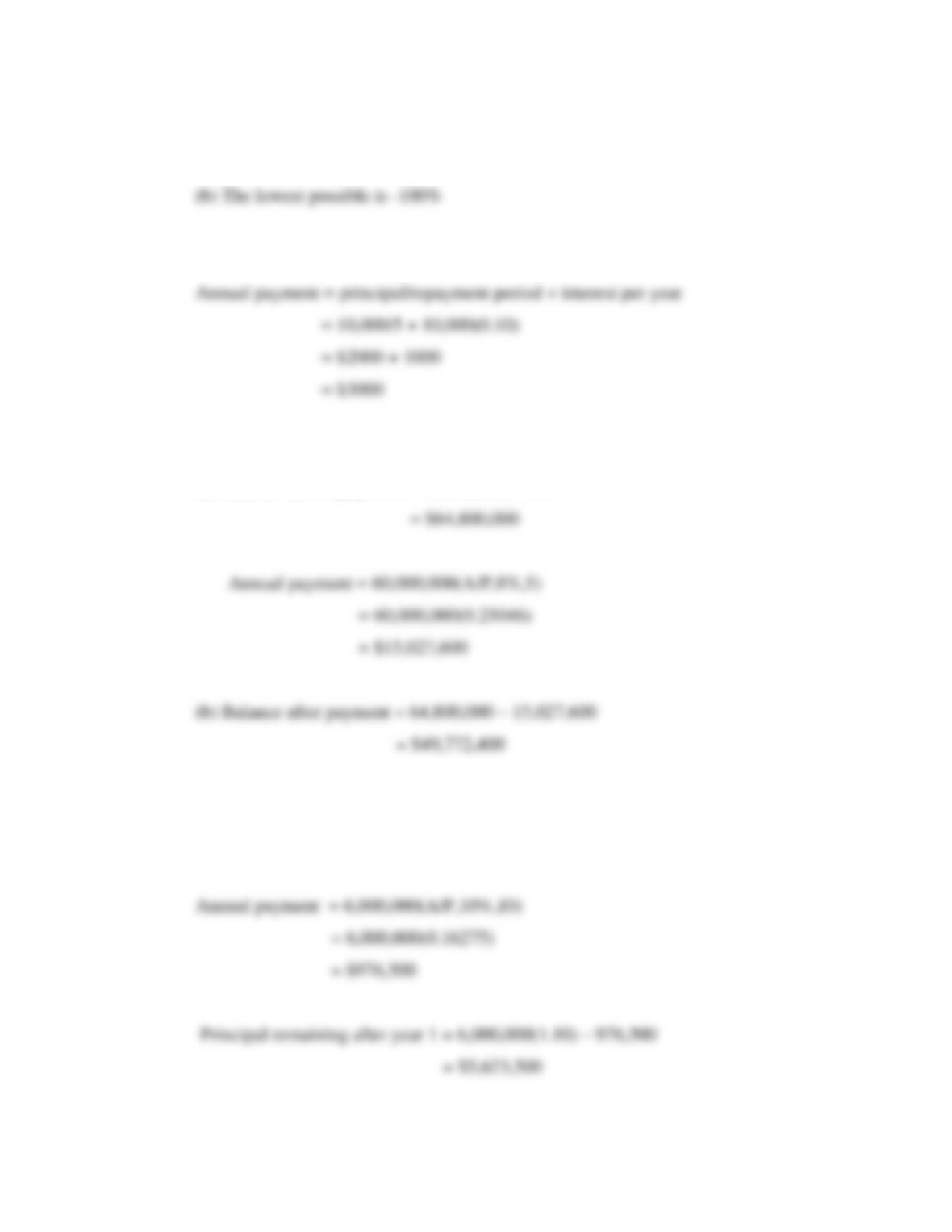
Solution 6.1
(a) The highest possible is infinity
Solution 6.2
Solution 6.3
(a) Balance before payment = 60,000,000(1.08)
Solution 6.4
In $ million units
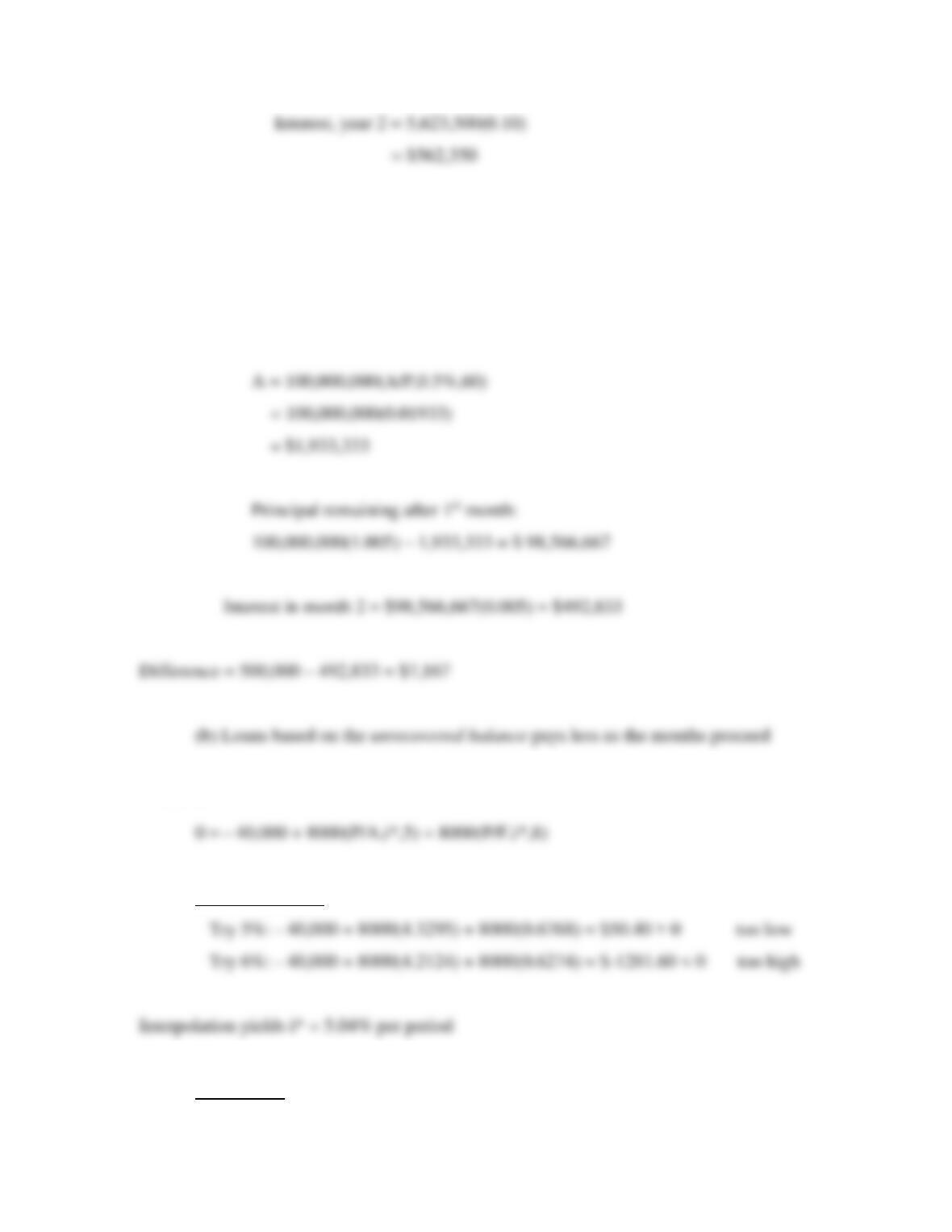
Solution 6.5
(a) For principal only, interest each month is 0.005(100,000,000) = $500,000
For unrecovered balance, monthly payment of interest and principal portion is:
Solution 6.6
Tabulated factors
Spreadsheet
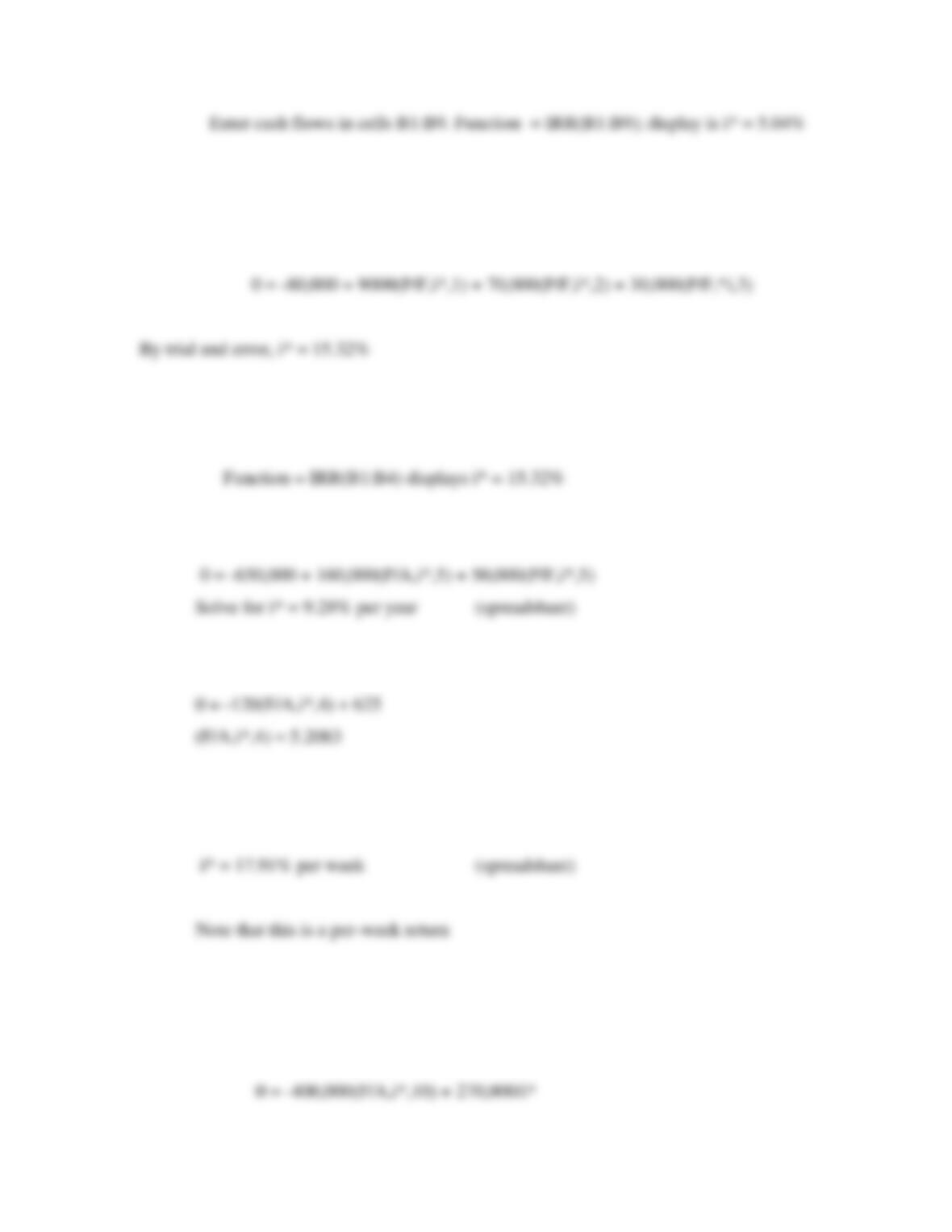
Solution 6.7
(a) Move all cash flows to year 1
(b) Enter cash flows for years 1 to 4 in cells B1:B4
Solution 6.8
Solution 6.9
Solve by interpolation or spreadsheet
Solution 6.10
(a) Tabulated factors
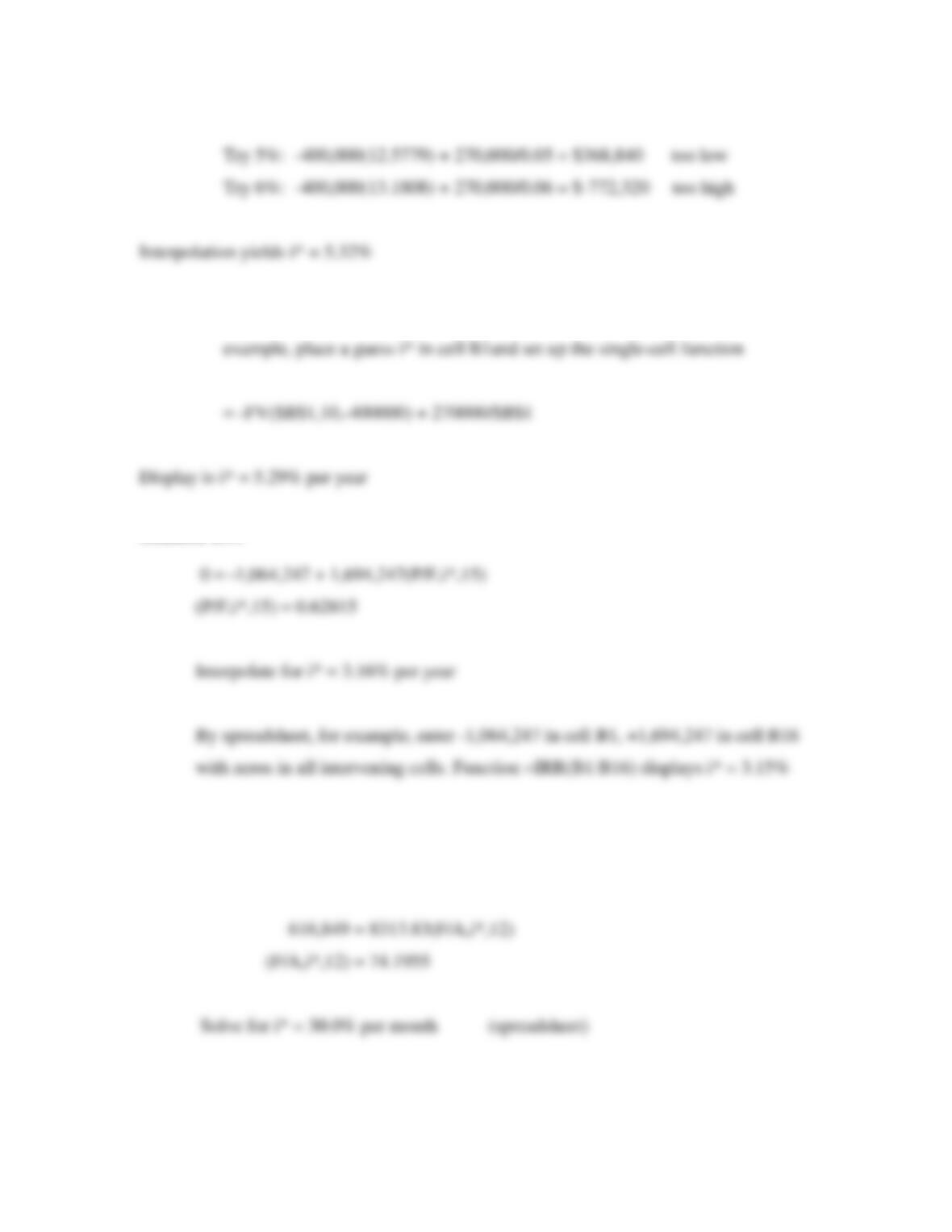
(b) Solve for i* by spreadsheet using the FV function and GOAL SEEK. For
Solution 6.11
Solution 6.12
Expenditure per month: 99,766/12 = $8313.83
Note that this is a per-month return
Solution 6.13
Solution 6.14
Solution 6.15
Solution 6.16
Solve by trial and error:
Solution 6.17
Spending $60,000 now will result in savings of $28,000 in years 0, 3 and 6. The
rate of return equation is :
Solution 6.18
(a) All monetary values in $ million units
Solution 6.19
Solution 6.20
Move $20 million to year 5 and then determine interest rate that will provide 100
scholarships every six months forever.
Solution 6.21
Solution 6.22
Solution 6.23
There is no income associated with a cost alternative. Therefore, the only way to obtain a
Solution 6.24
Solution 6.25
(a) The rate of return on the increment has to be larger than 18%
Y
Solution 6.26
Solution 6.27
(a) Incremental investment analysis is not required. Alternative X should be
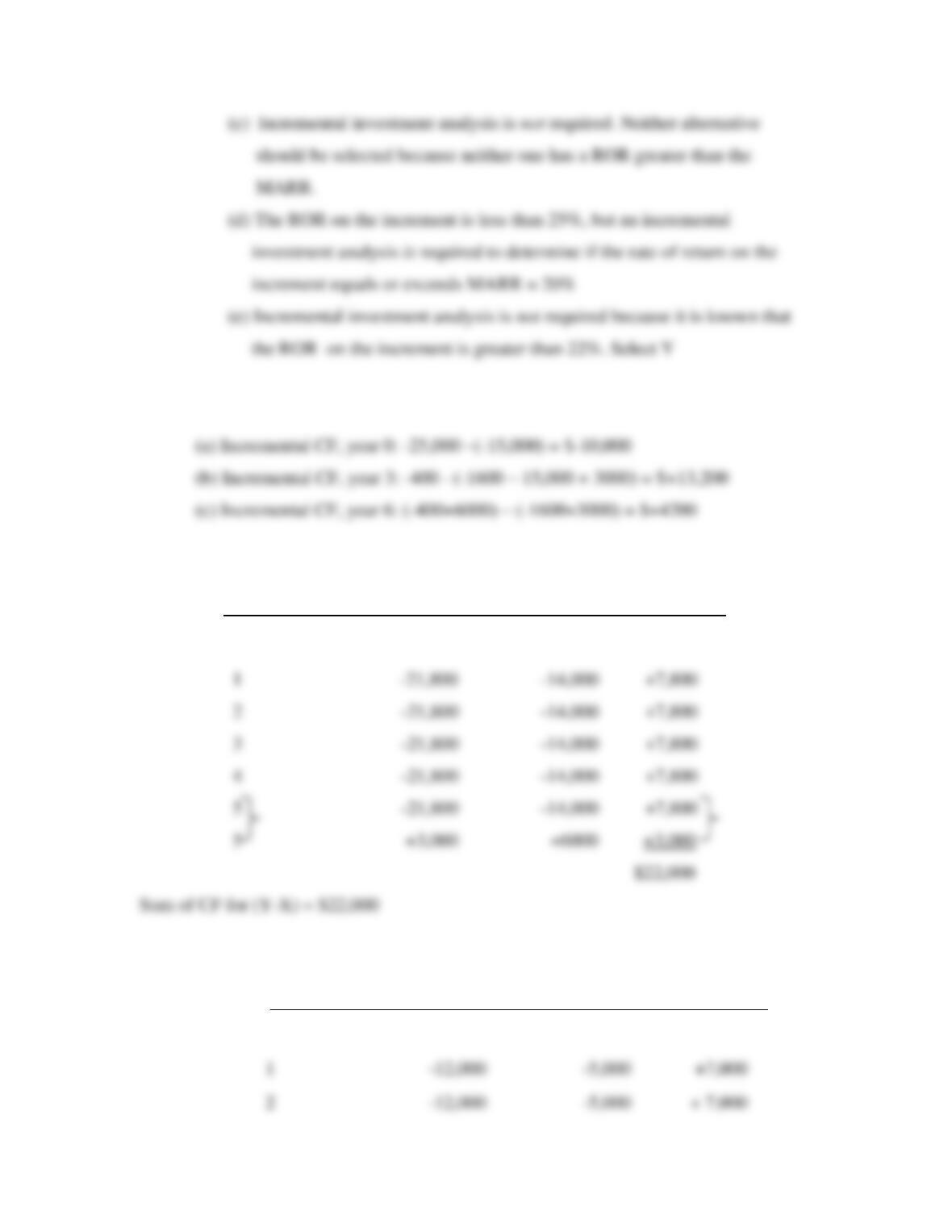
Solution 6.28
Solution 6.29
Year System X System Y CF for (Y – X)
0 -45,000 -65,000 -20,000
Solution 6.30
Year System X System Z CF for (Z – X)
0 –40,000 –95,000 -55,000
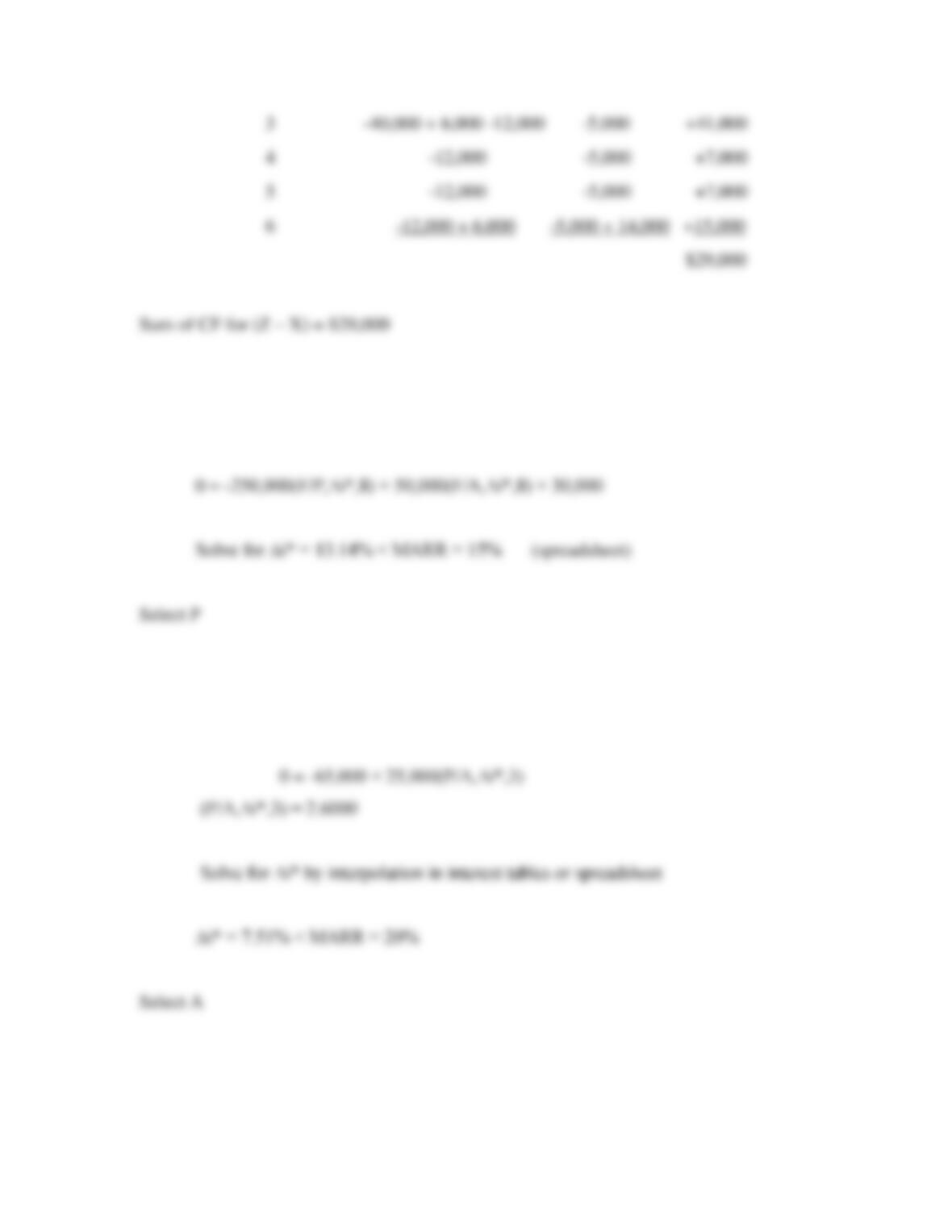
Solution 6.31
This is an incremental ROR analysis to find ∆i*
Solution 6.32
Write rate of return equation for increment on investment between B and A
Solution 6.33
Incremental cash flows over the LCM of 4 years in $1000 units
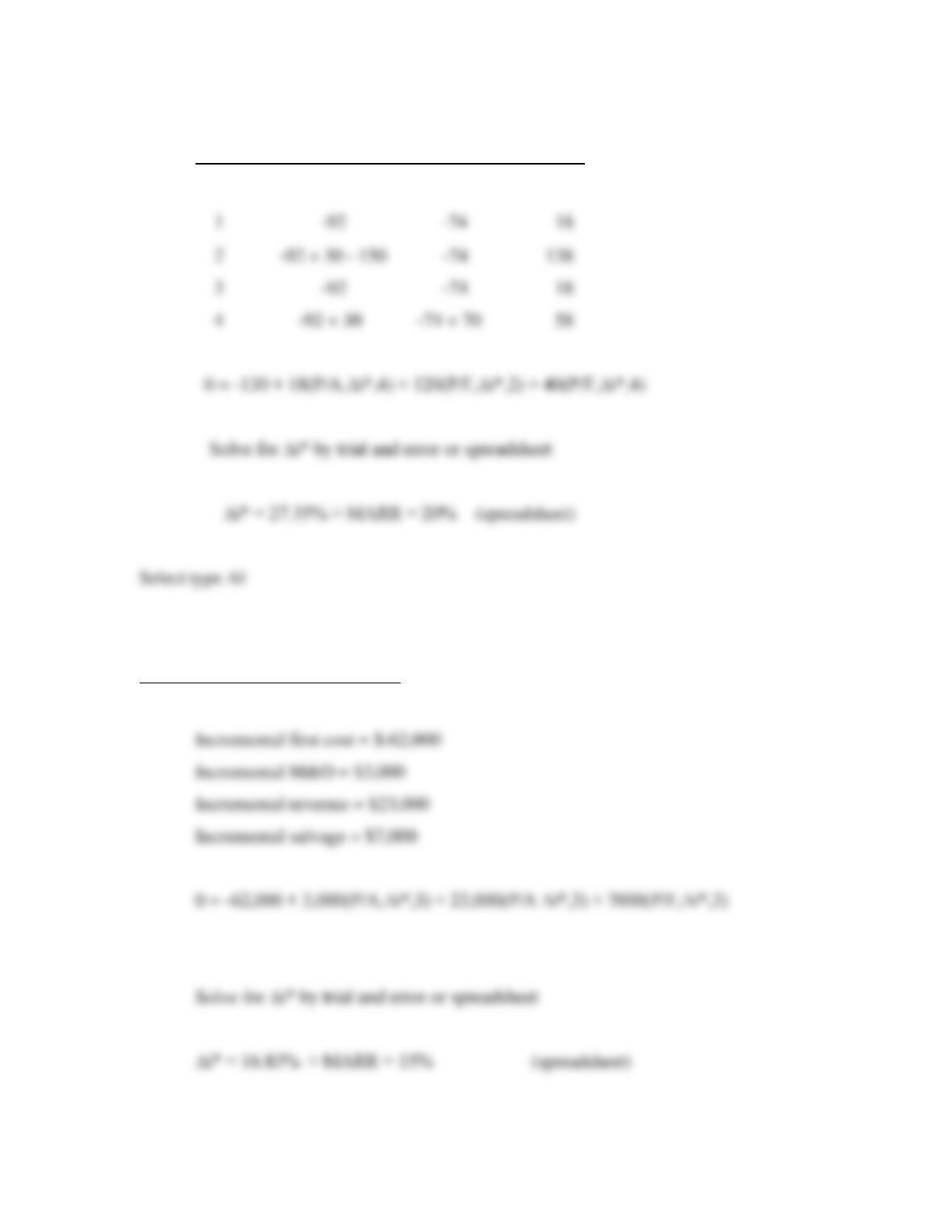
Year Type Fe Type Al Al – Fe
0 –150 –280 -130
Solution 6.34
Incremental CF amounts for (Y-X)
Solution 6.35
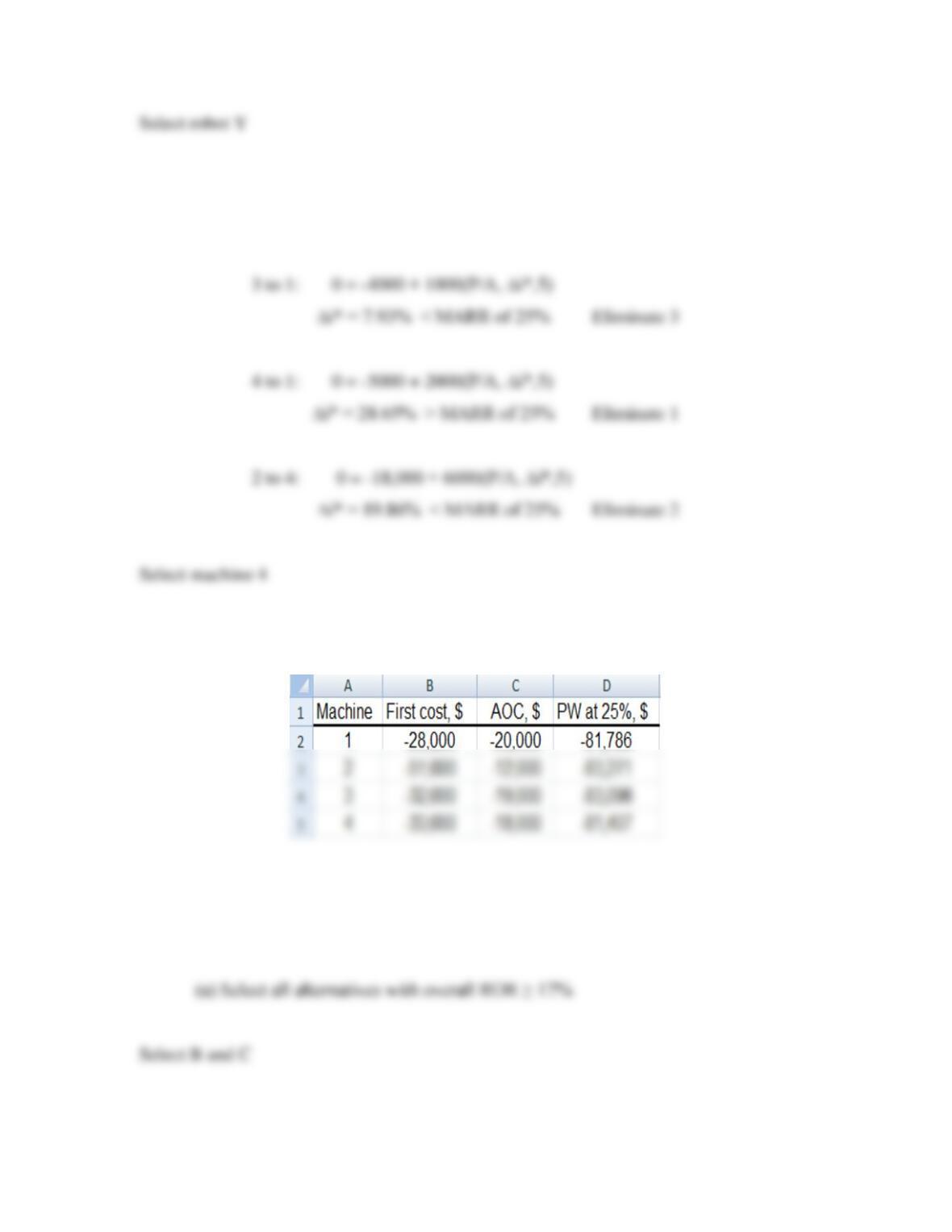
(a) Rank cost alternatives by increasing initial investment: 1, 3, 4, 2
(b) Use PV function to select machine 4 with the lowest PW of costs.
Solution 6.36
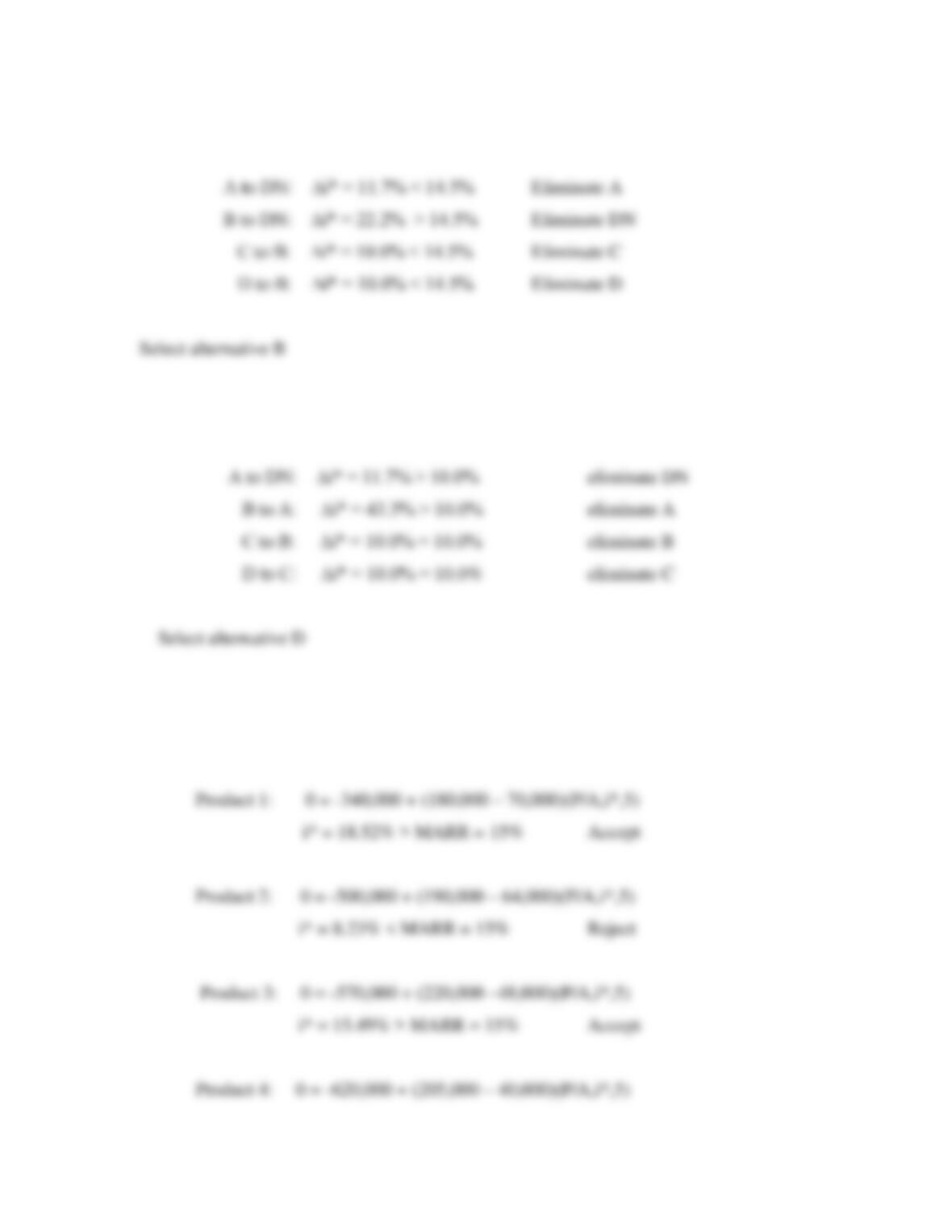
(b) Compare alternatives incrementally after ranking: DN, A, B, C, D
(c) Compare alternatives incrementally after ranking: DN, A, B, C, D
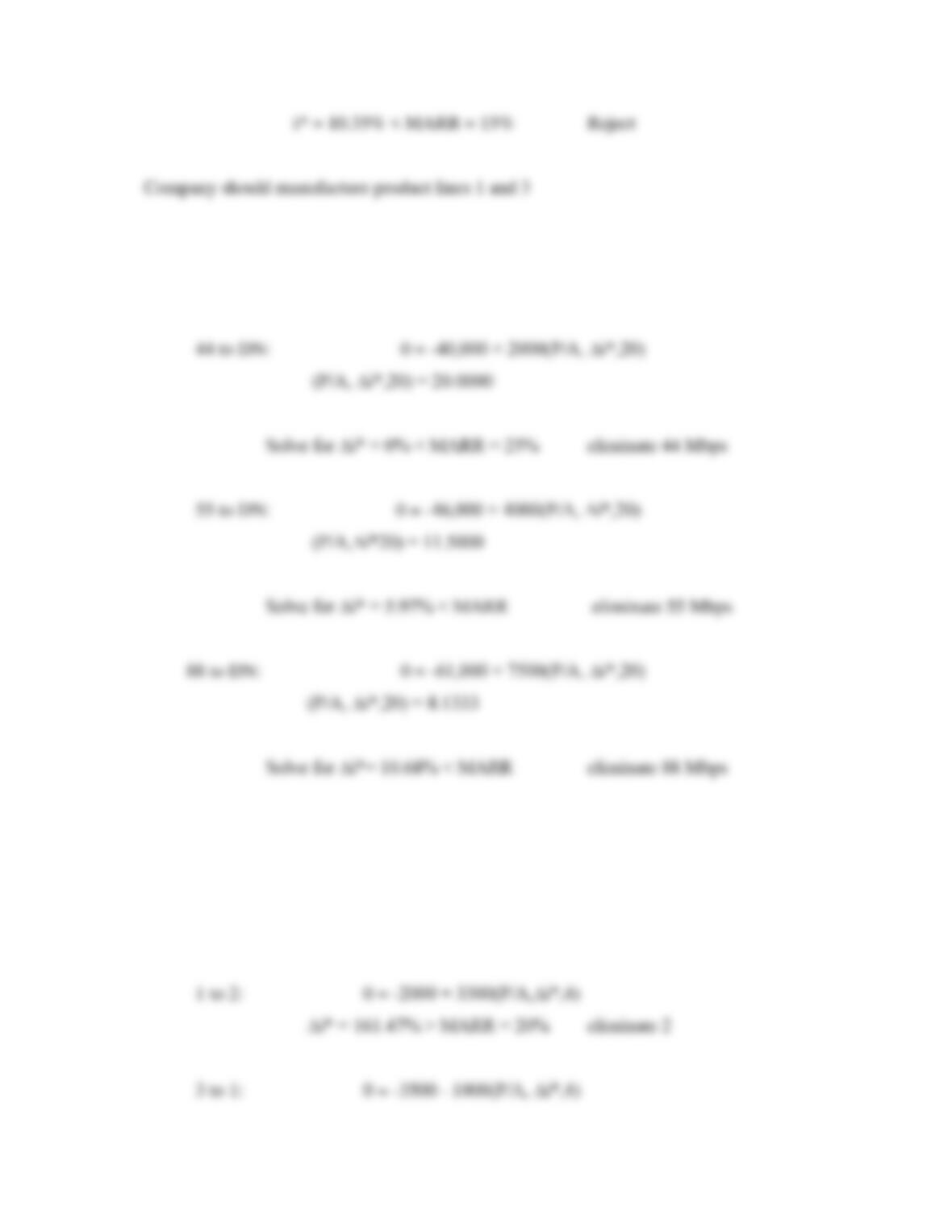
Solution 6.37
Alternatives are independent; compare each against DN
Solution 6.38
Rank revenue alternatives by increasing initial investment: DN, 44, 55, 88
Select DN
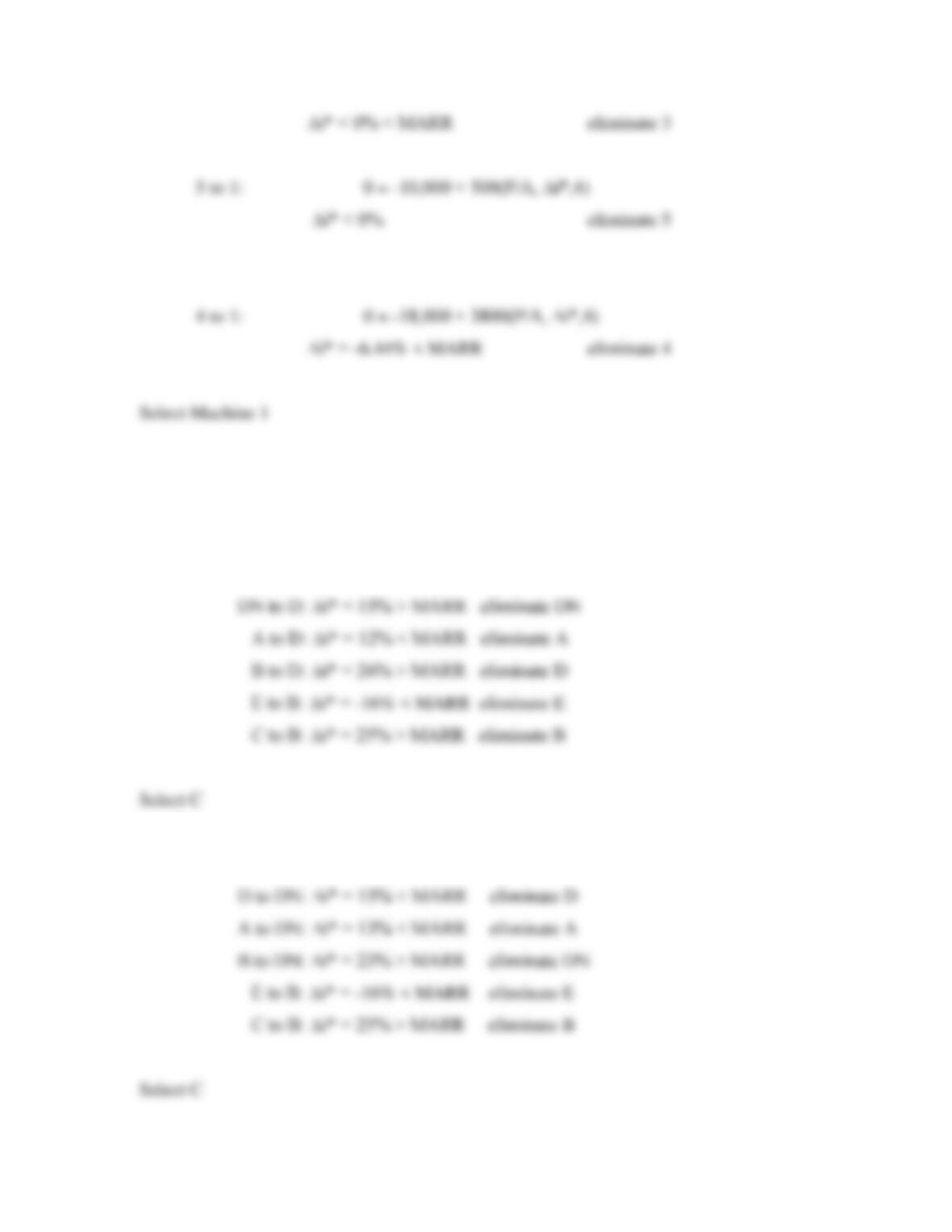
Solution 6.39
Rank cost alternatives by increasing initial investment: 2, 1, 3, 5, 4
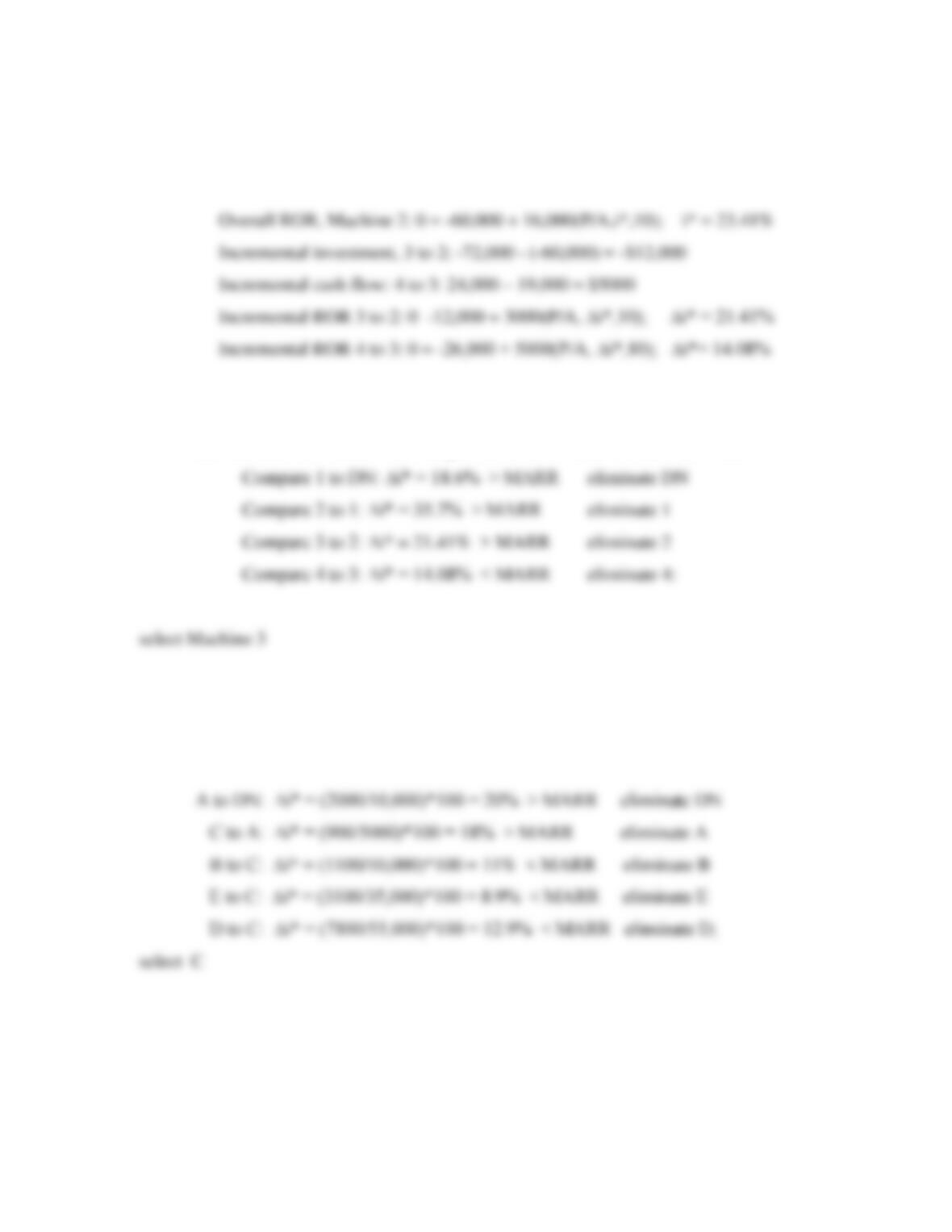
Solution 6.40
Rank revenue alternatives by increasing initial investment: DN, D, A, B, E, C
(a) MARR = 13.5%
(b) MARR = 16%
Solution 6.41
(a) Initial cost P1, Machine 1: -60,000 – (P1) = -16,000; P1 = $-44,000
(b) Machines are ranked according to initial investment: 1, 2, 3, 4; MARR = 18%
Solution 6.42
Rank alternatives: DN, A, C, B, E, D; i = P/A; MARR = 14%
Solution 6.43
(a) Select A and C with project ROR > MARR = 15.5%
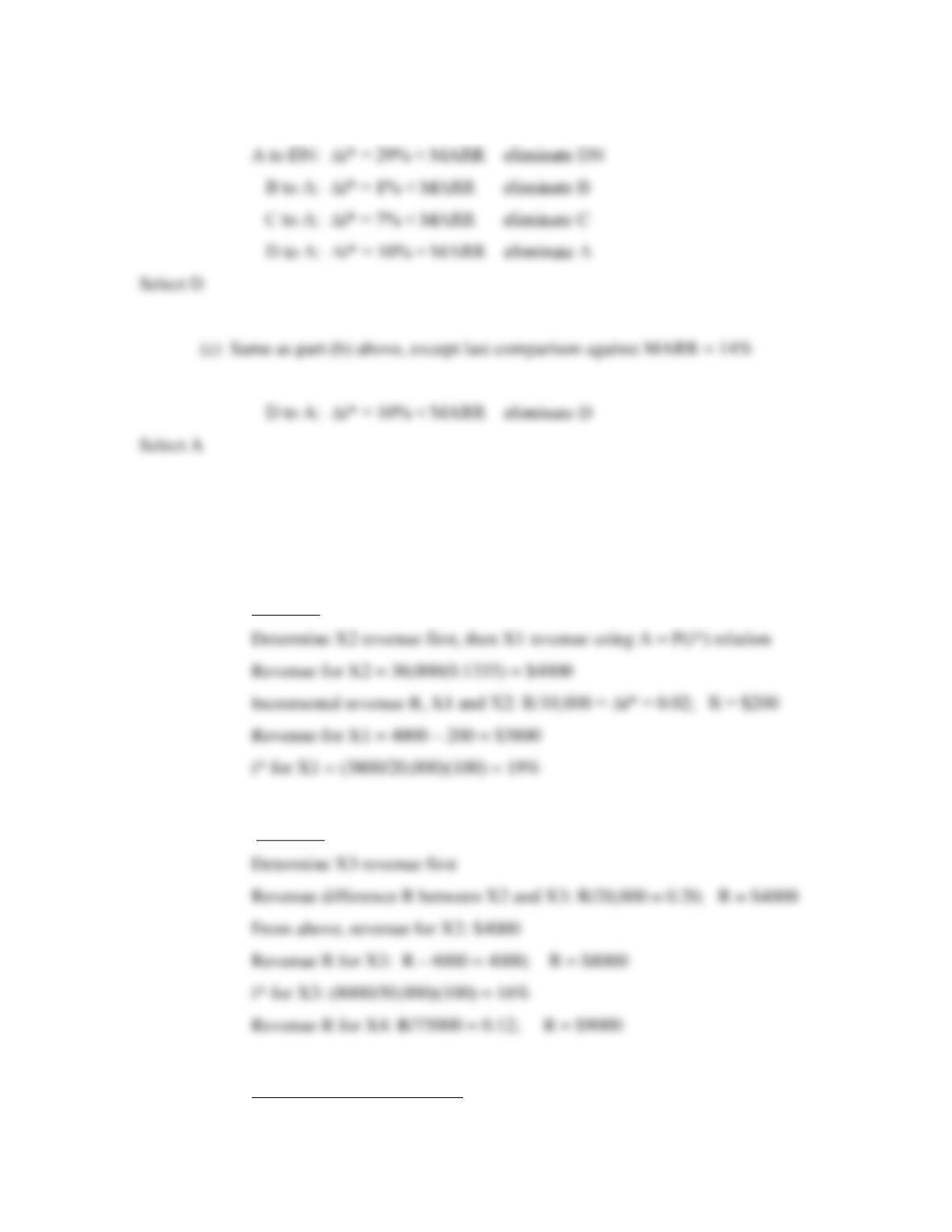
(b) Rank proposals: DN, A, B, C, D; MARR = 10%
Solution 6.44
(a) Evaluation order for mutually exclusive: DN, X1, X2, X3, X4
i* for X1
i* for X3
Incremental values on line 1
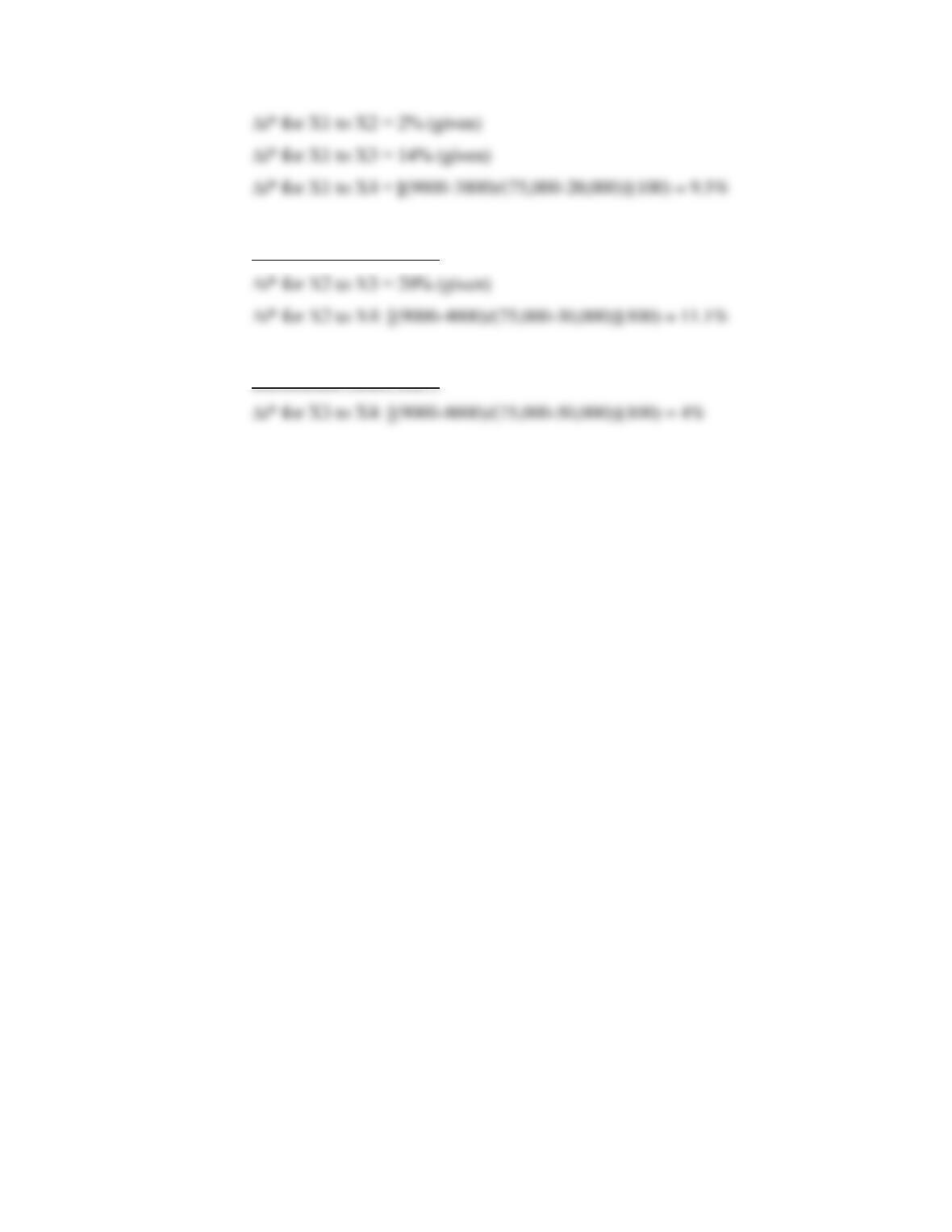
Incremental values line 2
Incremental values line 3
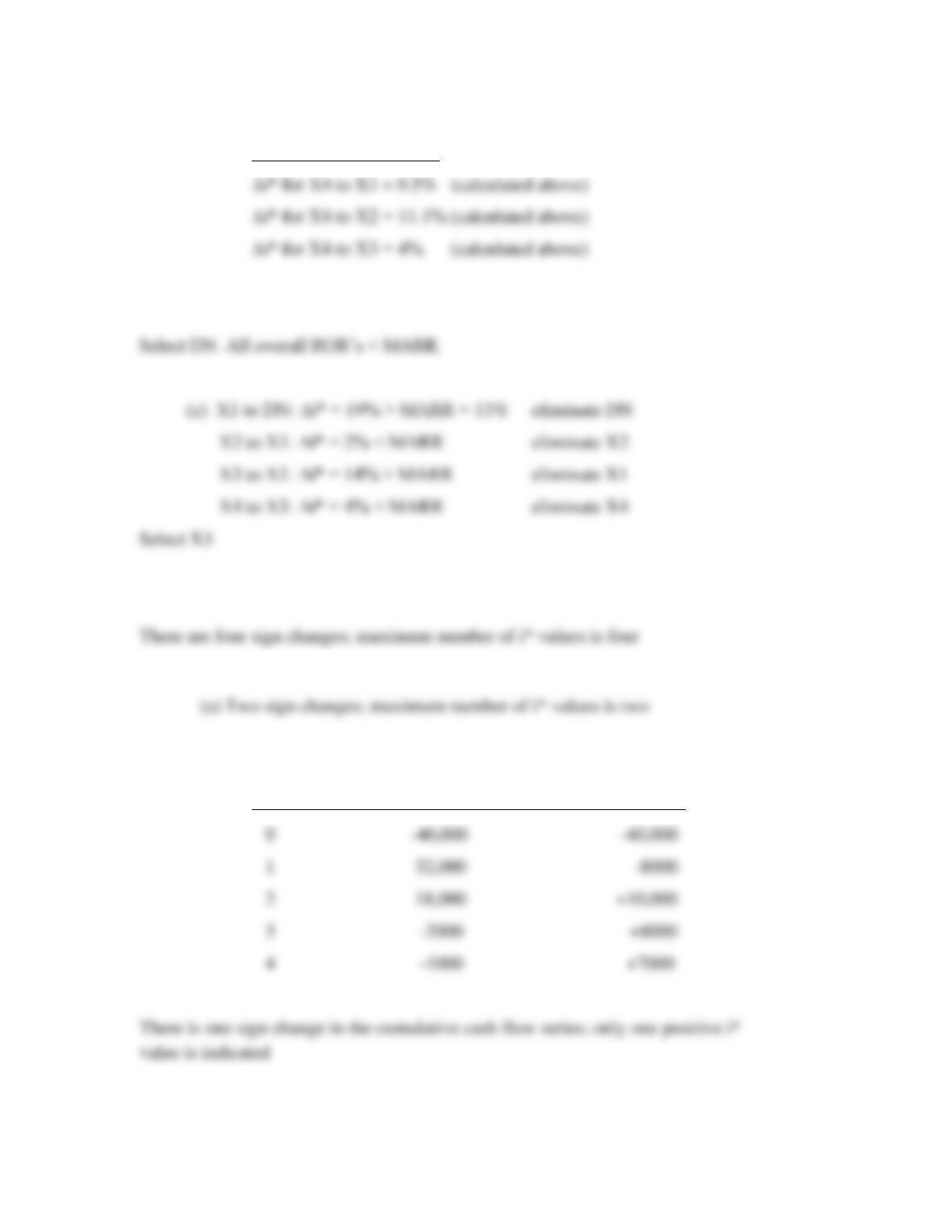
Solution 6.44 continued
Incremental values line 4
(b)
Solution 6.45
Solution 6.46
(b) Cumulative
Year Net Cash Flow, $ Cash Flow, $
Solution 6.47
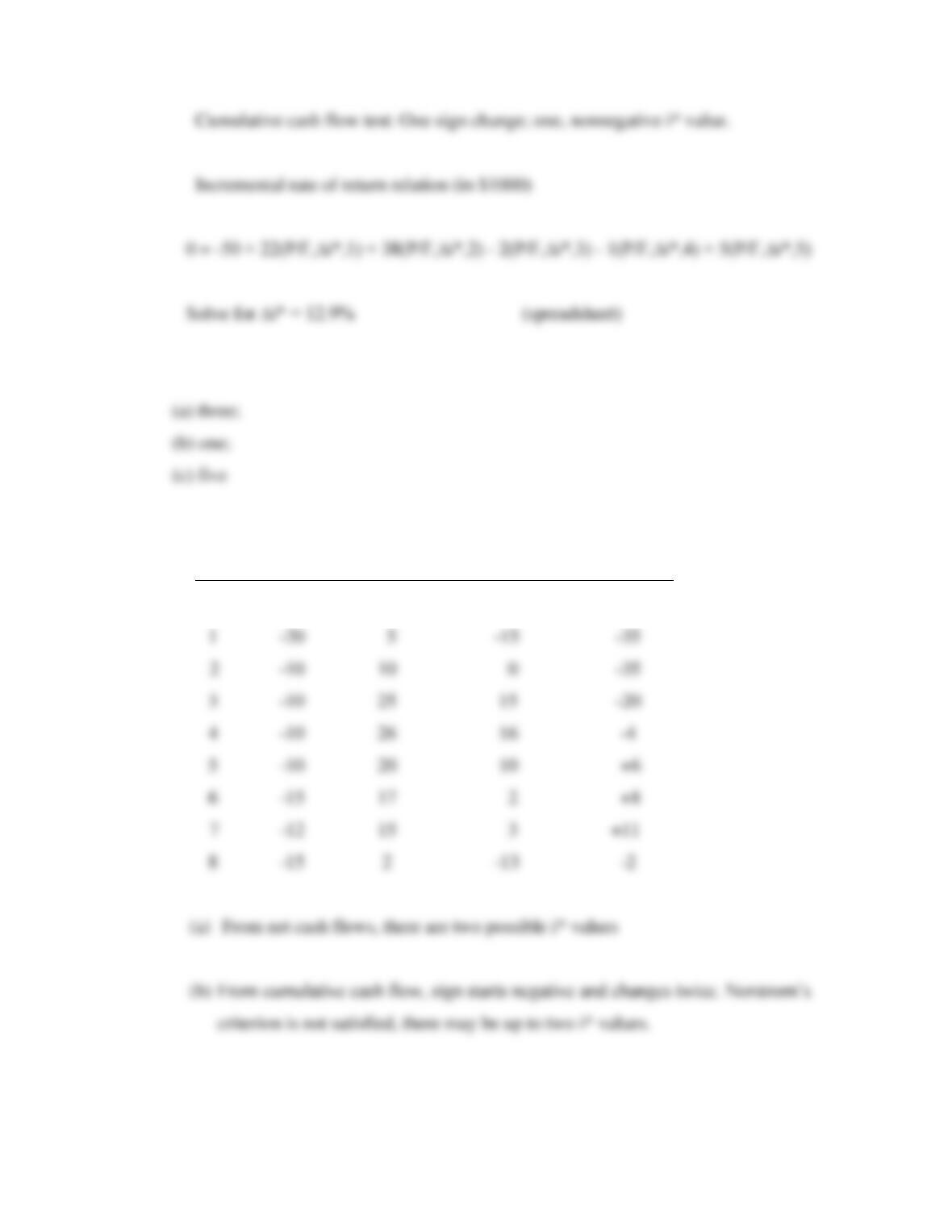
Cash flow rule of signs; three possible rate of return values
Solution 6.48
Solution 6.49
Quarter Expenses Revenue Net Cash Flow Cumulative
0 -20 0 -20 -20
Solution 6.50
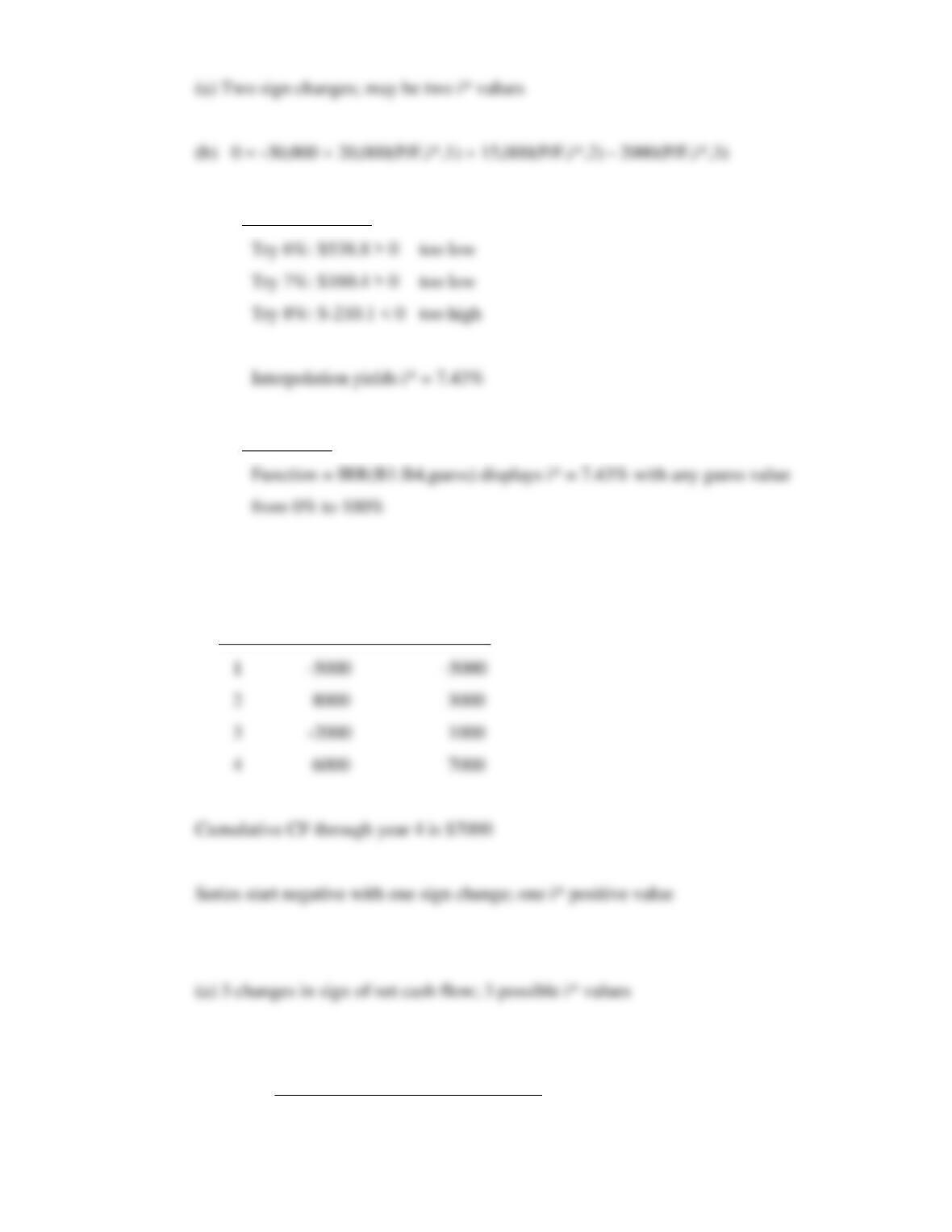
Tabulated factors
Spreadsheet
Solution 6.51
Cumulative
Year Net CF, $ CF, $
Solution 6.52
(b) Cumulative
Year Net CF, $ CF, $
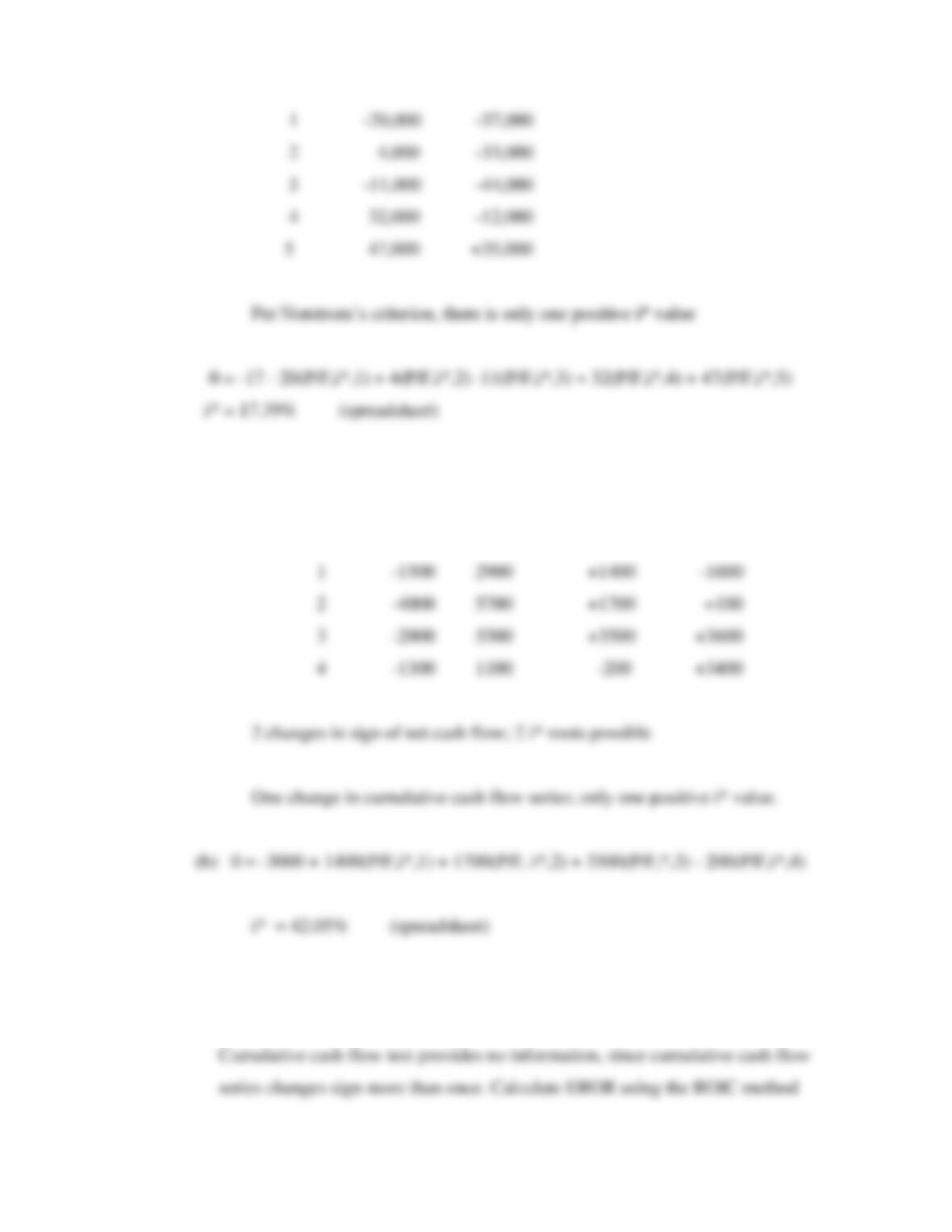
0 –17,000 -17,000
Solution 6.53
(a) Year Expenses Revenue Net CF Cumulative CF
0 -3000 0 -3000 –3000
Solution 6.54
(a) Cash flow rule of signs indicates three possible rate of return values.
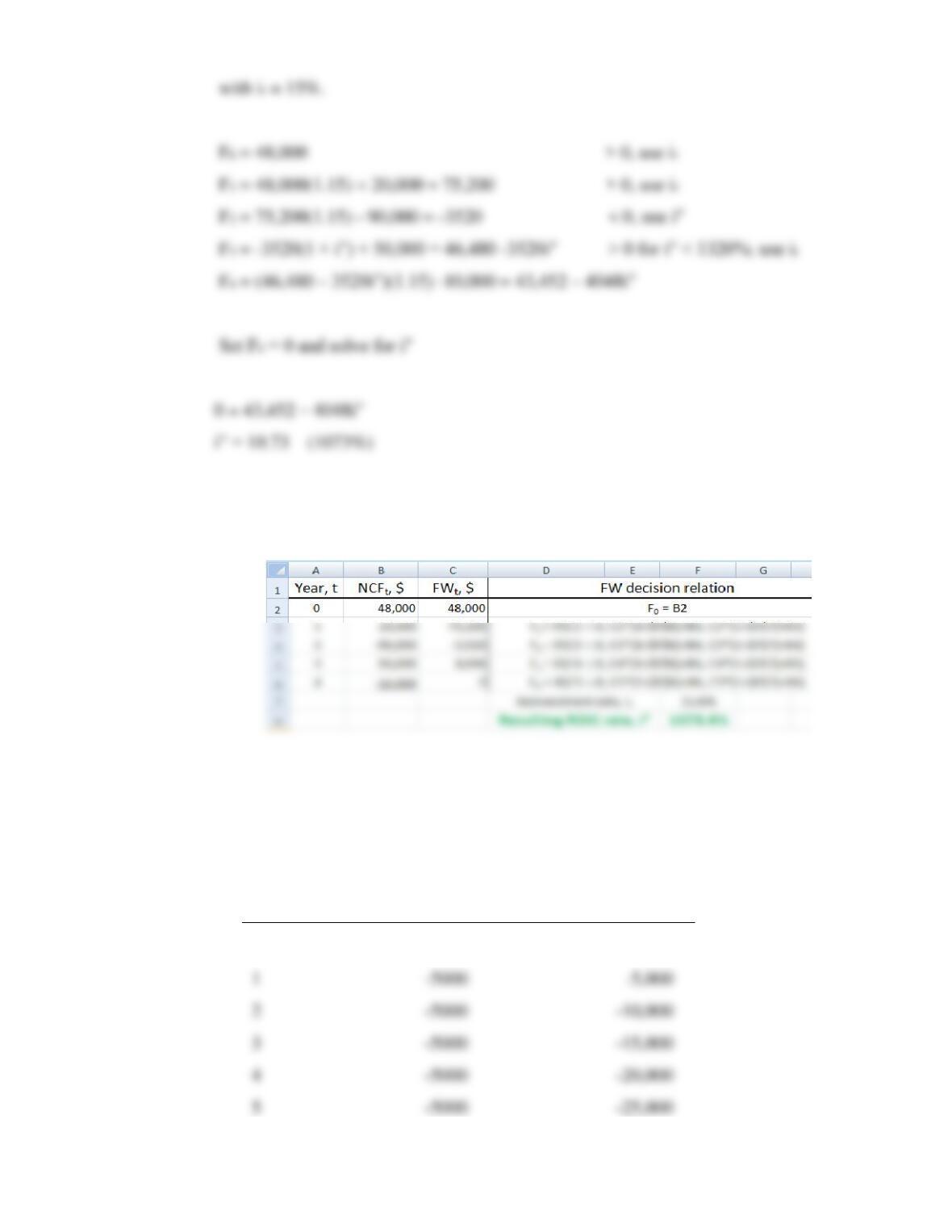
(b) Develop a spreadsheet similar to Figure 6.7 to determine i″ = 1073.4%
Solution 6.55
Tabulate net cash flow and cumulative cash flow values
Cumulative
Year Cash Flow, $ Cash Flow, $
0 0 0
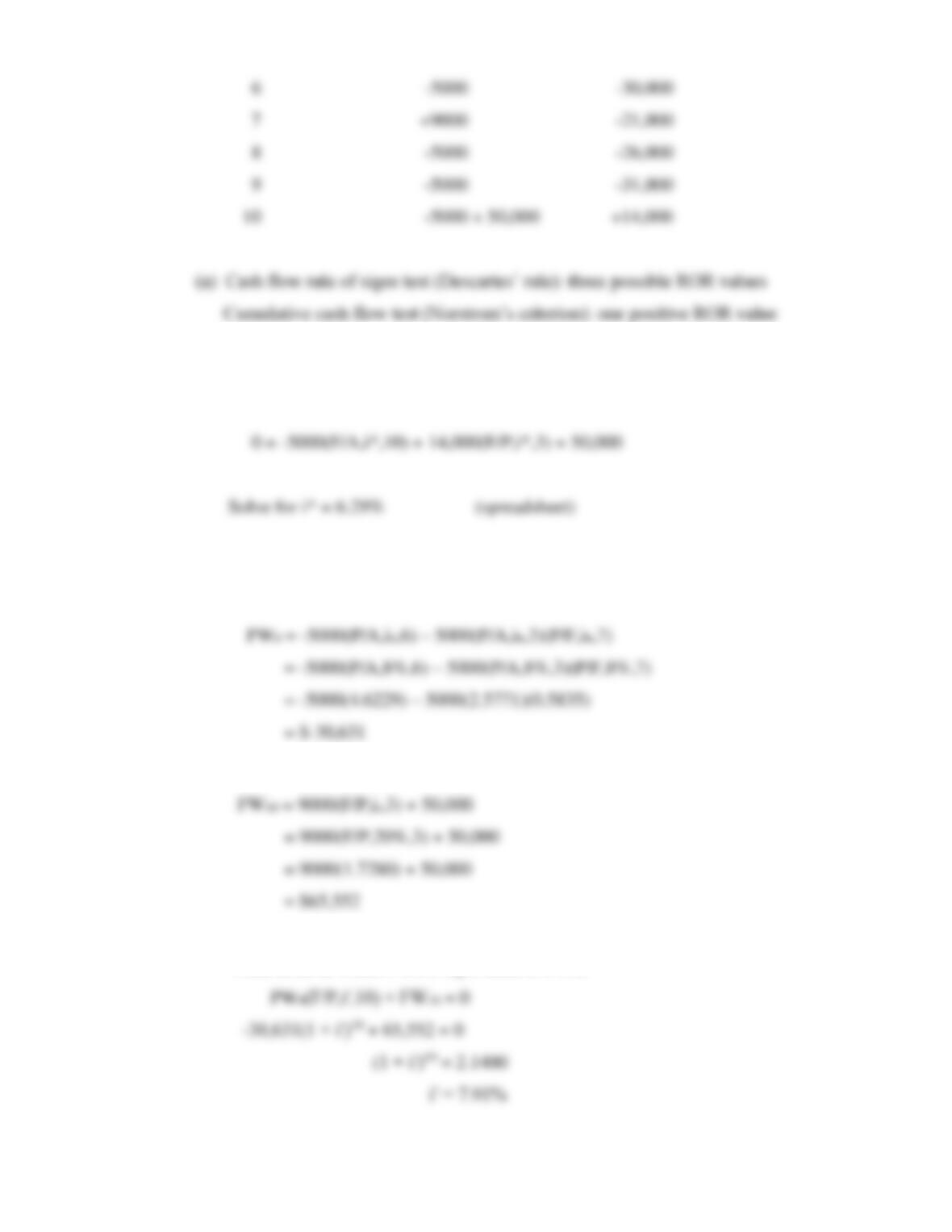
(b) Move all cash flows to year 10 and solve for i*
(c) Hand solution: MIRR with ir = 20% and ib = 8%
Solution 6.55 continued
Find ROR at which PW0 is equivalent to FW10
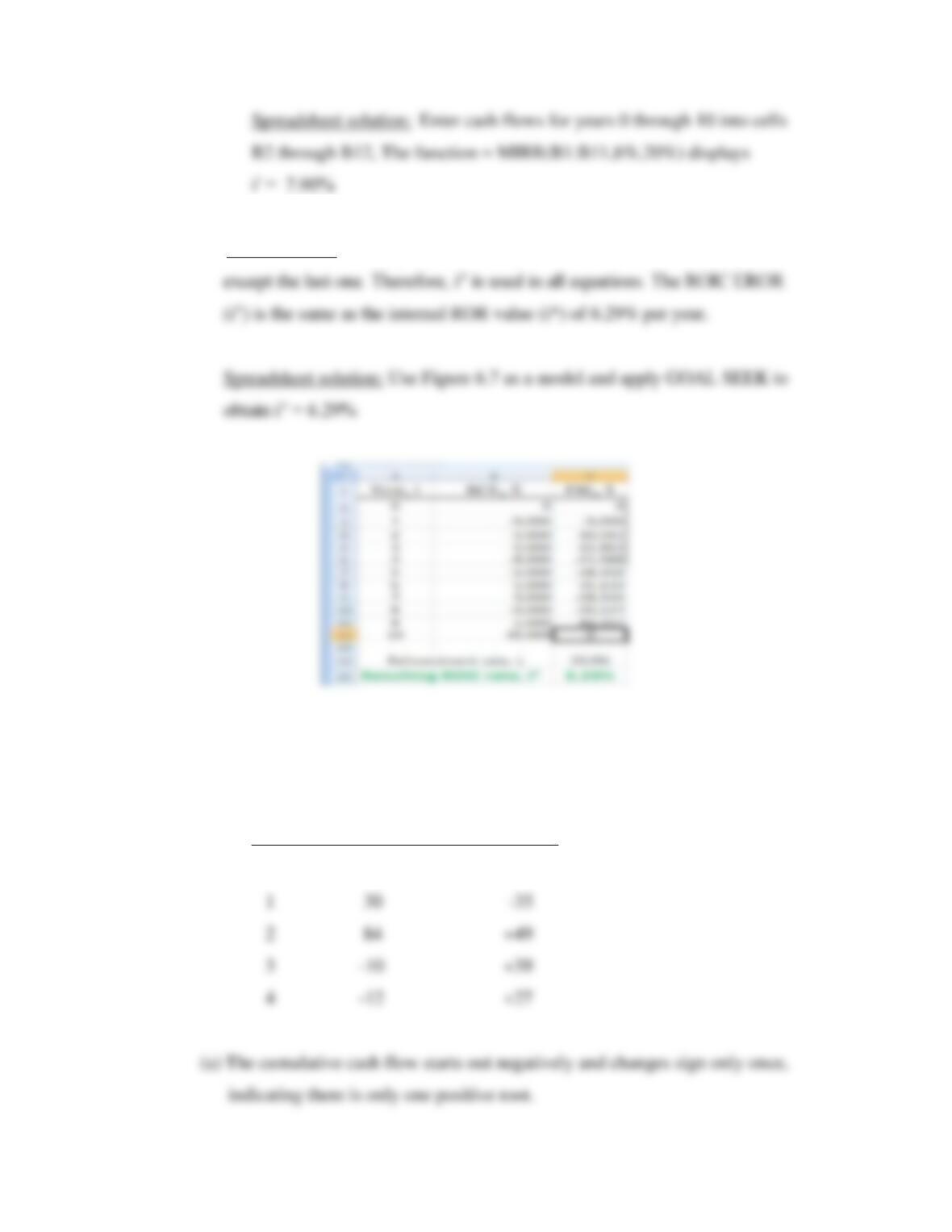
(d) Hand solution: In applying the ROIC procedure, all F values are negative
Solution 6.56
First, calculate cumulative cash flow (CF)
Cumulative
Year Cash Flow, $1000 CF, $1000
0 -65 -65
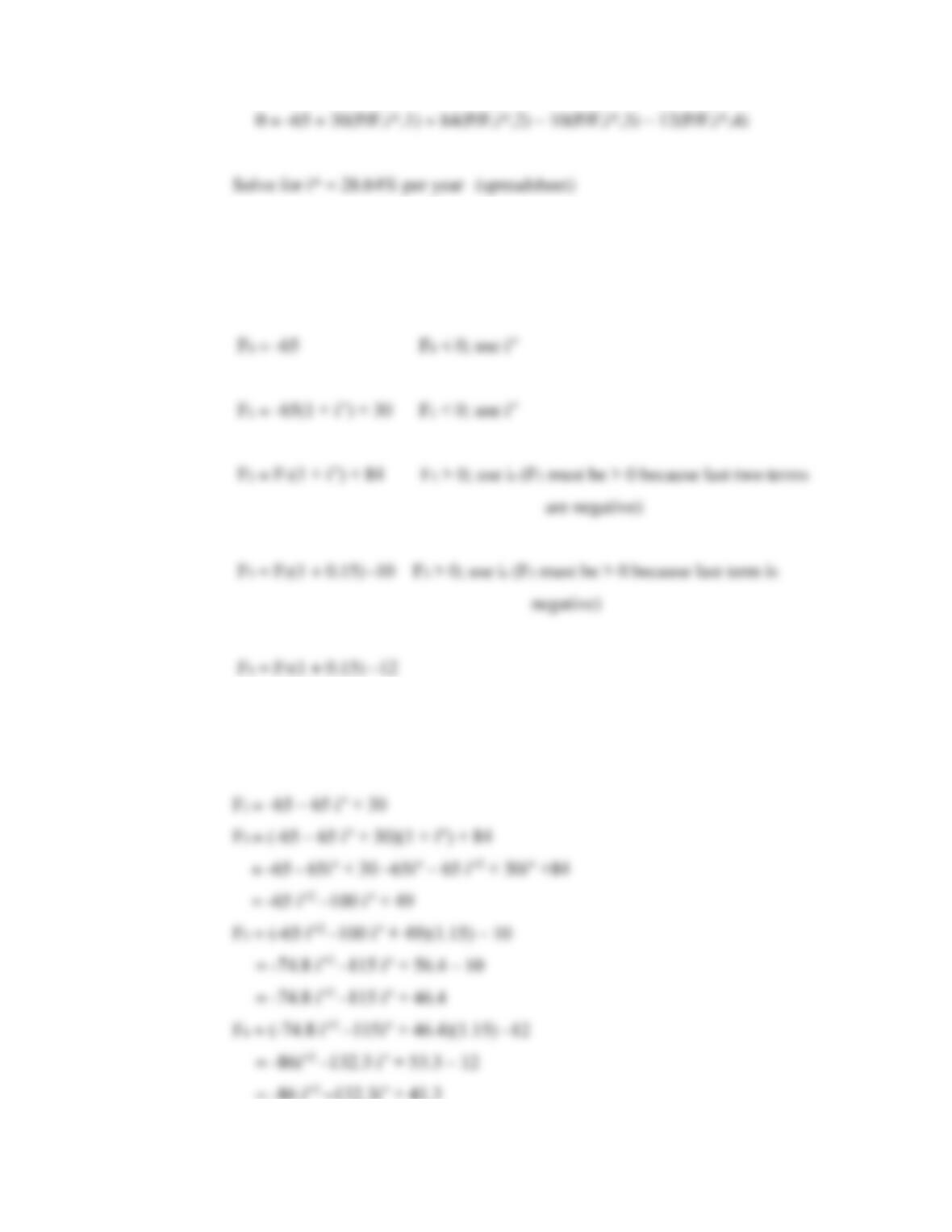
(b) Apply net-investment procedure for the ROIC method because reinvestment
rate ir is not equal to the i* rate of 28.64% per year
Solution 6.56 continued
Set F4 = 0 and solve for i″ by trial and error
= –86 i″2 –132.3i″ + 41.3
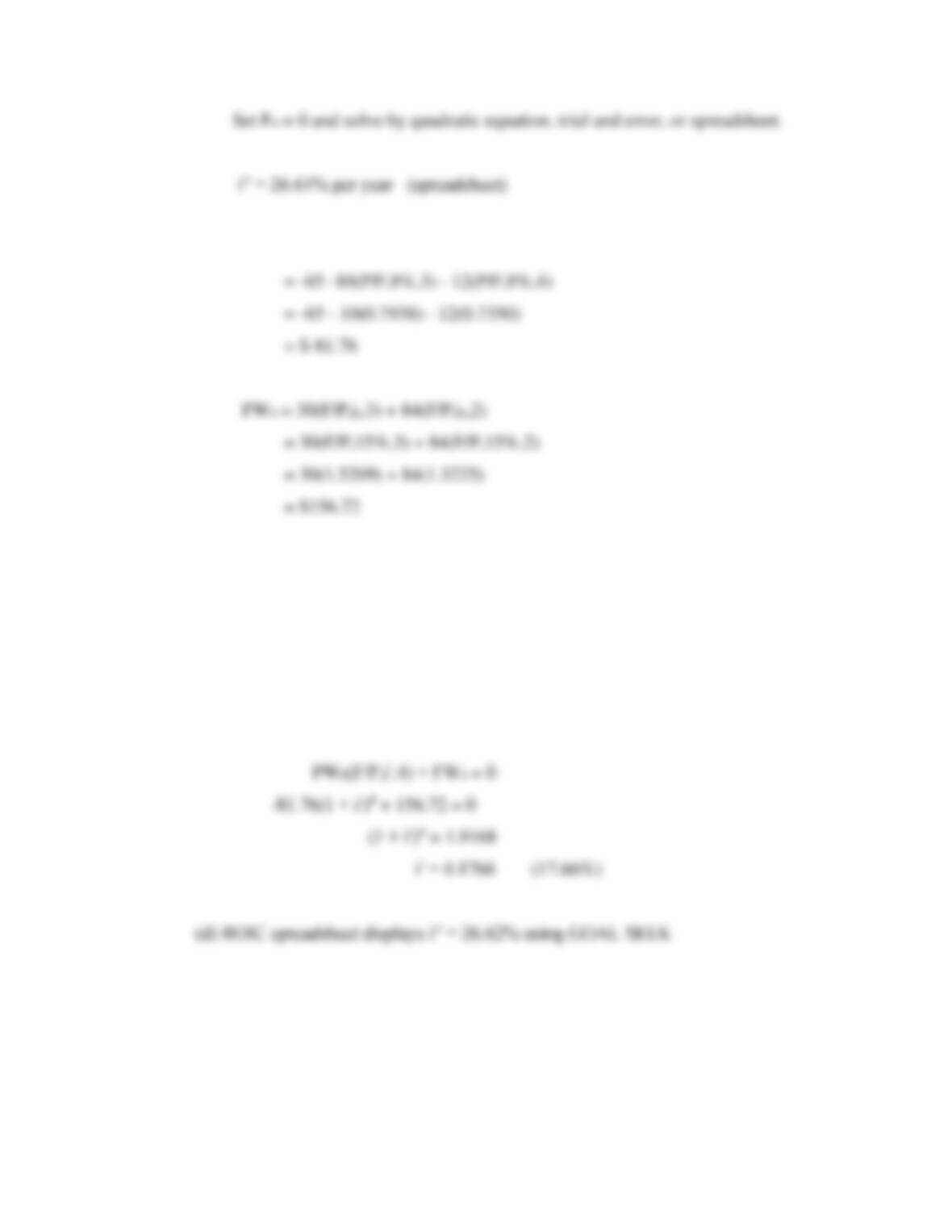
(c) PW0 = -65 -10(P/F,ib,3) – 12(P/F,ib,4)
Solution 6.56 continued
Find EROR at which PW0 is equivalent to FW4
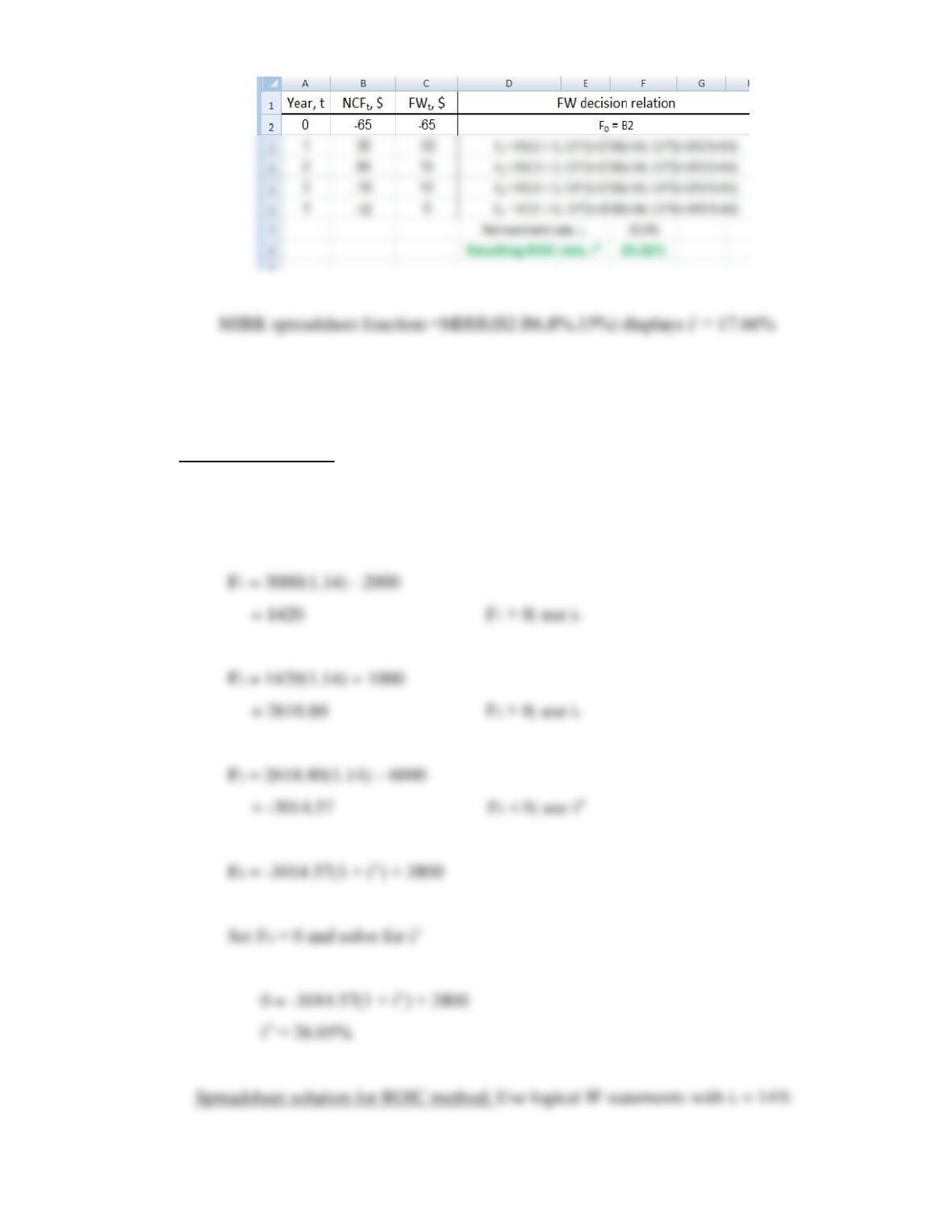
Solution 6.57
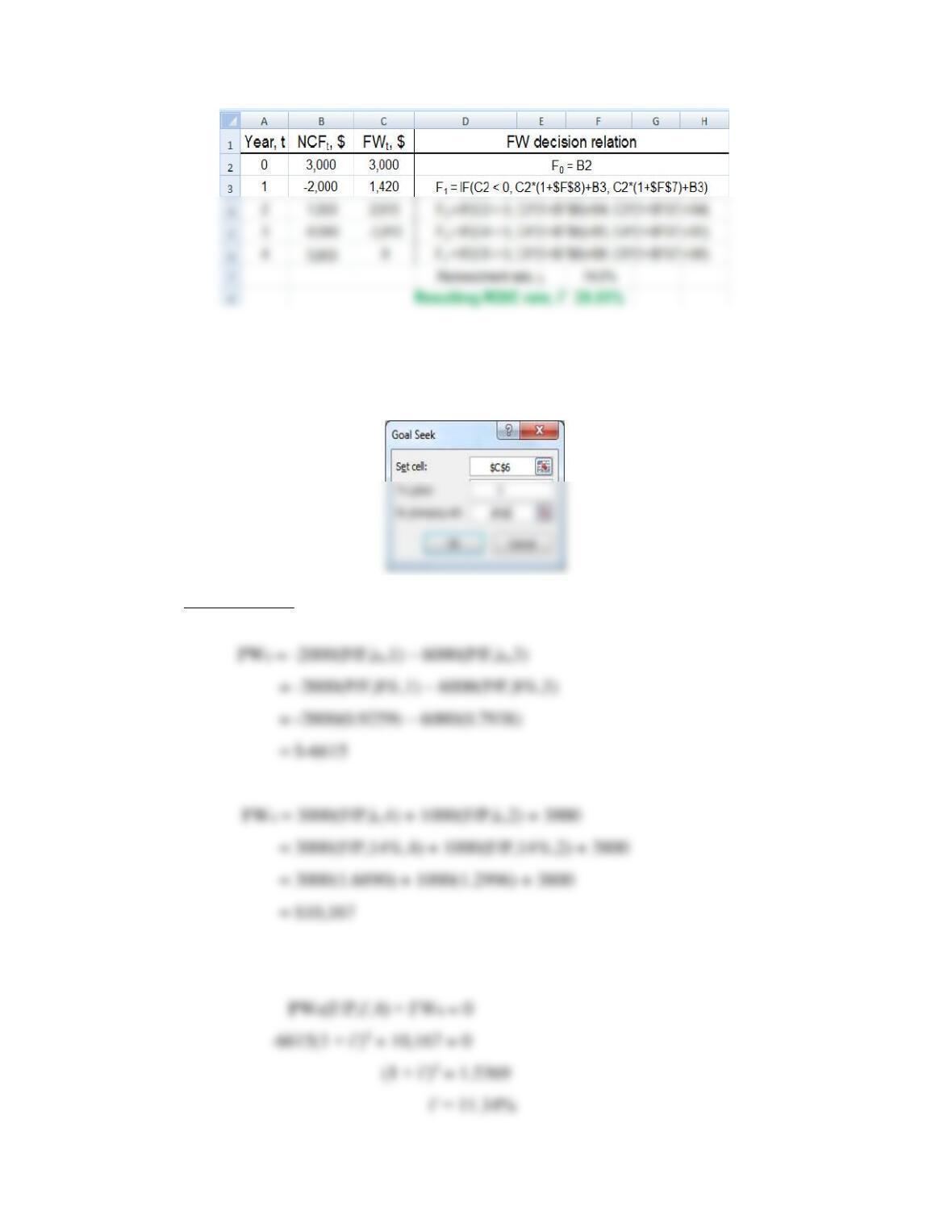
(a) Using hand solution: Apply ROIC procedure with ir = 14%
F0 = 3000 F0 > 0; use ir
Solution 6.57 continued
(b) Hand solution: Apply MIRR procedure with ib = 8% and ir = 14%
Find EROR at which PW0 is equivalent to FW4
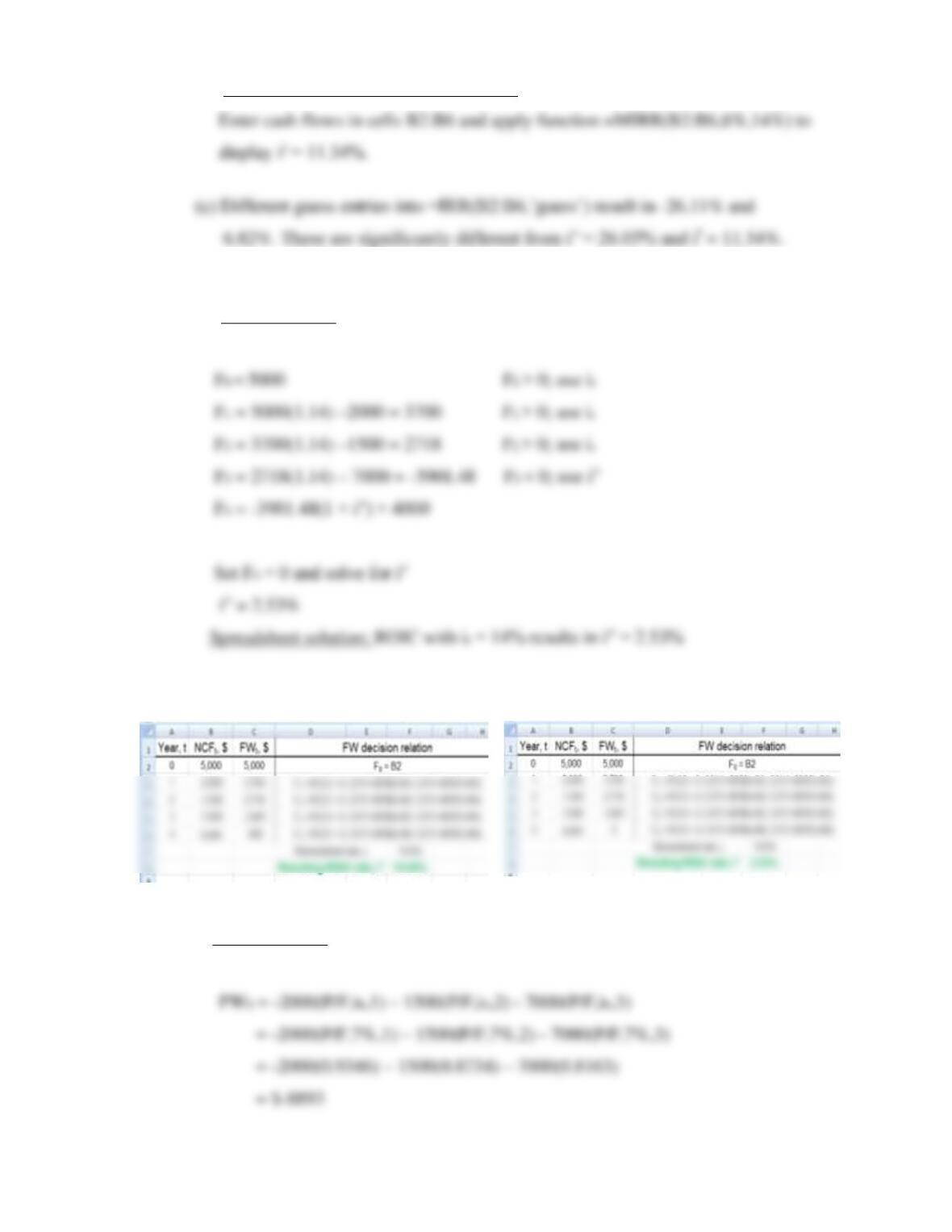
Spreadsheet solution for MIRR method
Solution 6.58
(a) Hand solution: ROIC procedure with ir = 14%
Before GOAL SEEK After GOAL SEEK
(b) Hand solution: Apply MIRR procedure with ib = 7% and ir = 14%
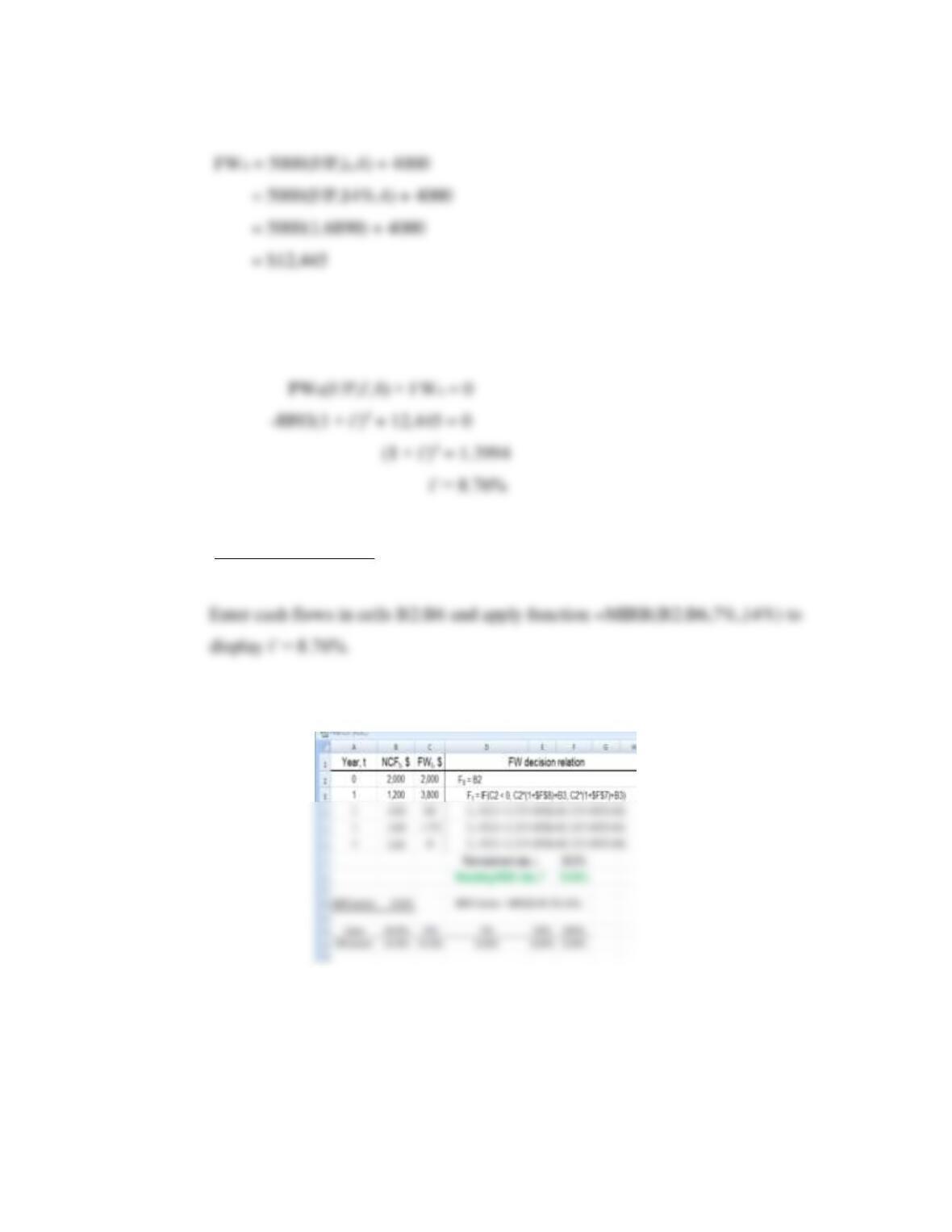
Solution 6.58 continued
Find EROR at which PW0 is equivalent to FW4
Spreadsheet solution:
Solution 6.59
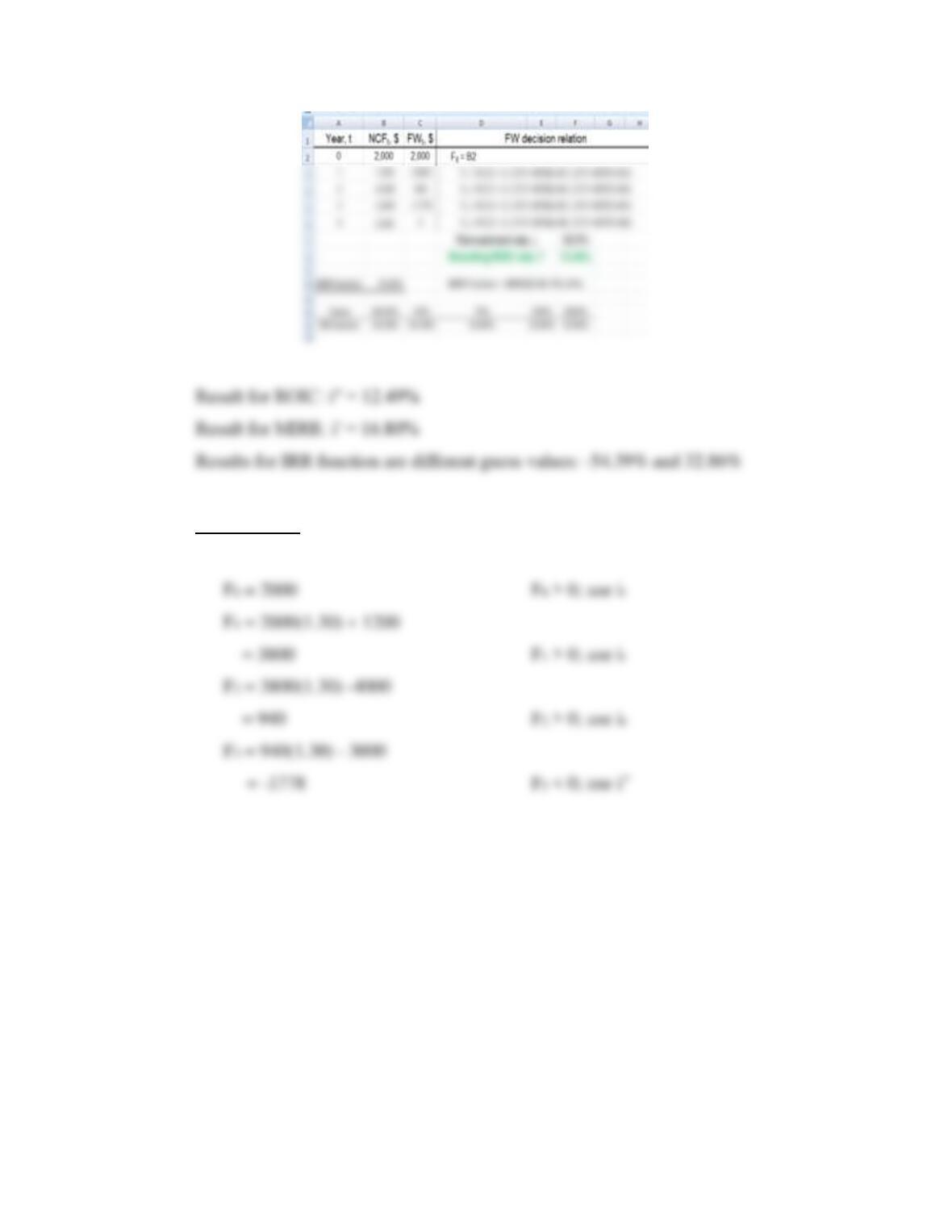
Hand solution: ROIC method
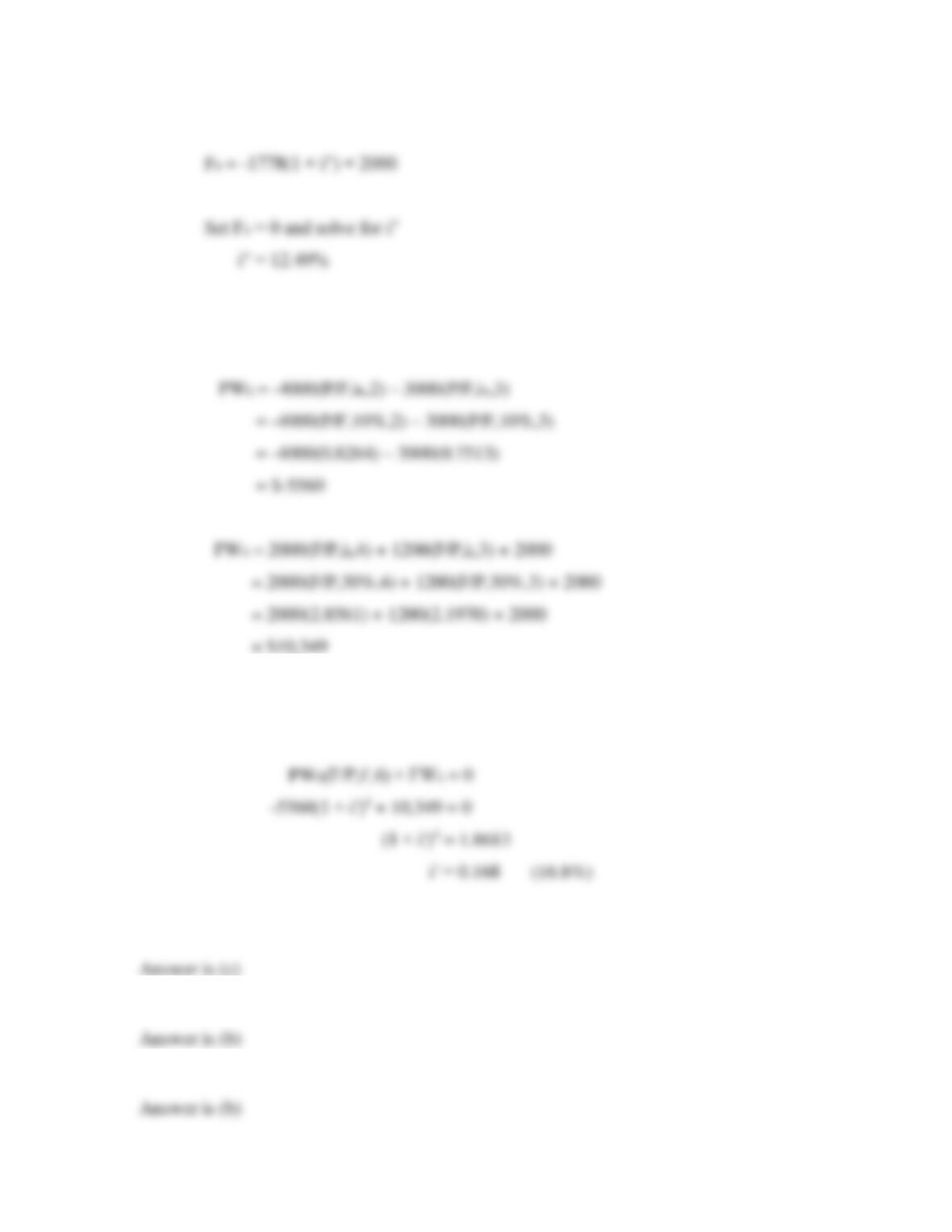
Solution 6.59 continued
Hand solution: MIRR method
Find EROR i′ at which PW0 is equivalent to FW4
Solution 6.60
Solution 6.61
Solution 6.62
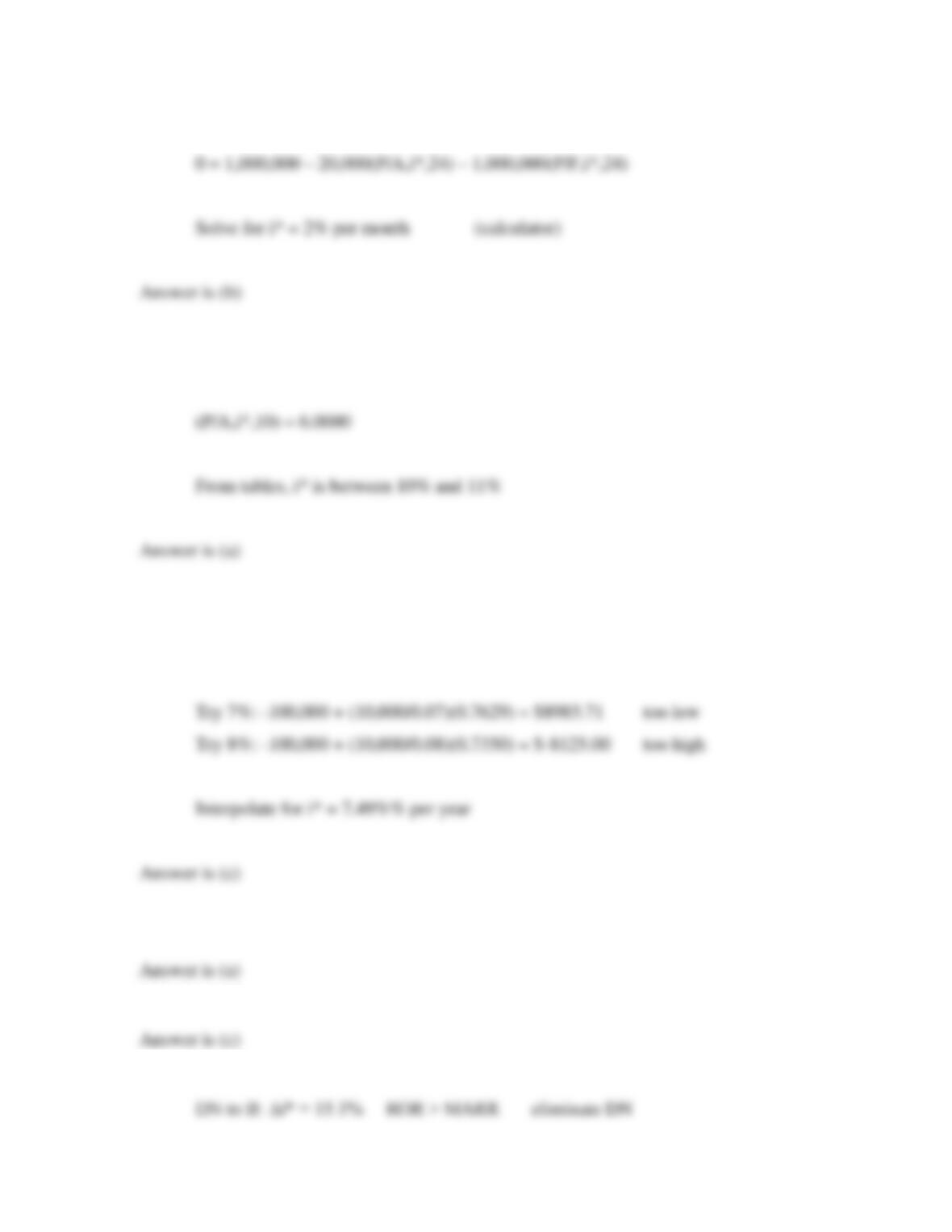
Solution 6.63
Solution 6.64
0 = -60,000 + 10,000(P/A,i*10)
Solution 6.65
0 = -100,000 + (10,000/i*) (P/F,i*,4)
Solution 6.66
Solution 6.67
Solution 6.68
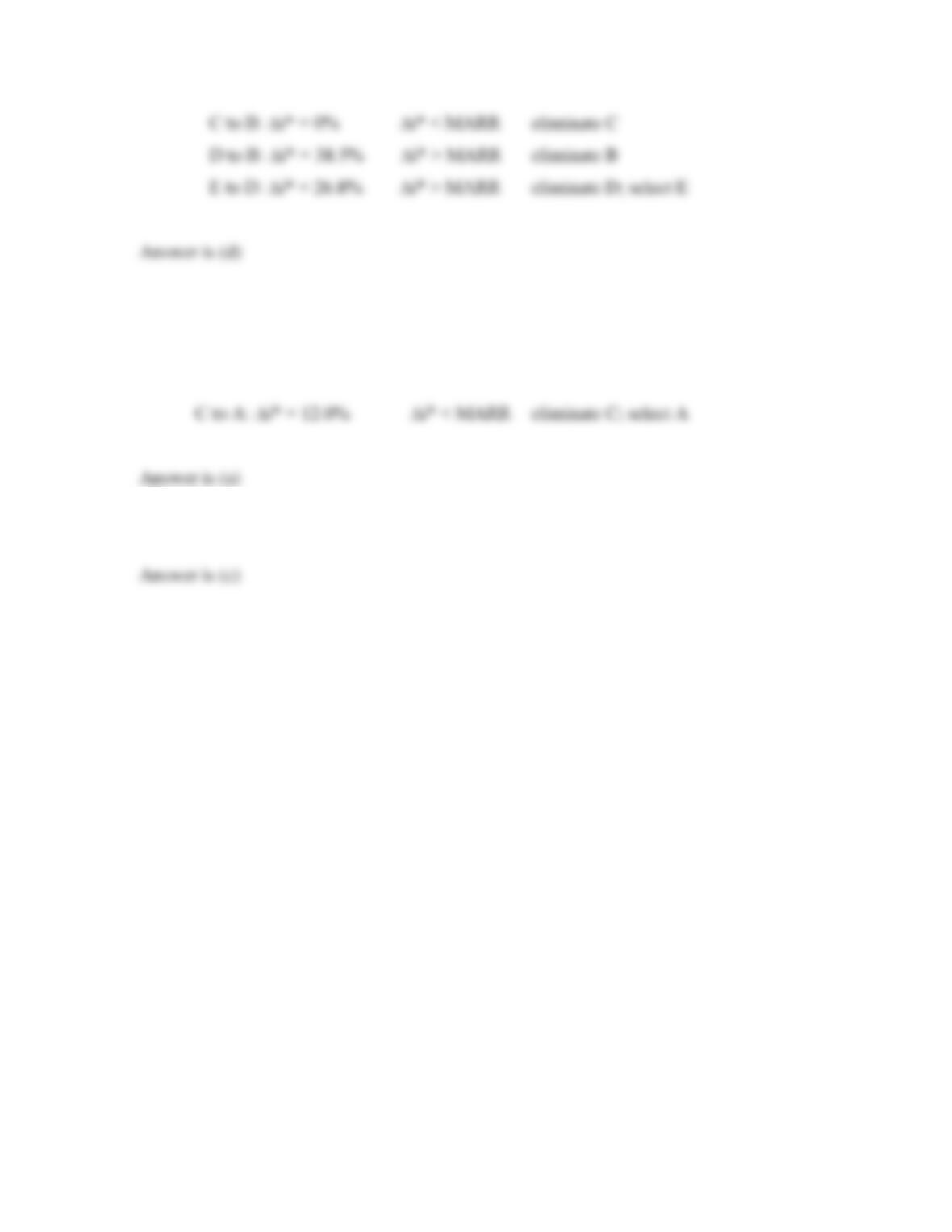
Solution 6.69
Only A and C have overall ROR > MARR of 16%
Solution 6.70