Chapter 6: Analysis of Financial Statements
Learning Objectives
At the completion of this chapter the student should be able to:
• Find the current industrial averages for common financial ratios for a specific sector of the
construction industry.
Instructional Hints
• Emphasize that in order for a construction company to obtain a bond, the surety will
require the company to submit copies of their financial statements. The surety will look at
these statements and compare them to other companies in the industry to make sure that
they are a health company. This is done by looking at the company’s financial ratios.
Activities
• Assign each student a different sector of the construction industry. Have the students find
the industrial average for each of the financial ratios and share them with the class.
Compare how the industrial averages compare across different sectors of the construction
industry.
Instruction Resources
• The figures and tables from this chapter in electronic format and PowerPoint slides can be
found at the instructor’s website.
• Financial statements for publicly held company can be downloaded from
http://www.sec.gov/edgar.shtml.

Solutions to the Textbook Problems
1. It is necessary because the income statement represents all transactions between two points in
2. When the depreciation method used differs greatly from the actual loss in value, the
depreciation of the fixed assets is overstated or understated in the financial statements;
3. Retention creates a receivable or payable that if often not collectable or payable in the short
4. Using Eq. (6-2) we get the following:
5. Using Eq. (6-3) we get the following:
6. Using Eq. (6-4) we get the following:
7. Using Eq. (6-5) we get the following:
8. Using Eq. (6-6) we get the following:
9. Using Eq. (6-7) we get the following:
10. The average accounts receivable—including retention—is calculated as follows:
Accounts Receivable = [($74,526 + $6,888) + ($38,212 + $4,235)]/2 = $61,930
The collection period is calculated using Eq. (6-8) as follows:

11. The average accounts payable—including retention—is calculated as follows:
Accounts Payable = [($38,682 + $3,768) + ($35,772 + $3,536)]/2 = $40,879
12. The average total assets is calculated as follows:
13. The average working capital is calculated using Eq. (6-13) as follows:
14. The average accounts payable—including retention—is calculated as follows:
15. Using Eq. (6-17) we get the following:
16. Using Eq. (6-18) we get the following:
17. The pretax profit margin is calculated using Eq. (6-19) as follows:
18. The average total assets is calculated as follows:
Total Assets = ($185,667 + $150,842)/2 = $168,254
19. The average equity is calculated as follows:
Equity = ($61,724 + $44,508)/2 = $53,116
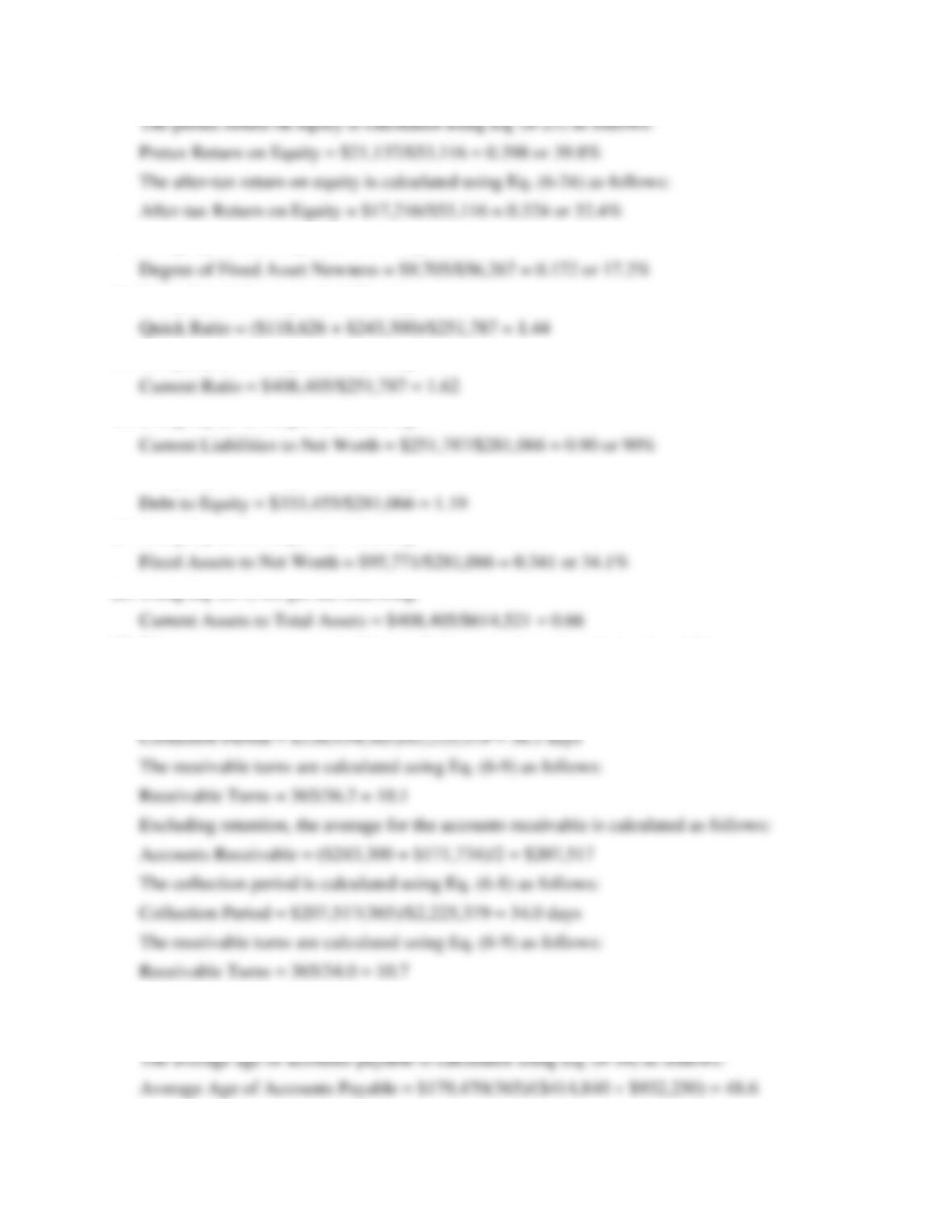
20. Using Eq. (6-25) we get the following:
21. Using Eq. (6-2) we get the following:
22. Using Eq. (6-3) we get the following:
23. Using Eq. (6-4) we get the following:
24. Using Eq. (6-5) we get the following:
25. Using Eq. (6-6) we get the following:
26. Using Eq. (6-7) we get the following:
27. The average accounts receivable—including retention—is calculated as follows:
Accounts Receivable = [($243,300 + $12,905) + ($171,734 + $12,929)]/2 = $220,434
The collection period is calculated using Eq. (6-8) as follows:
28. The average accounts payable—including retention—is calculated as follows:
Accounts Payable = [($191,046 + $14,945) + ($142,789 + $10,159)]/2 = $179,470

29. The average total assets is calculated as follows:
30. The average working capital is calculated using Eq. (6-13) as follows:
31. The average accounts payable—including retention—is calculated as follows:
32. Using Eq. (6-17) we get the following:
33. Using Eq. (6-18) we get the following:
34. The pretax profit margin is calculated using Eq. (6-19) as follows:
35. The average total assets is calculated as follows:
Total Assets = ($614,521 + $512,594)/2 = $563,558
36. The average equity is calculated as follows:
Equity = ($281,066 + $246,593)/2 = $263,830
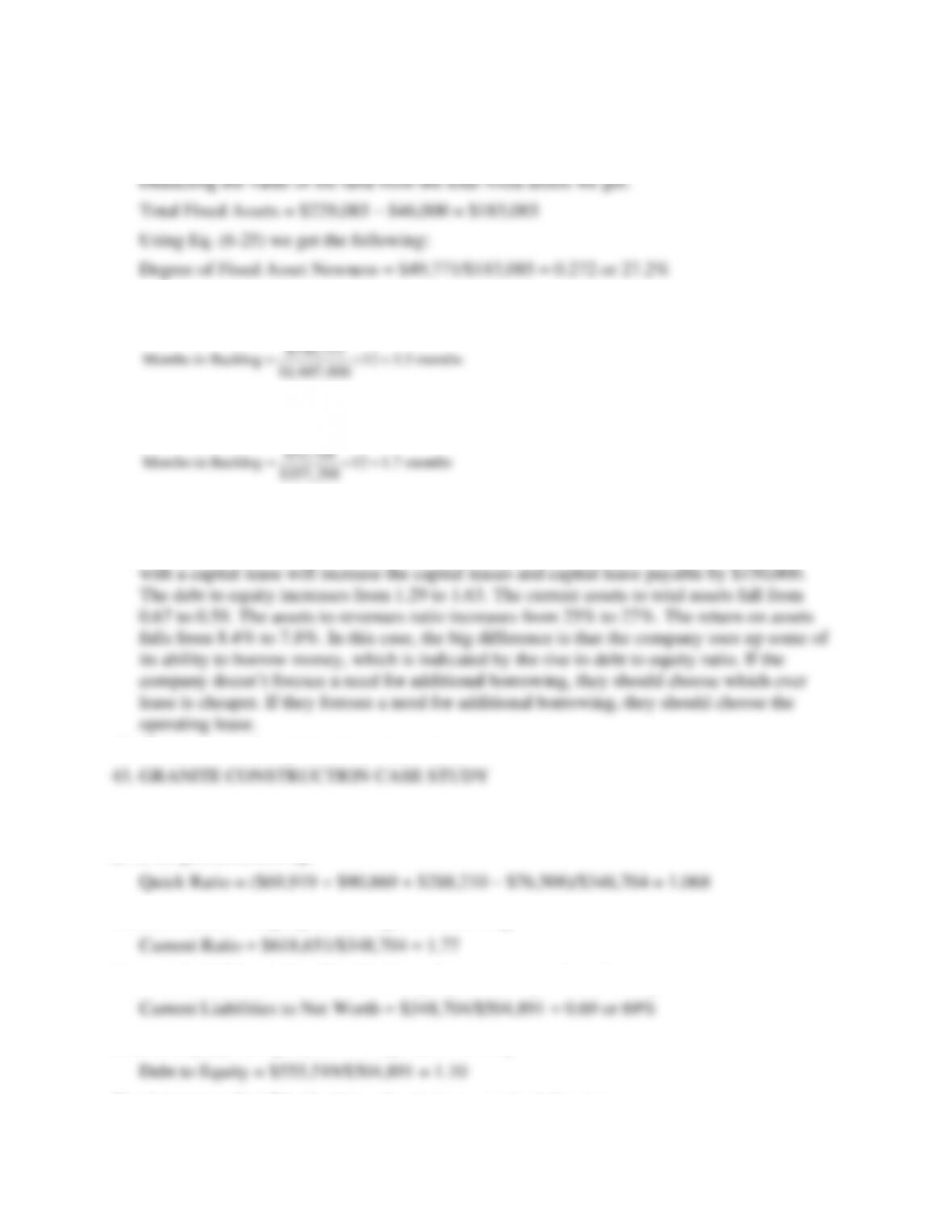
37. Deducting the value of the land from the net fixed assets we get:
Net Fixed Assets = $95,771 – $46,000 = $49,771
38. The uncompleted work on hand is $730,711 ($1,046,178 – $315,467). The months in backlog
is calculated using eq. (6-26) as follows:
$730,711
Months in Backlog 12 5.5 months
$1,607,000
= =
39. The uncompleted work on hand is $51,728 ($103,523 – $51,795). The months in backlog is
calculated using eq. (6-26) as follows:
$51,728
Months in Backlog 12 1.7 months
$357,298
= =
40. See Instructor’s website\Homework Excel Problems\Problem 06-40.xlsx.
41. Leasing the equipment with an operating lease will not have any effects on the balance sheet
or income statement; therefore, the financial ratios will not change. Leasing the equipment
42. The answer will vary based on current data.
Quick Ratio: Include cash and cash equivalents, short-term marketable securities, and account
receivable without retentions and allowanced for doubtful accounts in the calculation. Using Eq.
(6-2) we get the following:
Current Ratio: Using Eq. (6-3) we get the following:
Current Liabilities to Net Worth: Using Eq. (6-4) we get the following
Debt to Equity: Using Eq. (6-5) we get the following:
Fixed Assets to Net Worth: Using Eq. (6-6) we get the following:
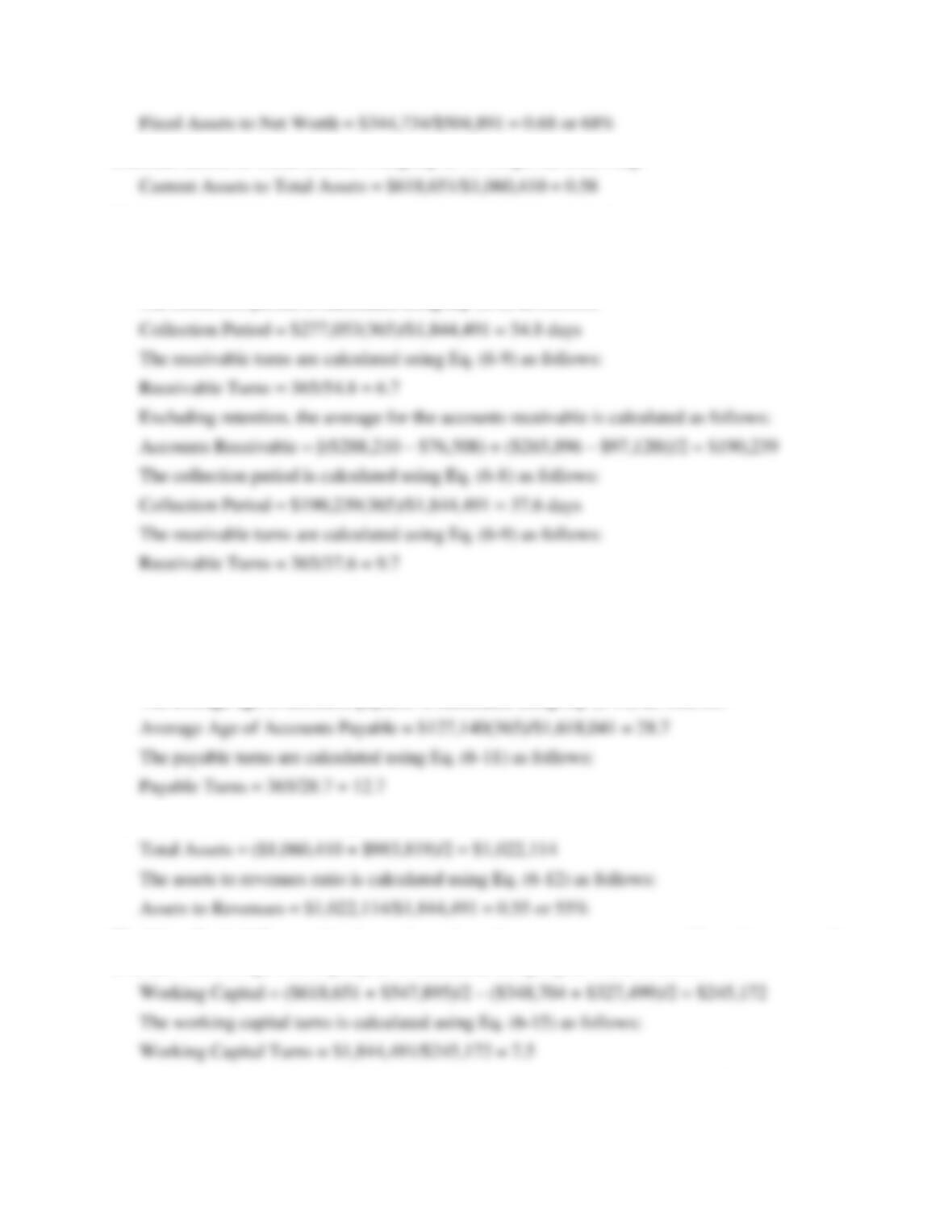
Current Assets to Total Assets: Using Eq. (6-7) we get the following:
Collection Period: The average accounts receivable—including retention and deducting
allowance for doubtful accounts—is calculated as follows
Accounts Receivable = ($288,210 + $265,896)/2 = $277,053
The collection period is calculated using Eq. (6-8) as follows:
Average Age of Accounts Payable: We do not have a breakdown of the constructions so we will
need to use the total cost rather than the materials and subcontractor costs. The average accounts
payable is calculated as follows:
Accounts Payable = ($135,468 + $118,813)/2 = $127,140
The average age of accounts payable is calculated using Eq. (6-10) as follows:
Assets to Revenues: The average total assets is calculated as follows:
Working Capital Turns: We do not have the subcontractor cost so we will need to use total
revenue. The average working capital is calculated using Eq. (6-13) as follows:
Accounts Payable to Revenue: The average accounts payable is calculated as follows:
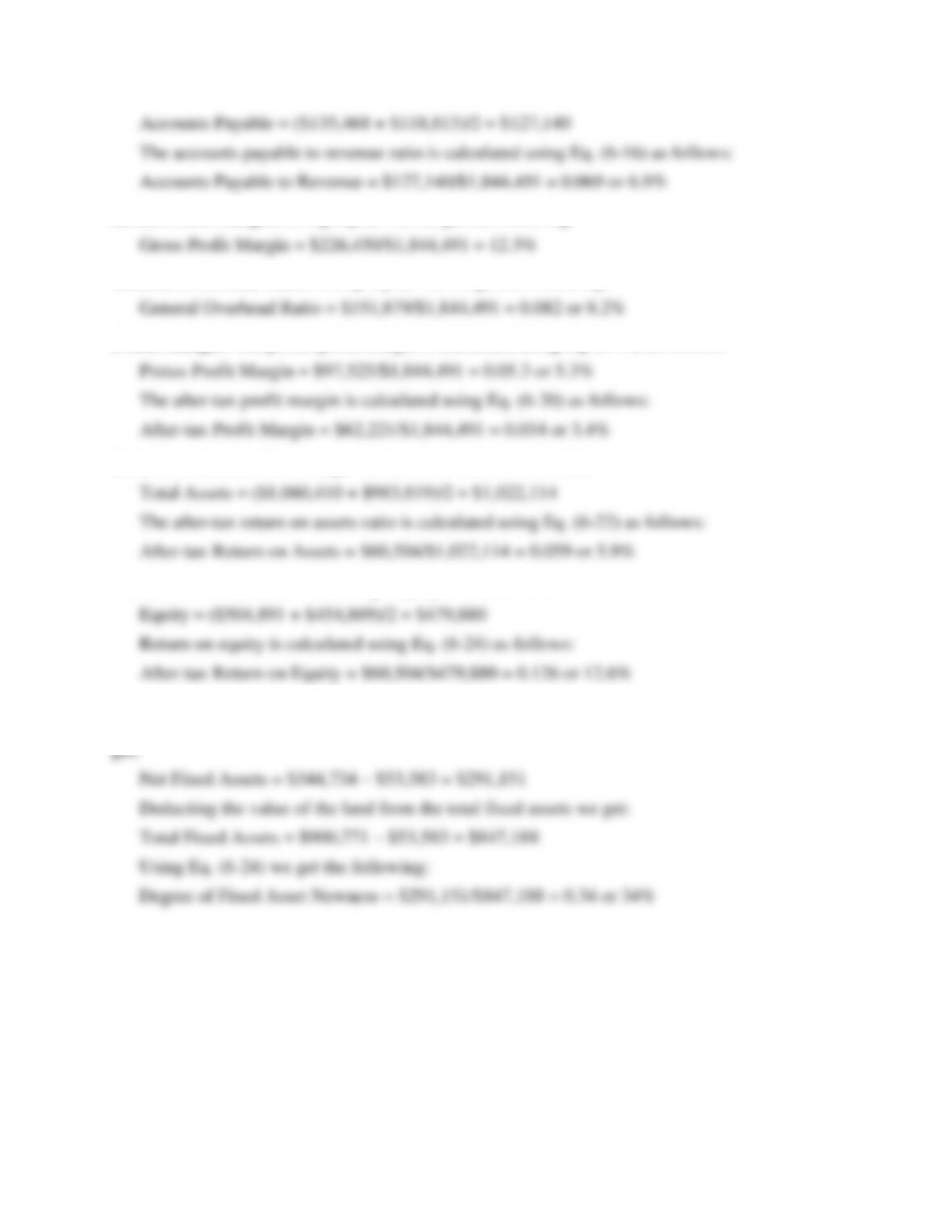
Gross Profit Margin: Using Eq. (6-17) we get the following:
General Overhead Ratio: Using Eq. (6-18) we get the following:
Profit Margin: The pretax profit margin is calculated using Eq. (6-19) as follows:
Return on Assets: The average total assets is calculated as follows:
Return on Investment: The average equity is calculated as follows:
Degree of Fixed Asset Newness: The quarry property will be depleted as the gravel is consumed
and is included in these calculations. Deducting the value of the land from the net fixed assets we