Problem 5.1
Heyden Motion Solutions ordered $7 million worth of seamless tubes for manufacturing
their high performance and precision linear motion products. If their annual operating
costs are $860,000 per year, how much annual revenue is required over a 3-year planning
period to recover the initial investment and operating costs at the company’s MARR of
15% per year?
Problem 5.2
NRG Energy plans to construct a giant solar plant in Santa Teresa, NM to supply
electricity to 30,000 southern NM and west TX homes. The plant will have 390,000
heliostats to concentrate sunlight onto 32 water towers to generate steam. NRG will
spend $560 million in constructing the plant and $430,000 per year in operating it. If a
salvage value of 20% of the initial cost is assumed, how much will the company have to
make each year for 15 years in order to recover its investment at a MARR of 18% per
year?
Problem 5.3
Environmental recovery company RexChem Partners plans to finance a site reclamation
project that will require a 4-year cleanup period. The company will borrow $3.8 million
now to finance the project. How much will the company have to receive in annual
payments for 4 years, provided it will also receive a final lump sum payment after 4 years
in the amount of $500,000? The MARR is 20% per year on its investment.
Problem 5.4
U.S. Steel is planning a plant expansion to produce austenitic, precipitation hardened,
duplex and martensitic stainless steel round bar (as well as various nickels) that is
expected to cost $13 million now and another $10 million 1 year from now. If total
operating costs will be $1.2 million per year starting 1 year from now, how much must
the company realize in revenue each year 1 through 10 to recover its investment plus15%
per year?
Problem 5.5
A small metal plating company wants to become involved in electronic commerce. A
modest e-commerce package is available for $20,000. Semiannual updates and site
maintenance will cost $300. The salvage value of the package is estimated to be $1500
after 3 years.If the company wants to recover its total cost in 3 years, what is the
equivalent semiannual amount of new income that must be realized at an interest rate of
5% per 6-month period?
Problem 5.6
Toro Company is expanding its US-based plastic molding plant as it continues to transfer
work from Juarez, Mexico contractors. The plant bought a $1.1 million precision
injection molding machine to make plastic parts for Toro lawn mowers, trimmers, and
snow blowers. The plant also spent $275,000 for three smaller plastic injection molding
machines to make plastic parts for a new line of sprinkler systems. The plant expects to
hire 13 people, including some engineers for the expansion. If the average loaded cost
(i.e., including benefits) of each employee is $100,000 per year, determine the annual
worth of the new systems over a five-year planning period at an interest rate of 10% per
year. Assume a 25% salvage value for the new equipment.
Problem 5.7
In an effort to retain troops who are proficient with weapons and who can speak the
languages of Middle Eastern countries, the Pentagon offered bonuses of $150,000 to
specialized personnel who were near or already eligible for retirement. If 400 enlisted
personnel accepted the bonus in year one, 300 in year two, and 600 in year three, what
was the equivalent annual cost of the program over the 3-year period at an interest rate of
6% per year?
Problem 5.8
A company that manufactures magnetic flow meters expects to undertake a project that
will have the cash flows estimated. At an interest rate of 10% per year, what is the
equivalent annual cost of the project? Find the AW value using (a) tabulated factors,
(b) calculator functions, and (c) a spreadsheet. Which method did you find the easiest to
use?
First cost, $ -800,000
Equipment replacement cost in year 2, $ -300,000
Annual operating cost, $/year -950,000
Salvage value, $ 250,000
Life, years 4
Problem 5.9
A small commercial building contractor purchased a used crane 2 years ago for $60,000.
Its operating cost was $2500 in month one, $2550 in month two, and amounts increasing
by $50 per month through the end of year two (now). If the crane was sold for $48,000
now, what was its equivalent monthly cost at an interest rate of 1% per month interest?
Problem 5.10
A 600-ton press used to produce composite-material fuel cell components for
automobiles using proton exchange membrane (PEM) technology can reduce the weight
of enclosure parts up to 75%. At MARR = 12% per year, calculate (a) capital recovery
and (b) annual revenue required. (c) Solve using a spreadsheet.

Installed cost = $-3.8 million
n = 12 years
Salvage value = $250,000
Annual operating costs = $-350,000 in year 1, increasing by $25,000 per year
Problem 5.11
Two machines with the following cost estimates are under consideration for a dishwasher
assembly process. Using an interest rate of 10% per year, determine which alternative
should be selected on the basis of an annual worth analysis.
Machine X Machine Y
First cost, $ -300,000 -430,000
Annual operating cost, $/year -60,000 -40,000
Salvage value, $ 70,000 95,000
Life, years 4 6
Problem 5.12
A public water utility is replacing its service trucks with more fuel-efficient vehicles.
Two types of trucks are under consideration: Type 1 uses “start– stop” technology that
turns the engine off when the vehicle comes to a halt in traffic or at a stop light. These
trucks will get 22 miles per gallon of gasoline and will cost $27,000 to buy. At the end of
the truck’s 5-year service life, it is expected to sell for $10,000. Type 2 trucks use a
system called Variable Cylinder Management wherein the engine operates on fewer
cylinders when the vehicle is cruising under light load conditions. These trucks will cost
$29,500 and will get 25 miles per gallon. Their salvage value is expected to be $12,000
after 5 years. The trucks are driven an average of 21,000 miles per year and the wholesale
price of gasoline is $4.00 per gallon. Which type of truck should the utility buy on the
basis of an annual worth comparison at an interest rate of 6% per year?
Problem 5.13
An engineer is considering two different liners for an evaporation pond that will receive
salty concentrate from a brackish water desalting plant. A plastic liner will cost $0.90 per
square foot and will have to be replaced in 20 years when precipitated solids have to be
removed from the pond using heavy equipment. A rubberized elastomeric liner is
tougher and, therefore, is expected to last 30 years, but it will cost $2.20 per square foot.
The pond covers 110 acres (1 acre = 43,560 square feet). Which liner is more cost
effective on the basis of an annual worth analysis at an interest rate of 8% per year? Solve
using (a) tabulated factors, and (b) a calculator.
Problem 5.14
One of two methods will produce solar panels for electric power generation. Method 1
will have an initial cost of $550,000, an annual operating cost of $160,000 per year, and
a $125,000 salvage value after its three-year life. Method 2 will cost $830,000 with an
annual operating cost of $120,000, and a $240,000 salvage value after its five-year life.
The company has asked you to determine which method is economically better, but it
wants the analysis done over a three-year planning period. The salvage value of Method 2
will be 35% higher after 3 years than it is after 5 years. If the company’s MARR is 10%
per year, which method should the company select?
Problem 5.15
An environmental engineer is considering three methods for disposing of a non-
hazardous chemical sludge: land application, fluidized-bed incineration, and private
disposal contract. The estimates for each method are estimated. (a) Determine which has
the least cost on the basis of an annual worth comparison at 10% per year. (b) Determine
the equivalent present worth value of each alternative using its AW value.
Problem 5.16
BP Oil is in the process of replacing sections of its Prudhoe Bay, Alaska oil transit
pipeline. This will reduce corrosion problems, while allowing higher line pressures and
flow rates to downstream processing facilities. The installed cost is expected to be about
$170 million. Alaska imposes a 22.5% tax on annual profits (net revenue over costs),
which are estimated to average $85 million per year for a 20 year period. Use tabulated
factors and a spreadsheet to answer the following: (a) At a corporate MARR of 10% per
year, does the project AW indicate it will make at least the MARR? (b) Recalculate the
AW at MARR values increasing by 10% per year, that is, 20%, 30%, etc. At what
required return does the project become financially unacceptable?
Problem 5.17
Equipment needed at a Valero Corporation refinery for the conversion of corn stock to
ethanol, a cleaner burning gasoline additive, will cost $175,000 and have net cash flows
of $35,000 the first year, increasing by $10,000 per year over the life of 5 years. (a) Use a
spreadsheet (and tabulated factors, if instructed to do so) to calculate the AW amounts at
different MARR values to determine when the project switches from financially justified
to unjustified. (b) Develop a spreadsheet chart that plots AW versus interest rate.
Problem 5.18
The TT Racing and Performance Motor Corporation wishes to evaluate two alternative
machines for NASCAR motor tune-ups. (a) Use the AW method at 9% per year to select
the better alternative. (b) Use spreadsheet single-cell functions to find the better
alternative.

Machine R Machine S
First cost, $ -250,000 -370,500
Annual operating cost, $ per year -40,000 -50,000
Life, years 3 5
Salvage value, $ 20,000 20,000
Problem 5.19
Estimates have been presented to Holly Farms, which is considering two environmental
chambers for a project that will detail laboratory confirmations of on-line bacteria tests in
chicken meat for the presence of E. coli 0157:H7 and Listeria monocytogenes. (a) If the
project will last for 6 years and i = 10% per year, perform an AW evaluation to determine
which chamber is more economical. (b) Chamber D103 can be purchased with different
options and, therefore, at different installed costs. They range from $300,000 to
$500,000. Will the selection change if one of these other models is installed? (c) Use
single-cell spreadsheet functions to solve part (b).
Chamber D103 Chamber 490G
Installed cost, $ -400,000 -250,000
Annual operating cost, $ per year -4,000 -3,000
Salvage value at 10% of P, $ 40,000 25,000
Life, years 3 2
Problem 5.20
Blue Whale Moving and Storage recently purchased a warehouse building in Santiago.
The manager has two good options for moving pallets of stored goods in and around the
facility. Alternative 1 includes a 4000-pound capacity, electric forklift (P = $-30,000;
n = 12 years; AOC = $-1000 per year; S = $8000) and 500 new pallets at $10 each. The
forklift operator’s annual salary and indirect benefits are estimated at $32,000.
Alternative 2 uses two electric pallet movers (“walkies”) each with a 3000-pound
capacity (for each mover, P = $-2,000; n = 4 years; AOC =$-150 per year; no salvage)
and 800 pallets at $10 each. The two operators’ salaries and benefits will total $55,000
per year. For both options, new pallets are purchased now and every two years that the
equipment is in use. (a) If the MARR is 8% per year, use tabulated factors to determine
which alternative is better. (b) Rework using a spreadsheet solution.
Problem 5.21
Calculate the equivalent annual cost for years 1 through infinity of $1,000,000 now and
$1,000,000 three years from now at an interest rate of 10% per year.
Problem 5.22

Calculate the infinite-life equivalent annual cost of $5,000,000 in year 0, $2,000,000 in
year 10, and $100,000 in years 11 through infinity. The interest rate is 10% per year.
Problem 5.23
Compare the alternatives below using the annual worth method at an interest rate of 10%
per year. Use (a) tabulated factors, and (b) calculator functions.
A B__
First cost, $ –60,000 –380,000
Annual cost, $/year –30,000 –5,000
Salvage value, $ 10,000 25,000
Life, years 3 ∞
Problem 5.24
For the cash flows below, use an annual worth comparison to determine which
alternative is best at an interest rate of 1% per month.
X Y Z___
First cost, $ –90,000 –400,000 -900,000
M&O costs, $/month -30,000 –20,000 –13,000
Overhaul every 10 years, $ — — –80,000
Salvage value, $ 7,000 25,000 200,000
Life, years 3 10 ∞
Problem 5.25
Cheryl and Gunther wish to place into a retirement fund an equal amount each year for 20
consecutive years to accumulate just enough to withdraw $24,000 per year starting
exactly one year after the last deposit is made. The fund has a reliable return of 8% per
year. Determine the annual deposit for two withdrawal plans: (a) forever (years 21 to
infinity); (b) 30 years (years 21 through 50). (c) How much less per year is needed when
the withdrawal horizon decreases from infinity to 30 years?
Problem 5.26
Baker|Trimline owned a specialized tools company for a total of 12 years when it was
sold for $38 million cash. During the ownership, annual net cash flow varied
significantly as follows:
Year 1 2 3 4 5 6 7 8 9 10 11 12
Net Cash Flow, 4 0 -1 -3 -3 1 4 6 8 10 12 12
$ million per year

The company made 12% per year on its positive cash flows and paid 10% per year
on short-term loans to cover the lean years. The president wants to use the cash
accumulated after 12 years to improve capital investments starting in year 13 and
forward. If an 8% per year return is expected after the sale, what annual amount can
Baker|Trimline invest forever?
Problem 5.27
A major repair on the suspension system of Jane’s 3-year old car cost her $2,000 because
the warranty expired after 2 years of ownership. Based on this experience, she will plan
on additional $2000 expenses every 3 years henceforth. Also, she spends $800 every
2 years for maintenance now that the warranty is over. This is for years 2, 4, 6, 8, and 10
when she plans to donate the car to charity. Use these costs to determine Jane’s
equivalent annual cost for years 1 through infinity at i = 5% per year, if cars she owns in
the future have the same cost pattern. Solve using tabulated factors and a spreadsheet, as
requested by your instructor.
Problem 5.28
A West Virginia coal mining operation has installed an in-shaft monitoring system for
oxygen tank and gear readiness for emergencies. Based on maintenance patterns for
previous systems, costs are minimal for the first few years, increase for a time period, and
then level off. Maintenance costs are expected to be $150,000 in year 3, $175,000 in
year 4, and amounts increasing by $25,000 per year through year 6 and remain constant
thereafter for the expected 10-year life of this system. If similar systems will replace the
current one, determine the perpetual equivalent annual maintenance cost at i = 10% per
year. Solve using tabulated factors and a spreadsheet, as requested by your instructor.
Problem 5.29
Harmony Auto Group sells and services imported and domestic cars. The owner is
considering the outsourcing of all its new car warranty service work to Winslow, Inc., a
private repair service that works on any make and year car. Both a 5-year contract basis
or 10-year license agreement are available from Winslow. Revenue from the
manufacturer will be shared with no added cost incurred by the car/warranty owner.
Alternatively, Harmony can continue to do warranty work in-house. Use the estimates
made by the Harmony owner to perform an annual worth evaluation at 10% per year to
select the best option. All dollar values are in millions.
Contract License In-house
First cost, $ 0 -2 -20
Annual cost, $ per year -1 -0.2 -4
Annual income, $ per year 2.5 1.3 8
Life, years 5 10 ∞

Problem 5.30
ABC Drinks purchases its 355 ml cans in large bulk from Wald-China Can Corporation.
The finish on the anodized aluminum surface is produced by mechanical finishing
technology called brushing or bead blasting. Engineers at Wald are switching to more
efficient, faster, and cheaper machines to supply ABC. Use the estimates and
MARR = 8% per year to select between two alternatives.
Brush alternative: P = $-400,000; n = 10 years; S = $50,000;
non-labor AOC = $-60,000 in year 1, decreasing by $5000
annually starting in year 2.
Bead blasting alternative: P = $-400,000; n is large, assume permanent; no
salvage; nonlabor AOC = $-70,000 per year.
Problem 5.31
You are an engineer with Yorkshire Shipping in Singapore. Your boss, Zul, asks you to
recommend one of two methods to reduce or eliminate rodent damage to silo-stored
grain as it awaits shipment. Perform an AW analysis at 10% per year compounded
quarterly. Dollar values are in millions.
Alternative A Alternative B
Major Reduction Almost Eliminate
First cost, $ -10 -35
Annual operating cost, $ per year -1.8 -0.6
Salvage value, $ 0.7 0.2
Life, years 5 Almost permanent
Problem 5.32
In comparing alternatives that have different lives by the annual worth method,
a. the annual worth value of both alternatives must be calculated over a time
period equal to the life of the shorter-lived one.
b. the annual worth value of both alternatives must be calculated over a time
period equal to the life of the longer-lived asset.
c. the annual worth values must be calculated over a time period equal to the
least common multiple of the lives.
d. the annual worth values can be compared over one life cycle of each
alternative.
Problem 5.33
If you have the present worth of an alternative with a 5-year life, you can obtain its
annual worth by:
a. multiplying the PW by i.
b. multiplying the PW by (A/F,i,5).
c. multiplying the PW by (P/A,i,5).
d. multiplying the PW by (A/P,i,5).
Problem 5.34
An automation asset with a high first cost of $10 million has a capital recovery (CR) of
$1,985,000 per year. The correct interpretation of this CR value is that:
a. the owner must pay an additional $1,985,000 each year to retain the asset.
b. each year of its expected life, a net revenue of $1,985,000 must be realized to
recover the $10 million first cost and the required rate of return on this
investment.
c. each year of its expected life, a net revenue of $1,985,000 must be realized to
recover the $10 million first cost.
d. the services provided by the asset will stop if less than $1,985,000 in net
revenue is reported in any year.
Problem 5.35
The AWs of three cost alternatives are $-23,000 for Alternative A, $-21,600 for B, and
$-27,300 for C. On the basis of AW values, the best economic choice is:
a. select alternative A.
b. select alternative B.
c. select alternative C.
d. select the do nothing alternative.
Problem 5.36

The initial cost of a packed-bed degassing reactor for removing trihalomethanes from
potable water is $84,000. The annual operating cost for power, site maintenance, etc. is
$13,000. If the salvage value of the pumps, blowers, and control systems is expected to
be $9000 at the end of 10 years, the AW of the packed-bed reactor at an interest rate of
8% per year is closest to:
a. $-26,140
b. $-25,520
c. $-24,900
d. $-13,140
Problem 5.37
The AW values of three revenue alternatives are $-23,000 for A, $-21,600 for B, and
$-27,300 for C. On the basis of these AW values, the correct decision is to:
a. select alternative A.
b. select alternative B.
c. select alternative C.
d. select the do nothing alternative.
Problem 5.38
Use these estimates.
Use an interest rate of 10% per year.
Alternative A B___
First cost, $ -50,000 -80,000
Annual cost, $/year -20,000 -10,000
Salvage value, $ 10,000 25,000
Life, years 3 6
The equivalent annual worth of alternative A is closest to:
a. $-25,130
b. $-37,100
c. $-41,500
d. $-42,900

Problem 5.39
Use these estimates.
Use an interest rate of 10% per year.
Alternative A B___
First cost, $ -50,000 -80,000
Annual cost, $/year -20,000 -10,000
Salvage value, $ 10,000 25,000
Life, years 3 6
The equivalent annual worth of alternative B is closest to:
a. $-25,130
b. $-28,190
c. $-37,080
d. $-39,100
Problem 5.40
Use these estimates.
Use an interest rate of 10% per year.
Alternative A B___
First cost, $ -50,000 -80,000
Annual cost, $/year -20,000 -10,000
Salvage value, $ 10,000 25,000
Life, years 3 6
The equivalent annual worth of alternative A over an infinite time period is closest to:
a. $-25,000
b. $-27,200
c. $-31,600
d. $-37,100
Problem 5.41
If you have the capitalized cost of an alternative that has an infinite life, you can get its
annual cost over a very long number of years by:
a. multiplying the capitalized cost by i.
b. multiplying the capitalized cost by (A/F,i,n).
c. dividing the capitalized cost by (P/A,i,n).
d. dividing the capitalized cost by i.
Problem 5.42
If you have the annual worth of an alternative that has a 5-year life, you can obtain its
perpetual annual worth by:
a. doing no calculations, since perpetual annual worth equals the annual worth.
b. multiplying the annual worth by (A/P,i,5).
c. dividing the annual worth by i.
d. multiplying the annual worth by i.
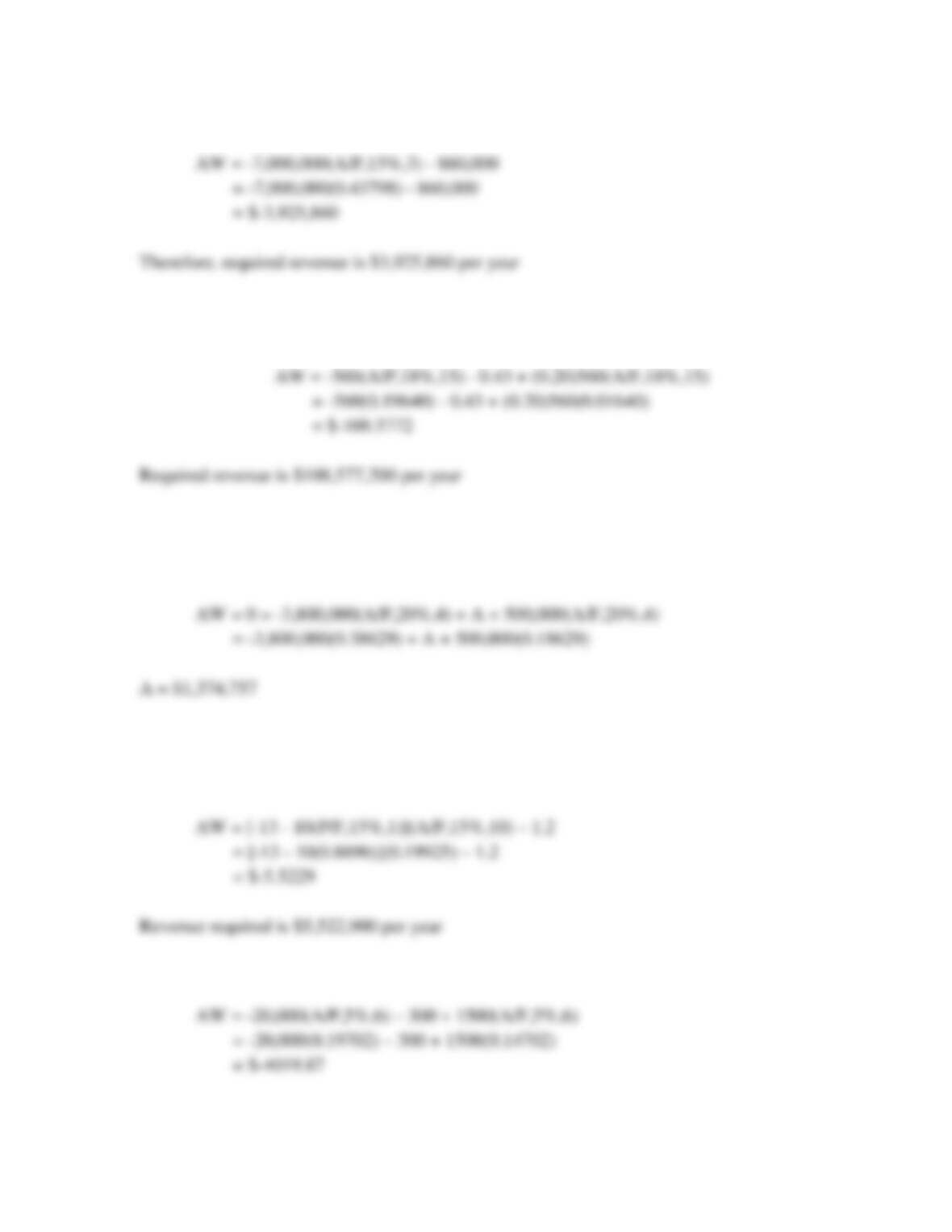
Solution 5.1
Solution 5.2
In $ millions,
Solution 5.3
Set AW = 0 and solve for annual income A
Solution 5.4
In $ millions,
Solution 5.5
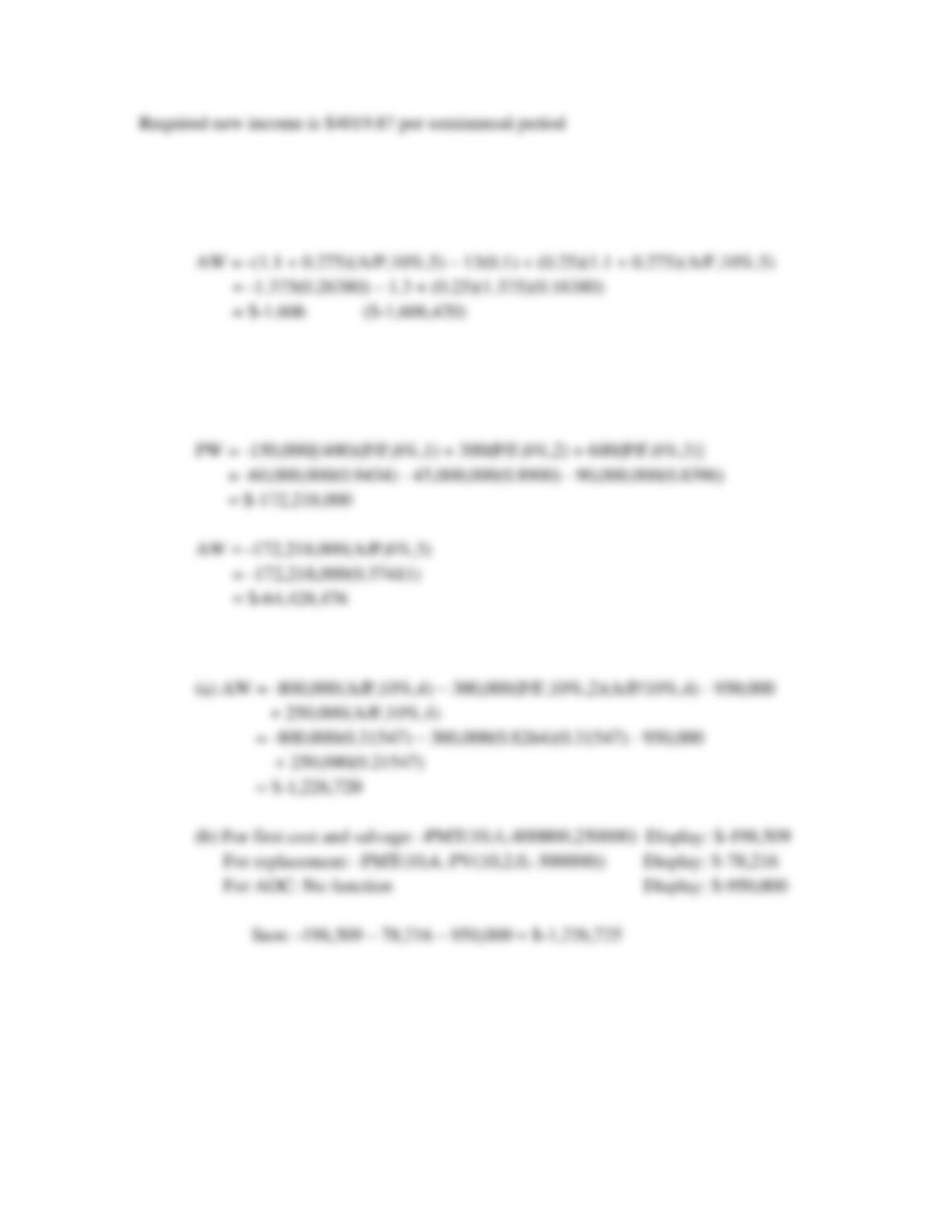
Solution 5.6
In $ million units
Solution 5.7
First find PW, then annualize over three years
Solution 5.8
(c)
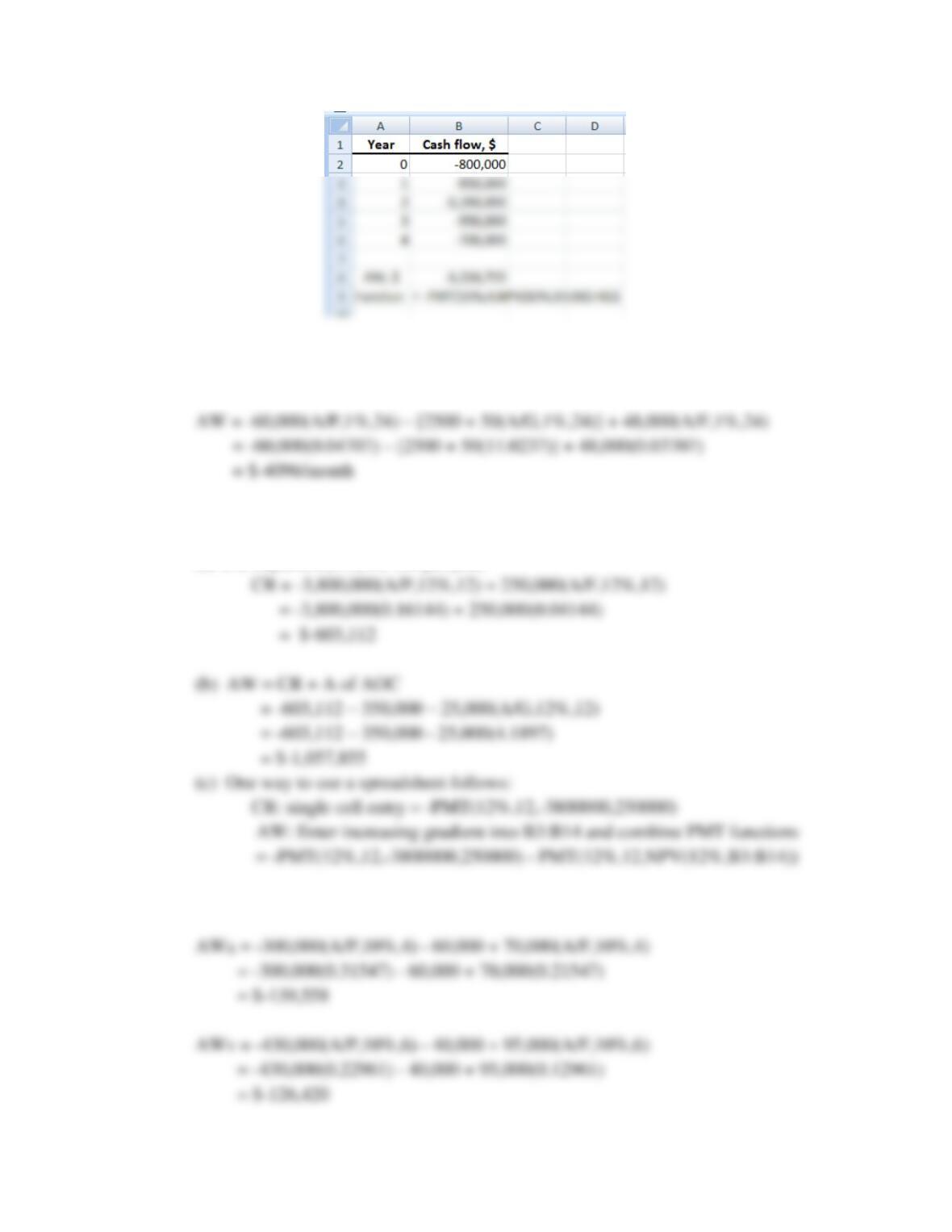
Solution 5.9
Solution 5.10
(a) Use Equation [5.3] for CR per year.
Solution 5.11
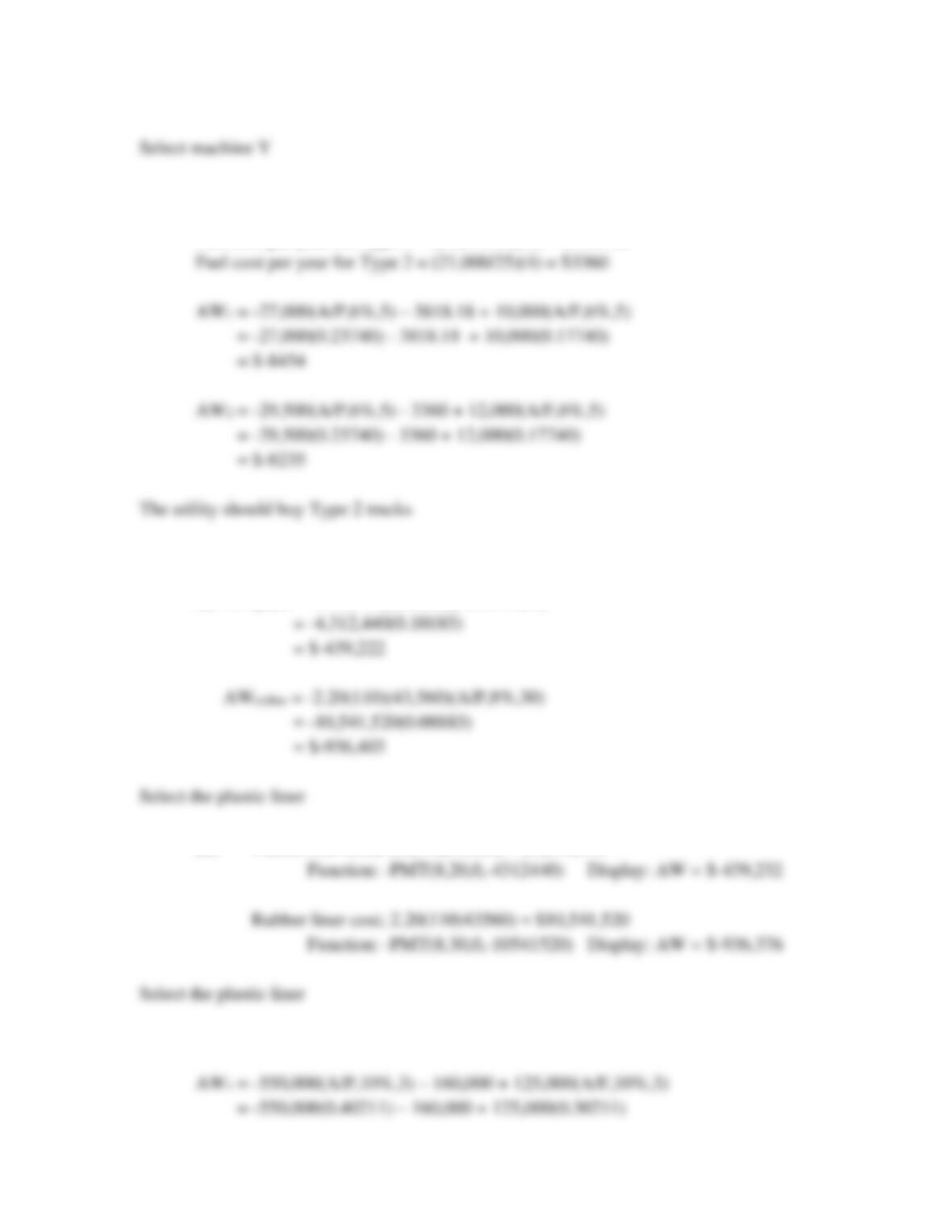
Solution 5.12
Fuel cost per year for Type 1 = (21,000/22)(4) = $3818.18
Solution 5.13
(a) AWplastic = -0.90(110)(43,560)(A/P,8%,20)
(b) Plastic: liner cost; 0.9(110)43560) = $4,312,440
Solution 5.14
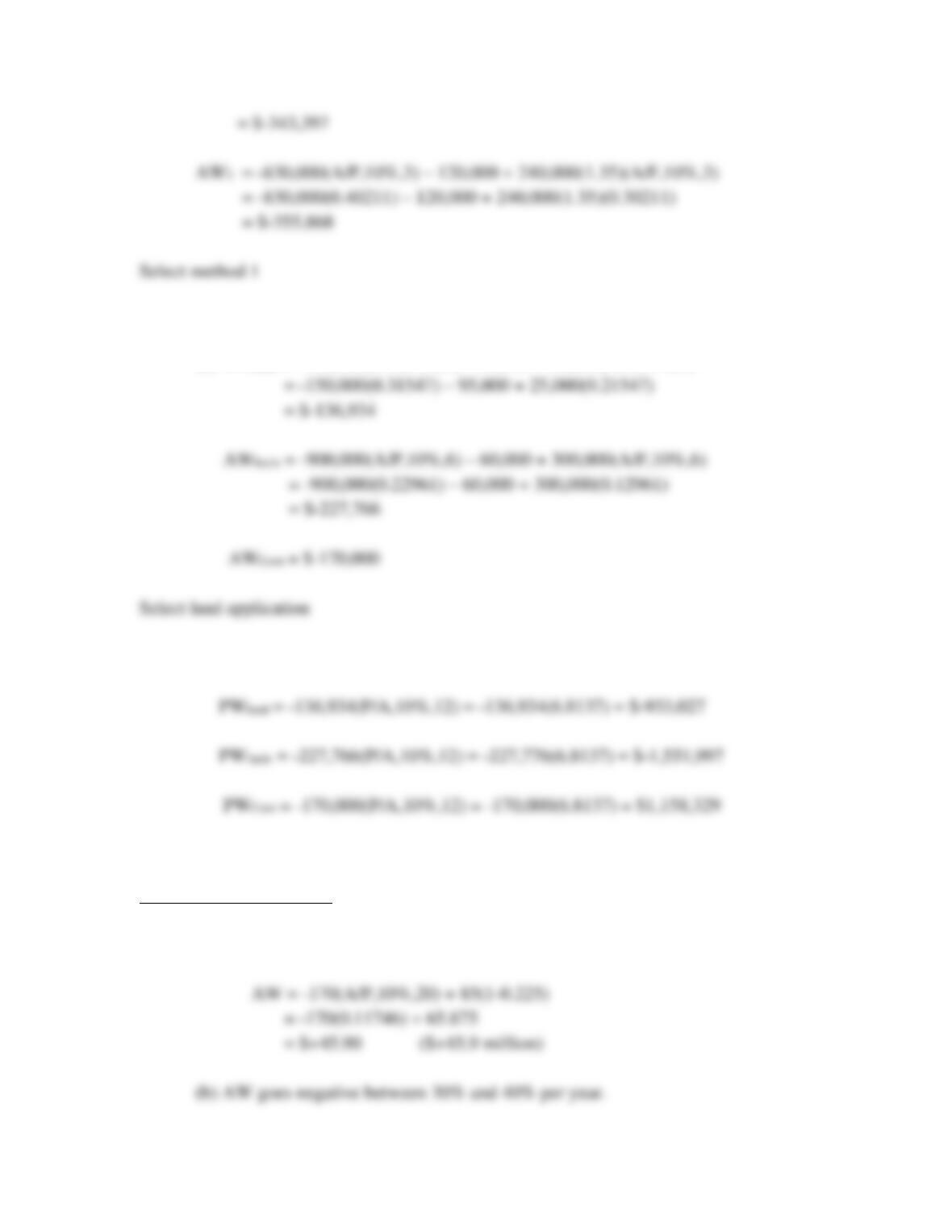
Solution 5.15
(a) AWLand = -150,000(A/P,10%,4) – 95,000 + 25,000(A/F,10%,4)
(b) Use the LCM of 12 years
Solution 5.16
Tabulated factor solution:
(a) Monetary terms in $ million. From AW, project clearly makes 10% per year.
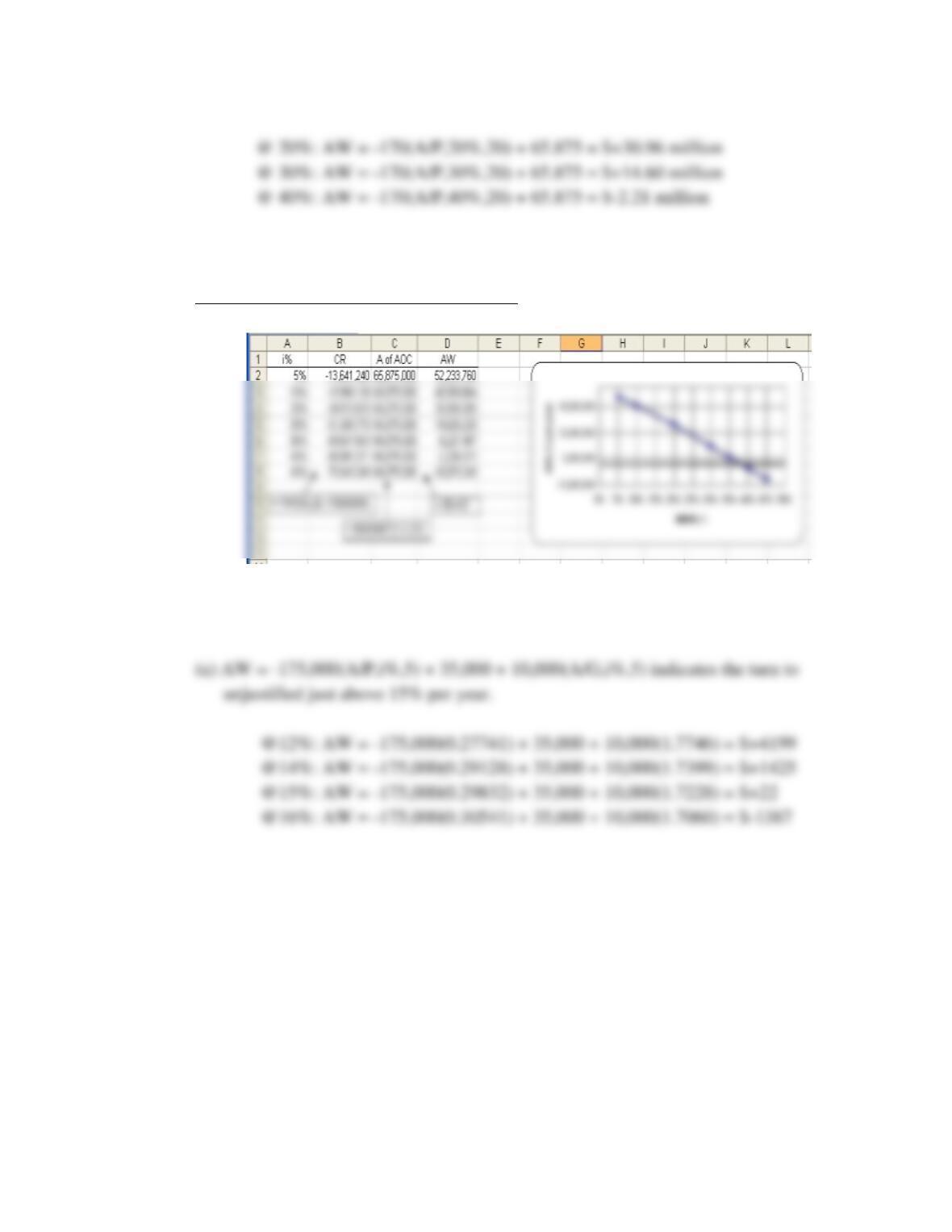
Spreadsheet solution with x-y scatter chart:
Solution 5.17
(b) Spreadsheet indicates just above 15% at the point where AW = 0.
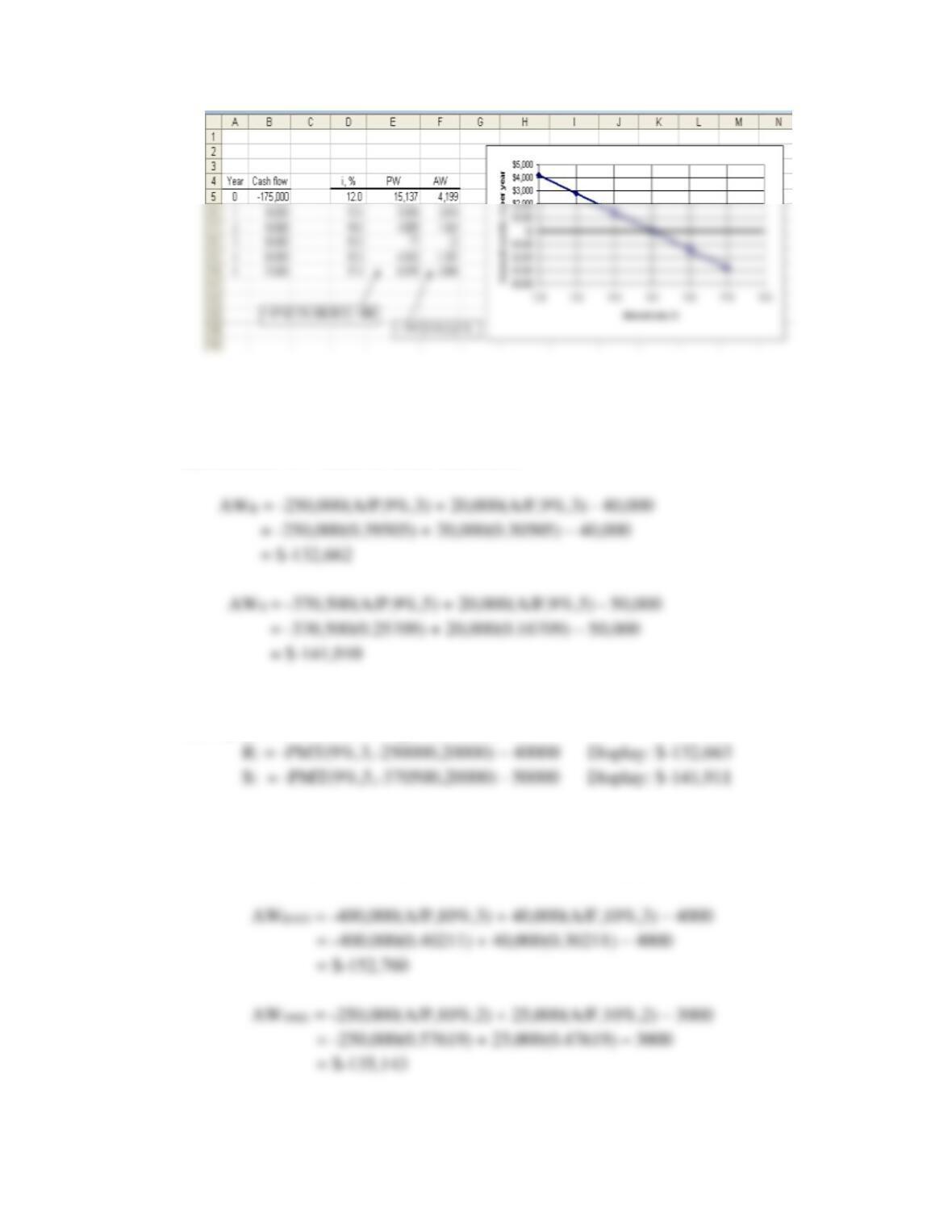
Solution 5.18
(a) Calculate AW values to select machine R.
(b) By spreadsheet, enter single cell functions.
Solution 5.19
(a) AW evaluation indicates chamber 490G to be more economic.
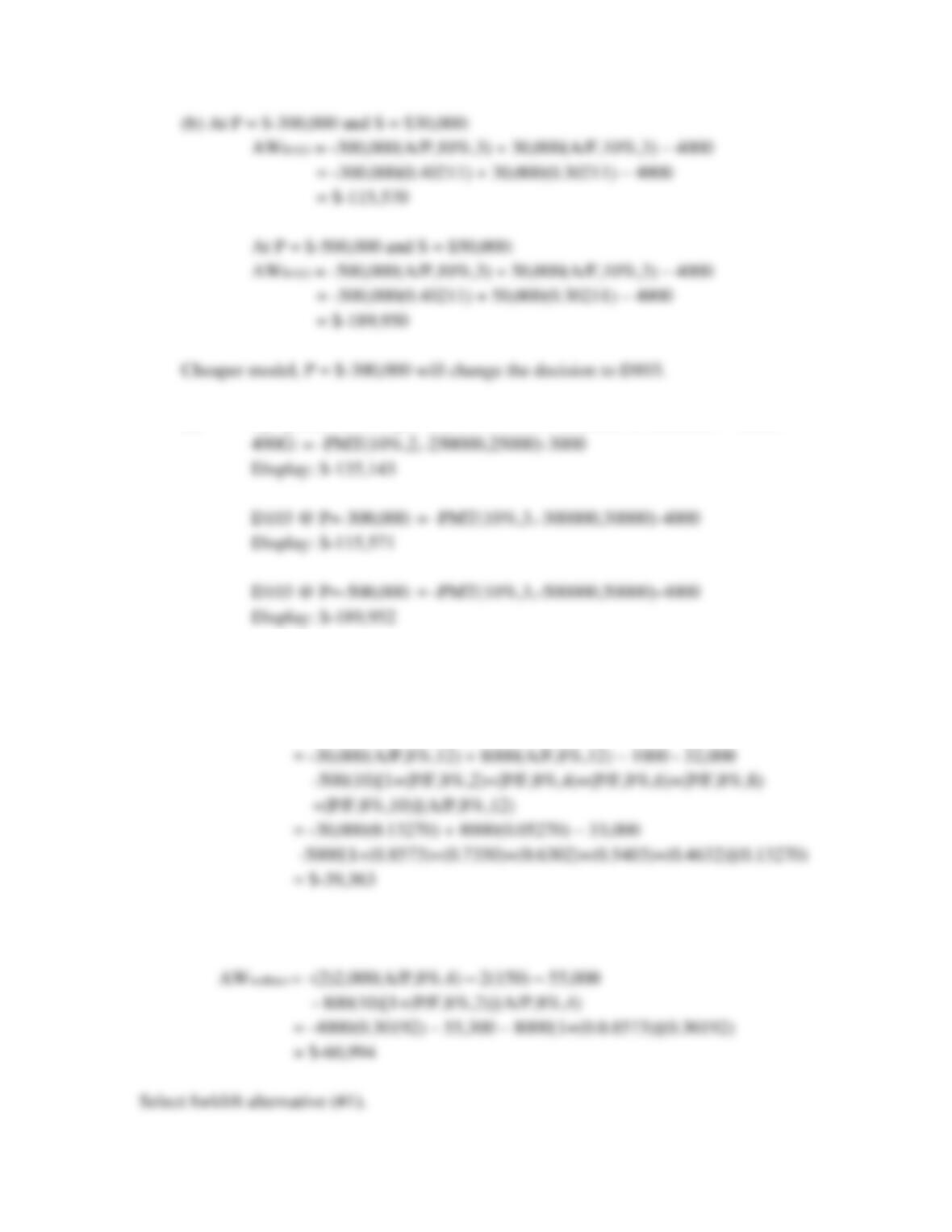
(c) By spreadsheet for part (b) use the PMT functions at different P values.
Solution 5.20
(a) AWforklift = CR – AOC – salary – AW of pallets
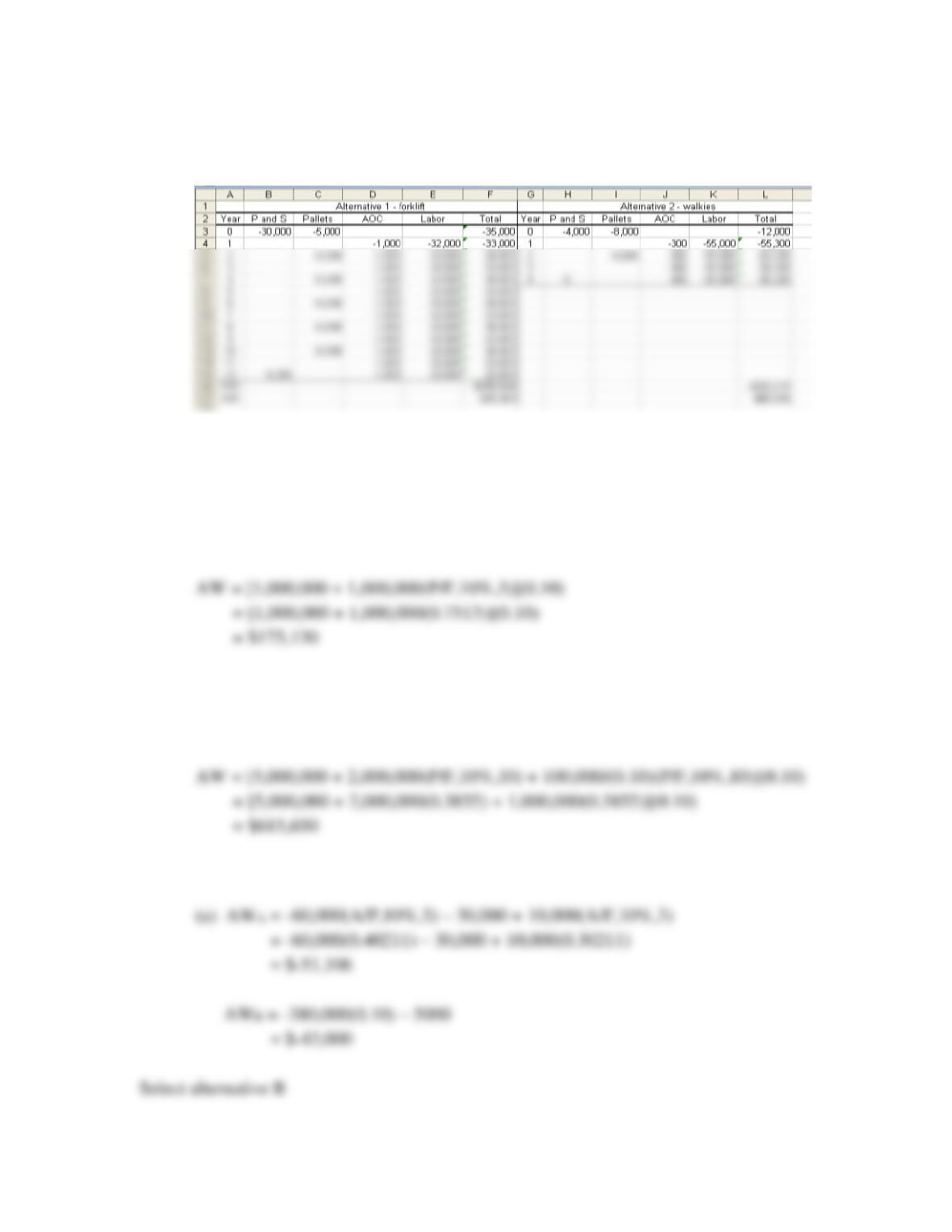
(b) A spreadsheet evaluation is as follows:
Solution 5.21
AW = PW(i)
Solution 5.22
AW = PW(i)
Solution 5.23
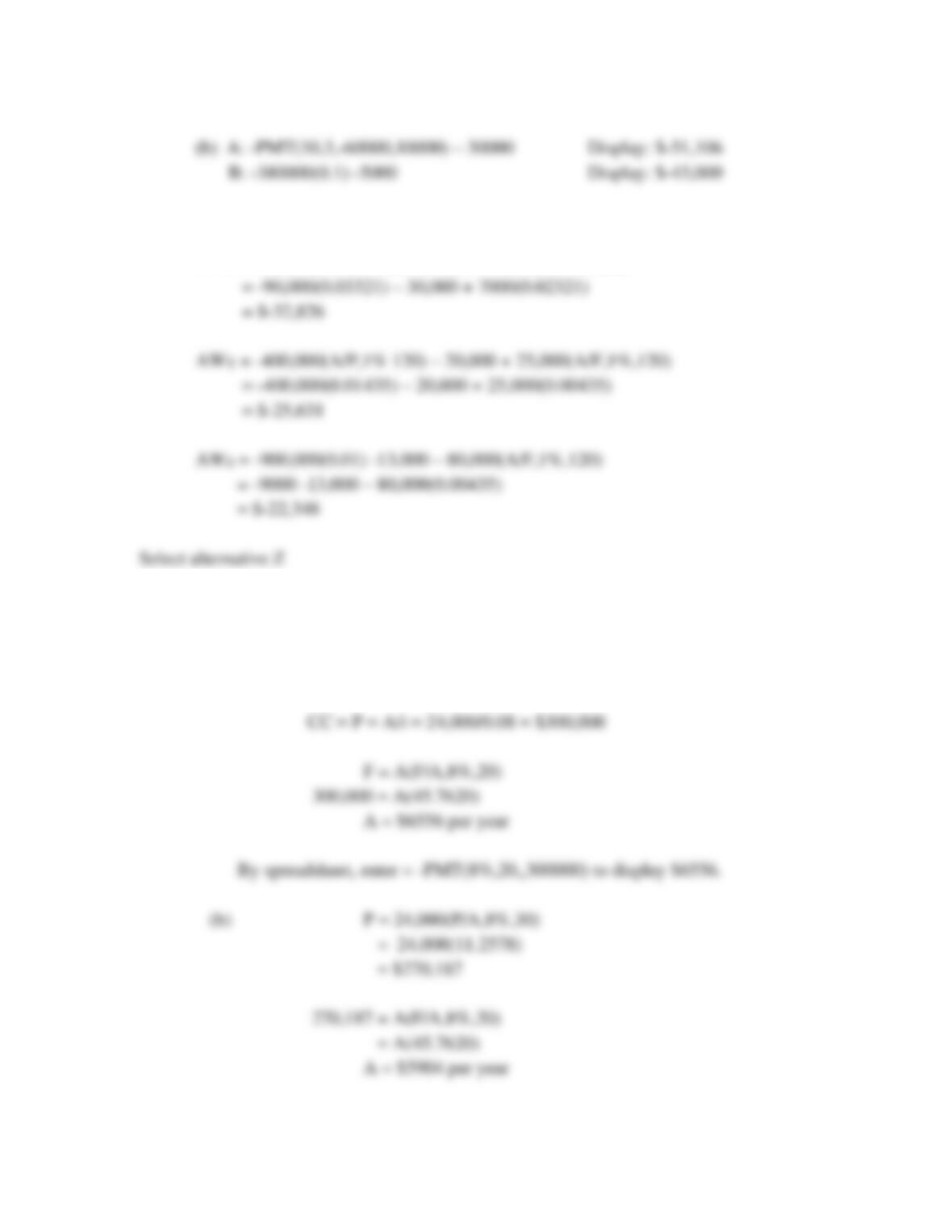
Solution 5.24
AWX = -90,000(A/P,1% 36) – 30,000 + 7000(A/F,1%,36)
Solution 5.25
(a) Determine amount needed at end of year 20, followed by A to accumulate
this future amount.
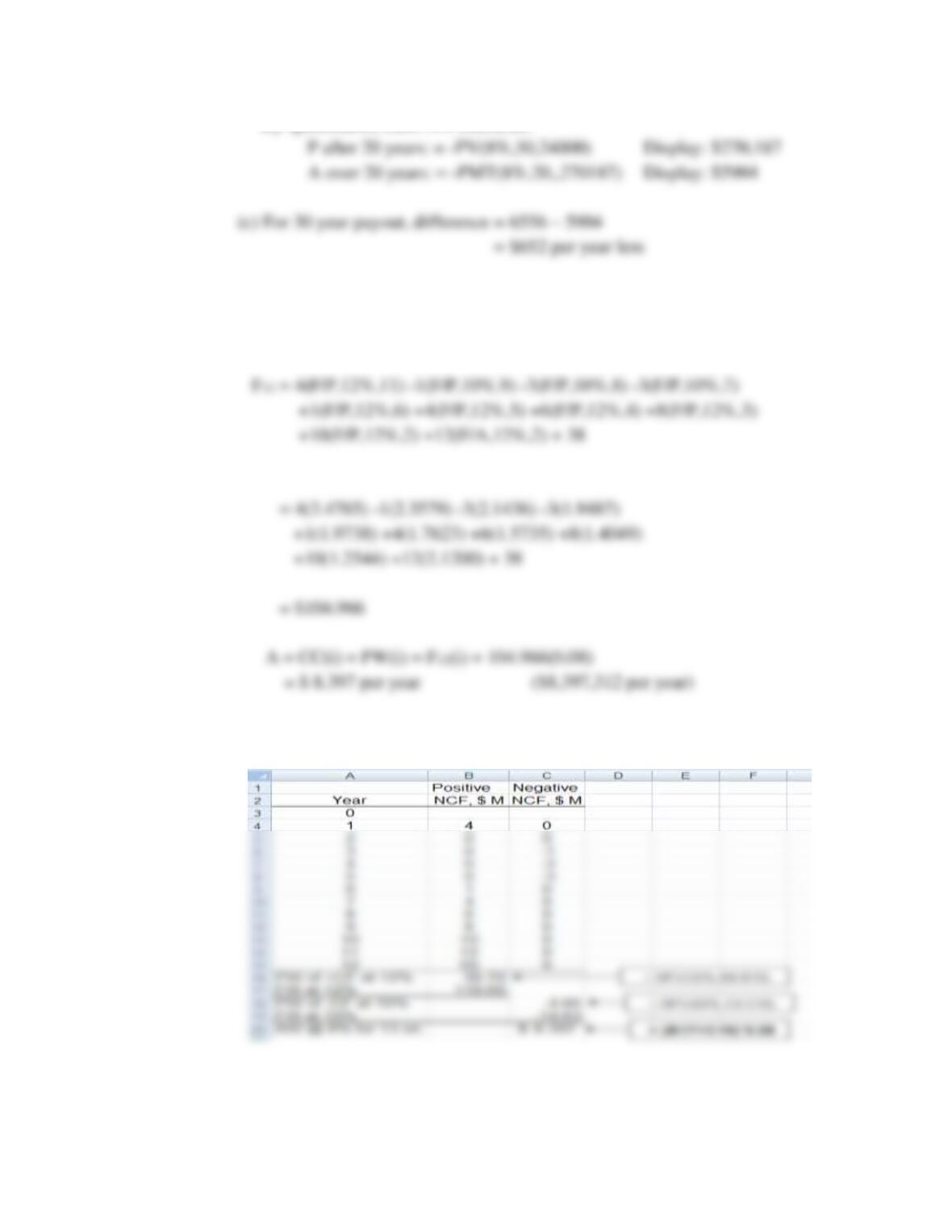
By spreadsheet, enter two functions.
Solution 5.26
(a) Find F in year 12; treat it as a CC value; then find A forever.
(b) Spreadsheet solution finds PW, then FW in year 12, then AW for 13 on.
Solution 5.27
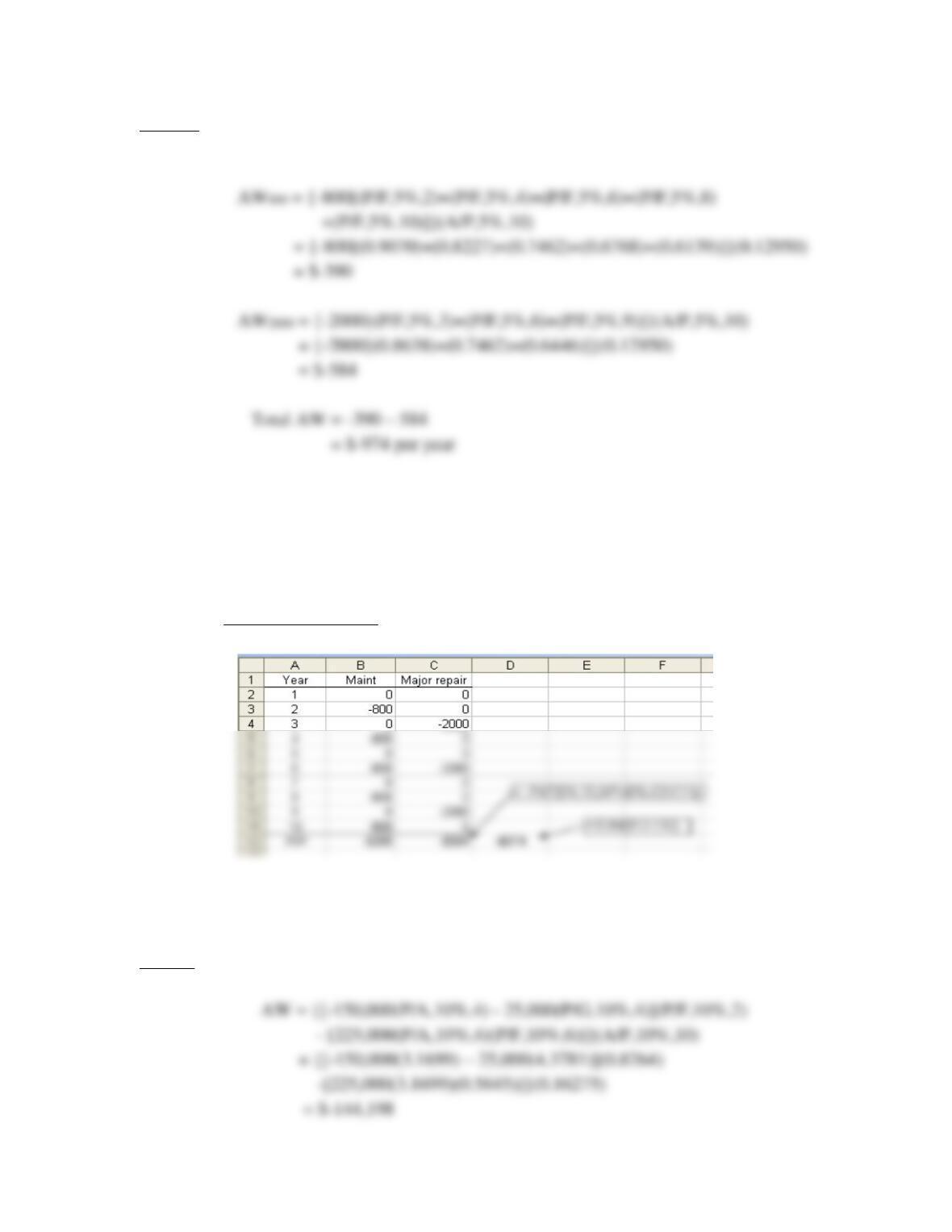
Factors: Use procedure in section 4.4, step 3, to find equivalent A over one life cycle of
the 2 recurring series ($-800 and $-2000). These will continue forever.
Spreadsheet solution
Solution 5.28
Factors: Perpetual AW is equal to AW over one life cycle.
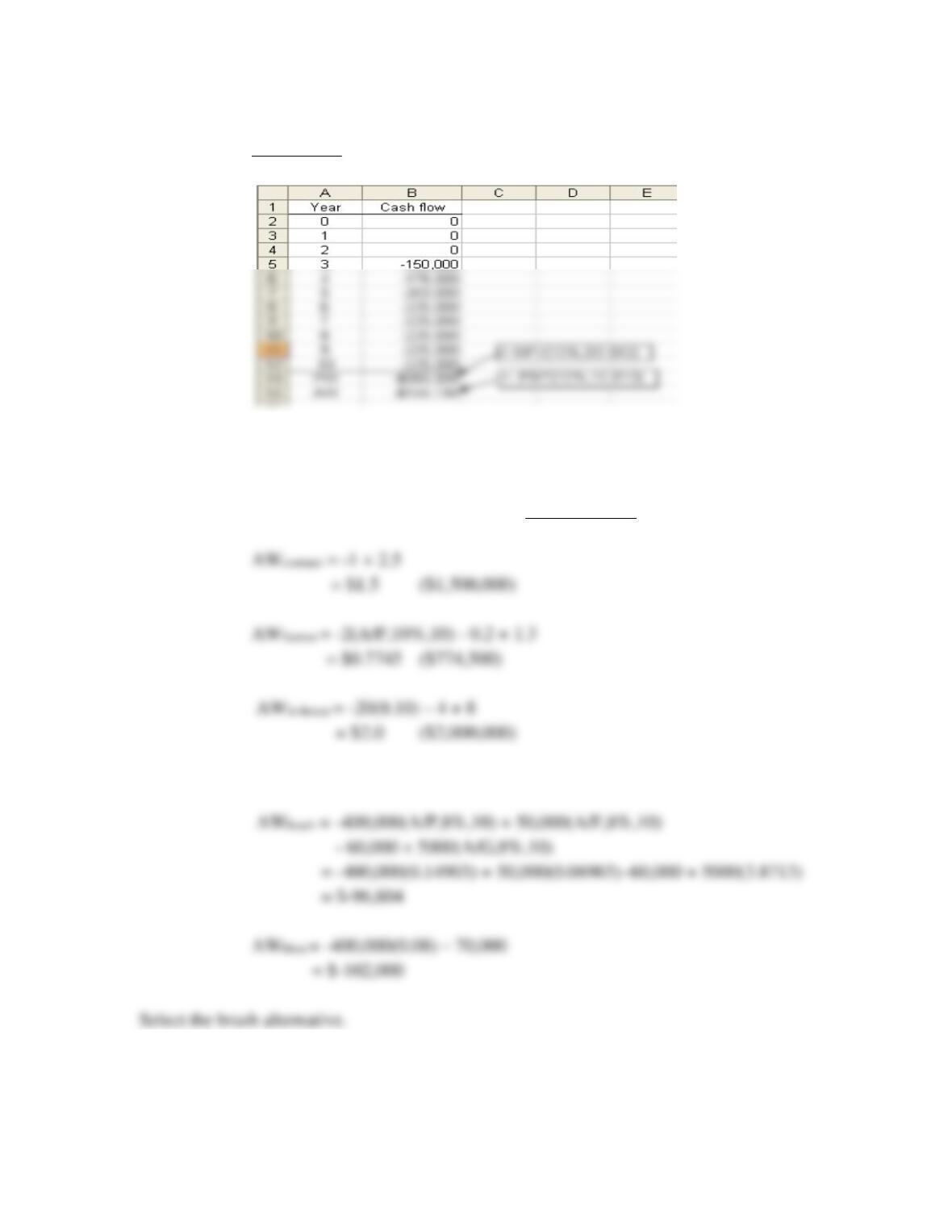
Spreadsheet
Solution 5.29
Money in $ million units. Determine AW values to select in-house.
Solution 5.30
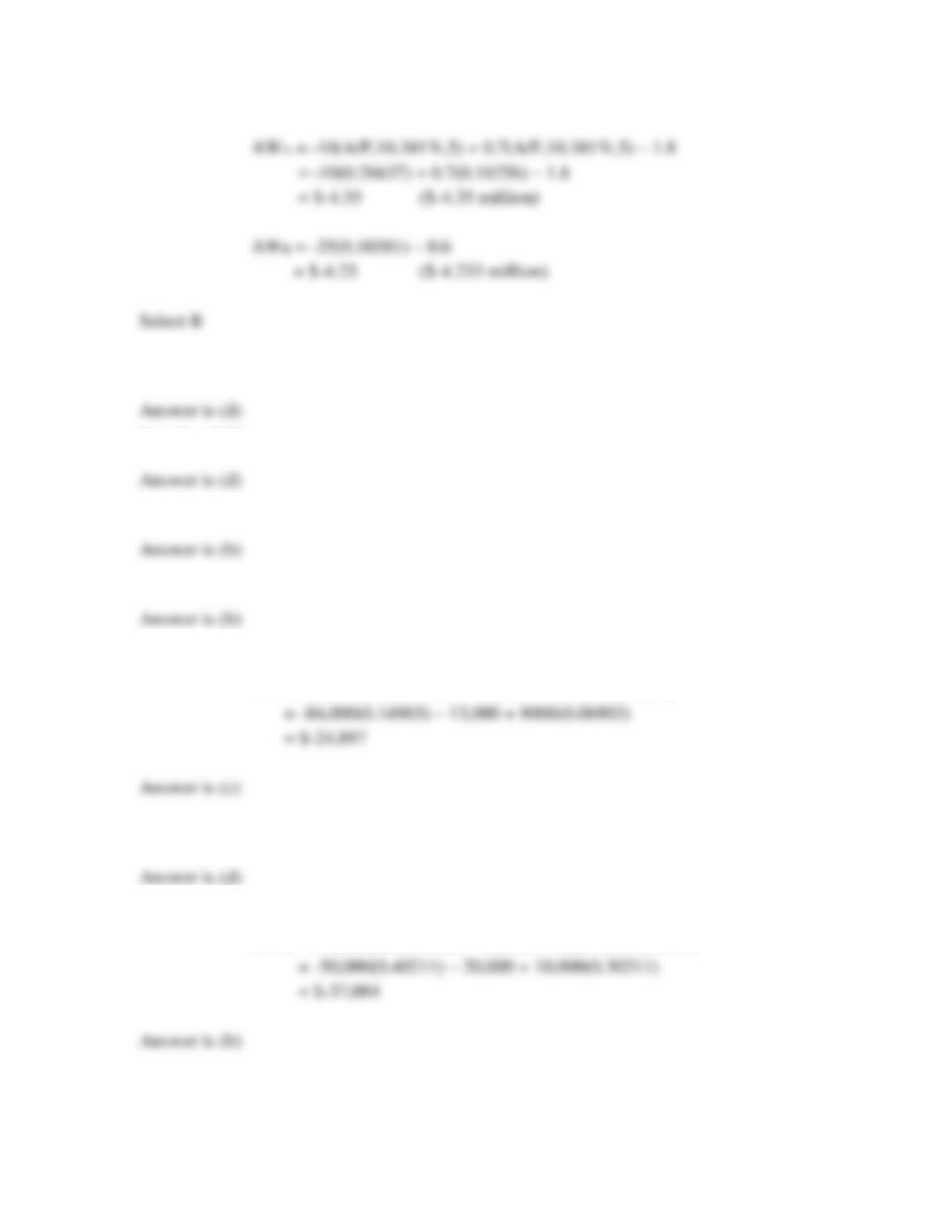
Solution 5.31
In $ million units. Effective annual i = (1.025)4 – 1 = 10.381%.
Solution 5.32
Solution 5.33
Solution 5.34
Solution 5.35
Solution 5.36
AW = -84,000(A/P,8%,10) – 13,000 + 9000(A/F,8%,10)
Solution 5.37
Solution 5.38
AWA = -50,000(A/P,10%,3) – 20,000 + 10,000(A/F,10%,3)
Solution 5.39
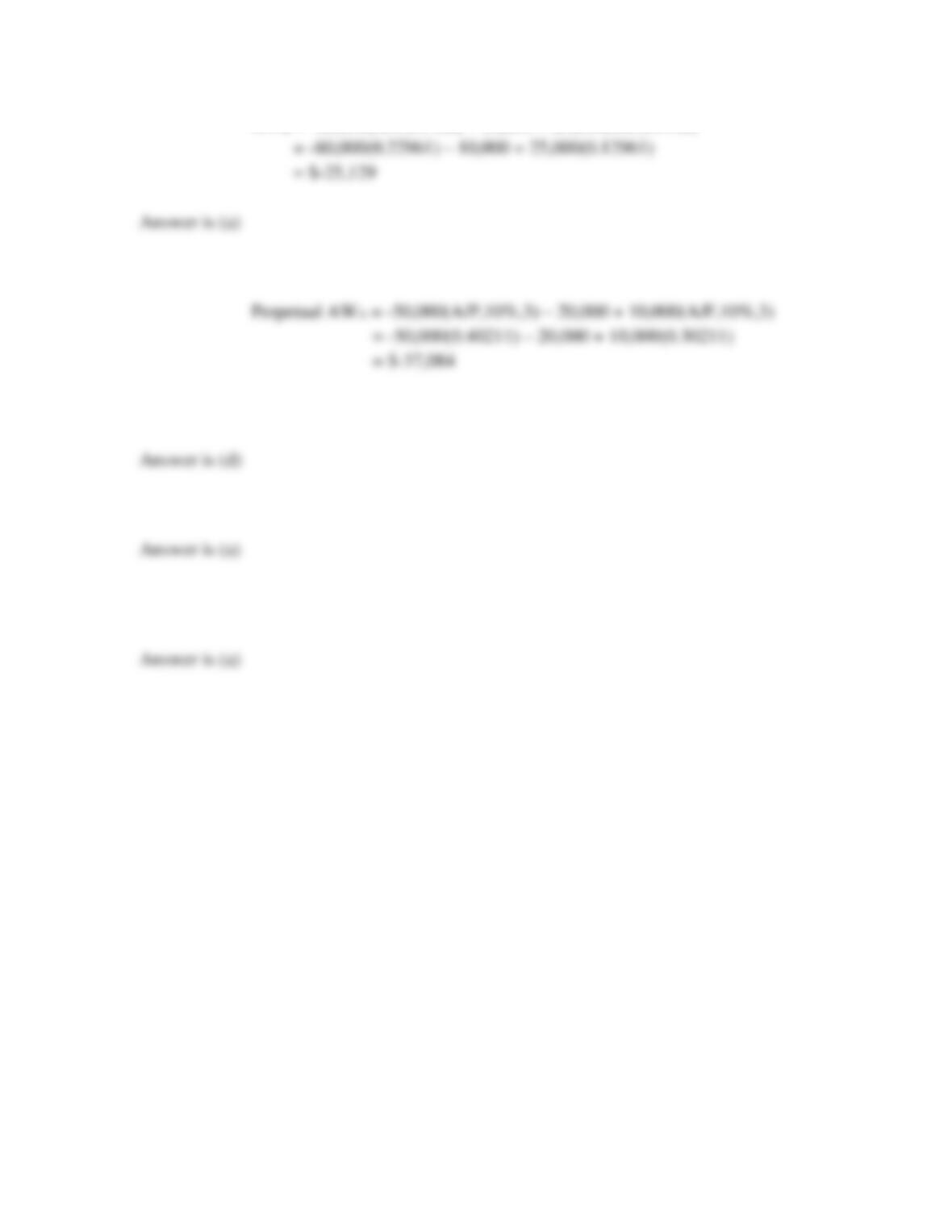
AWB = -80,000(A/P,10%,6) – 10,000 + 25,000(A/F,10%,6)
Solution 5.40
AW is same for all years, including an infinite life.
Solution 5.41
Solution 5.42