Chapter 5: Depreciation
Learning Objectives
At the completion of this chapter the student should be able to:
• Calculate deprecation using the straight-line depreciation method.
• Calculate deprecation using the sum-of-the-years depreciation method.
• Calculate deprecation using the declining-balance depreciation method.
Instructional Hints
• Emphasize the difference between depreciation calculated for tax purposes and for financial
purposes. Help the students understand that depreciation for tax purposes often depreciates
Activities
• Develop Table 5-6 and 5-7 using the procedures for calculation the 200% declining-balance
depreciation. To get Table 5-6, multiply the first year’s depreciation by 50%. To get Table 5-7,
multiply the first year’s depreciation by 87.5%. This will help the students learn to use the 200%
Instruction Resources
• The figures, sidebars, and tables from this chapter in electronic format and PowerPoint slides
can be found at the instructor’s website.
Solutions to the Textbook Problems
2. To accelerate depreciation.
4. The depreciation using the IRS tables is calculated by multiplying the depreciation rate in the
Example 5-3 is calculated by multiplying the depreciation rate by the preceding year’s book value until
the switch to straight-line is made.
5. Cost segregation allows building costs to be separated into personal property, land
6. It allows companies that place limited amounts of assets into service during a year to write off
7. See IRS publication 946, How to Depreciate Property for the current year, which may be
8. The reason may include: (1) a different depreciation method is being used to more closely
match actual value of the equipment, (2) a different recovery period is being used to more closely match
9. Using Eq. (5-3) we get the following annual depreciation rate:
Dm = (P – F)/N = ($110,000 – $10,000)/7 = $14,285.71
Using Eq. (5-5), the book values for each of the seven years are as follows:
BV1 = BV0 – D1 = $110,000 – $14,286 = $95,714
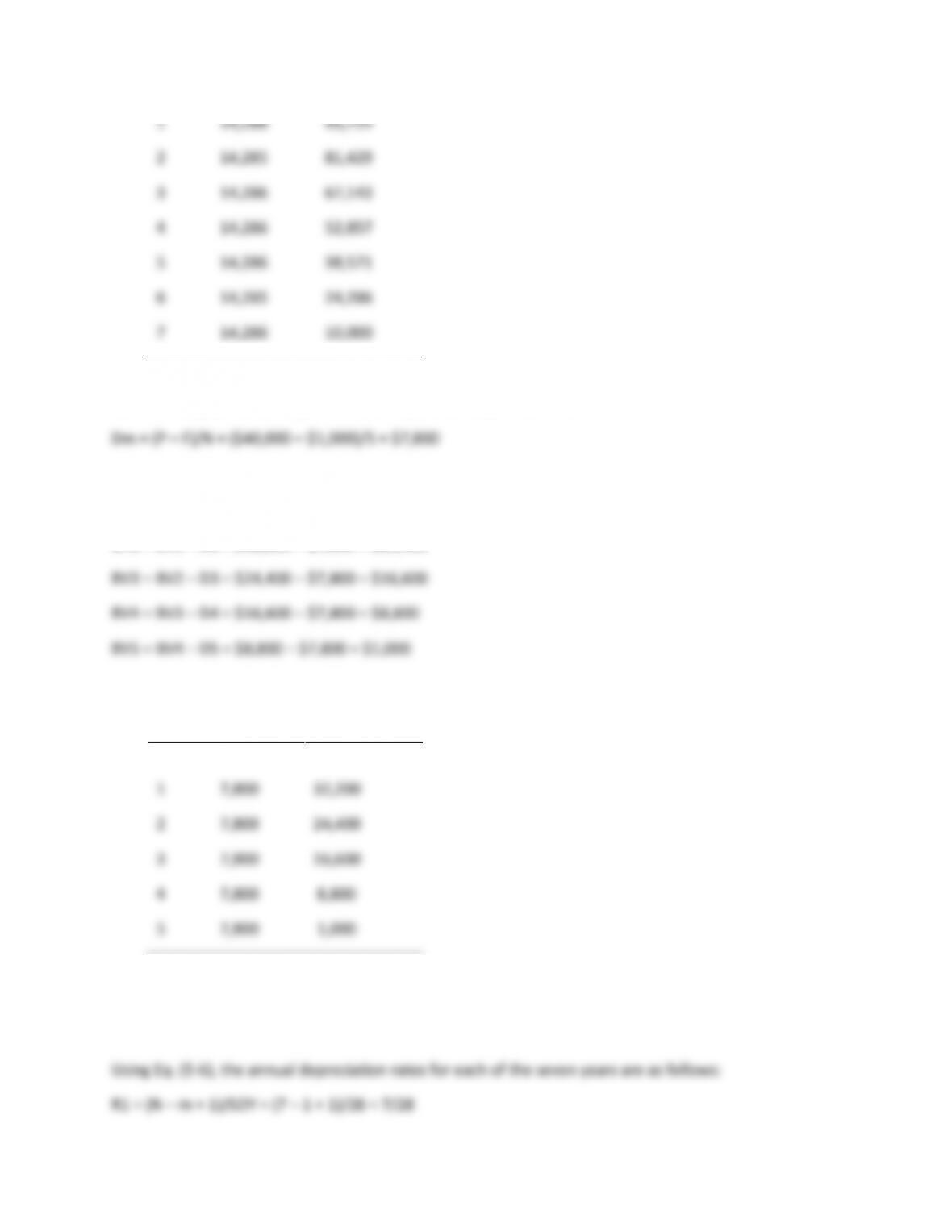
The depreciation schedule is as follows:
m
Dm ($)
BVm ($)
0
$110,000
1
14,286
95,714
2
14,285
81,429
3
14,286
67,143
4
14,286
52,857
5
14,286
38,571
6
14,285
24,286
7
14,286
10,000
10. Using Eq. (5-3) we get the following annual depreciation rate:
Using Eq. (5-5), the book values for each of the five years are as follows:
BV1 = BV0 – D1 = $40,000 – $7,800 = $32,200
BV2 = BV1 – D2 = $32,200 – $7,800 = $24,400
The depreciation schedule is as follows:
m
Dm ($)
BVm ($)
0
40,000
1
7,800
32,200
2
7,800
24,400
3
7,800
16,600
4
7,800
8,800
5
7,800
1,000
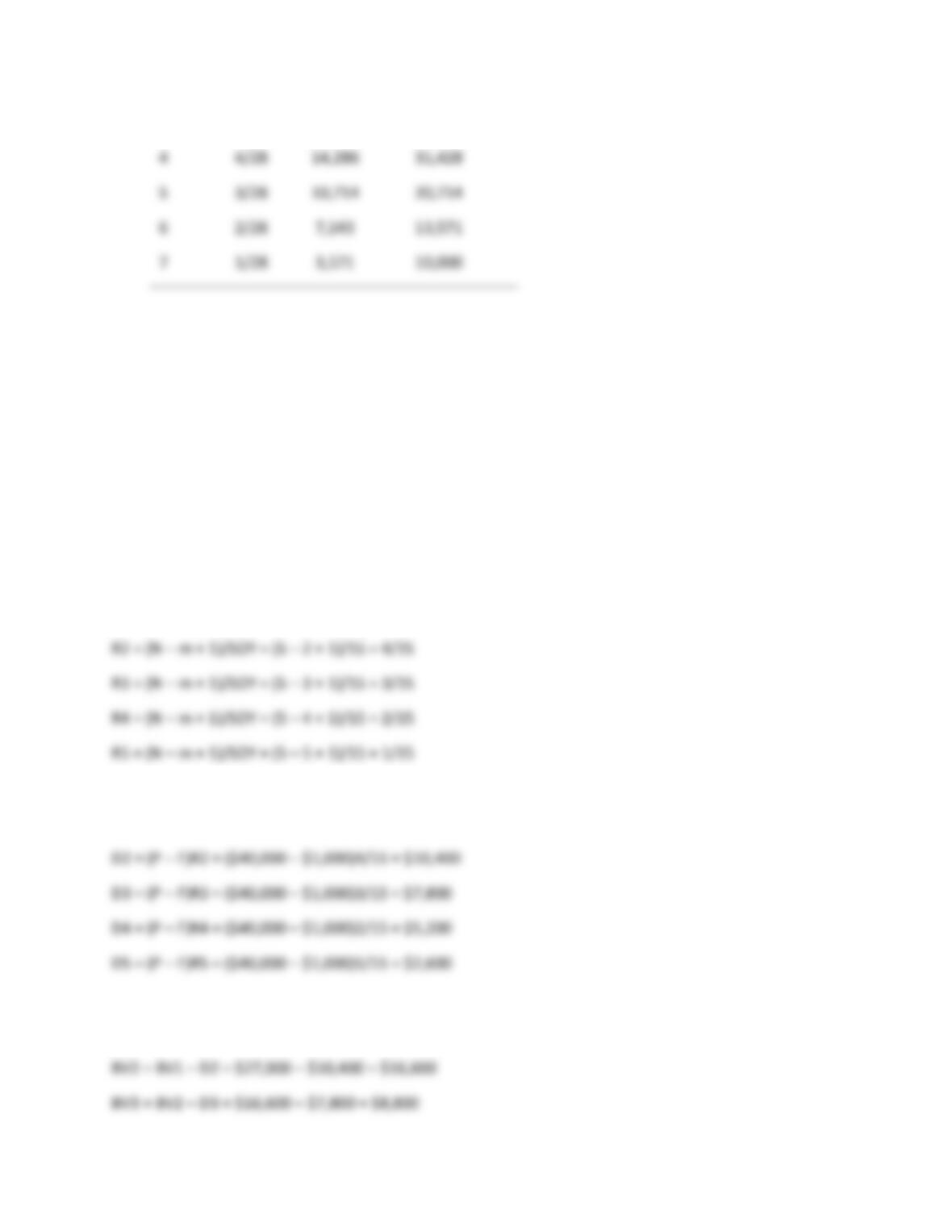
11. Using Eq. (5-7) the sum of the years is as follows:
SOY = N(N + 1)/2 = 7(7 + 1)/2 = 28
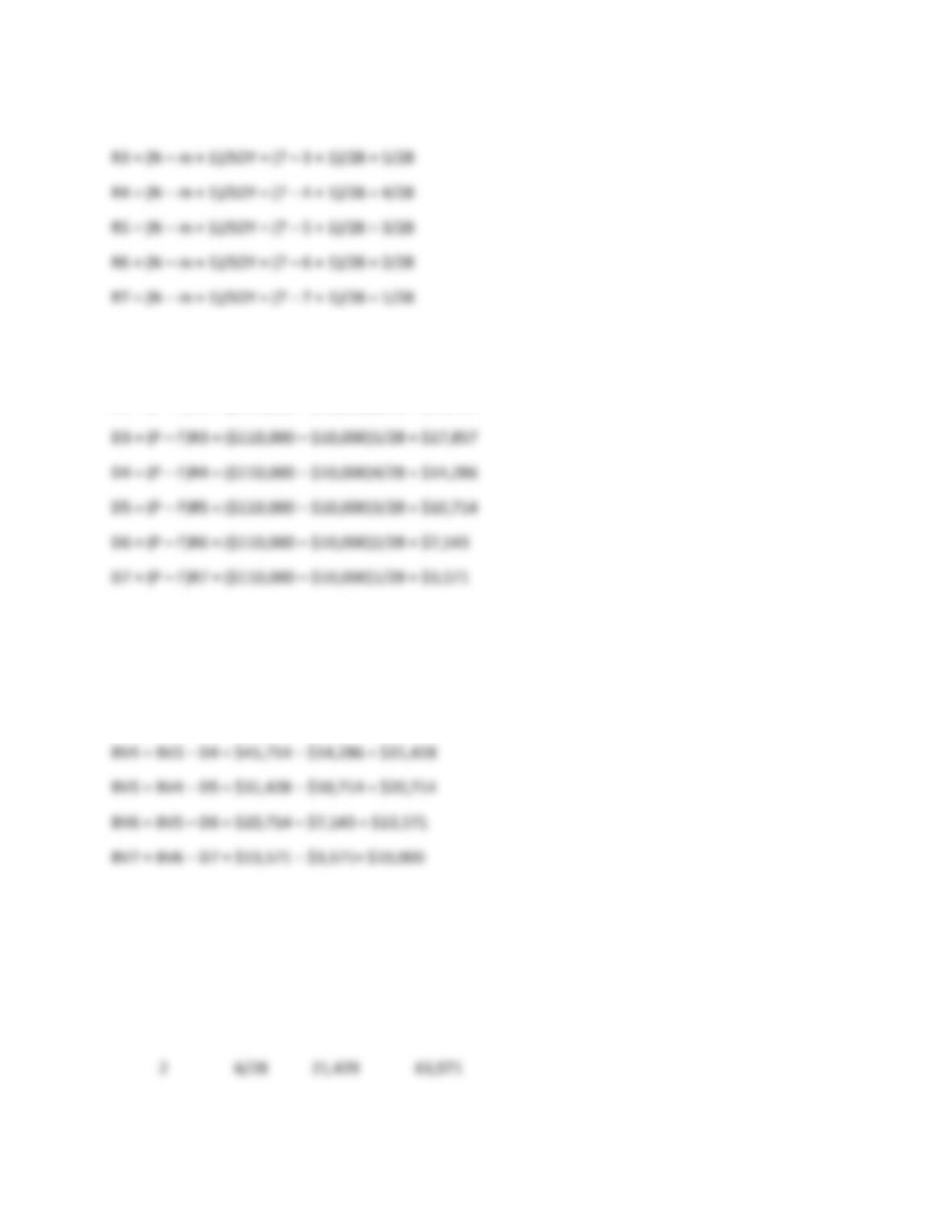
R2 = (N – m + 1)/SOY = (7 – 2 + 1)/28 = 6/28
Using Eq. (5-8), the annual depreciation for each of the seven years is as follows:
D1 = (P – F)R1 = ($110,000 – $10,000)7/28 = $25,000
D2 = (P – F)R2 = ($110,000 – $10,000)6/28 = $21,429
Using Eq. (5-11), the book values for each of the seven years are as follows:
BV1 = BV0 – D1 = $110,000 – $25,000 = $85,000
BV2 = BV1 – D2 = $85,000 – $21,429 = $63,571
BV3 = BV2 – D3 = $63,571 – $17,857 = $45,714
The depreciation schedule is as follows:
m
Rm
Dm ($)
BVm ($)
0
110,000
1
7/28
25,000
85,000
2
6/28
21,429
63,571
3
5/28
17,857
45,714
4
4/28
14,286
31,428
5
3/28
10,714
20,714
6
2/28
7,143
13,571
7
1/28
3,571
10,000
12. Using Eq. (5-7) the sum of the years is as follows:
SOY = N(N + 1)/2 = 5(5 + 1)/2 = 15
Using Eq. (5-6), the annual depreciation rates for each of the five years are as follows:
R1 = (N – m + 1)/SOY = (5 – 1 + 1)/15 = 5/15
Using Eq. (5-8), the annual depreciation for each of the five years is as follows:
D1 = (P – F)R1 = ($40,000 – $1,000)5/15 = $13,000
Using Eq. (5-11), the book values for each of the five years are as follows:
BV1 = BV0 – D1 = $40,000 – $13,000 = $27,000
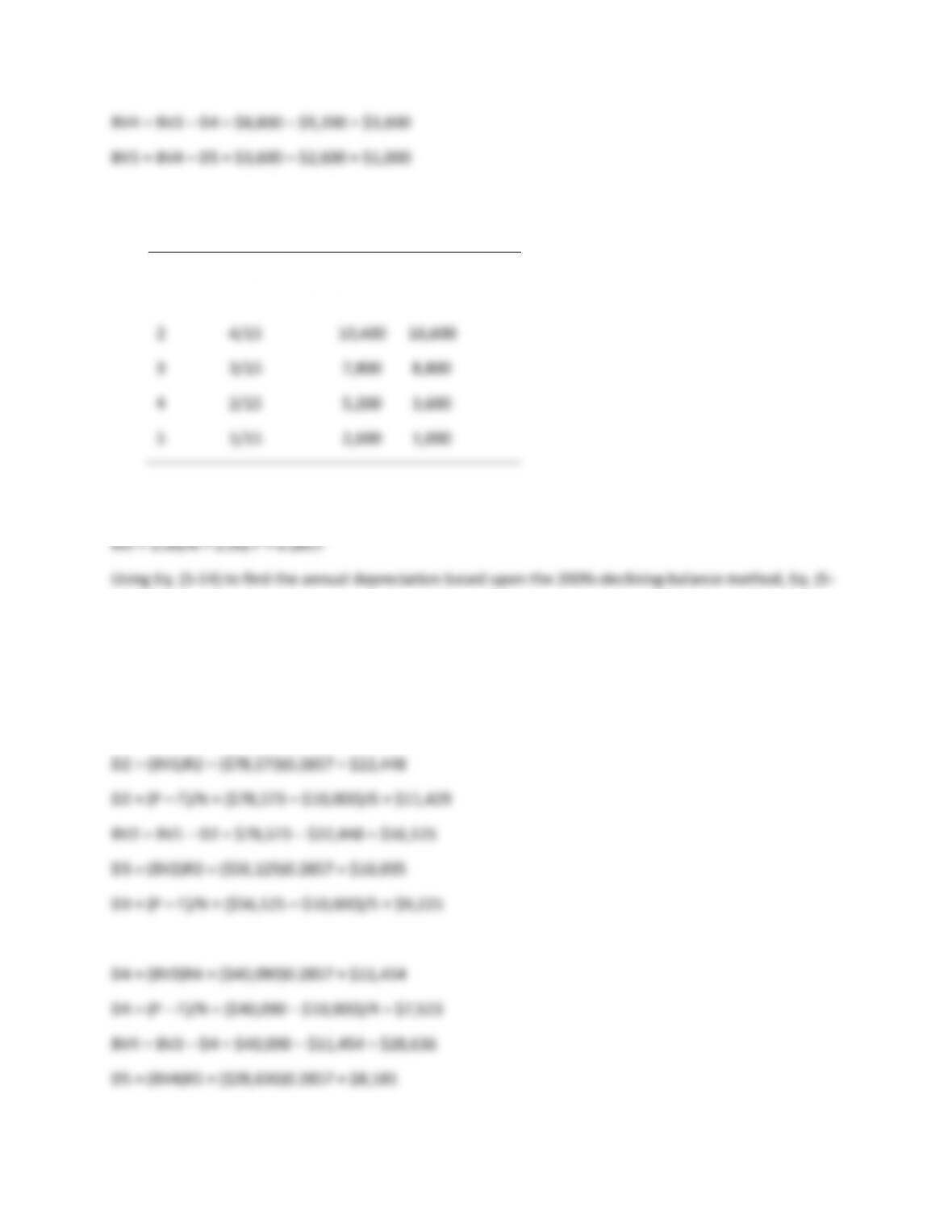
The depreciation schedule is as follows:
m
Rm
Dm ($)
BVm ($)
0
40,000
1
5/15
13,000
27,000
2
4/15
10,400
16,600
3
3/15
7,800
8,800
4
2/15
5,200
3,600
5
1/15
2,600
1,000
13. Using Eq. (5-12), the annual depreciation rate is calculated as follows:
3) to find the annual depreciation based upon the straight-line method, and Eq. (5-16) or (5-5) to find
the annual book values, we get the following for the seven years:
D1 = (BV0)R1 = ($110,000)0.2857 = $31,427
D1 = (P – F)/N = ($110,000 – $10,000)/7 = $14,286
BV1 = BV0 – D1 = $110,000 – $31,427 = $78,573
BV3 = BV2 – D3 = $56,125 – $16,035 = $40,090
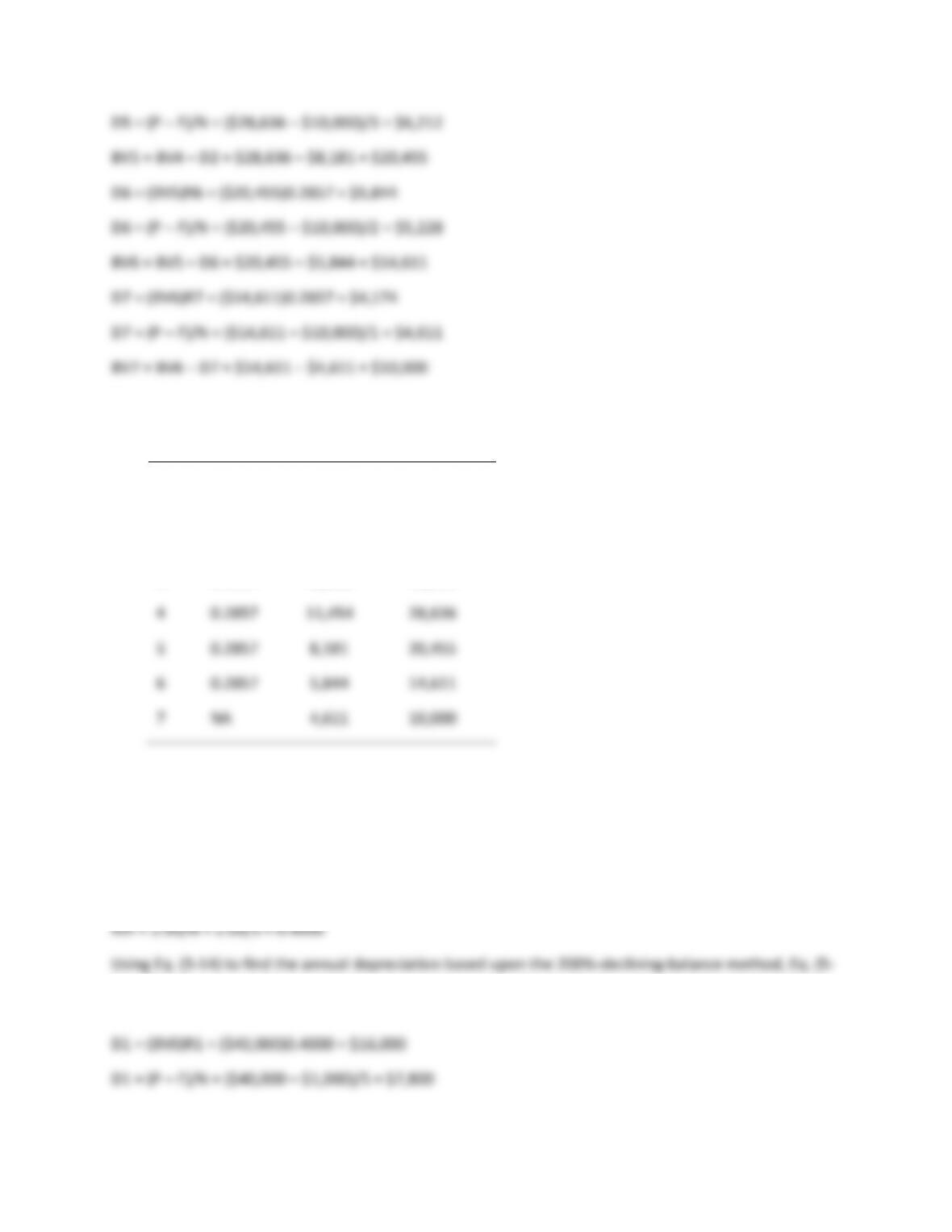
The switch to straight line was made in year seven. The depreciation schedule is as follows:
m
Rm
Dm ($)
BVm ($)
0
0
110,000
1
0.2857
31,427
78,573
2
0.2857
22,448
56,125
3
0.2857
16,035
40,090
4
0.2857
11,454
28,636
5
0.2857
8,181
20,455
6
0.2857
5,844
14,611
7
NA
4,611
10,000
14. Using Eq. (5-12), the annual depreciation rate is as follows:
3) to find the annual depreciation based upon the straight-line method, and Eq. (5-16) or (5-5) to find
the annual book values, we get the following for the four years:
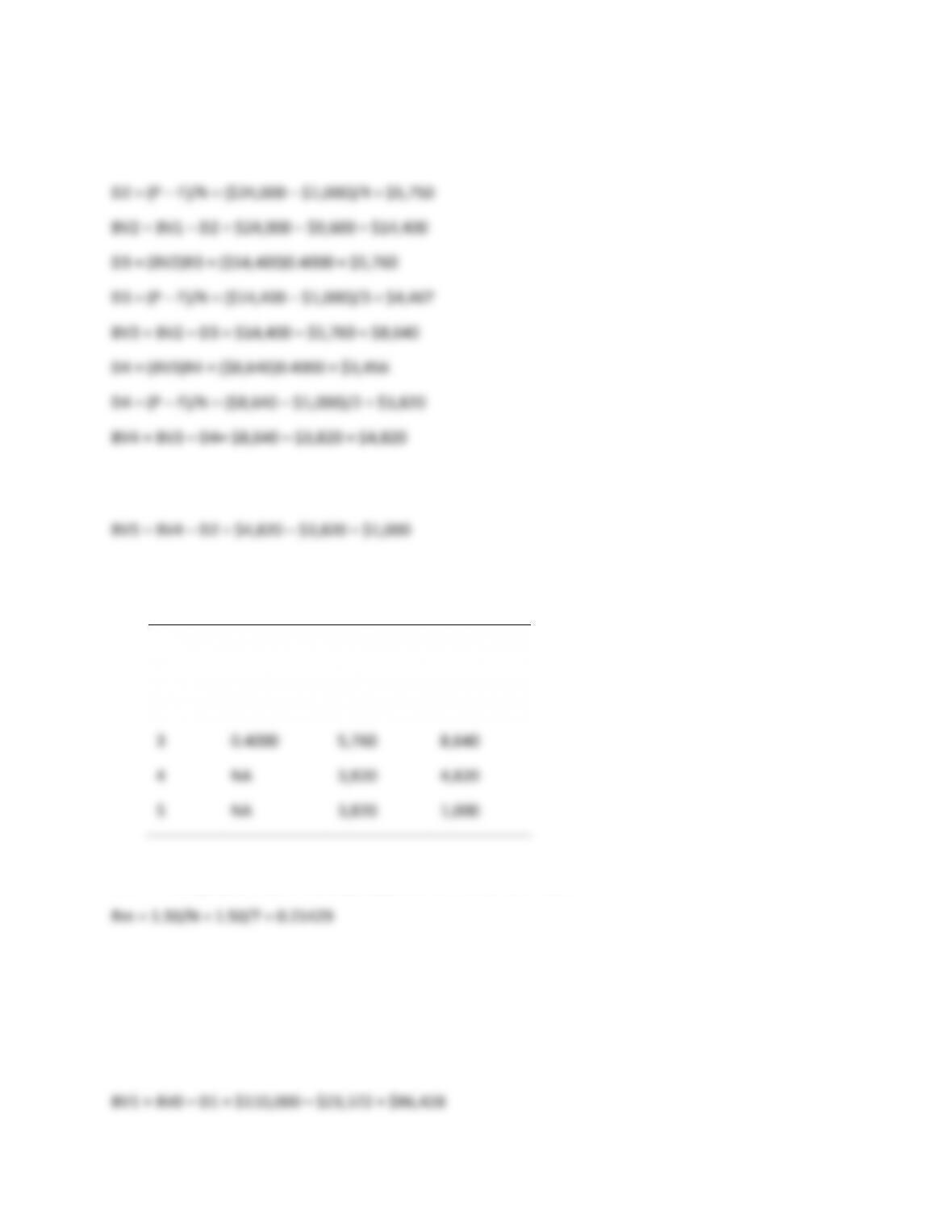
BV1 = BV0 – D1 = $40,000 – $16,000 = $24,000
D2 = (BV1)R2 = ($24,000)0.4000 = $9,600
The switch to straight-line depreciation was made in the fourth year. The annual depreciation for year
five is the same as for year four. Using Eq. (5-5) to find the book value for year five we get the following:
The depreciation schedule is as follows:
m
Rm
Dm ($)
BVm ($)
0
0
40,000
1
0.4000
16,000
24,000
2
0.4000
9,600
14,400
3
0.4000
5,760
8,640
4
NA
3,820
4,820
5
NA
3,820
1,000
15. Using Eq. (5-13), the annual depreciation rate is as follows:
Using Eq. (5-14) to find the annual depreciation based upon the 150%-declining-balance method, Eq. (5-
3) to find the annual depreciation based upon the straight-line method, and Eq. (5-16) or (5-5) to find
the annual book values, we get the following for the five years:
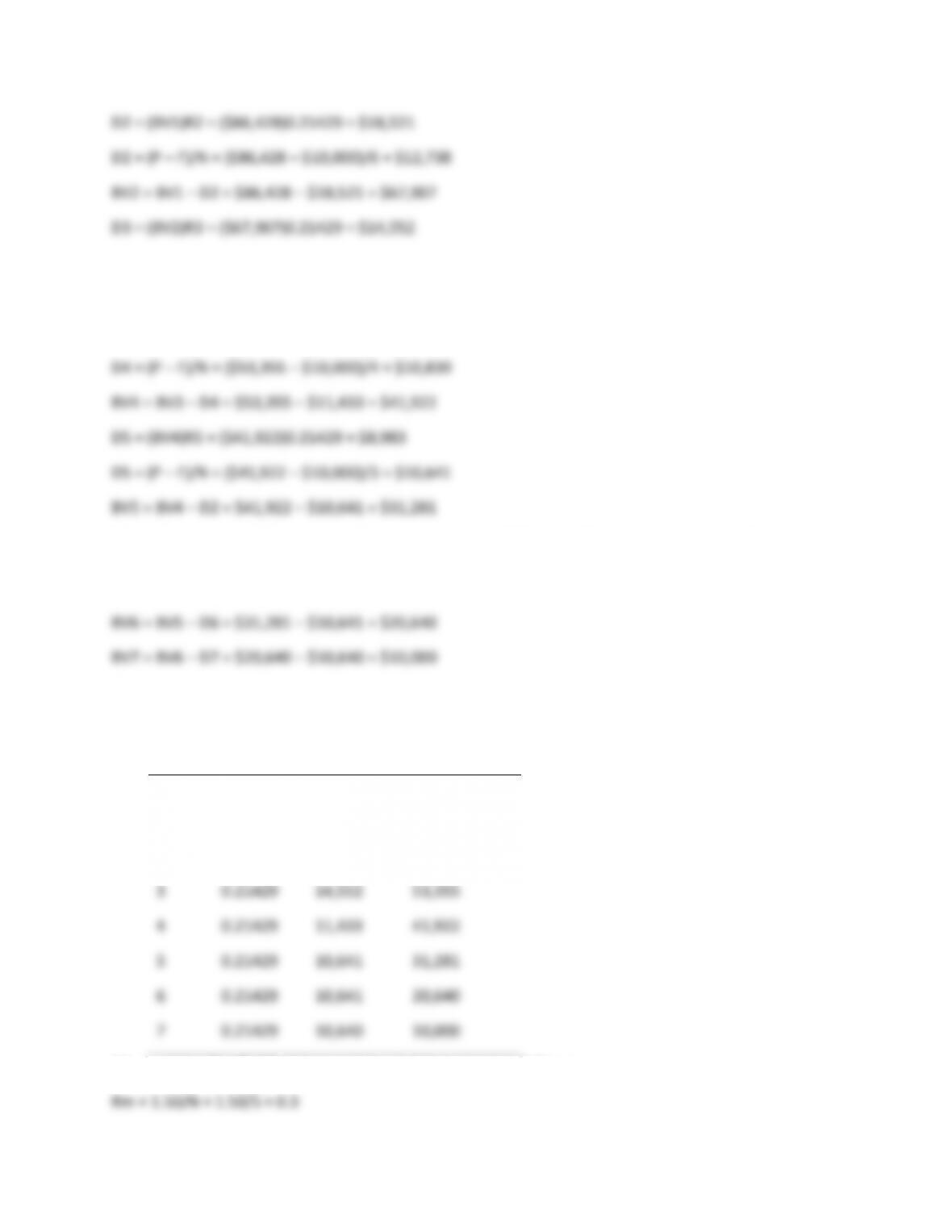
D1 = (BV0)R1 = ($110,000)0.21429 = $23,572
D1 = (P – F)/N = ($110,000 – $10,000)/7 = $14,286
D3 = (P – F)/N = ($67,907 – $10,000)/5 = $11,581
BV3 = BV2 – D3 = $67,907 – $14,552 = $53,355
D4 = (BV3)R4 = ($53,355)0.21429 = $11,433
The switch to straight-line depreciation was made in the fifth year. The annual depreciation for years six
and seven is the same as the fifth year. Using Eq. (5-5) to find the book value for years five and six we
get the following:
The depreciation in year seven is a dollar less to compensate for rounding errors. The depreciation
schedule is as follows:
m
Rm
Dm ($)
BVm ($)
0
0
110,000
1
0.21429
23,572
86,428
2
0.21429
18,521
67,907
3
0.21429
14,552
53,355
4
0.21429
11,433
41,922
5
0.21429
10,641
31,281
6
0.21429
10,641
20,640
7
0.21429
10,640
10,000
16. Using Eq. (5-13), the annual depreciation rate is as follows:
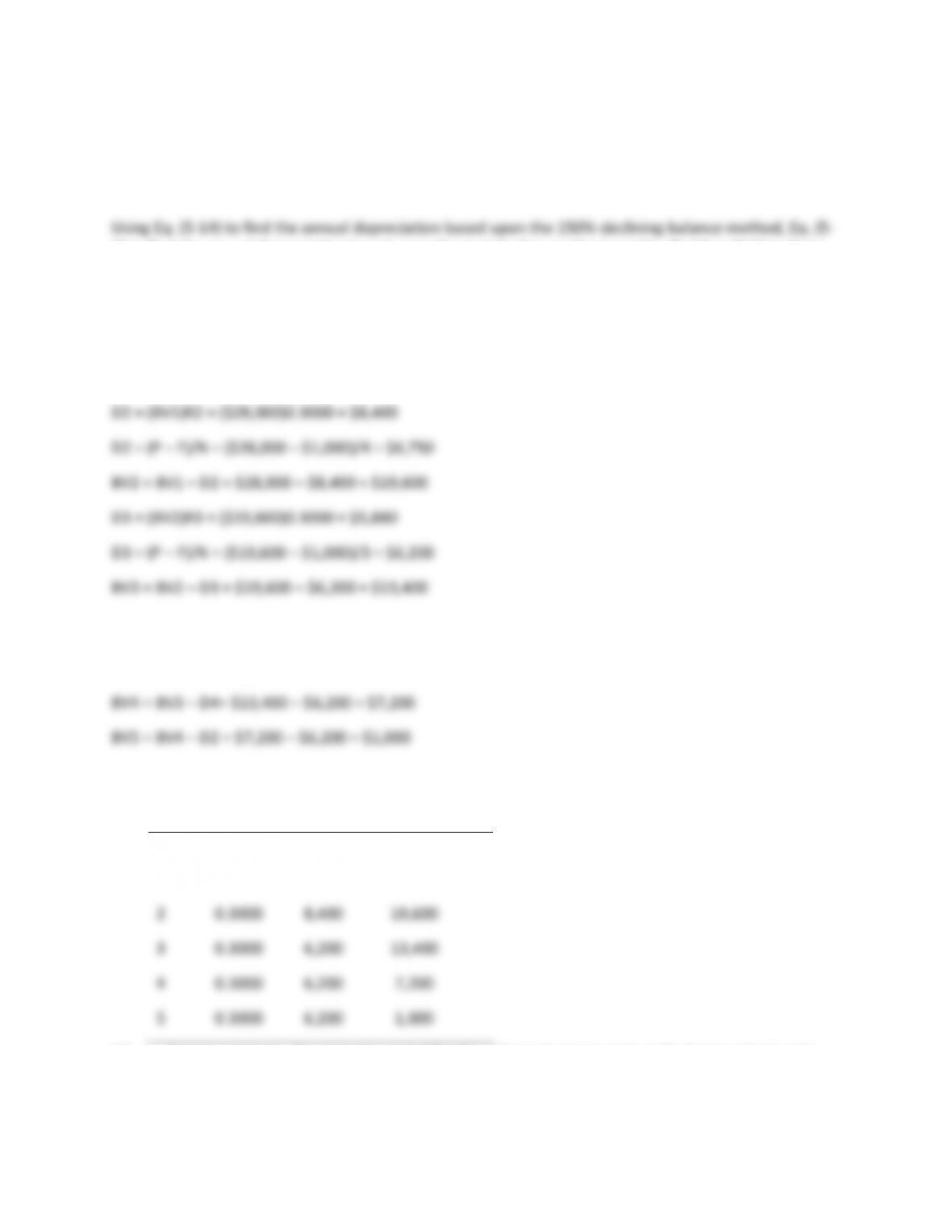
3) to find the annual depreciation based upon the straight-line method, and Eq. (5-16) or (5-5) to find
the annual book values, we get the following for the three years:
D1 = (BV0)R1 = ($40,000)0.3000 = $12,000
D1 = (P – F)/N = ($40,000 – $1,000)/5 = $7,800
BV1 = BV0 – D1 = $40,000 – $12,000 = $28,000
The switch to straight-line depreciation was made in the third year. The annual depreciation for years
four and five is the same as for year three. Using Eq. (5-5) to find the book value for years four and five
we get the following:
The depreciation schedule is as follows:
m
Rm
Dm ($)
BVm ($)
0
0
40,000
1
0.3000
12,000
28,000
2
0.3000
8,400
19,600
3
0.3000
6,200
13,400
4
0.3000
6,200
7,200
5
0.3000
6,200
1,000
17. For tax purposes, the recovery period for the rail spur is seven years and salvage value is zero.
The percentages for Table 5-6 are used to calculate the following annual depreciations:
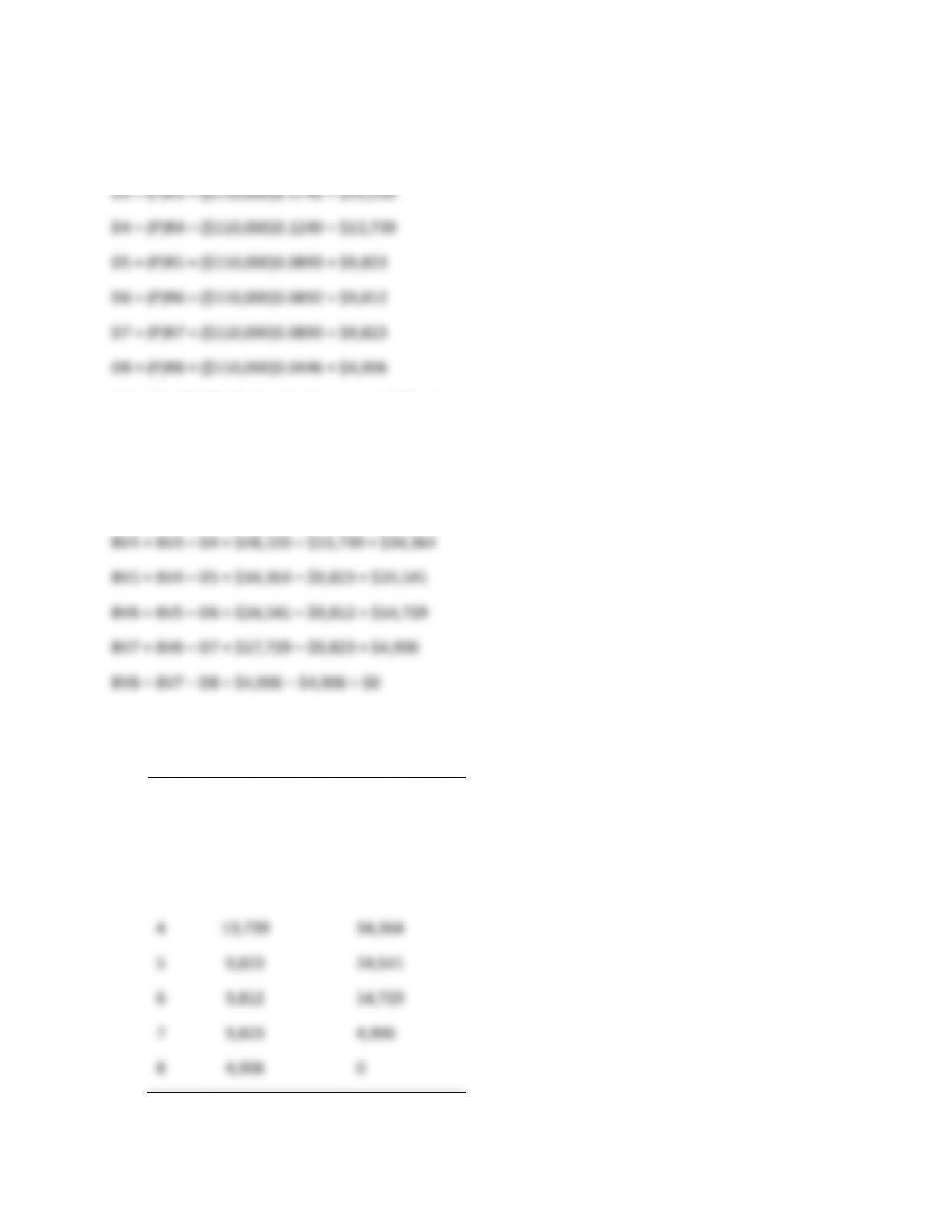
D1 = (P)R1 = ($110,000)0.1429 = $15,719
D2 = (P)R2 = ($110,000)0.2449 = $26,939
Using Eq. (5-16), the book values are as follows:
BV1 = BV0 – D1 = $110,000 – $15,719 = $94,281
BV2 = BV1 – D2 = $94,281 – $26,939 = $67,342
BV3 = BV2 – D3 = $67,342 – $19,239 = $48,103
The depreciation schedule is as follows:
m
Dm ($)
BVm ($)
0
110,000
1
15,719
94,281
2
26,939
67,342
3
19,239
48,103
4
13,739
34,364
5
9,823
24,541
6
9,812
14,729
7
9,823
4,906
8
4,906
0
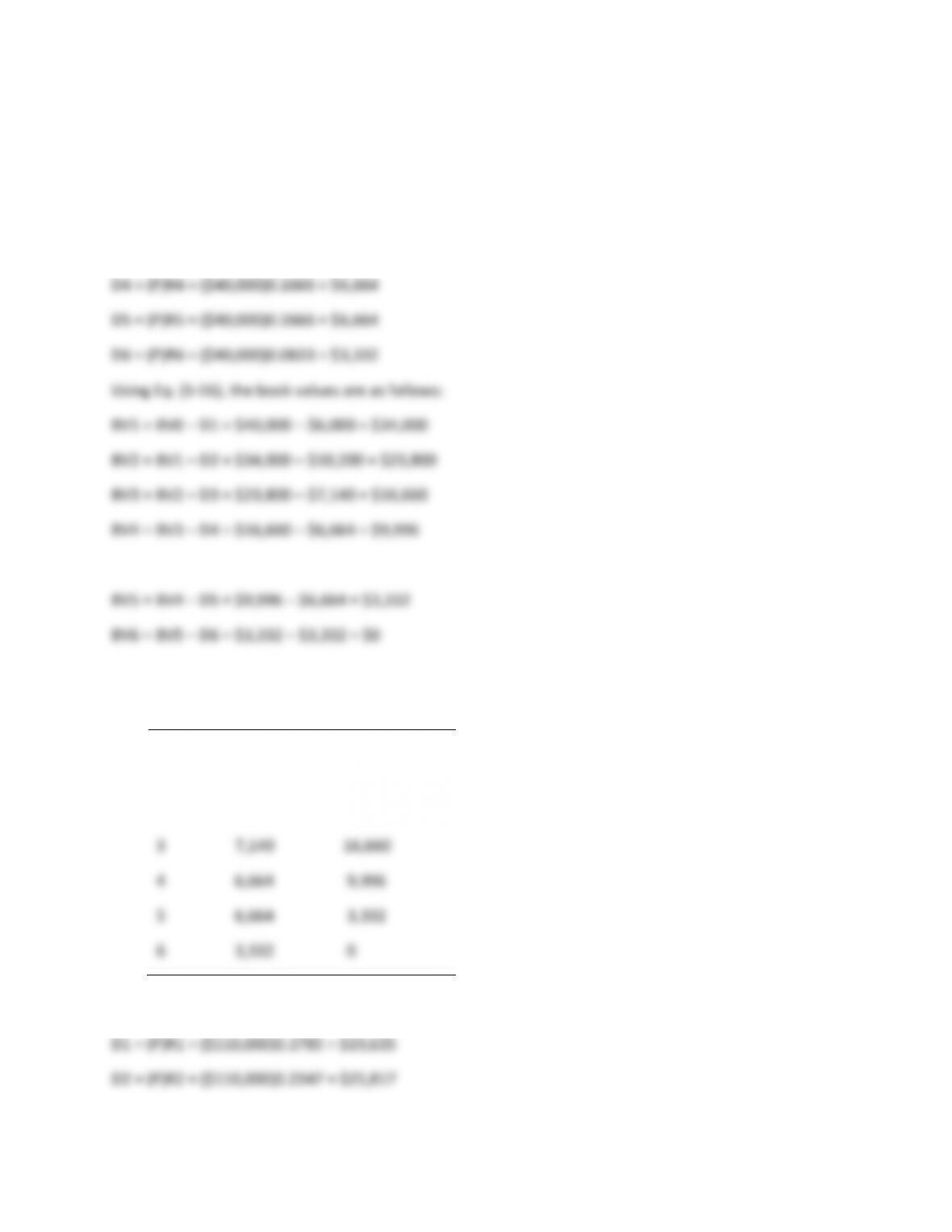
18. For tax purposes, the recovery period for the computer equipment is five years and salvage
value is zero. The percentages for Table 5-11 are used to calculate the following annual depreciations:
D1 = (P)R1 = ($40,000)0.1500 = $6,000
D2 = (P)R2 = ($40,000)0.2550 = $10,200
D3 = (P)R3 = ($40,000)0.1785 = $7,140
The depreciation schedule is as follows:
m
Dm ($)
BVm ($)
0
40,000
1
6,000
34,000
2
10,200
23,800
3
7,140
16,660
4
6,664
9,996
5
6,664
3,332
6
3,332
0
19. For tax purposes, the recovery period for the rail spur is seven years and salvage value is zero.
The percentages for Table 5-8 are used to calculate the following annual depreciations:
D3 = (P)R3 = ($110,000)0.1676 = $18,436
BV5 = BV4 – D5 = $32,945 – $9,757 = $23,188
BV6 = BV5 – D6 = $23,188 – $9,757 = $13,431
BV7 = BV6 – D7 = $13,431 – $9,757 = $3,674
BV8 = BV7 – D8 = $3,674 – $3,674 = $0
The depreciation schedule is as follows:
m
Dm ($)
BVm ($)
0
110,000
1
19,635
90,365
2
25,817
64,548
3
18,436
46,112
4
13,167
32,945
5
9,757
23,188
6
9,757
13,431
7
9,757
3,674
8
3,674
0
20. For tax purposes, the recovery period for the computer equipment is five years and salvage
value is zero. The percentages for Table 5-9 are used to calculate the following annual depreciations:
D1 = (P)R1 = ($40,000)0.1500 = $6,000
Using Eq. (5-16), the book values are as follows:
BV1 = BV0 – D1 = $40,000 – $6,000 = $34,000
BV2 = BV1 – D2 = $34,000 – $13,600 = $20,400
The depreciation schedule is as follows:
m
Dm ($)
BVm ($)
0
40,000
1
6,000
34,000
2
13,600
20,400
3
8,160
12,240
4
4,896
7,344
5
4,520
2,824
6
2,824
0
21. The rate for the first year based upon the fifth month is 15/24 or 0.625 of the straight-line
depreciation. Using Eq. (5-3) we get an annual depreciation rate as follows:
The depreciation for the first year is as follows:
At the end of the thirty-ninth year there is only 0.375 years left in the recovery period; therefore, we can
only take 37.5% of a full year’s straight-line depreciation in the fortieth year. The depreciation for the
fortieth year is as follows:
The depreciation schedule is as follows:
m
Dm ($)
BVm ($)
m
Dm ($)
BVm ($)
0
1,170,000
21
30,000
551,250
1
18,750
1,151,250
22
30,000
521,250
2
30,000
1,121,250
23
30,000
491,250
3
30,000
1,091,250
24
30,000
461,250
4
30,000
1,061,250
25
30,000
431,250
5
30,000
1,031,250
26
30,000
401,250
6
30,000
1,001,250
27
30,000
371,250
7
30,000
971,250
28
30,000
341,250
8
30,000
941,250
29
30,000
311,250
9
30,000
911,250
30
30,000
281,250
10
30,000
881,250
31
30,000
251,250
11
30,000
851,250
32
30,000
221,250
12
30,000
821,250
33
30,000
191,250
13
30,000
791,250
34
30,000
161,250
14
30,000
761,250
35
30,000
131,250
15
30,000
731,250
36
30,000
101,250
16
30,000
701,250
37
30,000
71,250
17
30,000
671,250
38
30,000
41,250
18
30,000
641,250
39
30,000
11,250
19
30,000
611,250
40
11,250
0
20
30,000
581,250
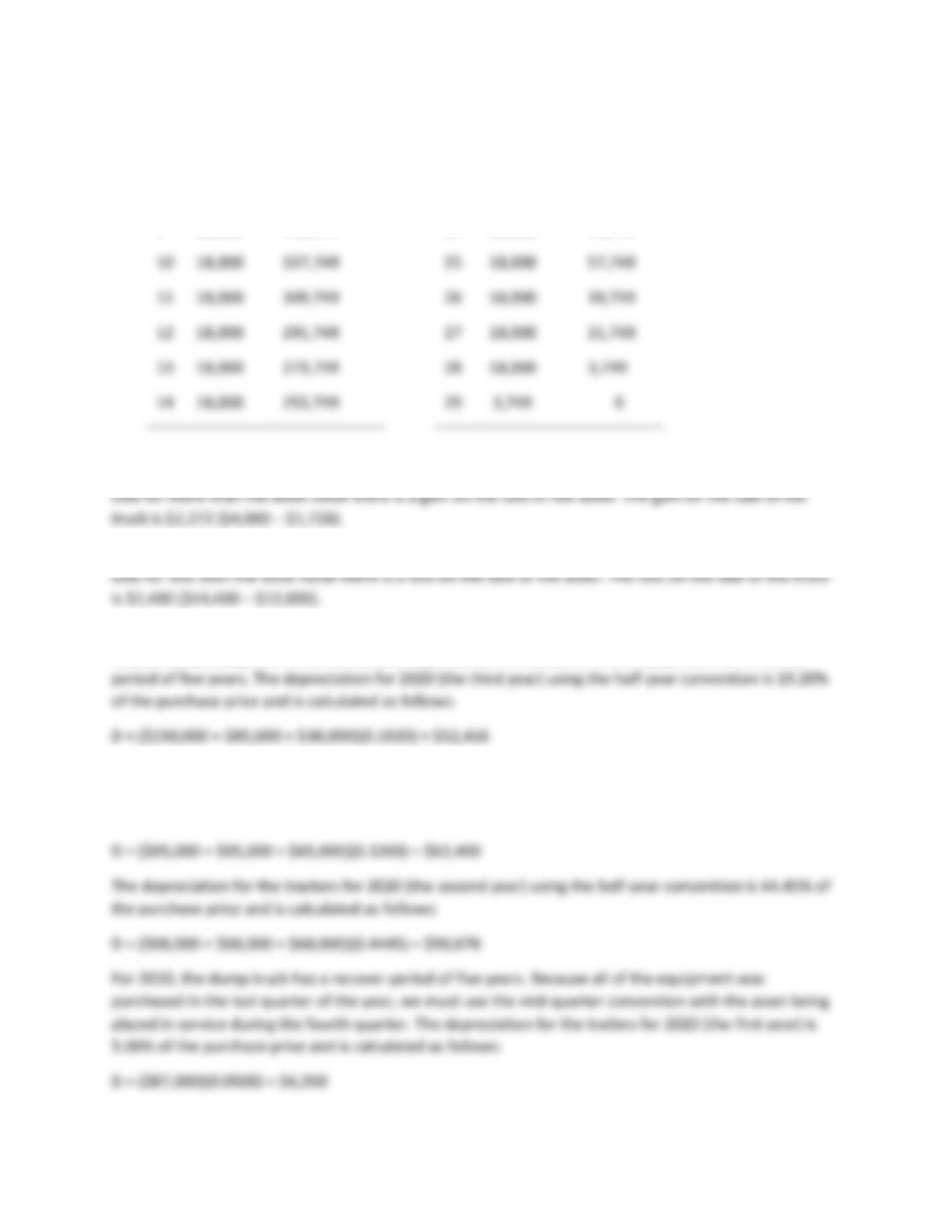
22. The rate for the first year based upon the ninth month is 7/24 or 0.2917 of the straight-line
depreciation. Using Eq. (5-3) we get an annual depreciation rate as follows:
Dm = (P – F)/N = ($495,000 – $0)/27.5 = $18,000
The depreciation for the first year is as follows:
At the end of the twenty-eighth year 27.2917 years of the 27.5 recovery period have been used, leaving
only 0.2083 years of depreciation left. In the twenty-ninth year we can only take 20.83% of a full year’s
straight-line depreciation. The depreciation for the twenty-ninth year is as follows:
Using Eq. (5-5) to find the book value for year twenty-nine we get the following:
The depreciation schedule is as follows:
m
Dm ($)
BVm ($)
m
Dm ($)
BVm ($)
0
495,000
15
18,000
237,749
1
5,251
489,749
16
18,000
219,749
2
18,000
471,749
17
18,000
201,749
3
18,000
453,749
18
18,000
183,749
4
18,000
435,749
19
18,000
165,749
5
18,000
417,749
20
18,000
147,749
6
18,000
399,749
21
18,000
129,749
7
18,000
381,749
22
18,000
111,749
8
18,000
363,749
23
18,000
93,749
9
18,000
345,749
24
18,000
75,749
10
18,000
327,749
25
18,000
57,749
11
18,000
309,749
26
18,000
39,749
12
18,000
291,749
27
18,000
21,749
13
18,000
273,749
28
18,000
3,749
14
18,000
255,749
29
3,749
0
23. From Example 5-4, the book value at the end of year five was $1,728. Because the asset was
24. From Example 5-4, the book value at the end of year two was $14,400. Because the asset was
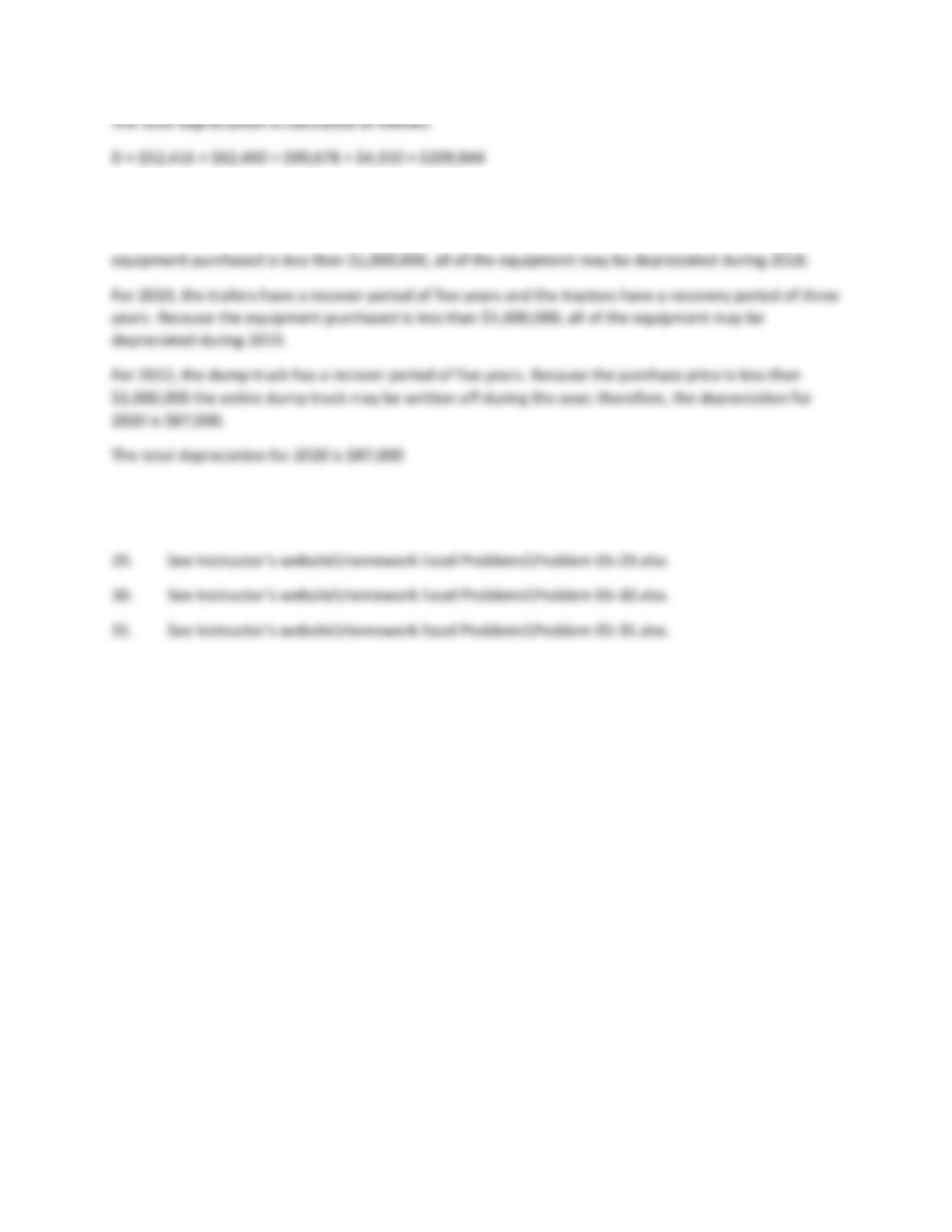
25. For tax calculations, assets purchased in the same year and which have the same recover period
may be lumped together when calculation deprecation. For 2018, all of the equipment has a recover
For 2019, the trailers have a recover period of five years and the tractors have a recovery period
of three years. The depreciation for the trailers for 2020 (the second year) using the half-year
convention is 32.00% of the purchase price and is calculated as follows:
26. Provided we have placed in service less than $2,500,000 of assets during the year, we
depreciate $1,000,000 during the year the asset is purchased, with the residual being depreciated as it
was in Problem 25. For 2018, all of the equipment has a recover period of five years. Because the
27. See Instructor’s website\Homework Excel Problems\Problem 05-27.xlsx.
28. See Instructor’s website\Homework Excel Problems\Problem 05-28.xlsx.