
CAUTION
Exercise 4
Material Take-Offs
OBJECTIVE
The objective of this exercise is to identify and calculate
quantities of materials used in a landscape design.
Before performing material take-offs, become
familiar with the reading and interpretation of
landscape construction documents. Failure
to properly interpret construction documents
may create significant errors in material and
INTRODUCTION
To obtain work the landscape contractor must prepare
estimates and bids based on design ideas that are
often expressed in graphic form. This price preparation
begins with reviewing the design and identifying the
types of work and materials required by the design. A
second step in the process is calculating the quantity
of materials required to complete the work. Material
Performing the take-off requires a consistent process
of examining the design for materials and construction
activities, measuring the design, and calculating quanti-
ties. To complete the materials take-off for a landscape
design, use the following procedure:
I. Identify all documents that contain information
regarding the landscape design. This could include
graphic drawings or written specifications.
A. Review the drawing(s) for orientation, scale,
of the design, while details will often show
vertical dimensions and specific construction
information.
C. Read the sections of specifications that
relate to landscaping work. Specifications, if
prepared for the project, often provide detailed
descriptions of the materials, installation
techniques, and conditions under which the
work must be completed.
97171_04_ch04_p016-020.indd 16 14/06/10 8:41 PM
construction steps along with typical construction
1. Removal of trees and shrubs, typically
calculated for each removal
3. Removal of undesired paving, typically
calculated by SF
4. Installation of site perimeter protection or
fencing, typically calculated by the linear
foot (LF)
5. Sodding, seeding, or other restoration work
required when construction is complete
1. Relocation of earth on the site, typically
calculated by the cubic yard (CY)
2. Removal of excess soil, or purchase and
3. Installation of silt fence, calculated by LF
4. Installation of erosion mat, calculated by SF
5. Installation of drainage tile, calculated by LF
6. Installation of drainage structures, each
1. Installation of utility lines, typically calculated
by LF
2. Installation of lighting systems, typically
3. Length of wire used to connect lighting,
typically calculated by LF
4. Footings required for lighting or site amenities.
Each footing requires calculation of materials
1. Measure each wall installation, separated
by different materials. Review any available
2. Measure the length of all walls and the amount
of capstone that may be required, typically
calculated by LF.
3. Calculate the quantities of any materials
placed for base below the wall or as fill behind
the wall, typically calculated by the ton (T)
calculated in CY or tons.
E. Paving installation. Locate all paved areas and
1. Measure each paved area separated according
to paving type, typically measured in SF.
Calculate the amount of paving material
required. This unit calculation will depend on
the type of material used.
2. Using any available details, determine what
type of base and setting bed materials are
F. Wood construction. Identify all wood structures
on the site.
1. Identify the wood members used in the design.
3. Calculate the connectors and fasteners needed
for the project. Each individual piece should
be counted.
G. Fencing or freestanding wall construction.
1. Freestanding walls are typically calculated
by estimating the tons of materials required.
Masonry walls will require item counts of all
type requires an item count of all materials
used. Chain link fence fabric may be ordered
by LF.
H. Amenity installation. Locate each site amenity
type and style.
2. Include quantities of materials required to
turf.
1. Determine the amount of seeded area,
typically by SF, 1,000 SF, or acre.
2. Determine the amount of sodded area,
typically by square, or 100 SF units.
Exercise 4 Material Take-Offs 17
97171_04_ch04_p016-020.indd 17 14/06/10 8:41 PM
18 Exercise 4 Material Take-Offs
4. Perform an item count for each shrub; total by
species and size.
5. Calculate the amount of each different ground
cover, typically by SF.
III. Measure and calculate the quantities of each
material used in the design, identified in the
previous step. The techniques identified in Exercise
1 for linear, perimeter, area, volume, and weight
measurement provide the tools to perform these
calculations. Prepare a separate calculation for each
different material for each step. For bulk materials,
PREREQUISITE EXERCISE
Students should have successfully completed Exercise 1,
Construction Math, and Exercise 3, Measuring with
Architects’ and Engineers’ Scales before beginning this
MATERIALS REQUIRED
• Calculator
• Writing materials
• Engineer’s scale
EXERCISE DESCRIPTION
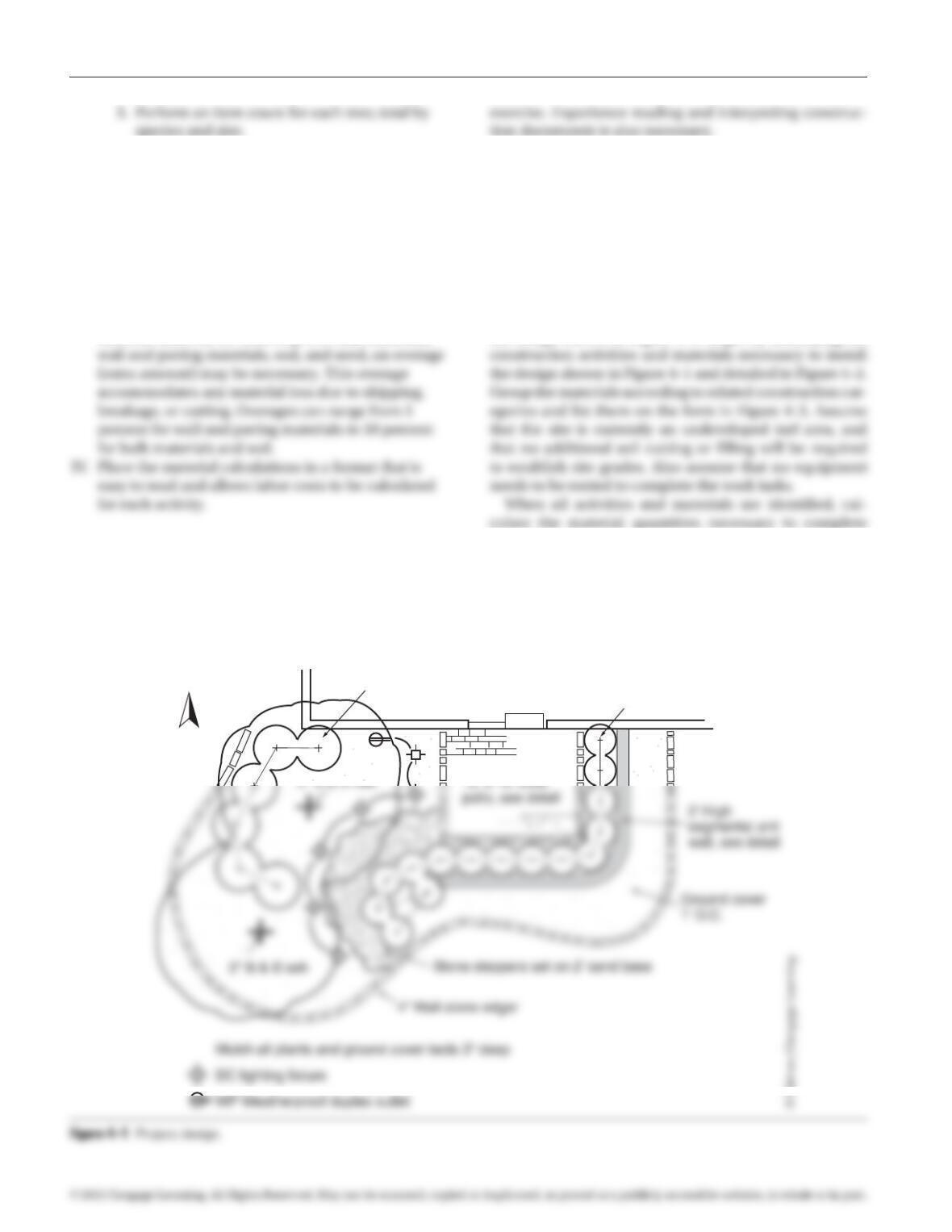
To complete this exercise prepare a materials take-off for
the design shown in Figure 4–1. Begin by identifying the
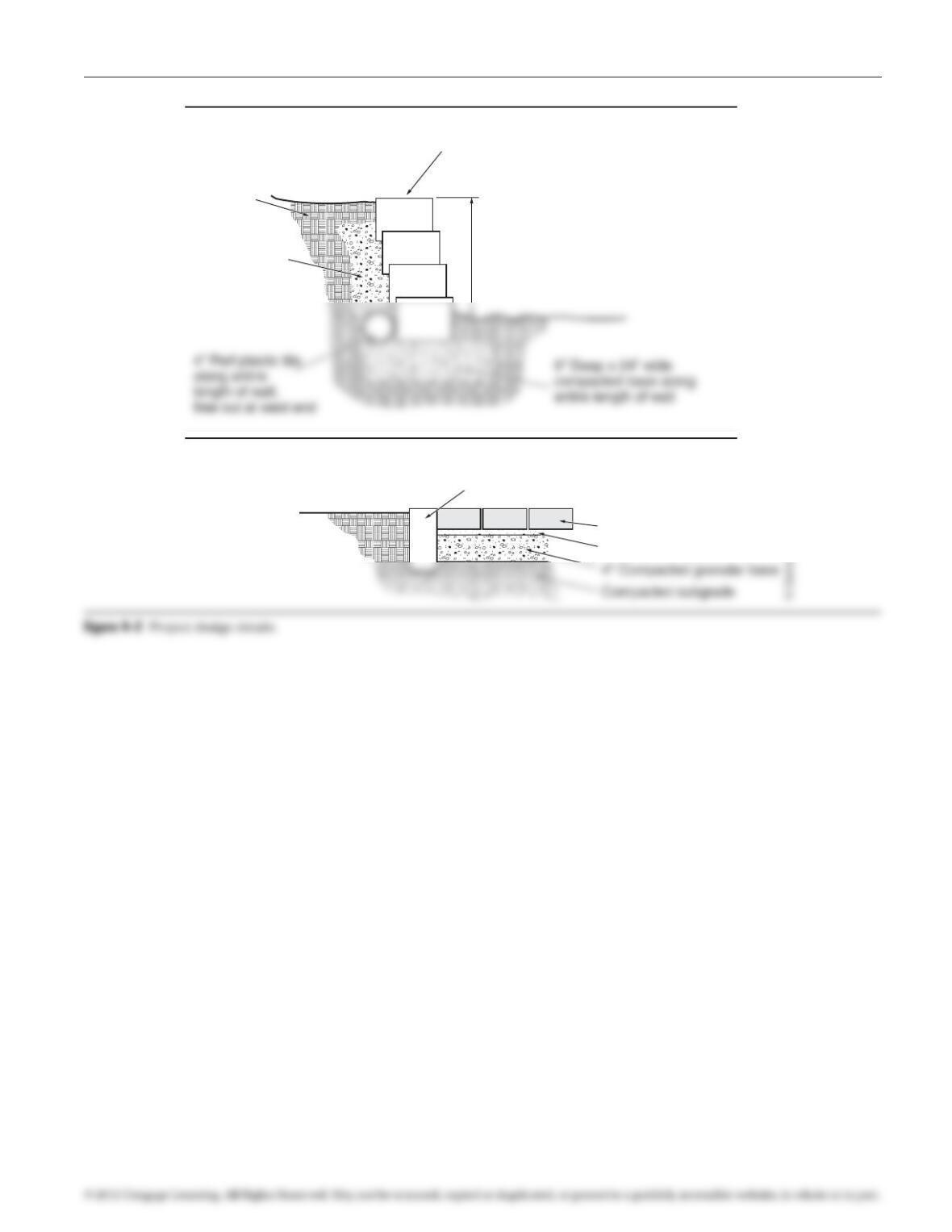
the design. Coordinate the estimate of materials for the
paved patio and retaining wall with the details shown
in Figure 4–2. Install these quantities in the form in
Figure 4–3. Include any overages for bulk materials, wall
and paving materials, and sod.
6 Large shrubs
5 gal. cont. 15 Medium
shrubs
2 gal. cont.
N
1″ = 10′
97171_04_ch04_p016-020.indd 18 14/06/10 8:41 PM
Exercise 4 Material Take-Offs 19
2′ Typical height
Segmental precast
wall units, no capstone
Cross section – Segmental Unit Wall
Backfill
6″ Zone of
free draining
angular fill
4″ Wide × 9″ deep stone edge restraint
Paving brick, 4″ × 8″
1″ Sand setting bed
Cross section – Brick Patio and Edge Restraint
97171_04_ch04_p016-020.indd 19 14/06/10 8:41 PM

20 Exercise 4 Material Take-Offs
MATERIAL TAKE-OFF FORM
Job: Date:
MATERIALS
Description Unit Qty. Over. Total Notes
SITE PREPARATION
WALL INSTALLATION
PAVING INSTALLATION
97171_04_ch04_p016-020.indd 20 14/06/10 8:41 PM