3-1
CHAPTER 3. FUNDAMENTALS OF PROBABILITY
CHAPTER 3. FUNDAMENTALS OF PROBABILITY ………………………………………………………….1
3.1. Introduction ……………………………………………………………………………………………….……………..1
3.2. Sample Space, Sets, and Events ……………………………………………………………………………….….1
3.3. Mathematics of Probability …………………………………………………………………………………..…….6
3.4./3.5. Random Variables and Their Probability Distributions/Moments …………………………….12
3.7. Simulation and Probability Distributions …………………………………………………………………….29
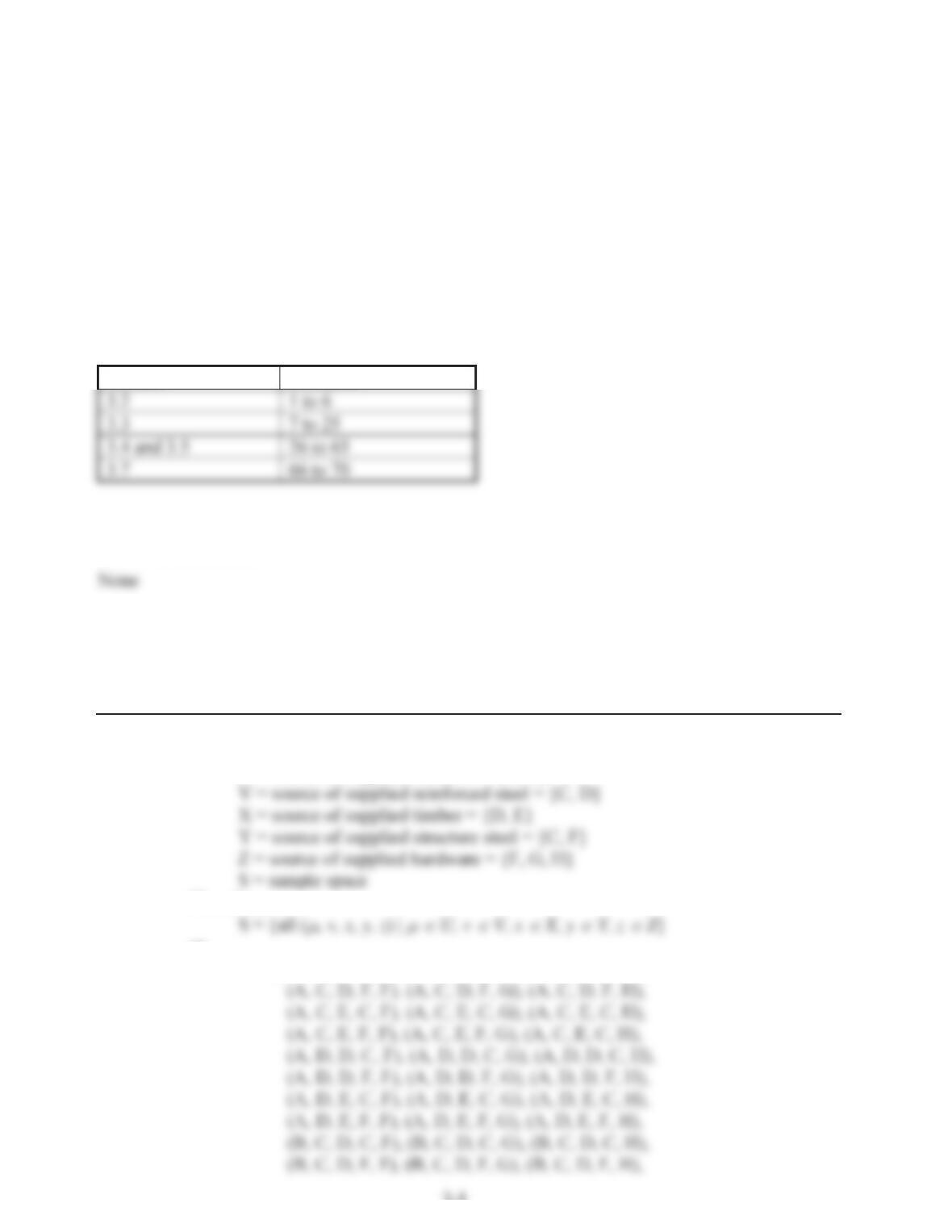
The following table provides a summary of the problems with their appropriate sections:
Section Problems
3.1. Introduction
3.2. Sample Space, Sets, and Events
Problem 3-1.
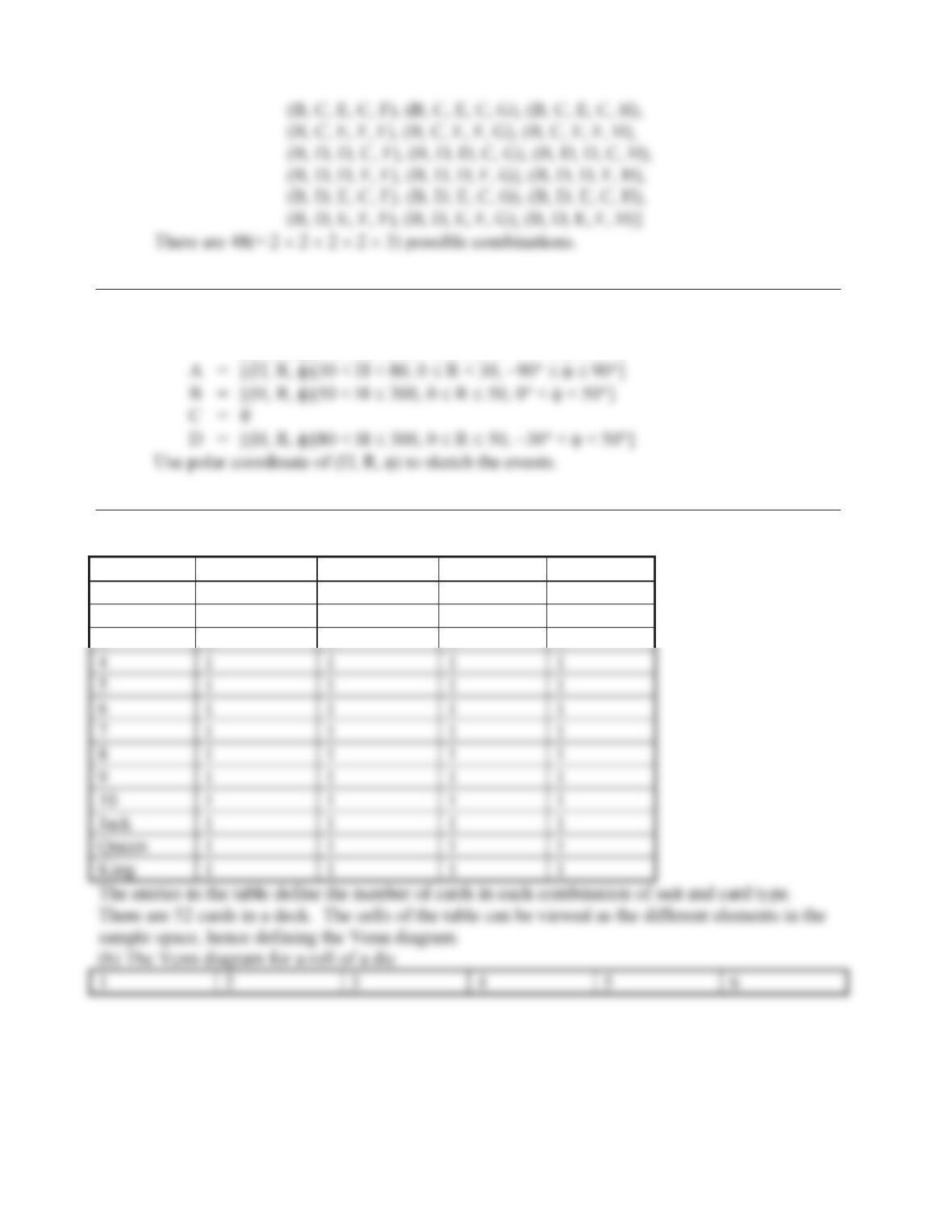
Define the following:
U = source of supplied concrete = {A, B}
Therefore,
or
S = { (A, C, D, C, F), (A, C, D, C, G), (A, C, D, C, H),
3-2
Problem 3-2.
S = sample space
= {(H, R, I)|0 d H d 300, 0 d R d 50, 90q d I d 90q}
Problem 3-3.
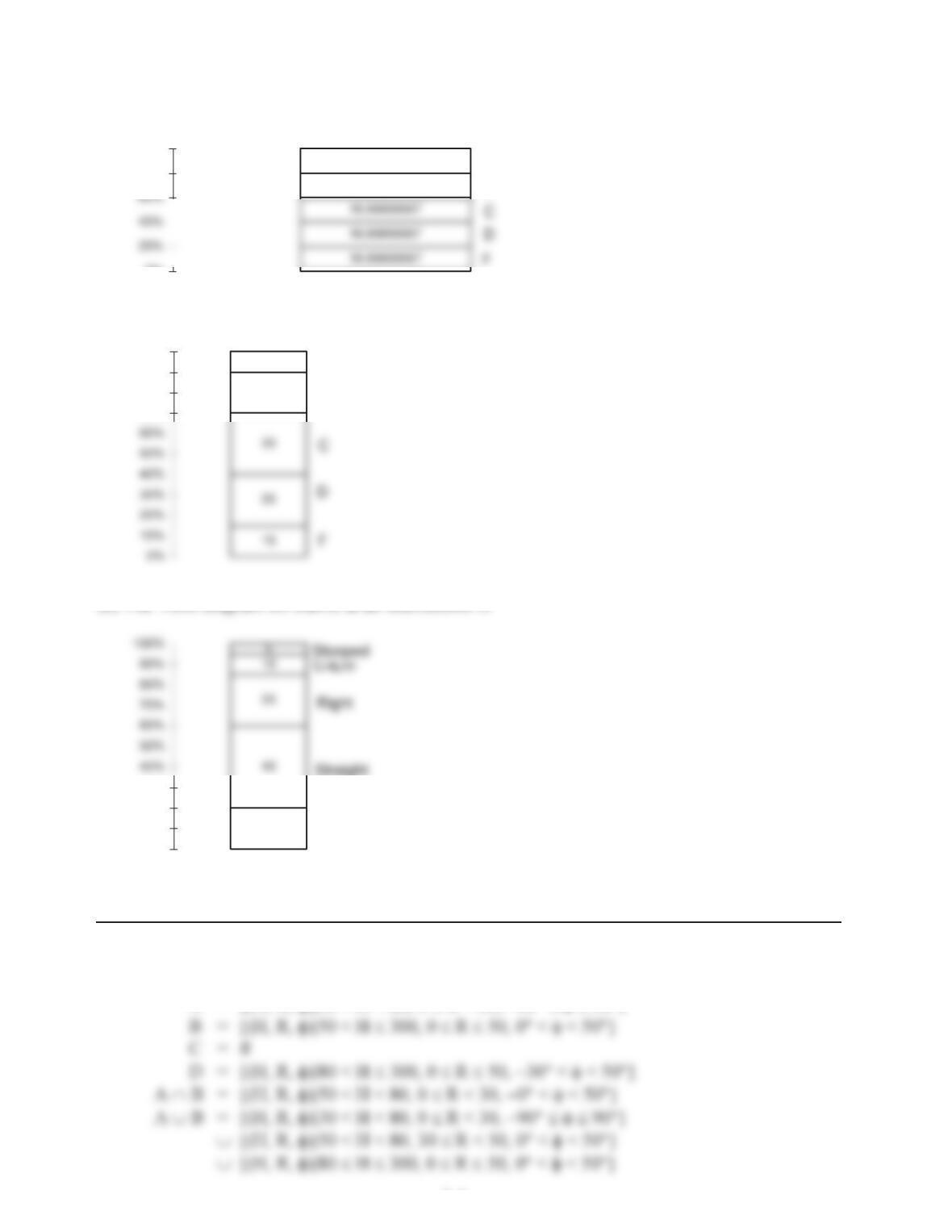
(a) The Venn diagram for a deck of cards is
Cards\Suit Clubs h Diamonds i Hearts j Spades k
Ace 1 1 1 1
2 1 1 1 1
3 1 1 1 1
3-3
(c) The Venn diagram for letter grades in a test is
16.66666667
16.66666667
0%
80%
100% A
B
(d) The Venn diagram for letter grades in this case is
A15
B25
C30
D20
F10
20
10
70%
80%
90%
100% A
B
(e) The Venn diagram for traffic at an intersection is
20
0%
10%
20%
30%
Left
Problem 3-4.
S = sample space
= {(H, R, I)|0 d H d 300, 0 d R d 50, 90q d I d 90q}
A = {(H, R, I)|30 < H < 80, 0 d R < 30, 90q d I d 90q}
3-4
Problem 3-5.
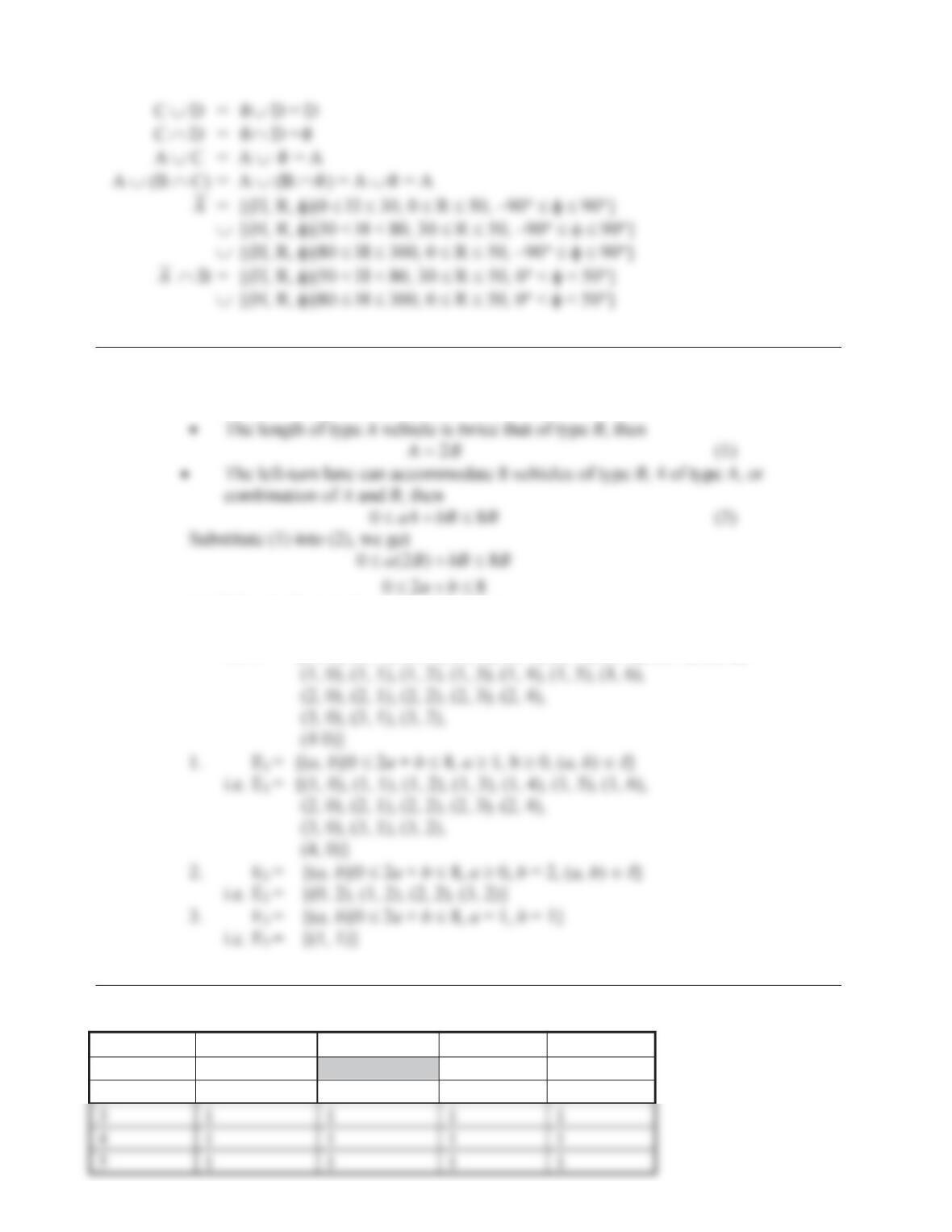
x Let (a, b) denote a sample point that there are a vehicles of type A and b
vehicles of type B.
Let S denote the sample space. Therefore,
S = {(a, b)|0 d 2a + b d 8, a t 0, b t 0, (a, b) I}, I = integers
i.e. S = {(0, 0), (0, 1), (0, 2), (0, 3), (0, 4), (0, 5), (0, 6), (0, 7), (0, 8),
Problem 3-6.
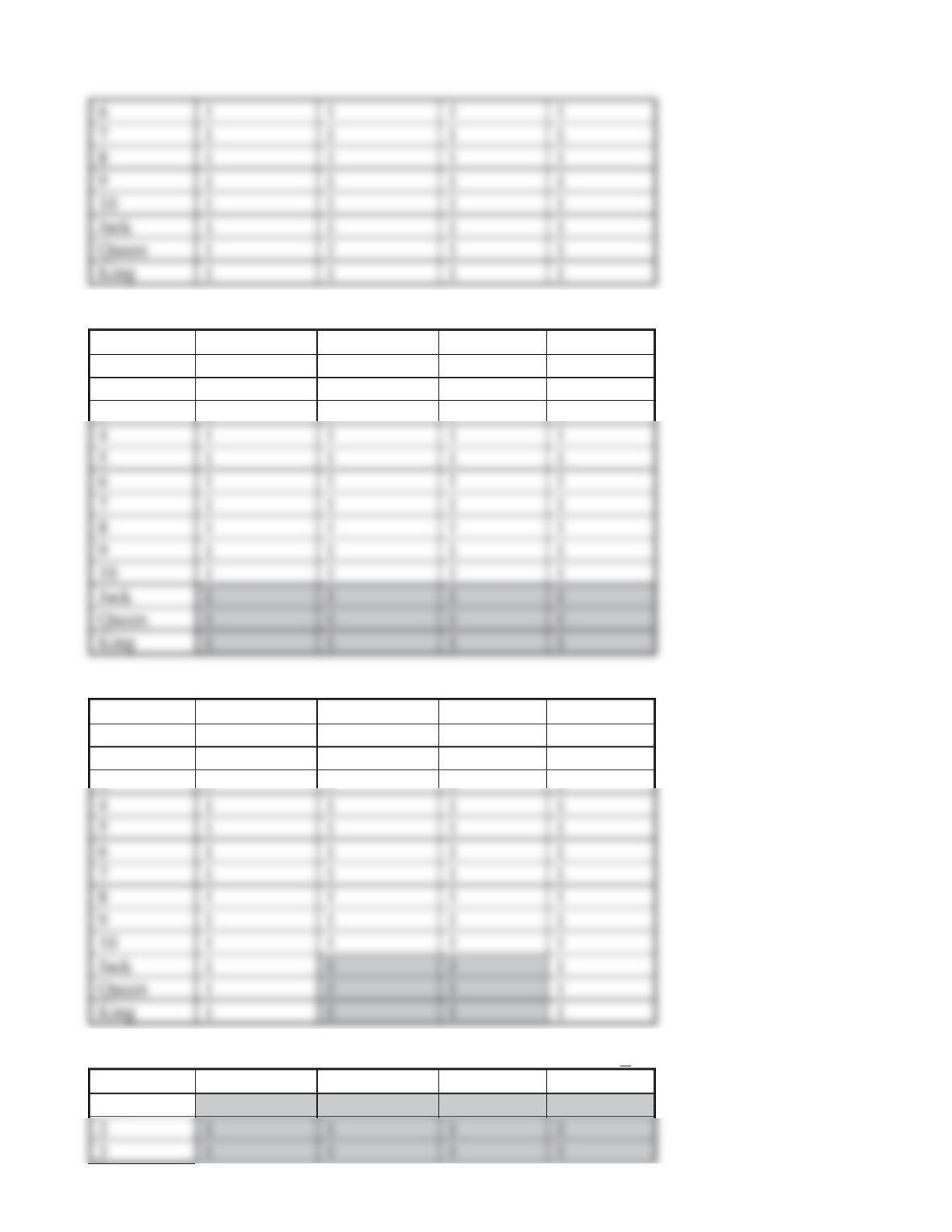
(a) The Venn diagram for event A = all diamond and all aces is
Cards\Suit Clubs h Diamonds i Hearts j Spades k
Ace 1 1 1 1
2 1 1 1 1
3-5
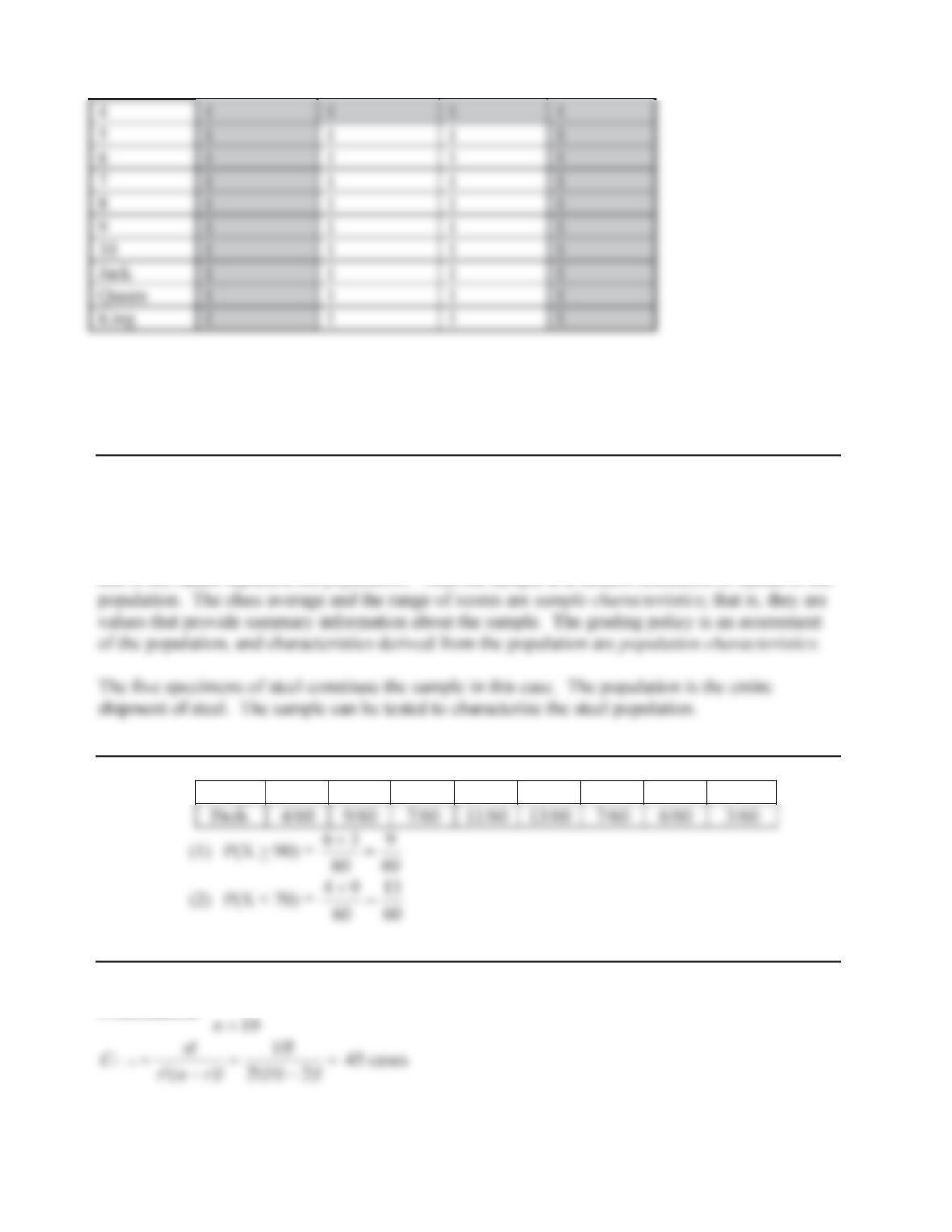
(b) The Venn diagram for event B = all face cards is
Cards\Suit Clubs h Diamonds i Hearts j Spades k
Ace 1 1 1 1
2 1 1 1 1
3 1 1 1 1
(c) The Venn diagram for event C = intersection of red and face cards is
Cards\Suit Clubs h Diamonds i Hearts j Spades k
Ace 1 1 1 1
2 1 1 1 1
(d) The Venn diagram for event D = union of black cards with values < 4 is
Cards\Suit Clubs h Diamonds i Hearts j Spades k
Ace 1 1 1 1
3-6
3.3. Mathematics of Probability
Problem 3-7.
The test score example discussed in Chapter 3 was useful for introducing some important
terminology. In the instructor’s viewpoint, the collection of test scores represents observations on
the random variable “test score.” The test scores for the class represent a sample of observations;
the test scores for all the students who have had the test (or similar test) in the past or will have the
test in the future represent the population. Thus the sample is a random collection or subset of the
Problem 3-8.
Range 50-59 60-69 70-74 75-79 80-84 85-89 90-94 95-100
Problem 3-9.
Combination: 10
2
r
Problem 3-10.
Combination: 30
10
n
r
Problem 3-11.
Number of systems = 10
State of rocket defined by success or failures of these subsystems
(b) How many states of 2 or less subsystems malfunctioning?
States for 2 sub system failures = (10!)/(2!(8!)) = 45
Problem 3-12.
Problem 3-13.
Problem 3-14.
Define A = the event that a beam is safe against load A, and
B = the event that a beam is safe against load B.
3-8
Problem 3-15.
The failure probability in shear: P(s) = 0.01
The failure probability in flexure: P(f) = 0.05
b) Events shear and flexure are perfectly and positively dependent:
Problem 3-16.
Define S = the event that a concrete beam fails by shear,
Problem 3-17.
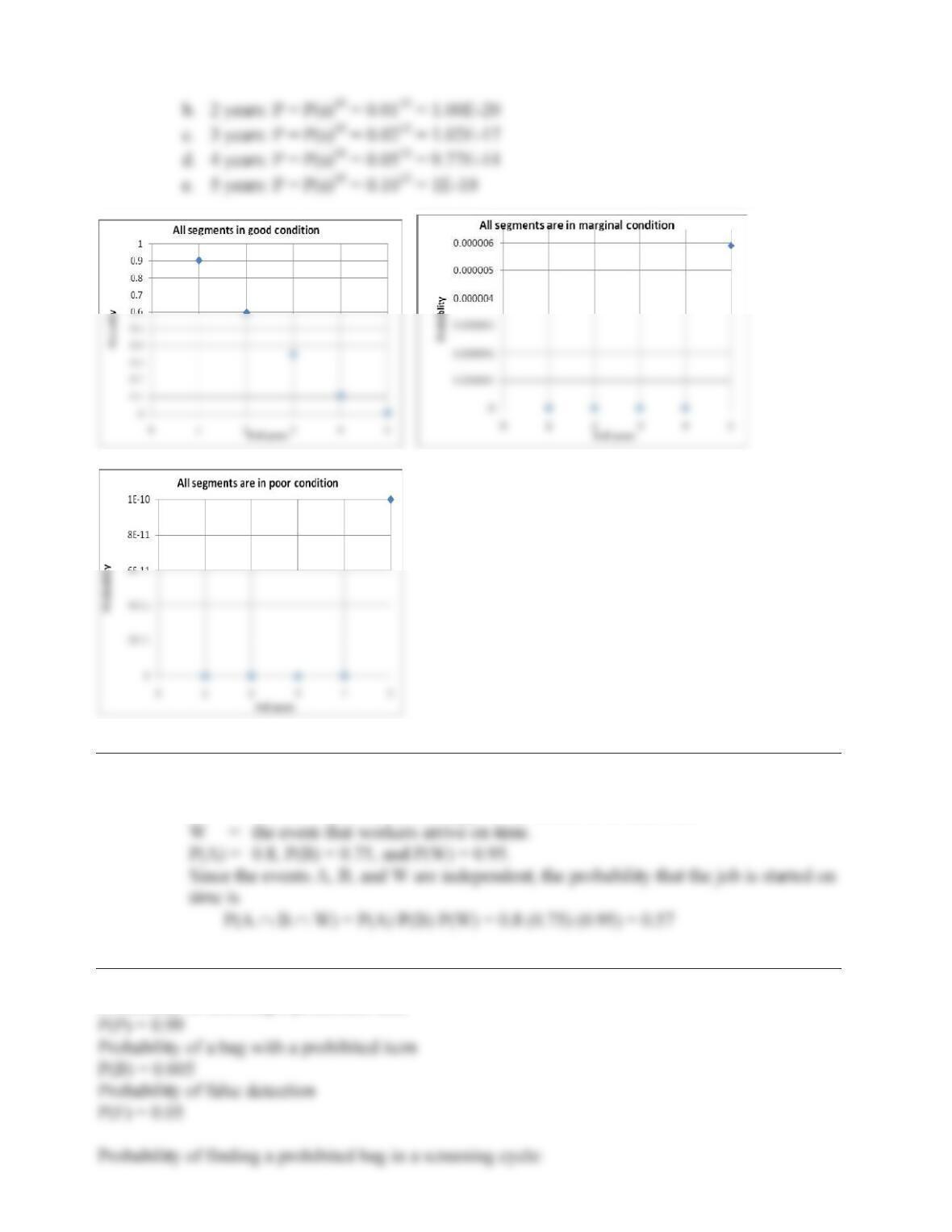
i) All segments are in good condition
a. 1 year: P = P(s)10 = 0.9910 = 0.904
ii) All segments are in marginal condition
a. 1 year: P = P(s)10 = 0.0110 = 1.00E-20
iii) All segments are in poor condition
a. 1 year: P = P(s)10 = 0.0010 = 0
3-9
Problem 3-18.
Define A = the event that material is supplied by source A on time,
B = the event that material is supplied by source B on time, and
Problem 3-19.
Probability of detecting a prohibited item
Problem 3-20.
P(defective) = 0.90
Problem 3-21.
P(Incoming Missile Detected)=P(IMD)=0.99
Problem 3-22.
P(0/5)= C(0/5)0.75×0.255 = 1(0.75)0(0.25)5 = 9.7656×10⁻⁴
P(1/5)=C(1/5)(0.751)(0.254) = 5(0.75)1(0.25)4 = 0.01465
3-11
Problem 3-23.
Define D = damaged item,
A = shipment by air,
Problem 3-24.
(a) Sample space for odd integers is {1,3,5}
Problem 3-25.
Define A = material from source A,
B = material from source B,
3-12
3.4./3.5. Random Variables and Their Probability Distributions/Moments
Problem 3-26.
Failure Probability = sum of the probabilities = 0.05 + 0.05 + 0.1 + 0.1 + 0.2 + 0.15 = 0.65
Problem 3-27.
Driver classification:
Low risk (L)
Medium risk (M)
(a)
P(C|L) = P( C L ) / P(L)
(b)
P(C|M) = P( C M ) / P(M)
(c)
P(C|H) = P( C H ) / P(H)
Problem 3-28.
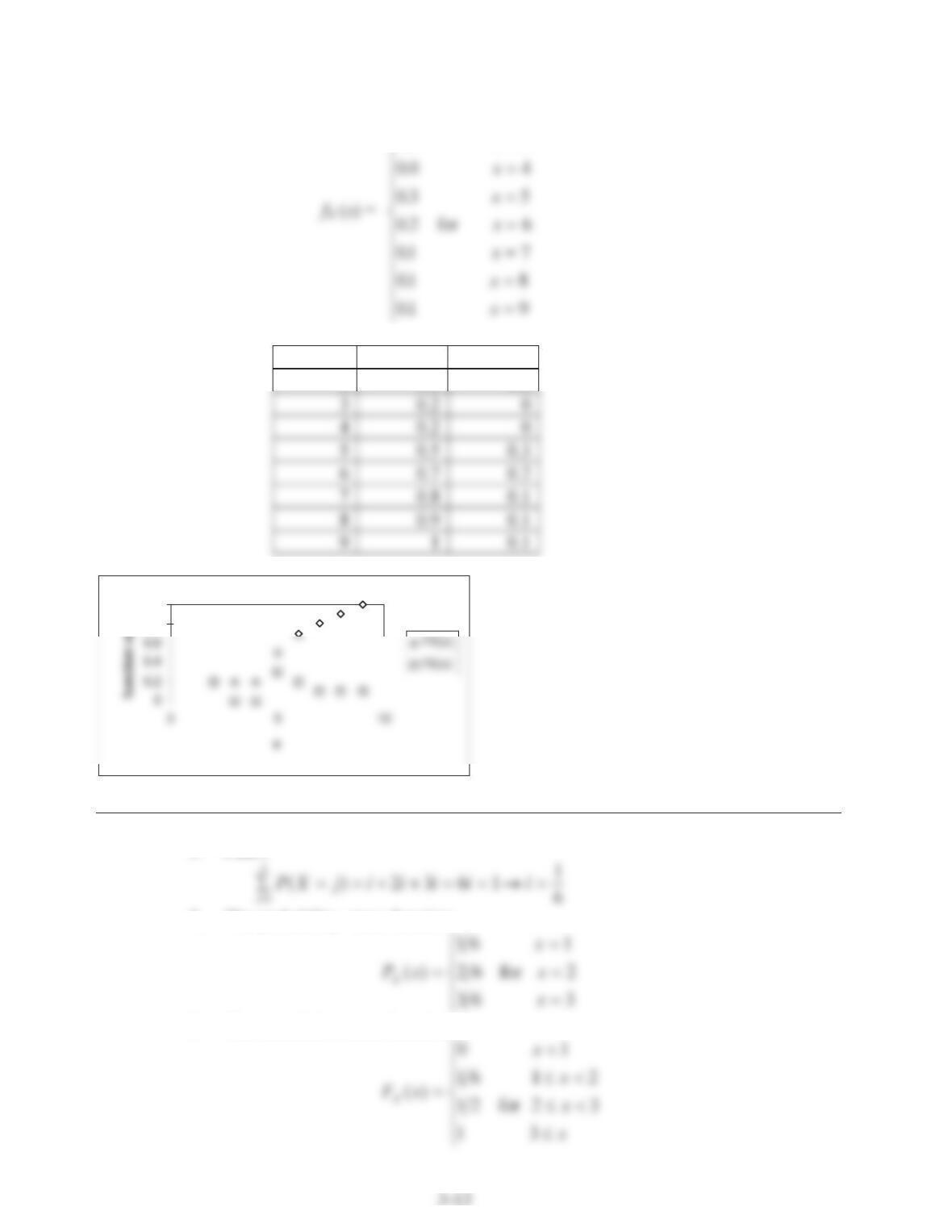
The probability mass function
02 2
00 3
.
.
x
x
°
x F
X
(x)f
X
(x)
2 0.2 0.2
0.8
1
Problem 3-29.
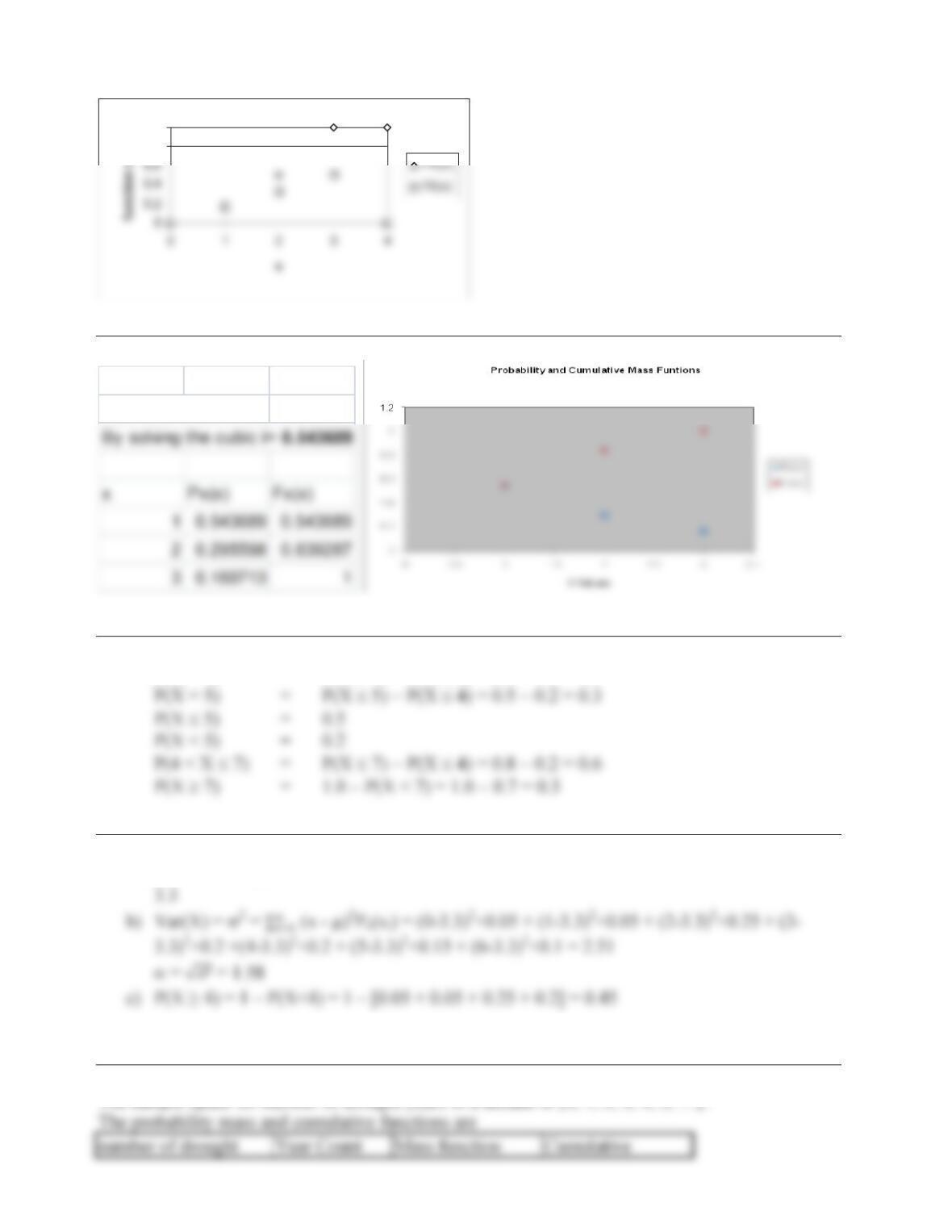
1. Find i
2. The probability mass function
3. The cumulative mass function
3-14
0.8
1
Problem 3-30.
Solve for i
i^3+i^2+i= 1
Problem 3-31.
P(X = 4) = P(X d 4) P(X d 3) = 0.2 0.2 = 0.
Problem 3-32.
a) E(X) = μ = σ
ୀଵ xiPx(xi) = 0×0.05 + 1×0.05 + 2×0.25 + 3×0.2 + 4×0.2 + 5×0.15 + 6×0.1 =
Problem 3-33.
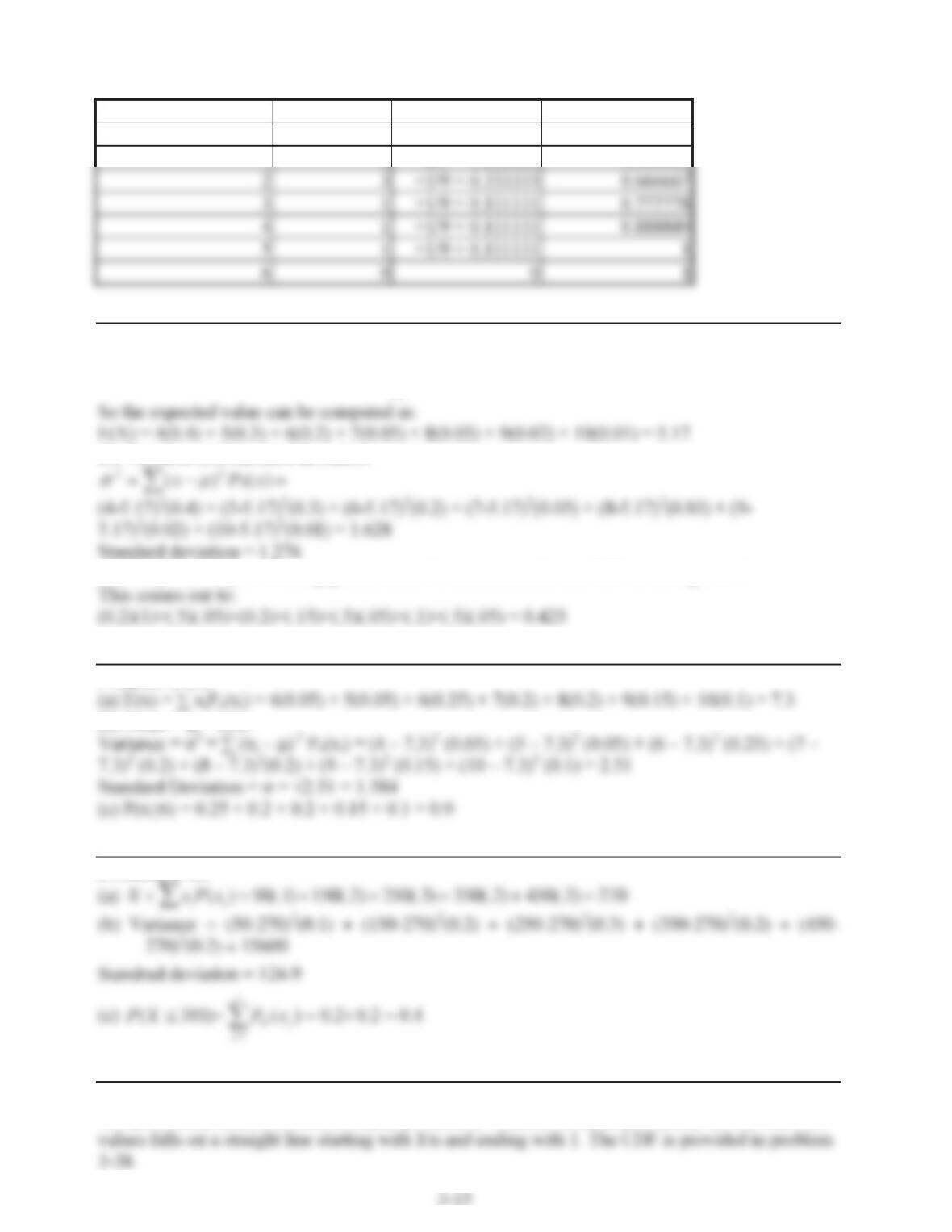
years in a decade function
0 1 =1/9 = 0.111111 0.111111
1 2 =2/9 = 0.222222 0.333333
Problem 3-34.
(a) The expect value of X is given by: )(*
1
xPx
n
i
i
¦
(b) Variance and standard deviation:
(c) The probability of X being greater than 6 is the area under the PDF to the right of 6.
Problem 3-35.
(b) Mean = = E(x)
Problem 3-36.
Problem 3-37.
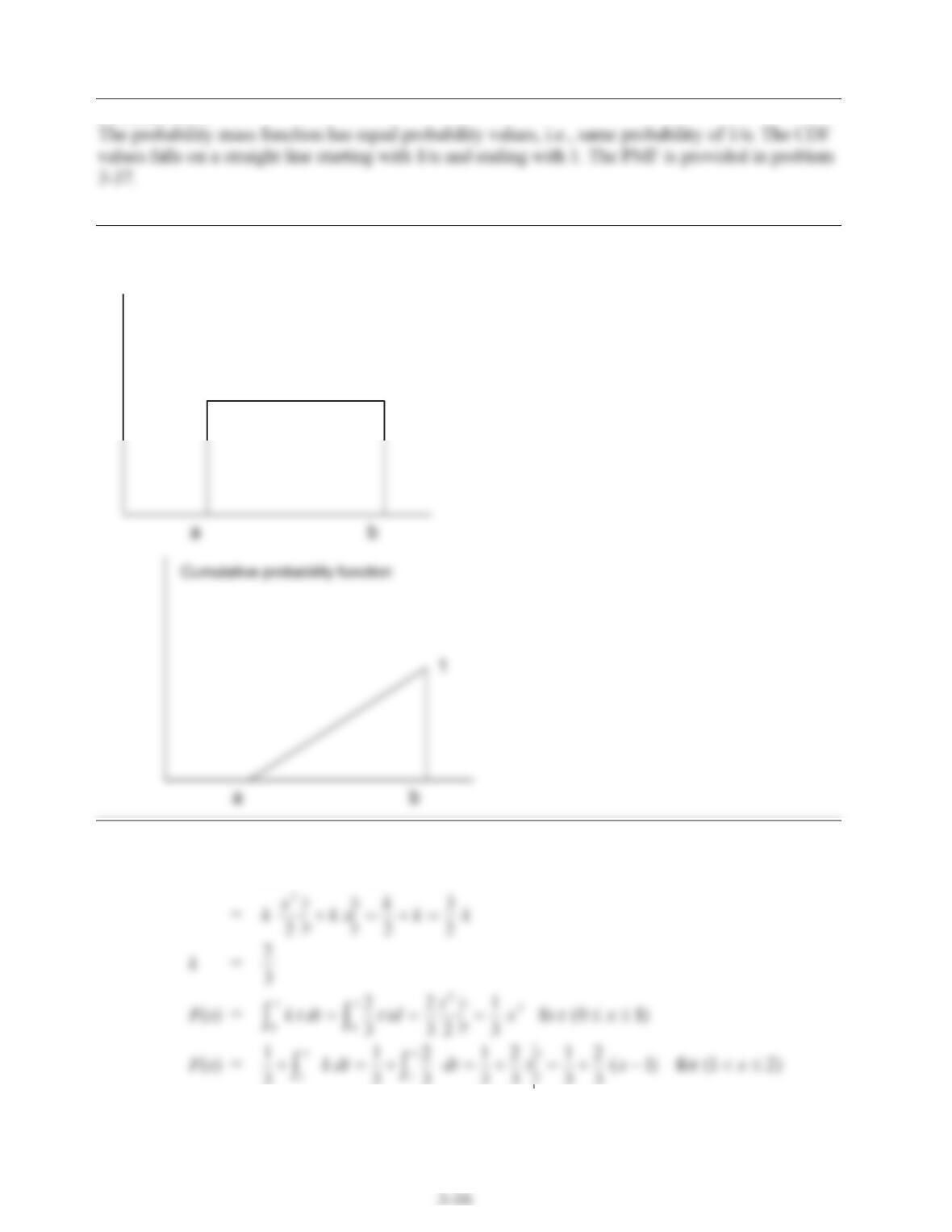
The probability mass function has equal probability values, i.e., same probability of 1/n. The CDF
Problem 3-38.
Problem 3-39.
1 = k(b-a)
k= 1/(b-a)
Problem 3-40.
1 = f x dx kx dx k dx()
³³³f
f
1
2
0
1
k
Probability density function