Chapter 3: Accounting Transactions
Learning Objectives
At the completion of this chapter the student should be able to:
• Explain what accounting transactions result in costs or revenues being recorded to the job cost
ledger.
• Explain the difference between recording an expense or revenue and the recording the
associated cash flow when using the percentage of completion accounting method.
• Explain when retention becomes a revenue and how keep uncollectible retention separate from
Instructional Hints
• The question is often raised, “Do construction managers really need to understand how
accounting transactions are made to be in order to be good construction managers? Is not
handling accounting transactions what we hire accountants for?” I use the teaching of
and 3-24 (which show bills being charge to a job) and Example 3-13 (which show the client being
billed) can help the student understand the timing deference between costs and revenues. It is
3-24, and 3-28 can be used to teach the students when this happens.
o It is important for financial managers in construction companies to understand that when using
percentage of completion accounting system the recording of a bill to the accounting systems
does not create a cash flow until the bill is paid. Examples 3-1, 3-2, 3-13, and 3-14 (which shows
how to record bills) and Examples 3-3 and 3-15 (which shows how to record payments) can be
this point. Examples 3-2, 3-13, and 3-14 can be used to help the student understand how
retention is kept separate until it becomes collectable.
o It is important for financial managers in construction companies to understand how to
accumulate the funds needed to pay for a jobsite employee’s vacation by billing each
construction project each pay period for the accrued vacation. Examples 3-5 and 3-9 can help
lease.
Activities
• Invite a construction accountant from industry to discuss construction accounting. Be sure they
discuss the unique characteristics of construction accounting, including job costing and
allocation of equipment costs.
Instruction Resources
• The figures from this chapter in electronic format and PowerPoint slides can be found at the
instructor’s website.
Solutions to the Textbook Problems
1. When the changes to the asset accounts are not equal to the changes to the liability and net
worth accounts on the balance sheet we know that the transactions are incorrect or additional
2. Invoice charged to a job without retention, invoiced charged to a job with retention, labor
charged to a job, labor charged to general overhead, recording office rent, recording office depreciation,
recording general overhead invoices, billing a client, loan payment, equipment depreciation, recording a
3. Paying invoices, paying an employee’s wages, paying payroll taxes, paying for benefits, receiving
payment from a client, purchase of equipment with a loan (if it includes a cash down payment), loan
4. Vacation time for jobsite employees, billing for retention, equipment charged to a job, purchase
5. An underbilling is where the company’s costs and profits (when the profits are uniformly
6. An overbilling is where the company’s billings to the client exceed the costs and profits (when
7. The solutions are as follows:
Invoice A:
BALANCE SHEET
ASSETS LIABILITIES
310 Accounts
5,000.00
INCOME STATEMENT
EXPENSES REVENUES EXPENSES
430 Current Period
Net Income
(5,000.00)
0
PROFIT
=
JOB COST
5,000.00 5,000.00
(5,000.00)
=0 =0 0
610 Materials 302.01.32300M
EQUITY
Payable-Trade
Invoice B:
BALANCE SHEET
ASSETS LIABILITIES
310 Accounts
11,115.00
INCOME STATEMENT
EXPENSES REVENUES EXPENSES
430 Current Period
Net Income
(12,350.00)
0
PROFIT
=
JOB COST
12,350.00 12,350.00
(12,350.00)
=0 =0 0
630 Subcontract 309.02.22100S
EQUITY
310 Accounts
1,235.00
Payable-Trade
Payable-Retention
Invoice C:
BALANCE SHEET
ASSETS LIABILITIES
310 Accounts
255.00
INCOME STATEMENT
EXPENSES REVENUES EXPENSES
430 Current Period
Net Income
(255.00)
0
PROFIT
=
JOB COST
255.00 255.00
(255.00)
=0 =0 0
650 Other 315.01.01800O
EQUITY
Payable-Trade
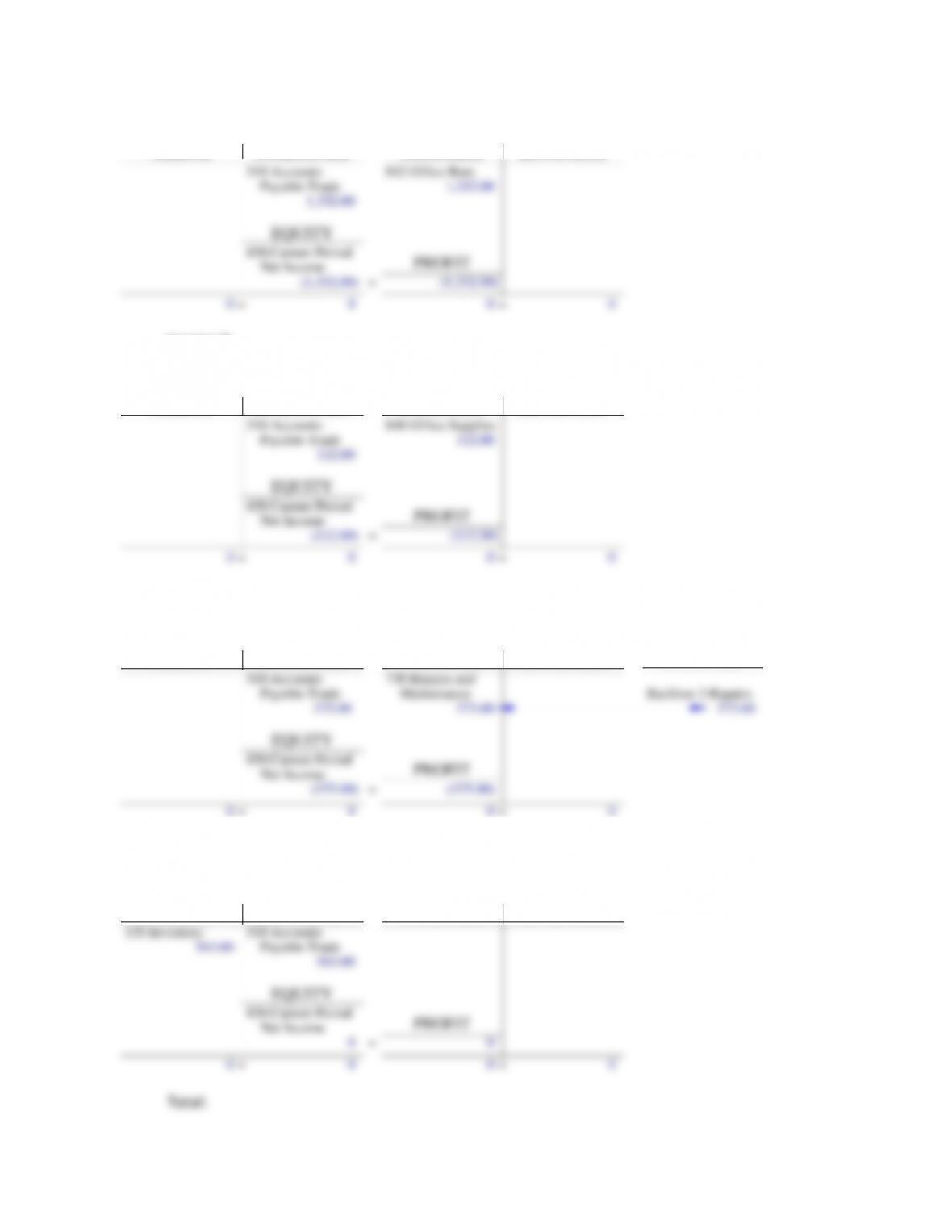
BALANCE SHEET
ASSETS LIABILITIES
310 Accounts
1,352.00
INCOME STATEMENT
EXPENSES REVENUES
430 Current Period
Net Income
(1,352.00)
0
PROFIT
=
1,352.00
(1,352.00)
=0 =0 0
842 Office Rent
EQUITY
Payable-Trade
Invoice E:
BALANCE SHEET
ASSETS LIABILITIES
310 Accounts
112.00
INCOME STATEMENT
EXPENSES REVENUES
430 Current Period
Net Income
(112.00)
0
PROFIT
=
112.00
(112.00)
=0 =0 0
840 Office Supplies
EQUITY
Payable-Trade
Invoice F:
BALANCE SHEET
ASSETS LIABILITIES
310 Accounts
375.00
INCOME STATEMENT
EXPENSES REVENUES EXPENSES
430 Current Period
Net Income
(375.00)
0
PROFIT
=
EQUIPMENT
375.00 375.00
(375.00)
=0 =0 0
730 Repairs and Backhoe 2-Repairs
EQUITY
Payable-Trade Maintenance
Invoice G:
BALANCE SHEET
ASSETS LIABILITIES
310 Accounts
563.00
INCOME STATEMENT
EXPENSES REVENUES
430 Current Period
Net Income 0
0
PROFIT
=0
=0 =0 0
EQUITY
130 Inventory
563.00 Payable-Trade
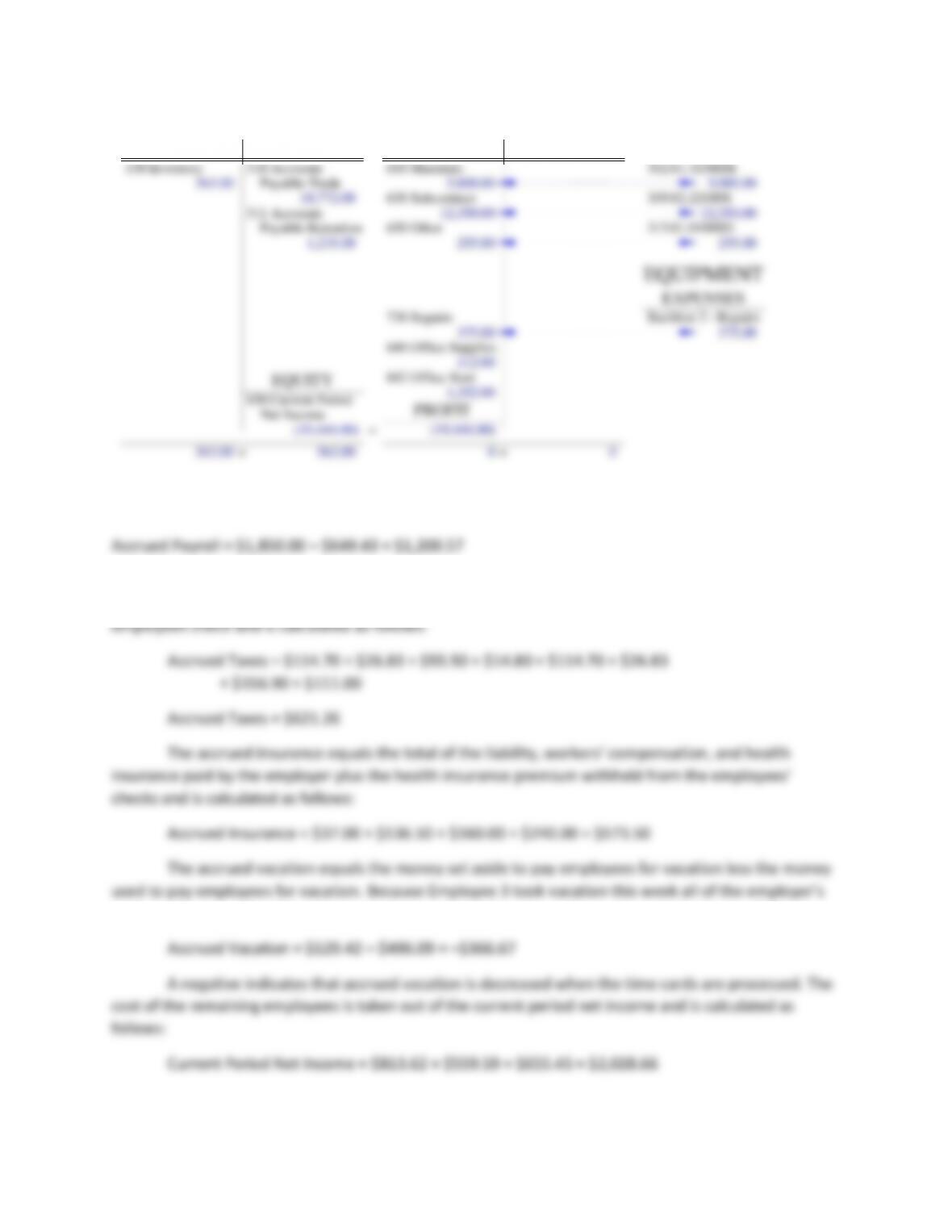
BALANCE SHEET
ASSETS LIABILITIES
310 Accounts
18,772.00
INCOME STATEMENT
EXPENSES REVENUES
EXPENSES
430 Current Period
Net Income
(19,444.00)
563.00
PROFIT
=
EQUIPMENT
5,000.00 5,000.00
(19,444.00)
=0 =563.00 0
610 Materials 302.01.32300M
EQUITY
130 Inventory
563.00 Payable-Trade
311 Accounts
1,235.00
Payable-Retention 12,350.00 12,350.00
630 Subcontract 309.02.22100S
255.00 255.00
650 Other 315.01.01800O
375.00 375.00
730 Repairs Backhoe 2 – Repairs
112.00
840 Office Supplies
1,352.00
842 Office Rent
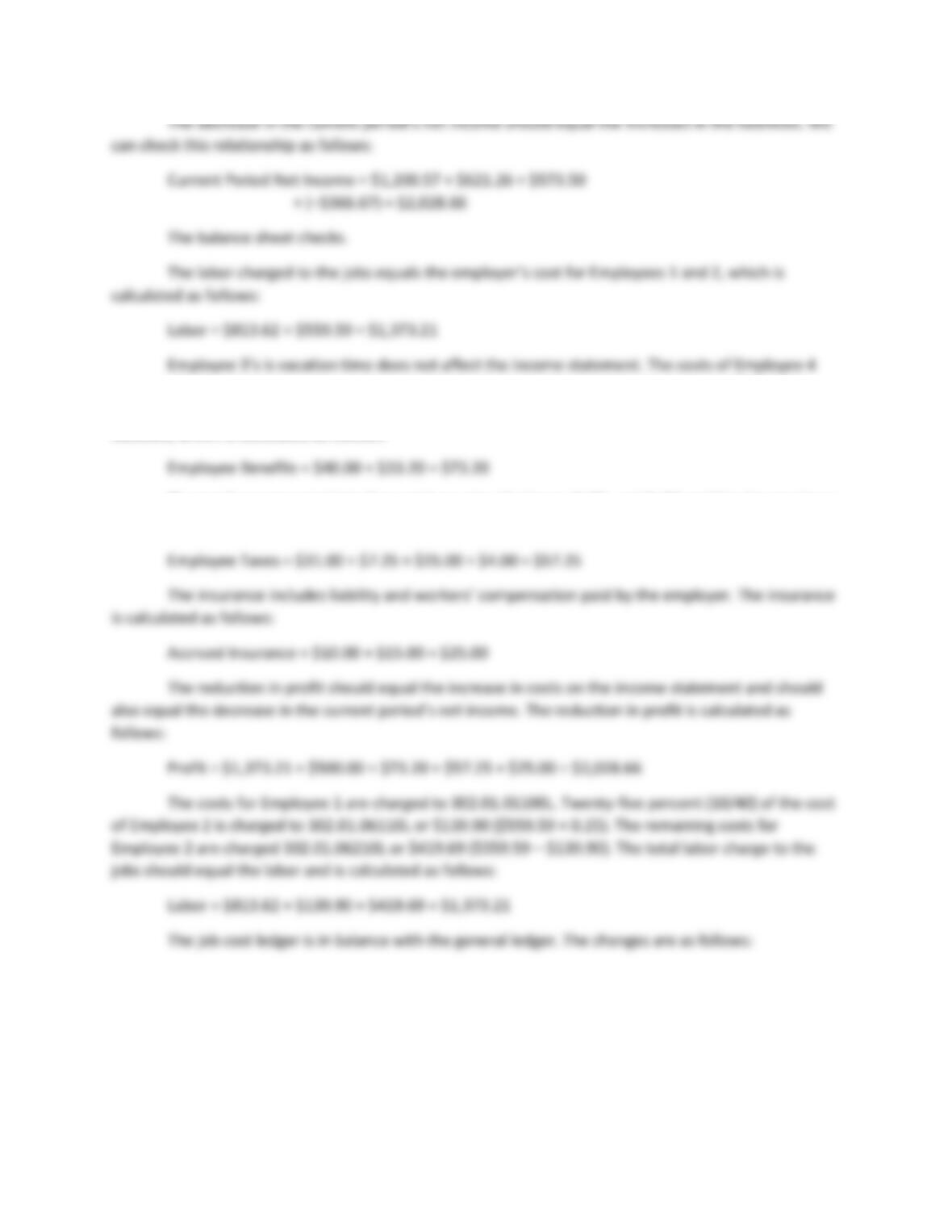
8. The accrued payroll equals the wages paid to the employees less the deduction withheld from
the employees paycheck and is calculated as follows:
The accrued taxes equals the social security, Medicare, SUTA, and FUTA paid by the employer
plus the social security, Medicare, federal withholdings, and state withholdings withheld from the
costs for Employee 3 will be taken out of accrued vacation. Accrued vacation is calculated as follows:
must be divided up between the general overhead categories. The employee’s wages are $500. The
employee benefits include the health insurance premium paid by the employer and the allowance for
vacation, which is calculated as follows:
The employee taxes include the social security, Medicare, SUTA, and FUTA paid by the employer
and is calculated as follows:
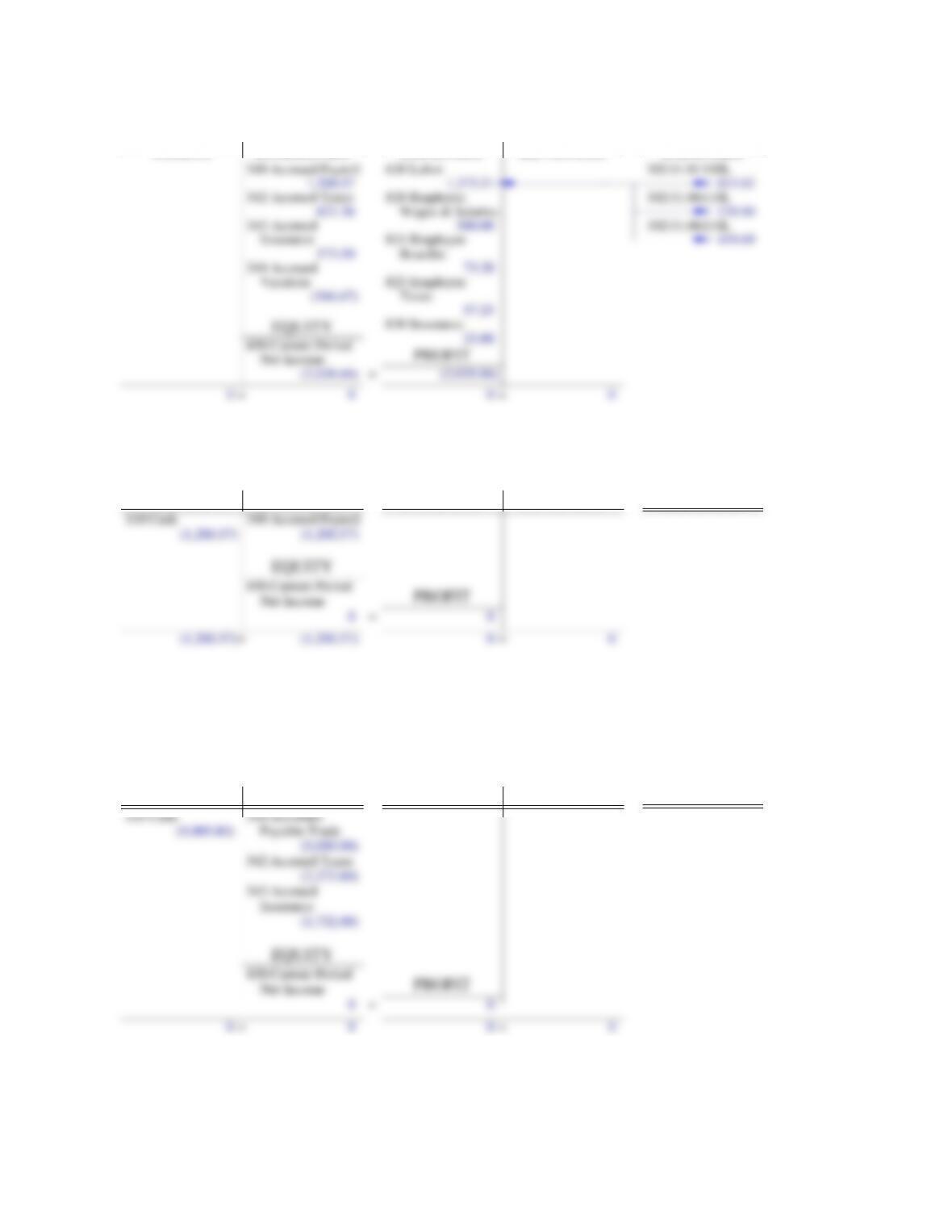
BALANCE SHEET
ASSETS LIABILITIES
340 Accrued Payroll
1,200.57
INCOME STATEMENT
EXPENSES REVENUES EXPENSES
430 Current Period
Net Income
(2,028.66)
0
PROFIT
=
JOB COST
1,373.21 813.62
(2,028.66)
=0 =0 0
620 Labor 302.01.01100L
EQUITY
342 Accrued Taxes
621.26
343 Accrued
Insurance 573.50
344 Accrued
Vacation(366.67)
500.00
820 Employee
Wages & Salaries
73.20
821 Employee
Benefits
57.25
825 Employee
Taxes
25.00
830 Insurance
139.90
302.01.06110L
419.69
302.01.06210L
9. The accrued payroll from Problem 2 is $1,200.57. The solution is as follows:
BALANCE SHEET
ASSETS LIABILITIES
340 Accrued Payroll
(1,200.57)
INCOME STATEMENT
EXPENSES REVENUES EXPENSES
430 Current Period
Net Income 0
(1,200.57)
PROFIT
=
JOB COST
0
=0 =(1,200.57) 0
EQUITY
110 Cash (1,200.57)
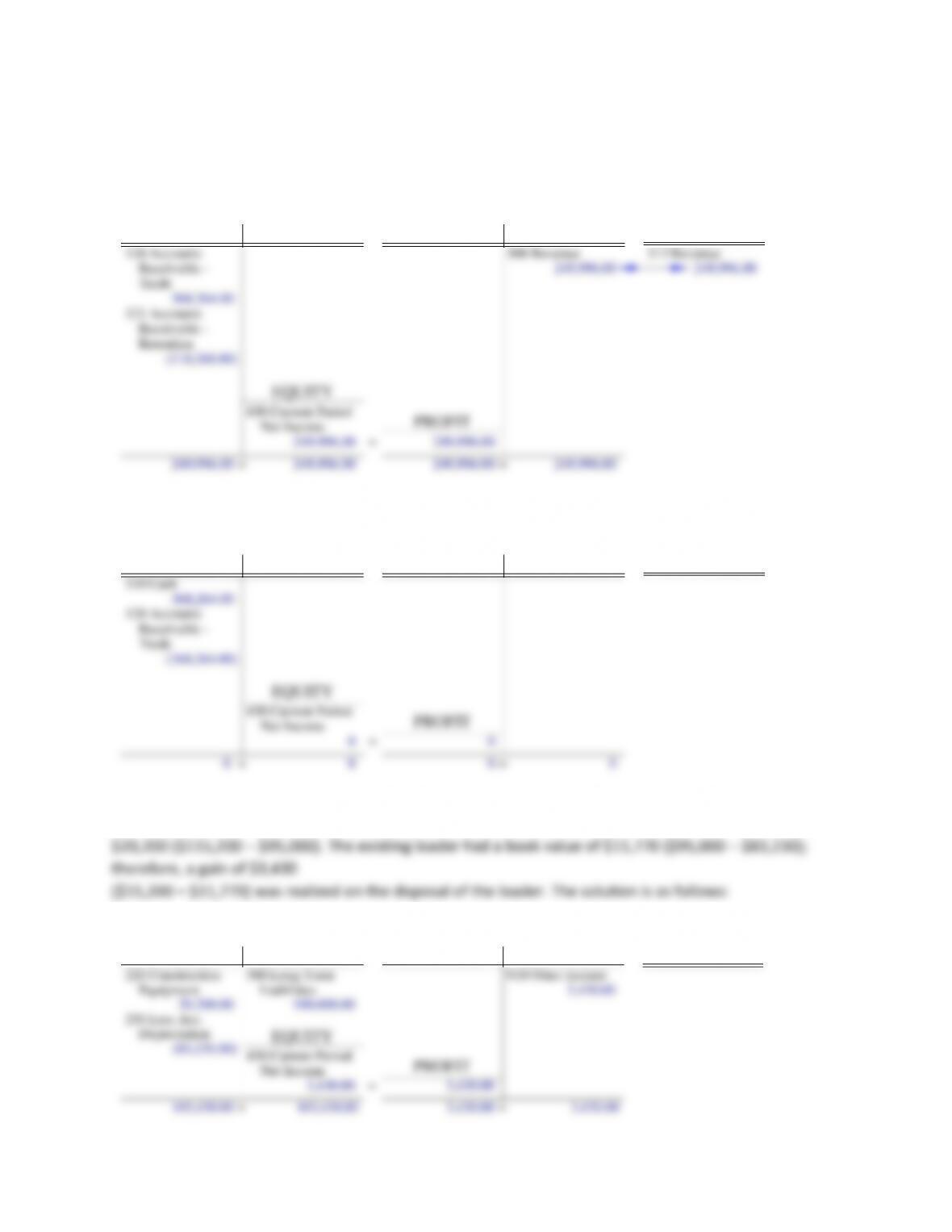
10. Because the concrete invoice was previously entered into the accounting system, there is no
change to the job cost ledger. The solution is as follows:
BALANCE SHEET
ASSETS LIABILITIES
310 Accounts
(5,000.00)
INCOME STATEMENT
EXPENSES REVENUES EXPENSES
430 Current Period
PROFIT
JOB COST
EQUITY
342 Accrued Taxes
(2,273.80)
343 Accrued
Insurance
(1,732.00)
Payable-Trade
110 Cash(9,005.80)
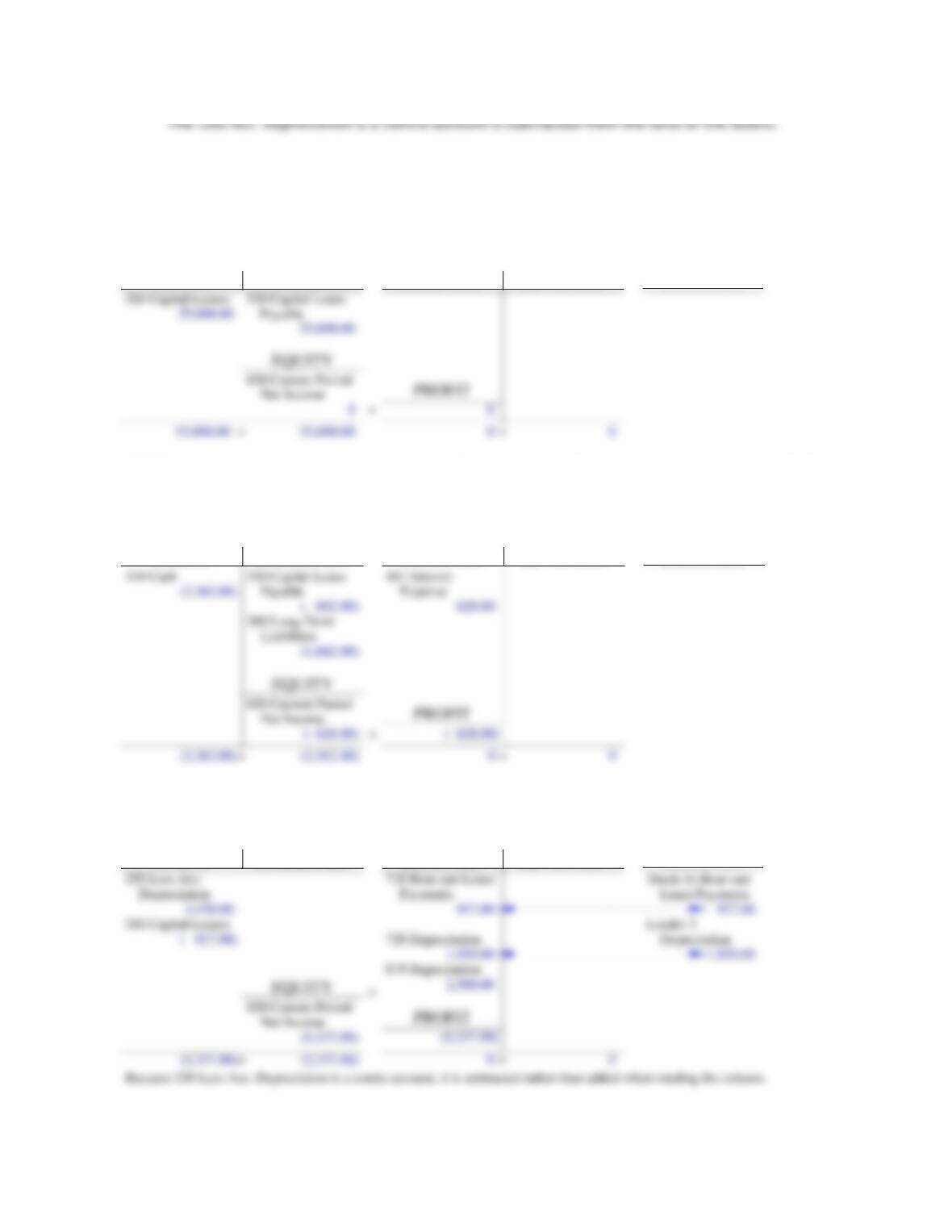
11. The $118,268 needs to be moved from accounts receivable-retention to accounts receivable-
trade and has been previously recognized as income; therefore, it should not be included as income. The
solution is as follows:
BALANCE SHEET
ASSETS LIABILITIES
120 Accounts
Receivable –
368,264.00
INCOME STATEMENT
EXPENSES REVENUES REVENUE
430 Current Period
Net Income
249,996.00
249,996.00
PROFIT
=
JOB COST
249,996.00 249,996.00
249,996.00
=249,996.00 =249,996.00 249,996.00
500 Revenue 313 Revenue
EQUITY
121 Accounts
Retention
(118,268.00)
Receivable –
Trade
12. The solution is as follows:
BALANCE SHEET
ASSETS LIABILITIES
110 Cash
368,264.00
INCOME STATEMENT
EXPENSES REVENUES EXPENSES
430 Current Period
Net Income 0
0
PROFIT
=
JOB COST
0
=0 =0 0
EQUITY
(368,264.00)
120 Accounts
Receivable –
Trade
13. The construction equipment account will see an increase of $115,200 as a result of the purchase
of the new loader and a decrease of $95,000 as a result of the sale of the old loader for a net change of
BALANCE SHEET
ASSETS LIABILITIES
380 Long-Term
Liabilities
100,000.00
INCOME STATEMENT
EXPENSES REVENUES EXPENSES
Net Income
PROFIT
EQUIPMENT
220 Construction
Equipment
20,200.00
910 Other Income
3,430.00
14. The lease is considered an operating lease and no changes will occur until a lease payment is
made.
15. The lease is considered a capital lease. The solution is as follows:
BALANCE SHEET
ASSETS LIABILITIES
350 Capital Lease
Payable
55,000.00
INCOME STATEMENT
EXPENSES REVENUES EXPENSES
430 Current Period
Net Income 0
55,000.00
PROFIT
=
EQUIPMENT
0
=0 =55,000.00 0
EQUITY
260 Capital Leases
55,000.00
16. The reduction in the loan principal is $1,042 ($1,312 – $270). The interest on the lease is $358
($1,050 – $692). The total interest is $628 ($270 + $358). The solution is as follows:
BALANCE SHEET
ASSETS LIABILITIES
350 Capital Lease
Payable
( 692.00)
INCOME STATEMENT
EXPENSES REVENUES EXPENSES
430 Current Period
Net Income
( 628.00)
(2,362.00)
PROFIT
=
EQUIPMENT
( 628.00)
=0 =(2,362.00) 0
EQUITY
110 Cash (2,362.00) 881 Interest
628.00
Expense
380 Long-Term
Liabilities
(1,042.00)
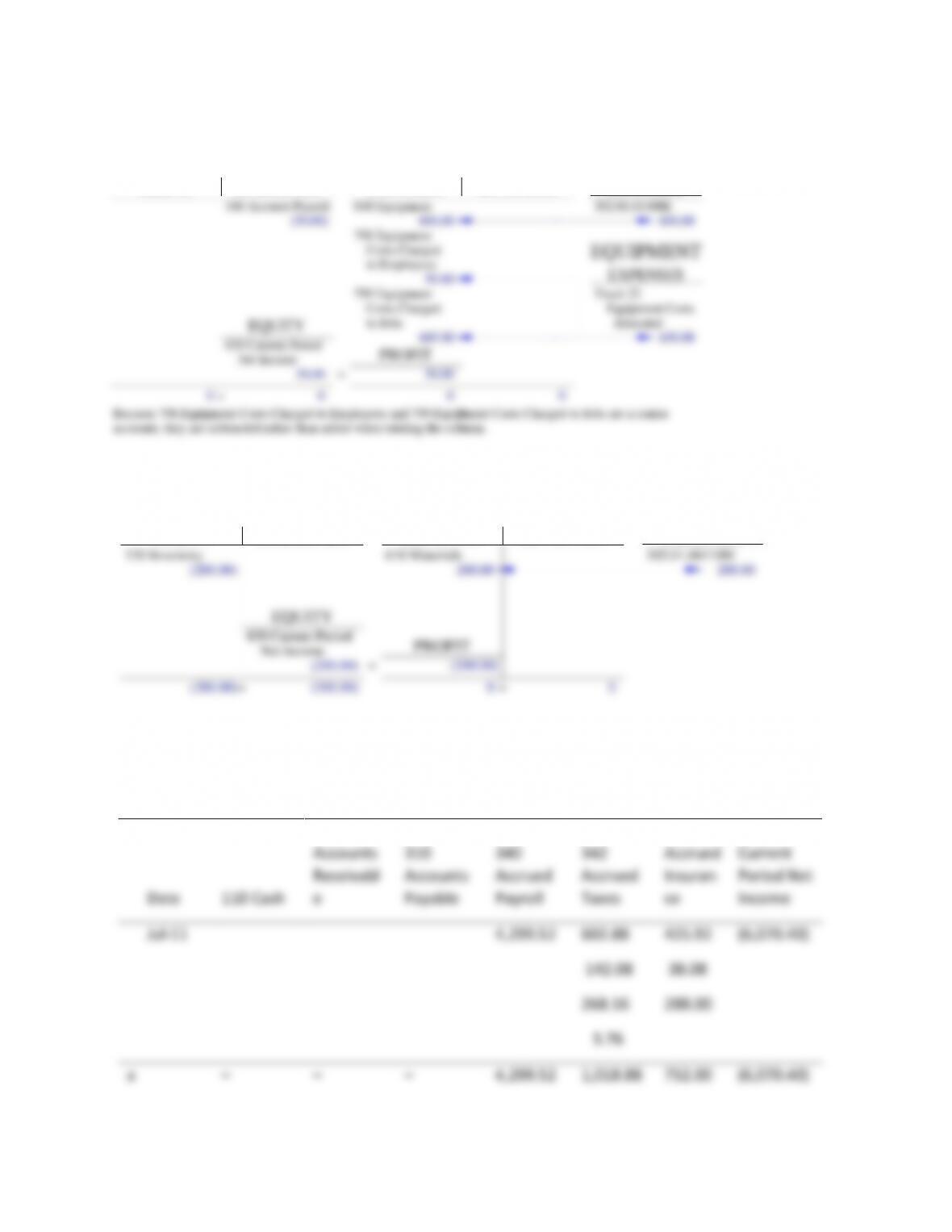
17. The solution is as follows:
BALANCE SHEET
ASSETS LIABILITIES INCOME STATEMENT
EXPENSES REVENUES EXPENSES
430 Current Period
Net Income
PROFIT
=
EQUIPMENT
917.00 917.00
Payments Truck 11-Rent and
EQUITY
250 Less Acc.
Depreciation
4,420.00
Lease Payments
260 Capital Leases
( 917.00) 1,920.00 1,920.00
720 Depreciation Loader 3
Depreciation
710 Rent and Lease
2,500.00
819 Depreciation
18. The solution is as follows:
BALANCE SHEET
ASSETS LIABILITIES INCOME STATEMENT
EXPENSES REVENUES EXPENSES
430 Current Period
Net Income50.00
0
PROFIT
=
JOB COST
50.00
50.00
=0 =
0 0
to Employees
EQUITY
340 Accrued Payroll
(50.00)
Costs Charged
798 Equipment
Because 798 Equipment Costs Charged to Employees and 799 Equipment Costs Charged to Jobs are a contra
accounts, they are subtracted rather than added when totaling the column.
600 00 650.00
to Jobs Equipment Costs
Allocated
Costs Charged
799 Equipment
640 Equipment
600.00
EXPENSES
EQUIPMENT
302.01.01100E
600.00
Truck 22
19. The solution is as follows:
BALANCE SHEET
ASSETS LIABILITIES
130 Inventory
(200.00)
INCOME STATEMENT
EXPENSES REVENUES EXPENSES
430 Current Period
Net Income
(200.00)
(200.00)
PROFIT
=
JOB COST
200.00 200.00
(200.00)
=0 =(200.00) 0
610 Materials 302.01.06110M
EQUITY
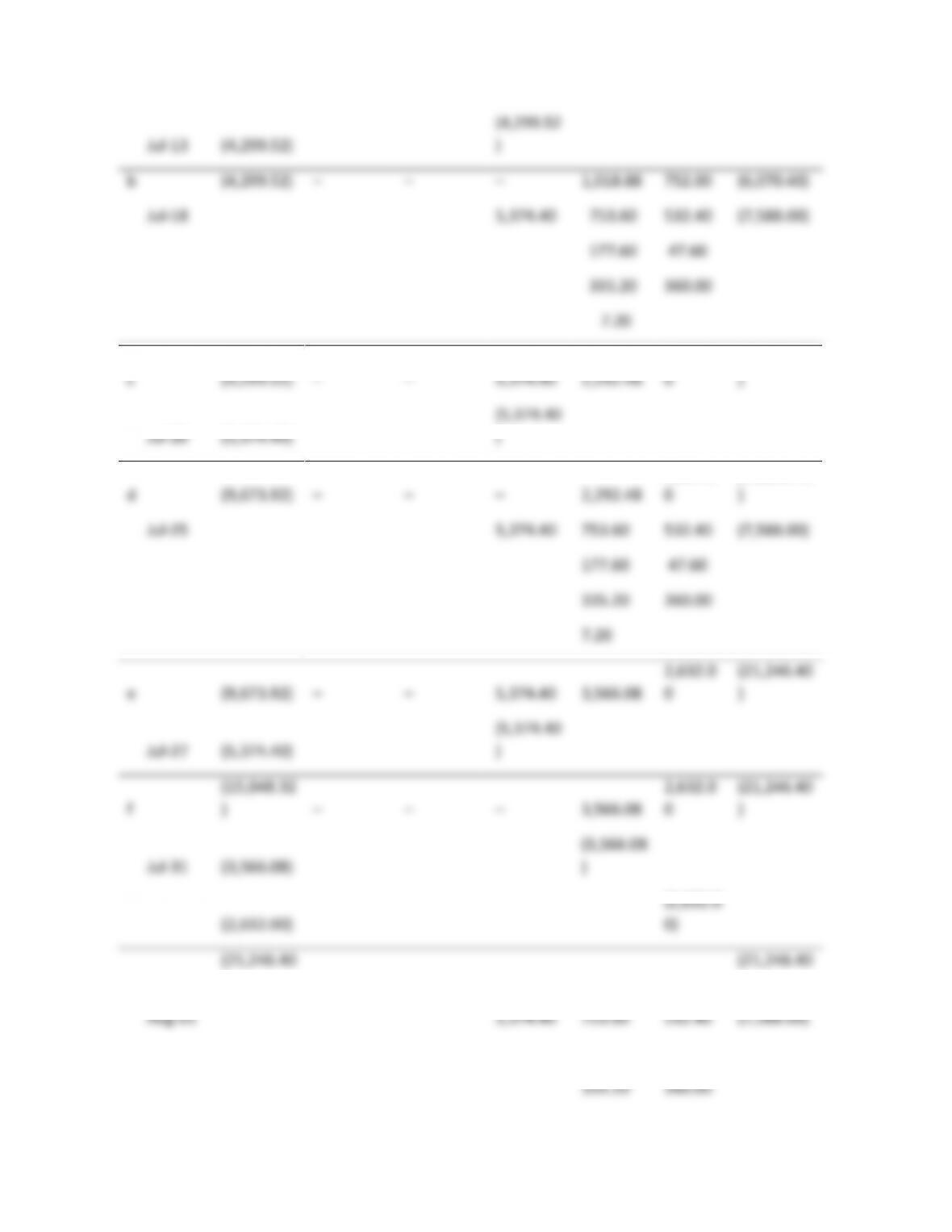
20. The accounts on the balance sheet are as follows after each transaction:
Balance Sheet
Date
110 Cash
120
Accounts
Receivabl
e
310
Accounts
Payable
340
Accrued
Payroll
342
Accrued
Taxes
343
Accrued
Insuran
ce
430
Current
Period Net
Income
Jul–11
4,299.52
602.88
425.92
(6,070.40)
142.08
38.08
268.16
288.00
5.76
a
4,299.52
1,018.88
752.00
(6,070.40)
Jul–13
(4,299.52)
(4,299.52
)
b
(4,299.52)
–
–
–
1,018.88
752.00
(6,070.40)
Jul–18
5,374.40
753.60
532.40
(7,588.00)
177.60
47.60
335.20
360.00
7.20
c
(4,299.52)
–
–
5,374.40
2,292.48
1,692.0
0
(13,658.40
)
Jul–20
(5,374.40)
(5,374.40
)
d
(9,673.92)
–
–
–
2,292.48
1,692.0
0
(13,658.40
)
Jul–25
5,374.40
753.60
532.40
(7,588.00)
177.60
47.60
335.20
360.00
7.20
e
(9,673.92)
–
–
5,374.40
3,566.08
2,632.0
0
(21,246.40
)
Jul–27
(5,374.40)
(5,374.40
)
f
(15,048.32
)
–
–
–
3,566.08
2,632.0
0
(21,246.40
)
Jul–31
(3,566.08)
(3,566.08
)
(2,632.00)
(2,632.0
0)
g
(21,246.40
)
–
–
–
–
–
(21,246.40
)
Aug–01
5,374.40
753.60
532.40
(7,588.00)
177.60
47.60
335.20
360.00

7.20
h
(21,246.40
)
–
–
5,374.40
1,273.60
940.00
(28,834.40
)
Aug–02
3,846.00
6,720.00
(10,566.00
)
i
(21,246.40
)
–
10,566.00
5,374.40
1,273.60
940.00
(39,400.40
)
Aug–03
(5,374.40)
(5,374.40
)
j
(26,620.80
)
–
10,566.00
–
1,273.60
940.00
(39,400.40
)
Aug–05
45,000.00
45,000.00
k
(26,620.80
)
45,000.00
10,566.00
–
1,273.60
940.00
5,599.60
Aug–08
5,374.40
753.60
532.40
(7,588.00)
177.60
47.60
335.20
360.00
7.20
l
(26,620.80
)
45,000.00
10,566.00
5,374.40
2,547.20
1,880.0
0
(1,988.40)
Aug–10
(5,374.40)
(5,374.40
)
m
(31,995.20
)
45,000.00
10,566.00
–
2,547.20
1,880.0
0
(1,988.40)
Aug–15
5,374.40
753.60
532.40
(7,588.00)
177.60
47.60
335.20
360.00
7.20
n
(31,995.20
)
45,000.00
10,566.00
5,374.40
3,820.80
2,820.0
0
(9,576.40)
Aug–15
(10,566.00
)
(10,566.0
0)
o
(42,561.20
)
45,000.00
–
5,374.40
3,820.80
2,820.0
0
(9,576.40)
Aug–17
(5,374.40)
(5,374.40
)
p
(47,935.60
)
45,000.00
–
–
3,820.80
2,820.0
0
(9,576.40)
Balance Sheet
Date
110 Cash
120
Accounts
Receivabl
e
310
Accounts
Payable
340
Accrued
Payroll
342
Accrued
Taxes
343
Accrued
Insuranc
e
430 Current
Period Net
Income
Aug–17
2,240.00
(2,240.00)
q
(47,935.6
0)
45,000.00
2,240.00
–
3,820.80
2,820.00
(11,816.40)
Aug–25
45,000.00
(45,000.00
)
r
(2,935.60)
–
2,240.00
–
3,820.80
2,820.00
(11,816.40)
Aug–31
(3,820.80)
(3,820.80
)
(2,820.00)
(2,820.0
0)
s
(9,576.40)
–
2,240.00
–
–
–
(11,816.40)
Aug–31
(2,240.00)
(2,240.00
)
t
(11,816.4
0)
–
–
–
–
–
(11,816.40)
Sep-03
1,705.00
(1,705.00)
u
(11,816.4
0)
–
1,705.00
–
–
–
(13,521.40)
Sep-05
20,800.00
20,800.00
v
(11,816.4
0)
20,800.00
1,705.00
–
–
–
7,278.60
Sep-15
(1,705.00)
(1,705.00
)
w
(13,521.4
0)
20,800.00
–
–
–
–
7,278.60
Sep-25
20,800.00
(20,800.00
)
x
7,278.60
–
–
–
–
–
7,278.60
The accounts on the income sheet are as follows after each transaction:
Income Statement
Date
Profit
500
Revenue
610
Materials
620 Labor
640
Equipment
Jul–11
(6,070.40)
6,070.40
a
(6,070.40)
–
–
6,070.40
–
Jul–13
b
(6,070.40)
–
–
6,070.40
–
Jul–18
(7,588.00)
7,588.00
c
(13,658.40)
–
–
13,658.40
–
Jul–20
d
(13,658.40)
–
–
13,658.40
–
Jul–25
(7,588.00)
7,588.00
e
(21,246.40)
–
–
21,246.40
–
Jul–27
f
(21,246.40)
–
–
21,246.40
–
Jul–31
g
(21,246.40)
–
–
21,246.40
–
Aug–01
(7,588.00)
7,588.00
h
(28,834.40)
–
–
28,834.40
–
Aug–02
3,846.00
(10,566.00)
6,720.00
i
(39,400.40)
–
3,846.00
28,834.40
6,720.00
Aug–03
j
(39,400.40)
–
3,846.00
28,834.40
6,720.00
Aug–05
45,000.00
45,000.00
k
5,599.60
45,000.00
3,846.00
28,834.40
6,720.00
Aug–08
(7,588.00)
7,588.00
l
(1,988.40)
45,000.00
3,846.00
36,422.40
6,720.00
Aug–10
m
(1,988.40)
45,000.00
3,846.00
36,422.40
6,720.00
Aug–15
(7,588.00)
7,588.00
n
(9,576.40)
45,000.00
3,846.00
44,010.40
6,720.00
Aug–15
o
(9,576.40)
45,000.00
3,846.00
44,010.40
6,720.00
Aug–17
p
(9,576.40)
45,000.00
3,846.00
44,010.40
6,720.00
Aug–17
(2,240.00)
2,240.00
q
(11,816.40)
45,000.00
3,846.00
44,010.40
8,960.00
Aug–25
r
(11,816.40)
45,000.00
3,846.00
44,010.40
8,960.00
Aug–31
s
(11,816.40)
45,000.00
3,846.00
44,010.40
8,960.00
Aug–31
t
(11,816.40)
45,000.00
3,846.00
44,010.40
8,960.00
Sep-03
(1,705.00)
1,705.00
u
(13,521.40)
45,000.00
5,551.00
44,010.40
8,960.00
Sep-05
20,800.00
20,800.00
v
7,278.60
65,800.00
5,551.00
44,010.40
8,960.00
Sep-15
w
7,278.60
65,800.00
5,551.00
44,010.40
8,960.00
Sep-25
x
7,278.60
65,800.00
5,551.00
44,010.40
8,960.00
The accounts on the job cost ledger are as follows after each transaction:
Job Cost
Date
1005.0611M
1005.0611L
1005.0611E
Jul–11
6,070.40
a
–
6,070.40
–
Jul–13
b
–
6,070.40
–
Jul–18
7,588.00
c
–
13,658.40
–
Jul–20
d
–
13,658.40
–
Jul–25
7,588.00
e
–
21,246.40
–
Jul–27
f
–
21,246.40
–
Jul–31
g
–
21,246.40
–
Aug–01
7,588.00
h
–
28,834.40
–
Aug–02
3,846.00
6,720.00

i
3,846.00
28,834.40
6,720.00
Aug–03
j
3,846.00
28,834.40
6,720.00
Aug–05
k
3,846.00
28,834.40
6,720.00
Aug–08
7,588.00
l
3,846.00
36,422.40
6,720.00
Aug–10
m
3,846.00
36,422.40
6,720.00
Aug–15
7,588.00
n
3,846.00
44,010.40
6,720.00
Aug–15
o
3,846.00
44,010.40
6,720.00
Aug–17
p
3,846.00
44,010.40
6,720.00
Aug–17
2,240.00
q
3,846.00
44,010.40
8,960.00
Aug–25
r
3,846.00
44,010.40
8,960.00
Aug–31
s
3,846.00
44,010.40
8,960.00
Aug–31
t
3,846.00
44,010.40
8,960.00
Sep-03
1,705.00
u
5,551.00
44,010.40
8,960.00
Sep-05
v
5,551.00
44,010.40
8,960.00
Sep-15
w
5,551.00
44,010.40
8,960.00
Sep-25
x
5,551.00
44,010.40
8,960.00
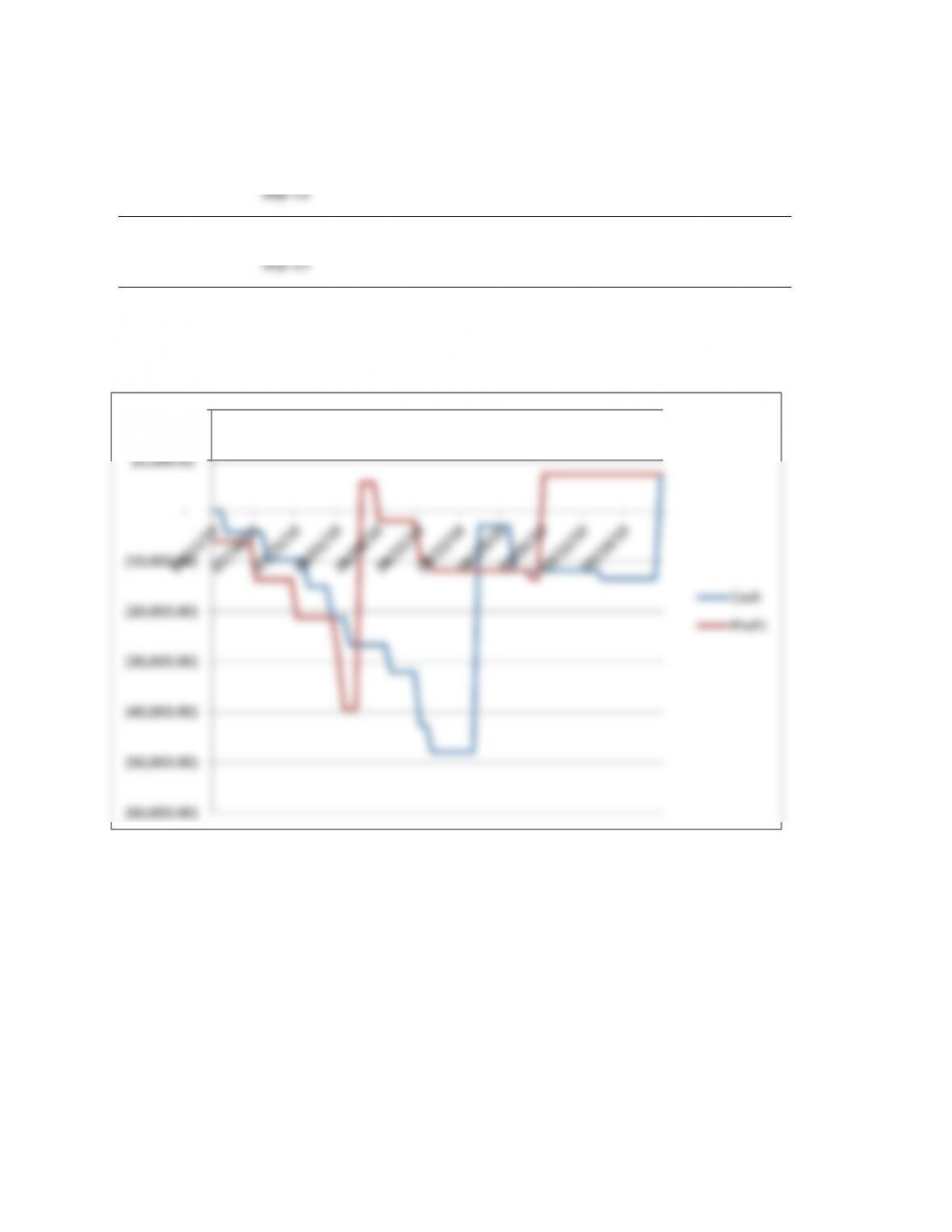
The cash and profits are as follows.
(60,000.00)
(50,000.00)
(40,000.00)
(30,000.00)
(20,000.00)
(10,000.00)
–
10,000.00
20,000.00
Cash
Profit