Chapter 18: Mathematics in Engineering
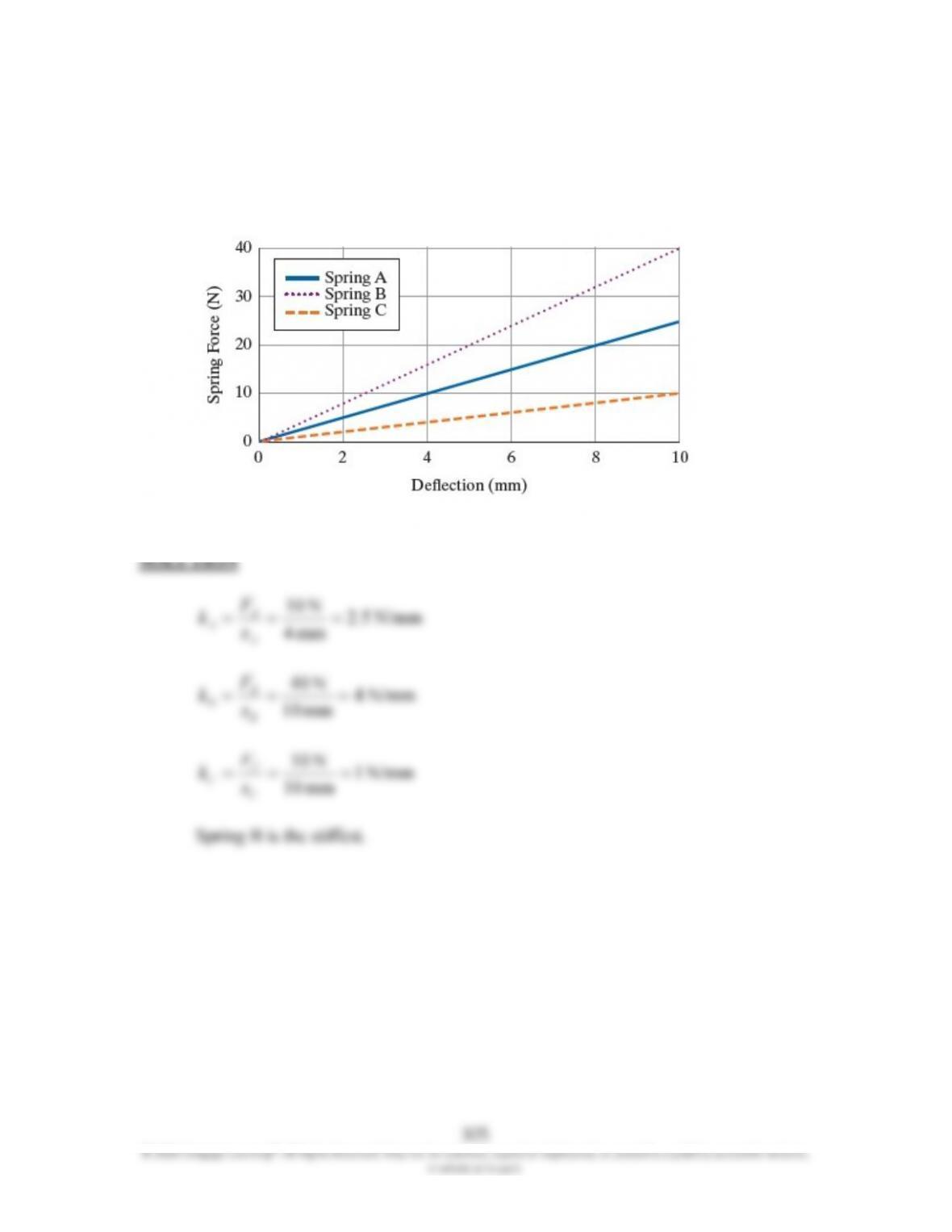
18.1 The force-deflection relationship for three springs are shown in the accompanying
figure. What is the stiffness (spring constant) of each spring? Which one of the
springs is the stiffest?
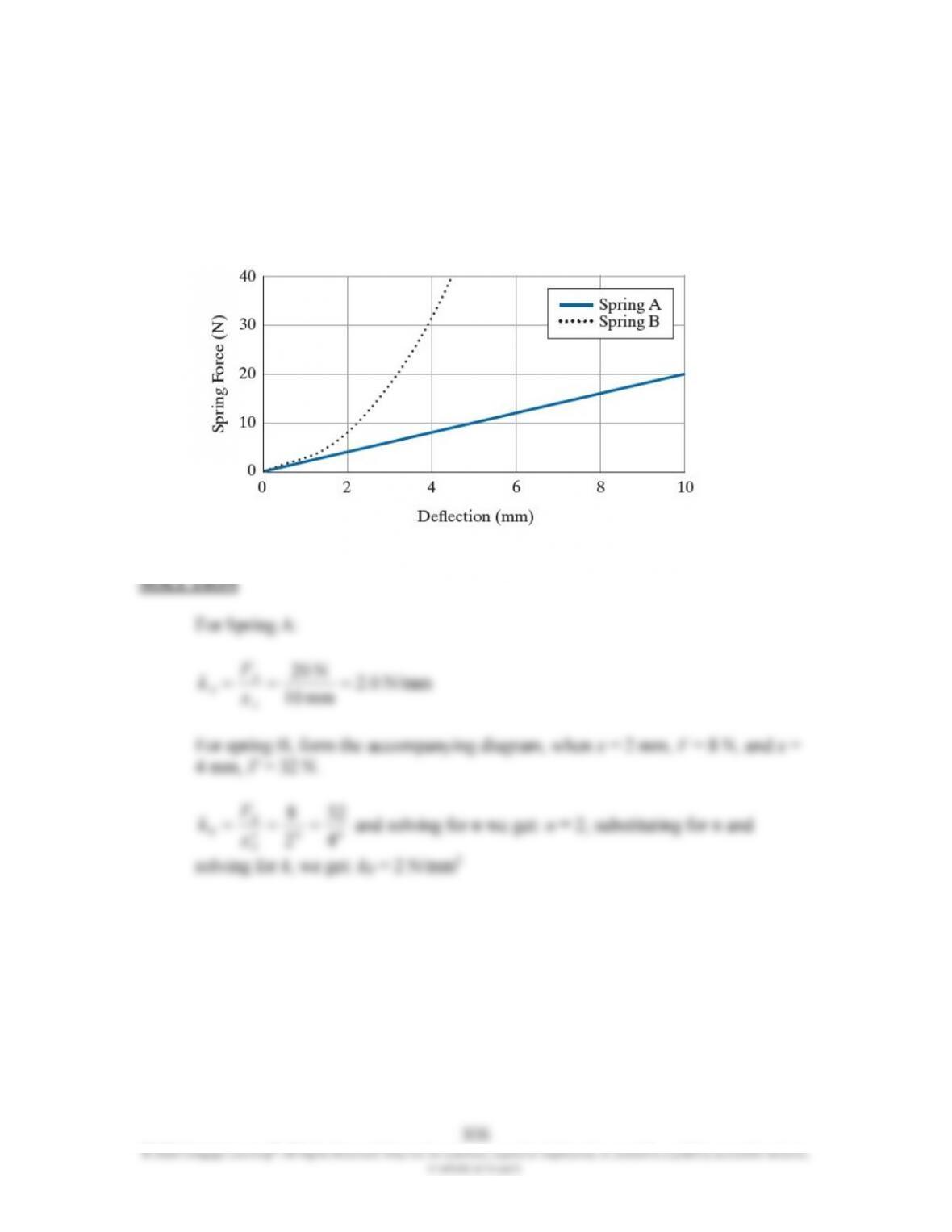
18.2 In the accompanying diagram spring A is a linear spring and spring B is a hard
spring, with characteristics that are described by the relationship n
kxF .
Determine the stiffness coefficient k for each spring. What is the exponent n for
the hard spring? In your own words, also explain the relationship between the
spring force and the deflection for the hard spring and how it differs from the
behavior of the linear spring.
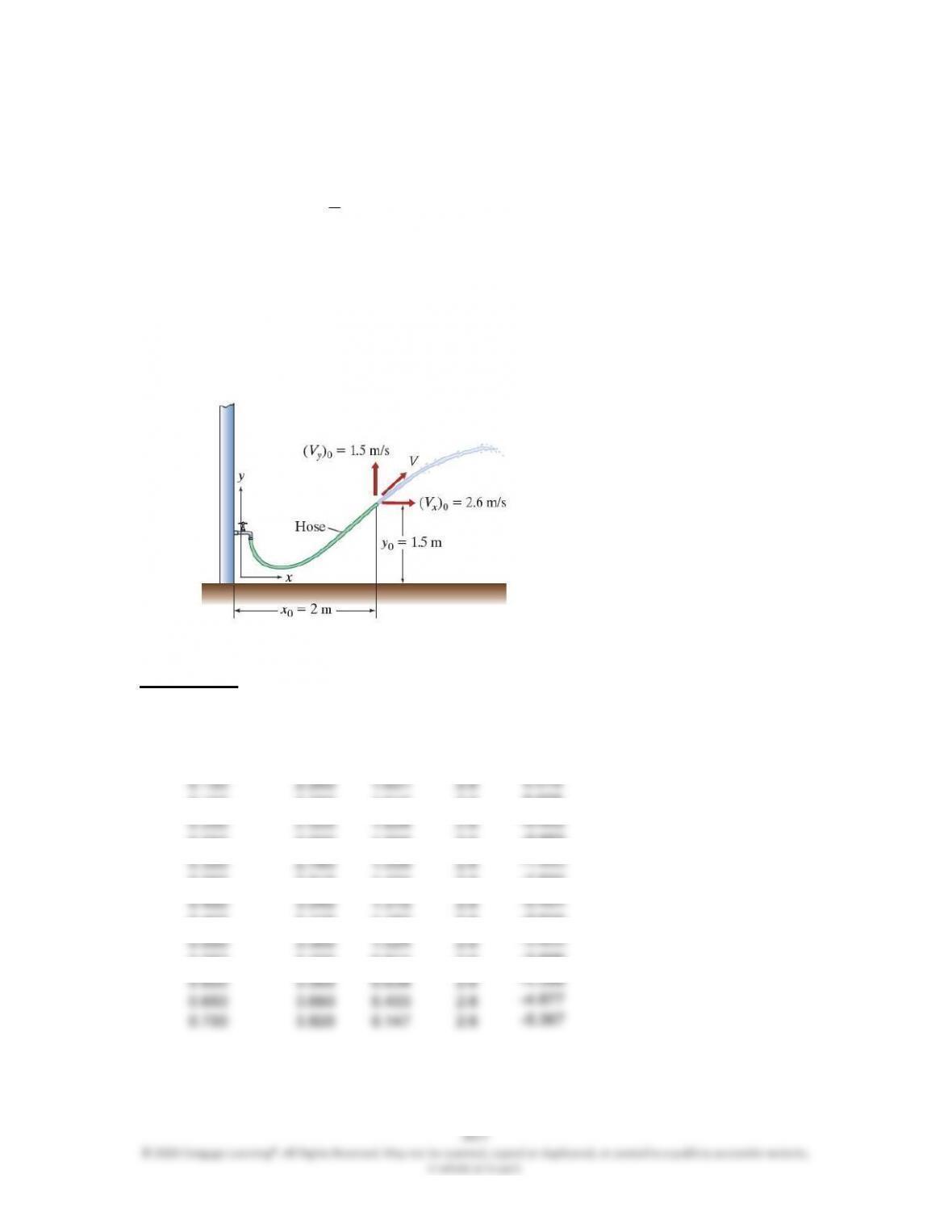
18.3 The equations describing the position of water stream (with respect to time)
coming out of the hose, shown in the accompanying figure are given by
tvxx x00 )(
2
00
2
1
)( gttvyy y
In these relationships, x and y are position coordinates, x0 and y0 are initial
coordinates of the tip of the hose, 0
)( x
v and 0
)( y
v are the initial velocities of
water coming out of the hose in the x and y directions, g = 9.81 m/s2, and t is time.
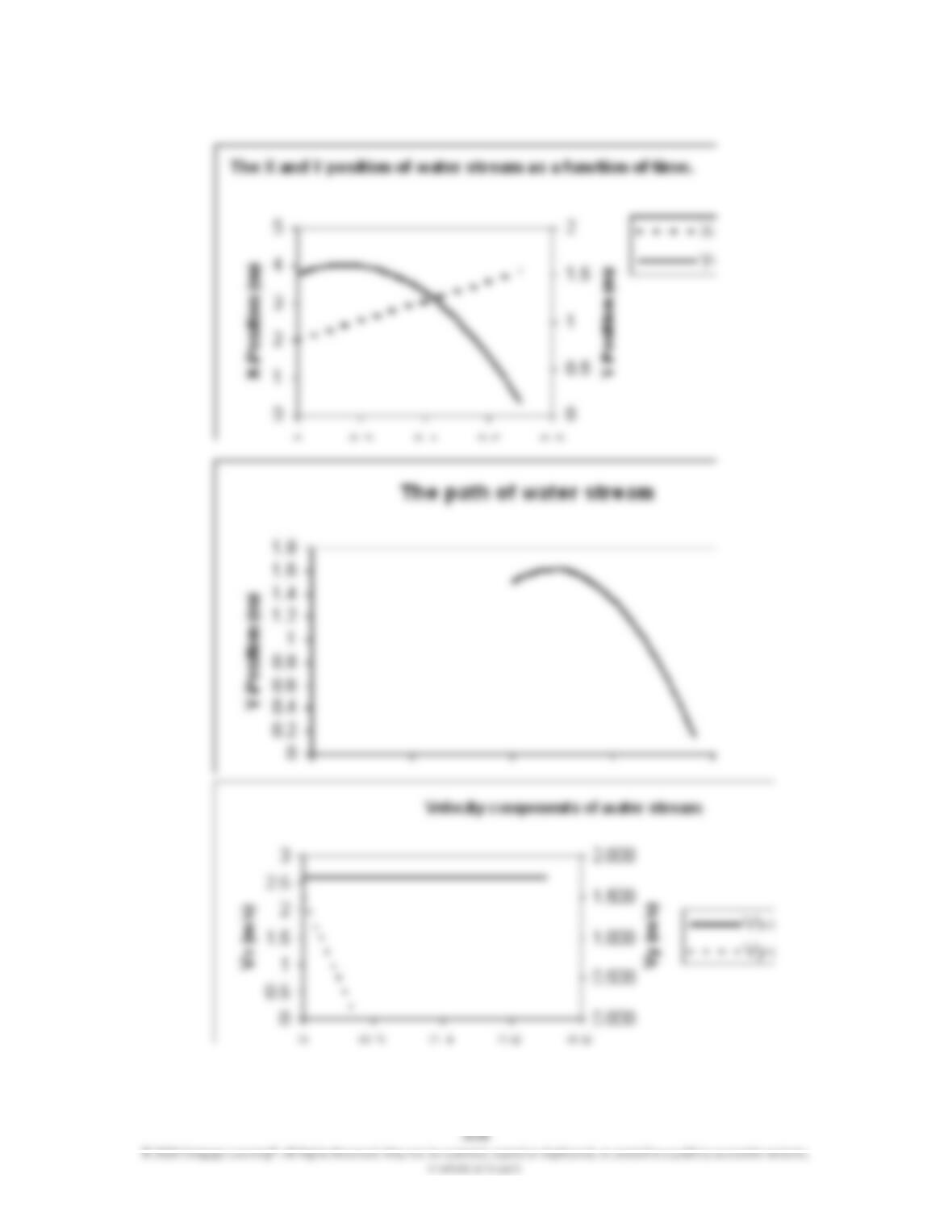
Plot the x and the y position of the water stream as a function of time. Also, plot
the path the water stream will follow as a function of time. Compute and plot the
components of velocity of the water stream as a function of time.
SOLUTION
t
(s)
x
(m)
y
(m)
Vx
(m/s)
Vy (m/s)
0 2 1.5 2.6 1.500
0.050 2.130 1.563 2.6 1.010
0.150 2.390 1.615 2.6 0.029
0.250 2.650 1.568 2.6 -0.953
0.350 2.910 1.424 2.6 -1.934
0.450 3.170 1.182 2.6 -2.915
0.550 3.430 0.841 2.6 -3.896
308
© 2020 Cengage Learning®. All Rights Reserved. May not be scanned, copied or duplicated, or posted to a publicly accessible website,
in whole or in part.
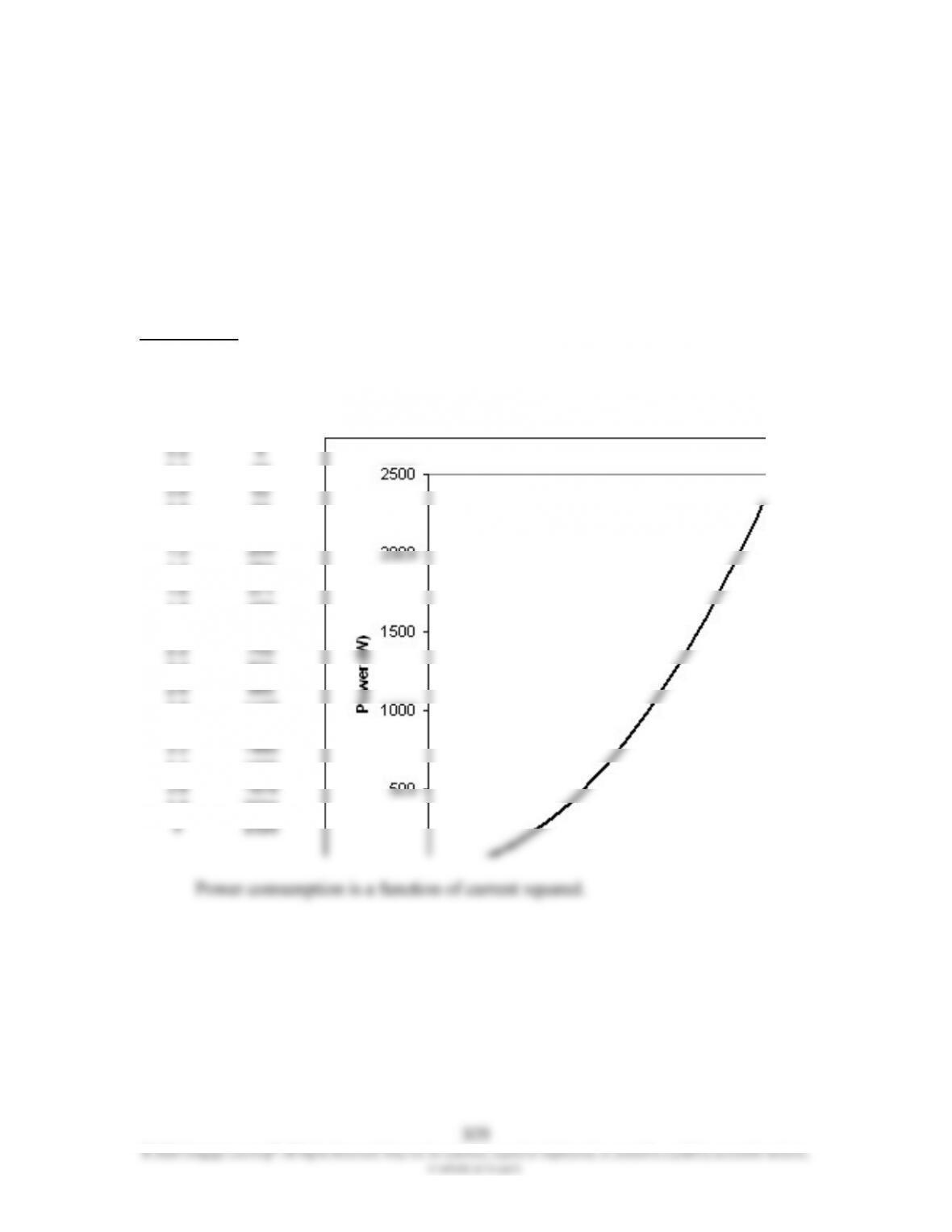
18.4 In Chapter 12, we explained that the electric power consumption of various
electrical components can be determined using the following power formula:
2
RIVIP , where P is power in Watts, V is the voltage, I is the current in
amps, and R is the resistance of the component in ohms. Plot the power
consumption of an electrical component with a resistance of 145 ohms. Vary the
value of the current from zero to 4 amps. Discuss and plot the change in power
consumption as the function of current drawn through the component.
SOLUTION
I
(amps)
P = RI2
(W)
0 0
0.4 23
0.8 93
1 145
1.4 284
1.8 470
2 580
2.4 835
2.8 1137
3 1305
3.4 1676
3.8 2094
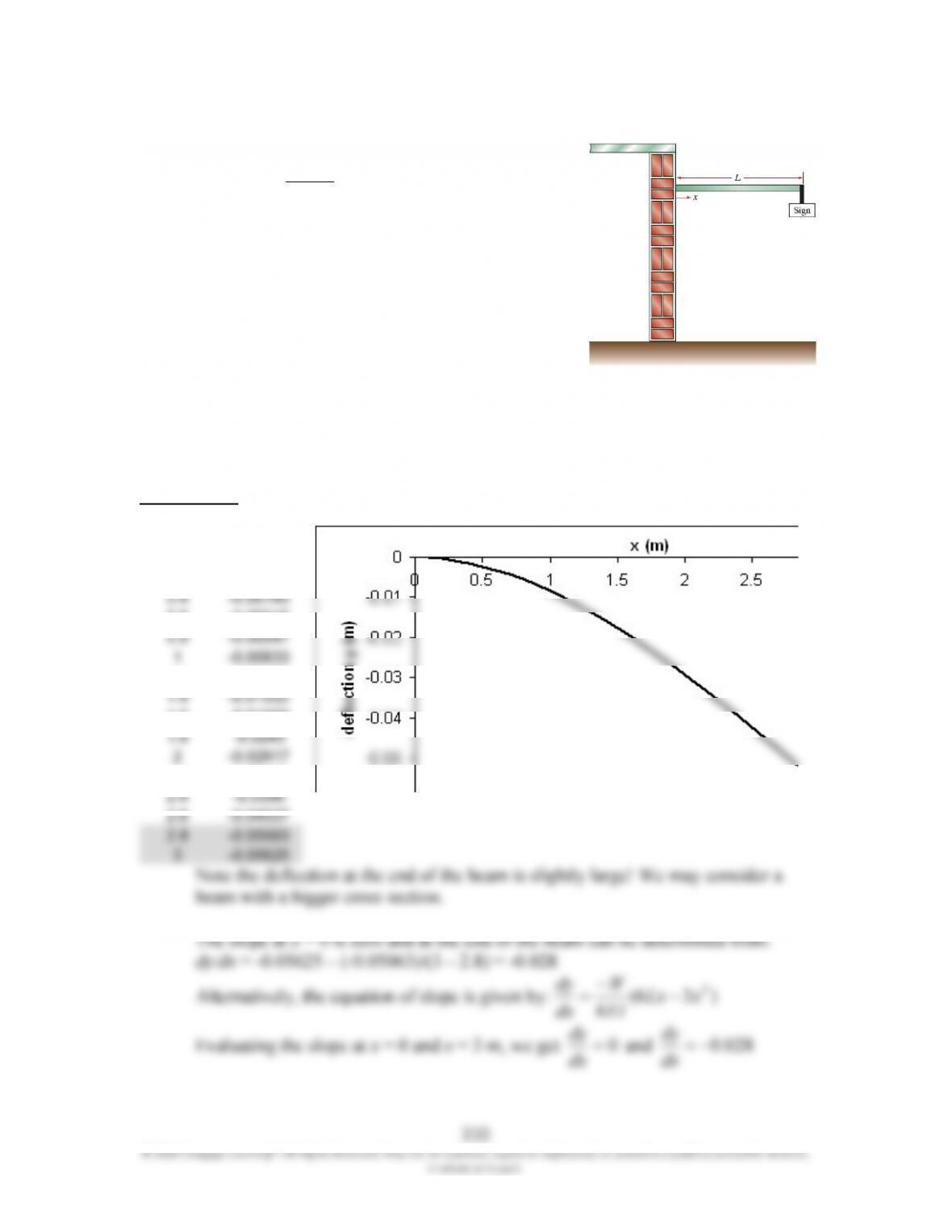
18.5 The deflection of a cantilevered beam supporting the weight of an advertising sign
is given by
)3(
6
2
xL
EI
Wx
y
where
y = deflection at a given x location, (m)
W = weight of the sign (N)
E = modulus of elasticity (N/m2)
I = second moment of area (m4)
x = distance from the support as shown (m)
L = length of the beam (m)
Plot the deflection of a beam with a length of 3 m with the modulus of elasticity
of E = 200 GPa and I = 1.2 x 106 mm4 and for a sign weighing 1500 N. What is
the slope of the deflection of the beam at the wall (x = 0) and at the end of the
beam where it supports the sign (x = L).
SOLUTION
x
(m)
y
(m)
0 0
0.2 -0.00037
0.6 -0.00315
1.2 -0.0117
1.6 -0.01973
2.2 -0.03428
EI
dx
Evaluating the slope at x = 0 and x = 3 m, we get 0
dx
dx
311
18.6 As we explained in earlier chapters, the drag force acting on a car is determined
experimentally by placing the car in a wind tunnel. The drag force acting on the
car is determined from
AVCF dd
2
2
1
where
Fd = measured drag force (N or lb)
Cd = drag coefficient (unitless)
= air density (kg/m3 or slugs/ft3)
V = air speed inside the wind tunnel (m/s or ft/s)
A = frontal area of the car (m2 or ft2)
The power requirement to overcome the air resistance is computed by VFP d
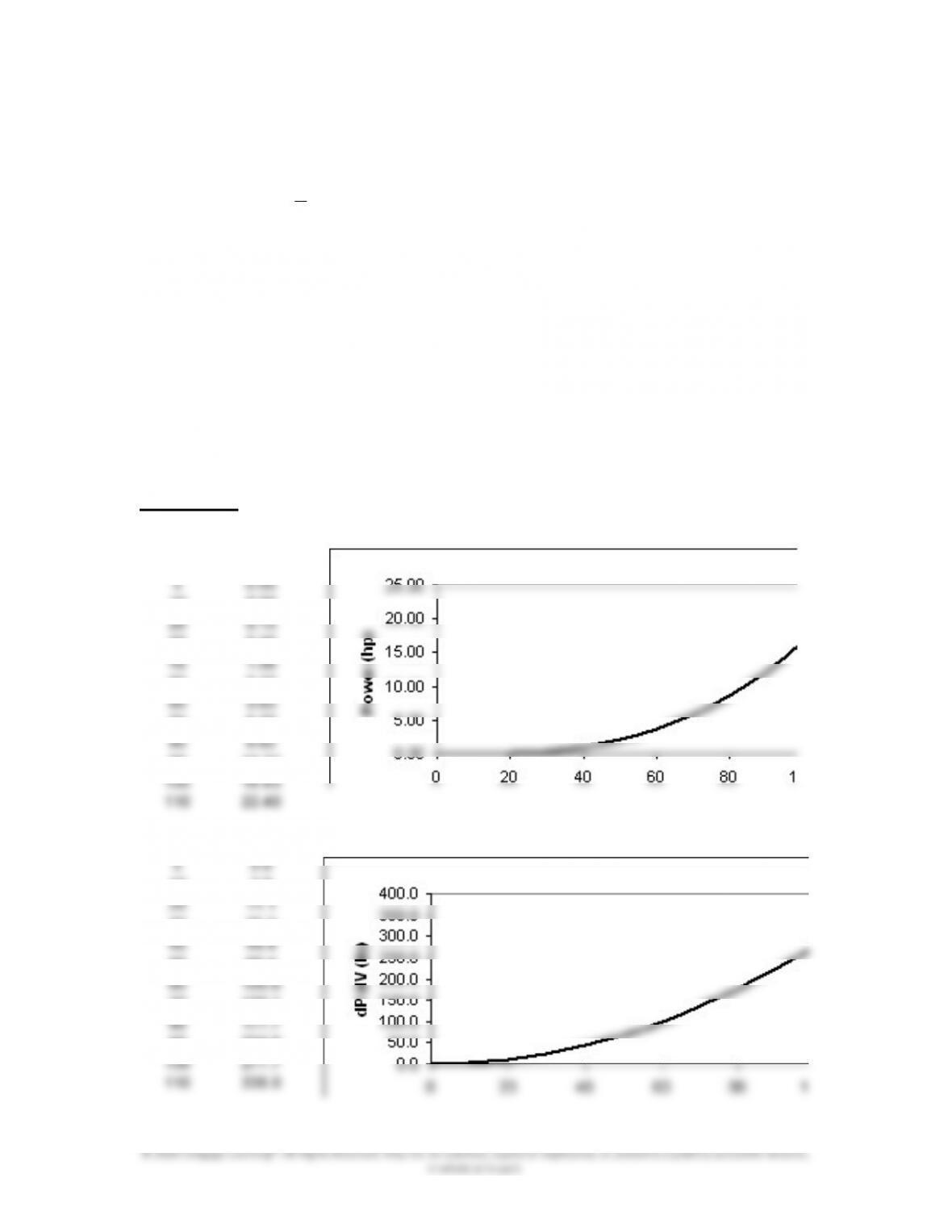
Plot the power requirement (in hp) to overcome air resistance for a car with a
frontal area of 2800 in2, a drag coefficient of 0.4, and for an air density of 0.00238
slugs/ft3. Vary the speed from zero to 110 ft/s (75 mph). Also, plot the rate of
change of power requirement as a function of speed.
SOLUTION
V
(ft/s)
Power
(hp)
10 0.02
30 0.45
50 2.10
70 5.77
90 12.27
V
(ft/s)
dP/dV = 3/2 Cd
A V2
10 2.8
30 25.0
50 69.4
70 136.1
90 224.9
312
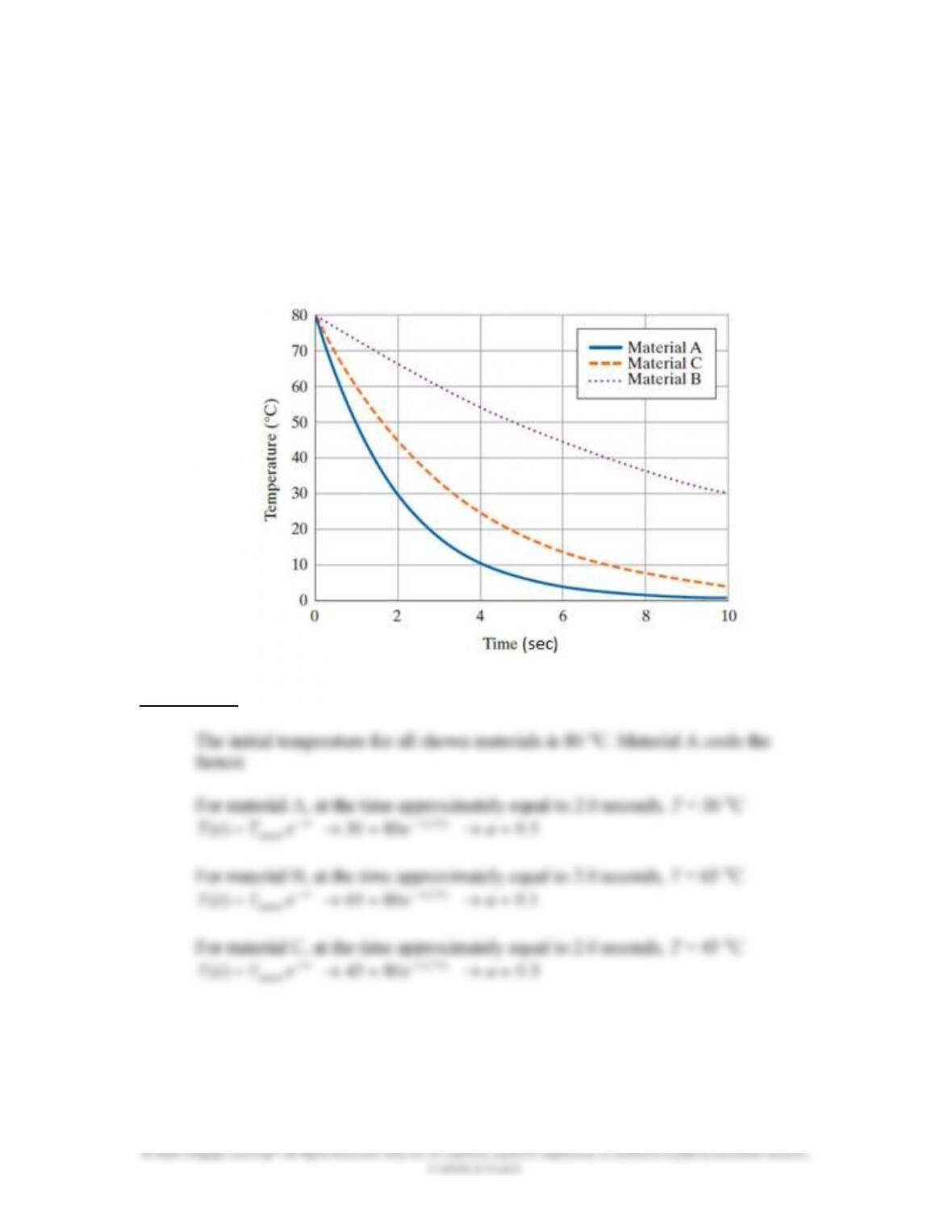
18.7 The cooling rate for three different materials is shown in the accompanying
figure. The mathematical equation describing the cooling rate for each material is
of the exponential form at
initial eTtT
)( . In this relationship, T(t) is the
temperature of material at time t and the coefficient a represents the thermal
capacity and resistance of the material. Determine the initial temperature and the
a coefficient for each material. Which material cools the fastest and what is the
corresponding a value?
SOLUTION
313
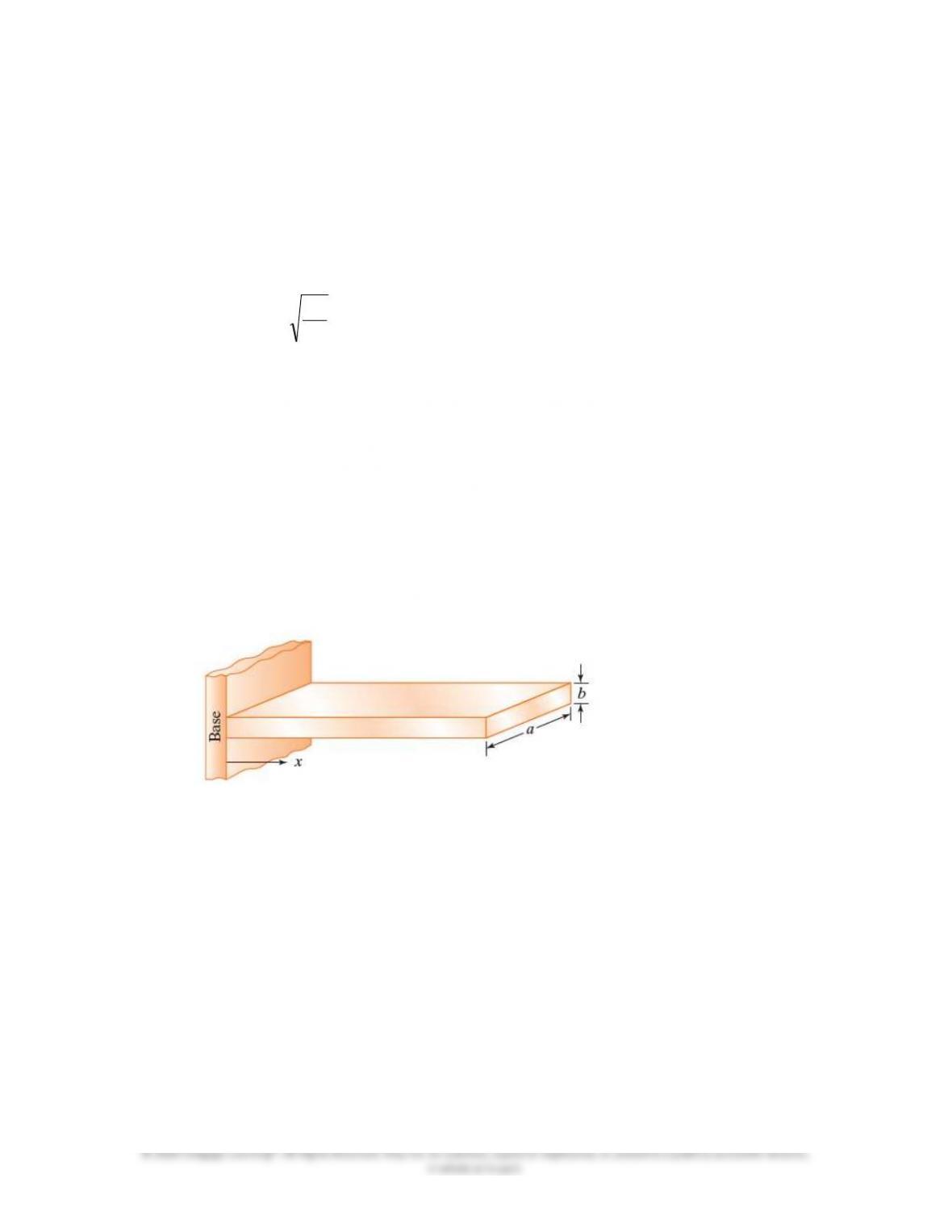
18.8 As explained in earlier chapters, fins, or extended surfaces, commonly are used in
a variety of engineering applications to enhance cooling. Common examples
include a motorcycle engine head, a lawn mower engine head, heat sinks used in
electronic equipment, and finned tube heat exchangers in room heating and
cooling applications. For long fins, the temperature distribution along the fin is
given by:
mx
ambientbaseambient eTTTT
)(
where
kA
hp
m
h = heat transfer coefficient (W/m2·K)
p = perimeter of the fin 2(a + b) (m)
A = cross-sectional area of the fin (a*b) (m2)
k = thermal conductivity of the fin material (W/m·K)
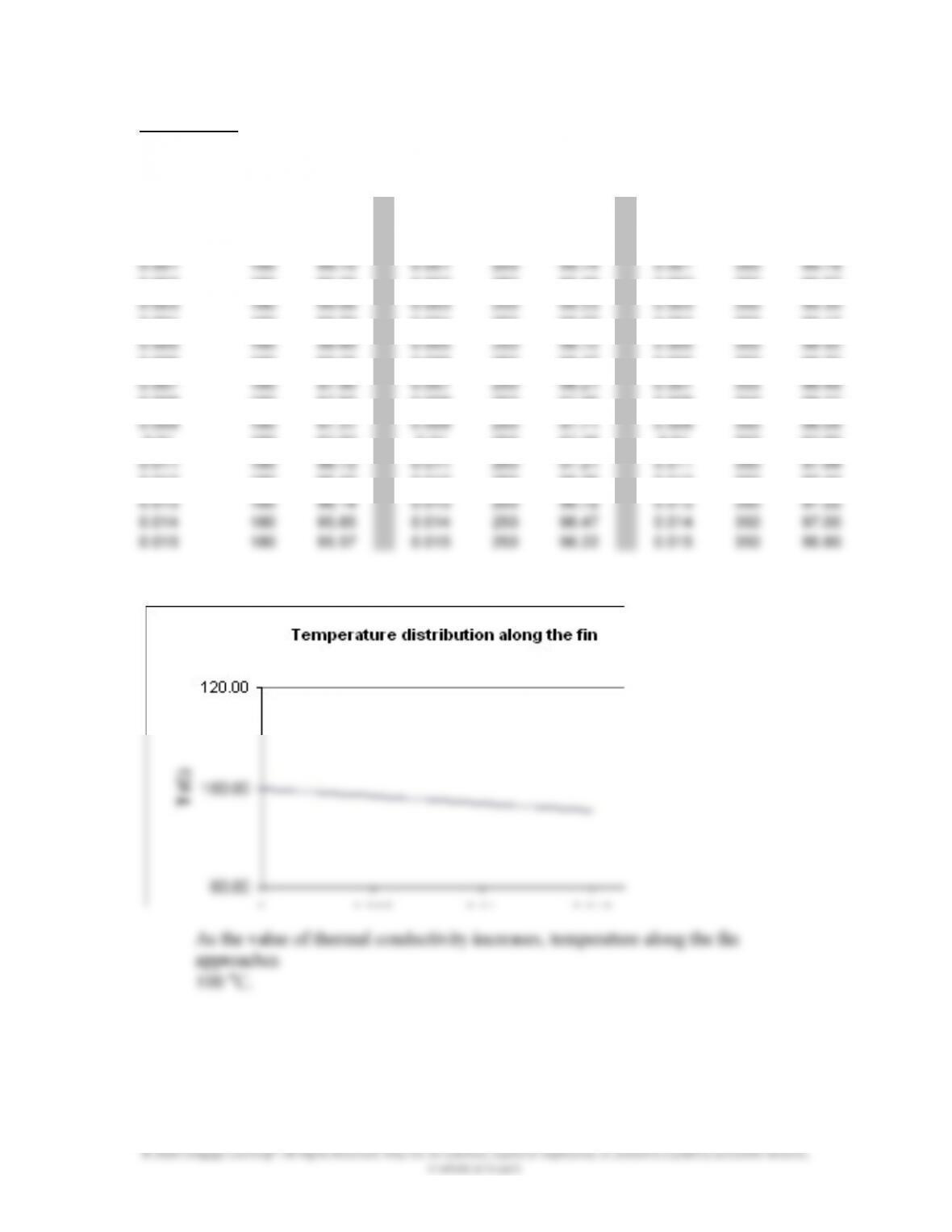
What are the dependent and independent variables? Next, consider aluminum fins
of a rectangular profile shown in the accompanying figure, which are used to
remove heat from a surface whose temperature is 100C. The temperature of the
ambient air is 20C. Plot the temperature distribution along the fin using the
following data: k = 180 W/m.K, h = 15 W/m2.K, a = 0.05 m, b = 0.015 m. Vary x
from 0 to 0.015 m. What is the temperature of the tip of the fin? Plot the
temperature of the tip as a function of k. Vary the k value from 180 to 350 W/m.K.
314
SOLUTION
T (C) is the dependent variable and x is the independent variable.
x
(m)
k
(W/m.K)
T
( C )
x
(m)
k
(W/m.K)
T
( C )
x
(m)
k
(W/m.K)
T
( C )
0 180 100.00 0 250 100.00
0 350 100.00
0.002 180 99.39 0.002 250 99.49
0.002 350 99.57
0.004 180 98.79 0.004 250 98.97
0.004 350 99.13
0.006 180 98.20 0.006 250 98.47
0.006 350 98.70
0.008 180 97.60 0.008 250 97.96
0.008 350 98.27
0.01 180 97.02 0.01 250 97.46
0.01 350 97.85
0.012 180 96.43 0.012 250 96.96
0.012 350 97.43
315
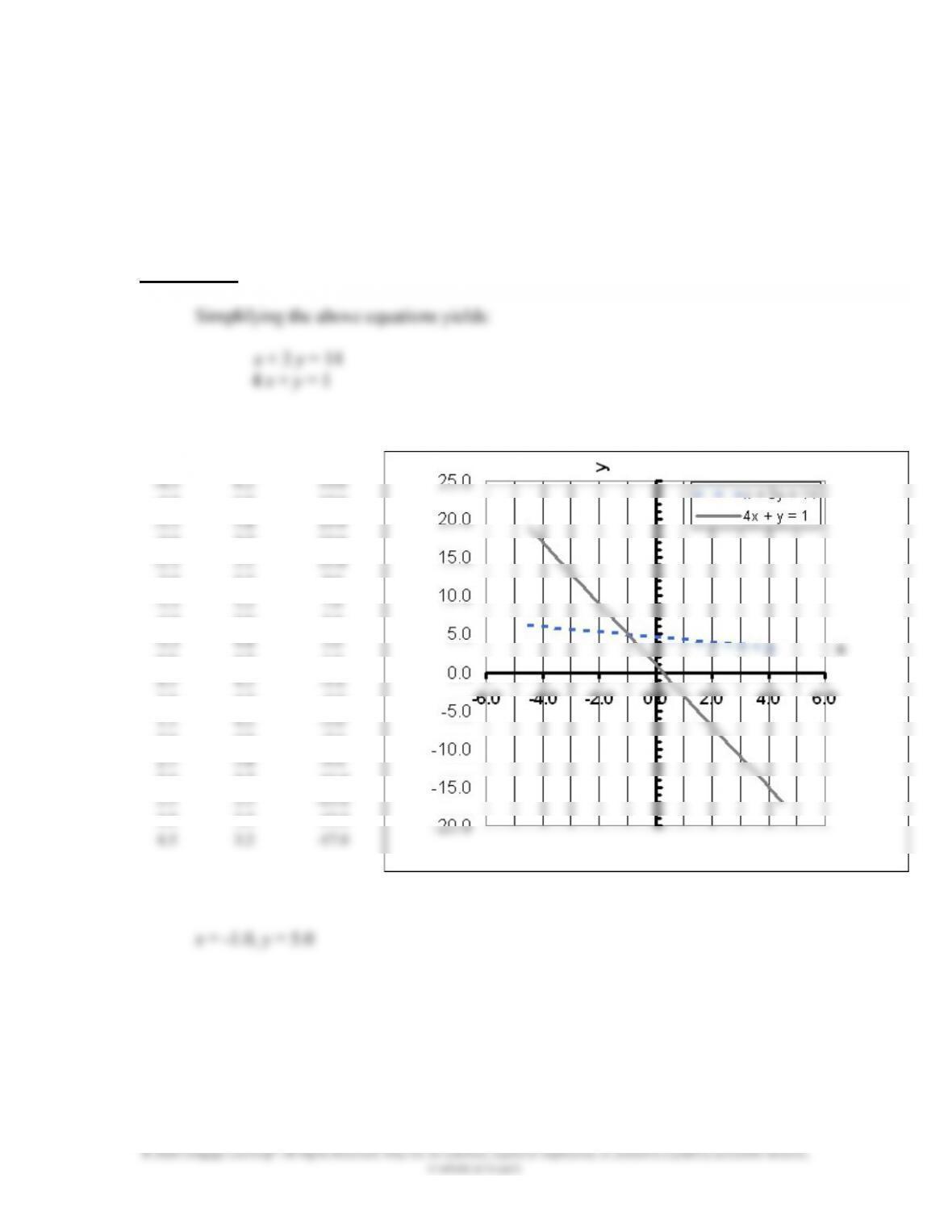
18.9 Use the graphical method discussed in this chapter to obtain the solution to the
following set of linear of equations.
2x + 6 y = 28
8 x + 2 y = 2
SOLUTION
x (14 – x)/3 1 – 4 x
–
4.5
6.2
19.0
–
4.0
6.0
17.0
–
3.5
5.8
15.0
–
3.0
5.7
13.0
–
2.5
5.5
11.0
–
2.0
5.3
9.0
–
1.5
5.2
7.0
–
1.0
5.0
5.0
–
0.5
4.8
3.0
0.0
4.7
1.0
0.5
4.5
–
1.0
1.0
4.3
–
3.0
1.5
4.2
–
5.0
2.0
4.0
–
7.0
2.5
3.8
–
9.0
3.0
3.7
–
11.0
3.5
3.5
–
13.0
4.0
3.3
–
15.0
4.5
3.2
–
17.0
316
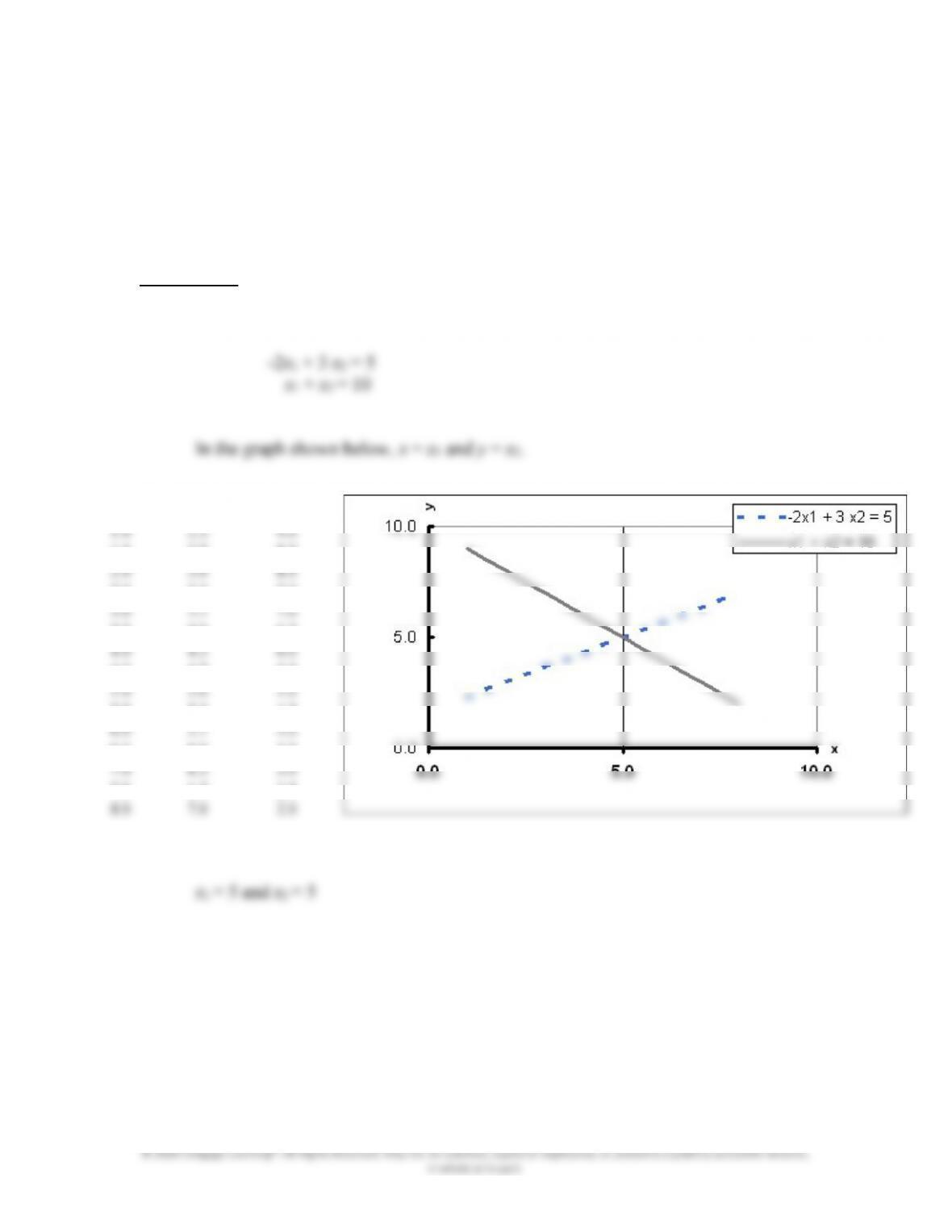
18.10 Use the graphical method discussed in this chapter to obtain the solution to the
following set of linear of equations.
-10 x1 + 15 x2 = 25
2 x1 + 2x2 = 20
SOLUTION
Simplifying the above equations yields:
X1 (5 + 2 x1)/3
10 – x1
1.0
2.3
9.0
1.5
2.7
8.5
2.0
3.0
8.0
2.5
3.3
7.5
3.0
3.7
7.0
3.5
4.0
6.5
4.0
4.3
6.0
4.5
4.7
5.5
5.0
5.0
5.0
5.5
5.3
4.5
6.0
5.7
4.0
6.5
6.0
3.5
7.0
6.3
3.0
7.5
6.7
2.5
8.0
7.0
2.0
317
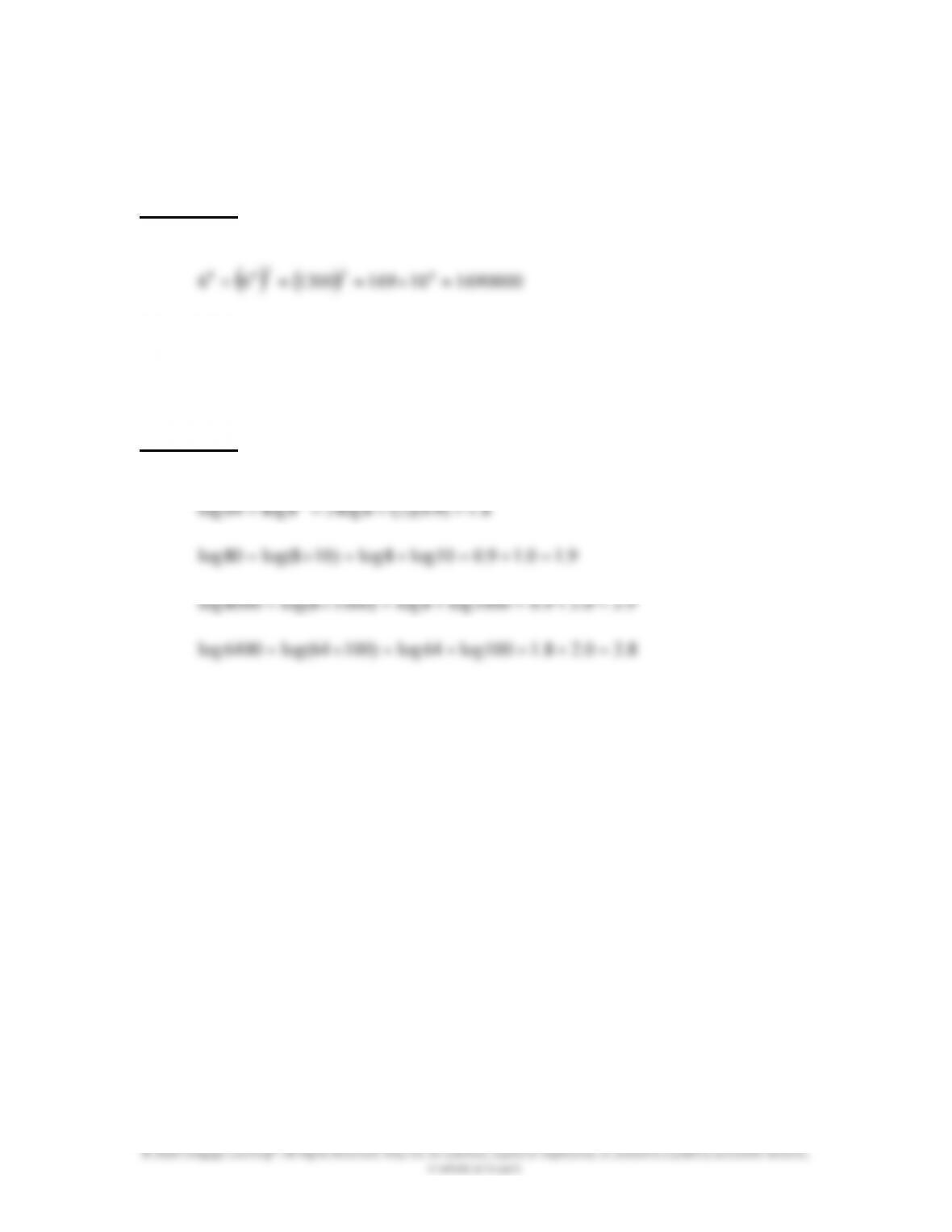
18.11 Without using your calculator, answer the following question. If 64 is
approximately equal to 1300, then what is the approximate value of 68?
SOLUTION
169000010169130066 4
2
2
48
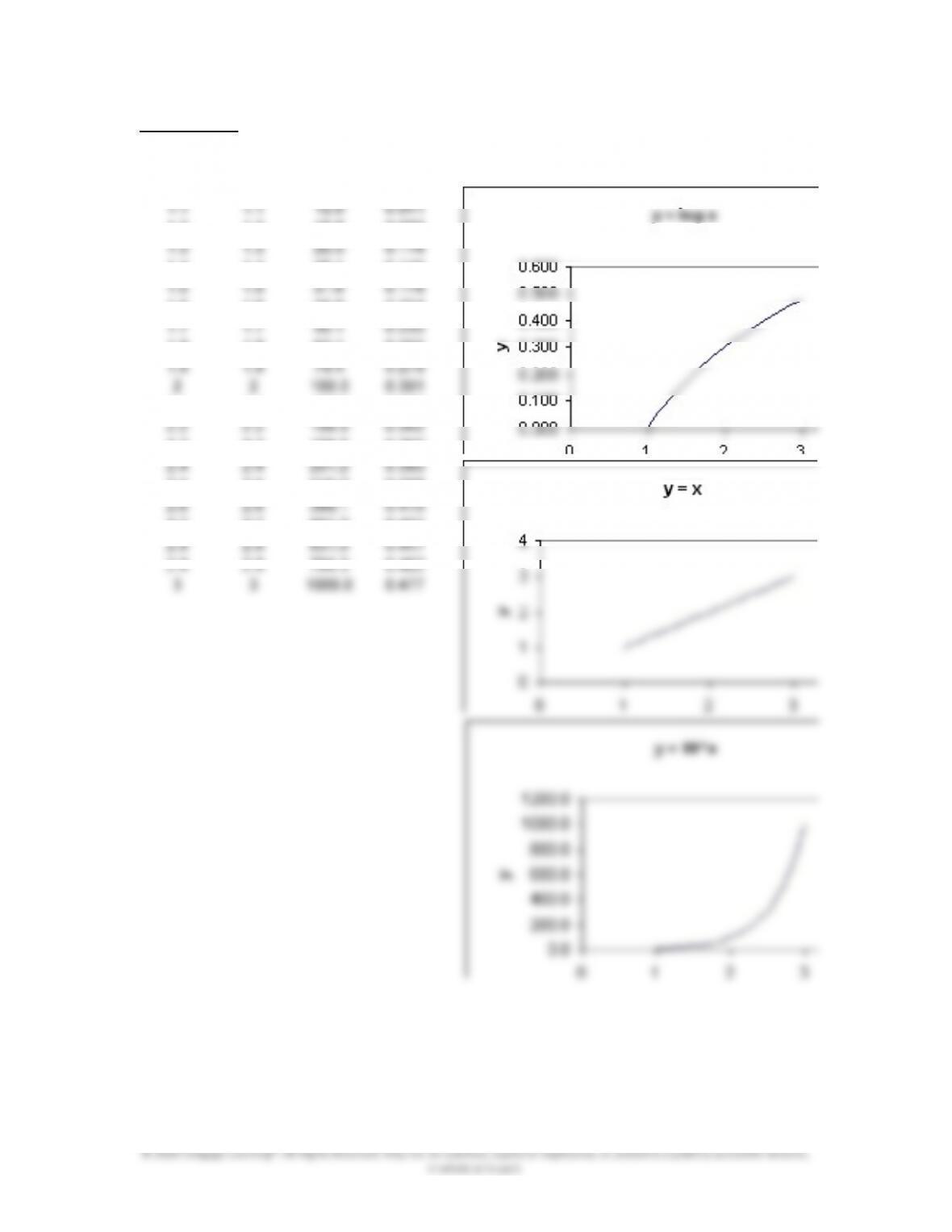
18.12 Without using your calculator, answer the following questions. If log 8 = 0.9, then
what are the values of log 64, log 80, log 8000, and log 6400?
SOLUTION
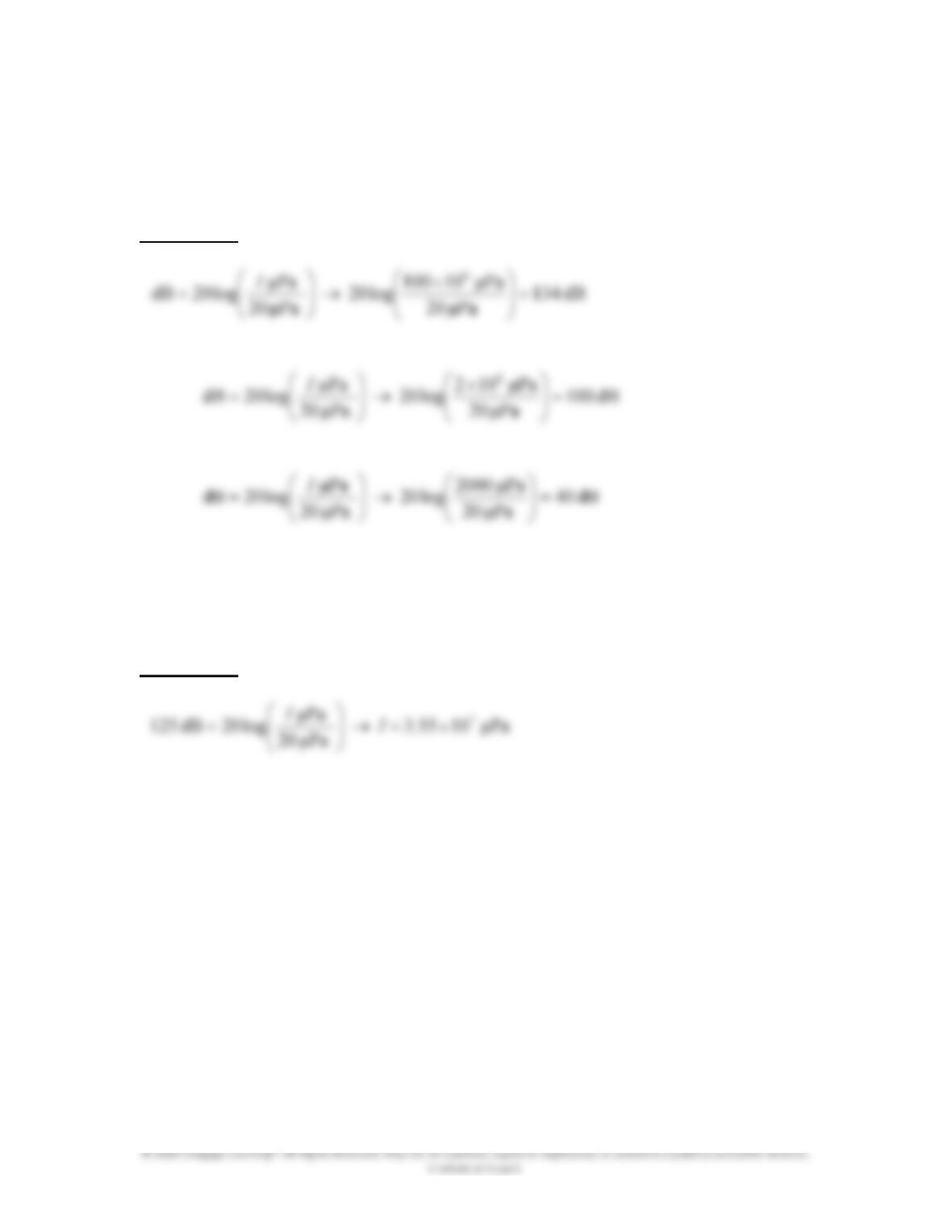
18.13 Plot the functions, y = x, y = 10x and y = log x. Vary the x value from 1 to 3. Is the
function y = log x a mirror image of y = 10x with respect to y = x, and if so why?
Explain.
318
SOLUTION
x
y = x
y = 10
x
log x
1 1 10.0 0.000
1.2 1.2 15.8 0.079
1.4 1.4 25.1 0.146
1.6 1.6 39.8 0.204
1.8 1.8 63.1 0.255
2.1 2.1 125.9 0.322
2.3 2.3 199.5 0.362
2.5 2.5 316.2 0.398
2.7 2.7 501.2 0.431
319
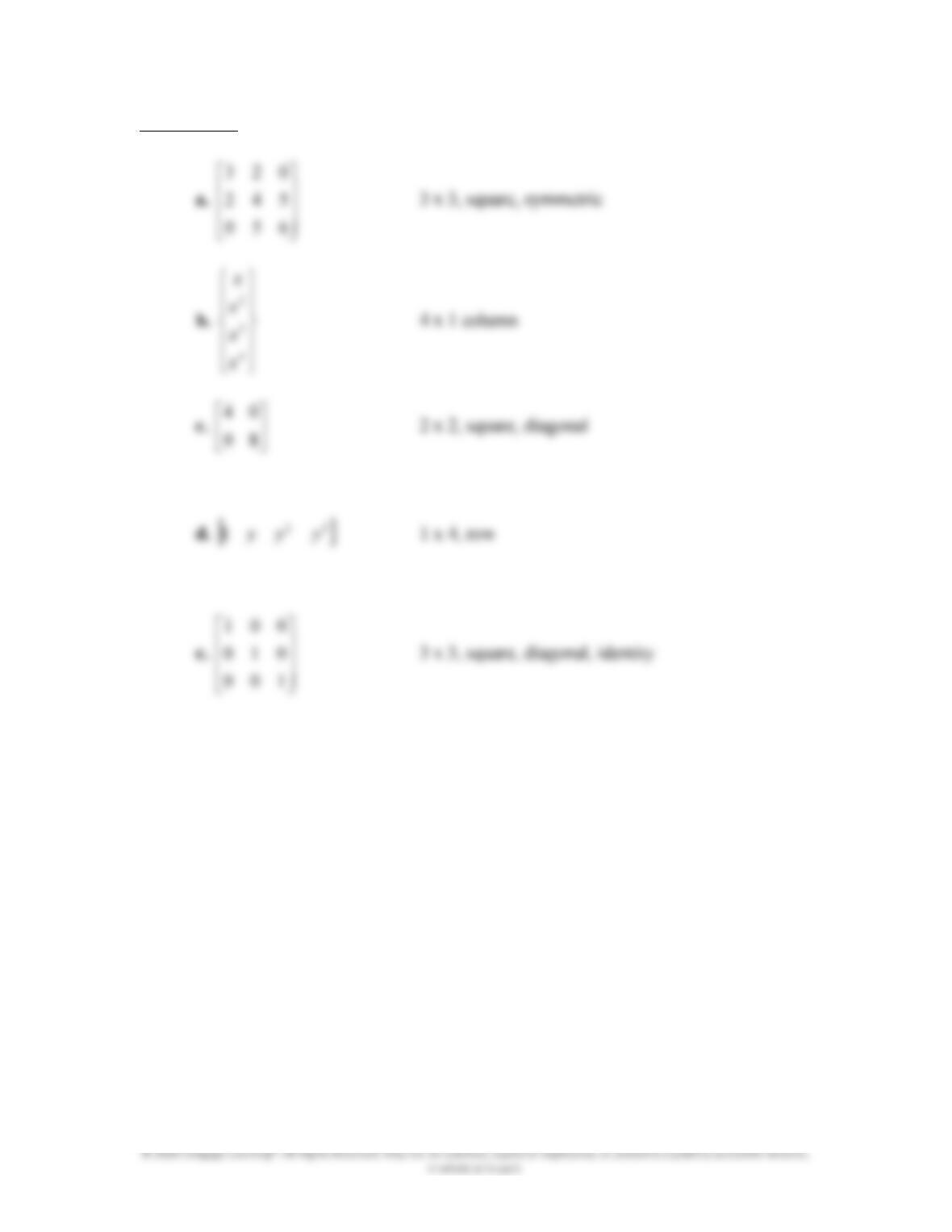
18.14 Using a sound meter the following measurements were made for the following
sources: rock band at a concert (100 x 106 Pa), a jackhammer (2 x 10⁶ Pa), and
a whisper (2000 Pa). Convert these readings to dB values.
SOLUTION
18.15 A jet plane taking off creates a noise with a magnitude of approximately 125 dB.
What is the magnitude of the pressure disturbance (in Pa)?
SOLUTION
μPa10 3.55
μPa 20
log20dB 125 7
I
18.16 Identify the size and the type of the given matrices. Denote whether the matrix is
a square, a column, a diagonal, a row, or a unit (identity).
a.
650
542
023
b.
4
3
2
x
x
x
x
c.
80
04 d.
32
1yyy
e.
100
010
001
320
SOLUTION
100
18.17 Given matrices:
351
707
124
A,
754
335
121
B, and
4
2
1
C,
perform the following operations.
a.
?
BA
b.
?
BA
c.
?3
A
d.
?
BA
e.
?
CA
f.
?
2A
g. Show that
AIAAI
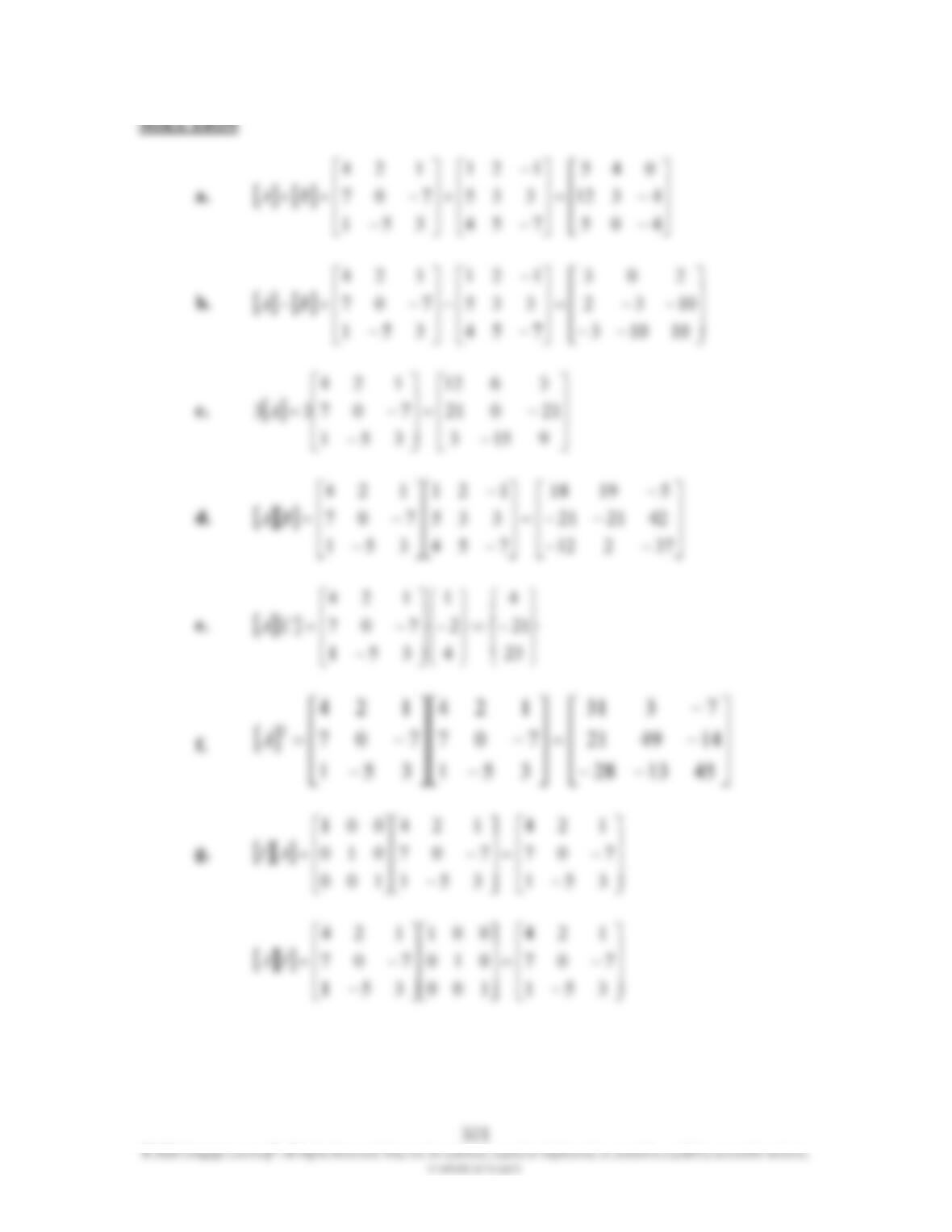
321
© 2020 Cengage Learning®. All Rights Reserved. May not be scanned, copied or duplicated, or posted to a publicly accessible website,
in whole or in part.
SOLUTION
a.
405
4312
045
754
335
121
351
707
124
BA
b.
10103
1032
203
754
335
121
351
707
124
BA
c.
9153
21021
3612
351
707
124
33 A
d.
37212
422121
51918
754
335
121
351
707
124
BA
e.
23
21
4
4
2
1
351
707
124
CA
f.
451328
144921
7331
351
707
124
351
707
124
2
A
g.
351
707
124
351
707
124
100
010
001
AI
351
707
124
100
010
001
351
707
124
IA