The company should purchase the dump truck because its rate of return is greater than the MARR of
18%.
30. The annual profit from the loader equals:
Annual Profit = (Hourly Revenue – Hourly Costs)(Billable Hours)
Annual Profit = ($98.00/hr – $30.00/hr – $38.00/hr)(1,100 hr) = $33,000
31. The mutually exclusive alternatives are as follows:
Alt.
Investments
Acceptable
Notes
Rate (%)
1
None
Yes
5.0
2
A
Yes
12.0
3
B
Yes
17.8
4
C
Yes
12.2
5
A & B
No
Insufficient Funds
NA
6
B & C
No
Insufficient Funds
NA
7
A & C
Yes
19.2
8
A, B, & C
No
Insufficient Funds
NA
investment and the bank account at the end of the year is determined by Eq. (15-1) as follows:
F = $80,000(1 + 0.21)1 + $20,000(1 + 0.05)1 = $117,800
Using Eq. (15-1) we get the following:
32. The mutually exclusive alternatives are as follows:
Alt.
Investments
Acceptable
Notes
Rate (%)
1
None
Yes
4.50
2
A
Yes
9.38
3
B
Yes
8.53
4
C
Yes
7.88
5
A & B
Yes
13.40
6
B & C
Yes
12.48
7
A & C
Yes
12.75
8
A, B, & C
No
Insufficient Funds
NA
investment and the bank account at the end of the year is determined by Eq. (15-1) as follows:
F = $70,000(1 + 0.16)1 + $130,000(1 + 0.045)1 = $217,050
Using Eq. (15-1) to set the cash investment equivalent to the value of the investment at the end of year
1 we get the following:
$217,050 = $200,000(1 + i)1
I = $130,000(1 + 0.12)1 + $70,000(1 + 0.16)1 = $226,800
Using Eq. (15-1) to set the cash investment equivalent to the value of the investment at the end of year
1 we get the following:
$226,800 = $200,000(1 + i)1
Solving for i we find that i equals 13.40%.
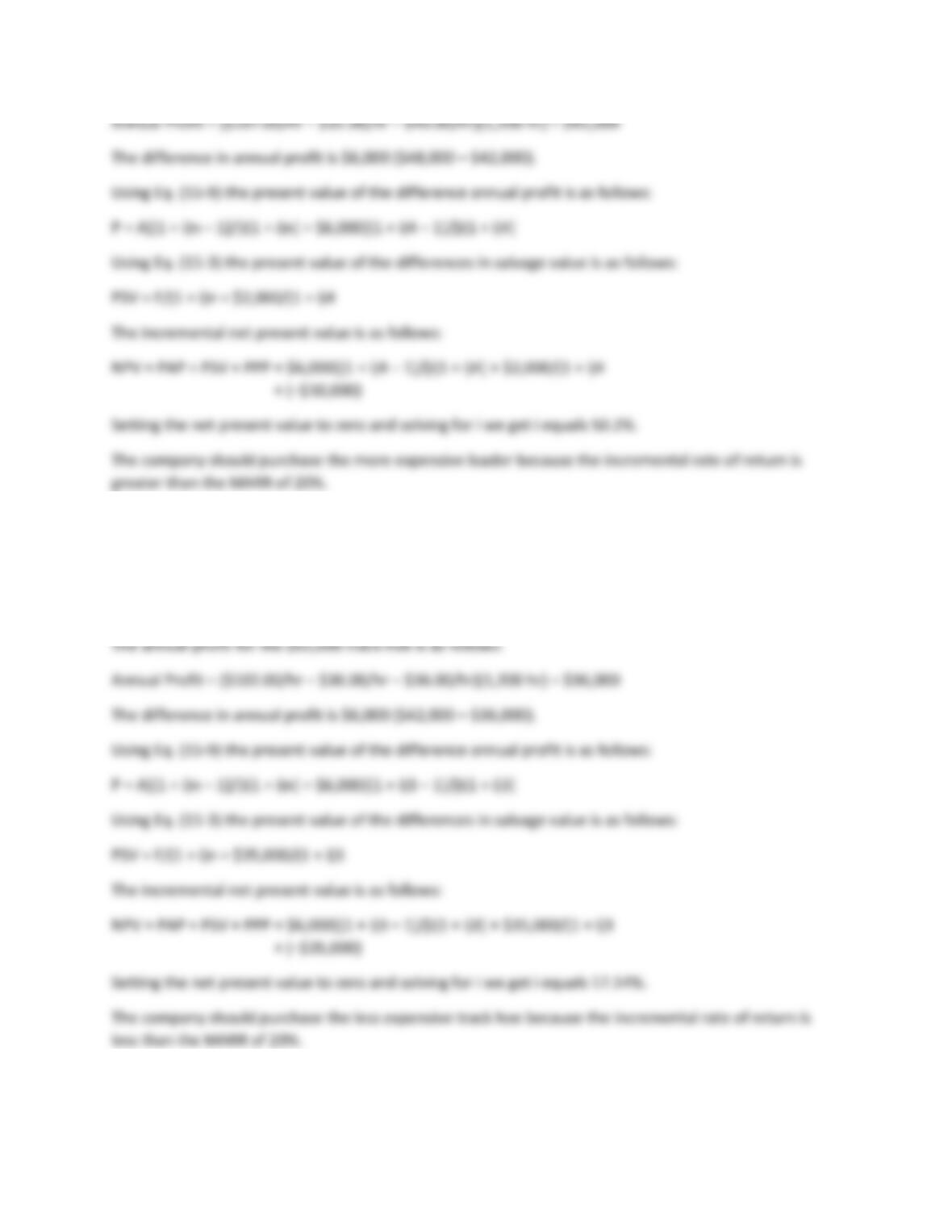
33. The difference in purchase price is $10,000 ($110,000 – $100,000). The difference in salvage
value is 20% of the difference in the purchase price or $2,000
($10,000 × 0.20). The annual profit for the $110,000 track hoe is as follows:
Annual Profit = (Hourly Revenue – Hourly Costs)(Billable Hours)
34. The difference in purchase price is $35,000 ($100,000 – $65,000). The difference in salvage
value is $35,000 ($35,000 – $0). The annual profit for the $100,000 track hoe is as follows:
Annual Profit = (Hourly Revenue – Hourly Costs)(Billable Hours)
Annual Profit = ($102.00/hr – $31.00/hr – $36.00/hr)(1,200 hr) = $42,000
35. Convert the purchase price to a uniform series of annual cash flows by Eq. (15-11) as follows:
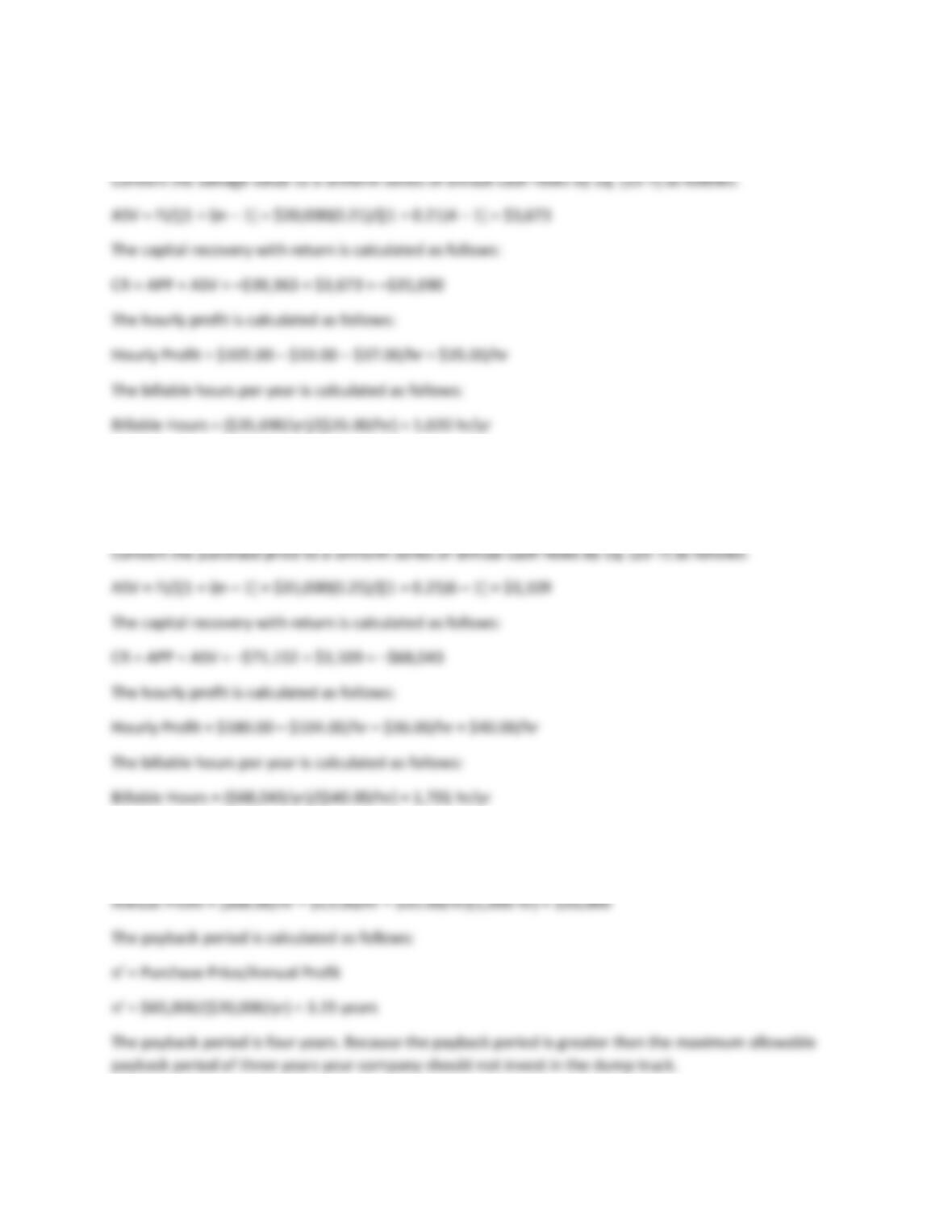
APP = P[i(1 + i)n]/[(1 + i)n – 1] = –$100,000[0.21(1 + 0.21)4]/[(1 + 0.21)4 – 1]
= –$39,363
36. Convert the salvage value to a uniform series of annual cash flows by Eq. (15-11) as follows:
APP = P[i(1 + i)n]/[(1 + i)n – 1] = –$210,000[0.25(1 + 0.25)6]/[(1 + 0.25)6 – 1]
= –$71,152
37. The annual profit from the dump truck equals:
Annual Profit = (Hourly Revenue – Hourly Costs)(Billable Hours)
38. The annual profit from the loader equals:
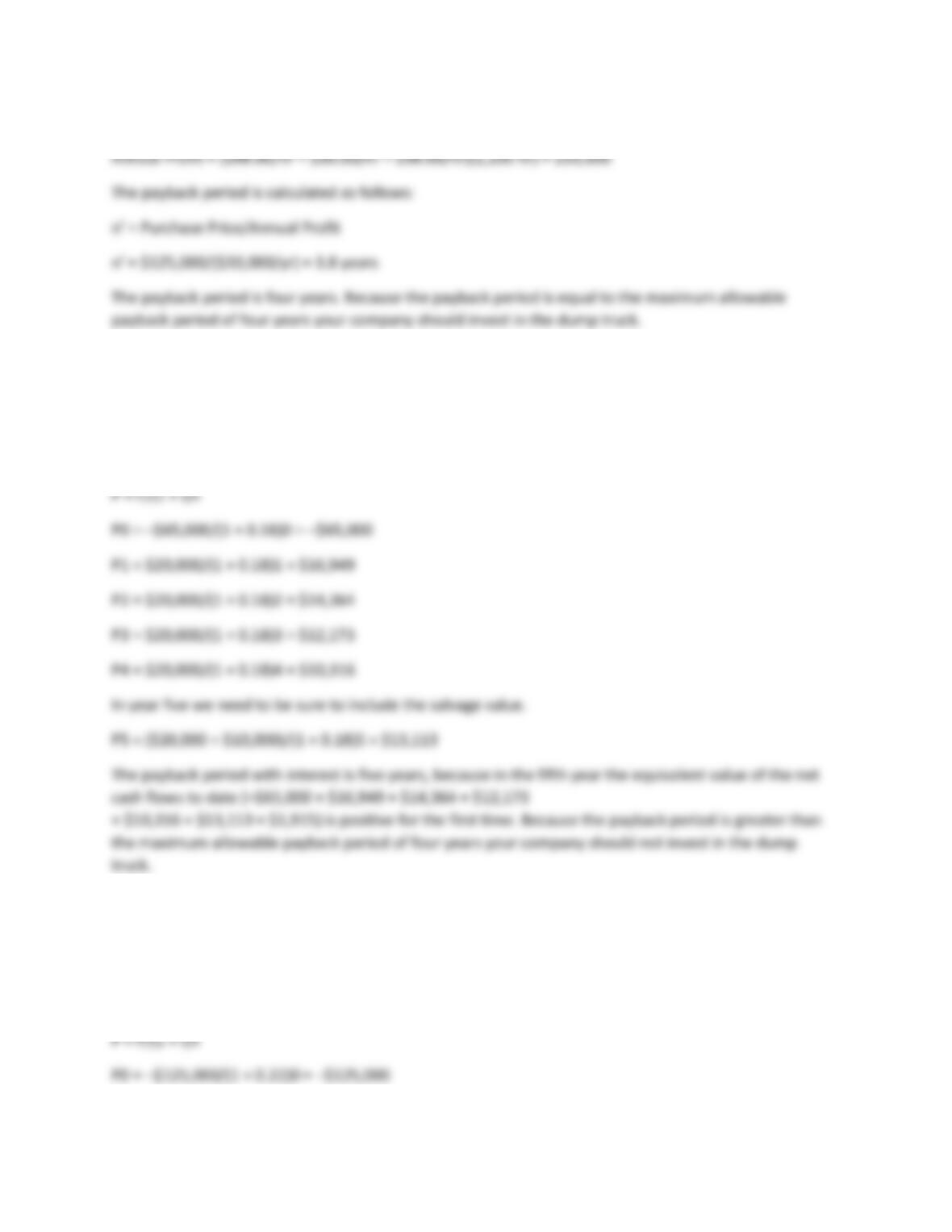
Annual Profit = (Hourly Revenue – Hourly Costs)(Billable Hours)
39. The annual profit from the dump truck equals:
Annual Profit = (Hourly Revenue – Hourly Costs)(Billable Hours)
Annual Profit = ($68.00/hr – $13.00/hr – $35.00/hr)(1,000 hr) = $20,000
Convert the annual cash flows to their present values using Eq. (15-3) as follows:
40. The annual profit from the loader equals:
Annual Profit = (Hourly Revenue – Hourly Costs)(Billable Hours)
Annual Profit = ($98.00/hr – $30.00/hr – $38.00/hr)(1,100 hr) = $33,000
Convert the annual cash flows to their present values using Eq. (15-3) as follows:
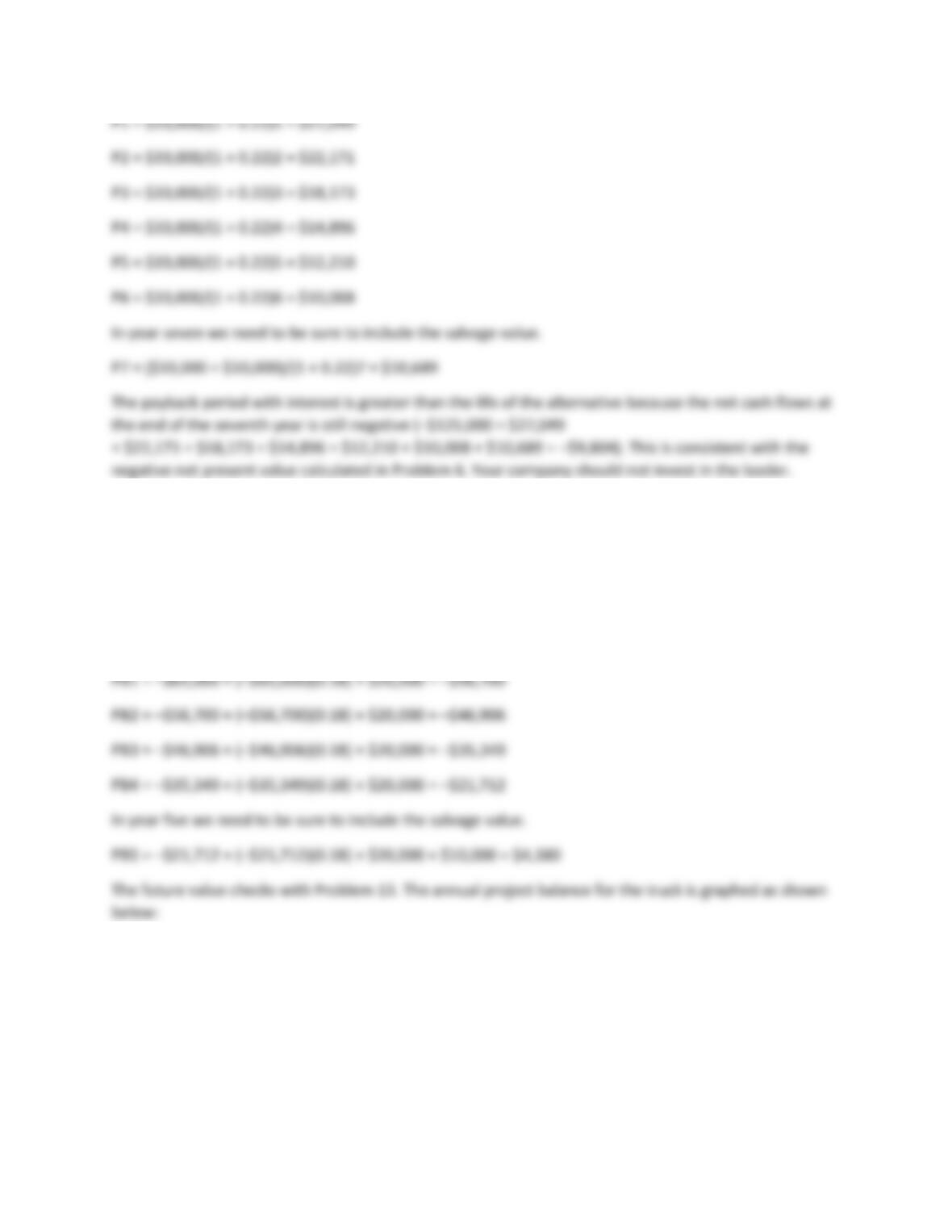
41. The annual profit from the dump truck equals:
Annual Profit = (Hourly Revenue – Hourly Costs)(Billable Hours)
Annual Profit = ($68.00/hr – $13.00/hr – $35.00/hr)(1,000 hr) = $20,000
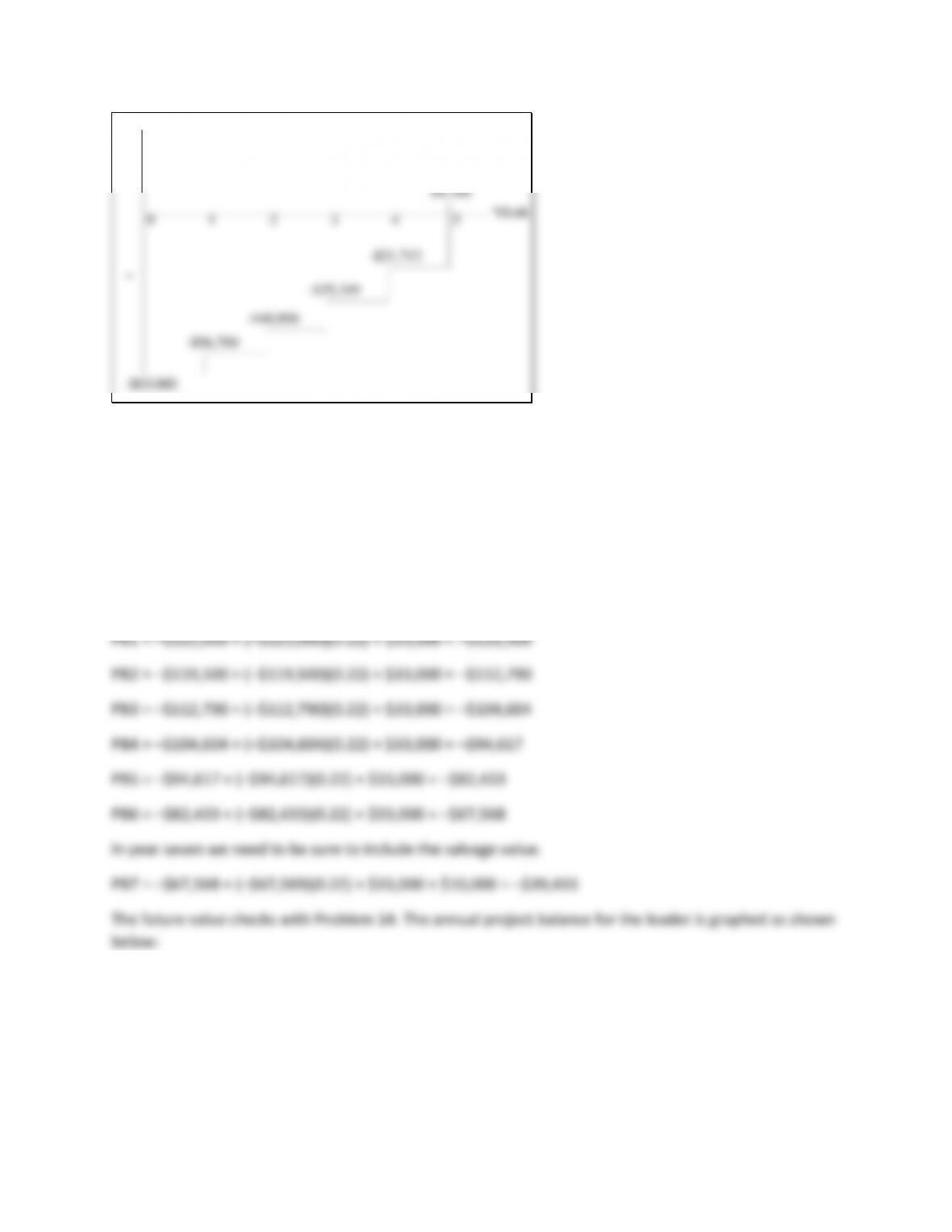
The project balances for each year are as follows:
PB0 = –65,000
0 1 2 3 4 5 YEAR
-$65,000
+
–
-$56,700
-$46,906
-$35,349
-$21,712
$4,380
42. The annual profit from the loader equals:
Annual Profit = (Hourly Revenue – Hourly Costs)(Billable Hours)
Annual Profit = ($98.00/hr – $30.00/hr – $38.00/hr)(1,100 hr) = $33,000
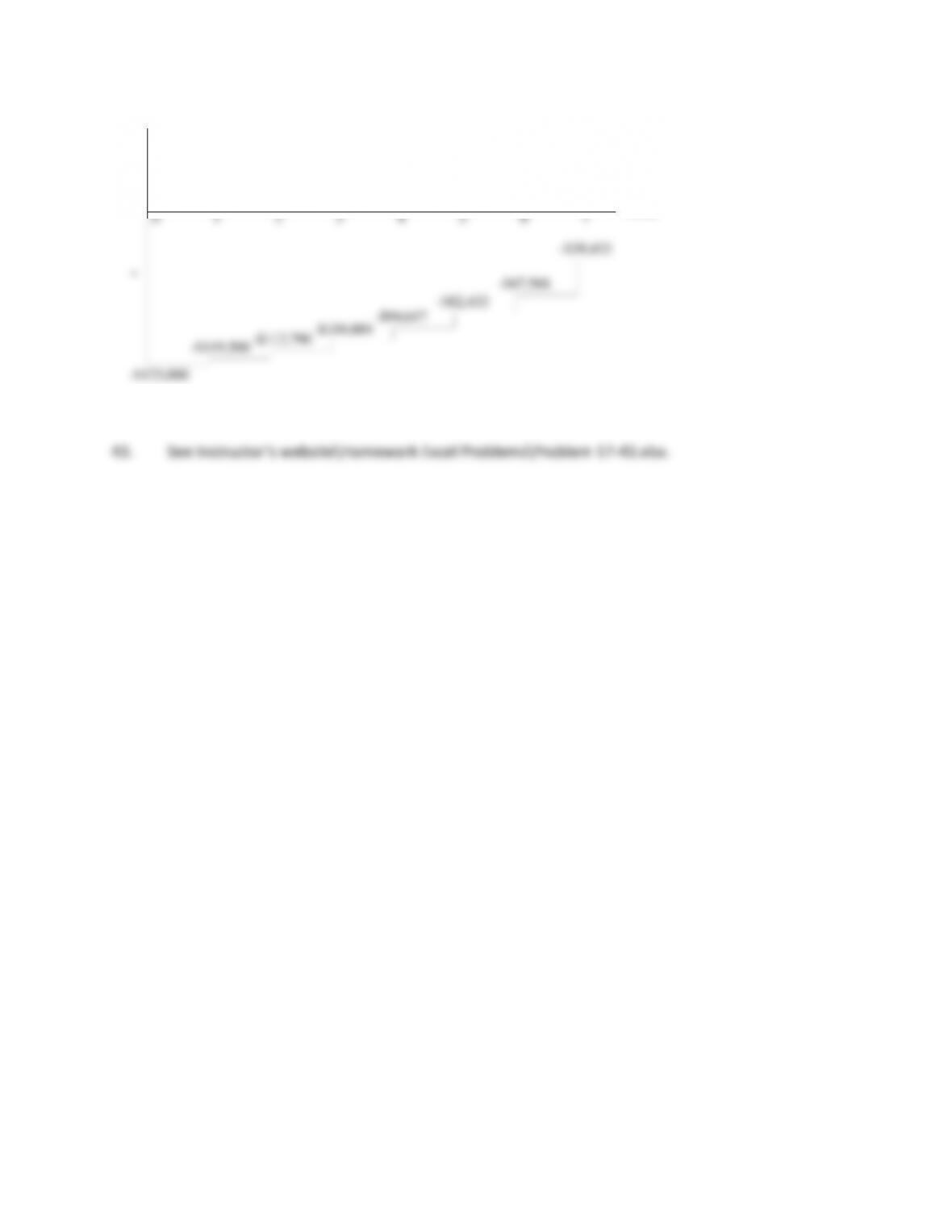
The project balances for each year are as follows:
PB0 = –125,000
0 1 2 3 4 5 YEAR
-$125,000
+
–
-$119,500
6 7
-$112,790 -$104,604 -$94,617
-$82,433
-$67,568
-$39,433