
Chapter 17: Making Financial Decisions
Learning Objectives
• At the completion of this chapter the student should be able to:
• Explain how to determine the minimum attractive rate of return.
Instructional Hints
• Help the students understand that the results of these methods are only as good as the
assumption they make regarding the costs, revenues, and salvage value.
Activities
• Divide the class into groups, assign each group one or two of the decision methods discussed in
the chapter, and give them a problem to solve. Have each group present their solution to the
Instruction Resources
• The figures, sidebars, and tables from this chapter in electronic format and PowerPoint slides
can be found at the instructor’s website.
Solutions to the Textbook Problems
2. To optimize profit on the available cash. It might be better to select one investment with an
average return than one high-return investment that forces you to choose a low-return investment.
4. The loss of interest or other return that is incurred by investing in another alternative. In other
words, you lose the opportunity to invest in something else when you invest in another investment.
6. The time over which an investment will be compared or studied. To eliminate the variable of
time.
8. To maximize return on the cash available for investing. If you select the alternatives from
10. It ignores interest on the investment, all cash flows that occur after the payback period, and the
life of the equipment.
11. Short-term investments.
12. It takes into account future worth, payback period with interest, and the exposure to loss.
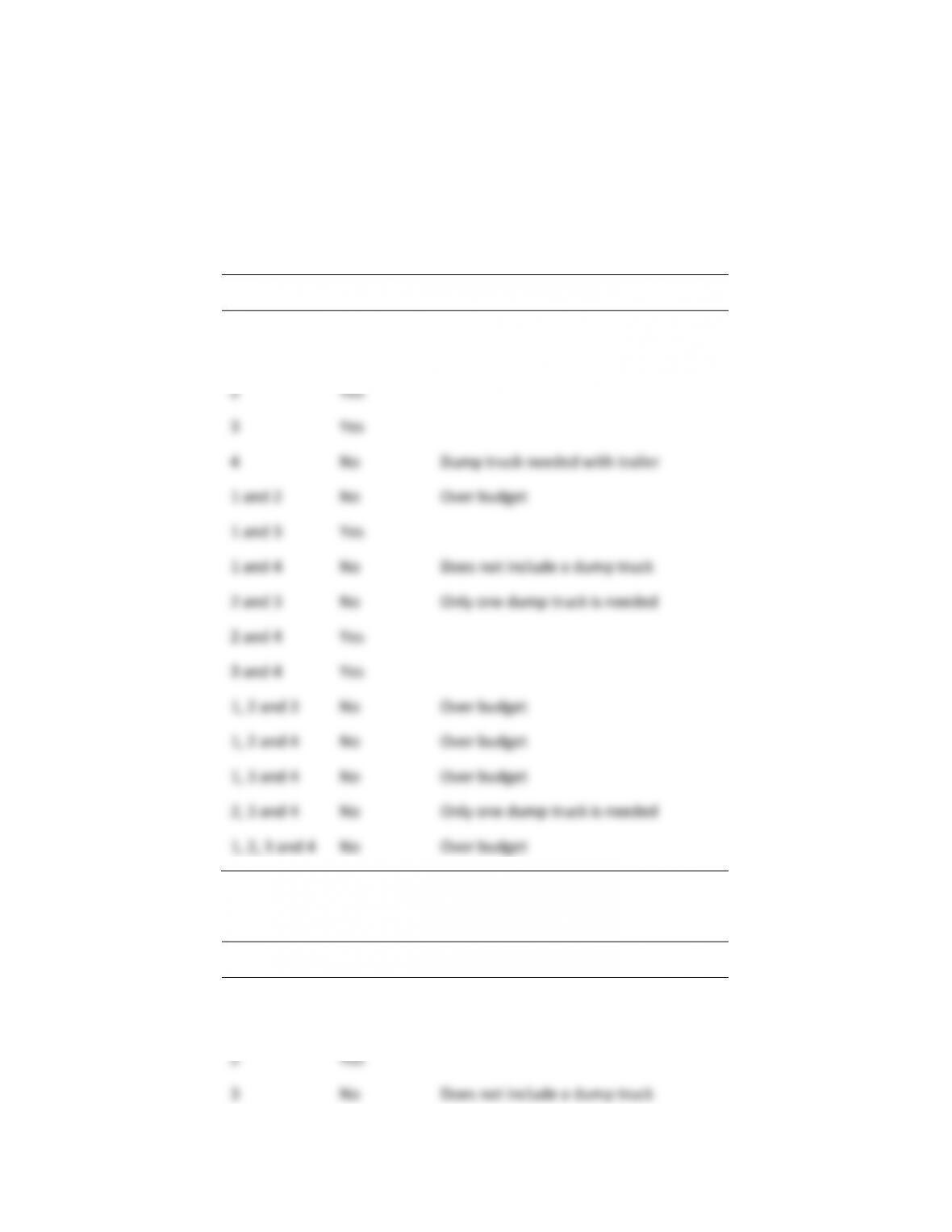
13. The mutually exclusive alternatives are as follows:
Alternatives
Acceptable
Reasoning
Do Nothing
No
Does not include a dump truck
1
No
Does not include a dump truck
2
Yes
3
Yes
4
No
Dump truck needed with trailer
1 and 2
No
Over budget
1 and 3
Yes
1 and 4
No
Does not include a dump truck
2 and 3
No
Only one dump truck is needed
2 and 4
Yes
3 and 4
Yes
1, 2 and 3
No
Over budget
1, 2 and 4
No
Over budget
1, 3 and 4
No
Over budget
2, 3 and 4
No
Only one dump truck is needed
1, 2, 3 and 4
No
Over budget
14. The mutually exclusive alternatives are as follows:
Alternatives
Acceptable
Reasoning
Do Nothing
No
Does not include a dump truck
1
Yes
2
Yes
3
No
Does not include a dump truck
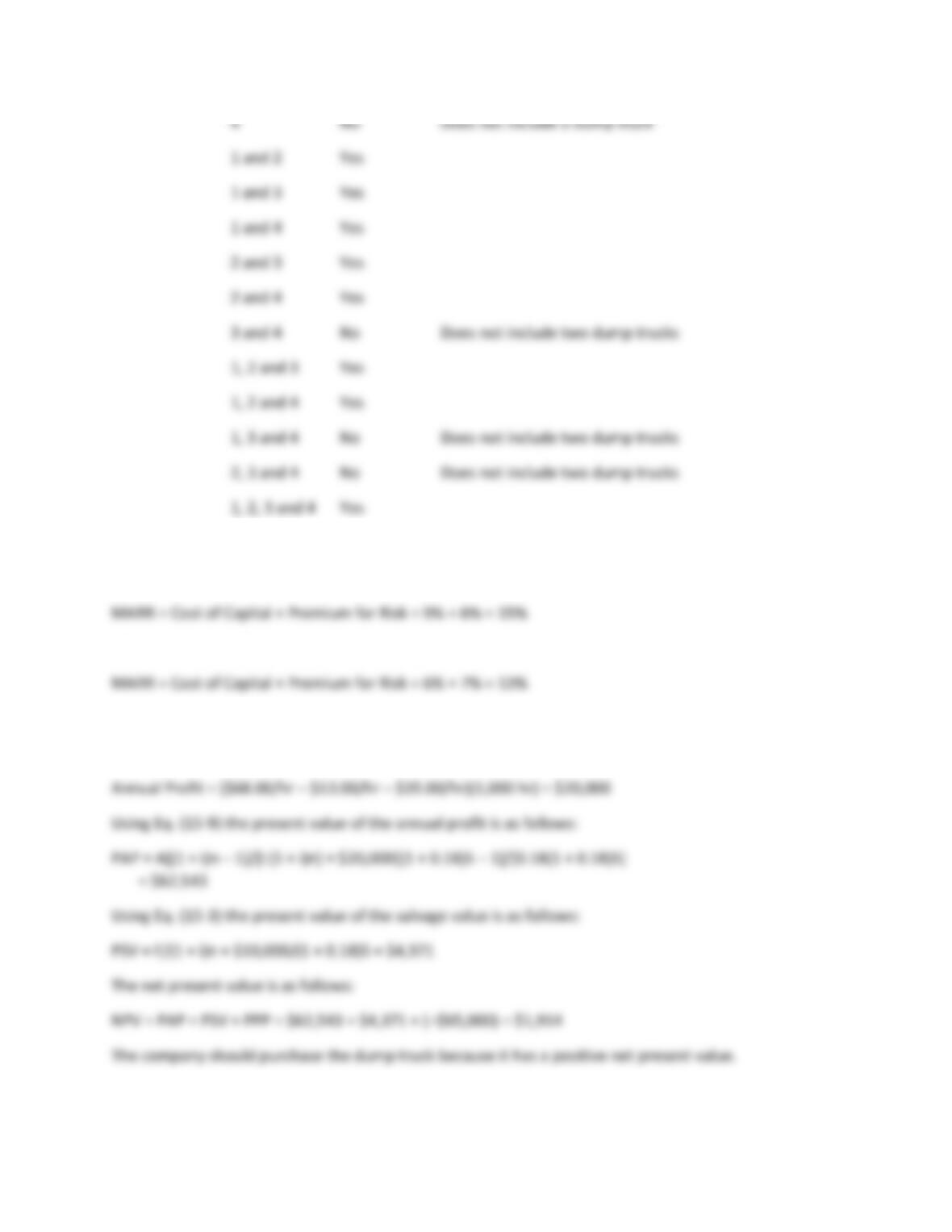
4
No
Does not include a dump truck
1 and 2
Yes
1 and 3
Yes
1 and 4
Yes
2 and 3
Yes
2 and 4
Yes
3 and 4
No
Does not include two dump trucks
1, 2 and 3
Yes
1, 2 and 4
Yes
1, 3 and 4
No
Does not include two dump trucks
2, 3 and 4
No
Does not include two dump trucks
1, 2, 3 and 4
Yes
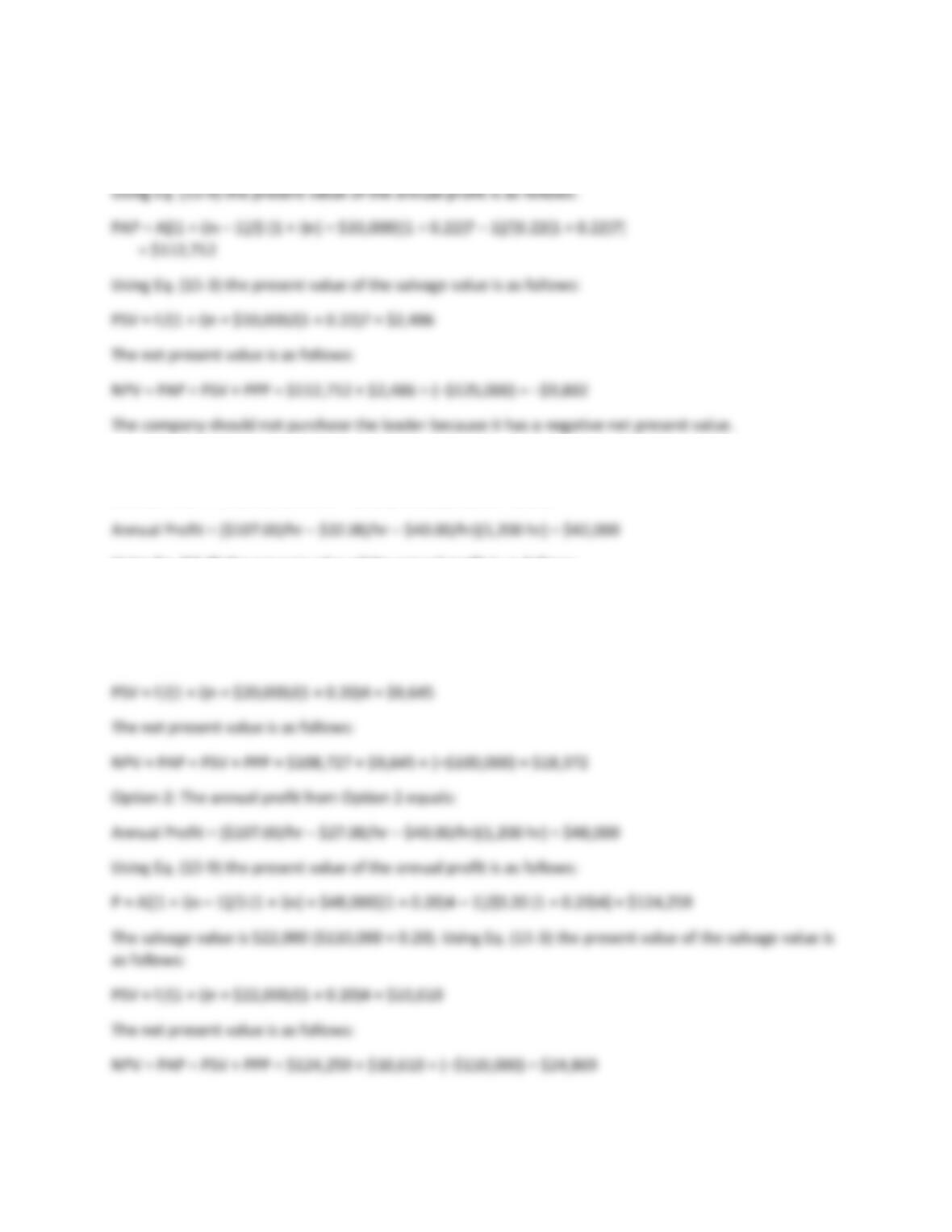
15. Using Eq. (17-1) we get the following:
16. Using Eq. (17-1) we get the following:
17. The annual profit from the dump truck equals:
Annual Profit = (Hourly Revenue – Hourly Costs)(Billable Hours)
18. The annual profit from the loader equals:
Annual Profit = (Hourly Revenue – Hourly Costs)(Billable Hours)
Annual Profit = ($98.00/hr – $30.00/hr – $38.00/hr)(1,100 hr) = $33,000
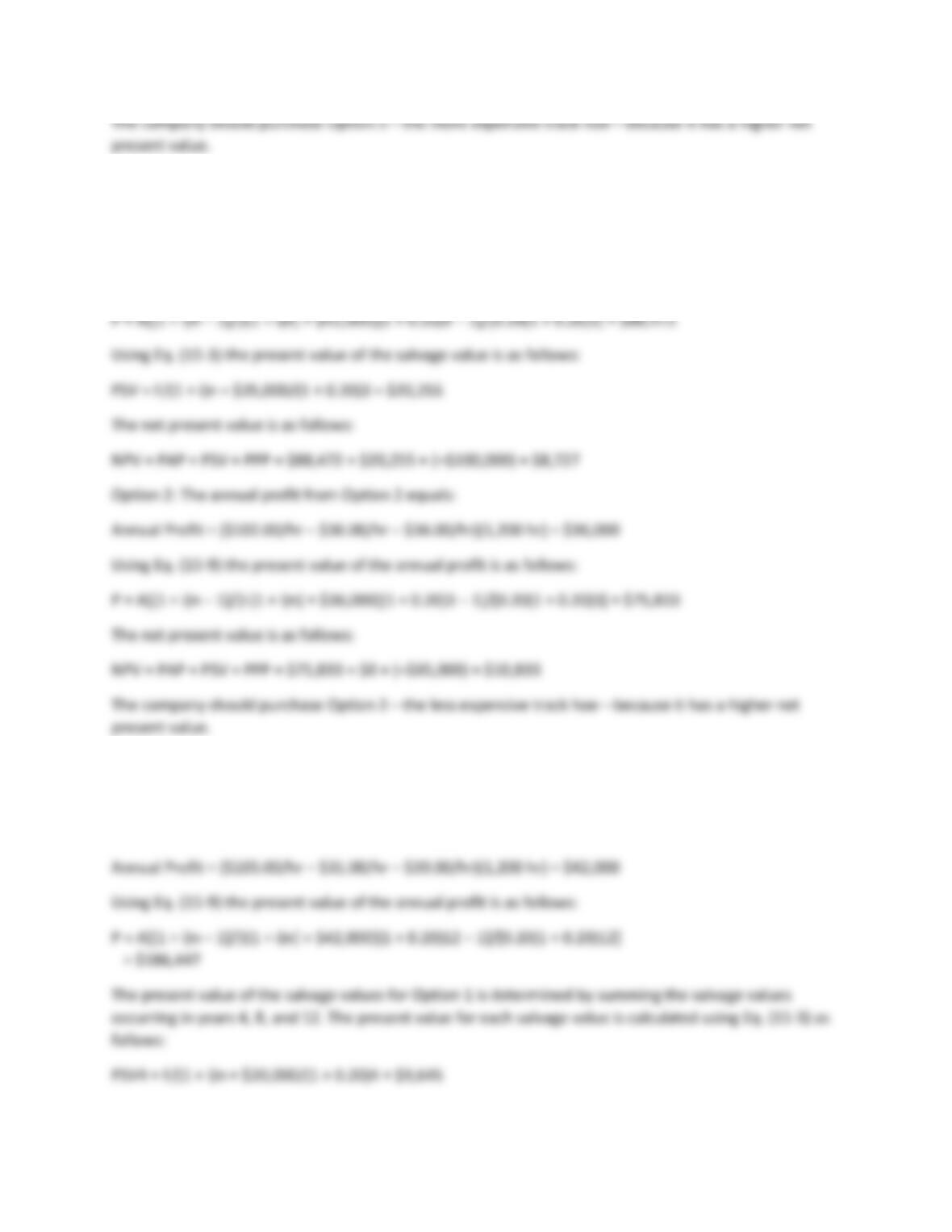
19. Option 1: The annual profit from Option 1 equals:
Annual Profit = (Hourly Revenue – Hourly Costs)(Billable Hours)
Using Eq. (15-9) the present value of the annual profit is as follows:
P = A[(1 + i)n – 1]/[i(1 + i)n] = $42,000[(1 + 0.20)4 – 1]/[0.20 (1 + 0.20)4] = $108,727
The salvage value is $20,000 ($100,000 × 0.20). Using Eq. (15-3) the present value of the salvage value is
as follows:
20. Option 1: The annual profit from Option 1 equals:
Annual Profit = (Hourly Revenue – Hourly Costs)(Billable Hours)
Annual Profit = ($102.00/hr – $31.00/hr – $36.00/hr)(1,200 hr) = $42,000
Using Eq. (15-9) the present value of the annual profit is as follows:
21. The least common life span is 12 years.
Option 1: The annual profit from Option 1 equals:
Annual Profit = (Hourly Revenue – Hourly Costs)(Billable Hours)
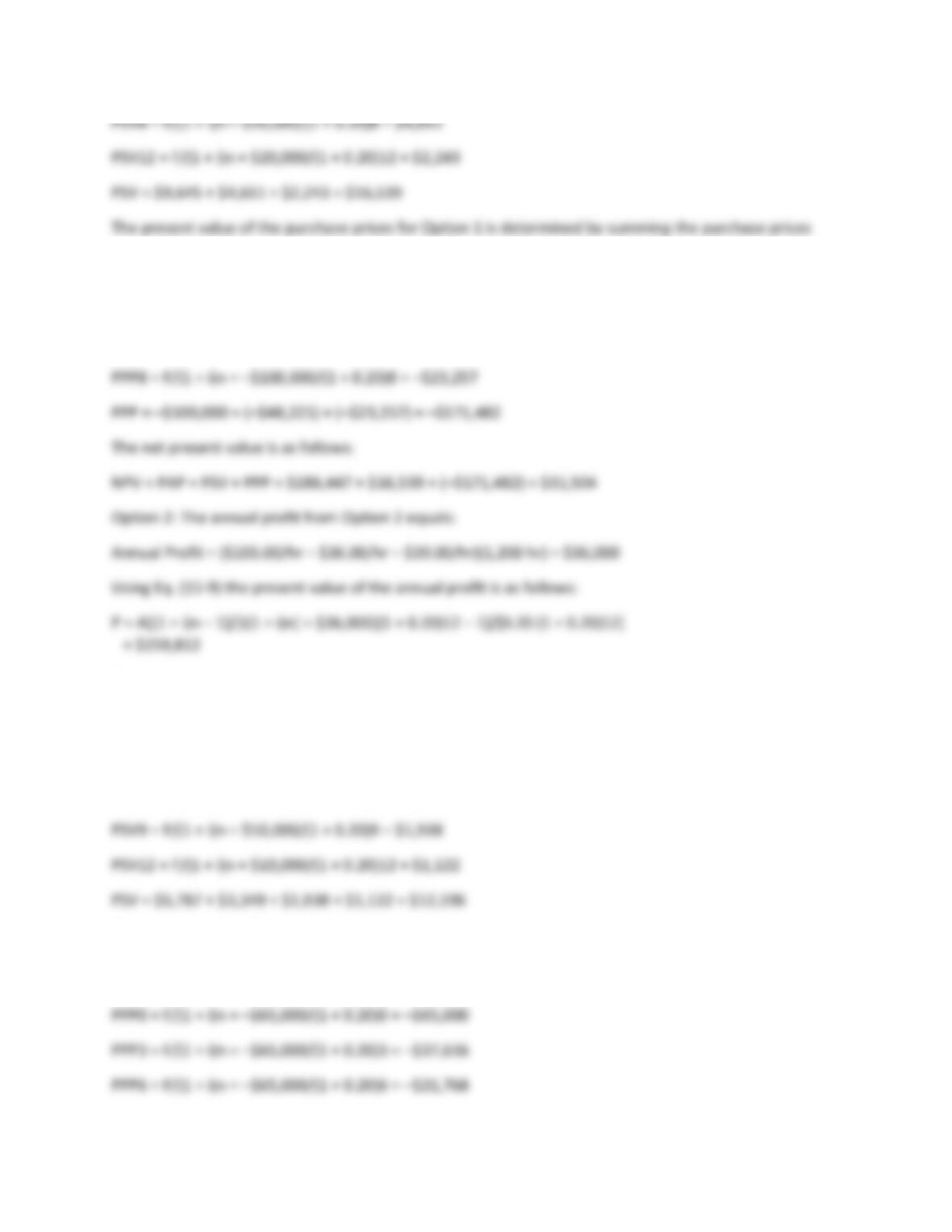
occurring in years 0, 4, and 8. The present value for each salvage value is calculated using Eq. (15-3) as
follows:
PPP0 = F/(1 + i)n = –$100,000/(1 + 0.20)0 = –$100,000
PPP4 = F/(1 + i)n = –$100,000/(1 + 0.20)4 = –$48,225
The present value of the salvage values for Option 2 is determined by summing the salvage values
occurring in years 3, 6, 9, and 12. The present value for each salvage value is calculated using Eq. (15-3)
as follows:
PSV3 = F/(1 + i)n = $10,000/(1 + 0.20)3 = $5,787
PSV6 = F/(1 + i)n = $10,000/(1 + 0.20)6 = $3,349
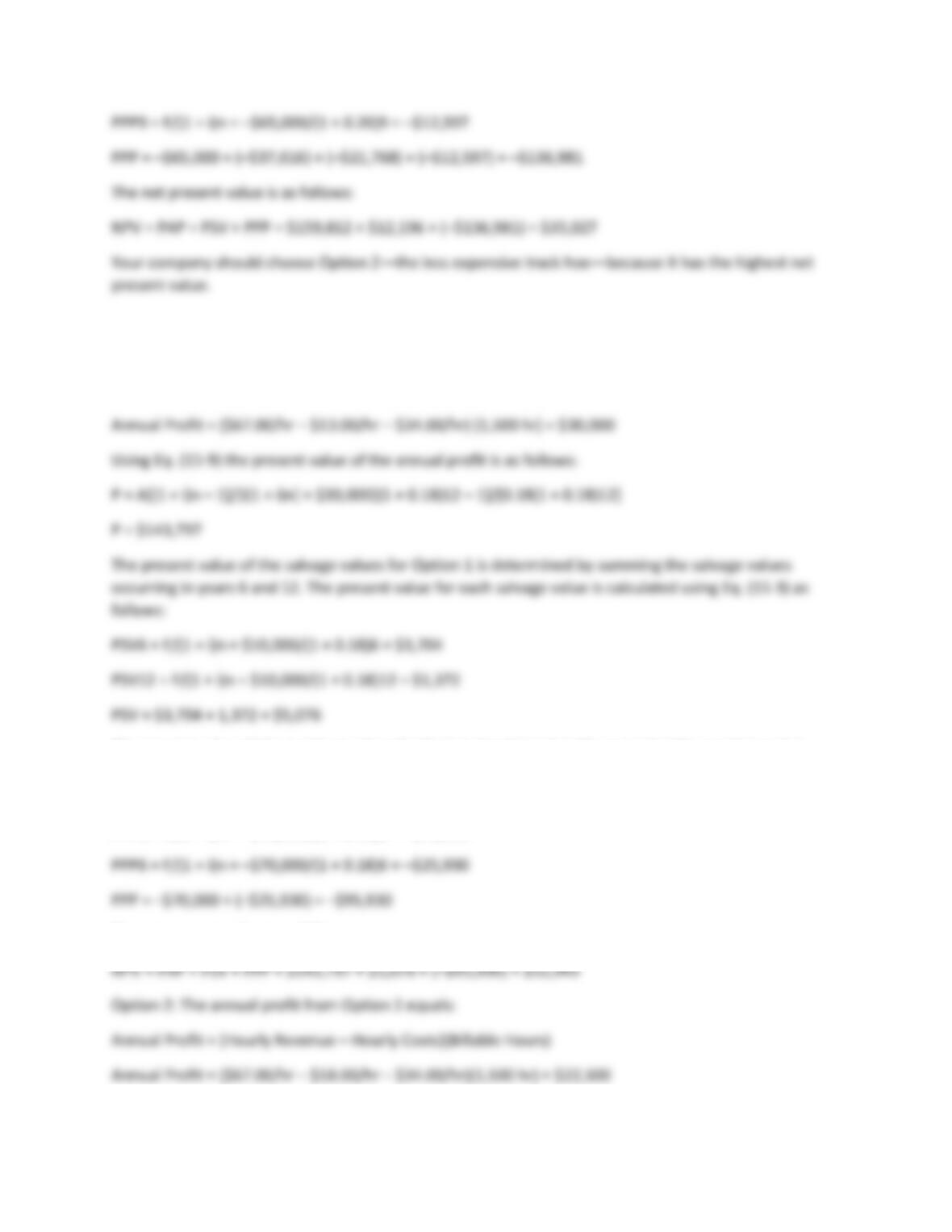
The present value of the purchase prices for Option 2 is determined by summing the purchase prices
occurring in years 0, 3, 6, and 9. The present value for each salvage value is calculated using Eq. (15-3) as
follows:
22. The least common life span is 12 years.
Option 1: The annual profit from Option 1 equals:
Annual Profit = (Hourly Revenue – Hourly Costs)(Billable Hours)
The present value of the purchase prices for Option 1 is determined by summing the purchase prices
occurring in years 0 and 6. The present value for each salvage value is calculated using Eq. (15-3) as
follows:
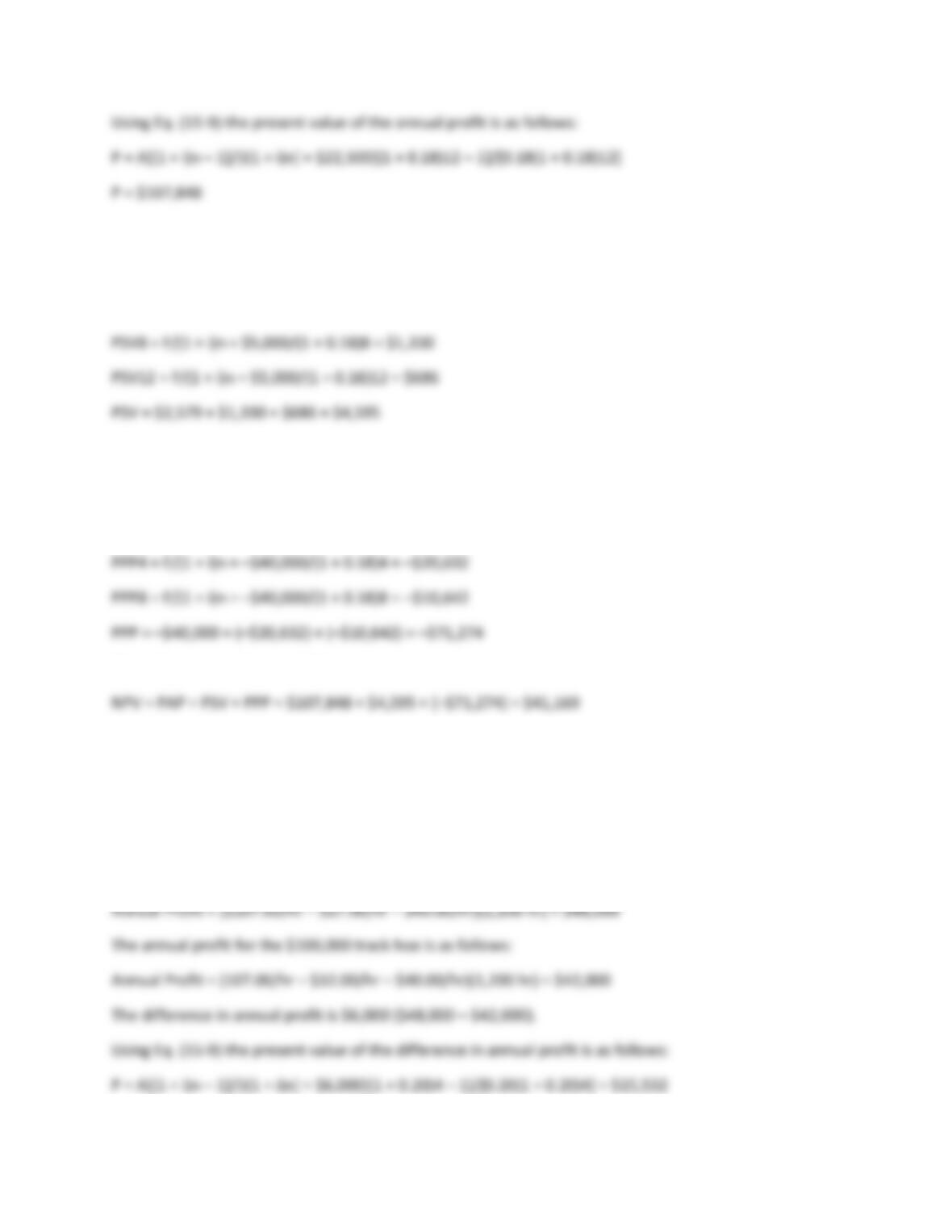
PPP0 = F/(1 + i)n = –$70,000/(1 + 0.18)0 = –$70,000
The net present value is as follows:
The present value of the salvage values for Option 2 is determined by summing the salvage values
occurring in years 4, 8, and 12. The present value for each salvage value is calculated using Eq. (15-3) as
follows:
PSV4 = F/(1 + i)n = $5,000/(1 + 0.18)4 = $2,579
The present value of the purchase prices for Option 2 is determined by summing the purchase prices
occurring in years 0, 4, and 8. The present value for each salvage value is calculated using Eq. (15-3) as
follows:
PPP0 = F/(1 + i)n = –$40,000/(1 + 0.18)0 = –$40,000
The net present value is as follows:
Your company should choose Option 1—the more expensive truck—because it has the highest net
present value.
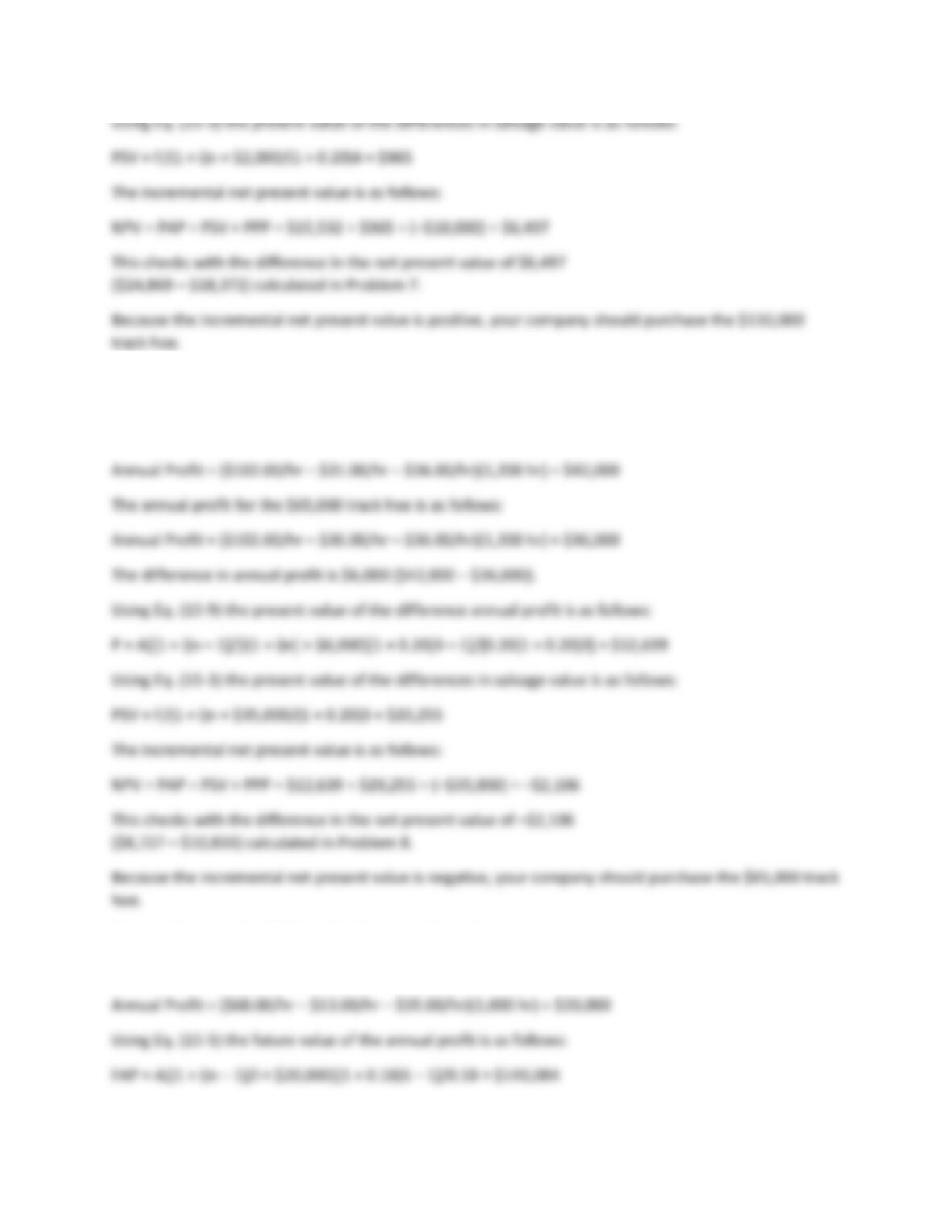
23. The difference in purchase price is $10,000 ($110,000 – $100,000). The difference in salvage
value is 20% of the difference in the purchase price or $2,000
($10,000 × 0.20). The annual profit for the $110,000 track hoe is as follows:
Annual Profit = (Hourly Revenue – Hourly Costs)(Billable Hours)
24. The difference in purchase price is $35,000 ($100,000 – $65,000). The difference in salvage
value is $35,000 ($35,000 – $0). The annual profit for the $100,000 track hoe is as follows:
Annual Profit = (Hourly Revenue – Hourly Costs)(Billable Hours)
25. The annual profit from the dump truck equals:
Annual Profit = (Hourly Revenue – Hourly Costs)(Billable Hours)
26. The annual profit from the loader equals:
Annual Profit = (Hourly Revenue – Hourly Costs)(Billable Hours)
27. Using Eq. (15-11) the annual equivalent for the purchase price is as follows:
Using Eq. (15-7) the annual equivalent for the salvage value is as follows:
28. Using Eq. (15-11) the annual equivalent for the purchase price is as follows:
APP = P[i(1 + i)n]/[(1 + i)n – 1] = –$125,000[0.22(1 + 0.22)7]/[(1 + 0.22)7 – 1]
= –$36,598
Using Eq. (15-7) the annual equivalent for the salvage value is as follows:
29. The annual profit from the dump truck equals:
Annual Profit = (Hourly Revenue – Hourly Costs)(Billable Hours)
Annual Profit = ($68.00/hr – $13.00/hr – $35.00/hr)(1,000 hr) = $20,000