303
Chapter 17: Engineering Materials
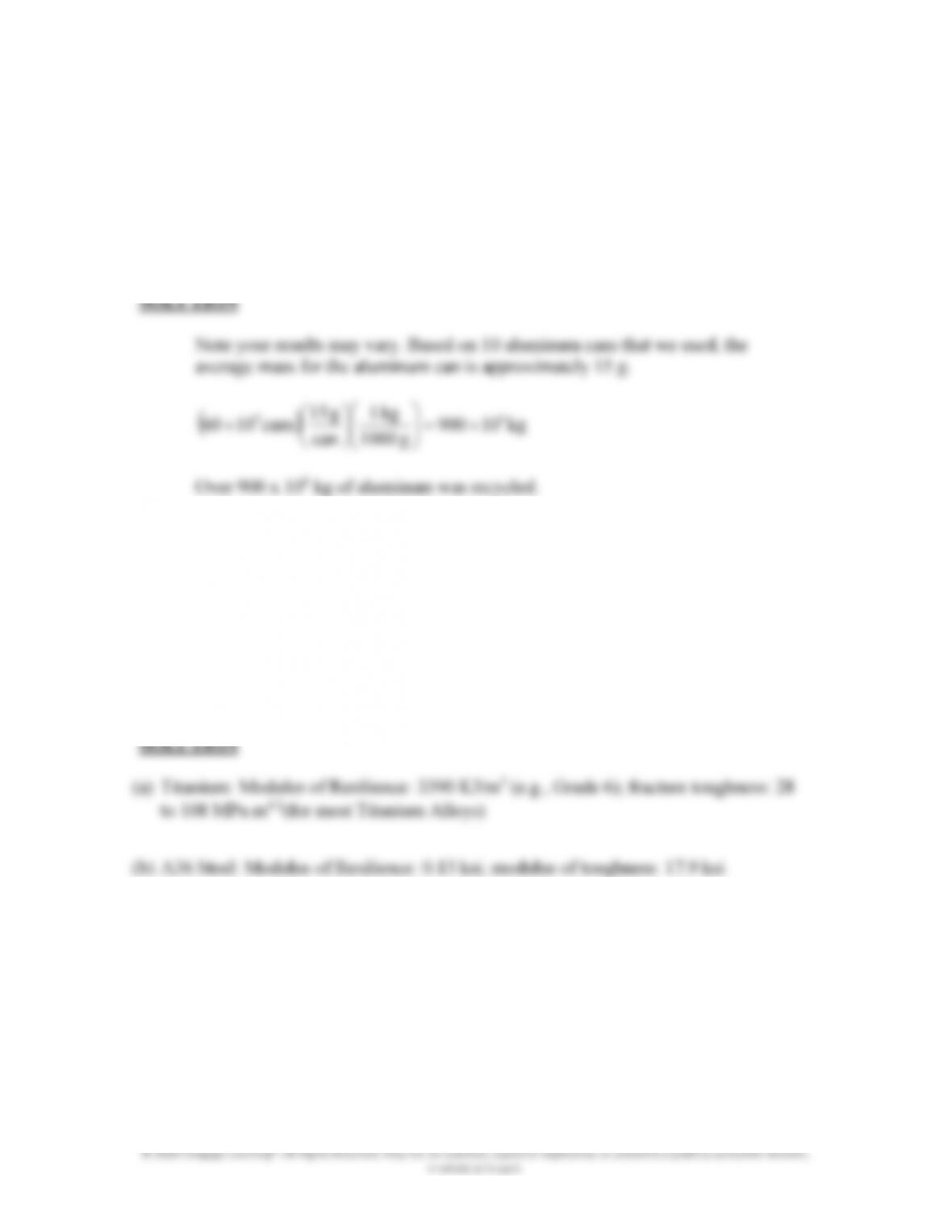
17.14 According to Aluminum Association, every year over 100 billion aluminum cans
are produced, and of these, approximately 60% were recycled. Measure the mass
of 10 aluminum cans and use an average mass for an aluminum can to estimate
the total mass of aluminum cans that was recycled.
17.27 As we discussed in this chapter, when selecting materials for mechanical
applications, the value of the modulus of resilience for a material shows how good
the material is at absorbing mechanical energy without sustaining any permanent
damage. Another important characteristic of a material is its ability to handle
overloading before it fractures. The value of modulus of toughness provides such
information. Look up the values of modulus of resilience and modulus of
toughness for (a) titanium and (b) steel.
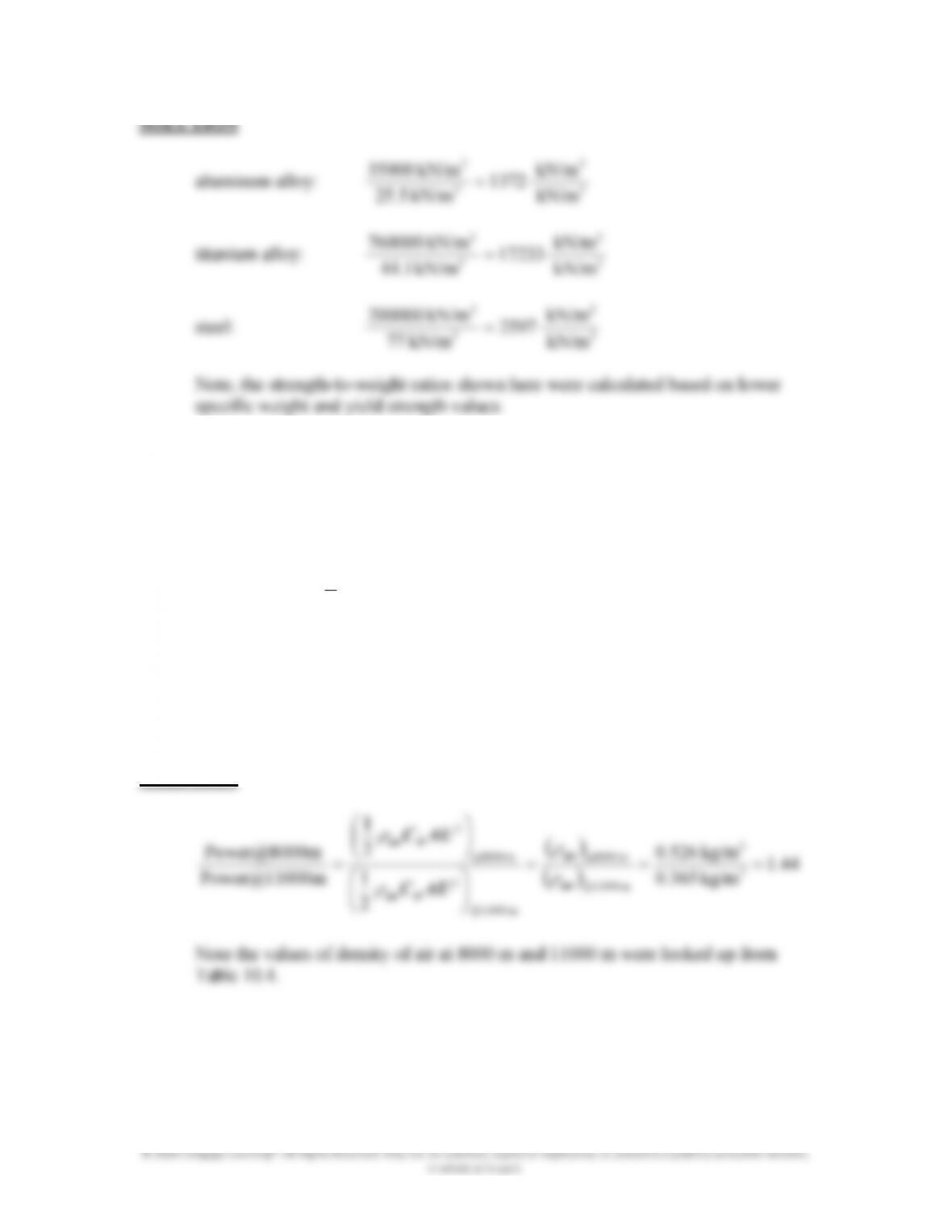
17.29 As we discussed in this chapter, the strength-to-weight ratio of material is an
important criterion when selecting material for aerospace applications. Calculate
the average strength-to-weight ratio for the following materials:
a. aluminum alloy
b. titanium alloy
c. steel.
Use Tables 17.3 and 17.4 to look up appropriate values.
304
© 2020 Cengage Learning®. All Rights Reserved. May not be scanned, copied or duplicated, or posted to a publicly accessible website,
in whole or in part.
SOLUTION
aluminum alloy: 3
2
3
2
kN/m
kN/m
1372
kN/m
5
.
25
kN/m 35000
titanium alloy: 3
2
3
2
kN/m
kN/m
17233
kN/m
1
.
44
kN/m 760000
steel: 3
2
3
2
kN/m
kN/m
2597
kN/m
77
kN/m 200000
Note, the strength-to-weight ratios shown here were calculated based on lower
specific weight and yield strength values.
17.32 As most of you know, commercial transport planes cruise at an altitude of
approximately 10,000 m (~33,000 ft). The power required to maintain level flight
depends on air drag, or resistance, at that altitude, which may be estimated by the
following relationship:
3
2
1AUCPower Dair
Where air is density of air at the given altitude, CD represents the drag coefficient
of the plane, A is the planform area, and U represents the cruising speed of the
plane. Assume that a plane is moving at constant speed, CD remaining constant,
determine the ratio of power that would be required if the plane is cruising at
8,000 m and when the plane may be cruising at 11,000 m.
SOLUTION